
Fire Suppression Systems Market Summary:
According to Transpire Insight, a detailed research report on the market reflects that the commercial buildings application segment dominates the Fire Suppression Systems Market, accounting for approximately 33.35% of the total market share in 2025. Johnson Controls International plc leads the market with over 10% market share in 2025, making it a leading contributor to market development, innovation, advanced fire suppression technologies, integrated fire safety solutions, expanding service capabilities, and growth dynamics.
Market Snapshot
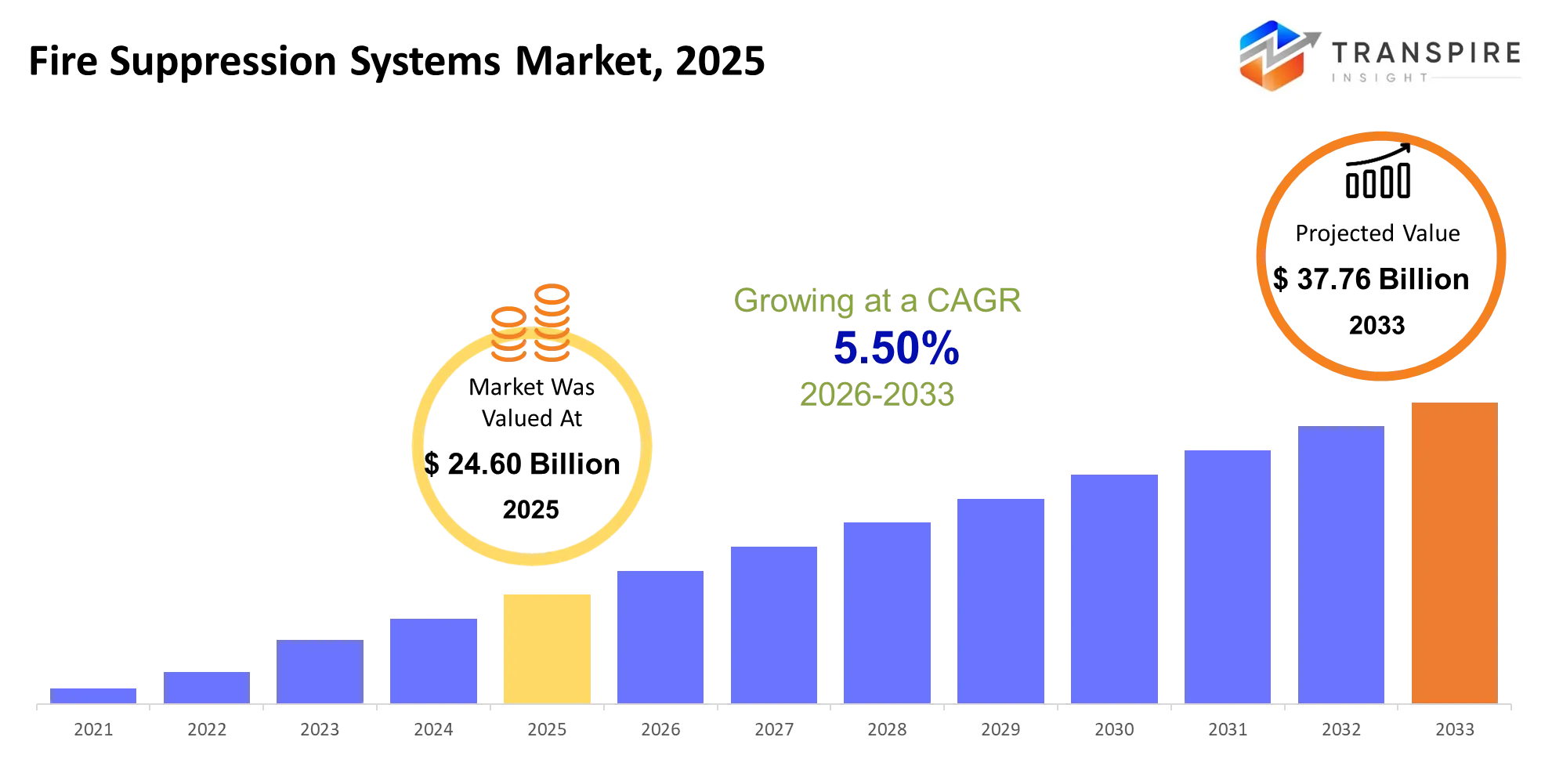
- Market Value (2025): USD 24.60 Billion.
- Expected Market Value (2026): USD 25.95 Billion.
- Estimated Market Value (2033): USD 37.76 Billion.
- Forecast CAGR (2026-2033): 5.50%
- Leading Region in 2025: North America
- Second-largest Region: Asia Pacific
- Fastest Growing Region: Europe
Introduction
Market for fire suppression systems comprises the worldwide industry that manufactures, sells, and installs engineered systems which have been developed for detecting, controlling, and extinguishing fires. This includes engineered devices such as water sprinklers, gas clean-agent cylinders, foam systems, and control panels. A fire suppression system is an engineered system which is used for detecting fires and extinguishing or controlling them through the use of gas, foam, dry chemical or water spray. Fire suppression systems provide prompt and efficient protection through automated fire suppression action, which helps to extinguish the fires before they do considerable damage or require human involvement. The protection of assets is facilitated through the use of clean agents to reduce water usage and damage to property and equipment, especially in data centers and other critical industries. Fire suppression also leads to decreased insurance costs, since compliant fire suppression systems can positively affect property risk evaluations for insurance purposes. In addition, fire suppression systems help to minimize structural damages and downtime.
For instance:- Europe Fire Protection Systems Market Size and ForecastInvestments focus on eco-friendly clean agents, IoT systems and industry upgrade. Germany and the UK are the front-runners in this market, mainly due to stringent EU safety rules and sustainability requirements.
Market Highlights: -
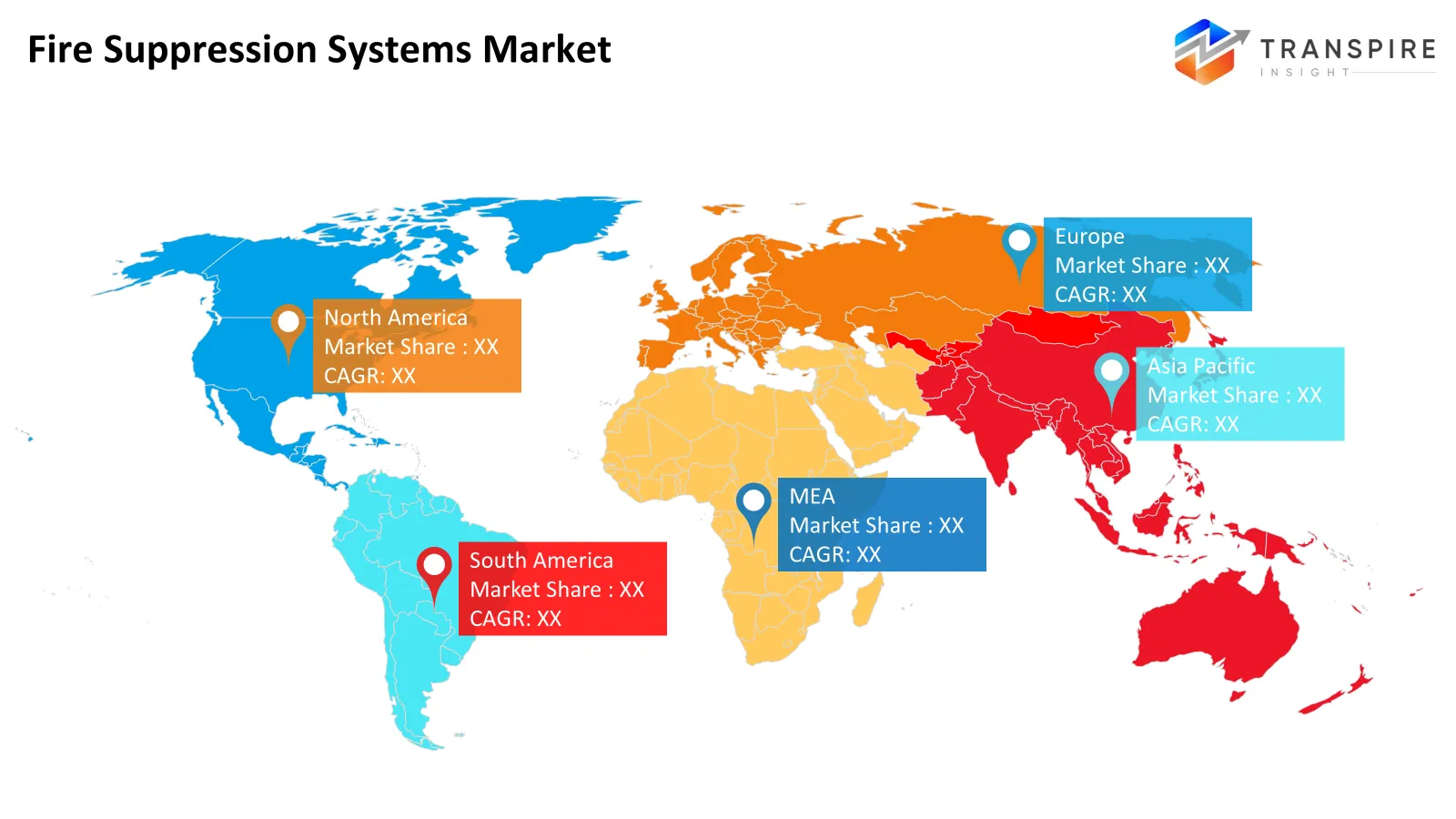
- North America is anticipated to hold around 35% share of the Fire Suppression Systems Market over the predicted time frame.
- Asia Pacific is expected to grow at a rapid CAGR in the Fire Suppression Systems Market by holding around 29% of the share during the forecast period.
- Europe is anticipated to hold around 25% share of the Fire Suppression Systems Market over the predicted time frame.
- By system type, the Automatic segment dominated the market and holds nearly 62% share in 2025 and is projected to grow at a substantial CAGR during the forecast period.
- By end use industry, the Oil & Gas segment dominated the market and holds nearly 22% share in 2025 and is projected to grow at a substantial CAGR during the forecast period.
- By technology, the Addressable segment dominated the market and holds nearly 64% share in 2025 and is projected to grow at a substantial CAGR during the forecast period.
- Expansion and Modernization of Fire Services: The Government of India sanctioned an amount of ₹5,000 crores for the Scheme for Expansion and Modernization of Fire Services in the States. The scheme focuses on modernization of fire services, firefighting equipment, fire stations, technology upgradation, creating an increase in the demand of fire suppression systems.
How is Technology Driving Growth in the Fire Suppression Systems Market?
In the case of the Fire Suppression Systems Market, advancements in technology are being increasingly incorporated to enhance accuracy of fire detection, speed of response, efficiencies in performance and sustainability of operations. AI, together with thermal imaging, is helping achieve accurate detection of fires, targeted suppression of fires and enhanced ability to differentiate between actual threats and triggers that result in false alarms. Internet-of-Things (IoT) technology, on the other hand, allows for real-time monitoring of system operation, remote monitoring, predictive maintenance, and integration with building management software. In addition, environmentally friendly suppression technology options are becoming popular through the use of fluorine free foam, clean agent fire suppression technology, advanced water mist technology and targeting nozzles.
|
Report Metrics |
Details |
|
Market size value in 2025 |
USD 24.60 Billion |
|
Market size value in 2026 |
USD 25.95 Billion |
|
Revenue forecast in 2033 |
USD 37.76 Billion |
|
Growth rate |
CAGR of 5.50% from 2026 to 2033 |
|
Base year |
2025 |
|
Historical data |
2021 - 2024 |
|
Forecast period |
2026 - 2033 |
|
Report coverage |
Revenue forecast, competitive landscape, growth factors, and trends |
|
Regional scope |
United States; Canada; Mexico; United Kingdom; Germany; France; Italy; Spain; Denmark; Sweden; Norway; China; Japan; India; Australia; South Korea; Thailand; Brazil; Argentina; South Africa; Saudi Arabia; United Arab Emirates |
|
Key company profiled |
Johnson Controls, Siemens, Honeywell, Carrier, Halma, Bosch, Minimax, Victaulic, Tyco, Viking Group, Gentex, Eaton, Fike, Hochiki, Marioff |
|
Customization scope |
Free report customization (country, regional & segment scope). Avail customized purchase options to meet your exact research needs. |
|
Report Segmentation |
By Suppression Agent (Water-based, Foam-based, Dry Chemical, Wet Chemical, Clean Agents, CO₂, Inert Gas, Others); By Product Configuration (Fixed Systems, Portable/Mobile Systems, Fire Extinguishers, Sprinklers, Fire Suppression Cabinets, Nozzles, Control Systems, Others); By System Type (Automatic, Manual, Semi-automatic, Pre-action, Deluge, Wet-pipe, Dry-pipe, Others); By End-use Industry (Commercial Buildings, Residential, Manufacturing, Oil & Gas, Mining, Transportation, Data Centers, Others); By Installation (New Build, Retrofit, Replacement, Expansion, Upgrade, Maintenance, Temporary, Others); By Technology (Conventional, Addressable, Intelligent, IoT-enabled, AI-enabled, Remote Monitoring, Smart Detection, Others); By Service (Installation, Inspection, Maintenance, Monitoring, Testing, Consulting, Repair, Others) |
Market Drivers
Fire Suppression Systems Market is fueled by strict governmental norms for fire safety. In addition, there is a need for upgraded fire protection infrastructure owing to the rapid pace of urbanization along with the development of skyscrapers and industrial complexes. Advanced technology-based fire protection equipment, such as IoT-based fire sensors and wireless fire detectors, have increased the efficiency of the fire suppression systems. Eco-friendly fire suppressants and fire protection systems are also gaining popularity owing to the need for sustainable fire protection measures. In addition, the increasing investments being made in data center infrastructure are driving the market for fire suppression systems. Fire suppression systems are very important because they allow automatic control, which means fast detection and suppression of the fire and minimal reliance on humans in the initial stages. Asset protection is also ensured with the use of clean-agent or gas fire suppression systems since they will protect electronic assets and sensitive equipment without the danger of water damage. Fire suppression helps to achieve the goal of cost savings, including reduced property damage, production loss, and down-time. Companies might also take advantage of some insurance benefits since good fire protection will be an asset for the insurance risk assessment.
For Instance: -
- North America Fire Protection Systems Market Investment in analytics, monitoring, and green gaseous systems through Internet of Things is being made. Strict safety standards in the United States and Canada are resulting in capital investments which promise handsome returns in risky areas.
- The South African fire protection and suppression market is growing rapidly due to stringent safety norms, urbanization, and industrial development. Worth several million dollars, the investment in the commercial sector, mining industry, and high-rise building sector presents lucrative prospects for advanced and environmentally friendly suppression solutions.
Restrain
The Fire Suppression Systems Market is also confronted with difficulties such as the high cost of installing, maintaining, and testing the system. The problems associated with the high cost of the equipment used in these systems have also been pointed out. Accidental discharge and false alarms are some other issues that could lead to disruptions and downtime in operations.
|
Driver |
Relative Impact on Growth (%) |
Geographic Relevance |
Impact Timeline |
Demand Strength |
Growth Mechanism |
Key Beneficiaries |
Major Constraint |
|
Stringent Fire Safety Regulations and Building Codes |
28% |
North America, Europe, Asia-Pacific |
Short-term |
High |
Mandatory compliance drives new system installations |
System manufacturers, installers, inspection providers |
Complex compliance and certification requirements |
|
Expansion of Data Centers and Critical Infrastructure |
24% |
North America, Europe, Asia-Pacific |
Medium-term |
High |
Critical assets require specialized suppression protection |
Clean-agent vendors, integrators, technology providers |
High engineering and installation costs |
|
Fire Service Modernization and Infrastructure Investment |
20% |
Asia-Pacific, Middle East & Africa |
Medium-term |
High |
Public investment accelerates equipment modernization |
Equipment manufacturers, contractors, service providers |
Budget limitations and project execution delays |
|
IoT, AI and Intelligent Fire Protection Adoption |
16% |
North America, Europe, Asia-Pacific |
Long-term |
High |
Connected systems enable monitoring and predictive maintenance |
Technology vendors, integrators, facility operators |
Integration complexity and cybersecurity risks |
|
Shift Toward Sustainable Suppression Technologies |
12% |
Europe, North America, Asia-Pacific |
Medium-term |
Medium |
Environmental rules accelerate alternative-agent adoption |
Clean-agent, water-mist, fluorine-free technology vendors |
Higher transition and technology costs |
Analysis of Prices and Consumer Behaviour
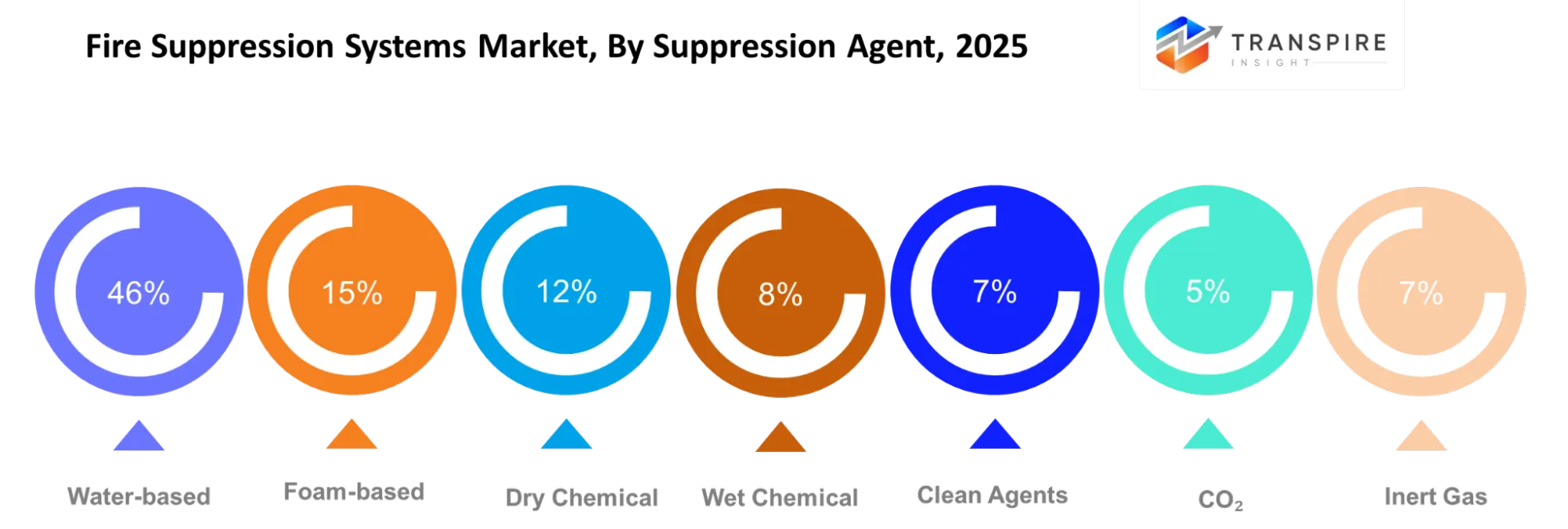
In terms of products, water based fire suppression systems account for 46.35% of total market share in 2025 owing to the benefits in cost-effectiveness and performance. The fixed fire suppression market accounted for almost 81.20% of total market share in 2025 thanks to the needs for permanent protection of fires in buildings and critical facilities. The share of new installations is about 64.20% of total revenue in 2025 as a result of the continuous demand for fire suppression systems in new commercial, industrial, and infrastructure projects. The commercial buildings category accounted for about 33.35% of total market share in 2025 in view of fire safety standards, building regulations and investments in property protection. System reliability, regulatory compliance, lifecycle cost, and protection performance are the criteria which define the buying behavior of the end users. In addition, another 51.30% of turnover is generated through system integrators and EPC contractors in 2025.
|
Investment Factor |
Why It Matters to Investors |
Opportunity |
Investment Implication |
|
Data Center Expansion |
Digital infrastructure requires specialized protection for critical assets. |
Clean-agent, water-mist, and precision suppression systems. |
High — Medium- to long-term growth potential |
|
Intelligent Fire Protection |
Connected systems improve monitoring, diagnostics, and operational efficiency. |
IoT-enabled, addressable, AI-assisted, and remote-monitoring solutions. |
High — Technology-led scalable opportunity |
|
Regulatory Compliance & Modernization |
Stricter fire-safety requirements stimulate mandatory system upgrades. |
Retrofit, inspection, testing, maintenance, and compliant equipment. |
High — Recurring compliance-driven demand |
|
Special-Hazard Applications |
Complex industrial hazards require engineered, application-specific suppression systems. |
Oil & gas, batteries, manufacturing, marine, and critical infrastructure. |
High — Premium specialized-solution opportunity |
|
Recurring Service Revenue |
Fire systems require regular inspection, testing, maintenance, and certification. |
Long-term maintenance contracts and remote monitoring services. |
High — Supports predictable recurring revenues |
|
Sustainable Suppression Technologies |
Environmental requirements are accelerating substitution of legacy agents. |
Water mist, inert gases, clean agents, and fluorine-free technologies. |
Medium — Long-term technology transition opportunity |
Who are the Key Players in the Fire Suppression Systems Market and how do they compete?
Competitiveness in the international market for fire suppression systems is achieved through the presence of firms that focus on high-tech suppression systems, industry-specific solutions, and creation of distribution and service networks on the international level. Competing not just on price but relying on suppression technologies, intelligent fire detection and control, clean agent systems, water-based systems, and integration with building and safety systems, such competition strategy results in continuous product development as well as better protection against fires for organizations.
Developing intelligent fire protection systems, advanced technologies for detection and suppression of fires, as well as fire safety systems, Johnson Controls becomes more competitive on the market. Developing advanced fire suppression systems for commercial buildings, data centers, manufacturing plants, health care facilities, and other critical infrastructure, companies become different from their competitors. Honeywell International builds its competitive advantage through the development of integrated fire detection, alarm, and fire suppression systems, building automation, and industrial safety.
Top Companies in the Fire Suppression Systems Market
- Johnson Controls
- Siemens
- Honeywell
- Carrier
- Halma
- Bosch
- Minimax
- Victaulic
- Tyco
- Viking Group
- Gentex
- Eaton
- Fike
- Hochiki
- Marioff
|
Company |
Est. Revenue Share Range |
Key Offerings |
Strategic Positioning |
Geographic Strength |
Technology Focus |
|
Johnson Controls |
5-8% (Estimated) |
Water mist, gaseous systems, foam, sprinklers, extinguishers |
Integrated fire protection portfolio |
North America, Europe, Asia-Pacific |
Water mist, intelligent controls, special-hazard suppression |
|
Siemens |
4-7% (Estimated) |
Sinorix water mist, inert gas, CO₂, object protection |
Technology-led integrated fire safety |
Europe, North America, Asia-Pacific |
Smart suppression, water mist, inert gas, digital monitoring |
|
Honeywell |
3-6% (Estimated) |
FK-1230, Inferno Shield, clean-agent, rack suppression |
Critical-facility and clean-agent specialization |
North America, Europe, Asia-Pacific |
Clean agents, remote monitoring, critical-asset protection |
|
Carrier / Kidde Solutions |
3-5% (Estimated) |
Engineered suppression, inert gas, water mist, foam, dry chemical |
Broad multi-brand fire protection platform |
North America, Europe, Asia-Pacific |
Inert gas, water mist, engineered suppression |
|
Minimax |
2-4% (Estimated) |
Water-based, gas suppression, detection/control, fire prevention |
Full-spectrum engineered fire protection |
Europe, Asia-Pacific, Middle East |
Detection-control integration, water systems, oxygen reduction |
|
Victaulic |
2-4% (Estimated) |
Sprinklers, valves, piping systems, fire protection systems |
Installation-efficient system engineering |
North America, Europe, Asia-Pacific |
Grooved systems, sprinklers, valves, system integration |
|
Viking Group |
2-4% (Estimated) |
Sprinklers, valves, foam, gas, water mist |
Broad component and system portfolio |
North America, Europe, Asia-Pacific |
Water, foam, gaseous suppression, sprinkler technologies |
|
Fike |
1-3% (Estimated) |
Cheetah Xi, clean agents, water mist, flame detection |
Special-hazard and mission-critical protection |
North America, Europe, Asia-Pacific |
Addressable controls, video analytics, thermal detection |
|
Marioff |
1-3% (Estimated) |
HI-FOG water mist, sprinklers, valves, marine systems |
Water-mist technology specialization |
Europe, Asia-Pacific, North America |
High-pressure water mist, automated activation |
|
Hochiki |
<1-2% (Estimated) |
Suppression controls, clean agents, aerosol systems, detection |
Detection-led suppression specialization |
Asia-Pacific, North America, Europe |
Addressable controls, clean agents, multi-criteria detection |
Market Segmentation
The Fire Suppression Systems Market share is divided into seven categories: By suppression agent, product configuration, system, end use industry, installation, technology and service.
The Automatic dominated the market, accounting for nearly 62% in 2025 and is expected to rise at a significant CAGR during the forecast period.
The Fire Suppression Systems Market is segmented by system type into Automatic, Manual, Semi-automatic, Pre-action, Deluge, Wet-pipe, Dry-pipe, Others. Among these, the Automatic segment dominated the market, accounting for nearly 62% in 2025 and expected to increase at a significant CAGR during the forecast period. The Automatic Fire Suppression Systems Segment held the largest share of 62% in 2025 owing to its ability to detect fires quickly, suppress them promptly, minimize manual handling, and protect assets. The growing use of Automatic Fire Suppression Systems in commercial buildings, industrial structures, data centers, and infrastructure, along with strict safety policies, is likely to drive segment growth.
The Oil & Gas dominated the market, accounting for nearly 22% in 2025, and is expected to rise at a significant CAGR during the forecast period.
The Fire Suppression Systems Market is segmented by end use industry into Commercial Buildings, Residential, Manufacturing, Oil & Gas, Mining, Transportation, Data Centers, Others. Among these, the Oil & Gas segment dominated the market, accounting for nearly 22% in 2025 and expected to increase at a significant CAGR during the forecast period. In the Fire Suppression Systems Market, the Oil & Gas segment dominated the market with its almost 22% share in 2025 due to strict fire safety regulations, presence of many hazards associated with fire and explosion, and usage of flammable material. The constant investment being made in refinery, process plants, pipeline, and offshore installations has increased the demand for fire suppression systems.
The Addressable dominated the market, accounting for nearly 64% in 2025 and is expected to rise at a significant CAGR during the forecast period.
The Fire Suppression Systems Market is segmented by technology into Conventional, Addressable, Intelligent, IoT-enabled, AI-enabled, Remote Monitoring, Smart Detection, Others. Among these, the Addressable segment dominated the market, accounting for nearly 64% in 2025 and expected to increase at a significant CAGR during the forecast period. Addressable was the most dominant type of market, comprising almost 64% in 2025, due to precise identification of the device, accurate detection of fire location, centralized monitoring system, and quick responses to the emergencies. Increasing installations of such systems within commercial properties, industrial structures, data centers, and infrastructure has boosted the demand for intelligent systems.
Regional Segment Analysis of the Fire Suppression Systems Market:
- North America (U.S., Canada, Mexico)
- Europe (Germany, France, U.K., Italy, Spain, Rest of Europe)
- Asia-Pacific (China, Japan, India, Rest of APAC)
- South America (Brazil and the Rest of South America)
- The Middle East and Africa (UAE, South Africa, Rest of MEA)
North America is the fastest-growing region in the Fire Suppression Systems Market during the period, holding around 35% share.
North America is expected to grow at a rapid CAGR in the Fire Suppression Systems Market holding around 35% share during the forecast period. North America is the region witnessing the highest growth rate within the Fire Suppression Systems Market, accounting for about 35% of the market share. This region has been growing on the back of fire safety laws and regulations, upgrading of existing infrastructure, construction of new commercial and industrial buildings, and increasing investments in data centers.
Asia Pacific is the fastest-growing region in the Fire Suppression Systems Market during the period, holding around 29% share.
Asia pacific is the fastest-growing region in the Fire Suppression Systems Market during the forecast period, holding around 29% share during the forecast period. Asia-Pacific is the fastest-growing region in the Fire Suppression Systems Market, accounting for more than 29% of market share, due to fast urbanization, industrialization, infrastructure development, and increasing commercial infrastructure. The growing investments in data centers, manufacturing plants, energy infrastructure, and smart buildings are aiding the adoption of advanced fire suppression systems.
Europe is expected to grow at a rapid CAGR in the Fire Suppression Systems Market, holding around 25% of the share during the forecast period.
Europe is expected to grow at a rapid CAGR in the Fire Suppression Systems Market holding around 25% share during the forecast period. The European region is anticipated to witness a very fast CAGR in the Fire Suppression Systems Market due to its market share of about 25%. Factors like strict fire safety regulations, development of infrastructures, industrial growth, and adoption of advanced fire suppression systems are responsible for the growth of this regional market.
Strategies for Market Growth in Non-Leading Regions:
Efficient and scalable manufacturing and installation technologies in fire suppression system development will be helpful for small to medium-sized fire protection companies. Fire suppression system manufacturing and assembly in the local market and regional factories and facilities will help to avoid high dependency on imports and cut the expenses for installations and maintenance. Collaboration with regional construction firms, facility managers, industrial manufacturers, data centers and fire safety distributors will help to promote fire suppression systems in the market. Training and development of skills are necessary to improve the level of fire safety regulations, installation, inspection, maintenance and system technology knowledge. Moreover, flexible financing, long-term service and maintenance contracts will make fire suppression systems more accessible for customers. Programs and collaboration with the government, construction and infrastructure projects and digital sales and service will help to increase accessibility to fire suppression systems and ensure sustainable market development in developing countries.
Future Market Trends for the Fire Suppression Systems Market: -
- IoT & AI Integration: Smart control panels and predictive analytics ensure hazard monitoring on the go.
- Eco-Friendly Agents: The use of water mist and inert gases as alternatives to halons.
- Green Foams: Moving away from traditional aqueous film-forming foams due to environmental regulations.
- Special Hazards Applications: Increasing need for special hazards coverage for data centers, EV manufacturers, and battery energy storage systems.
Recent Development
- In June 2026: Introduction of Rotarex Firetec's novel Water Mist Fire Suppression System took place during INTERSCHUTZ 2026 in Hannover, Germany. This development is a testament to the innovations that have been made in the Fire Suppression Systems Market. It will go a long way in meeting the growing need for reliable fire suppression systems.
- In September 2026: The Company Rotarex Firetec entered into the field of marine fire suppression due to the MED certification it obtained from DNV. Such a move increases the strength of the market position of the company while simultaneously increasing the need for certified and effective fire suppression systems in the marine industry.
This study forecasts revenue at global, regional and country levels from 2020 to 2033. Transpire Insight has segmented the Fire Suppression Systems Market based on the below-mentioned segments:
Fire Suppression Systems Market, By Suppression Agent
- Water-based
- Foam-based
- Dry Chemical
- Wet Chemical
- Clean Agents
- CO₂
- Inert Gas
- Others
Fire Suppression Systems Market, By Product Configuration
- Fixed Systems
- Portable/Mobile Systems
- Fire Extinguishers
- Sprinklers
- Fire Suppression Cabinets
- Nozzles
- Control Systems
- Others
Revenue Management Software Market, By System Type
- Automatic
- Manual
- Semi-automatic
- Pre-action
- Deluge
- Wet-pipe
- Dry-pipe
- Others
Fire Suppression Systems Market, By End Use Industry
- Commercial Buildings
- Residential
- Manufacturing
- Oil & Gas
- Mining
- Transportation
- Data Centers
- Others
Fire Suppression Systems Market, By Installation
- New Build
- Retrofit
- Replacement
- Expansion
- Upgrade
- Maintenance
- Temporary
- Others
Fire Suppression Systems Market, By Technology
- Conventional
- Addressable
- Intelligent
- IoT-enabled
- AI-enabled
- Remote Monitoring
- Smart Detection
- Others
Fire Suppression Systems Market, Service
- Installation
- Inspection
- Maintenance
- Monitoring
- Testing
- Consulting
- Repair
- Others
Food Processing Automation Market, By Regional Analysis
North America
- US
- Canada
- Mexico
Europe
- Germany
- UK
- France
- Italy
- Spain
- Russia
- Rest of Europe
Asia Pacific
- China
- Japan
- India
- South Korea
- Australia
- Rest of Asia Pacific
South America
- Brazil
- Argentina
- Rest of South America
Middle East & Africa
- UAE
- Saudi Arabia
- Qatar
- South Africa
- Rest of the Middle East & Africa
Frequently Asked Questions
Find quick answers to common questions.
The market is valued at USD 24.60 billion in 2025 and is projected to reach USD 37.76 billion by 2033.
The Automatic segment dominates, accounting for nearly 62% in 2025, driven by rapid detection, automatic suppression, and reduced human intervention.
The Oil & Gas segment leads with nearly 22% share in 2025, supported by stringent safety requirements and high fire risks.
Europe is expected to grow rapidly, holding around 25% share, supported by stringent regulations and infrastructure modernization.
IoT, AI, eco-friendly agents, green foams, water mist, and special-hazard applications are key trends driving fire protection innovation.
- Johnson Controls
- Siemens
- Honeywell
- Carrier
- Halma
- Bosch
- Minimax
- Victaulic
- Tyco
- Viking Group
- Gentex
- Eaton
- Fike
- Hochiki
- Marioff
About the Authors

Avinash Kumar
I’m Avinash Kumar, a Senior Research Analyst at Transpire Insight, with expertise in the Electronics and Semiconductor and Energy & Power industry. My work focuses on analyzing emerging technologies, market trends, industry developments, and innovation across these sectors. I specialize in transforming complex technical and market insights into clear, research-backed content that helps professionals, businesses, and decision-makers stay informed. Through continuous industry research and data-driven analysis, I strive to deliver accurate, reliable, and practical perspectives on the latest advancements shaping the semiconductor and energy landscape.

Chakradhar Khansole
Chakradhar serves as the Research Director at Transpire Insight, bringing over 8 years of experience in technology, innovation, and strategic market intelligence. He specializes in transforming complex market data into actionable business insights that enable organizations to make informed, growth-oriented decisions. Recognized for his strategic vision and analytical expertise, Chakradhar leads high-impact research initiatives, delivering comprehensive market assessments, competitive intelligence, and forward-looking industry analysis.
Recently Published Reports
-
Apr 2026
Fiber Optic Faceplates Market
Fiber Optic Faceplates Market Size, Share & Analysis Report By Type (< 300 mm2, 300-350 mm2, and > 350 mm2, By Application (Night Vision, Holographic Imaging, Medical, and Others), and Geography (North America, Europe, Asia-Pacific, Middle East and Africa, South and Central America), 2021 - 2031
-
Apr 2026
High Temperature Superconductors Market
High Temperature Superconductors Market Size, Share & Analysis Report By Type (1G HTS, and 2G HTS), By Application (Power Cable, Fault Current Limiter, and Transformer), and Geography (North America, Europe, Asia-Pacific, Middle East and Africa, South and Central America), 2021 - 2031
-
Apr 2026
Industrial Plugs and Socket Market
Industrial Plugs and Socket Market Size, Share & Analysis Report By Type (Industrial Plugs, Industrial Sockets), By Current (Up to 32 A, 32 to 125 A, Above 125 A), By Protection (Dustproof and Splash Proof, Waterproof, Explosion Proof), By End User (Heavy Industries, Oil and Gas, Chemicals and Pharmaceuticals, Power Generation, Others), and Geography (North America, Europe, Asia-Pacific, Middle East and Africa, South and Central America), 2021 - 2031
-
Apr 2026
InGaAs Avalanche Photodiodes Market
InGaAs Avalanche Photodiodes Market Size, Share & Analysis Report By Type (1100 - 1700 nm, and 1000 - 1600 nm), By Application (Missile Warning System, Muzzle Flash Detection, Wafer Defect Inspection, Laser Rangefinders, and Others), and Geography (North America, Europe, Asia-Pacific, Middle East and Africa, South and Central America), 2021 - 2031