
EV Solid-state Battery Market Summary:
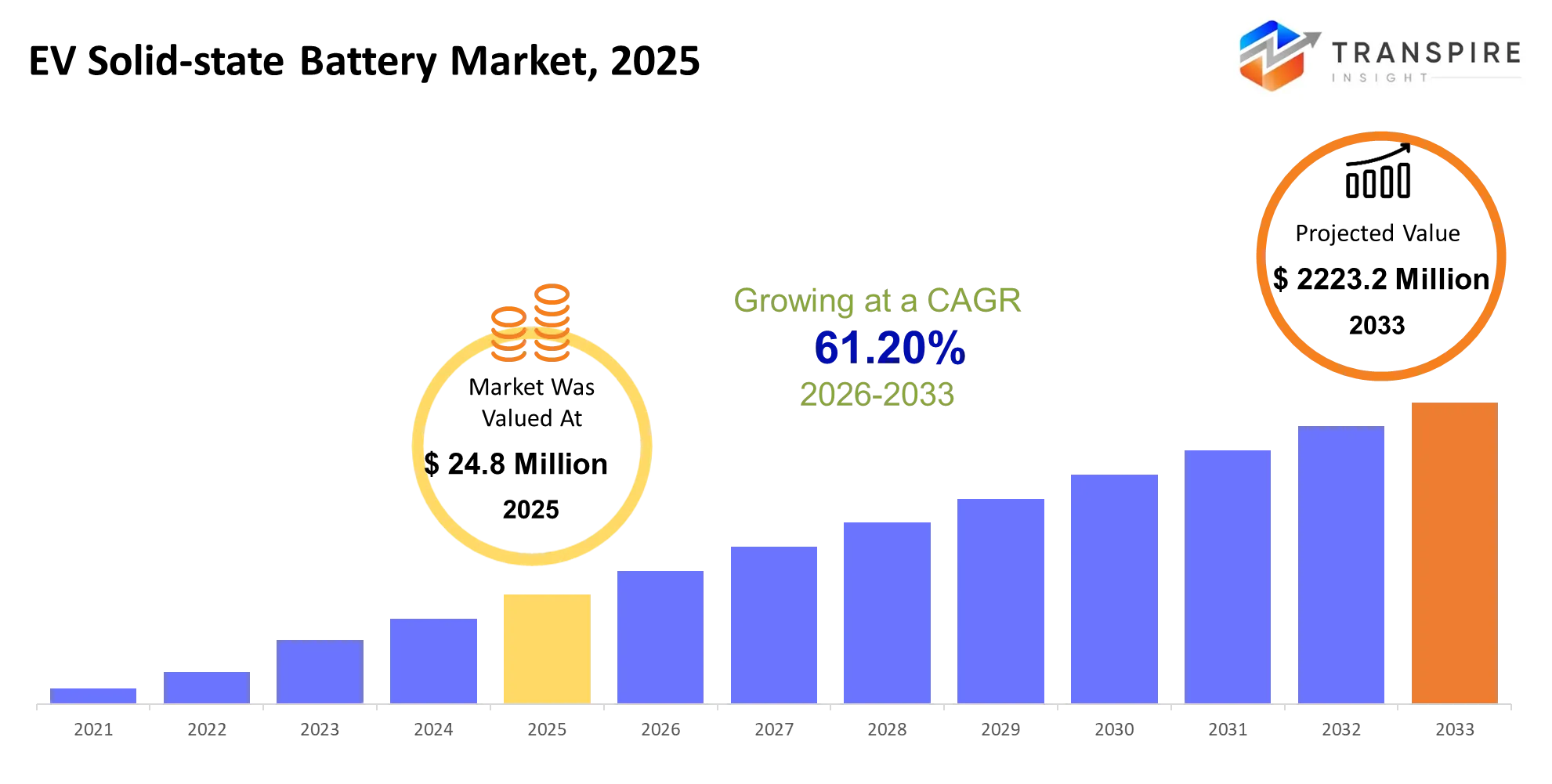
As per the Transpire Insight, The EV Solid-state Battery Market size is estimated at USD 24.8 million in 2025 and is anticipated to reach USD 2223.2 million by 2033, growing at a CAGR of 61.20% from 2026 to 2033.
EV solid-state battery market systems that allow manufacturers to deliver longer range, faster charging, and a lower risk of fire - without dramatically increasing vehicle weight - are finally moving forward and becoming relevant for manufacturing volume vehicles. From lab-level claims and prototypes three to five years ago, to OEM-supported pilot lines, engineering samples, and vehicle launches, a structural shift is taking shape toward a semi-solid and all-solid-state architecture that can support a lithium-metal anode and packs with higher density. The real-world catalyst has been EV fires' spotlight, along with premium segment customer demands for additional range and charging speed, which have forced automakers to buy their way into breakthroughs rather than simply waiting on existing lithium-ion cells. Growth looks like this: range and safety demands lead to more OEM investment; investment improves processing and yields; the better yield mitigates commercialisation risk and enables premium EV platforms to migrate toward solid-state. Toyota, BYD, and Samsung plan to start all-solid EV production.
EV Solid-state Battery Market Size & Forecast:
- Market Size 2025: USD 24.8 Million
- Expected Market Value (2033): USD 2223.2 Million
- Forecast CAGR (2026-2033): 61.20%
- Leading Region in 2025: Asia Pacific
- Fastest Growing Region: Middle East and Africa
- Key Company Profiles: Toyota, Samsung SDI, QuantumScape, Solid Power, Panasonic Energy, CATL, BYD, LG Energy Solution, ProLogium, Factorial Energy, SK On, Honda, Nissan, Hyundai Mobis, Ilika.
Key EV Solid-state Battery Market Insights:
Reliability and automotive qualification of materials are becoming more important than headline energy density when choosing the market, and the market is shifting from isolated cell demonstrations to supply-chain-controlled pilot production. The momentum is building in Asia, as automakers, material suppliers and cell manufacturers are coordinating launch plans for the region with emerging solid-state standards and capacity.
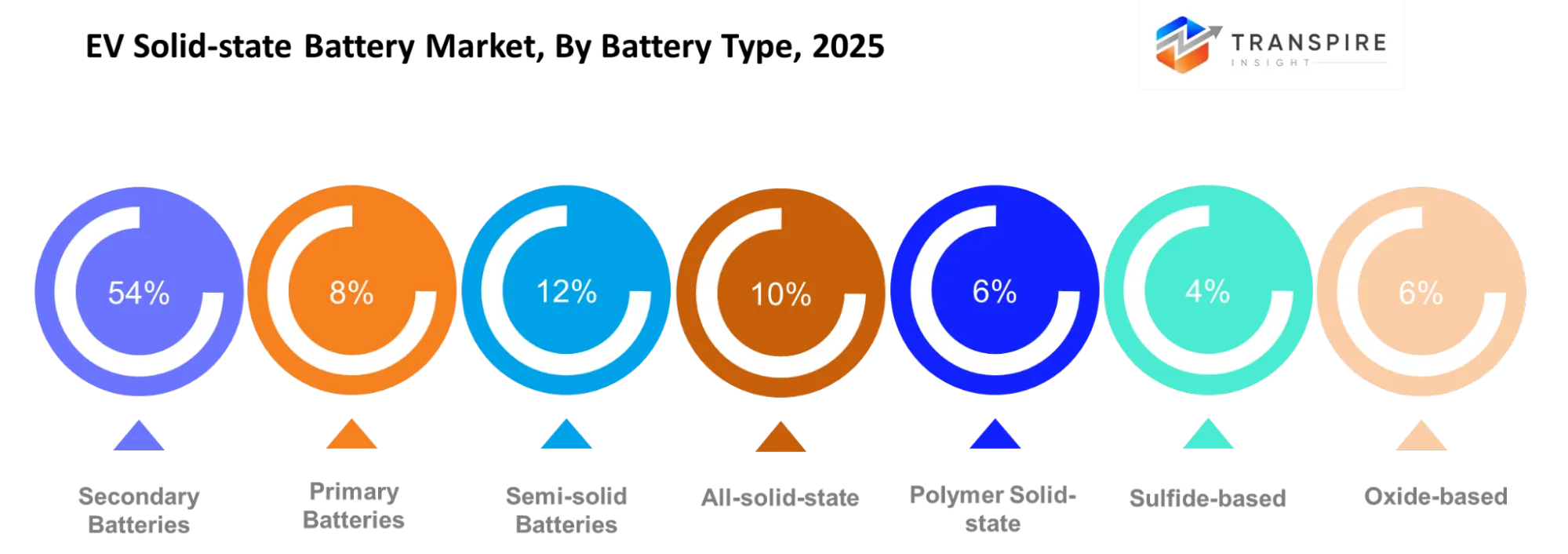
- Secondary batteries, 54% as Toyota links rechargeable BEVs to Sumitomo’s durable cathode-material program, shifting demand toward lifecycle-tested cells.
- Shorten validation cycles with transitional architectures, 12% as CATL continues to develop semi-solid batteries to persuade OEMs to consider staged electrification upgrades.
- All-solid-state batteries, where 10% of BYD's 2 GWh sulfide pilot line is required for 2027 vehicle trials, are taking the competition out of prototypes to repeatable yield.
- A lead-acid battery, 8%, as Ilika's expert cells continue to be relevant in low-volume applications where reliable performance is more important than traction-scale power.
- Polymer solid-state, 6%, as Factorial continues its lithium-metal development efforts, driving premium OEMs to focus on pack-level energy density.
- Sulfide batteries, 4% behind CATL's 420 Wh/kg, 1,500-cycle development in the dry room, are driving demand for dry-room processing and interface-control expertise.
- Toyota-Idemitsu electrolyte pilots drive 3% oxide-based battery development, as a trend in industrial-scale precursor supply.
- Other battery formats, 3% as Samsung SDI aims for second-half 2027 mass production, to widen solid-state application beyond EVs to physical-AI.
- China's GB/T 43568-2026 standard and tax incentives are driving qualification over experimental EV purchases, up 37.5%.
What are the Key Drivers, Restraints, and Opportunities in the EV Solid-State Battery Market?
Driver:
The principal growth driver is the need to improve usable EV range and charging convenience without enlarging the battery pack. Solid electrolytes can enable higher-energy cell architectures, particularly when paired with lithium-metal anodes, allowing automakers to package more energy into premium cars, performance models, and future commercial vehicles. The trigger has been a sharper gap between consumer expectations for refuelling-like convenience and the physical limits of current pack designs. This creates a revenue pathway for cell suppliers through higher-value battery content per vehicle, while OEMs can use longer range, safety credentials and lighter packs to differentiate vehicle platforms. EV battery deployment reached 1.2 TWh, while high-performance battery innovation has become strategically important for automakers competing on range and charging experience.
Restraint:
Manufacturing complexity remains the principal constraint. All-solid-state cells require tighter control of interfaces, pressure, electrolyte uniformity, and production conditions than conventional lithium-ion cells, while high manufacturing costs and immature supply chains restrict volume deployment. These structural issues persist because laboratory performance does not automatically translate into high-yield automotive production.
Opportunity:
The most attractive opportunity is premium-first commercialization followed by localized supply-chain expansion. Luxury EVs, high-performance vehicles, electric trucks, and fleet platforms can absorb an early price premium when range, payload, or safety produces measurable operating value. BYD plans an all-solid-state EV launch from 2027 and mass production from 2030, while Toyota and Samsung have similar early-production timelines. Regional investment in dry-room equipment, ceramic processing, sulfide handling and lithium-metal integration could turn pilot capability into localised industrial capacity.
What Has the Impact of Artificial Intelligence Been on the EV Solid-State Battery Market?
AI can also be used to accelerate the trial-and-error process involved in manufacturing solid-state cells. Machine-learning models can screen different combinations of electrolytes and electrodes, test out new formulations and relate composition to conductivity, stability and degradation behaviour before intensive lab work. AI-enabled process monitoring can evaluate parameters including the coating uniformity, pressure, temperature and interface formation during the manufacturing process, to spot defects earlier and improve reliability.
Predictive modelling can then provide estimates of cycle life, thermal characteristics, and failure mode, allowing automakers to more quickly qualify solid-state cells for automotive applications. Digital twins between the lab and pilot line can also connect lab results with scale-up conditions so that engineers can determine the process window before equipment is scaled up. All this is especially relevant as solid-state manufacturing is a more complex, costly process than traditional lithium-ion cell manufacture. The limiting factor is that AI models can only make accurate predictions if they are trained on quality experimental data sets, and so far there is only limited long-term solid-state cell data. There are also costs for software, computing, and validation when integrating the models into existing lab and production systems.
In April 2026, SandboxAQ launched AQVolt26, a massive machine-learning dataset and suite of interatomic potentials specifically trained to accelerate the discovery and computational modelling of next-generation solid-state battery electrolytes.
https://www.batterypoweronline.com/news/sandboxaq-introduces-solid-state-battery-modeling-ai/
Key EV Solid-State Battery Market Trends:
The market has moved beyond the catchy “breakthrough” phrases to evidence-based industrialisation, and the first trial of whether solid-state cells can achieve automotive yield, reliability and pack integration is in premium EV programs. Short-term winners will include companies that deliver chemistry performance, as well as manufacturing discipline, supplier control and OEM validation, but not solely by claiming to have lab energy-density results.
- Semi-solid cells are commercially available, and rigid systems that are all-solid-state are focused on prototype and pilot stage validation.
- Toyota, BYD, and Samsung are all leaning toward the 2027-2028 timeframe for their initial all-solid-state EV releases.
- BYD's roadmap puts scale readiness in the spotlight from 2020, and all-solid-state EV sales in 2027.
- Higher range and performance can justify cell cost premiums, making premium EVs the preferred launch platform.
- This is because automotive interest revolves around the conductivity of sulfide electrolytes, which also makes them sensitive to moisture and requires dry-room and handling requirements.
- Oxide and ceramic systems are relevant when chemical stability and temperature tolerance are of greater concern than processing complexity.
- Pack engineering is as critical as cell chemistry because for some solid-state designs, additional pressure-management systems must be added.
- Rapidly improving LFP, silicon-anode, and advanced lithium-ion batteries are bringing the bar up for commercialisation of solid-state batteries.
- China is setting the early supply availability stage: About 80% of committed solid-state capacity is in China.
- There's a growing trend of early testing on motorcycles or other specialised mobility platforms before it progresses to passenger cars.
EV Solid-State Battery Market Segmentation
By Battery Type:
Secondary batteries dominate at 54%, reflecting their strong alignment with rechargeable EV powertrains, repeated charging cycles, and practical automotive deployment. Semi-solid batteries account for 12%, offering an intermediate pathway toward fully solid architectures, while all-solid-state batteries represent 10% as manufacturers advance higher-energy-density designs. Primary batteries hold 8%, followed by polymer solid-state at 6%, sulfide-based at 4%, oxide-based at 3%, and other configurations at 3%. This composition highlights continued reliance on rechargeable technologies while investment increasingly targets solid-state chemistries that can improve safety, energy density, charging performance, and long-term suitability for automotive applications.
By Capacity:
The market spans cells below 20 mAh through above 100 Ah, covering applications from compact electronics to large automotive traction systems. High-capacity formats are gaining strategic importance as EV manufacturers seek greater driving range and pack efficiency. Smaller capacities remain relevant for wearables, medical devices, and electronics, while 50-100 Ah and above-100-Ah cells increasingly align with vehicle platforms requiring substantial energy storage and sustained power delivery.
By Vehicle Type:
Passenger cars represent the principal commercial pathway, supported by continued EV platform development and battery integration. Commercial vehicles, trucks, buses, two-wheelers, luxury EVs, and performance EVs provide distinct opportunities based on payload, driving range, charging requirements, and operating cycles. Heavy-duty applications particularly emphasise durability and energy density, while two-wheelers prioritise compact packaging and cost efficiency, creating differentiated technology requirements across vehicle categories.
By Application:
Electric vehicles represent the leading role, reflecting the technology's primary development focus on improving range, safety, charging performance, and pack efficiency. Consumer electronics, energy storage, wearables, medical devices, aerospace, and robotics broaden validation opportunities and provide alternative commercialization pathways. These applications allow battery developers to test different cell sizes, operating conditions, and material combinations while automotive qualification progresses toward higher-volume production and longer-term deployment.
By Electrolyte:
Sulfide, oxide, polymer, ceramic, glass, hybrid, and composite technologies compete around conductivity, chemical stability, mechanical compatibility, manufacturability, and interface performance. Sulfide electrolytes attract attention for high ionic conductivity, while oxide systems offer strong stability characteristics. Polymer and hybrid approaches can support easier processing and intermediate architectures. The competitive focus is therefore shifting from electrolyte selection alone toward integrated electrode-electrolyte interfaces, production yield, durability, and scalable manufacturing.
By Vehicle Class:
Premium and luxury EVs provide an early commercialization pathway because higher-value platforms can better accommodate emerging battery costs. Performance vehicles similarly emphasise acceleration, range, thermal control, and rapid charging, while economy models require stronger cost reductions before widespread adoption. Commercial and heavy-duty classes introduce additional requirements around cycle life and payload efficiency. This creates a staged adoption pattern in which high-value vehicles can support initial solid-state deployment.
By Technology:
Thin-film, bulk-type, hybrid solid-liquid, semi-solid, all-solid-state, lithium-metal, and silicon-anode designs represent different maturity and performance trade-offs. Electric vehicles record a reported 37.5% CAGR, reinforcing their position as the principal high-growth application. Lithium-metal and all-solid-state configurations target higher energy density, while semi-solid and hybrid designs offer transitional routes toward commercialization. Future competition will increasingly depend on manufacturability, durability, cost, and vehicle-level validation.
What are the Key Use Cases Driving the EV Solid-State Battery Market?
The main application is electric-vehicle propulsion, which accounts for the largest segment in secondary-battery sales at 54%. Additional development efforts are targeted at increasing usable energy density, safety, and extending driving range without increasing battery weight at a corresponding rate.
Potential applications are growing to include premium passenger electric vehicles, high-performance vehicles, electric trucks, buses, and commercial vehicle fleets, where range, payload efficiency, durability, and charging time have an economic impact.
There are also new applications that include robotics, aerospace, advanced mobility, and portable high-energy systems, where small, high-energy batteries can offer value as well as in traditional electric-vehicle applications. The International Energy Agency cites robotic devices as a potential origin for demand as solid-state production capacity increases.
|
Report Metrics |
Details |
|
Market size value in 2025 |
USD 24.8 Million |
|
Market size value in 2026 |
USD 78.6 Million |
|
Revenue forecast in 2033 |
USD 2223.2 Million |
|
Growth rate |
CAGR of 61.20% from 2026 to 2033 |
|
Base year |
2025 |
|
Historical data |
2021 - 2024 |
|
Forecast period |
2026 - 2033 |
|
Report coverage |
Revenue forecast, competitive landscape, growth factors, and trends |
|
Regional scope |
United States; Canada; Mexico; United Kingdom; Germany; France; Italy; Spain; Denmark; Sweden; Norway; China; Japan; India; Australia; South Korea; Thailand; Brazil; Argentina; South Africa; Saudi Arabia; United Arab Emirates |
|
Key companies profiled |
Toyota, Samsung SDI, QuantumScape, Solid Power, Panasonic Energy, CATL, BYD, LG Energy Solution, ProLogium, Factorial Energy, SK On, Honda, Nissan, Hyundai Mobis, Ilika. |
|
Customization scope |
Free report customization (country, regional & segment scope). Available customized purchase options to meet your exact research needs. |
|
Report Segmentation |
By Battery Type (Secondary Batteries, Primary Batteries, Semi-solid Batteries, All-solid-state Batteries, Polymer Solid-state, Sulfide-based, Oxide-based, Others); By Capacity (Below 20 mAh, 20-500 mAh, 500-2,000 mAh, 2,000-10,000 mAh, 10-50 Ah, 50-100 Ah, Above 100 Ah, Others); By Vehicle Type (Passenger Cars, Commercial Vehicles, Two-wheelers, Buses, Trucks, Luxury EVs, Performance EVs, Others); By Application (Electric Vehicles, Consumer Electronics, Energy Storage, Wearables, Medical Devices, Aerospace, Robotics, Others); By Electrolyte (Sulfide, Oxide, Polymer, Ceramic, Glass, Hybrid, Composite, Others); By Vehicle Class (Economy, Mid-range, Premium, Luxury, Commercial, Heavy-duty, Sports, Others); By Technology (Thin-film, Bulk-type, Hybrid Solid-liquid, Semi-solid, All-solid-state, Lithium-metal, Silicon-anode, Others). |
Which Regions are Driving the EV Solid-state Battery Market Growth?
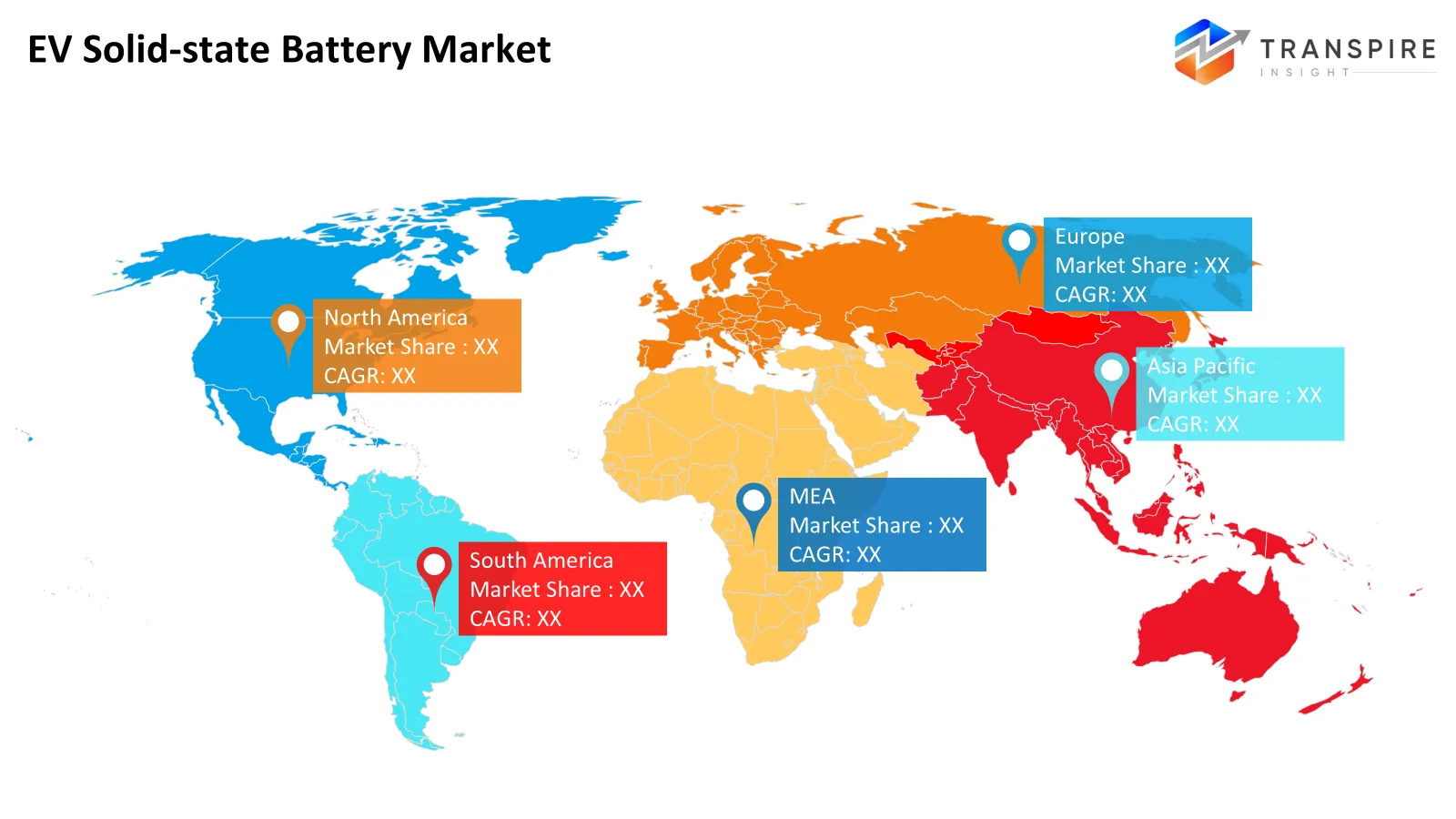
Asia Pacific leads the EV solid-state battery market with a 40.85% share, supported by China, Japan, and South Korea’s integrated battery-materials, cell-manufacturing, and automotive ecosystems. China’s large EV production base enables suppliers to test semi-solid and next-generation cell technologies across multiple vehicle classes rather than relying on isolated prototypes. Japan contributes deep materials expertise through Toyota’s cathode-material collaboration with Sumitomo Metal Mining, aimed at preparing all-solid-state BEV production. South Korean firms add advanced separator, cathode, and high-nickel cell capabilities, making the region the most complete commercialization ecosystem.
In August 2026, China's State Administration for Market Regulation announced a partnership-driven initiative where China's proposed international solid-state battery standard was successfully initiated at the International Electrotechnical Commission (IEC).
Europe accounts for 25% but takes a different model for competitive supply, in contrast to Asia Pacific. Europe's competitive advantage is not on the scale of raw production but in regulation, premium vehicle platform, and transparent battery supply chains. Europe's demanding sustainability regulations incentivise OEMs to treat battery data, lifecycle behaviour, and recyclability as a product feature when deploying the supply chain. Electric vehicle batteries entering the EU market after 18 February 2027 will be required to include a digital battery passport, further incentivising the use of transparent and validated battery solutions. Volkswagen PowerCo-QuantumScape licence partnership would give Europe access to lithium-metal solid-state batteries without building each piece of core technology itself.
In July 2026, QuantumScape Battery, Inc. amended its collaboration agreement with Volkswagen Group's PowerCo SE to restructure their joint development and commercialization program.
Middle East and Africa have only 4.15% of market share, but they are the fastest-growing regions with a CAGR of 35.40%. Their recent growth was driven by government-backed electrification plans, integration with renewables, and battery diversification in Gulf markets. Regional demand will be driven by fleet purchases, drive cycles, operations in extreme temperatures, and plug-in charging connectivity with solar production, in contrast to the manufacturing-driven growth in the Asia Pacific. Opportunities for battery pack assembly that is local to the application and stationary storage will allow solid-state batteries to be proven safe and thermally stable before passenger electric vehicles are introduced.
In August 2026, ACWA Power signed three major Storage Services Agreements with the Saudi Power Procurement Company (SPPC) to develop battery energy storage plants at Haden, Muwayh, and AlKahfah. This partnership represents a combined investment of SAR 4.35 billion ($1.2 billion) for 2,000 MW / 8,000 MWh of standalone capacity under a build-own-operate model.
Who are the Key Players in the EV Solid-state Battery Market, and how do they compete?
The competition is largely a matter of translating lab progress into reliably repeatable automotive manufacturing, with different players exploring a spectrum of approaches to materials management, pilot-line scale-up, OEM partnerships, and licensing. Toyota and Honda do so with an emphasis on proprietary chemistry and vehicle-integrated design, while Samsung SDI, Panasonic Energy, LG Energy Solution, SK On and CATL have established their credentials in cell manufacturing that can de-risk scale-up. Toyota's vision, including an all-solid-state battery electric vehicle and a cathode supply partnership with Sumitomo Metal Mining, provides a blueprint for scaling from materials development through vehicle commercialization.
Others try to differentiate by R&D in high-energy-density technology, advanced manufacturing expertise or OEM relationships for supply: Samsung SDI, Panasonic Energy, LG Energy Solution and SK On; using established semi-solid ecosystems in China as a stepping stone to all solid cells: CATL and BYD; or maintaining in-house development as a path towards future vehicle platform dominance: Nissan and Hyundai Mobis. Solid Power emphasises sulfide electrolytes and technology collaborations with BMW, Samsung SDI and SK On. Factorial Energy, ProLogium and Ilika target distinct niches in lithium-metal cells, ceramic architecture and specialised solid-state formats.
Key Players are:
- Toyota
- Samsung SDI
- QuantumScape
- Solid Power
- Panasonic Energy
- CATL
- BYD
- LG Energy Solution
- ProLogium
- Factorial Energy
- SK On
- Honda
- Nissan
- Hyundai Mobis
- Ilika
Recent Development News
- In September 2026, Factorial Energy partnered with Mitsui Kinzoku under a joint development agreement to support the industrialisation of Factorial’s Solstice™ all-solid-state battery platform. The collaboration combines Factorial’s cell and manufacturing-development capabilities with Mitsui Kinzoku’s sulfide solid-electrolyte technology, supporting scale-up and supply-chain qualification for next-generation battery production. https://www.telecomschamber.org/2026/09/page/4/
- In February 2026, Gotion High-Tech signed a strategic partnership agreement with BASF to jointly develop high-performance solid-state battery materials. This collaboration combines chemical processing expertise with established pilot production lines to eliminate core material hurdles, accelerating operational yields ahead of scheduled vehicle integration testing. https://battery-news.de/en/2026/02/13/gotion-and-basf-to-cooperate-on-solid-state-batteries/
What Strategic Insights Define the Future of the EV Solid-State Battery Market?
The market will move into a staged commercialisation. In the near-term, semi-solid batteries will grow, while all solid-state technologies will be deployed in luxury EVs and limited-volume fleets initially, and then later in broad-market vehicles. The real risk is not battery price, but rather a big difference between one working high-performance prototype and a mass-produced automotive cell at scale, where interface degradation, moisture sensitivity, pressure, and lower first-harvest yield can hold up a launch. A growing opportunity could be a single "materials-to-passport" business model, with a provider establishing traceability of the electrolyte source, life-cycle information, and battery-health monitoring, then being able to better beat the European 2027-timeframe for the battery passport. From a strategic perspective, don't jump at building your own gigafactory; rather, line up OEM validation, gather pilot-scale yield data, farm out half of the capital risk through licensing or joint ventures, and start in high-value applications with range, safety, and payload advantages for higher early-bird prices.
Key Segmentations are:
By Battery Type
- Secondary Batteries
- Primary Batteries
- Semi-solid Batteries
- All-solid-state Batteries
- Polymer Solid-state
- Sulfide-based
- Oxide-based
- Others
By Capacity
- Below 20 mAh
- 20-500 mAh
- 500-2,000 mAh
- 2,000-10,000 mAh
- 10-50 Ah
- 50-100 Ah
- Above 100 Ah
- Others
By Vehicle Type
- Passenger Cars
- Commercial Vehicles
- Two-wheelers
- Buses
- Trucks
- Luxury Evs
- Performance Evs
- Others
By Application
- Electric Vehicles
- Consumer Electronics
- Energy Storage
- Wearables
- Medical Devices
- Aerospace
- Robotics
- Others
By Electrolyte
- Sulfide
- Oxide
- Polymer
- Ceramic
- Glass
- Hybrid
- Composite
- Others
By Vehicle Class
- Economy
- Mid-range
- Premium
- Luxury
- Commercial
- Heavy-duty
- Sports
- Others
By Technology
- Thin-film
- Bulk-type
- Hybrid Solid-liquid
- Semi-solid
- All-solid-state
- Lithium-metal
- Silicon-anode
- Others
By Regional Analysis
North America
- US
- Canada
- Mexico
Europe
- Germany
- UK
- France
- Italy
- Spain
- Russia
- Rest of Europe
Asia Pacific
- China
- Japan
- India
- South Korea
- Australia
- Rest of Asia Pacific
South America
- Brazil
- Argentina
- Rest of South America
Middle East & Africa
- UAE
- Saudi Arabia
- Qatar
- South Africa
- Rest of the Middle East & Africa
Frequently Asked Questions
Find quick answers to common questions.
The EV solid-state battery market size was valued at USD 24.8 million in 2025 and is poised to reach USD 2223.2 million by 2033, expanding at a 61.20% CAGR.
Key segments for the EV solid-state battery market are By Battery Type (Secondary Batteries, Primary Batteries, Semi-solid Batteries, All-solid-state Batteries, Polymer Solid-state, Sulfide-based, Oxide-based, Others); By Capacity (Below 20 mAh, 20-500 mAh, 500-2,000 mAh, 2,000-10,000 mAh, 10-50 Ah, 50-100 Ah, Above 100 Ah, Others); By Vehicle Type (Passenger Cars, Commercial Vehicles, Two-wheelers, Buses, Trucks, Luxury EVs, Performance EVs, Others); By Application (Electric Vehicles, Consumer Electronics, Energy Storage, Wearables, Medical Devices, Aerospace, Robotics, Others); By Electrolyte (Sulfide, Oxide, Polymer, Ceramic, Glass, Hybrid, Composite, Others); By Vehicle Class (Economy, Mid-range, Premium, Luxury, Commercial, Heavy-duty, Sports, Others); By Technology (Thin-film, Bulk-type, Hybrid Solid-liquid, Semi-solid, All-solid-state, Lithium-metal, Silicon-anode, Others).
Growth is primarily driven by higher energy-density requirements, EV range improvement, battery safety, fast-charging development, lithium-metal technology, and automotive investment in solid-state manufacturing.
The EV solid-state battery market is led by major manufacturers, including Toyota, Samsung SDI, QuantumScape, Solid Power, Panasonic Energy, CATL, BYD, LG Energy Solution, ProLogium, Factorial Energy, SK On, Honda, Nissan, Hyundai Mobis, and Ilika.
Asia Pacific holds 40.85% of the market, supported by strong battery manufacturing, EV production, R&D capabilities, supply-chain integration, and government-backed technology development.
Commercial opportunities include premium EV deployment, lithium-metal batteries, semi-solid technologies, battery manufacturing partnerships, advanced electrolyte development, and applications in commercial vehicles, robotics, and aerospace.
- Toyota
- Samsung SDI
- QuantumScape
- Solid Power
- Panasonic Energy
- CATL
- BYD
- LG Energy Solution
- ProLogium
- Factorial Energy
- SK On
- Honda
- Nissan
- Hyundai Mobis
- Ilika
About the Authors

Avinash Kumar
I’m Avinash Kumar, a Senior Research Analyst at Transpire Insight, with expertise in the Electronics and Semiconductor and Energy & Power industry. My work focuses on analyzing emerging technologies, market trends, industry developments, and innovation across these sectors. I specialize in transforming complex technical and market insights into clear, research-backed content that helps professionals, businesses, and decision-makers stay informed. Through continuous industry research and data-driven analysis, I strive to deliver accurate, reliable, and practical perspectives on the latest advancements shaping the semiconductor and energy landscape.

Chakradhar Khansole
Chakradhar serves as the Research Director at Transpire Insight, bringing over 8 years of experience in technology, innovation, and strategic market intelligence. He specializes in transforming complex market data into actionable business insights that enable organizations to make informed, growth-oriented decisions. Recognized for his strategic vision and analytical expertise, Chakradhar leads high-impact research initiatives, delivering comprehensive market assessments, competitive intelligence, and forward-looking industry analysis.
Recently Published Reports
-
Apr 2026
Fiber Optic Faceplates Market
Fiber Optic Faceplates Market Size, Share & Analysis Report By Type (< 300 mm2, 300-350 mm2, and > 350 mm2, By Application (Night Vision, Holographic Imaging, Medical, and Others), and Geography (North America, Europe, Asia-Pacific, Middle East and Africa, South and Central America), 2021 - 2031
-
Apr 2026
High Temperature Superconductors Market
High Temperature Superconductors Market Size, Share & Analysis Report By Type (1G HTS, and 2G HTS), By Application (Power Cable, Fault Current Limiter, and Transformer), and Geography (North America, Europe, Asia-Pacific, Middle East and Africa, South and Central America), 2021 - 2031
-
Apr 2026
Industrial Plugs and Socket Market
Industrial Plugs and Socket Market Size, Share & Analysis Report By Type (Industrial Plugs, Industrial Sockets), By Current (Up to 32 A, 32 to 125 A, Above 125 A), By Protection (Dustproof and Splash Proof, Waterproof, Explosion Proof), By End User (Heavy Industries, Oil and Gas, Chemicals and Pharmaceuticals, Power Generation, Others), and Geography (North America, Europe, Asia-Pacific, Middle East and Africa, South and Central America), 2021 - 2031
-
Apr 2026
InGaAs Avalanche Photodiodes Market
InGaAs Avalanche Photodiodes Market Size, Share & Analysis Report By Type (1100 - 1700 nm, and 1000 - 1600 nm), By Application (Missile Warning System, Muzzle Flash Detection, Wafer Defect Inspection, Laser Rangefinders, and Others), and Geography (North America, Europe, Asia-Pacific, Middle East and Africa, South and Central America), 2021 - 2031