
Europe Wearable AI Market Size & Forecast:
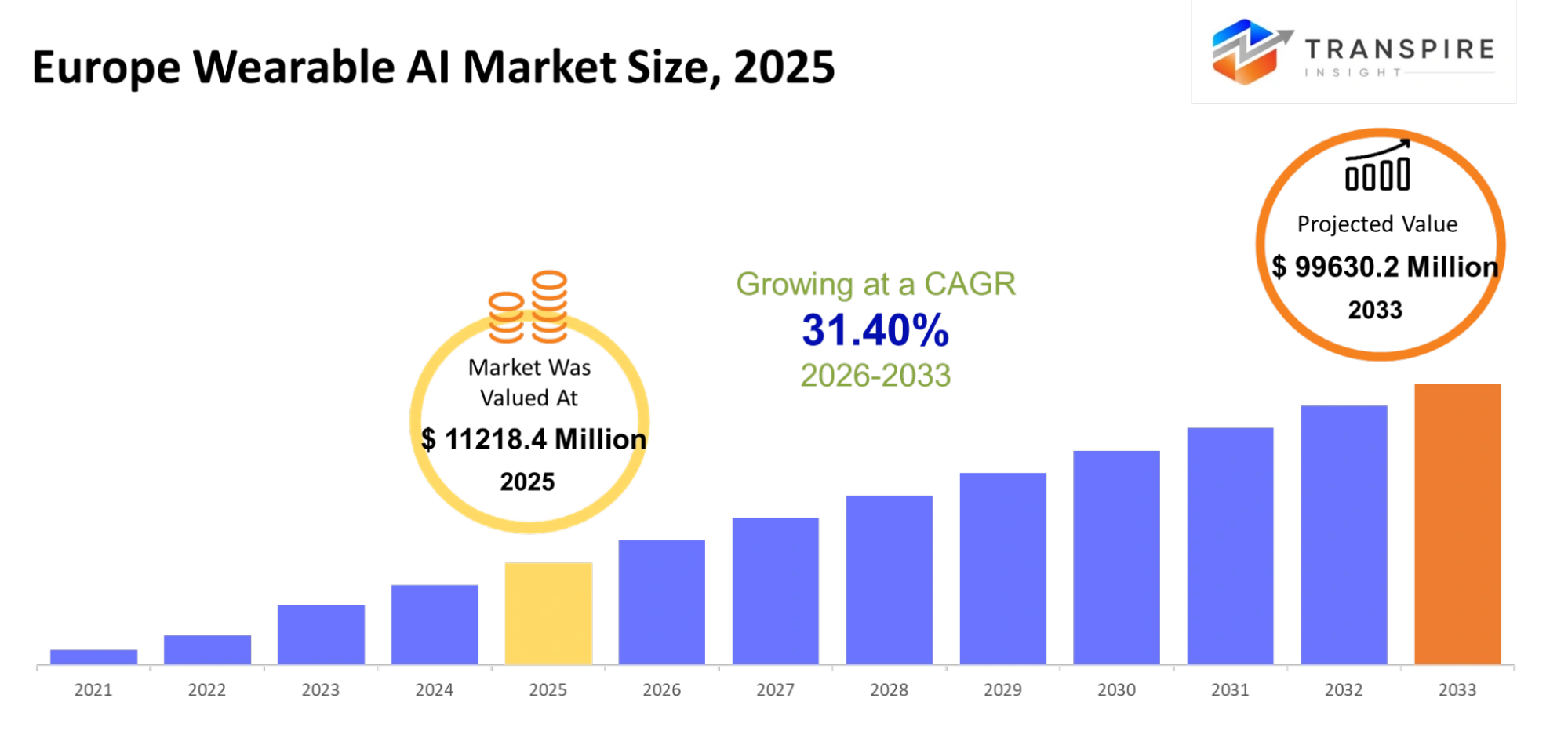
- Europe Wearable AI Market Size 2025: USD 11218.4 Million
- Europe Wearable AI Market Size 2033: USD 99630.2 Million
- Europe Wearable AI Market CAGR: 31.40%
- Europe Wearable AI Market Segments: By Product Type (Smartwatches, Smart Glasses, Fitness Bands), By Application (Healthcare, Consumer Electronics, Industrial), By End-User (Consumers, Enterprises).
To learn more about this report,  Download Free Sample Report
Europe Wearable AI Market Summary:
Europe Wearable AI Market size was estimated at USD 11218.4 Millionin 2025 and is anticipated to reach USD 99630.2 Million by 2033, growing at a CAGR of 31.40% from 2026 to 2033.
The European wearable artificial intelligence market operates as part of the larger consumer electronics and digital health sector because products will utilize smart software to work with common wearable devices which include watches and eyewear and fitness bands. User expectations will drive the market because people expect devices to provide health and productivity and safety information through continuous tracking instead of basic step counting functions. European consumers will require products that offer discreet design and extended battery performance and enhanced data protection, which will compel manufacturers to develop new methods for connecting their hardware and software systems.
Technological advancements in on-device processing and edge computing and sensor accuracy will enable these products to function independently from cloud services. European countries will enforce stricter data protection regulations which will affect medical-grade product development and testing and marketing methods used by companies. The market will move toward transparent data handling and certified health applications whereas tech companies and healthcare providers will work together to enhance the everyday application of wearable artificial intelligence technology.
Key Market Trends & Insights:
- The European Wearable AI Market experiences changes in consumer adoption because people have become more aware of their health. The market currently shows strong demand for preventive healthcare solutions which users prefer because they provide immediate health data and simple health tracking methods.
- The European Wearable AI Market benefits from artificial intelligence advancements which enhance product performance. The smart algorithms now enable better data analysis together with tailored user feedback and performance-based system adjustments. The continuous development process through which manufacturers work enables them to create more accurate and quick systems which result in better user experiences across their healthcare and sports and everyday life management systems.
- European healthcare systems now implement wearable AI systems for remote patient monitoring and early disease detection. Medical facilities now use internet-connected devices to monitor their patients' health status from locations outside the hospital or clinic environment. The system enables organizations to manage their expenses while decreasing patient hospital admissions and increasing treatment effectiveness which leads to significant changes in the European Wearable AI Market.
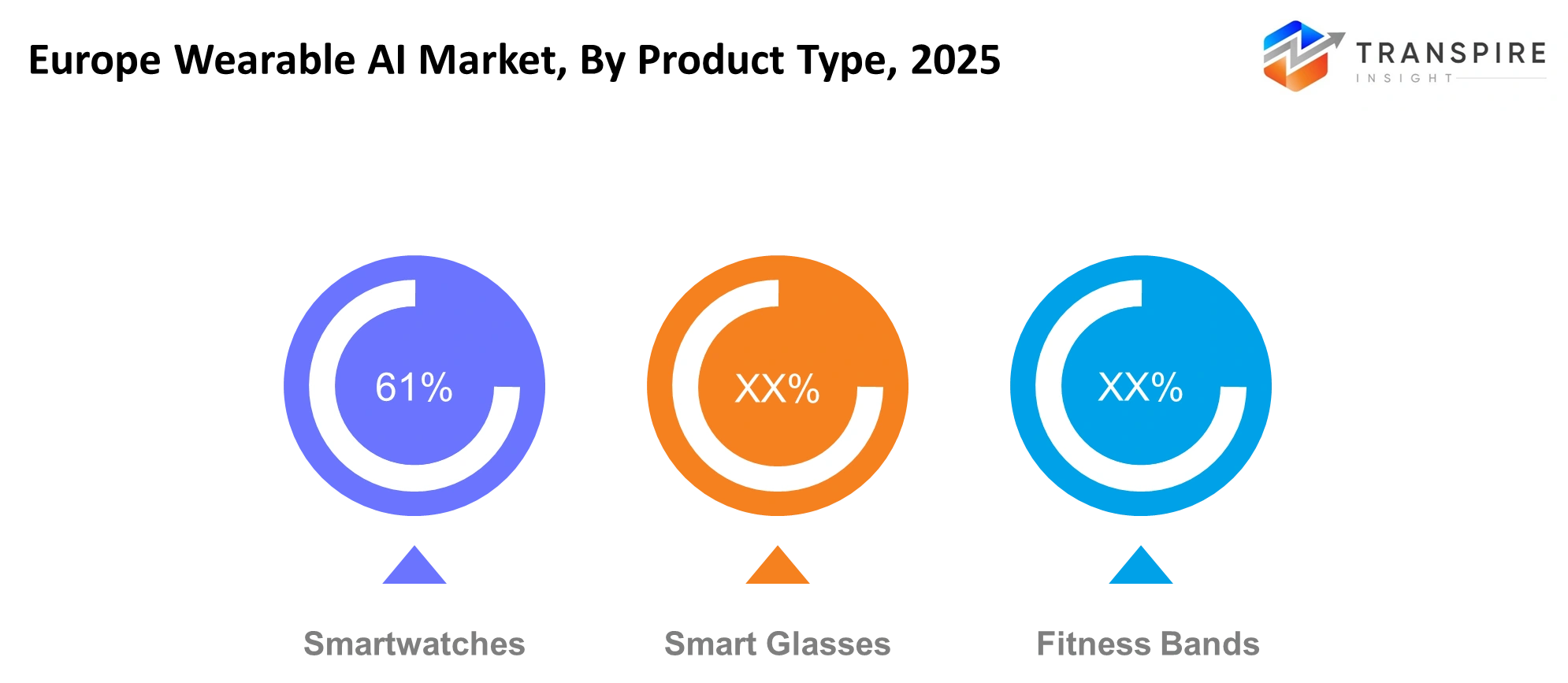
- The smartwatch market maintains its leading position because customers prefer its functional design and user-friendly features. Users find the product attractive because it includes communication features together with health monitoring capabilities and application compatibility. The market expansion in Europe through wearable AI technology products results from product development activities which create compact devices that perform multiple tasks.
- European countries enforce strict data protection regulations which impact how businesses develop their products and design their market entry plans. Companies work to establish secure data management systems while they meet the specific data protection requirements of their operational regions. The European Wearable AI Market develops through privacy-based innovations which depend on users' trust in transparent systems.
Europe Wearable AI Market Segmentation
By Product Type :
- Smartwatches: The European AI Wearable Market will grow at a steady pace because people value both health monitoring and communication capabilities of smartwatches. The smartwatch will enable users to monitor their heart rate and sleep patterns while receiving alerts through its all-in-one device system. The market demand will increase because of better battery performance and advanced sensor technology which meets consumer needs for simple and portable wearable devices.
- Smart Glasses: Europe Wearable AI Market in smart glasses will gain attention as augmented display and real-time data access become more useful in daily activities. The smart glasses system enables users to navigate their surroundings while providing remote support and enabling hands-free communication functions. The adoption rate will increase because better design solutions and lower prices will solve privacy issues which developers face.
- Fitness Bands: Europe Wearable AI Market in fitness bands will remain stable due to affordability and simple health tracking features. Fitness bands will focus on step counting, calorie tracking, and basic health insights. The market will expand because budget-conscious customers want lightweight devices which offer essential tracking features without extra functions or high expenses.
To learn more about this report, Download Free Sample Report
By Application :
- Healthcare: The European wearable artificial intelligence market for healthcare applications will grow because wearable devices enable continuous vital sign monitoring and health condition assessment through early symptom detection. Hospitals and individuals will use such devices for remote patient care and data collection. The system will enable accurate patient tracking which leads to better treatment outcomes and decreases hospital readmission through timely medical alerts and ongoing patient surveillance.
- Consumer Electronics: The European wearable artificial intelligence market for consumer electronics will expand because more people want connected devices which provide them with better daily convenience. Wearable devices will connect with smartphones and home automation systems to deliver users with notifications and entertainment content and personal assistant functions. The continuous development of new features together with user-friendly designs will drive demand from all age demographics.
- Industrial: The European wearable artificial intelligence market for industrial applications will expand as businesses implement wearable technologies which boost employee productivity and job safety. Workers will use essential wearables to track their physical state while these devices help them complete their work tasks and protect them from potential dangers at their job sites. Industries will invest in such technology to increase productivity while ensuring better safety standards and operational control.
By End-User :
- Consumers: The market for wearable AI technology in Europe will grow because consumers now understand personal health and fitness better than before. Consumers will select wearable devices which provide simple tracking features together with advanced connectivity options. The demand for products will increase because they become more fashionable and economical and they match the daily routines of people from various lifestyle categories.
- Enterprises: The European wearable AI market for enterprises will experience growth because businesses implement wearable solutions which enhance operational efficiency and workforce management capabilities. Enterprises will deploy wearable devices to monitor employee performance and maintain workplace safety while enabling instant communication between workers. Organizations will boost their investments in wearable AI technology because they want to optimize their business procedures and achieve greater operational output.
Country Insights
- Germany exhibits continuous development in the European Wearable AI Market because of its strong industrial support and its early acceptance of new technological advancements. The market requires products that include fitness tracking systems and workplace safety equipment and healthcare monitoring devices. Local manufacturers emphasize producing high-quality products with precise performance while consumers prefer dependable wearable products that provide extended service life.
- The United Kingdom maintains a significant presence in the European Wearable AI Market because health awareness increases and people use digital technologies in their daily activities. People use wearable devices extensively for their fitness activities and to monitor remote patients and for their lifestyle management needs. The market expands because technology-oriented customers use AI-driven personal assistant tools more frequently. France maintains its growth in the European Wearable AI Market through increasing demand for intelligent health devices and fashionable wearable technologies. The market requires products that provide both practical functions and visually appealing designs which motivates brands to develop products that combine both elements. The government provides financial backing for digital health projects which enables wider adoption of these solutions in medical practices and wellness programs.
- The European Wearable AI Market in Italy shows steady growth because lifestyle preferences and design elements create product demand in the country. Younger people and fitness enthusiasts show increasing interest in using wearable devices. The local market receives support from consumers who want fashionable technologies that provide practical benefits for their daily activities. Spain shows rising potential in the Europe Wearable AI Market due to increasing awareness of personal health and fitness tracking. The market shows increased adoption because more people use smartphones and affordable wearable devices become available. Daily life products attract customers who prefer devices that deliver easy-to-use functions and dependable performance.
Recent Development News
Smart ring competition intensifies with AI features (2026)
- Ultrahuman launched its Ring Pro across Europe with improved sensors and on-device AI processing.
- The product highlights growing demand for AI-driven health insights without subscriptions, a key trend in European wearable adoption.
AI features becoming standard in wearable devices (2026)
- Around 40% of new wearable devices are expected to include AI capabilities such as health monitoring and predictive analytics.
- This indicates rapid mainstream adoption of AI across wearable categories in Europe.
|
Report Metrics |
Details |
|
Market size value in 2025 |
USD 11218.4 Million |
|
Market size value in 2026 |
USD 14729.8 Million |
|
Revenue forecast in 2033 |
USD 99630.2 Million |
|
Growth rate |
CAGR of 31.40% from 2026 to 2033 |
|
Base year |
2025 |
|
Historical data |
2021 - 2024 |
|
Forecast period |
2026 - 2033 |
|
Report coverage |
Revenue forecast, competitive landscape, growth factors, and trends |
|
Country scope |
Europe (Germany, United Kingdom, France, Italy, Spain, Rest of Europe) |
|
Key company profiled |
Apple Inc., Samsung Electronics Co. Ltd., Google LLC (Fitbit), Garmin Ltd., Huawei Technologies Co. Ltd., Xiaomi Corporation, Sony Corporation, Meta Platforms Inc., Microsoft Corporation, Amazon.com Inc., Vuzix Corporation, Epson Corporation, RealWear Inc., Oura Health Ltd., Whoop Inc. |
|
Customization scope |
Free report customization (country, regional & segment scope). Avail customized purchase options to meet your exact research needs. |
|
Report Segmentation |
By Product Type (Smartwatches, Smart Glasses, Fitness Bands), By Application (Healthcare, Consumer Electronics, Industrial), By End-User (Consumers, Enterprises). |
Key Europe Wearable AI Company Insights
- The European market for wearable AI products demonstrates active participation from both established technology companies and dedicated health tracking and fitness monitoring and smart assistance wearable technology companies. Companies continue to enhance their products through improved device accuracy and extended battery lifespan and increased user comfort which will lead to wider product acceptance by consumers and professionals who have varying age and usage requirements.
- The European market for wearable AI products demonstrates increasing collaboration between software developers and hardware manufacturers who work together to create improved user experiences and better data integration solutions. Companies will spend money on artificial intelligence capabilities which provide immediate data analysis and customized user suggestions and uninterrupted device connection to enhance the everyday functionality of wearable tech products as well as their capacity to assist users in maintaining their health over time.
Europe Wearable AI Market Companies:
- Apple Inc.
- Samsung Electronics Co. Ltd.
- Google LLC (Fitbit)
- Garmin Ltd.
- Huawei Technologies Co. Ltd.
- Xiaomi Corporation
- Sony Corporation
- Meta Platforms Inc.
- Microsoft Corporation
- Amazon.com Inc.
- Vuzix Corporation
- Epson Corporation
- RealWear Inc.
- Oura Health Ltd.
- Whoop Inc
Europe Wearable AI Market Segmentation
By Product Type
- Smartwatches
- Smart Glasses
- Fitness Bands
By Application
- Healthcare
- Consumer Electronics
- Industrial
By End-User
- Consumers
- Enterprises
Frequently Asked Questions
Find quick answers to common questions.
The Approximate Europe Wearable AI Market size for the Market will be USD 99630.2 Million in 2033.
Key Segments for the Europe Wearable AI Market are By Product Type (Smartwatches, Smart Glasses, Fitness Bands), By Application (Healthcare, Consumer Electronics, Industrial), By End-User (Consumers, Enterprises).
Major Europe Wearable AI Market Players are Apple Inc., Samsung Electronics Co. Ltd., Google LLC (Fitbit), Garmin Ltd., Huawei Technologies Co. Ltd., Xiaomi Corporation, Sony Corporation, Meta Platforms Inc., Microsoft Corporation, Amazon.com Inc., Vuzix Corporation, Epson Corporation, RealWear Inc., Oura Health Ltd., Whoop Inc.
The Current Europe Wearable AI Market size is USD 11218.4 Million in 2025.
The Europe Wearable AI Market CAGR is 31.40%.
- Apple Inc.
- Samsung Electronics Co. Ltd.
- Google LLC (Fitbit)
- Garmin Ltd.
- Huawei Technologies Co. Ltd.
- Xiaomi Corporation
- Sony Corporation
- Meta Platforms Inc.
- Microsoft Corporation
- Amazon.com Inc.
- Vuzix Corporation
- Epson Corporation
- RealWear Inc.
- Oura Health Ltd.
- Whoop Inc
Recently Published Reports
-
Apr 2026
Fiber Optic Faceplates Market
Fiber Optic Faceplates Market Size, Share & Analysis Report By Type (< 300 mm2, 300-350 mm2, and > 350 mm2, By Application (Night Vision, Holographic Imaging, Medical, and Others), and Geography (North America, Europe, Asia-Pacific, Middle East and Africa, South and Central America), 2021 - 2031
-
Apr 2026
High Temperature Superconductors Market
High Temperature Superconductors Market Size, Share & Analysis Report By Type (1G HTS, and 2G HTS), By Application (Power Cable, Fault Current Limiter, and Transformer), and Geography (North America, Europe, Asia-Pacific, Middle East and Africa, South and Central America), 2021 - 2031
-
Apr 2026
Industrial Plugs and Socket Market
Industrial Plugs and Socket Market Size, Share & Analysis Report By Type (Industrial Plugs, Industrial Sockets), By Current (Up to 32 A, 32 to 125 A, Above 125 A), By Protection (Dustproof and Splash Proof, Waterproof, Explosion Proof), By End User (Heavy Industries, Oil and Gas, Chemicals and Pharmaceuticals, Power Generation, Others), and Geography (North America, Europe, Asia-Pacific, Middle East and Africa, South and Central America), 2021 - 2031
-
Apr 2026
InGaAs Avalanche Photodiodes Market
InGaAs Avalanche Photodiodes Market Size, Share & Analysis Report By Type (1100 - 1700 nm, and 1000 - 1600 nm), By Application (Missile Warning System, Muzzle Flash Detection, Wafer Defect Inspection, Laser Rangefinders, and Others), and Geography (North America, Europe, Asia-Pacific, Middle East and Africa, South and Central America), 2021 - 2031