

Europe Vitamin C Market Size & Forecast:
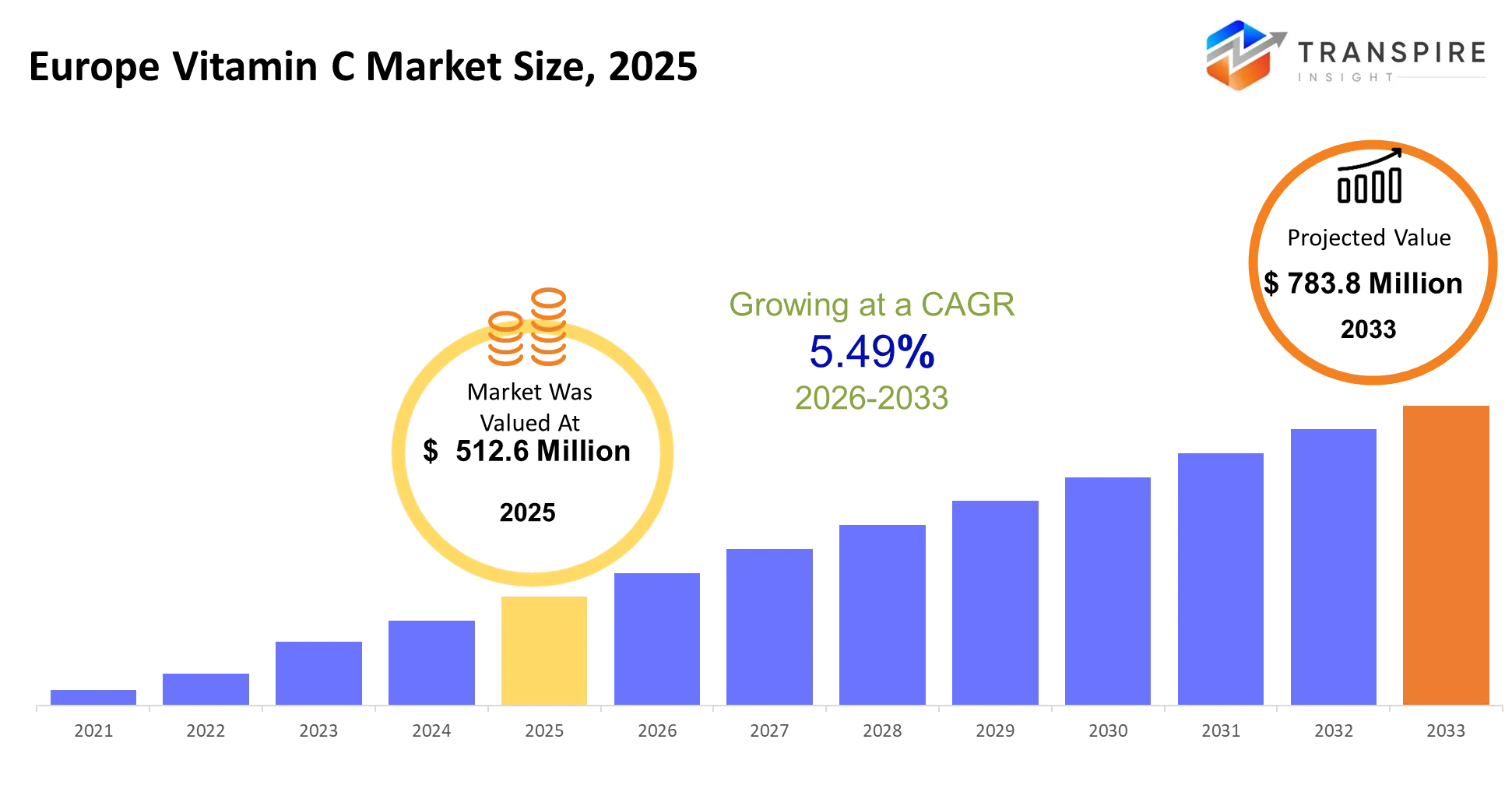
- Europe Vitamin C Market Size 2025: USD 512.6 Million
- Europe Vitamin C Market Size 2033: USD 783.8 Million
- Europe Vitamin C Market CAGR: 5.49%
- Europe Vitamin C Market Segments: By Type (Ascorbic Acid, Sodium Ascorbate, Calcium Ascorbate, Others); By Application (Food & Beverages, Pharmaceuticals, Cosmetics, Animal Feed, Others); By End-User (Food Industry, Pharma Companies, Cosmetic Industry, Agriculture, Others); By Form (Powder, Tablets, Liquid, Others)
To learn more about this report,  Download Free Sample Report
Europe Vitamin C Market Summary
The Europe Vitamin C Market was valued at USD 512.6 Million in 2025. It is forecast to reach USD 783.8 Million by 2033. That is a CAGR of 5.49% over the period.
The Europe Vitamin C market supports basic operations in food processing and pharmaceuticals and personal care products through its ability to extend product shelf life and maintain product stability and help products achieve their health benefits. Manufacturers use it to stop oxidation in packaged foods and preserve supplement effectiveness and create consistent active ingredient levels in skincare products.
The past three to five years have witnessed a fundamental change in procurement practices which now require producers to choose fermentation-based and non-synthetic solutions for their products. The COVID-19 pandemic created the initial trigger which revealed Europe’s high reliance on imported raw materials and led to both stockpiling and regional supply chain expansion.
The combination of these two factors has created supply chain challenges which require stricter quality standards. Buyers commit to extended contract periods despite rising costs because they want to achieve reliability which helps their businesses grow steady income and encourages them to build new facilities throughout Europe.
Key Market Insights
- The European Vitamin C Market receives its main market share through Western Europe which controls more than 45% of the total market share for 2024 because of its strong pharmaceutical manufacturing capabilities and advanced food processing systems.
- The fastest-growing area until 2030 exists in Eastern Europe because of rising nutraceutical production and cost-effective manufacturing facilities that enhance industry development in the entire region.
- Ascorbic acid maintains its market lead with about 60% share because it delivers cost advantages and maintains common application in food preservation and pharmaceuticals.
- The second largest market segments for dietary supplements consist of calcium ascorbate and sodium ascorbate because premium products contain their buffered formulations which customers prefer.
- The cosmetic and clinical sectors drive the fastest growing segment for specialty derivatives since 2022 because of their need for Vitamin C formats that maintain high bioavailability in a stabilized form.
- Food and beverage products remain the main usage area because they hold more than 50% market share while manufacturers change their products to meet clean-label standards and shelf-life requirements.
- The fastest post-2020 growth rate appears in nutraceutical applications because supplement brands introduce new products that meet the growing demand for immune system support and preventive health solutions.
- The food industry leads end-user demand with approximately 40% share which it sustains through its bulk purchasing activities and ongoing product development efforts.
- The cosmetic industry experiences rapid growth because premium skincare brands use stabilized Vitamin C derivatives to improve product performance and create unique product features.
- The top market players have established strategic partnerships while launching regional expansion programs since 2021 to enhance supply chain resilience and strengthen their market positions.
What are the Key Drivers, Restraints, and Opportunities in the Europe Vitamin C Market?
Driver:
The shift toward preventive healthcare and fortified nutrition which started after 2020 has created one major growth driver for Europe. The COVID-19 period triggered sustained changes in consumer purchasing behavior, with pharmacies and supplement brands reporting multi-year increases in immune-support product sales. The shift resulted in increased procurement from nutraceutical manufacturers who developed new production methods and their supplier networks to prevent supply shortages. Food processors developed new products that contained functional health ingredients which resulted in increased Vitamin C usage beyond its standard use as a preservative. Health supplements and fortified foods together create a stable demand base that generates consistent revenue streams for businesses.
Restraint:
The requirement to use imported raw materials from Asia creates a permanent limitation that prevents organizations from managing their expenses and operational capacity. European producers face higher energy, labor, and environmental compliance costs, which makes local production less competitive at scale. The solution to this imbalance requires extended direct capital expenditure for both fermentation infrastructure development and complete supply chain system changes. Buyers experience both price fluctuations and delivery inconsistencies which results in extended purchase delays that decrease profit potential for manufacturers.
Opportunity:
The market presents an excellent chance to create high-purity derivatives which serve specific pharmaceutical and premium cosmetic applications. Enhanced stabilized formulations together with their controlled-release systems enable the creation of new product solutions which provide extended shelf life and improved effectiveness.Western European countries experience more investment in their regional production facilities which specialize in specialty grades instead of bulk production. The new system enables suppliers to achieve better profit margins while decreasing their risk from fluctuating commodity prices, which leads the market toward growth based on value generation.
What Has the Impact of Artificial Intelligence Been on the Europe Vitamin C Market?
The manufacturing of Vitamin C and its subsequent distribution operations undergo transformation through the implementation of AI and modern digital technologies. The manufacturing facilities implement automated process control systems throughout their fermentation and synthesis production lines, which utilize sensors and AI systems to continuously manage temperature and pH levels and feedstock materials in order to achieve optimal production results. The large-scale systems which these facilities use to serve food and pharmaceutical customers, achieve better operational results because they reduce batch inconsistencies and increase production capacity.
Production plants now use machine learning models to forecast equipment breakdowns and develop better maintenance schedules. Operators can predict equipment failures by studying past system performance and current sensor readings which helps them decrease unexpected production halts while increasing equipment usage. Demand forecasting systems enable suppliers to match their production levels with the changing purchase patterns of food processors and supplement manufacturers, which results in faster inventory turnover and decreased inventory costs.
The digital solutions have produced measurable results which include enhanced production efficiency and greater adherence to quality control requirements. The high costs required for system integration, together with the absence of adequate high-quality training data for specific manufacturing processes, present obstacles that prevent smaller regional manufacturers from adopting new technologies.
Key Market Trends
- Manufacturers have adopted dual-supplier strategies since 2020 because they need to reduce their dependence on China while establishing partnerships with European and Japanese manufacturers.
- Clean-label reformulation processes became faster after 2021 because food brands started using fermentation-derived products instead of synthetic ascorbic acid blends to satisfy retailer and consumer requirements.
- COVID-19 created a major increase in supplement sales between 2020 and 2022 which made companies like DSM expand their production facilities while they started to offer more contract manufacturing services.
- The European Union implemented new regulatory requirements for additives and labeling between 2021 and2024 which compelled companies to create improved traceability systems that would demonstrate their supply chain origins.
- Cosmetic manufacturers have adopted stabilized Vitamin C derivatives which provide better shelf stability and high-performance skincare results since 2022.
- The 2022 energy cost increases throughout Europe forced manufacturers to improve their fermentation processes and they needed to assess production facilities located in regions with lower energy prices.
- Buyers have started to accept extended contract durations and premium pricing during the last three years because they need to obtain stable supplies of pharmaceutical-grade Vitamin C which currently experiences market fluctuations.
- Manufacturers must achieve their 2030 sustainability objectives through environmentally friendly production techniques that use bio-based materials and decrease solvent consumption during chemical production processes.
- The market became more competitive after 2021 when smaller regional companies began to compete in specialized markets for organic-certified Vitamin C which created challenges for global suppliers who needed to establish unique market presence.
Europe Vitamin C Market Segmentation
By Type:
Ascorbic acid holds the dominant market position because it provides cost-effective solutions which can be used in various industries and its supply network has been established throughout both food processing and pharmaceutical markets. Sodium ascorbate and calcium ascorbate follow with smaller shares which manufacturers use to create buffered products that have reduced acidity for their nutritional supplements and clinical nutrition products. Other specialty derivatives remain niche but are gaining traction in cosmetics and high-value applications where stability and targeted delivery matter.
Buffered variants grow on the back of gastrointestinal tolerance concerns and premium positioning in nutraceuticals while ascorbic acid maintains its market position through its contracts that deliver products for food preservation at large quantities. Over the forecast period manufacturers will focus on developing specialty derivatives which will allow them to create products that generate higher profits through unique product offerings.
By Application:
Food and beverages lead the application landscape because processed products require oxidation control and shelf-life extension and they need label-friendly additives. Pharmaceuticals represent a strong secondary segment because they require immune-support formulations and injectable preparations which use our products on a regular basis. The formulation science field has developed scientific knowledge which enables cosmetics and animal feed products to achieve consistent growth.
Food applications will grow because of product reformulation efforts together with retailer demands for cleaner product labels while the pharmaceutical sector will maintain its current level of demand because of fixed dosing requirements. Cosmetic applications are expanding through stabilized derivatives that improve product performance. Future growth will direct manufacturers towards high-value applications which will compel them to customize product grades while funding specific research development activities.
By End-User:
The food industry because of its needs for bulk purchasing and perpetual demand for preservation products, operates as its most significant sector. Pharma companies maintain a significant position due to regulated usage and consistent volume requirements across therapeutic and preventive products. The cosmetic industry and agriculture sectors represent smaller shares but show increasing engagement with specialized formulations.
The private-label business activities of food manufacturers together with their product reformulation processes generate product volume, while pharmaceutical companies focus on maintaining product quality and adhering to industry regulations. Cosmetic brands create new products through the development of stabilized forms and derivative formulations that can be used on skin. The process of expanding into new markets demands that suppliers maintain their production capacity while developing new ways to meet customer needs, which in turn drives them to adopt systems that enable adaptable manufacturing.
By Form:
Powder dominates the market due to ease of handling, longer shelf life, and compatibility with bulk manufacturing processes in food and pharma industries. The market for tablets and liquid forms exists because people use these products to directly consume dietary supplements and medical treatments in their homes and medical facilities. The market for other forms such as encapsulated and coated products remains limited, but current technological progress is enabling their market expansion
Powder growth benefits from its capacity to streamline transportation and support industrial mixing operations, while tablets succeed because consumers prefer their ability to deliver precise dosage amounts. Liquid formulations are gaining traction in clinical nutrition and functional beverages. Product developers need to improve bioavailability and stability across different uses because future demand will require them to deliver products in new delivery methods.
What are the Key Use Cases Driving the Europe Vitamin C Market?
Food processing serves as the primary application where food manufacturers utilize Vitamin C to prevent oxidation and preserve product color and extend the storage duration of their packaged merchandise. The bakery and meat and beverage industries require reliable delivery of products to fulfill their retail demands for stable and clear product labeling.
The pharmaceutical industry along with nutraceutical markets continue to grow through their partnership with supplement companies and contract development organizations that create immune-support products. Cosmetic companies are increasing their use of stabilized derivatives in serums and topical products because these substances enhance product effectiveness and extend product shelf life.
The industry now explores new applications that include functional beverages and enhanced animal nutrition solutions which help producers achieve improved performance and better health results. Healthcare professionals are driving the surge in interest toward clinical nutrition and personalized supplement solutions that focus on specific high-purity product needs.
|
Report Metrics |
Details |
|
Market size value in 2025 |
USD 512.6 Million |
|
Market size value in 2026 |
USD 539.3 Million |
|
Revenue forecast in 2033 |
USD 783.8 Million |
|
Growth rate |
CAGR of 5.49% from 2026 to 2033 |
|
Base year |
2025 |
|
Historical data |
2021 - 2024 |
|
Forecast period |
2026 - 2033 |
|
Report coverage |
Revenue forecast, competitive landscape, growth factors, and trends |
|
Regional scope |
Europe (Germany, United Kingdom, France, Italy, Spain, Rest of Europe) |
|
Key company profiled |
BASF, DSM, Lonza, Merck, Glanbia, Pfizer, CSPC Pharma, Northeast Pharma, Shandong Luwei, North China Pharma, Anhui Tiger, Foodchem, Now Foods, Nature’s Bounty, Herbalife |
|
Customization scope |
Free report customization (country, regional & segment scope). Avail customized purchase options to meet your exact research needs. |
|
Report Segmentation |
By Type (Ascorbic Acid, Sodium Ascorbate, Calcium Ascorbate, Others); By Application (Food & Beverages, Pharmaceuticals, Cosmetics, Animal Feed, Others); By End-User (Food Industry, Pharma Companies, Cosmetic Industry, Agriculture, Others); By Form (Powder, Tablets, Liquid, Others) |
Which Regions are Driving the Europe Vitamin C Market Growth?
Western Europe leads because it has a comprehensive system of pharmaceutical production facilities, advanced food manufacturing sectors, and European Union enforcement of its additive and labeling rules. Germany France and the Netherlands achieve advantages through their robust research and development systems which combine with efficient supply networks for producing and using high-purity Vitamin C. The requirements of regulatory bodies for traceability and quality standards lead buyers to prefer suppliers who have established record of meeting compliance requirements. The combination of logistics systems and innovation funding creates an ecosystem that supports regional leadership while driving ongoing product development.
Southern Europe functions as a stable contributor to the market because countries such as Italy and Spain depend on continuous demand from their food processing and agricultural industries. The region experiences development through consumption patterns which remain constant because people use processed foods and animal nutrition products. The economic stability of these nations enables them to maintain regular purchasing practices throughout periods of market instability. Suppliers who focus on volume-based business models find the region to be a dependable source of revenue.
Eastern Europe has become the region with the fastest growth because of new investments into nutraceutical factories and facilities which produce goods at lower costs. Poland and Hungary have become attractive locations for companies to enter because of their low labor expenses and their progress in matching EU regulatory requirements. The period after 2022 has seen contract manufacturing operations and regional supply networks expand which has led to this development. The growth path from this period will produce significant chances for cost-saving and capacity-building investors during the period from 2026 to 2033.
Who are the Key Players in the Europe Vitamin C Market and How Do They Compete?
The Europe Vitamin C Market presents a structure which shows semi-consolidation because major global suppliers control most of the market while regional and niche companies compete for premium market segments. The ascorbic acid market still values cost efficiency, but the competition now centers on technological advancement and ability to track products and expertise in product development. Existing market players protect their market position by developing better products, while new companies focus on organic products and buffered items and specific application markets. Businesses now use supply chain management and regulatory compliance as major factors to create competitive advantages because recent supply chain disruptions revealed their dependency on imported goods.
DSM-Firmenich invests in technology-based research and development while managing its product portfolio through its development of high-purity specialized pharmaceutical formulas and nutritional products. The company establishes its market advantage through clinical-based research findings which enable direct customer interactions, while its recent divesting of non-core assets enables targeted investment in profitable business fields. BASF focuses on strategic business transformation by discontinuing less profitable product lines and expanding its advanced nutrition product range through its extensive research and development capabilities and European partnerships.
Lonza uses its contract development and manufacturing expertise to provide pharmaceutical clients with custom formulation services that meet their needs for strict product specifications and uniform product results. Glanbia uses its brand power and distribution channels to develop new fortified products in the performance nutrition market. These strategies demonstrate a complete business transformation which focuses on specialized services to create value for customers instead of competing through high-volume production.
Company List
- BASF
- DSM
- Lonza
- Merck
- Glanbia
- Pfizer
- CSPC Pharma
- Northeast Pharma
- Shandong Luwei
- North China Pharma
- Anhui Tiger
- Foodchem
- Now Foods
- Nature’s Bounty
- Herbalife
Recent Development News
“In March 2026, DSM-Firmenich released its global vitamin market outlook highlighting supply chain disruptions and shifting trade routes. The update signaled increased logistics costs and volatility impacting Vitamin C availability and pricing across Europe. https://www.dsm-firmenich.com
“In September 2025, BASF completed the sale of its Food and Health Performance Ingredients business to Louis Dreyfus Company. This strategic divestment reflects a shift toward higher-value nutrition segments, including specialty Vitamin C derivatives. https://www.basf.com
What Strategic Insights Define the Future of the Europe Vitamin C Market?
The Europe Vitamin C Market is moving toward a value-driven structure which gives preference to specialty grades and traceable sourcing and application-specific formulations instead of bulk commodity supply. The current market direction arises from stronger EU regulatory controls about additives which run parallel to customer demand for pharmaceutical products that need clinically tested and highly pure materials. The upcoming five to seven years will see revenue growth driven by unique products instead of business expansion through existing products.
The specialty derivatives market presents hidden dangers because advanced fermentation and stabilization technology production remains under control of a small group of manufacturers. Buyers will experience two main problems because this situation allows one side to control prices while preventing product development.
The emerging market opportunity involves combining Vitamin C with customized nutrition systems which use digital tools to assist users in Western European countries. Companies that invest early in formulation science and partner with health-tech platforms can capture this shift. The organization needs to concentrate its strategic efforts on creating high-margin proprietary product lines which will use traceability methods and clinical proof for their support.
Europe Vitamin C Market Report Segmentation
By Type
- Ascorbic Acid
- Sodium Ascorbate
- Calcium Ascorbate
- Others
By Application
- Food & Beverages
- Pharmaceuticals
- Cosmetics
- Animal Feed
- Others
By End-User
- Food Industry
- Pharma Companies
- Cosmetic Industry
- Agriculture
- Others
By Form
- Powder
- Tablets
- Liquid
- Others
Frequently Asked Questions
Find quick answers to common questions.
The Europe Vitamin C Market size is USD 783.8 Million in 2033.
Key segments for the Europe Vitamin C Market are By Type (Ascorbic Acid, Sodium Ascorbate, Calcium Ascorbate, Others); By Application (Food & Beverages, Pharmaceuticals, Cosmetics, Animal Feed, Others); By End-User (Food Industry, Pharma Companies, Cosmetic Industry, Agriculture, Others); By Form (Powder, Tablets, Liquid, Others).
Major Europe Vitamin C Market players are BASF, DSM, Lonza, Merck, Glanbia, Pfizer, CSPC Pharma, Northeast Pharma, Shandong Luwei, North China Pharma, Anhui Tiger, Foodchem, Now Foods, Nature’s Bounty, Herbalife.
The Europe Vitamin C Market size is USD 512.6 Million in 2025.
The Europe Vitamin C Market CAGR is 5.49% from 2026 to 2033.
- BASF
- DSM
- Lonza
- Merck
- Glanbia
- Pfizer
- CSPC Pharma
- Northeast Pharma
- Shandong Luwei
- North China Pharma
- Anhui Tiger
- Foodchem
- Now Foods
- Nature’s Bounty
- Herbalife
Recently Published Reports
-
Apr 2026
Baby Infant Formula Market
Baby Infant Formula Market Size, Share & Analysis Report By ype (Infant Milk, Follow On Milk, Specialty Baby Milk, Growing-Up Milk), By Ingredient (Carbohydrate, Fat, Protein, Minerals, Vitamins, and Others), By Product Form (Powder, Liquid, and Ready-to-feed), By Distribution Channels (Supermarket/Hypermarket, Specialty Store, Pharmacies, Online Retail, and Others), and Geography (North America, Europe, Asia-Pacific, Middle East and Africa, South and Central America), 2021 - 2031
-
Apr 2026
Edible Insects for Animal Feed Market
Edible Insects for Animal Feed Market Size, Share & Analysis Report By Type (Insect Powder, Insect Meal, Insect Bar, Insect Paste, Insect Oil, and Others), By Insect Type (Beetles, Cricket, Caterpillar, Hymenoptera, Orthoptera, Tree Bugs, and Others), By Application (Livestock, Pet Food, and Aquaculture), By Livestock Type (Poultry, Swine, and Others), and Geography (North America, Europe, Asia-Pacific, Middle East and Africa, South and Central America), 2021 - 2031
-
Apr 2026
Food Industry Disinfection and Bacterial Control Market
Food Industry Disinfection and Bacterial Control Market Size, Share & Analysis Report By Type (Chemical Disinfectants, Physical Disinfectants, and Biocides and Antimicrobials), By Application (Food Processing Equipment Surface Disinfection, Food Preparation Areas Surface Disinfection, Storage Areas Surface Disinfection, Anti-microbial Coatings Food Preservation, and Preservative Solutions Food Preservation), By End User (Meat and Poultry Processing, Dairy Processing, Seafood Processing, Bakery and Confectionery, Restaurants and Commercial Kitchens, and Food Service Providers), By Sales Channel (Online, Offline), and Geography (North America, Europe, Asia-Pacific, Middle East and Africa, South and Central America), 2021 - 2031
-
Apr 2026
Freeze Dried Food Market
Freeze Dried Food Market Size, Share & Analysis Report By Product Type (Fruits, Vegetables, Freeze-Dried Dairy Products, Freeze-Dried Meat and Seafood, Freeze-Dried Pet Food, and Prepared Meal), By Nature (Organic, and Conventional), By Form (Powdered, Granules, and Diced), By End Use (Breakfast Cereals, Dairy Products, Bakery & Confectionery, Nutritional Bars & Supplements, Powdered Beverages, Snacks, and Retail (Household)), and Geography (North America, Europe, Asia-Pacific, Middle East and Africa, South and Central America), 2021 - 2031