

Japan Dicyclopentadiene (DCPD) Market Size & Forecast:
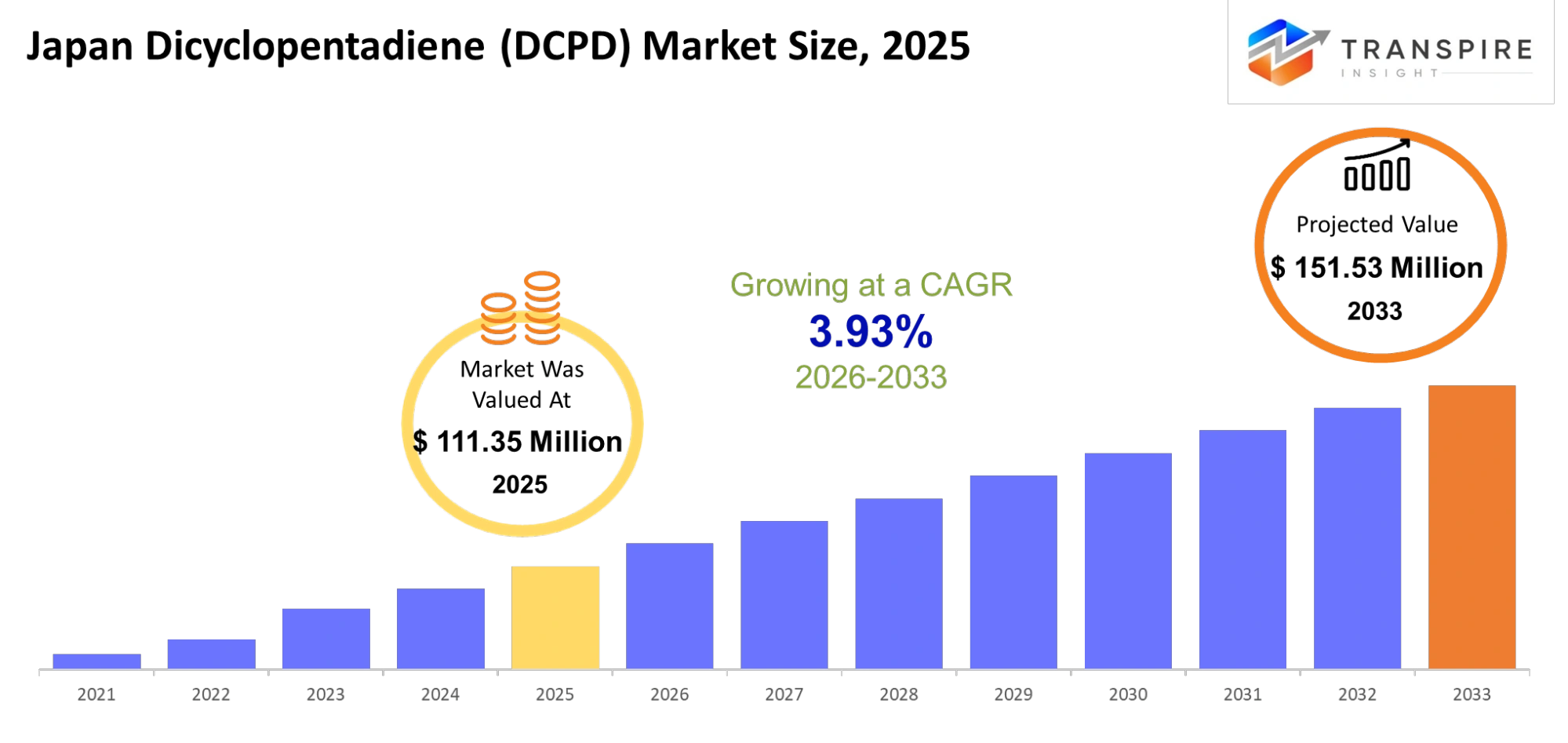
- Japan Dicyclopentadiene (DCPD) Market Size 2025: USD 111.35 Million
- Japan Dicyclopentadiene (DCPD) Market Size 2033: USD 151.53 Million
- Japan Dicyclopentadiene (DCPD) Market CAGR: 3.93%
- Japan Dicyclopentadiene (DCPD) Market Segments: By Type (High Purity DCPD, Technical Grade DCPD, Hydrogenated DCPD, Others); By Application (Resins, Polymers, Adhesives, Coatings, Elastomers, Sealants, Others); By End-User (Chemical Industry, Automotive Industry, Construction Industry, Electronics Industry, Industrial Firms, Packaging Industry, Others); By Form (Liquid, Solid, Others)
To learn more about this report,  Download Free Sample Report
Japan Dicyclopentadiene (DCPD) Market Summary
The Japan Dicyclopentadiene (DCPD) Market was valued at USD 111.35 Million in 2025. It is forecast to reach USD 151.53 Million by 2033. That is a CAGR of 3.93% over the period.
Dicyclopentadiene (DCPD) serves as an essential material for developing high-performance resins which Japanese companies use to produce lightweight automotive components and marine coatings that resist corrosion and industrial composite materials. The material enables manufacturers to create products which withstand extreme coastal conditions and industrial operations while maintaining optimal strength-to-weight performance.
The automotive and infrastructure markets have adopted poly-DCPD resins during the last five years to replace metal components with molded composite materials. The COVID-19 pandemic caused supply chain interruptions which affected petrochemical industries because of feedstock price fluctuations and stricter environmental regulations that Japan imposed on volatile organic compound emissions.
Manufacturers needed to establish local supply chains because these circumstances forced them to treat resins as valuable materials which required specialized processing. The adoption process has gained speed because electric vehicle programs use lightweight materials while marine systems need protection against corrosion, which results in more stable demand and better integration with local production networks.
Key Market Insights
- The Japan Dicyclopentadiene DCPD Market experiences growth because of increasing requirements for lightweight automotive parts and industrial resin systems that prevent corrosion.
- The market maintains ongoing structural development because domestic resin manufacturing and specialty chemical production processes increasingly adopt petrochemical resources.
- The Kanto region leads the Japan Dicyclopentadiene DCPD Market because it contains numerous automotive original equipment manufacturers and petrochemical production facilities.
- The Chubu region experiences its highest growth rate because of support from electric vehicle production centers and advanced material research initiatives.
- The Kansai region shows consistent demand from its three main industries which include coatings and adhesives and industrial manufacturing.
- The market is led by hydrocarbon resins which have strong applications in adhesives, coatings, and tire manufacturing.
- The Poly-DCPD resin segment ranks second because it has extensive applications in structural composites and automotive lightweighting solutions.
- The Japanese Dicyclopentadiene DCPD market is mostly controlled by automotive applications which exist because of electric vehicle weight reduction needs and fuel efficiency requirements.
- The fastest-growing application of marine coatings develops because coastal infrastructure needs corrosion-resistant protection.
- The construction and infrastructure sector experiences rapid expansion because durable composite materials become more widely used.
What are the Key Drivers, Restraints, and Opportunities in the Japan Dicyclopentadiene (DCPD) Market?
The Japan Dicyclopentadiene (DCPD) Market experiences its main growth from the automotive and industrial manufacturing sectors which now prefer lightweight and high-performance materials. Metal parts in electric vehicles must be substituted with DCPD-based resins and composites because of enhanced fuel efficiency regulations which automakers must follow. The resin demand increase results from a shift in manufacturing processes which Japanese companies use to achieve better weight-to-strength ratios instead of focusing on material expenses during their production process.
The market faces its main limitation because it relies on naphtha-derived petrochemical feedstocks which suffer from both crude oil price fluctuations and dependency on imported materials. DCPD producers face unpredictable costs which create operational difficulties because it affects their ability to establish long-term contracts and makes it hard to decide when to increase production capacity. The requirement for high-grade DCPD purification creates complex challenges which prevent companies from fast tracking their production processes while reducing their potential earnings even though there is strong demand from customers.
The Chubu and Kyushu regions present the most valuable opportunity through their development of EV-oriented composite manufacturing hubs. Japanese car manufacturers need thermoset resins with better thermal stability because they are establishing their own EV supply chains. ENEOS Corporation and Mitsui Chemicals invest in advanced catalytic cracking and resin-grade optimization technologies to prepare for this industrial transition. The combination of material development with EV platform manufacturing will drive the next growth stage for the Japan Dicyclopentadiene DCPD Market expansion.
What Has the Impact of Artificial Intelligence Been on the Japan Dicyclopentadiene (DCPD) Market?
The Japan Dicyclopentadiene DCPD Market experiences operational efficiency changes through artificial intelligence together with advanced digital technologies which transform petrochemical production and resin processing systems. The DCPD production facilities use AI-based control systems to manage catalytic cracking operations which results in consistent product output while decreasing energy use during the production of hydrocarbon resin materials. Exhaust gas cleaning systems and scrubber performance monitoring receive industrial automation technology which helps Japanese companies achieve better emissions control and needs fewer manual inspections.
Machine learning models are now widely applied for predictive maintenance of high-pressure reactors and separation units used in DCPD purification. These systems analyze vibration, temperature, and pressure data to forecast equipment failures, helping operators reduce unplanned downtime and extend asset life. The supply chain scheduling process receives improvements through AI-driven optimization platforms which increase efficiency in feedstock distribution while decreasing operational interruptions that occur throughout chemical production facilities.
The adoption process faces obstacles because of elevated system integration expenses together with the difficulties involved in upgrading existing petrochemical manufacturing systems. Many plants still rely on fragmented sensor systems which prevents the acquisition of complete data essential for developing precise predictive models. The existing theoretical capabilities of AI do not match its actual deployment results because the industry needs advanced digital systems yet requires more time to complete their implementation.
Key Market Trends
- Japanese automotive OEMs during the period from 2022 to 2025 transitioned their manufacturing processes away from metal-based components to DCPD composite materials which resulted in more efficient vehicle weight distribution.
- The company ENEOS Corporation established extended downstream resin operations during 2024 to secure DCPD supply which faced interruptions because of unpredictable naphtha feedstock price fluctuations.
- The development of electric vehicle platforms after 2023 created an increased need for DCPD resins which withstand high temperatures in both battery enclosures and car structural parts.
- The 2022 implementation of stricter VOC emission regulations led manufacturers to adopt DCPD processing methods which emit fewer pollutants from their petrochemical production facilities.
- Mitsui Chemicals decided to invest more resources into catalytic process improvement projects during 2025 because the company wanted to boost DCPD production output while decreasing energy consumption during manufacturing.
- Marine coating manufacturers adopted DCPD-based formulations after 2023 when corrosion failures in coastal infrastructure showed their durability limits.
- Japanese petrochemical companies started to develop local supply chains in 2021 to decrease their need for imports while handling international shipping interruptions.
- Digital monitoring systems which organizations installed in 2024 enhanced reactor stability while decreasing unexpected operational interruptions at DCPD purification facilities throughout major industrial sites.
- Automotive Tier-1 suppliers increased procurement of modified DCPD resins in 2025 to meet stricter lightweighting targets and performance benchmarks.
Japan Dicyclopentadiene (DCPD) Market Segmentation
By Type:
High Purity Dicyclopentadiene serves advanced chemical production needs because its pure form maintains consistent composition which results in stable chemical reactions and high-quality product output. Industrial operations use Technical Grade DCPD because it meets their need for economical yet dependable performance which requires less than pure product. The industry selects Hydrogenated DCPD because it enhances product stability while providing superior protection against both heat and oxidation.
Different grades of DCPD support varied industrial needs across manufacturing sectors. High Purity variants support fine chemical synthesis and specialty materials. Technical Grade remains important for bulk resin and polymer production due to balanced cost and performance. Hydrogenated forms expand usage into durable materials that need longer life and better environmental resistance.
By Application:
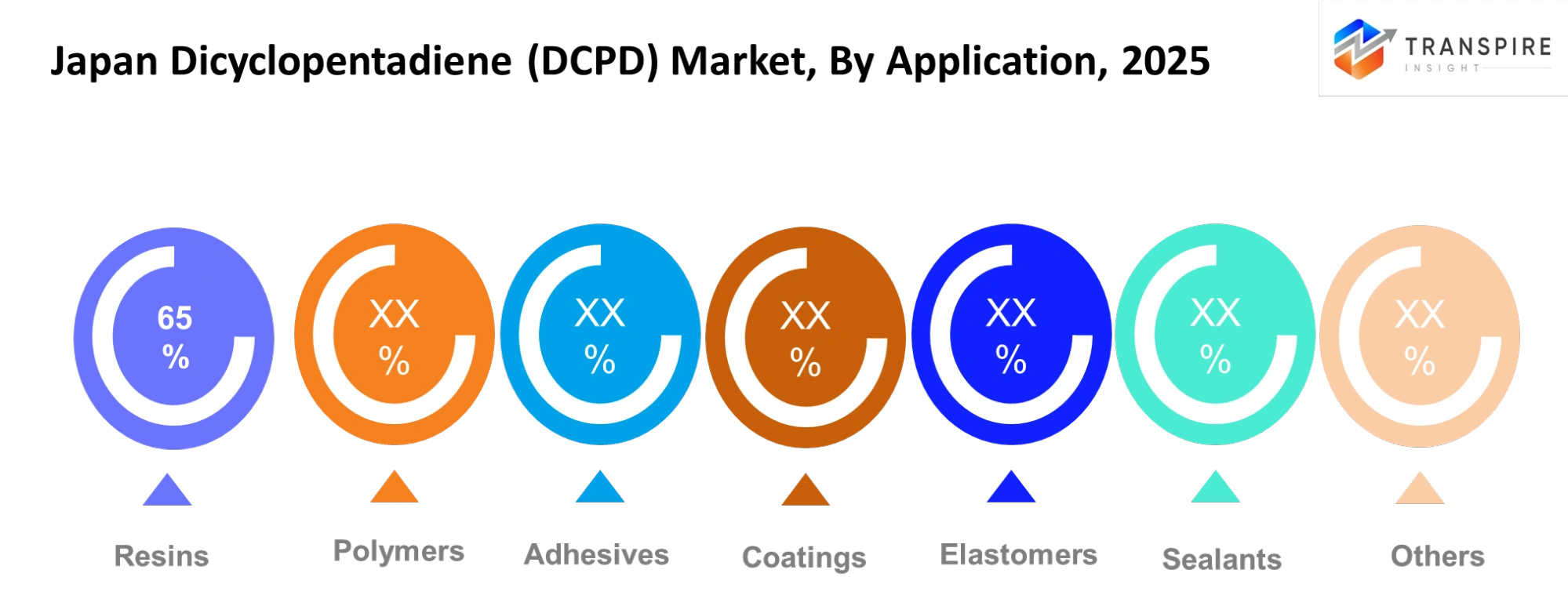
DCPD-based resins provide strong structural performance which manufacturers use for both molding and composite material production. The hardness of DCPD-based polymers increases their chemical resistance which makes them suitable for use in industrial applications. The bonding strength of adhesives improves through DCPD use while coatings receive better durability and surface protection which extends their product lifespan.
DCPD-based elastomers combine flexible properties with strong performance, which enables their use in both automotive and industrial applications. The material functions as a sealant which maintains strong sealing performance during pressure and temperature variations. DCPD functions as a specialty chemical which maintains formulation stability and boosts performance across multiple production processes.
To learn more about this report, Download Free Sample Report
By End-User:
The chemical industry uses DCPD as a base material for producing resins, intermediates, and specialty compounds. The automotive industry requires lightweight components together with coatings and adhesives because they enhance vehicle performance. The construction industry uses coatings and sealants to create infrastructure materials which offer both durability and weather resistance.
The electronics industry uses insulating materials and protective coatings to maintain device reliability. Industrial companies use DCPD-based products for both machinery components and production materials. Packaging companies use durable polymer materials which provide strong protection to their products. Other industries use DCPD to create unique chemical mixtures and performance-enhancing substances.
By Form :
Industrial processing experts prefer Liquid Dicyclopentadiene because its chemical reaction handling and blending operations require less effort to manage. The material enables organizations to execute their resin and polymer production processes without interruptions. The liquid state enables ongoing processing operations which require continuous material movement and precise chemical reaction management to produce uniform product quality.
DCPD enters solid form for use in situations which require both storage stability and precise melting control. The product enables customers to transport it safely while it maintains its quality for an extended period when stored in suitable environmental conditions. The production process starts with solid material, which transforms into liquid during processing times, this method enables manufacturers to produce different products while protecting material properties that will be used in final products.
What are the Key Use Cases Driving the Japan Dicyclopentadiene (DCPD) Market?
The main application of Dicyclopentadiene exists in the automotive industry which uses DCPD-based resins for manufacturing bumpers and structural panels and electric vehicle battery housings. The demand for this product results from two main factors which include fuel efficiency regulations and the need for lightweight materials in electric vehicle production.
Industrial adhesives and marine coatings find new uses through expansion into the construction and shipbuilding industries. Coastal engineering and infrastructure construction companies now use DCPD resins to enhance their materials for protecting against corrosion damage which occurs in areas with high humidity and saltwater exposure.
New applications are being developed for wind energy composite materials and electronic encapsulation products that require high performance. Japanese material suppliers are testing DCPD formulations for turbine blade durability and thermal stability in electronics through their research work which benefits from increasing renewable energy investments and growing demand for miniaturized electronic devices.
|
Report Metrics |
Details |
|
Market size value in 2025 |
USD 111.35 Million |
|
Market size value in 2026 |
USD 115.73 Million |
|
Revenue forecast in 2033 |
USD 151.53 Million |
|
Growth rate |
CAGR of 3.93% from 2026 to 2033 |
|
Base year |
2025 |
|
Historical data |
2021 - 2024 |
|
Forecast period |
2026 - 2033 |
|
Report coverage |
Revenue forecast, competitive landscape, growth factors, and trends |
|
Country scope |
Japan |
|
Key company profiled |
ExxonMobil, Shell, Chevron Phillips, Dow, LyondellBasell, Braskem, Zeon Corporation, JSR Corporation, Mitsui Chemicals, Maruzen Petrochemical, Kolon Industries, ENEOS, Sinopec, Formosa Plastics, LG Chem |
|
Customization scope |
Free report customization (country, regional & segment scope). Avail customized purchase options to meet your exact research needs. |
|
Report Segmentation |
By Type (High Purity DCPD, Technical Grade DCPD, Hydrogenated DCPD, Others); By Application (Resins, Polymers, Adhesives, Coatings, Elastomers, Sealants, Others); By End-User (Chemical Industry, Automotive Industry, Construction Industry, Electronics Industry, Industrial Firms, Packaging Industry, Others); By Form (Liquid, Solid, Others) |
Which Regions are Driving the Japan Dicyclopentadiene (DCPD) Market Growth?
The Dicyclopentadiene market in Japan shows the Kanto region as its leading area because of its high number of petrochemical facilities and automotive original equipment manufacturers and advanced materials production plants. Yokohama and Chiba port facilities provide strong infrastructure which enables fast naphtha feedstock import and direct DCPD derivative distribution. The integrated refining and resin production systems enable continuous material delivery and large-scale manufacturing operations. Industrial facilities adopt high-purity DCPD products because strict environmental regulations control their operations.
The Chubu region maintains its steady contribution to industrial production while developing multiple core industries instead of focusing on petroleum-based manufacturing. The manufacturing sector in Nagoya generates ongoing needs which benefit automotive suppliers and machinery manufacturing businesses. Chubu customers depend on permanent domestic contracts and strong Tier-1 supplier partnerships whereas Kanto customers choose export-based business models. The supply networks connected to Toyota show consistent investment patterns which create stable demand for their products throughout different market cycles.
Kyushu region has become the most rapidly expanding area because new electric vehicle supply chains and government semiconductor and advanced materials projects established their funding base in 2023. The Fukuoka and Kitakyushu areas developed new industrial parks and port facilities which enhanced their ability to obtain raw materials. This new direction caused chemical manufacturers to build DCPD resin production facilities near their target industrial markets. Kyushu offers investors a strategic entrance point which enables them to capture developing market needs for electric vehicle production and next-generation composite materials between 2026 and 2033.
Who are the Key Players in the Japan Dicyclopentadiene (DCPD) Market and How Do They Compete?
The Japan Dicyclopentadiene market shows a moderate level of competition because only a few petrochemical companies and specialty chemical manufacturers control most of the market. The industry competes through feedstock security and process efficiency and downstream resin innovation which goes beyond price competition. Companies that already operate in the market achieve competitive advantages through their refinery operations and their contracts with automotive and industrial companies. The process of entering the market faces obstacles because DCPD production needs expensive equipment and strict standards for purifying high-quality DCPD.
ENEOS Corporation strengthens its position through vertical integration across refining and petrochemical operations which provides them with continuous naphtha supply and maintains their DCPD production levels. Mitsui Chemicals develops new catalytic processes and advanced resin technology to create lightweight materials for electric vehicles and high-performance composite products. ZEON Corporation uses its knowledge of specialty polymers to provide modified DCPD resins which meet the needs of adhesive and electronic material applications while they build new partnerships with automotive Tier-1 suppliers.
Maruzen Petrochemical achieves market competitiveness because it runs a cost-efficient refinery system and maintains an efficient domestic distribution network that connects to main industrial centers. Tokyo Chemical Industry (TCI) operates in a niche segment because it provides research institutions and specialized markets with high-purity DCPD which they produce through their flexible manufacturing system and their ability to export products. The companies expand their operations through partnerships which contribute to their capacity development but they do not pursue global expansion through major acquisitions.
Company List
- ExxonMobil
- Shell
- Chevron Phillips
- Dow
- LyondellBasell
- Braskem
- Zeon Corporation
- JSR Corporation
- Mitsui Chemicals
- Maruzen Petrochemical
- Kolon Industries
- ENEOS
- Sinopec
- Formosa Plastics
- LG Chem
Recent Development News
In April 2026, Mitsui Chemicals, Idemitsu Kosan, and Sumitomo Chemical also confirmed unconditional antitrust clearance from Japan’s Fair Trade Commission for their planned joint venture restructuring under Prime Polymer. The approval removes the final domestic regulatory barrier for the April 2026 integration, enabling a more consolidated production structure that is expected to stabilize upstream petrochemical intermediates, including DCPD-linked derivatives used in resins and advanced materials.Source https://www.mlex.com/
In December 2025 (effective restructuring in 2026), Sumitomo Chemical and Prime Polymer finalized a business integration agreement transferring Sumitomo’s domestic PP and LLDPE operations into the Prime Polymer joint venture. The restructuring, implemented in stages through 2026, reshapes Japan’s olefin and downstream resin production base, indirectly influencing demand stability for petrochemical intermediates such as DCPD used in specialty resins, composites, and coatings. Source https://www.sumitomo-chem.co.jp/
What Strategic Insights Define the Future of the Japan Dicyclopentadiene (DCPD) Market?
Over the next 5–7 years, the Japan Dicyclopentadiene (DCPD) Market is structurally shifting. The urgent need for customized high-performance resins has emerged because electric vehicle platforms require redesign and industrial decarbonization efforts. The growth of production will depend on how producers achieve their goals for producing DCPD derivatives which meet requirements for lightweight materials and thermal protection and product lifespan. The system now operates through engineered material integration which creates value for both automotive manufacturers and infrastructure development programs.
DCPD supply chains face less visible danger from upstream petrochemical concentration because their production process relies on naphtha cracking which leads to DCPD supply chain vulnerabilities through refining margin compression dangers and Japanese refinery capacity reductions. Strong downstream demand periods will still lead to supply shortages because of this.
The establishment of electric vehicle composite material production centers in Kyushu and Chubu presents a new business opportunity because government industrial clusters support the development of advanced polymer technology. The market currently exhibits initial demand for modified DCPD resins which will be used in battery enclosures and structural composites. Market participants should establish co-development partnerships with EV manufacturers while creating specialty-grade production capabilities to achieve financial benefits from rising product complexity instead of competing through volume production.
Japan Dicyclopentadiene (DCPD) Market Report Segmentation
By Type
- High Purity DCPD
- Technical Grade DCPD
- Hydrogenated DCPD
By Application
- Resins
- Polymers
- Adhesives
- Coatings
- Elastomers
- Sealants
By End-User
- Chemical Industry
- Automotive Industry
- Construction Industry
- Electronics Industry
- Industrial Firms
- Packaging Industry
By Form
- Liquid
- Solid
Frequently Asked Questions
Find quick answers to common questions.
The Japan Dicyclopentadiene (DCPD) Market size is USD 151.53 Million in 2033.
Key segments for the Japan Dicyclopentadiene (DCPD) Market are By Type (High Purity DCPD, Technical Grade DCPD, Hydrogenated DCPD, Others); By Application (Resins, Polymers, Adhesives, Coatings, Elastomers, Sealants, Others); By End-User (Chemical Industry, Automotive Industry, Construction Industry, Electronics Industry, Industrial Firms, Packaging Industry, Others); By Form (Liquid, Solid, Others).
Major Japan Dicyclopentadiene (DCPD) Market players are ExxonMobil, Shell, Chevron Phillips, Dow, LyondellBasell, Braskem, Zeon Corporation, JSR Corporation, Mitsui Chemicals, Maruzen Petrochemical, Kolon Industries, ENEOS, Sinopec, Formosa Plastics, LG Chem.
The Japan Dicyclopentadiene (DCPD) Market size is USD 111.35 Million in 2025.
The Japan Dicyclopentadiene (DCPD) Market CAGR is 3.93% from 2026 to 2033.
- ExxonMobil
- Shell
- Chevron Phillips
- Dow
- LyondellBasell
- Braskem
- Zeon Corporation
- JSR Corporation
- Mitsui Chemicals
- Maruzen Petrochemical
- Kolon Industries
- ENEOS
- Sinopec
- Formosa Plastics
- LG Chem
Recently Published Reports
-
Apr 2026
Healthcare Polymer Packaging Market
Healthcare Polymer Packaging Market Size, Share & Analysis Report By Packaging Type (Syringes, IV Bottles and Pouches, Clamshells, Blisters, Bottles & Jars, Containers, Tubes, IV Parental Packaging, Others), By Type (Regulated, Non-regulated), By Polymer Type (LDPE (Low-Density Polyethylene), HDPE (High-Density Polyethylene), Homo-polymer (Homo), Random Copolymer (Random), Block Copolymer (Block), PET, Polystyrene, Polyvinyl Chloride, Polyamide/EVOH, Others), and Geography (North America, Europe, Asia-Pacific, Middle East and Africa, South and Central America), 2021 - 2031
-
Apr 2026
Hydrophilic Tape (Waterstop) Market
Hydrophilic Tape (Waterstop) Market Size, Share & Analysis Report By Type (Bentonite-Based Hydrophilic Tape, Rubber-Based Hydrophilic Tape), By Application (Residential Buildings, Commercial Buildings, Infrastructure Projects), and Geography (North America, Europe, Asia-Pacific, Middle East and Africa, South and Central America), 2021 - 2031
-
Apr 2026
Metalens Market
Metalens Market Size, Share & Analysis Report By Type (Visible Light Metalens, and Infrared Metalens), By Application (Consumer Electronics, Automotive Electronics, Industrial, Medical, and Others), and Geography (North America, Europe, Asia-Pacific, Middle East and Africa, South and Central America), 2021 - 2031
-
Apr 2026
PBT Resin Market
PBT Resin Market Size, Share & Analysis Report By Type (Reinforced PBT Resin, Unreinforced PBT Resin), By Processing Method (Injection Molding, Extrusion, Blow Molding, Others), By End-User (Automotive, Electrical & Electronics, Consumer Appliances, Industrial Machinery, Medical Devices, Packaging, Others), and Geography (North America, Europe, Asia-Pacific, Middle East and Africa, South and Central America), 2021 - 2031