

Europe Virtual Networking Market Summary
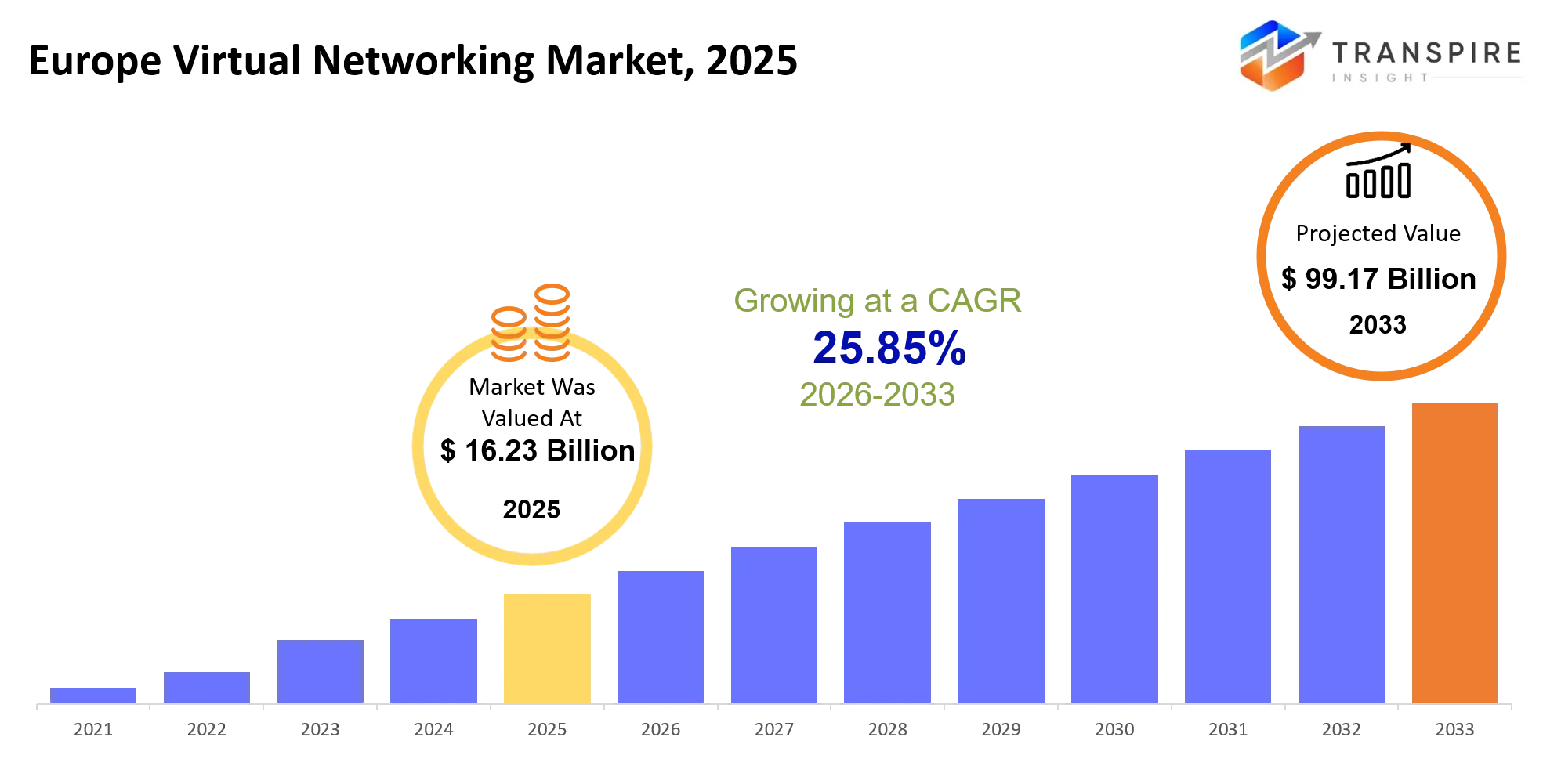
As per Transpire Insight Analysis the Europe Virtual Networking Market size is estimated at USD 16.23 Billion in 2025 and is anticipated to reach USD 99.17 Billion by 2033, growing at a CAGR of 25.85% from 2026 to 2033.
European companies link people, apps, cloud services, branch locations, and shared data areas using virtual network setups. They are not limited to one type of fixed network hardware. A lot of groups now use software-defined networking and private virtual networks. Some also choose SD-WAN and network function virtualization. Many of them add cloud security tools alongside these choices. With this setup, IT groups can get links in place sooner. It also helps them run distant sites from a single dashboard.
In the last few years, the trend has moved again. More firms now pick cloud-managed options and architectures built in software. Hybrid work played a role in that. The move also picked up as businesses began running more than one cloud at once. At the same time, online attacks increased. New and tougher rules in Europe led firms to place access controls in one central area. Later, NIS2 added more obligations for service providers, and it paid closer attention to how they deal with cyber risk.
Europe Virtual Networking Market Size & Forecast:
- Europe Virtual Networking Market Size 2025: USD 16.23 Billion
- Expected Market Value 2033: USD 99.17 Billion
- Forecast CAGR: 25.85%
- Leading region in 2025:Western Europe
- Fastest Growing region:Central & Eastern Europe
- Key Profile: Cisco Systems, VMware, Microsoft, IBM, Juniper Networks, HPE, Nokia, Ericsson, Huawei, Arista Networks, Fortinet, Palo Alto Networks, Versa Networks, Ciena, Zscaler
Key Market Insights
- Market size: In 2025, the sector is said to be worth USD 16.23 billion. By 2033, it is expected to grow to USD 99.17 billion.
- Cloud transition: More firms in Europe are moving away from equipment-heavy network setups. They are shifting to cloud-managed networking. This is linked with quicker rollout and easier central control.
- Connectivity modernization: SD-WAN use is rising. Enterprises are bringing together branch sites, cloud apps, staff working remotely, and more than one network provider.
- Regional leadership: Western Europe leads the picture, especially Germany, the UK, and France. A clear percentage by country was not included in the source.
- Fastest expansion: Central and Eastern Europe looks like the quickest growth area. Companies there are upgrading links and shifting toward cloud-based IT.
- Edge computing: Edge-node deployments went up a lot. The figure went from 498 in 2022 to roughly 1,836 in 2024. That change raises the need to run and watch networks across many sites.
- Cloud use also kept climbing. In 2023, 45.2% of business users in the EU used cloud services. This is up by 4.2 points from 2021. More companies are also asking for virtual network options.
- Security rules have tightened too. NIS2 has pushed cybersecurity expectations higher. This lands on digital infrastructure and on ICT providers. Because of that, network staff and security staff are often expected to team up more closely.
- At the same time, the stack is shifting. SD-WAN, SASE, Zero Trust, network virtualization, and cloud-native security are being set up together. They are not treated as fully separate layers anymore.
- For money and planning, EU member states pointed to 1,910 Digital Decade actions. The stated total was €288.6 billion. The intent is to expand work on digital infrastructure and move technology forward.
What are the Key Drivers, Restraints, and Opportunities in the Europe Virtual Networking Market?
Cloud migration and distributed company networks are pushing growth. In Europe, more firms now place apps in several places at once. That can mean private data centers, public cloud services, office sites, and edge locations. Because of that mix, older networking built around specific hardware is harder to manage each day. In 2023, EU company cloud use reached 45.2%. Between 2022 and 2024, deployment of edge nodes also rose fast. Virtual networking can help by building links from one place, using code to define routes, and leaning on software-based network functions. On top of this, NIS2 adds extra pressure. It lifts security expectations for digital services and for ICT providers.
Older systems still get in the way. Big firms often cannot switch networks quickly. A fast move can break or slow core services. Upgrading to newer designs also takes time and effort. It is not like swapping one tool for another. Teams need checks that different parts can work together. They also need staff who know the setup and security reviews before launch. Money is another issue. Modernizing costs more than many teams plan for. Europe also has a smaller pool of advanced ICT specialists than it needs. That staffing gap can delay projects and raise total spend.
Federated cloud-edge networking is being seen as the next move. The EURO-3C program, funded with €75 million and planned for 2026, looks to build a bigger federated telco-edge-cloud model. It points to Europe trying to connect links between network access, cloud services, and edge sites. With that foundation, vendors may have space to offer programmable networking. They can also bring safer edge links, orchestration support, and products designed to work together.
What Has the Impact of Artificial Intelligence Been on the Europe Virtual Networking Market?
AI is reshaping how networks are run. Cloud managed instead of watching everything by hand, teams can use automation for spotting issues, estimating what might happen next, and tuning settings. Many network tools now rely on machine learning to flag odd traffic behavior, spot likely security events, estimate future capacity needs, and route attention to important application flows. With AI in the loop, operators can also cut down on repetitive tasks. It can suggest configuration edits, point out where performance slows, and help trigger responses during incidents across large, split networks. This matters more when companies use hybrid cloud, multiple clouds, remote access, and edge sites, since these setups produce a lot of telemetry.
Using predictive methods, networks can spot strange latency, packet loss, congestion, or device odd patterns before business apps feel it. AI can also help with smarter routing and workload tuning, so available bandwidth is used in a more efficient way. That can lower the chance of paying for extra infrastructure that is not needed. Support for this shift also appears in the wider European tech scene. The European Commission said AI use by EU firms rose 48% in 2025 from the prior year.Still, there is a big roadblock. Training data for network tasks must be good and easy to access. Telemetry is often scattered across different vendors and systems. At the same time, traffic logs can raise privacy and security risks. These issues can lower model accuracy and make rollout slower, especially when networks are made of many vendor parts.
Key Market Trends
- Since 2021, more firms across Europe have shifted toward cloud networking. Hybrid setups and multi-cloud plans are now common.
- In 2023, 45.2% of EU businesses used cloud services. That figure pushed demand for virtual links that can cover work spread across sites.
- At the edge, the picture changed fast. Node count rose from 498 in 2022 to around 1,836 in 2024. This raised the bar for how networks are coordinated across many locations.
- NIS2 work starting in 2024 also changed decisions. Teams now look at how they connect systems, how they watch traffic, how they control access, and how they handle cyber risk.
- SD-WAN is no longer only for connecting branches. Many groups now fold it into SASE style designs. These cover cloud apps, staff working remotely, and rules aligned with Zero Trust.
- Across Europe, AI use picked up in 2025. That trend opened the door to better network checks that can predict issues. It also supported automation to tune infrastructure without as much manual work.
- EU plans are placing more weight on self control over tech. They also stress safe cloud systems, edge computing, and less reliance on outside vendors.
- Network suppliers now market joined systems, not lone parts. The packages often tie SD-WAN with security features, cloud links, and monitoring data.
- Spending is moving toward designs that cut delay. Companies are putting more apps closer to people by using edge compute.
- Many current infrastructure efforts now stress more than speed. They also call out working well together, staying up in disruptions, protecting data, and using less energy.
Europe Virtual Networking Market Segmentation
By Transportation Mode
The transportation list does not fit a virtual networking market. Virtual networking does not break demand down by physical shipping. Because of that, using transport-mode slices in a networking report would point to the wrong signals. It should not be the main way to define the market.Road Freight, Rail Freight, Air Freight, Sea Freight, Inland Waterways, Pipeline Transport, Multimodal Transport, and Last-Mile Delivery are logistics labels. They describe how goods move. They are not the same thing as networking technology categories.
Those transport labels might matter later. They would matter when you study what connectivity tools logistics firms use. Even then, they are not a direct way to measure the virtual networking market.A better approach is to sort virtual networking by how the system is built and sold. You can group it by networking architecture, how it is deployed, what role the connectivity serves, what security features it includes, or which kind of business uses it.If you swap transport categories for tech-based segmentation, the study should match real buying choices more closely. That change should make the findings more reliable.
By Service Type
The service labels shown are tied to logistics work. They fit freight and shipping tasks, not virtual network offerings. Freight Forwarding, Warehousing, Distribution, Transportation Management, Customs Brokerage, Inventory Management, Cold Chain Logistics, and Reverse Logistics do not map well to virtual network services.
Virtual network firms usually create value with software based connectivity. They also focus on network control, security links, cloud connections, and setup of network infrastructure. If these logistics categories stay in place, the split between segments would not match the market view. It could also push revenue numbers into the wrong buckets.A better set of service groups would be managed networking, SD-WAN, virtual private networking, network virtualization, cloud networking, network security, and network monitoring. This layout should make it easier to see how vendors earn money. It should also reflect how enterprises buy these solutions.
By Cargo Type
The terms General Cargo, Bulk Cargo, Perishable Goods, Pharmaceuticals, Automotive Parts, Consumer Goods, Chemicals, and E-Commerce Parcels describe cargo categories. These labels alone do not determine virtual networking revenue. A single cargo category can influence what level of connectivity a firm wants. Even then, that effect is usually minor. It is not the main way to divide the market.
Most spending on virtual networking comes from other drivers. For example, firms plan their network setup in specific ways. They also list which apps must work. Security rules matter a lot. So do user and site locations. Cloud use can also shape the final decision.
Look at pharma and e-commerce companies. They often want links that stay stable with few outages. But their buying choice still turns on uptime and security. The cargo label does not guide the decision. So, a study that focuses on technology should not rely on cargo based segmentation. Use groups tied to application demands instead. Or use segments that match industry needs in a broader way.
By Technology
Transportation Management Systems, Warehouse Management Systems, GPS Tracking, IoT, AI Analytics, Robotics, RFID, and Blockchain are logistics tools. They are not the same as tools for virtual networking.
That said, IoT and AI Analytics can change what network needs look like. Many connected devices send lots of data. They often need fast links and low delay. Still, the systems listed for logistics do not fit as direct virtual networking classes.
A better way to group the technologies is to include SD-WAN. Also include network functions virtualization. Add virtual private networks, SASE, cloud networking, software-defined networking, network virtualization, and AI-assisted network management.These groups point to the technologies that drive demand and spend in enterprise networking.
By End User
Manufacturing, retail, e-commerce, automotive, food and beverage, healthcare, chemicals, and construction can all be used as industry groups when you study enterprise network adoption.
In manufacturing, teams need steady links between sites, cloud services, industrial sensors, and internal business systems. Retail and e-commerce lean on many branch locations, online services, and payment and transaction security.Automotive firms must move data across plants, supplier sites, engineering groups, and production tools that are now more connected. Healthcare has a different focus, mainly safe access and trustworthy sharing of data.
Chemicals and construction also face the reality of spread out locations, plus more work with remote operations. Food and beverage teams use digital tools in production, shipping, and in-store retail networks.How fast an organization adopts depends a lot on where the sites are, what runs in the cloud, the role of operational technology, the security bar, and how much they want one place to manage the network.
By Region
Germany, the UK, France, Italy, Spain, the Netherlands, Belgium, and Poland can be helpful for a regional view. Germany has a big industrial base and firms spend a lot on enterprise tech. The UK shows steady take up in cloud, finance, technology, and managed infrastructure. France leans on enterprise digitization and tech work in government programs. Italy and Spain look like solid options too, since companies are updating their core systems. The Netherlands and Belgium also stand out, mainly because of data centers, fast connectivity, and links to international firms. Poland adds more room to grow as digital infrastructure is built out and enterprises modernize.
The source figures did not include country market shares. Because of that, it would not be right to attach any guessed percentages to specific countries. European Commission updates also point to ongoing spending for connectivity, cloud edge systems, cyber defense, and broader business digitization.
What are the Key Use Cases Driving the Europe Virtual Networking Market?
A key use case is safe connectivity for companies that run operations across many sites. Teams rely on virtual networking to link branch locations, workers who connect from home, apps hosted in the cloud, and data centers. This avoids having to lay down new cabling and hardware for each link. Tools such as SD-WAN and cloud-managed networking also cut down setup work. At the same time, they give teams a clearer view of what is happening across the network. Because of this, many distributed company environments are driving adoption.
Cloud app links and protected remote access are growing as hybrid work becomes more common. Multi-cloud setups also push this trend forward. In manufacturing, connectivity helps connect shop floors to cloud services. In finance, retail, healthcare, and consulting, firms need tight access rules for business apps across several sites. NIS2 rules add more pressure to watch the network more closely and enforce stronger security checks for organizations in scope.
New areas are starting to appear too. These include edge computing, plus network tuning that uses AI. Another focus is federated setups that tie telco edge and cloud together. The European Commission wants 10,000 secure, climate-neutral edge nodes by 2030. The EURO-3C project also shows that more funding is going into telecom, edge, and cloud infrastructure working together.
|
Report Metrics |
Details |
|
Market size value in 2025 |
USD 16.23 Billion |
|
Market size value in 2026 |
USD 20.42 Billion |
|
Revenue forecast in 2033 |
USD 99.17 Billion |
|
Growth rate |
CAGR of 25.85% from 2026 to 2033 |
|
Base year |
2025 |
|
Historical data |
2021 - 2024 |
|
Forecast period |
2026 - 2033 |
|
Report coverage |
Revenue forecast, competitive landscape, growth factors, and trends |
|
Regional scope |
Europe |
|
Key company profiled |
Cisco Systems, VMware, Microsoft, IBM, Juniper Networks, HPE, Nokia, Ericsson, Huawei, Arista Networks, Fortinet, Palo Alto Networks, Versa Networks, Ciena, Zscaler |
|
Customization scope |
Free report customization (country, regional & segment scope). Avail customized purchase options to meet your exact research needs. |
|
Report Segmentation |
By Type (Virtual Private Networking, Software-Defined Networking, Network Virtualization, Virtual Network Functions, Cloud Networking, Network-as-a-Service, Virtual LAN, Virtual WAN); By Component (Software, Hardware, Network Services, Virtual Routers, Virtual Switches, Network Controllers, Security Appliances, Management Platforms); By Deployment (Cloud-Based, On-Premise, Hybrid, Public Cloud, Private Cloud, Multi-Cloud, Edge-Based, Hosted); By Application (Enterprise Networking, Data Centers, Remote Access, Cloud Connectivity, Branch Networking, IoT Networking, Cybersecurity, Digital Collaboration); By End User (BFSI, IT & Telecom, Healthcare, Manufacturing, Retail, Government, Education, Media & Entertainment); By Region (UK, Germany, France, Netherlands, Spain, Italy, Sweden, Switzerland) |
Which Regions are Driving the Europe Virtual Networking Market Growth?
Western Europe leads the way. Germany, the UK, and France bring the most support for enterprise networking. Germany has a big manufacturing base, so it keeps pushing reliable network needs. The UK leans on finance and related services, plus steady uptake of cloud tools. France is also active, with more work in government tech and spending on AI. It also invests in faster and better connectivity. There are many data centres in the area, along with telecom firms and cloud players. Add in tech vendors and trained IT staff, and the groundwork for virtual networking is already in place.
The markets in Northern and Western Europe tend to be steadier. Newer adoption regions do not look as consistent for revenue. The Netherlands and Belgium have strong exchange links and a high level of data-centre work. They also act as major connection points for Europe. The UK keeps enterprise tech spend at a fairly even pace. Rules for rollout and security also push firms to update their network design. Many firms feel they must upgrade instead of waiting. Because of that, demand can hold up even when company budgets move around.
Central and Eastern Europe looks like the quicker growth area from 2026 to 2033. Poland is a key example. Many firms there are growing cloud setups, adding data-centre space, and building more digital services. Broader EU spending helps too, especially where connectivity and network upgrades are still catching up. For vendors, there is room to join in stages. They can offer managed SD-WAN, cloud networking support, security services, and edge options. This lets them enter without having to swap every old system all at once.
Who are the Key Players in the Europe Virtual Networking Market and How Do They Compete?
Big vendors still dominate networking, cloud, security, and core infrastructure. Even so, smaller specialists keep pushing in with software-first offerings. The focus is shifting too. Buyers care less about unit price on hardware. They want bundled features that work together. That means SD-WAN, SASE, cloud links, security tools, observability, and automation. Many buyers also prefer to do it all through fewer management systems. Cisco, Microsoft, Broadcom’s VMware group, Juniper, and HPE go after this by pairing wide tech sets with strong partner networks and support for enterprises.
Cisco is moving ahead with network gear that is ready for AI, plus security and observability. Its Cisco 360 Partner Program also adds more room for specialist partners. Microsoft leans on Azure connectivity and its large cloud reach. In practice, network services slot into larger cloud rollouts. Broadcom promotes VMware Cloud Foundation as a private cloud choice, and it brings networking and security into the mix for virtual workloads.
Juniper highlights AI-assisted network work and infrastructure that can be run by cloud tools. Hewlett Packard Enterprise pairs its networking with edge and hybrid-cloud systems. All of this points to a wider stack approach. Vendors try to keep accounts by tying networking, security, cloud, and automation together under one management layer. What matters next will be migration help, work between different systems, AI features, and the skill to run it all at scale
Company List
- Cisco Systems
- VMware (Broadcom)
- Microsoft
- IBM
- Juniper Networks (HPE)
- Hewlett Packard Enterprise (HPE)
- Nokia
- Ericsson
- Huawei
- Arista Networks
- Fortinet
- Palo Alto Networks
- Versa Networks
- Ciena
- Zscaler
Recent Development News
"In January 2026, Cisco launched the Cisco 360 Partner Program. The program introduced new partner designations and resources across networking, cloud and AI, security, collaboration, Splunk, and services, strengthening Cisco's partner-led expansion in enterprise infrastructure.https://newsroom.cisco.com/c/r/newsroom/en/us/a/y2026/m01/cisco-launches-new-cisco-360-partner-program-built-with-partners-for-the-ai-era.html
"In February 2026, Cisco launched new AI-era networking and security innovations. The portfolio included AgenticOps capabilities, AI traffic optimization for SASE, and new Cisco Silicon One technology, strengthening the company's position in AI-ready network infrastructure.https://newsroom.cisco.com/c/r/newsroom/en/us/a/y2026/m02/cisco-launches-breakthrough-innovations-for-the-ai-era.html
"In March 2026, Broadcom announced the 2026 VMware Explore program focused on modern private cloud. The program included technical training and partner enablement across VMware Cloud Foundation, with European events planned for Frankfurt and London, supporting wider private-cloud adoption.xhttps://www.broadcom.com/company/news/product-releases/64086
What Strategic Insights Define the Future of the Europe Virtual Networking Market?
Across Europe, virtual networking is shifting. More firms are leaning on software-defined setups. Many also want cloud links. Security is getting built in earlier. This happens as apps spread across private clouds, public clouds, branch sites, and edge areas.
There is another problem that is easy to miss. If too many teams buy from the same vendor, they can get locked in. That can hurt the ability to mix products later. It can also make it hard to switch later. This gets worse when networking, security, and cloud tools are sold as one stack.Workforce is also a risk. New virtual systems need people who can handle more than one layer. They must deal with networking, cybersecurity, cloud design, and automation at the same time.At the same time, there is a chance to build federated telco edge to cloud setups. In Europe, some efforts aim to tie telecom networks to distributed computing. The EURO-3C effort, funded at €75 million and announced in 2026, points to that path.
For market players, the focus should stay on systems that can work together. Regional tech partnerships matter too. AI help in day to day management may be useful. Still, it is wise to avoid heavy reliance on one vendor’s ecosystem.
Europe Virtual Networking Market Report Segmentation
By Transportation Mode
- Road Freight
- Rail Freight
- Air Freight
- Sea Freight
- Inland Waterways
- Pipeline Transport
- Multimodal Transport
- Last-Mile Delivery
By Service Type
- Freight Forwarding
- Warehousing
- Distribution
- Transportation Management
- Customs Brokerage
- Inventory Management
- Cold Chain Logistics
- Reverse Logistics
By Cargo Type
- General Cargo
- Bulk Cargo
- Perishable Goods
- Pharmaceuticals
- Automotive Parts
- Consumer Goods
- Chemicals
- E-Commerce Parcels
By Technology
- Transportation Management Systems
- Warehouse Management Systems
- GPS Tracking
- IoT
- AI Analytics
- Robotics
- RFID
- Blockchain
By End User
- Manufacturing
- Retail
- E-Commerce
- Automotive
- Food & Beverage
- Healthcare
- Chemicals
- Construction
By Region
- Germany
- UK
- France
- Italy
- Spain
- Netherlands
- Belgium
- Poland
Frequently Asked Questions
Find quick answers to common questions.
The expected Europe Virtual Networking Market size for the market will be USD 99.17 Billion in 2033.
Key segments for the Europe Virtual Networking Market are By Type (Virtual Private Networking, Software-Defined Networking, Network Virtualization, Virtual Network Functions, Cloud Networking, Network-as-a-Service, Virtual LAN, Virtual WAN); By Component (Software, Hardware, Network Services, Virtual Routers, Virtual Switches, Network Controllers, Security Appliances, Management Platforms); By Deployment (Cloud-Based, On-Premise, Hybrid, Public Cloud, Private Cloud, Multi-Cloud, Edge-Based, Hosted); By Application (Enterprise Networking, Data Centers, Remote Access, Cloud Connectivity, Branch Networking, IoT Networking, Cybersecurity, Digital Collaboration); By End User (BFSI, IT & Telecom, Healthcare, Manufacturing, Retail, Government, Education, Media & Entertainment); By Region (UK, Germany, France, Netherlands, Spain, Italy, Sweden, Switzerland)
Major Europe Virtual Networking Market players are Cisco Systems, VMware, Microsoft, IBM, Juniper Networks, HPE, Nokia, Ericsson, Huawei, Arista Networks, Fortinet, Palo Alto Networks, Versa Networks, Ciena, Zscaler
The Europe Virtual Networking Market size is USD 16.23 Billion in 2025.
The Europe Virtual Networking Market CAGR is 25.85% from 2026 to 2033.
- Cisco Systems
- VMware (Broadcom)
- Microsoft
- IBM
- Juniper Networks (HPE)
- Hewlett Packard Enterprise (HPE)
- Nokia
- Ericsson
- Huawei
- Arista Networks
- Fortinet
- Palo Alto Networks
- Versa Networks
- Ciena
- Zscaler
About the Authors

Mayur Shinde
I am Mayur Shinde, a Senior Research Analyst at Transpire Insight, specializing in the Automotive & Transportation and Information & Communication Technology (ICT) Industry. My work focuses on analyzing emerging market trends, technological advancements, competitive landscapes, and industry developments to deliver accurate, data-driven insights. I am passionate about transforming complex market information into clear, actionable content that helps businesses, professionals, and decision-makers stay informed and make confident strategic decisions.

Chakradhar Khansole
Chakradhar serves as the Research Director at Transpire Insight, bringing over 8 years of experience in technology, innovation, and strategic market intelligence. He specializes in transforming complex market data into actionable business insights that enable organizations to make informed, growth-oriented decisions. Recognized for his strategic vision and analytical expertise, Chakradhar leads high-impact research initiatives, delivering comprehensive market assessments, competitive intelligence, and forward-looking industry analysis.
Recently Published Reports
-
Apr 2026
3D Optical Profiler Market
3D Optical Profiler Market Size, Share & Analysis Report By Type (Desktop 3D Optical Profiler, and Portable 3D Optical Profiler), By Technology (Confocal Technology, and White Light Interference), By End-Use Industry (Manufacturing, Research Institutions, Automotive, Aerospace and Defense, Medical Devices, and Other), and Geography (North America, Europe, Asia-Pacific, Middle East and Africa, South and Central America), 2021 - 2031
-
Apr 2026
Depth Sensor Market
Depth Sensor Market Size, Share & Analysis Report By Type (Infrared Depth Sensors, Time-of-Flight (ToF) Sensors, Stereo Vision Sensors, Structured Light Sensors, Ultrasonic Depth Sensors), By Application (Automotive, Robotics, Gaming, Consumer Electronics, Industrial Automation, Healthcare, Security & Surveillance, Others), By End Users (Automotive Manufacturers, Consumer Electronics Companies, Healthcare Providers, Industrial Companies, Security Agencies, Gaming Companies, Robotics Companies, Others), and Geography (North America, Europe, Asia-Pacific, Middle East and Africa, South and Central America), 2021 – 2031
-
Apr 2026
Digital Manufacturing Market
Digital Manufacturing Market Size, Share & Analysis Report By Component (Hardware, Software, and Services), By Technology (Robotics, 3D Printing, Internet of Things (IoT), and Others), By Application (Automotive and Transportation, Aerospace and Defense, Consumer Electronics, Industrial Machinery, and Others), By Process Type (Computer-Based Designing, Computer-Based Simulation, Computer 3D Visualization, Analytics, and Others), and Geography (North America, Europe, Asia-Pacific, Middle East and Africa, South and Central America), 2021 – 2031
-
Apr 2026
Digital Visa Services Market
Digital Visa Services Market Size, Share & Analysis Report By Type (Individual Travelers, Group Travelers), By Application (Tourism, Business Travel, Others), and Geography (North America, Europe, Asia-Pacific, Middle East and Africa, South and Central America), 2021 – 2031