
Europe Tracking as a Service Market Size & Forecast:
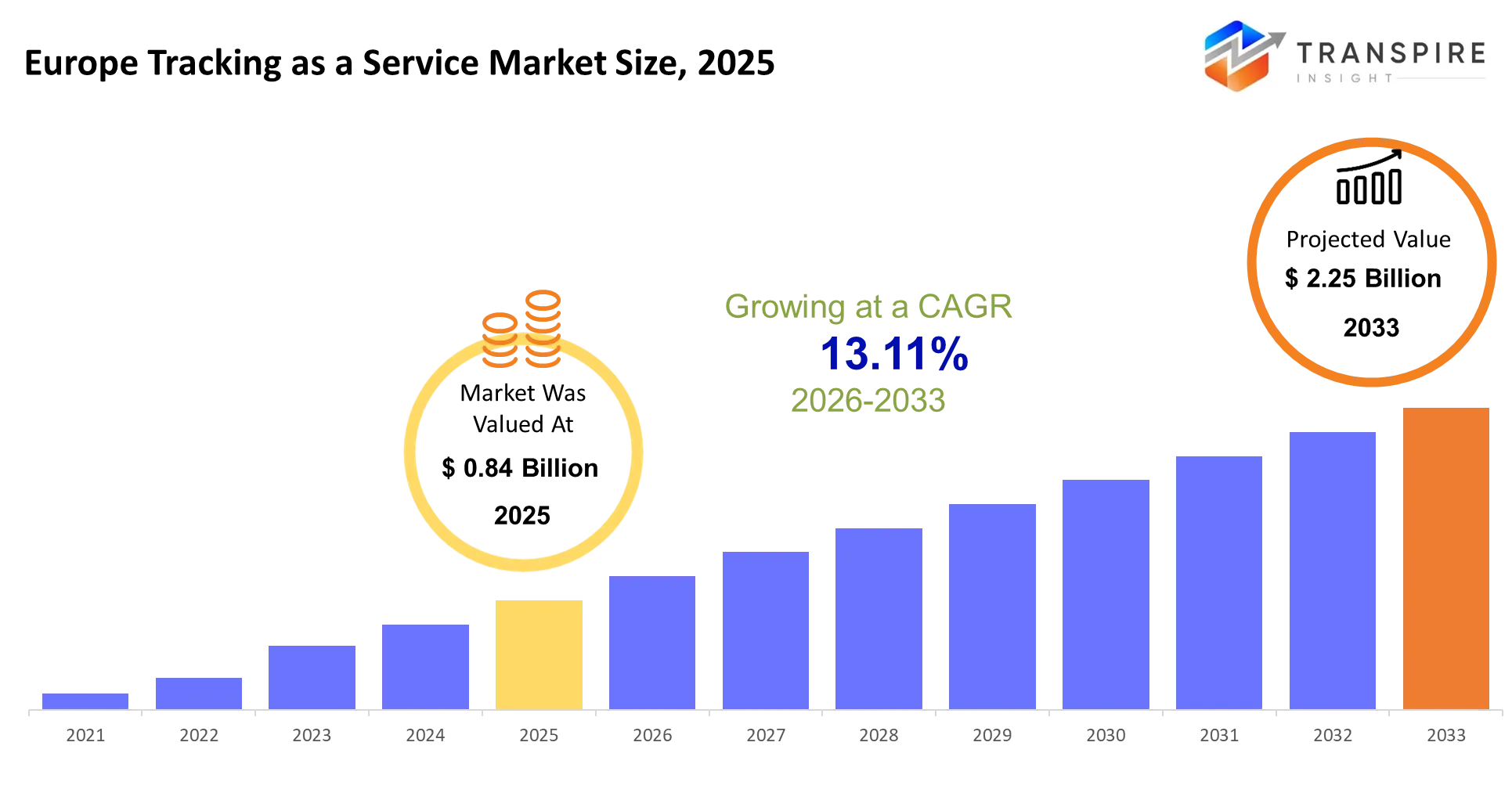
- Europe Tracking as a Service Market Size 2025: USD 0.84 Billion
- Europe Tracking as a Service Market Size 2033: USD 2.25 Billion
- Europe Tracking as a Service Market CAGR: 13.11%
- Europe Tracking as a Service Market Segments: By Type (Asset Tracking, Fleet Tracking, Personnel Tracking, Others), By Application (Logistics, Transportation, Retail, Healthcare, Others), By End-User (Enterprises, SMEs, Government, Others), By Technology (GPS, RFID, IoT, Others).
To learn more about this report,  Download Free Sample Report
Europe Tracking as a Service Market Summary:
The Europe Tracking as a Service Market size is estimated at USD 0.84 Billion in 2025 and is anticipated to reach USD 2.25 Billion by 2033, growing at a CAGR of 13.11% from 2026 to 2033. European Tracking as a Service enables businesses to monitor their essential assets and shipments and equipment throughout all times. The system helps maritime and industrial environments by preventing cargo theft and enhancing fleet management and supporting instant decision-making between ports and warehouses and transportation systems.
The market has evolved during the last three to five years from simple GPS tracking systems toward IoT platforms that integrate sensors with analytics and cloud-based tracking solutions. The new system enables organizations to shift their operational approach from beginning tracking to implementing predictive operational practices. The worldwide pandemic of COVID-19 created supply chain disruptions which revealed operational weaknesses that prevented companies from accurately monitoring their goods until the demand for digital tracking systems increased.
Organizations now spend money on ongoing surveillance systems which help them prevent operational interruptions and minimize insurance costs and fulfill advanced regulatory demands. The pattern creates permanent income through service-based business models while companies expand their usage of services in both logistics and industrial business models.
Key Market Insights
- The Europe Tracking as a Service Market sees Western Europe as its leading region because it controls more than 45% of the market share which Germany UK and France operate through their logistics hubs in 2025.
- The Eastern European region experiences the fastest growth between 2025 and 2030 because its manufacturing operations expand and its cross-border trade operations implement digital transformation programs.
- The asset tracking platforms control the market through their 50% market share in 2025 which arises from customers demanding solutions for tracking both their fleets and cargo.
- The transport optimization and regulatory compliance requirements enable fleet management services to become the second major market segment.
- The market for tracking solutions that use predictive analytics will experience the fastest growth between now and 2030 because companies are moving toward making decisions based on predictions.
- The logistics and transportation sector maintains a dominant market position through its more than 55% share which shows high demand for systems that provide real-time shipment tracking and route optimization.
- The maritime tracking market develops as a new demand segment which experiences fast growth because of port digitization processes and environmental monitoring regulations that require stricter compliance.
- The Europe Tracking as a Service Market sees logistics providers holding nearly 48% market share in 2025 because they need to meet their complicated supply chain demands.
- The industrial manufacturing sector becomes the most rapidly expanding user segment because it uses tracking technology to observe equipment status and enhance asset efficiency while minimizing production interruptions.
What are the Key Drivers, Restraints, and Opportunities in the Europe Tracking as a Service Market?
The enforcement of stricter supply chain transparency and compliance frameworks across the EU serves as a main driver that accelerates the growth of the Europe Tracking as a Service Market. The need for live tracking systems has become necessary for logistics companies because they must comply with cargo security regulations and emissions reporting requirements and cross-border documentation standards. The deployment of IoT sensors has become economically feasible for large-scale applications because their costs have decreased and network coverage has improved. The combination of these two factors has transformed tracking into an essential operational tool which providers now need for their business model because it generates consistent subscription-based revenue streams.
The most critical structural challenge for organizations arises from data fragmentation and their need to integrate with outdated systems. European industrial and maritime operators continue to use isolated IT systems which prevent them from accessing modern cloud-based tracking systems. The process of upgrading these systems demands organizations to make substantial initial financial commitments which results in operational interruptions and requires specialized skills for system integration. The combination of these operational difficulties creates delays in decision-making processes which hampers full technology implementation in mid-sized companies while creating a temporary obstacle to revenue growth despite the presence of long-term advantages.
The development of 5G-enabled smart ports and industrial corridors creates a significant opportunity for economic growth. Northern European ports are making financial investments in connected infrastructure which enables them to conduct real-time data exchange with high data throughput capabilities. This environment enables advanced tracking systems to provide predictive tracking solutions which use advanced algorithms to forecast congestion and automate asset routing processes, thereby enabling organizations to offer higher-value services through premium pricing strategies.
What Has the Impact of Artificial Intelligence Been on the Europe Tracking as a Service Market?
Artificial intelligence develops tracking systems into operational control systems that go beyond their original function of monitoring maritime and industrial environments. Operators now use AI models to automate scrubber monitoring and fleet compliance tracking by continuously analyzing sensor feeds from exhaust gas cleaning systems, fuel lines, and navigation data. The systems detect non-compliance events as they happen and they can change control settings to maintain emissions at legal limits which decreases the need for human work and mitigates auditing risks.
Machine learning now provides predictive capabilities that were impossible to achieve in the past. The models use historical data about engine load and fuel quality together with voyage conditions to predict when scrubbers need maintenance and to calculate emissions across different operating conditions. This system helps operators plan maintenance tasks because it predicts when equipment will fail while it enables them to optimize fuel usage through route and weather data. The implementation of these measures leads to better vessel availability for companies which results in substantial fuel savings that typically reach low single-digit percentages while their compliance performance improves.
The main obstacle for adoption currently remains as the most important problem to solve. The operating conditions at many vessels restrict them to use training data which does not meet high standards, resulting in connectivity issues that decrease their model accuracy and impede their ability to make quick decisions during intricate maritime operations.
Key Market Trends
- The logistics operators implemented cloud-based tracking solutions which provide better shipment tracking capabilities than their previous use of GPS devices since 2020.
- The companies started investing more in real-time tracking technologies which help them detect blind spots after COVID-19 disrupted their operations between 2020 and 2022, thus preventing expensive shipment delays and rerouting.
- The IoT sensor tracking systems which they developed enable Western European fleet operators to monitor vehicle condition and track vehicle location, according to more than 60 percent of major fleet operators who will operate their fleets this way by 2024.
- The maritime operators adopted tracking systems which automatically generate reports as a response to regulatory changes concerning emissions and cargo security requirements that emerged after 2021.
- The companies ORBCOMM and Geotab developed new AI capabilities which attracted customers to their predictive tracking solutions because of their enhanced analytics capabilities.
- The period from 2022 to 2025 saw subscription-based pricing models become the standard for hardware sales, which resulted in mid-sized companies finding it easier to adopt new products while generating continuous revenue streams for sellers.
- Eastern Europe developed into a center for manufacturing and logistics operations, which created a new requirement for businesses to implement tracking systems and tools that help manage supply chain operations which cross international borders.
- The demand for integration solutions rose after 2023, as businesses needed their operational systems to connect with ERP and warehouse management systems for centralized data processing.
- The maritime ports that implemented smart infrastructure systems started using tracking information to forecast traffic jams, which allowed them to use automatic asset distribution systems that enhanced their operational performance by 2025.
Europe Tracking as a Service Market Segmentation
By Type
The type segmentation shows its strongest performance through asset tracking and fleet tracking because both methods directly affect logistics efficiency and cost management. Asset tracking leads in share because companies require continuous visibility of high-value cargo, containers, and equipment across borders. Fleet tracking functions as the second most important method because transport operators need to track their drivers and optimize their routes.
Personnel tracking remains smaller but is gaining relevance in hazardous industrial environments where safety compliance is critical. The market now requires solutions which combine location tracking with condition monitoring and analytics capabilities. Future growth will likely favor hybrid platforms that unify asset and fleet visibility, encouraging providers to design scalable, subscription-based offerings while buyers prioritize interoperability across supply chain systems.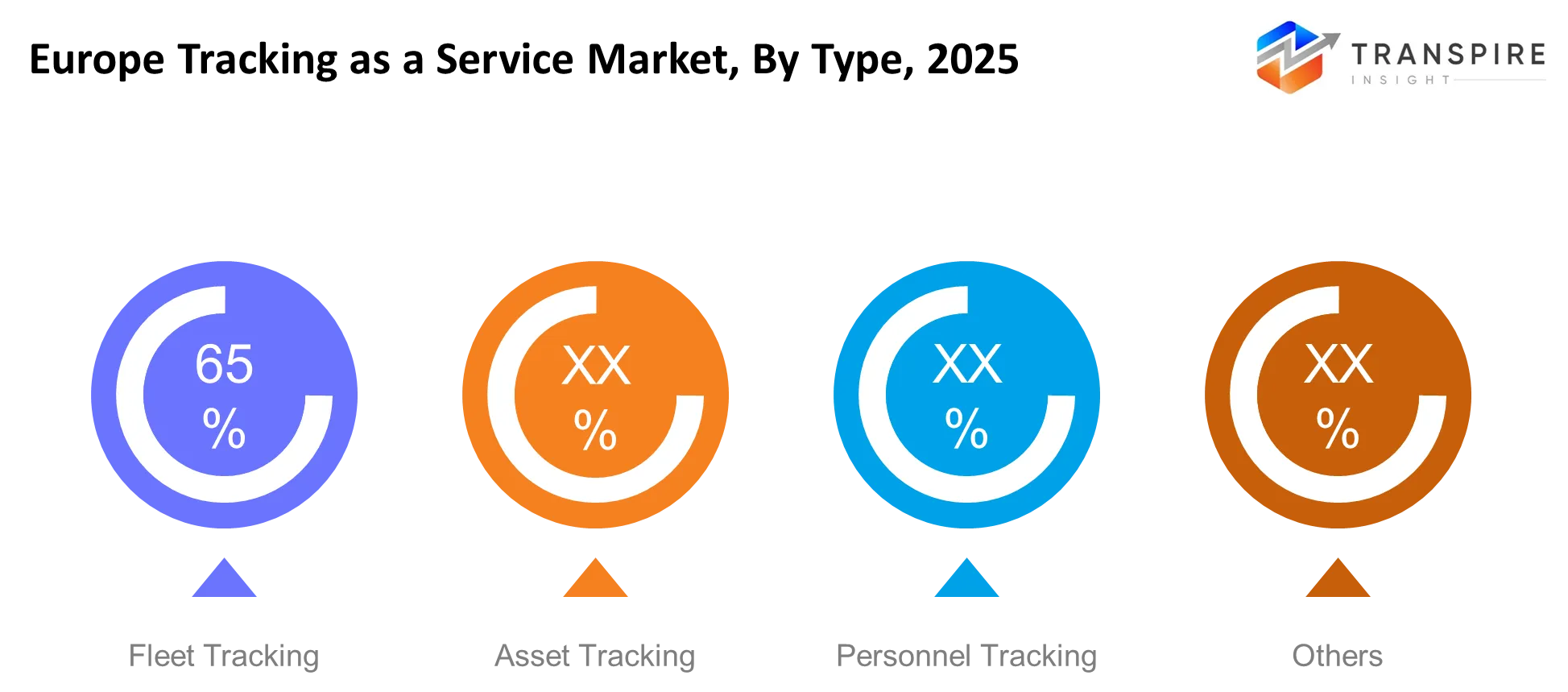
To learn more about this report, Download Free Sample Report
By Application
The two sectors of logistics and transportation control application distribution because their operations require real-time tracking systems to handle their intricate distribution networks. The retail sector has improved its market position because omnichannel fulfillment systems demand accurate inventory management and effective last-mile delivery operations.
The healthcare sector is experiencing growing adoption because medical facilities need to track their medical equipment and temperature-sensitive shipments following the pandemic disruptions. Each application displays distinct usage patterns because logistics operations require optimal route planning while healthcare needs to achieve both regulatory standards and dependable operation. The upcoming phase will introduce tailored analytics and reporting solutions for specific applications which will enable solution providers to create unique value propositions that work seamlessly with their business processes.
By End-User
Large enterprises lead the end-user segmentation because their financial capacity and supply chain complexity require them to spend money on sophisticated tracking systems. Small and medium enterprises have traditionally lagged because they lack sufficient funds and necessary technical skills. The shift toward subscription-based models together with cloud deployment has created lower entry barriers which allow smaller companies to adopt new technologies at their own pace.
The government and public sector require ongoing demand because they need systems for monitoring infrastructure and protecting border security. Growth patterns indicate that SMEs will represent the fastest expansion segment as affordability improves and digital tools become easier to deploy. Vendors will respond to the shift by creating onboarding processes which they will simplify together with modular solutions that match different operational sizes.
By Technology
GPS technology maintains its status as the leading tracking technology because of its dependable performance and worldwide availability, which serves as the primary system for most tracking systems. RFID has established a strong presence in warehouse and inventory management where short-range identification is sufficient and cost efficiency is critical.
IoT-based technologies are expanding rapidly because sensors now enable people to monitor temperature and humidity and equipment performance together with their current location data. This transition reflects a broader move toward data-driven operations rather than simple tracking. The current situation supports this transition because better connectivity and cheaper sensor technology enable progress, but system integration complexity continues to act as an operational barrier. Future development will combine GPS accuracy with IoT intelligence to enable providers to deliver predictive insights while buyers gain deeper operational control.
What are the Key Use Cases Driving the Europe Tracking as a Service Market?
The primary application of logistics and freight transportation operations exists because companies need to monitor their containers and trailers and high-value shipments throughout European transportation routes. The application plays a vital role in generating revenue because its real-time visibility system prevents cargo loss and enables better route planning and assists with cross-border documentation compliance.
The retail industry and healthcare Sector are developing new applications. Retail chains use tracking to manage omnichannel inventory and last-mile delivery, while healthcare providers track medical devices and temperature-sensitive pharmaceuticals to meet strict regulatory and safety requirements.
New use cases now include smart port operations together with industrial equipment monitoring. Ports are starting to adopt tracking data for both congestion prediction and automatic yard management operations, while manufacturers use tracking systems to observe their essential machinery operations and decrease unexpected operational interruptions.
|
Report Metrics |
Details |
|
Market size value in 2025 |
USD 0.84 Billion |
|
Market size value in 2026 |
USD 0.95 Billion |
|
Revenue forecast in 2033 |
USD 2.25 Billion |
|
Growth rate |
CAGR of 13.11% from 2026 to 2033 |
|
Base year |
2025 |
|
Historical data |
2021 - 2024 |
|
Forecast period |
2026 - 2033 |
|
Report coverage |
Revenue forecast, competitive landscape, growth factors, and trends |
|
Regional scope |
Europe (Germany, United Kingdom, France, Italy, Spain and Rest of Europe) |
|
Key company profiled |
Oracle, SAP, IBM, Cisco, Verizon, AT&T, Vodafone, Trimble, Geotab, Samsara, Fleet Complete, CalAmp, Zebra Technologies, Honeywell, Sierra Wireless |
|
Customization scope |
Free report customization (country, regional & segment scope). Avail customized purchase options to meet your exact research needs. |
|
Report Segmentation |
By Type (Asset Tracking, Fleet Tracking, Personnel Tracking, Others), By Application (Logistics, Transportation, Retail, Healthcare, Others), By End-User (Enterprises, SMEs, Government, Others), By Technology (GPS, RFID, IoT, Others) |
Which Regions are Driving the Europe Tracking as a Service Market Growth?
The market in Western Europe reaches its highest point because countries implement strict regulations while maintaining their port facilities at high operational standards. The logistics networks of Germany, Netherlands, and United Kingdom operate with high density through their use of digital customs systems and their enforcement of strict emissions regulations. Shipping operations generate permanent requirements for businesses to provide solutions which enable users to track their shipments and receive updates at any moment. The ecosystem includes technology providers and telecom networks and integrated logistics platforms which enable rapid implementation of advanced tracking services while sustaining the business's current market position.
Northern Europe maintains its status as a dependable market player through the efforts of Denmark and Sweden who prioritize environmental practices and operational efficiency instead of expanding their operations. This area displays different characteristics from Western Europe because it focuses on developing infrastructure through extended planning processes while implementing digital maritime technologies at a gradual pace. Environmental regulations drive shipowners and logistics companies to invest in tracking systems which support their fuel efficiency objectives. The combination of predictable regulatory implementation and effective public-private partnerships establishes a dependable income stream for service providers.
The industrial growth and logistics corridor development initiatives make Eastern Europe the region with the highest growth rate. Since 2022, Poland and Romania have raised their funding levels for upgrading port facilities and developing infrastructure to facilitate international trade. The manufacturing sector is relocating its operations which has resulted in increased export activities that require businesses to implement tracking systems for their complicated supply chain operations. The period between 2026 and 2033 will create strong market entry opportunities for investors because tracking solutions will become scalable and cost-effective.
Who are the Key Players in the Europe Tracking as a Service Market and How Do They Compete?
The Europe Tracking as a Service Market shows moderate fragmentation because both worldwide technology companies and local specialized companies operate in the market. Existing companies protect their market position through software development while new companies introduce cloud-based platforms that provide system compatibility with existing systems. Companies now compete through analytics capabilities and platform compatibility and service delivery methods instead of hardware cost. The current evaluation method requires buyers to assess vendors based on their ability to provide predictive insights and regulatory reporting and their capacity to integrate logistics and enterprise systems with their location tracking system.
ORBCOMM uses satellite and cellular hybrid connectivity to create a tracking system that provides uninterrupted service during remote maritime operations. The system enables ORBCOMM to provide services to shipping companies that operate outside of terrestrial network range. Geotab provides data-driven fleet optimization through its advanced telematics system and AI-powered analytics that help drivers become better and save fuel. Through partnerships with transport operators and third-party enterprise software platform integration the company expands its ecosystem reach.
Trimble Inc. uses its precision positioning technology together with its complete supply chain solutions which include hardware software and analytics to compete in the market. The system integration simplifies operations for large corporations which handle multiple transportation methods. TomTom uses its superior mapping data together with its navigation algorithms to provide precise routing information and traffic congestion assessments which are essential for European road networks. The company plans to expand through two strategies which involve improving its real-time data services and creating operational tracking systems by working with mobility and logistics partners.
Company List
- Oracle
- SAP
- IBM
- Cisco
- Verizon
- AT&T
- Vodafone
- Trimble
- Geotab
- Samsara
- Fleet Complete
- CalAmp
- Zebra Technologies
- Honeywell
- Sierra Wireless
Recent Development News
In March 2026, AMI Labs Raises $1.03 Billion to Build Real-World AI Tracking Models: AMI Labs, co-founded by AI researcher Yann LeCun, secured $1.03 billion in funding to develop “world models” capable of understanding real-world environments and movement patterns. The technology has potential applications in mobility tracking, fleet intelligence, and predictive monitoring systems across Europe’s connected vehicle ecosystem.
Source: https://techcrunch.com
In February 2026, Tether Launches USAT with compliance-focused transaction monitoring infrastructure: Tether introduced USAT, a regulated stablecoin platform incorporating enhanced compliance monitoring and transaction-tracking systems. The company stated that its infrastructure expansion includes closer collaboration with regulators and law-enforcement agencies in Europe and the U.S.
Source: https://techcrunch.com
What Strategic Insights Define the Future of the Europe Tracking as a Service Market?
The Europe Tracking as a Service Market is developing autonomous platforms which use decision-making systems that operate tracking systems to deliver active operational support. The industry is experiencing this transformation because organizations need to comply with stricter regulations and AI technology has reached advanced development stages and businesses must handle their worldwide supply chains which have become more complicated. The next five to seven years will see value creation from platforms which use predictive analytics and compliance automation to provide smooth integration with enterprise systems.
The platform concentration risk exists because a small number of major providers dominate essential tracking systems and data infrastructure. The system would create obstacles for organizations to change their system and it would reduce their ability to use new technology while making it harder for smaller companies to operate. The development of 5G-based smart logistics corridors which operate throughout Eastern Europe presents a new business opportunity because they enable organizations to exchange high-volume data in real time which supports advanced applications like automated routing and dynamic asset allocation.
Market participants should establish their systems on open interoperable designs and they should develop strategic alliances with telecommunications and infrastructure companies to build their future market strength.
Europe Tracking as a Service Market Report Segmentation
By Type
- Asset Tracking
- Fleet Tracking
- Personnel Tracking
- Others
By Application
- Logistics
- Transportation
- Retail
- Healthcare
- Others
By End-User
- Enterprises
- SMEs
- Government
- Others
By Technology
- GPS
- RFID
- IoT
- Others
Frequently Asked Questions
Find quick answers to common questions.
The Approximate Europe Tracking as a Service Market size for the Market will be USD 2.25 Billion in 2033.
The key Segments of the Europe Tracking as a Service Market are By Type (Asset Tracking, Fleet Tracking, Personnel Tracking, Others), By Application (Logistics, Transportation, Retail, Healthcare, Others), By End-User (Enterprises, SMEs, Government, Others), By Technology (GPS, RFID, IoT, Others).
Major Players in the Europe Tracking as a Service Market are Oracle, SAP, IBM, Cisco, Verizon, AT&T, Vodafone, Trimble, Geotab, Samsara, Fleet Complete, CalAmp, Zebra Technologies, Honeywell, Sierra Wireless.
The Current Market size of the Europe Tracking as a Service Market is USD 0.84 Billion in 2025.
The Europe Tracking as a Service Market CAGR is 13.11%.
- Oracle
- SAP
- IBM
- Cisco
- Verizon
- AT&T
- Vodafone
- Trimble
- Geotab
- Samsara
- Fleet Complete
- CalAmp
- Zebra Technologies
- Honeywell
- Sierra Wireless
Recently Published Reports
-
Apr 2026
3D Optical Profiler Market
3D Optical Profiler Market Size, Share & Analysis Report By Type (Desktop 3D Optical Profiler, and Portable 3D Optical Profiler), By Technology (Confocal Technology, and White Light Interference), By End-Use Industry (Manufacturing, Research Institutions, Automotive, Aerospace and Defense, Medical Devices, and Other), and Geography (North America, Europe, Asia-Pacific, Middle East and Africa, South and Central America), 2021 - 2031
-
Apr 2026
Depth Sensor Market
Depth Sensor Market Size, Share & Analysis Report By Type (Infrared Depth Sensors, Time-of-Flight (ToF) Sensors, Stereo Vision Sensors, Structured Light Sensors, Ultrasonic Depth Sensors), By Application (Automotive, Robotics, Gaming, Consumer Electronics, Industrial Automation, Healthcare, Security & Surveillance, Others), By End Users (Automotive Manufacturers, Consumer Electronics Companies, Healthcare Providers, Industrial Companies, Security Agencies, Gaming Companies, Robotics Companies, Others), and Geography (North America, Europe, Asia-Pacific, Middle East and Africa, South and Central America), 2021 – 2031
-
Apr 2026
Digital Manufacturing Market
Digital Manufacturing Market Size, Share & Analysis Report By Component (Hardware, Software, and Services), By Technology (Robotics, 3D Printing, Internet of Things (IoT), and Others), By Application (Automotive and Transportation, Aerospace and Defense, Consumer Electronics, Industrial Machinery, and Others), By Process Type (Computer-Based Designing, Computer-Based Simulation, Computer 3D Visualization, Analytics, and Others), and Geography (North America, Europe, Asia-Pacific, Middle East and Africa, South and Central America), 2021 – 2031
-
Apr 2026
Digital Visa Services Market
Digital Visa Services Market Size, Share & Analysis Report By Type (Individual Travelers, Group Travelers), By Application (Tourism, Business Travel, Others), and Geography (North America, Europe, Asia-Pacific, Middle East and Africa, South and Central America), 2021 – 2031