
Europe Telecom Tower Market Size & Forecast:
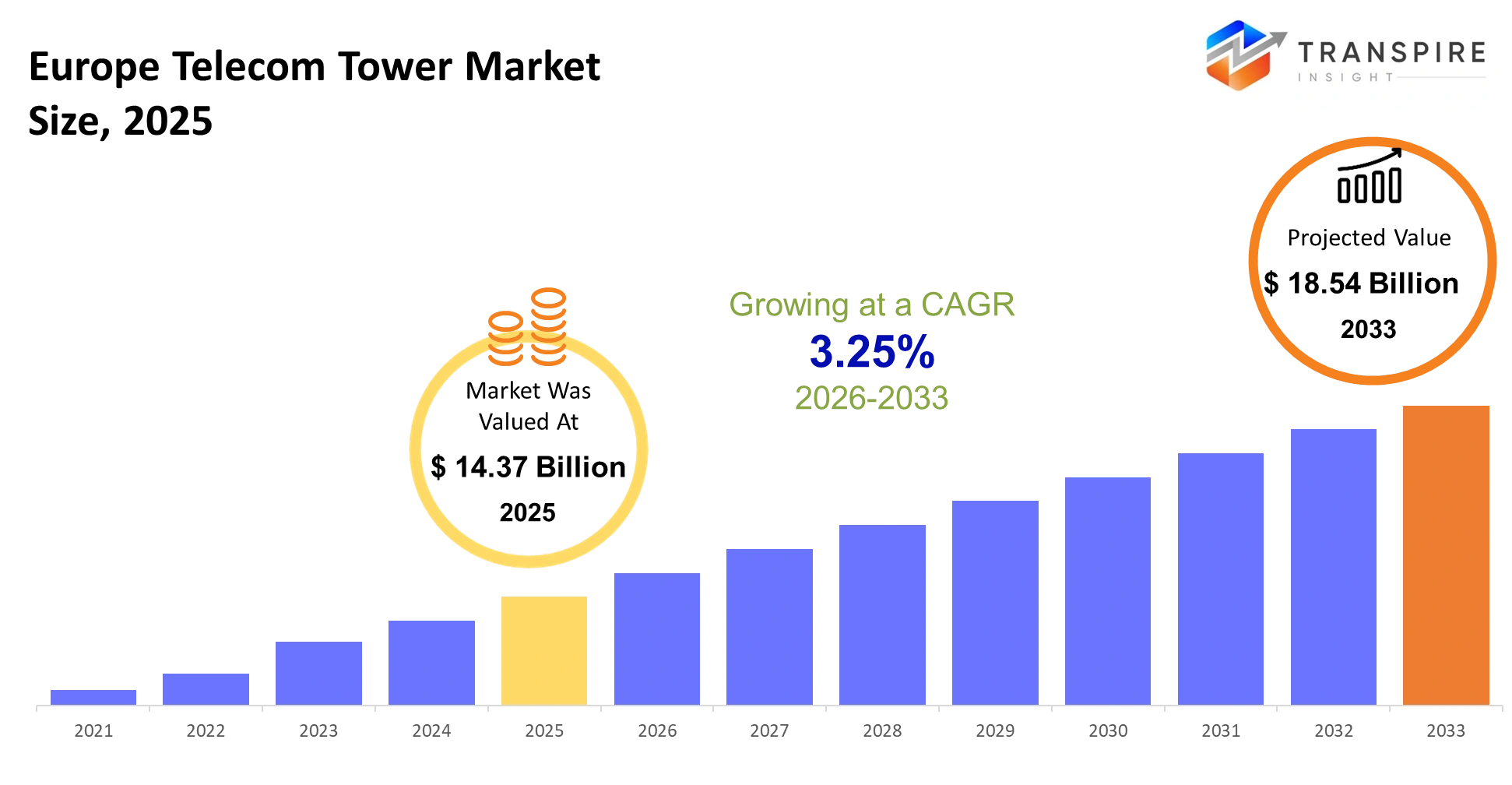
- Europe Telecom Tower Market Size 2025: USD 14.37 Billion
- Europe Telecom Tower Market Size 2033: USD 18.54 Billion
- Europe Telecom Tower Market CAGR: 3.25%
- Europe Telecom Tower Market Segments: By Type (Lattice Towers, Monopole Towers, Guyed Towers, Small Cells, Others); By Application (Mobile Networks, Broadcasting, Internet Services, 5G Infrastructure, Others); By End-User (Telecom Operators, Infrastructure Providers, Government, Private Operators, Others); By Ownership (Operator-owned, Private-owned, Shared Infrastructure, Others)
To learn more about this report,  Download Free Sample Report
Europe Telecom Tower Market Summary
The Europe Telecom Tower Market was valued at USD 14.37 Billion in 2025. It is forecast to reach USD 18.54 Billion by 2033. That is a CAGR of 3.25% over the period.
The telecom tower market in Europe supports mobile connectivity throughout the region because it provides operators with necessary equipment to build wireless networks that deliver continuous voice and data service throughout urban areas and transportation routes and maritime facilities and industrial sites. The market has evolved during the past five years toward independent tower companies and shared network models because carriers seek to minimize their capital expenses while they expedite their 5G network rollouts. The Russia-Ukraine conflict changed market operations because it revealed energy weaknesses and forced tower operators to spend money on power-saving technologies and emergency power solutions and various equipment procurement methods. The demand for low-latency connectivity in smart manufacturing and logistics operations and digital public service delivery systems is driving current market expansion. Infrastructure providers see increased tenancy ratios which lead to recurring lease revenue streams because operators build small cells and edge-enabled tower sites to handle rising 5G traffic demands.
Key Market Insights
- The Europe Telecom Tower Market in 2025 experienced 58% market share from Western Europe because the region implemented extensive 5G infrastructure projects across Germany France and the UK.
- Central and Eastern Europe represent the fastest-growing regional telecom tower industry segment during 2025–2030 due to expanding rural broadband programs and lower tower penetration.
- The Europe Telecom Tower Market in 2025 saw macro towers control more than 64% of the market because they enable extensive network coverage and support multiple users through their network design.
- The second-largest market segment for rooftop towers exists because urban areas need better wireless connections while cities have restricted space for new development.
- The telecom tower market will experience its fastest growth from small cell infrastructure between now and 2030 because operators need to enhance their indoor network performance and deliver 5G services with minimal delay.
- Telecom providers adopted tower colocation services to decrease capital costs through shared infrastructure arrangements and outsourcing solutions.
- Mobile communication applications accounted for nearly 70% of Europe telecom infrastructure market revenue in 2025, supported by rapid smartphone data consumption growth.
- Municipalities are adopting IoT and smart city connectivity solutions because these technologies are becoming essential for their connected transport and utility system deployments.
- The Europe Telecom Tower Market in 2025 experienced mobile network operators holding about 62% of the market because they pursued extensive 5G network growth initiatives.
- Independent tower companies represent the fastest-growing end-user category as telecom operators divest passive infrastructure assets to improve operational efficiency.
What are the Key Drivers, Restraints, and Opportunities in the Europe Telecom Tower Market?
The European Telecom Tower Market experiences its strongest growth through 5G networks which expand throughout both urban and industrial environments. European telecom operators intensified tower investments after governments accelerated spectrum allocation and digital connectivity targets under regional broadband initiatives. 5G networks require operators to build their networks with more dense sites which include macro towers and rooftop installations and small cells to deliver low-latency service. Tower leasing operations have increased because operators now share equipment through common infrastructure instead of constructing independent facilities. The tower companies obtain increased long-term cash flow visibility when their tenancy ratios increase because they receive higher revenue from existing sites.
The market faces its greatest structural challenge through complicated zoning laws which require extended periods for site permission to be granted. Tower deployment in countries such as Germany, Italy, and France often faces municipal restrictions, environmental assessments, and local opposition related to visual impact and electromagnetic concerns. National planning frameworks contain these restrictions as fundamental elements which require extensive time to resolve. The approval process causes delays which hinder tower operators from expanding rural areas while delaying their chances to monetize their assets which results in decreased short-term revenue growth and extended timeframes for network expansion.
Edge computing integration presents a major long-term opportunity for the Europe Telecom Tower Market. Telecom infrastructure providers transform tower sites into distributed edge hubs which industrial automation and connected logistics and real-time data processing solutions depend on.The northern European region, with its strong fiber internet connections and developed industrial systems, serves as a strategic investment area for modern business applications according to Sweden and Finland.
What Has the Impact of Artificial Intelligence Been on the Europe Telecom Tower Market?
The Europe Telecom Tower Market experiences transformation through artificial intelligence and advanced digital technologies that enhance tower operations and energy management together with network reliability. The increasing adoption of AI monitoring systems by tower operators enables them to perform automated site inspections while monitoring equipment status and managing energy usage for their distributed telecom network resources. The development of remote monitoring systems enables real-time analysis of temperature changes and battery status and diesel generator operation, which helps operators minimize physical maintenance work while enhancing productivity throughout their extensive tower networks.
Telecom networks use machine learning models to enhance their predictive maintenance capabilities through various network maintenance tasks. The operators use historical performance data together with sensor analytics to predict battery failures and cooling system failures and network congestion before the actual outages happen. The predictive method decreases unexpected downtime while increasing tower operational time and decreasing maintenance expenses through service priority based on asset condition assessment instead of predetermined maintenance schedules. European tower companies use AI-based energy optimization systems to decrease their electricity usage while energy prices in the region experience fluctuations.
The high expenses for system integration together with incomplete existing system infrastructure create a significant barrier that prevents organizations from adopting artificial intelligence technology. The majority of telecom tower sites operate with outdated equipment which fails to work with modern analytics systems, resulting in extended deployment times and reduced data accuracy across networks that use multiple vendors.
Key Market Trends
- European telecom operators began to increase their tower asset sales to Cellnex Telecom and Vantage Towers since 2021.
- The period from 2020 to 2025 experienced a major rise in small cell deployments because dense urban 5G networks needed both low-latency coverage and increased data capacity.
- After the pandemic revealed connectivity problems throughout remote industrial and residential areas European regulators established stricter rural broadband requirements.
- After the 2022 energy price increase across Europe tower operators began to construct renewable-powered infrastructure.
- The implementation of AI-powered remote monitoring systems since 2023 has helped telecom companies decrease their need for manual maintenance by improving their ability to detect faults across their network of remote telecom facilities.
- Telecom companies began using multi-tenant tower systems because their rising infrastructure development costs made it more expensive to build individual towers.
- Nordic countries experienced faster edge computing development because manufacturers needed ultra-low-latency networks for their industrial automation systems and real-time analytics purposes.
- Major cities saw an increase in rooftop tower installations because new ground-based macro tower construction required lengthy approval processes.
- The period since 2022 has seen operators actively pursue fiber-connected tower upgrades as their main goal involves developing high-capacity backhaul networks for supporting standalone 5G systems.
- European telecom infrastructure providers increasingly partnered with hyperscale cloud companies to transform tower locations into distributed edge connectivity hubs.
Europe Telecom Tower Market Segmentation
By Type:
The telecom industry uses lattice towers as their primary solution because operators need high-capacity towers to provide their services across long distances and multiple tenants. The structural strength and antenna support capabilities of lattice towers make them necessary for both rural network operations and international communication routes. The requirements for improved lattice systems which can support additional network equipment and fiber connections have increased due to the 5G network expansion across Germany and France and Spain.
The second largest market share of monopole towers exists because urban areas need quick deployment systems which require minimal land space. Municipal authorities increasingly favor compact monopole installations because lower visual impact simplifies zoning approvals compared with traditional lattice structures. Small cells represent the fastest-growing segment as operators densify urban networks to improve low-latency coverage and indoor connectivity performance. Investors increasingly support small cell infrastructure because high-capacity urban data consumption continues to outpace macro tower bandwidth capabilities across major European cities.
To learn more about this report, Download Free Sample Report
By Application:
Mobile networks account for the largest application share because telecom carriers continue expanding nationwide 4G and 5G coverage obligations. The demand for stronger network capacity during dense urban areas and transportation systems increases because more people use smartphones and video streaming services and businesses require mobile access to their systems. Telecom infrastructure providers continue prioritizing mobile communication projects because recurring tenancy revenue improves long-term asset profitability.
The 5G infrastructure market has become the most rapidly expanding application sector because European countries now expedite spectrum distribution while businesses implement digital transformation projects. The manufacturing industries and logistics centers and intelligent transportation networks need ultra-low-latency connections that fiber-connected locations and tower networks provide. Internet service usage keeps increasing because cloud computing and remote work and edge computing require dependable broadband access. Product developers increasingly focus on energy-efficient radio equipment and edge-enabled tower systems to support future bandwidth-intensive applications.
By End-User
Telecom operators currently dominate end-user demand because national carriers continue investing heavily in network modernization and coverage expansion. The United Kingdom and Italy and France large operators increasingly choose to lease shared tower infrastructure instead of building their own assets which helps them decrease capital costs while improving their deployment speed. Infrastructure providers have strengthened their market power after multiple telecom firms sold their passive systems to dedicated tower management companies.
Private wireless networks now serve as the primary network choice for industrial enterprises which use them to automate manufacturing processes and enhance logistics efficiency. Ports and airports and industrial campuses need dedicated low-latency communication systems which enable autonomous operations and real-time data analysis. Government-backed digital connectivity programs also continue driving tower investments in underserved rural regions where broadband expansion remains a strategic priority.Infrastructure vendors are looking to tap the expanding market for recurring revenue flowing from the customization of networks for enterprises.
By Ownership:
The market retains power through operator-owned networks because legacy telecom companies maintain direct control over their essential tower assets and nationwide network systems. The existing ownership patterns in Southern and Eastern European regions still enable operators to run integrated business operations which include all network maintenance activities and network expansion projects and equipment leasing processes. The increasing cost of operations together with the substantial 5G infrastructure investment needs has made complete ownership of tower assets less appealing to businesses.
The shared infrastructure system has emerged as the most rapidly expanding ownership type because tower sharing enables better asset utilization while decreasing the need for duplicate network investments. Independent tower companies now purchase telecom infrastructure assets which they lease to multiple competing operators through their multi-tenant leasing contracts. Private investors continue to expand their ownership of telecommunication infrastructure because they seek reliable cash returns which will last over extended periods and depend on the growing need for telecommunications services. The network densification process and edge computing deployment activities will create a more complex financing environment which will lead market participants to favor shared ownership solutions during the upcoming forecast period.
What are the Key Use Cases Driving the Europe Telecom Tower Market?
The main reason European countries choose to install telecom towers is to enable mobile broadband access. Telecom companies expand their base station networks through the installation of macro towers and rooftop systems which enable high-density smartphone usage and video streaming and business mobility services in urban areas and transportation routes and industrial sites.
Private wireless networks in manufacturing facilities and logistics centers and major ports are driving the development of nearby applications. Industrial operators increasingly depend on dedicated telecom infrastructure to operate their automated production systems and connected warehousing facilities and real-time asset tracking technology. Broadcasting networks continue to upgrade their tower systems to enhance digital transmission reach and strengthen network reliability.
Telecom sites equipped with edge technology enable autonomous vehicle systems and smart city infrastructure as their primary use case. Nordic and Western European cities use low-latency tower networks to test connected traffic management systems and public safety monitoring and AI-powered urban infrastructure solutions which need permanent real-time data processing.
|
Report Metrics |
Details |
|
Market size value in 2025 |
USD 14.37 Billion |
|
Market size value in 2026 |
USD 14.82 Billion |
|
Revenue forecast in 2033 |
USD 18.54 Billion |
|
Growth rate |
CAGR of 3.25% from 2026 to 2033 |
|
Base year |
2025 |
|
Historical data |
2021 - 2024 |
|
Forecast period |
2026 - 2033 |
|
Report coverage |
Revenue forecast, competitive landscape, growth factors, and trends |
|
Regional scope |
Europe (Germany, United Kingdom, France, Italy, Spain, Rest of Europe) |
|
Key company profiled |
American Tower, Cellnex, SBA Communications, Crown Castle, Indus Towers, Helios Towers, Vantage Towers, Phoenix Tower, China Tower, ATC Europe, TowerCo, Bharti Infratel, Eaton Towers, IHS Towers, Vertical Bridge |
|
Customization scope |
Free report customization (country, regional & segment scope). Avail customized purchase options to meet your exact research needs. |
|
Report Segmentation |
By Type (Lattice Towers, Monopole Towers, Guyed Towers, Small Cells, Others); By Application (Mobile Networks, Broadcasting, Internet Services, 5G Infrastructure, Others); By End-User (Telecom Operators, Infrastructure Providers, Government, Private Operators, Others); By Ownership (Operator-owned, Private-owned, Shared Infrastructure, Others) |
Which Regions are Driving the Europe Telecom Tower Market Growth?
Western Europe continues to function as the primary market region because Germany together with the United Kingdom and France maintain their position as the most important 5G deployment countries while they develop their telecom systems throughout their nation. The combination of effective regulatory collaboration, initial spectrum distribution methods, and developed fiber network systems has established a dependable setting which enables tower construction and network infrastructure expansion. The shared infrastructure networks which major telecom operators and tower companies operate together enable their business model to achieve high tenancy levels while generating stable income streams. The combination of urban population density and advanced industrial connectivity programs creates a continuous need for macro tower systems rooftop locations and edge-enabled telecom infrastructure.
Northern Europe generates a minor yet consistent portion of regional revenue because telecom infrastructure investment emphasizes operational efficiency and digital integration capabilities instead of pursuing aggressive network expansion. The three Nordic countries of Sweden and Finland and Denmark focus their efforts on developing energy-efficient tower operations which use renewable energy sources to establish base stations. Telecom operators have used their economic strength and steady technology investment to develop their networks for cost-efficient operations without needing to change their spending plans. The Nordic telecom providers have established strong partnerships with cloud service providers and manufacturing companies which creates greater demand for edge computing tower infrastructure.
Central and Eastern Europe currently act as the most rapidly developing regional market because of their increasing broadband network development and digital infrastructure funding initiatives.Telecom investments in Poland, Romania and Hungary increased after the European Union-backed connectivity initiatives brought connections to their remote and industrial areas. Multiple operators expedited their tower building and network improvement work because geopolitical events demonstrated the requirement for improved regional digital security and diverse communication systems. The growth path between 2026 and 2033 will provide major expansion opportunities for tower businesses equipment manufacturers and investors who focus on infrastructure development.
Who are the Key Players in the Europe Telecom Tower Market and How Do They Compete?
The European Telecom Tower Market displays a competitive structure that exists between full consolidation and total competition because major independent tower companies operate extensive infrastructure systems throughout various nations. The industry now competes through three main factors which include tower sharing performance energy management systems and the development of extended service agreements with telecom companies. The established companies in the market use both acquisitions and international infrastructure development to protect their existing market presence while the smaller regional companies operate their businesses through targeted urban installations and dedicated wireless network solutions. Today companies compete through three factors which include their geographic presence, their ability to run operations efficiently, and their capacity to deliver edge-enabled network systems instead of relying on basic tower ownership rights.
Through its aggressive acquisition strategy in Spain, France, Italy, and the United Kingdom, Cellnex Telecom has created one of the largest multi-country tower portfolios in Europe while establishing its presence in various markets. The company uses high tenancy ratios together with its integrated edge connectivity solutions to create value for both telecom operators and enterprise customers. Vantage Towers concentrates its business activities on training operational efficiency for shared infrastructure in combination with deploying urban rooftop systems throughout Germany and Southern Europe. The company establishes strong ties with major mobile operators which lead to recurring revenue streams that help finance its 5G densification initiatives.
American Tower Corporation expands its European business operations by acquiring companies and developing data-driven infrastructure management systems which enhance energy performance and equipment maintenance capabilities. Deutsche Telekom safeguards its competitive edge through complete control of its network operations together with its robust enterprise connectivity solutions that serve clients across various industries.Vodafone Group increasingly emphasizes infrastructure partnerships and Open RAN deployment strategies to reduce network costs and improve deployment flexibility across emerging 5G corridors.
Company List
- American Tower
- Cellnex
- SBA Communications
- Crown Castle
- Indus Towers
- Helios Towers
- Vantage Towers
- Phoenix Tower
- China Tower
- ATC Europe
- TowerCo
- Bharti Infratel
- Eaton Towers
- IHS Towers
- Vertical Bridge
Recent Development News
In February 2026, Cellnex Telecom entered a partnership with Point One Navigation to expand centimeter-accurate positioning infrastructure across six European countries. The collaboration strengthens edge-enabled telecom infrastructure for autonomous mobility, robotics, and industrial connectivity applications across Europe.https://www.cellnex.com
In March 2026, Vantage Towers entered a partnership with Telefónica to deploy 5G Standalone indoor connectivity infrastructure at Plaza Norte 2 in Spain. The deployment improved high-capacity indoor network performance and demonstrated growing demand for advanced small cell and DAS solutions in commercial real estate environments.https://www.vantagetowers.com
What Strategic Insights Define the Future of the Europe Telecom Tower Market?
The Europe Telecom Tower Market progresses toward software-controlled distributed frameworks that integrate tower facilities with edge computation resources and artificial intelligence-based network management systems. The primary force behind this transition is the growing requirement for ultra-low-latency connectivity across industrial automation, autonomous mobility, and real-time digital services. The upcoming five to seven years will witness tower operators transforming from their current role as passive infrastructure owners into active suppliers of digital infrastructure solutions that provide enhanced services to enterprises.
The telecom market faces an unrecognized danger because it depends on a few major telecom customers through their concentrated market presence. The increasing consolidation among European mobile operators will result in reduced pricing power and slower tenancy expansion for tower companies operating in established markets. Local zoning regulations have become stricter, which creates another challenge that will postpone the deployment of urban small cell networks despite the ongoing 5G investment surge.
Central and Eastern Europe present a significant business opportunity through edge-enabled telecom infrastructure, which powers industrial digitization initiatives and European Union connectivity programs. Market participants should establish partnerships with cloud service providers and industrial companies and municipal governments to maintain infrastructure relevance beyond existing mobile network services.
Europe Telecom Tower Market Report Segmentation
By Type
- Lattice Towers
- Monopole Towers
- Guyed Towers
- Small Cells
- Others
By Application
- Mobile Networks
- Broadcasting
- Internet Services
- 5G Infrastructure
- Others
By End-User
- Telecom Operators
- Infrastructure Providers
- Government
- Private Operators
- Others
By Ownership
- Operator-owned
- Private-owned
- Shared Infrastructure
- Others
Frequently Asked Questions
Find quick answers to common questions.
The Europe Telecom Tower Market size is USD 18.54 Billion in 2033.
Key segments for the Europe Telecom Tower Market are By Type (Lattice Towers, Monopole Towers, Guyed Towers, Small Cells, Others); By Application (Mobile Networks, Broadcasting, Internet Services, 5G Infrastructure, Others); By End-User (Telecom Operators, Infrastructure Providers, Government, Private Operators, Others); By Ownership (Operator-owned, Private-owned, Shared Infrastructure, Others).
Major Europe Telecom Tower Market players are American Tower, Cellnex, SBA Communications, Crown Castle, Indus Towers, Helios Towers, Vantage Towers, Phoenix Tower, China Tower, ATC Europe, TowerCo, Bharti Infratel, Eaton Towers, IHS Towers, Vertical Bridge.
The Europe Telecom Tower Market size is USD 14.37 Billion in 2025.
The Europe Telecom Tower Market CAGR is 3.25% from 2026 to 2033.
- American Tower
- Cellnex
- SBA Communications
- Crown Castle
- Indus Towers
- Helios Towers
- Vantage Towers
- Phoenix Tower
- China Tower
- ATC Europe
- TowerCo
- Bharti Infratel
- Eaton Towers
- IHS Towers
- Vertical Bridge
Recently Published Reports
-
Apr 2026
3D Optical Profiler Market
3D Optical Profiler Market Size, Share & Analysis Report By Type (Desktop 3D Optical Profiler, and Portable 3D Optical Profiler), By Technology (Confocal Technology, and White Light Interference), By End-Use Industry (Manufacturing, Research Institutions, Automotive, Aerospace and Defense, Medical Devices, and Other), and Geography (North America, Europe, Asia-Pacific, Middle East and Africa, South and Central America), 2021 - 2031
-
Apr 2026
Depth Sensor Market
Depth Sensor Market Size, Share & Analysis Report By Type (Infrared Depth Sensors, Time-of-Flight (ToF) Sensors, Stereo Vision Sensors, Structured Light Sensors, Ultrasonic Depth Sensors), By Application (Automotive, Robotics, Gaming, Consumer Electronics, Industrial Automation, Healthcare, Security & Surveillance, Others), By End Users (Automotive Manufacturers, Consumer Electronics Companies, Healthcare Providers, Industrial Companies, Security Agencies, Gaming Companies, Robotics Companies, Others), and Geography (North America, Europe, Asia-Pacific, Middle East and Africa, South and Central America), 2021 – 2031
-
Apr 2026
Digital Manufacturing Market
Digital Manufacturing Market Size, Share & Analysis Report By Component (Hardware, Software, and Services), By Technology (Robotics, 3D Printing, Internet of Things (IoT), and Others), By Application (Automotive and Transportation, Aerospace and Defense, Consumer Electronics, Industrial Machinery, and Others), By Process Type (Computer-Based Designing, Computer-Based Simulation, Computer 3D Visualization, Analytics, and Others), and Geography (North America, Europe, Asia-Pacific, Middle East and Africa, South and Central America), 2021 – 2031
-
Apr 2026
Digital Visa Services Market
Digital Visa Services Market Size, Share & Analysis Report By Type (Individual Travelers, Group Travelers), By Application (Tourism, Business Travel, Others), and Geography (North America, Europe, Asia-Pacific, Middle East and Africa, South and Central America), 2021 – 2031