

Europe Sports Technology Market Size & Forecast:
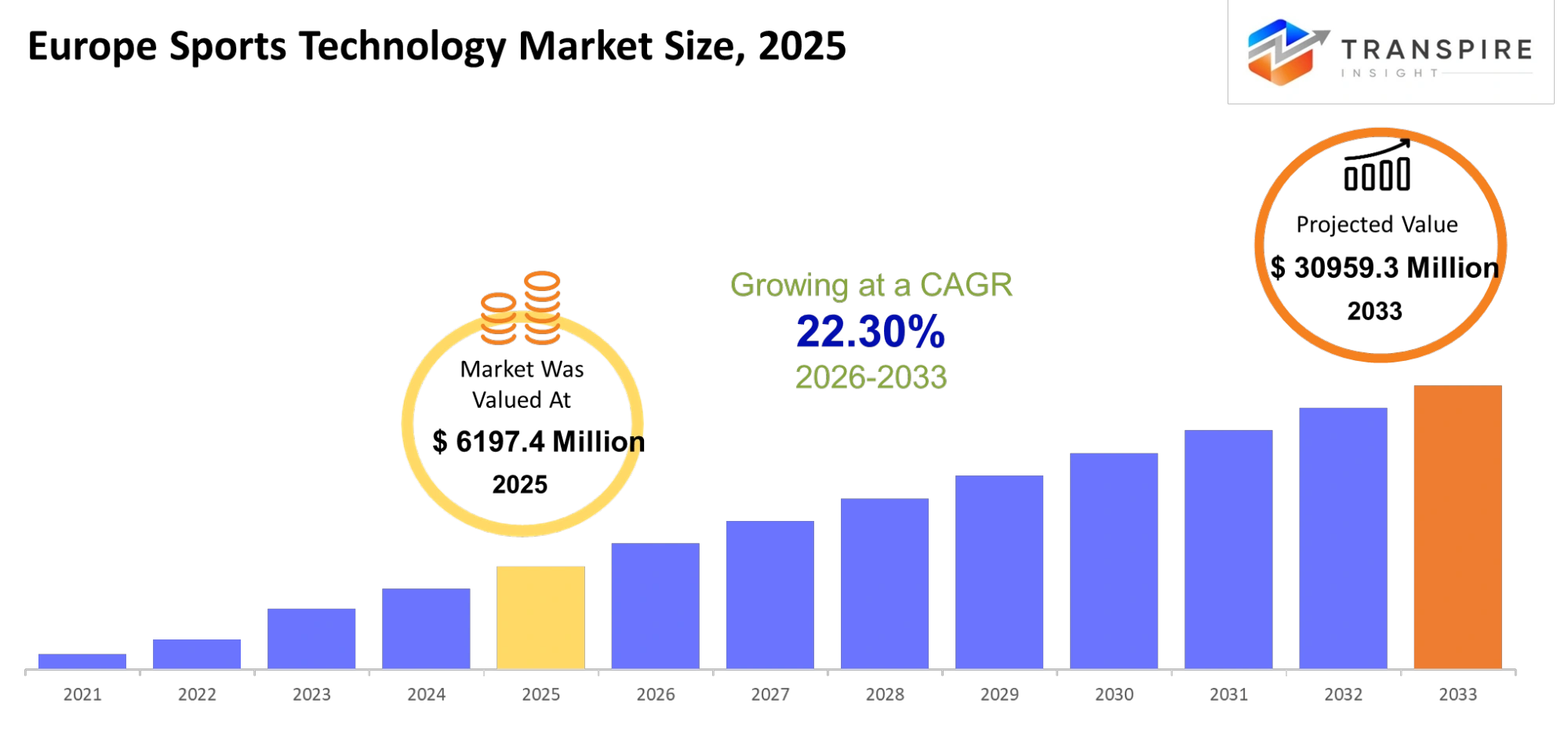
- Europe Sports Technology Market Size 2025: USD 6197.4 Million
- Europe Sports Technology Market Size 2033: USD 30959.3 Million
- Europe Sports Technology Market CAGR: 22.30%
- Europe Sports Technology Market Segments: By Type (Wearables, Smart Equipment, Analytics Software, AR/VR, IoT Devices, Others); By Application (Performance Tracking, Fan Engagement, Coaching, Broadcasting, Training, Others); By End-User (Teams, Athletes, Leagues, Broadcasters, Fitness Centers, Others); By Deployment (Cloud, On-premises, Hybrid, Mobile Platforms, Digital Platforms, Others)
To learn more about this report,  Download Free Sample Report
Europe Sports Technology Market Summary:
The Europe Sports Technology Market size is estimated at USD 6197.4 Million in 2025 and is anticipated to reach USD 30959.3 Million by 2033, growing at a CAGR of 22.30% from 2026 to 2033. The europe sports technology market for the industry of sports and digital innovations is going to be a fascinating meeting point of sports science and data analysis on one hand, and audience engagement on the other. The Europe sports technology market is going to be driven by athletes' need for precision, accuracy, and real-time information. The clubs and leagues will adopt smart wearables, intelligent coaching tools, and new viewing methods based on artificial intelligence. Audience participation is going to be driven by the need for augmented experience and personalized content consumption. Privacy laws will become stricter across the Europe countries in regard to athlete surveillance and data usage.
What Has the Impact of Artificial Intelligence Been on the Europe Sports Technology Market?
Artificial Intelligence (AI) is fast revolutionizing the europe sports technology market through the application of intelligent systems, adding value to organizational operations, analyses, and competitive positioning within this environment. Artificial Intelligence in europe sports technology market settings is enhancing market research processes through its ability to make sense out of massive amounts of data drawn from athletes' performance records, fan reactions, and digital media engagement. The advanced machine learning algorithms will continue to unravel new insights that will help stakeholders gain a clearer understanding of market trends. The application of AI in the europe sports technology market will enable businesses to evolve past traditional analysis into predictive analytics that will aid in demand forecasting.
In the europe sports technology market ecosystem, artificial intelligence will also transform operations through smart automation. The automation of production and performance processes such as video analysis, injury predictions, and training will ensure that processes in these areas become more efficient in terms of speed and reduction of cost. Supply chain operations will also get an AI boost through improved optimization of manufacturing and logistics operations.
Simultaneously, AI will bring new levels of personalization and innovation into the europe sports technology market. The audience will enjoy personalized content and experiences facilitated by advanced algorithms. Companies that employ AI to understand their market and target their audiences will enjoy an edge over competitors by offering targeted services, which not only benefit the athletes but also the customers.
Key Market Trends & Insights:
- Market growth is being fuelled by growing applications of artificial intelligence in europe sports technology market platforms.
- The development of smart automation and machine learning algorithms helps in real-time performance monitoring and better decision-making capabilities.
- Growing demands from investments made in fan engagement, wearables, and immersive technologies including AR/VR are driving the europe sports technology market.
- Some of the latest trends in europe sports technology include data-driven coaching and injury prevention technologies using predictive analysis.
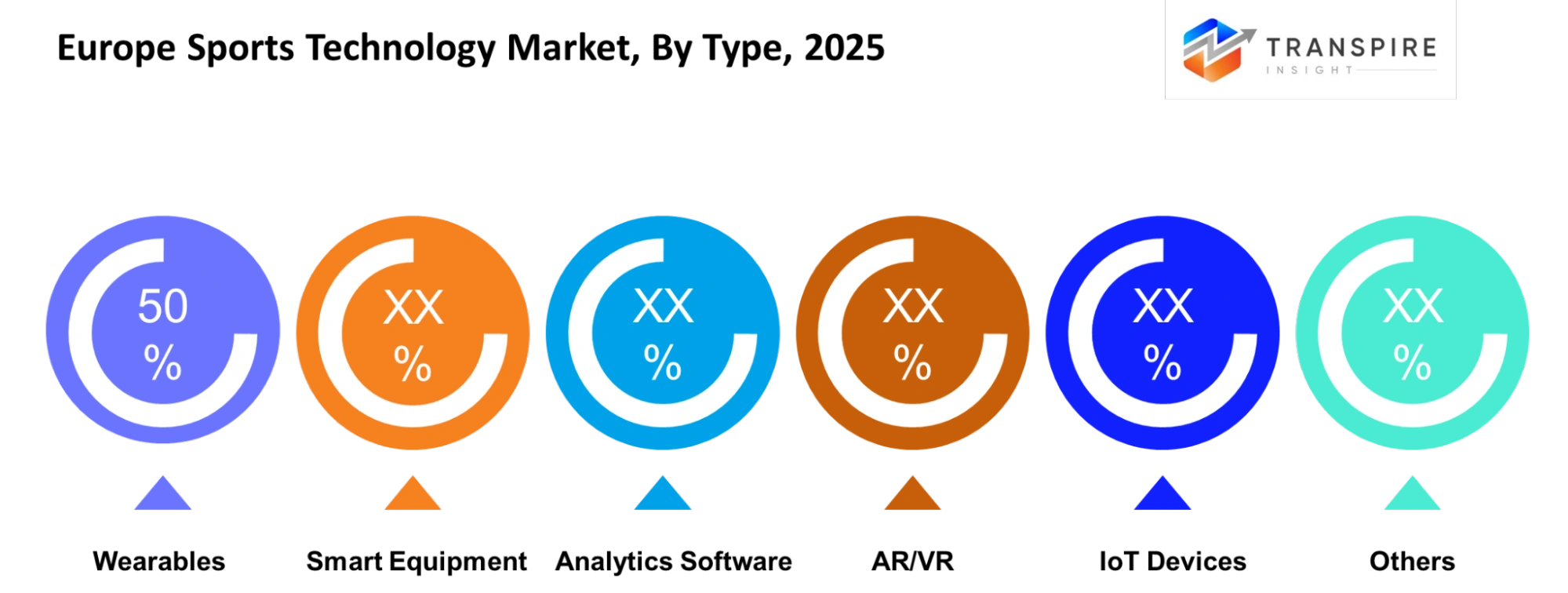
- Wearable devices have the maximum market share (~35%) in the europe sports technology market due to increased demand among professionals and sports teams.
- AR/VR-based fan engagement solutions will be the fastest-growing application area in the europe sports technology market until 2030.
- Sports performance monitoring remains the dominant application area in the europe sports technology market with nearly 40% market share.
- Professional sports teams will dominate the market with more than 50% market share owing to their large investments in training technologies.
Europe Sports Technology Market Segmentation
By Type
Wearable technology is used to monitor physical parameters, movements, and fatigue levels, thereby ensuring consistent performance monitoring. Intelligent gear is another technology used to install sensors in the gear itself, allowing information gathering during actual matches and training. Analytics programs will help transform gathered information into something useful, which can be leveraged to develop strategies for the organization and to measure their results.
AR/VR technology is used in simulation training and interaction with fans, providing controlled spaces for practicing and entertaining fans in particular. IoT technology is used to create an interlinked network between various systems to enable data sharing from one system to another easily and efficiently. There will also be several other technologies, including some niche ones.
To learn more about this report, Download Free Sample Report
By Application
The performance tracker will stay one of the main types of software that will be helpful in monitoring athletes’ performances and health status. Fan engagement software will grow with personalized content and more interactive approaches for fan entertainment. Coaches will use analysis to optimize training programs and develop new strategies. The broadcasting industry will take advantage of visualization and stats features to boost viewership.
The training type of sports app will be oriented on developing skills with the help of simulations and analytical programs. Administrative applications will also play a significant role in organizing training and communication between different departments. Every type of software will be characterized by data-driven approaches and improved interactions with the users.
By End-User
These teams will be very dedicated to using resources to invest in these systems because of the role they play in improving coordination, efficiency, and planning for the future. The players will use technology in assessing their performance and measuring how quickly they are recovering. They will come up with development plans based on the needs of each player individually.
The fitness centers will utilize technology to enhance user attraction using personalized exercise programs and digital monitoring techniques. The end-users will also include schools that will embrace technology-based education methods to reduce costs and improve efficiency. This section will focus on demonstrating the different degrees of adoption by various end-users based on their budgetary constraints, scale, and purposes.
By Deployment,
The cloud solutions will provide flexibility, scalability, and access from any location. The on-premise solutions will ensure better control over the data and infrastructure used. Hybrid deployments will enable flexibility while ensuring security requirements. Mobile platform deployments will allow access from anywhere, allowing individuals to monitor their performance and gain insights.
The digital platforms will combine several different services within an integrated environment. There will be other methods for deploying technology that will depend on individual requirements. The deployment section is likely to capture the way in which accessibility, cost considerations, and security concerns affect technology adoption. The structure for technology deployment will keep changing as the need arises.
What are the Main Challenges for the Europe Sports Technology Market Growth?
The expansion of the European sports technology market faces continuous hindrances from technical and operational problems. Many solutions still face performance limitations when handling real-time data at scale, especially in high-pressure sporting environments. The process of integrating wearables with analytics platforms and legacy systems creates multiple challenges which result in operational delays and distribution problems. Supply chain disruptions which affect advanced components like sensors and chips will create scalability restrictions that result in delayed product deployment for the European sports technology market.
The market faces significant growth barriers because of manufacturing and commercialization obstacles. The high production expenses for smart equipment and AI-driven platforms will create accessibility problems which especially affect smaller organizations. The strict data protection requirements and athlete monitoring regulations which European countries enforce will extend development schedules and increase operational expenses. The European sports technology market will experience slower commercialization cycles because companies need to meet changing standards while maintaining product reliability.
The adoption challenges will create additional growth barriers which will particularly affect areas that lack digital infrastructure development. Advanced technology implementation faces challenges for smaller clubs and training centers because they lack both funding and qualified personnel. The gap will create two effects which include decreased adoption speed and increased market differences. Companies will face two simultaneous forces: intense competition with pricing pressure will drive them to innovate at an increased rate while emerging technologies will create disruptions for current solutions in the European sports technology market.
Regional Insights
Western Europe will dominate the market with wide-scale adoption of analytical software, wearable devices, and automated technology. Nations like the United Kingdom, Germany, and France will experience steady demand because of existing infrastructural resources, heavy investment in digital technologies, and presence of sports ecosystem that facilitates the continuous integration of technology.
Eastern Europe will experience consistent growth through investments made towards sports venues and growing adoption of digital technologies. The Polish and Czech Republic markets will target affordable solutions, whereas nations from Southern Europe like Spain and Italy will concentrate on fan engagement and broadcast improvements.
Recent Development News
In April 2026, Sportway Media Group announced its acquisition. The company, along with Broadcast Solutions, acquired Studio Automated to strengthen AI-driven live sports production capabilities and build a scalable broadcast platform. https://www.osborneclarke.com
In April 2026, INTERSPORT Austria announced acquisition. The company completed acquisition of INTERSPORT Slovenia Group to expand retail presence across Central and South-Eastern Europe and strengthen regional market position. https://via.tt.se
|
Report Metrics |
Details |
|
Market size value in 2025 |
USD 6197.4 Million |
|
Market size value in 2026 |
USD 7566.8 Million |
|
Revenue forecast in 2033 |
USD 30959.3 Million |
|
Growth rate |
CAGR of 22.30% from 2026 to 2033 |
|
Base year |
2025 |
|
Historical data |
2021 - 2024 |
|
Forecast period |
2026 - 2033 |
|
Report coverage |
Revenue forecast, competitive landscape, growth factors, and trends |
|
Regional scope |
Europe (Germany, United Kingdom, France, Italy, Spain, Rest of Europe) |
|
Key company profiled |
Nike, Adidas, Garmin, Fitbit, Apple, Samsung, Catapult Sports, Stats Perform, SAP, IBM, Microsoft, Sony, Intel, Cisco, Huawei |
|
Customization scope |
Free report customization (country, regional & segment scope). Avail customized purchase options to meet your exact research needs. |
|
Report Segmentation |
By Type (Wearables, Smart Equipment, Analytics Software, AR/VR, IoT Devices, Others); By Application (Performance Tracking, Fan Engagement, Coaching, Broadcasting, Training, Others); By End-User (Teams, Athletes, Leagues, Broadcasters, Fitness Centers, Others); By Deployment (Cloud, On-premises, Hybrid, Mobile Platforms, Digital Platforms, Others) |
How Can New Companies Establish a Strong Foothold in the Europe Sports Technology Market?
New entrants who want to establish a strong base in the European sports technology industry should concentrate their efforts on specific innovative solutions instead of pursuing widespread business development. The process of creating initial market distinction requires businesses to identify specific market segments which include injury prevention and real-time analytics and fan engagement. The industry trends predict that businesses will need to develop solutions which address specific issues for performance optimization and efficient broadcasting and data-driven decision-making. The company will establish its credibility through strategic alliances with clubs and leagues and technology providers which will help it enter the market more quickly.
Technology differentiation will remain a key factor in gaining traction within the europe sports technology market. Startups which develop AI-powered solutions and predictive analytics tools and intelligent automation systems will attract interest from investors and customers. Zone7 has developed injury prediction platforms which solve actual performance problems which teams can use at their venues while SkillCorner provides advanced tracking data which teams and broadcasters can use. Emerging businesses will use innovation strategies to provide measurable advantages which will help them compete against established companies.
The success of a business over time depends on its ability to develop products which match both existing market trends and actual needs of users. The company will increase product adoption through its commitment to developing scalable solutions which meet data protection standards and deliver ongoing product improvements. The emerging businesses that want to gain market dominance in Europe sports technology should combine technical abilities with straightforward approaches to resolving issues which will help them keep pace with industry transformations.
The existing companies will have an edge because of their superior research capabilities, extensive customer base, and constant improvements in terms of analytics and wearables. These companies include such companies like Catapult Sports and Stats Perform that will sustain their leadership due to product diversification and cooperation with major world sports organizations.
The new competitors will be able to survive on the market because of the specific approach that will enable them to offer products for smaller clubs and regional leagues as well as use a more flexible pricing strategy. Cooperation with technology vendors and sports organizations will also play a key role in this situation.
Key Europe Sports Technology Market Company Insights
The existing firms will maintain their competitive advantage through the provision of ongoing product updates, data integration ability, and long contracts with sports leagues. Companies like Catapult Sports and SAP SE will increase their efforts into developing solutions related to monitoring, analytics, and cloud services.
New companies will be engaged in innovative development in order to provide specialized and affordable solutions for smaller clubs and training centers. Cooperation with sports leagues, broadcasting firms, and IT companies will facilitate the entry of emerging firms into the market.
Company List
- Nike
- Adidas
- Garmin
- Fitbit
- Apple
- Samsung
- Catapult Sports
- Stats Perform
- SAP
- IBM
- Microsoft
- Sony
- Intel
- Cisco
- Huawei
What are the Key Use-Cases Driving the Growth of the Europe Sports Technology Market?
The practical use cases which show measurable benefits to teams and athletes and commercial stakeholders are driving the expansion of the European sports technology market. The main use of performance tracking needs wearable sensors together with AI-powered systems to measure athlete workload and recovery and their risk of injuries in real time. The use-case enables better training and medical support decisions while it connects with healthcare systems that provide rehabilitation and preventive care services to build stronger market presence.
The europe sports technology market experiences growth from fan engagement which needs immersive technologies that include AR and VR together with customized content delivery systems. Data analytics allows broadcasters and clubs to create interactive experiences which lead to better viewer retention and increased monetization options. The media and entertainment industry has been impacted by this shift because digital content consumption now requires fresh interactive and tailored viewing experiences.
The europe sports technology market now regards operational efficiency and intelligent automation as critical elements of its development. Organizations achieve cost savings and better accuracy through automated video analysis in coaching together with AI-based scheduling and logistics solutions. Organizations are implementing these applications in enterprise settings to use data-driven solutions that improve their management systems and resource allocation.
The europe sports technology market will see increased adoption through new applications that include predictive analytics and connected IoT ecosystems. The new developments create deep insights together with cross-platform system integration and continuous performance improvement capabilities which will lead to ongoing technological progress and greater industrywide effects in the market.
Europe Sports Technology Market Report Segmentation
By Type
- Wearables
- Smart Equipment
- Analytics Software
- AR/VR
- IoT Devices
- Others
By Application
- Performance Tracking
- Fan Engagement
- Coaching
- Broadcasting
- Training
- Others
By End-User
- Teams
- Athletes
- Leagues,
- Broadcasters,
- Fitness Centers
- Other
By Deployment
- Cloud
- On-premises
- Hybrid
- Mobile Platforms
- Digital Platforms
- Others
Frequently Asked Questions
Find quick answers to common questions.
The approximate Europe Sports Technology Market size for the market will be USD 30959.3 Million in 2033.
Key segments for the Europe Sports Technology Market are By Type (Wearables, Smart Equipment, Analytics Software, AR/VR, IoT Devices, Others); By Application (Performance Tracking, Fan Engagement, Coaching, Broadcasting, Training, Others); By End-User (Teams, Athletes, Leagues, Broadcasters, Fitness Centers, Others); By Deployment (Cloud, On-premises, Hybrid, Mobile Platforms, Digital Platforms, Others).
Major Europe Sports Technology Market players are Nike, Adidas, Garmin, Fitbit, Apple, Samsung, Catapult Sports, Stats Perform, SAP, IBM, Microsoft, Sony, Intel, Cisco, Huawei.
The Europe Sports Technology Market size is USD 6197.4 Million in 2025.
The Europe Sports Technology Market CAGR is 22.30%.
- Nike
- Adidas
- Garmin
- Fitbit
- Apple
- Samsung
- Catapult Sports
- Stats Perform
- SAP,
- IBM
- Microsoft,
- Sony,
- Intel
- Cisco
- Huawei
Recently Published Reports
-
Apr 2026
3D Optical Profiler Market
3D Optical Profiler Market Size, Share & Analysis Report By Type (Desktop 3D Optical Profiler, and Portable 3D Optical Profiler), By Technology (Confocal Technology, and White Light Interference), By End-Use Industry (Manufacturing, Research Institutions, Automotive, Aerospace and Defense, Medical Devices, and Other), and Geography (North America, Europe, Asia-Pacific, Middle East and Africa, South and Central America), 2021 - 2031
-
Apr 2026
Depth Sensor Market
Depth Sensor Market Size, Share & Analysis Report By Type (Infrared Depth Sensors, Time-of-Flight (ToF) Sensors, Stereo Vision Sensors, Structured Light Sensors, Ultrasonic Depth Sensors), By Application (Automotive, Robotics, Gaming, Consumer Electronics, Industrial Automation, Healthcare, Security & Surveillance, Others), By End Users (Automotive Manufacturers, Consumer Electronics Companies, Healthcare Providers, Industrial Companies, Security Agencies, Gaming Companies, Robotics Companies, Others), and Geography (North America, Europe, Asia-Pacific, Middle East and Africa, South and Central America), 2021 – 2031
-
Apr 2026
Digital Manufacturing Market
Digital Manufacturing Market Size, Share & Analysis Report By Component (Hardware, Software, and Services), By Technology (Robotics, 3D Printing, Internet of Things (IoT), and Others), By Application (Automotive and Transportation, Aerospace and Defense, Consumer Electronics, Industrial Machinery, and Others), By Process Type (Computer-Based Designing, Computer-Based Simulation, Computer 3D Visualization, Analytics, and Others), and Geography (North America, Europe, Asia-Pacific, Middle East and Africa, South and Central America), 2021 – 2031
-
Apr 2026
Digital Visa Services Market
Digital Visa Services Market Size, Share & Analysis Report By Type (Individual Travelers, Group Travelers), By Application (Tourism, Business Travel, Others), and Geography (North America, Europe, Asia-Pacific, Middle East and Africa, South and Central America), 2021 – 2031