

Europe Semiconductor IP Market Size & Forecast:
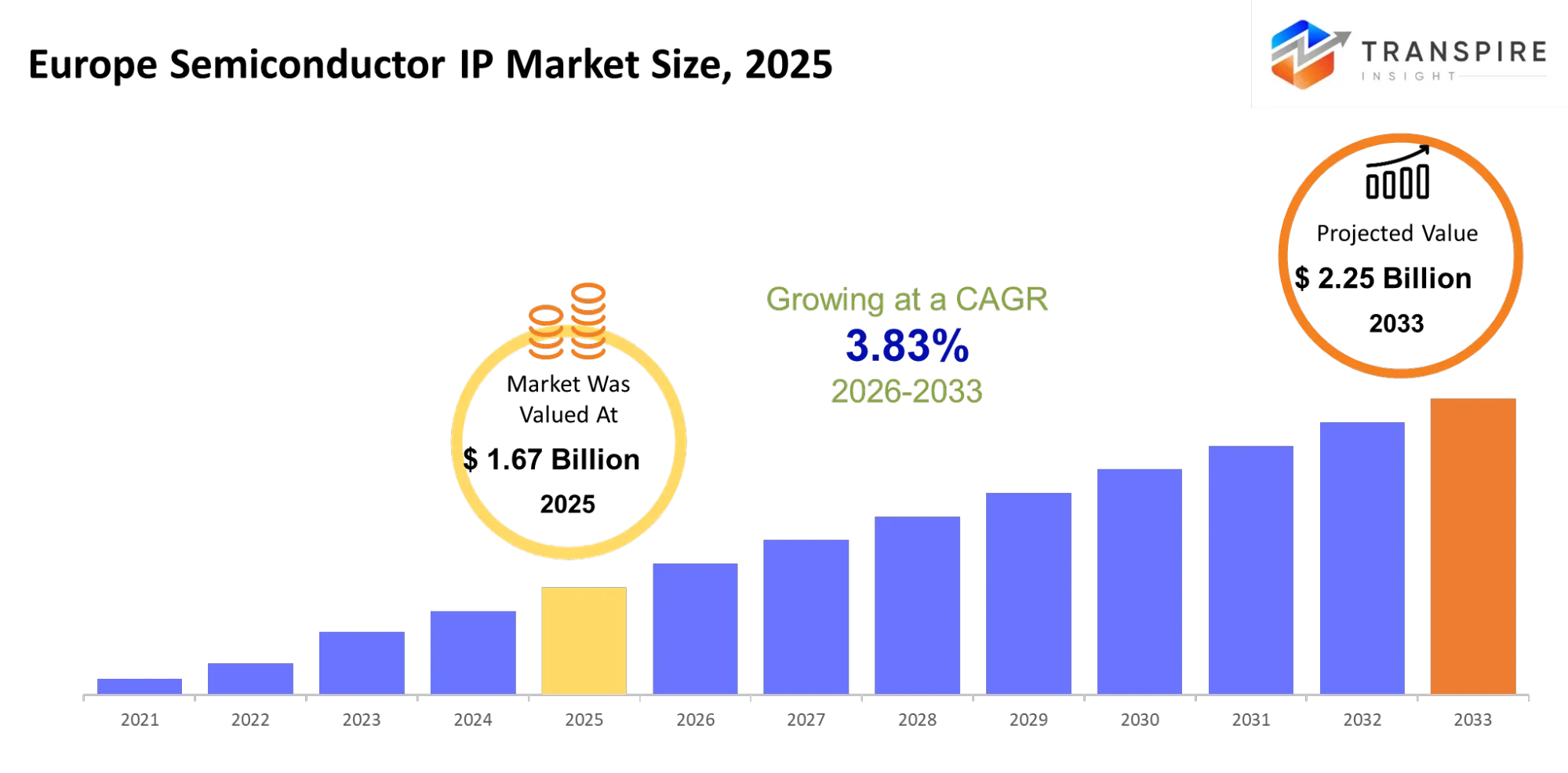
- Europe Semiconductor IP Market Size 2025: USD 1.67 Billion
- Europe Semiconductor IP Market Size 2033: USD 2.25 Billion
- Europe Semiconductor IP Market CAGR: 3.83%
- Europe Semiconductor IP Market Segments: By IP Core Type (Processor IP, Interface IP, Memory IP, Digital IP, Analog IP, Others); By Design (Soft IP, Hard IP, Firm IP, Others); By Application (Consumer Electronics, Automotive, Industrial, Telecom, Healthcare, Others); By Processor (32-bit, 64-bit, Multi-core, Others); By Enterprise Size (Large Enterprises, SMEs, Others); By End User (Fabless Companies, IDMs, Foundries, Others)
Europe Semiconductor IP Market Summary
The Europe Semiconductor IP Market was valued at USD 1.67 billion in 2025. It is forecast to reach USD 2.25 billion by 2033. That is a CAGR of 3.83% over the period.
The Europe Semiconductor IP Market is like the foundation of a house it provides the parts that are used to design chips. This helps companies put together parts like processor cores and interface modules to make complex systems. In terms it saves time and money for companies that make electronics for cars, factories and super computers by letting them make new chips faster for devices that are connected and smart.
In the few years there has been a big change in how chips are designed. Now companies are using intelligence to design chips and put many things on one chip. This change happened because there were problems, with getting the parts needed to make chips so companies had to find a way to make them faster and not rely on making everything from scratch. As a result companies started wanting to use parts that were already made and could be used again in cars and factories.
This change is making companies that make chips and other companies that use them want to use a modular way of designing things. This means they can make new things faster for cars, smart cars and computers that can do many things at the same time. The Europe Semiconductor IP Market is also growing because companies need parts to make their chips use less power and work better. This is happening over Europe and it is changing how chips are made.
Key Market Insights
- The Europe Semiconductor IP Market changed after 2022 to focus more on AI-assisted chip design. This shift increased the use of modular IP blocks across various industries.
- Companies are reusing Semiconductor IP often. In fact the reuse rate went up by 30% between 2023 and 2025. This happened because companies wanted to reduce the costs of designing custom chips.
- Western Europe has the share of the market with over 45% in 2025. This is due to its automotive and semiconductor research and development ecosystems.
- Eastern Europe is growing fast. Will continue to do so until 2030. The reason is that more companies are outsourcing semiconductor design and there is an increase in engineering talent in the region.
- Processor IP and interface IP are the popular types. They are in demand for use in automotive and high-performance computing applications.
- Memory and security IP are growing rapidly. This is because of the increasing need for connected vehicles and IoT systems.
- The main demand for Semiconductor IP comes from the industry. This is driven by the need for driver-assistance systems, electric vehicle control systems and software-defined vehicle architecture.
- Industrial and data center applications are also growing quickly. This is because AI workloads are making semiconductor requirements more complex.
- Companies like Arm, Synopsys, Cadence Siemens EDA and Imagination Technologies are improving their IP portfolios. They are using AI-enabled design tools. Forming partnerships with other companies in the ecosystem.
- A companys competitive advantage depends on its design efficiency, verification speed and compatibility with advanced semiconductor process nodes those, below 10nm.
What are the Key Drivers, Restraints, and Opportunities in the Europe Semiconductor IP Market?
Drivers
The Europe Semiconductor IP Market is driven by a change towards putting everything on one chip and using artificial intelligence to design these chips. This is happening because cars, factories and computers are getting more complex and need cheaper design solutions. So companies that make semiconductors are using parts they already have to make chips faster which means they make more money from licensing and more people use these designs.
Restraints
One big problem in this market is that it needs skilled engineers and complicated processes to check everything, which slows down the process of putting these parts together and makes it hard for smaller companies to grow. This is a hurdle because making semiconductor IP needs a lot of expertise time to test and the ability to work with different manufacturing technologies. As a result new products take longer to come out and cost more for new semiconductor companies to design.
Opportunity
There is a chance for companies that use artificial intelligence to help design and check these semiconductor parts. Companies that invest in these tools and systems are getting ahead in the car and edge computing industries. As Europe works to become more independent in semiconductors local companies will be able to make and use their semiconductor IP which will lead to faster innovation, in the Europe Semiconductor IP Market over time.
What Has the Impact of Artificial Intelligence Been on the Europe Semiconductor IP Market?
Europes semiconductor IP ecosystem is changing because of intelligence and advanced digital technologies. These technologies are making it easier to design, verify and optimize chip architectures. Artificial intelligence is being used more and more in EDA workflows to automate the verification of IP blocks. This means that people do not have to do much manual design work and it is easier to make sure that everything is consistent across processor cores, interface modules and memory IP.
This has made it possible to put IP into system-on-chip designs that are used in automotive electronics and industrial applications. Artificial intelligence is making a difference in the way that chips are designed. It is helping to improve the way that chips work and making them more efficient.
Machine learning models are being used to predict how well semiconductor designs will perform. They help with things like power efficiency, signal integrity and thermal behavior. These models let engineers try out design scenarios before they actually make the chips. This reduces the number of times they have to try something. It makes it more likely that the chip will work right the first time. As a result it is taking time to develop chips and the design process is getting more efficient. The cost of developing chips is also going down for advanced semiconductor nodes that are smaller than 10nm.
However there is still a problem. It is very expensive and complicated to use intelligence to design IP across old semiconductor workflows. Many design environments are still using lots of tools that do not work well together. This makes it hard to use intelligence seamlessly and it slows down the automation process. With these problems more and more semiconductor companies are using artificial intelligence because they want to be able to design chips faster and make them more reliable and efficient. This is especially true, in Europes artificial intelligence and edge computing ecosystems.
Key Market Trends
- The Europe Semiconductor IP Market changed a lot after 2022 because of tools that use Artificial Intelligence to help with design. This made it easier to automate the process of checking and building chips.
- A lot of semiconductor companies started to use IP reuse often between 2023 and 2025. This helped them save money and time when it came to designing chips. The number of companies doing this went up by 30 percent.
- In 2025 Western Europe was still the player in the Europe Semiconductor IP Market. This was because of all the research and development going on in the semiconductor field. They also had a system in place for designing advanced chips.
- After 2024 Eastern Europe started to grow fast as a place where companies could outsource their design work. This was possible because they had a lot of engineers who were good at their jobs.
- The processor and interface IP segments became really popular because of the demand for automotive System on Chip and Artificial Intelligence computing applications.
- The security and memory IP segments also grew fast because more and more connected vehicles and edge computing systems were being made.
- The biggest reason for the growth of the Europe Semiconductor IP Market was the industry. This was because of the need for Advanced Driver Assistance Systems and software-defined vehicle architectures.
- The industrial and data center applications also started to use semiconductor IP because of the complex Artificial Intelligence work they were doing and the expansion of cloud infrastructure.
- Companies like Arm, Synopsys, Cadence Siemens EDA and Imagination Technologies made their Artificial Intelligence-enabled IP development platforms stronger since 2024.
- To stay competitive companies started to focus on making the design process working with other companies and making sure their products were compatible with the latest semiconductor technology that is less, than 10 nanometers.
Europe Semiconductor IP Market Segmentation
By Design IP Type
The Europe Semiconductor IP Market is divided into types like processor IP, interface IP, memory IP, analog IP, security IP, standard cell libraries and others. The processor IP and interface IP are used a lot because the systems in electronics and AI computing systems are getting more complex. The memory IP and security IP are also getting more popular as people want to process data and store it efficiently on digital platforms that are connected.
By IP Source Model
The market has ways of getting IP like licensed IP, royalty-based IP, subscription-based IP open source IP and custom IP development. Most people prefer licensed IP and royalty-based IP because they are tried and tested and they save time when designing. Some smaller companies are now using subscription-based IP and open-source IP because they are flexible and cost-effective.

By Application
The Europe Semiconductor IP Market is used in areas like automotive electronics, consumer electronics, industrial automation, data centers, artificial intelligence systems, IoT devices and others. Automotive electronics is the area because more people are buying electric vehicles and cars with advanced driver assistance systems. Data centers and AI systems are also growing fast because they need to process a lot of data.
By End User
The people who use the Europe Semiconductor IP Market include semiconductor foundries, fabless companies, integrated device manufacturers, system OEMs, automotive OEMs and technology firms. Fabless companies and automotive OEMs are using it a lot because they outsource chip design and vehicle electronicsre getting more complex and software-driven.
By Technology Node
The market is divided into technology nodes like below 10nm, 10–28nm above 28nm and advanced nodes. The nodes below 10nm are getting fast because they are needed for AI and high-performance computing. The older nodes are still used for applications that're sensitive to cost and legacy semiconductor applications.
By Functionality
The Europe Semiconductor IP Market is divided into design IP, verification IP, implementation IP, embedded IP, connectivity IP and others. The verification IP and design IP are used a lot because semiconductors are getting more complex. The connectivity IP is also getting important because people want chips that can work together and are integrated. The Europe Semiconductor IP Market is, about the Europe Semiconductor IP Market and its different segments.
What are the Key Use Cases Driving the Europe Semiconductor IP Market?
The Europe Semiconductor IP Market is mainly driven by people making system-on-chip designs for car electronics. This is where processor IP and interface IP come in which helps put things like ADAS and EV control systems and fancy infotainment systems. This is the use because car makers need to make chips faster and they need parts that are reliable and can be used again to meet the strict rules for safety and performance.
There are also areas where this is used, like artificial intelligence and industrial automation systems. Here companies that do not make their chips and technology firms use memory IP and security IP to help with fast computing and keeping data safe. Data centers are also starting to use IP to make their systems work better and to make chip design less complicated.
New areas where this is being used include edge computing and software-defined vehicle architectures. In these areas connectivity IP and embedded IP help devices, cars and buildings talk to each other in time. These areas are getting more popular as Europe starts to use mobility and industrial systems that use artificial intelligence, which need semiconductor designs that are flexible and work well. The Europe Semiconductor IP Market is really important, for all these things.
|
Report Metrics |
Details |
|
Market size value in 2025 |
USD 1.67 Billion |
|
Market size value in 2026 |
USD 1.73 Billion |
|
Revenue forecast in 2033 |
USD 2.25 Billion |
|
Growth rate |
CAGR of 3.83% from 2026 to 2033 |
|
Base year |
2025 |
|
Historical data |
2021 - 2024 |
|
Forecast period |
2026 - 2033 |
|
Report coverage |
Revenue forecast, competitive landscape, growth factors, and trends |
|
Regional scope |
Europe |
|
Key company profiled |
Arm Holdings, Synopsys, Cadence Design Systems, Siemens EDA, Alphawave IP, Rambus, Ceva, VeriSilicon, Imagination Technologies, Arteris, eMemory, Dolphin Design, Silvaco, Faraday Technology, Lattice Semiconductor |
|
Customization scope |
Free report customization (country, regional & segment scope). Avail customized purchase options to meet your exact research needs. |
|
Report Segmentation |
By IP Core Type (Processor IP, Interface IP, Memory IP, Digital IP, Analog IP, Others); By Design (Soft IP, Hard IP, Firm IP, Others); By Application (Consumer Electronics, Automotive, Industrial, Telecom, Healthcare, Others); By Processor (32-bit, 64-bit, Multi-core, Others); By Enterprise Size (Large Enterprises, SMEs, Others); By End User (Fabless Companies, IDMs, Foundries, Others) |
Which Regions are Driving the Europe Semiconductor IP Market Growth?
Western Europe leads the Europe Semiconductor IP Market due to its strong semiconductor design ecosystem, advanced automotive electronics industry, and early adoption of AI-driven chip development. Countries such as Germany and France host major automotive OEMs and semiconductor design hubs, which continuously demand high-performance processor IP and interface IP. Strong regulatory frameworks supporting vehicle safety, electrification, and digital infrastructure further reinforce adoption across automotive and industrial applications.
Northern Europe represents a stable and innovation-driven contributor to the market, supported by high digital maturity and consistent investment in advanced electronics and cloud infrastructure. Unlike Western Europe’s scale-driven dominance, this region benefits from steady integration of semiconductor IP into industrial automation and clean energy technologies. Strong economic resilience and predictable regulatory rollout ensure continuous demand for memory IP, security IP, and connectivity-focused semiconductor design solutions.
Eastern Europe is the fastest-growing region, driven by increasing semiconductor design outsourcing and rising engineering capabilities. Recent investments in technology parks and R&D centers have strengthened the region’s position as a cost-efficient hub for IP development and verification services. Expanding automotive electronics manufacturing and growing participation in global semiconductor supply chains are accelerating adoption, making the region a key growth opportunity for the 2026–2033 period for IP vendors and design service providers.
Who are the Key Players in the Europe Semiconductor IP Market and How Do They Compete?
The Europe Semiconductor IP Market is moderately consolidated, with a small group of global IP providers controlling advanced processor, interface, and verification technologies while smaller niche firms focus on specialized design services. Competition is primarily driven by technology innovation and design efficiency rather than pricing, as customers prioritize performance, compatibility with advanced nodes, and faster chip development cycles. Incumbents are actively defending market share by expanding AI-enabled design platforms and strengthening ecosystem integration with semiconductor foundries and automotive OEMs.
Arm Holdings focuses on processor IP architectures optimized for energy efficiency and scalable performance in automotive and AI-driven applications. Its competitive advantage lies in widespread ecosystem adoption and strong compatibility across system-on-chip designs. Expansion is supported through deeper partnerships with automotive and cloud computing firms to accelerate software-defined architecture deployment.
Synopsys strengthens its position through leadership in verification IP and EDA-integrated design ecosystems. Its differentiation comes from end-to-end chip design automation capabilities that reduce development cycles for semiconductor companies. Growth is driven by acquisitions and integration of AI-based design optimization tools into its IP portfolio.Cadence Design Systems competes through advanced design and simulation IP solutions, particularly in mixed-signal and system-level verification. Its advantage lies in high-performance simulation accuracy and tight integration with foundry processes. Expansion is supported by strategic collaborations with chip manufacturers to enable next-generation AI and automotive semiconductor development workflows.
Company List
- Arm Holdings
- Synopsys
- Cadence Design Systems
- Siemens EDA
- Alphawave IP
- Rambus
- Ceva
- VeriSilicon
- Imagination Technologies
- Arteris
- eMemory
- Dolphin Design
- Silvaco
- Faraday Technology
Recent Development News
In July 2025, Synopsys announced the completion of its acquisition of Ansys following final regulatory approval. The integration strengthened its semiconductor IP and design ecosystem by combining EDA tools with advanced multiphysics simulation, enabling faster chip-to-system development cycles across automotive and AI applications.https://www.tomshardware.com
In April 2023–2025, Synopsys advanced its AI-driven physical design and IP automation capabilities through enhanced Fusion Compiler and macro placement technologies. These upgrades improved semiconductor IP integration efficiency by optimizing large-scale IP blocks and reducing floorplanning complexity in advanced-node chip design workflows.https://arxiv.org
What Strategic Insights Define the Future of the Europe Semiconductor IP Market?
The Europe Semiconductor IP Market is moving toward a highly automated, AI-assisted chip design ecosystem where reusable IP blocks and system-level integration will define competitive advantage. This shift is driven by rising demand for software-defined vehicles, advanced AI workloads, and accelerating complexity in semiconductor architectures that require faster design cycles and lower engineering cost. As chip designs move toward heterogeneous integration, IP licensing models will become central to semiconductor value creation across automotive and industrial applications.
A key hidden risk lies in over-dependence on a small group of dominant IP providers, which creates structural concentration risk across Europe’s semiconductor design ecosystem. Any disruption in licensing access, pricing control, or ecosystem compatibility could significantly slow innovation cycles and increase development costs for downstream industries.
An emerging opportunity is the expansion of AI-native semiconductor IP design platforms that automate architecture generation and verification. These tools are beginning to reduce manual design dependency and enable faster customization for automotive and edge AI applications. Market participants should prioritize investment in AI-enabled IP ecosystems and cross-industry partnerships to secure long-term positioning as design cycles become increasingly software-driven and time-sensitive.
Europe Semiconductor IP Market Report Segmentation
By Design IP Type
- Processor IP
- Interface IP
- Memory IP
- Analog IP
- Security IP
- Standard Cell Libraries
- Others
By IP Licensing Model
- Licensed IP
- Royalty-Based IP
- Subscription-Based IP
- Open Source IP
- Custom IP Development
- Others
By Application
- Automotive Electronics
- Industrial Automation
- Consumer Electronics
- Data Centers
- Artificial Intelligence Systems
- IoT Devices
- Others
By End User
- Fabless Semiconductor Companies
- Semiconductor Foundries
- Integrated Device Manufacturers
- System OEMs
- Automotive OEMs
- Technology Firms
- Others
By Technology Node
- Below 10nm
- 10–28nm
- Above 28nm
- Advanced Nodes (Others)
By Functionality
- Design IP
- Verification IP
- Implementation IP
- Embedded IP
- Connectivity IP
- Others
Frequently Asked Questions
Find quick answers to common questions.
The expected Europe Semiconductor IP Market size for the market will be USD 2.25 Billion in 2033.
Key segments for the Europe Semiconductor IP Market are By IP Core Type (Processor IP, Interface IP, Memory IP, Digital IP, Analog IP, Others); By Design (Soft IP, Hard IP, Firm IP, Others); By Application (Consumer Electronics, Automotive, Industrial, Telecom, Healthcare, Others); By Processor (32-bit, 64-bit, Multi-core, Others); By Enterprise Size (Large Enterprises, SMEs, Others); By End User (Fabless Companies, IDMs, Foundries, Others).
Major Europe Semiconductor IP Market players are Arm Holdings, Synopsys, Cadence Design Systems, Siemens EDA, Alphawave IP, Rambus, Ceva, VeriSilicon, Imagination Technologies, Arteris, eMemory, Dolphin Design, Silvaco, Faraday Technology, Lattice Semiconductor.
The Europe Semiconductor IP Market size is USD 1.67 Billion in 2025.
The Europe Semiconductor IP Market CAGR is 3.83% from 2026 to 2033.
- Arm Holdings
- Synopsys
- Cadence Design Systems
- Siemens EDA
- Alphawave IP
- Rambus
- Ceva
- VeriSilicon
- Imagination Technologies
- Arteris
- eMemory
- Dolphin Design
- Silvaco
- Faraday Technology
About the Authors

Avinash Kumar
I’m Avinash Kumar, a Senior Research Analyst at Transpire Insight, with expertise in the Electronics and Semiconductor and Energy & Power industry. My work focuses on analyzing emerging technologies, market trends, industry developments, and innovation across these sectors. I specialize in transforming complex technical and market insights into clear, research-backed content that helps professionals, businesses, and decision-makers stay informed. Through continuous industry research and data-driven analysis, I strive to deliver accurate, reliable, and practical perspectives on the latest advancements shaping the semiconductor and energy landscape.

Chakradhar Khansole
Chakradhar serves as the Research Director at Transpire Insight, bringing over 8 years of experience in technology, innovation, and strategic market intelligence. He specializes in transforming complex market data into actionable business insights that enable organizations to make informed, growth-oriented decisions. Recognized for his strategic vision and analytical expertise, Chakradhar leads high-impact research initiatives, delivering comprehensive market assessments, competitive intelligence, and forward-looking industry analysis.
Recently Published Reports
-
Apr 2026
Fiber Optic Faceplates Market
Fiber Optic Faceplates Market Size, Share & Analysis Report By Type (< 300 mm2, 300-350 mm2, and > 350 mm2, By Application (Night Vision, Holographic Imaging, Medical, and Others), and Geography (North America, Europe, Asia-Pacific, Middle East and Africa, South and Central America), 2021 - 2031
-
Apr 2026
High Temperature Superconductors Market
High Temperature Superconductors Market Size, Share & Analysis Report By Type (1G HTS, and 2G HTS), By Application (Power Cable, Fault Current Limiter, and Transformer), and Geography (North America, Europe, Asia-Pacific, Middle East and Africa, South and Central America), 2021 - 2031
-
Apr 2026
Industrial Plugs and Socket Market
Industrial Plugs and Socket Market Size, Share & Analysis Report By Type (Industrial Plugs, Industrial Sockets), By Current (Up to 32 A, 32 to 125 A, Above 125 A), By Protection (Dustproof and Splash Proof, Waterproof, Explosion Proof), By End User (Heavy Industries, Oil and Gas, Chemicals and Pharmaceuticals, Power Generation, Others), and Geography (North America, Europe, Asia-Pacific, Middle East and Africa, South and Central America), 2021 - 2031
-
Apr 2026
InGaAs Avalanche Photodiodes Market
InGaAs Avalanche Photodiodes Market Size, Share & Analysis Report By Type (1100 - 1700 nm, and 1000 - 1600 nm), By Application (Missile Warning System, Muzzle Flash Detection, Wafer Defect Inspection, Laser Rangefinders, and Others), and Geography (North America, Europe, Asia-Pacific, Middle East and Africa, South and Central America), 2021 - 2031