
Europe Scrap Metal Recycling Market Size & Forecast:
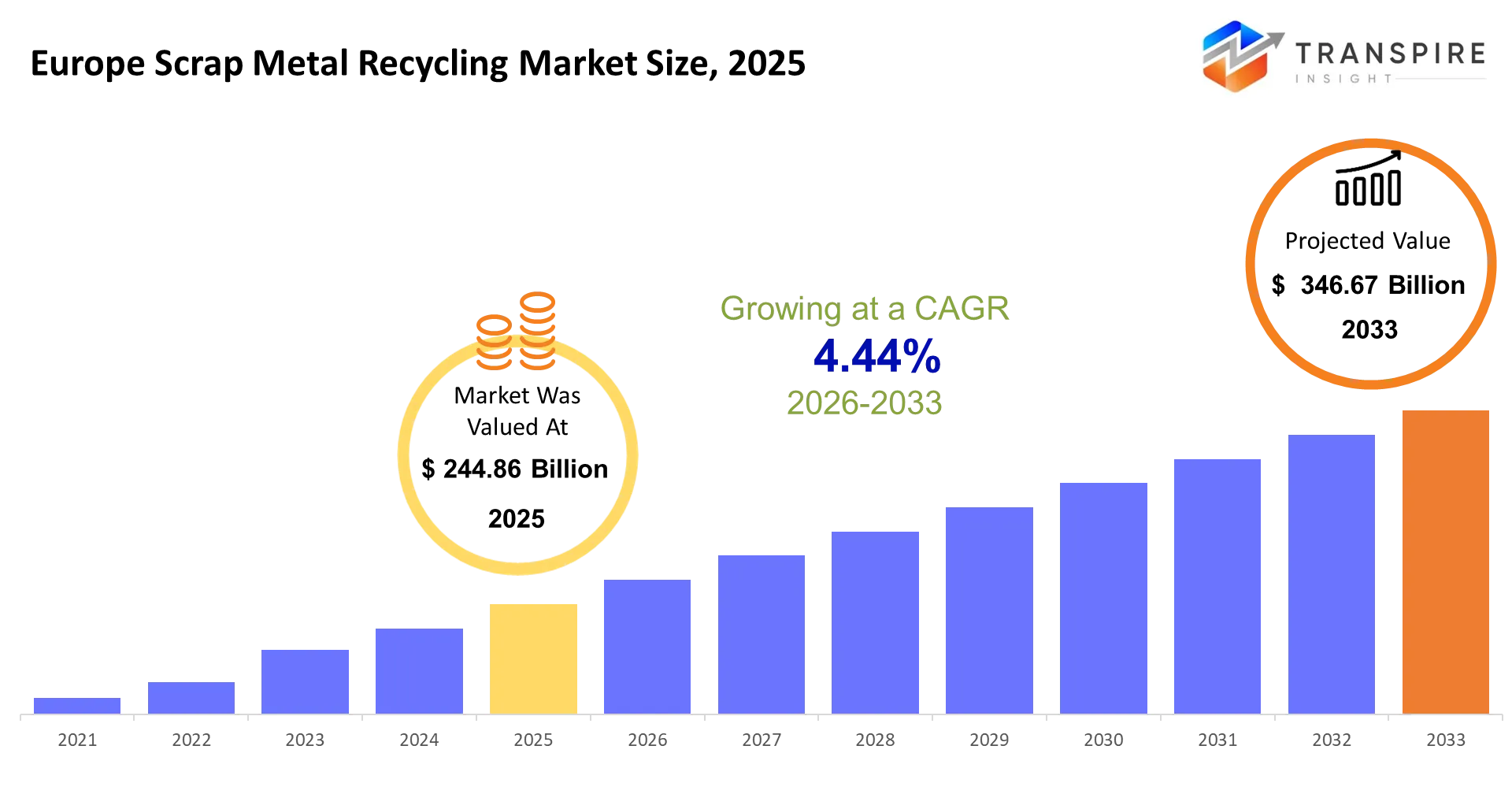
- Europe Scrap Metal Recycling Market Size 2025: USD 244.86 Billion
- Europe Scrap Metal Recycling Market Size 2033: USD 346.67 Billion
- Europe Scrap Metal Recycling Market CAGR: 4.44%
- Europe Scrap Metal Recycling Market Segments: By Type (Ferrous Metals, Non-ferrous Metals, Precious Metals, Others); By Application (Construction, Automotive, Manufacturing, Electronics, Others); By End-User (Industrial, Commercial, Government, Recycling Firms, Others); By Process (Collection, Processing, Trading, Smelting, Others)
To learn more about this report,  Download Free Sample Report
Europe Scrap Metal Recycling Market Summary
The Europe Scrap Metal Recycling Market was valued at USD 244.86 Billion in 2025. It is forecast to reach USD 346.67 Billion by 2033. That is a CAGR of 4.44% over the period.
The Europe Scrap Metal Recycling Market processes end-of-life vehicles demolished infrastructure ship dismantling outputs and industrial scrap to produce reusable ferrous and non-ferrous metals which serve both steel production and manufacturing needs. The system enables construction and automotive and maritime repair ecosystems to obtain materials at lower costs while decreasing their need for imported raw ores. The system now provides essential support to European heavy industries by maintaining their raw material needs while enabling them to achieve their circular manufacturing objectives.
The market has shifted toward electric arc furnace steelmaking during the past three to five years because this method requires scrap metal as its primary input material. The implementation of AI sorting systems together with sensor-based material recovery technologies has created better quality scrap materials while making processing operations more effective. The post-2022 energy crisis together with the Russian-Ukrainian conflict induced geopolitical disruptions created real-world conditions which restricted raw material supplies and increased the costs of virgin metal.
Recycled metals became more economically attractive because of these combined forces which resulted in higher domestic scrap retention and faster development of advanced recycling facilities. Revenue growth now depends on three factors which include processing efficiency material purity and regional supply security rather than on the availability of scrap materials.
Key Market Insights
- The Scrap Metal Recycling Market in Europe is dominated by Western Europe which holds a market share of almost 42% for 2025 because of its superior steel recycling facilities and high number of industrial operations.
- Northern Europe will experience its fastest growth because the region has implemented advanced circular economy policies which enable it to attain high collection efficiency rates from 2025 until 2030.
- Eastern Europe shows rising participation because industrial modernization leads to increased scrap production and cross-border recycling activities.
- The recycling of ferrous scrap materials dominates the market with approximately 65% market share which will continue until 2025 because of strong demand for steel production.
- Non-ferrous recycling holds the second-largest market share which comes from aluminum and copper recovery that originates in the automotive and electronic industries.
- The segment of e-scrap processing will experience its highest growth rate between 2025 and 2030 because of fast-paced electronics turnover and mandatory e-waste regulatory requirements.
- The Europe Scrap Metal Recycling Market receives its main driving force from steel manufacturing which accounts for almost 55% market share because the industry depends on recycled steel to produce their products.
- The automotive dismantling process shows the fastest growth rate because the electric vehicle transition system needs both vehicle recycling and battery material recovery processes.
- The construction sector holds its status as the biggest end-user market because they recycle scrap materials from demolition work and infrastructure construction projects.
- The automotive sector displays the highest growth rate among all end-user segments because electric vehicle adoption increases and new regulations for recycling end-of-life vehicles emerge.
What are the Key Drivers, Restraints, and Opportunities in the Europe Scrap Metal Recycling Market?
The Europe Scrap Metal Recycling Market is primarily driven by strict EU decarbonization policies that mandate lower carbon intensity in steel and manufacturing supply chains. Electric arc furnace steel production has become more popular because steelmakers now prefer using recycled scrap metal instead of iron ore. The regulatory push for carbon pricing through the EU Emissions Trading System has generated higher demand for premium ferrous scrap which enables recyclers to achieve better revenue stability through permanent supply contracts with steel manufacturers.
Member states face a critical challenge because scrap collection systems remain uncoordinated and materials collectors deliver unsteady scrap quality. Various industrial scrap streams exhibit different contamination levels which create processing challenges and result in higher sorting expenses. The structural problem persists because Western Europe possesses better infrastructure than Eastern Europe which prevents recovery operations from being standardized throughout the area. The strong market demand indicates that recyclers should expand their operations however they must deal with diminishing profit margins.
Advanced digital sorting and AI-enabled material recovery systems which automotive manufacturers deploy at their German and Dutch hubs present an innovative market opportunity. These technologies enhance purity rates while enabling the extraction of high-value copper and aluminum applications from non-ferrous metals. The automotive industry increasingly establishes closed-loop recycling partnerships with firms like Aurubis which create integrated supply chains that decrease their need for raw materials. These ongoing developments will establish Europe as the top global authority on advanced circular metal recovery systems which use high-efficiency technologies.
What Has the Impact of Artificial Intelligence Been on the Europe Scrap Metal Recycling Market?
The Europe Scrap Metal Recycling Market undergoes transformation through artificial intelligence which enhances the detection and categorization and treatment of scrap materials in industrial recycling systems. The AI-based vision systems perform automatic scrap sorting at dismantling yards through their ability to identify metal materials using image analysis methods which exceed the accuracy of human sorting methods. The system enables recycling facilities that operate at high capacity to process materials more quickly while delivering better production results to steel manufacturing companies and metallurgy processing plants.
The company uses machine learning models to perform predictive maintenance on shredders and conveyors and smelting equipment by studying vibration and thermal information to anticipate equipment failures before they happen. The system has increased operational availability because it minimizes unexpected equipment breakdowns while it extends the operational lifespan of equipment, which benefits large industrial facilities that ArcelorMittal operates. The AI-based route optimization systems in recycling operations that depend on logistics systems help optimize scrap collection processes which result in reduced transportation expenses while decreasing fuel usage throughout the various regional transportation systems.
The recycling industry faces a major challenge because standardized training data of high quality remains inaccessible for its different waste streams. The model's precision decreases in actual industrial settings because there are different types of scrap materials and various levels of contamination present in cross-border industrial operations. The companies achieve higher cost efficiency and better regulatory compliance through their ongoing implementation of sensor-based automation systems and digital material tracking solutions which have established German and Dutch advanced recycling facilities as the first AI-based circular metal processing operations in Europe.
Key Market Trends
- The European Scrap Metal Recycling Market transitioned from its previous waste management system, which relied on landfill disposal, to its current system, which requires EU member states to implement circular economy regulations according to the EU Green Deal requirements.
- The European steel industry saw its Electric arc furnace steel production operations depend on recycled scrap materials for more than 40% of its requirements between 2021 and 2025 across major European steelmaking companies.
- The Netherlands and Germany established new AI-enabled scrap sorting centers after 2023, which enabled them to better recover materials and decrease contamination levels.
- The energy crisis of 2022 forced companies to stop using imported materials and start utilizing recycled domestic scrap, which led to supply chain transformations.
- The companies ArcelorMittal and Tata Steel Europe expanded their financial support for closed-loop recycling programs after 2024 because this method enabled them to obtain low-carbon feedstock materials.
- The automotive original equipment manufacturers (OEMs) changed their production process from traditional manufacturing methods to new vehicle recycling systems, which became required by European Union (EU) regulations for product end-of-life management.
- Eastern European countries established stricter regulations for scrap exports after 2023, which led to a regional shift in waste management practices toward establishing domestic recycling facilities.
- The recovery efficiency of non-ferrous metals increased by almost 30% during the period from 2022 to 2025 because companies implemented sensor technology for sorting operations.
- The market competition changed from companies collecting scrap materials based on volume to processors working with high-purity materials because clean scrap received higher value in the market.
- The introduction of digital tracking systems after 2024 improved the visibility of scrap supply chains, which resulted in a decrease of illegal waste disposal and unlicensed international movement of waste materials.
Europe Scrap Metal Recycling Market Segmentation
By Type:
The Europe Scrap Metal Recycling Market recognizes ferrous metals as its primary material because these metals are used extensively to produce steel and support major construction projects. Ferrous scrap remains the dominant material in trade because demolition sites and obsolete vehicles provide a steady supply of this material.
The automotive industry and electronics manufacturing processes require aluminum and copper materials which make up non-ferrous metals as a smaller yet valuable segment of their market share. Industrial and electronic waste streams produce precious metals which exist as niche materials because they have low recovery rates but extremely valuable extraction potential. The non-ferrous recovery process will develop at a faster rate throughout the forecast period because of increased EV adoption which compels recyclers to use new technologies for material value extraction through advanced separation and purification methods.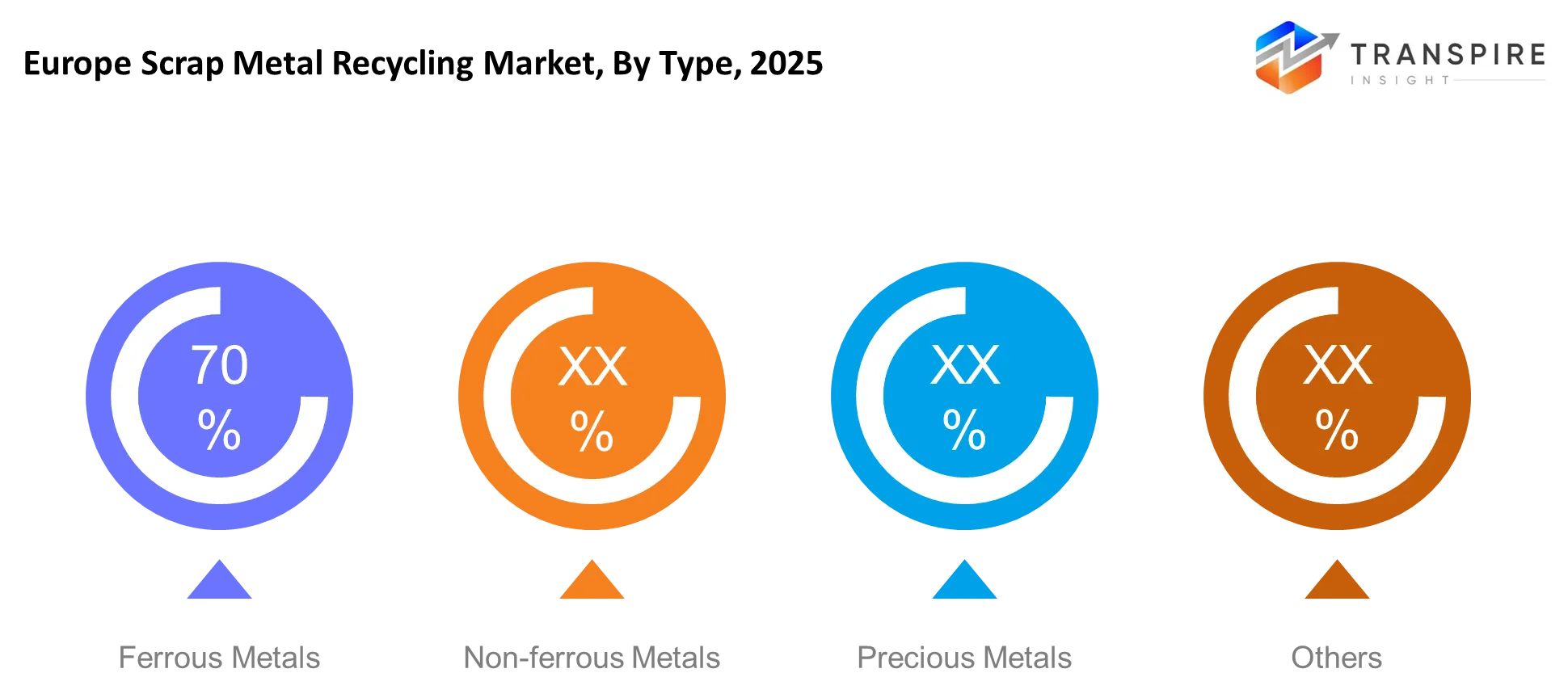
To learn more about this report, Download Free Sample Report
By Application:
The European scrap metal recycling industry receives its main demand from construction activities which require continuous infrastructure development and the demolition of obsolete urban buildings. The steel beam and reinforcement material scrap market segment generates consistent scrap material which supports its operation. The automotive industry is experiencing rapid growth because end-of-life vehicle regulations are becoming stricter and electric vehicle production requires more recyclable materials.
Manufacturing processes generate substantial industrial waste streams while the electronics recycling sector is growing because of the high speed at which devices become obsolete. The recycling industry for automotive materials will experience quick growth because battery-electric vehicles will soon enter their final stages of use which will require recyclers to develop new methods for recovering mixed materials and implementing advanced sorting technology.
By End-User:
Industrial users account for the largest share of scrap metal recycling demand because manufacturing waste continues to be generated and steel production remains high. The recycling industry operates as a vital intermediary which collects and processes scrap materials and sells them to different supply chain partners. Through their regulatory measures and infrastructure development initiatives government bodies create demand which drives their enforcement activities and their EU circular economy implementation efforts.
The construction industry together with service-related waste streams creates waste generation which produces ongoing waste streams for commercial sectors. The recycling industry will empower its operational capabilities throughout the upcoming period because industry consolidation will enable major companies to develop automated systems and effective waste treatment facilities.
By Process:
Collection services serve as the fundamental element which drives the Europe Scrap Metal Recycling Market because proper material aggregation defines the subsequent processing stages that determine overall processing results. The processing stage creates maximum value because it uses sorting and shredding and separation technologies to achieve material purity which determines resale value. Trading operates as the primary liquidity mechanism which links scrap suppliers to steel producers and industrial customers.
The smelting process stands as the most expensive production stage which transforms treated scrap into reusable metal feedstock for manufacturing purposes. The processing field will develop into the most technologically advanced area because AI-driven sorting systems and sensor technology will enhance operational efficiency while decreasing contamination levels and boosting profits for recycling companies which use advanced recycling methods.
What are the Key Use Cases Driving the Europe Scrap Metal Recycling Market?
The core demand for scrap metal recycling in Europe exists because steel production requires recycled ferrous scrap as its main input. Electric arc furnace operations rely heavily on scrap feedstock to replace iron ore, which leads to both lower carbon emissions and reduced production expenses. Large steelmakers use consistent scrap supply as their primary method to fulfill EU decarbonization standards and to handle carbon pricing pressures.
The recycling networks benefit from automotive dismantling and construction demolition, which generate substantial amounts of recoverable metals. The recycling of end-of-life vehicles is increasing because electric vehicles become more popular, while infrastructural development projects in Germany and France produce continuous steel scrap supplies for industrial recycling facilities.
The emergence of new applications enables the recovery of advanced electronics through industrial waste streams, which includes the extraction of copper and rare metals for clean energy systems. The process of decommissioning offshore wind infrastructure has gained importance as aging turbines enter their recycling phases, which drives the need for exact metal recovery methods.
|
Report Metrics |
Details |
|
Market size value in 2025 |
USD 244.86 Billion |
|
Market size value in 2026 |
USD 255.72 Billion |
|
Revenue forecast in 2033 |
USD 346.67 Billion |
|
Growth rate |
CAGR of 4.44% from 2026 to 2033 |
|
Base year |
2025 |
|
Historical data |
2021 - 2024 |
|
Forecast period |
2026 - 2033 |
|
Report coverage |
Revenue forecast, competitive landscape, growth factors, and trends |
|
Regional scope |
Europe (Germany, United Kingdom, France, Italy, Spain, Rest of Europe) |
|
Key company profiled |
ArcelorMittal, Sims Metal Management, Nucor, European Metal Recycling, Schnitzer Steel, Tata Steel, Aurubis, Commercial Metals Company, Gerdau, Liberty Steel, OmniSource, Kuusakoski, SA Recycling, David J Joseph, EMR Group |
|
Customization scope |
Free report customization (country, regional & segment scope). Avail customized purchase options to meet your exact research needs. |
|
Report Segmentation |
By Type (Ferrous Metals, Non-ferrous Metals, Precious Metals, Others); By Application (Construction, Automotive, Manufacturing, Electronics, Others); By End-User (Industrial, Commercial, Government, Recycling Firms, Others); By Process (Collection, Processing, Trading, Smelting, Others) |
Which Regions are Driving the Europe Scrap Metal Recycling Market Growth?
Western Europe leads the Europe Scrap Metal Recycling Market because it operates advanced industrial facilities and enforces stringent environmental regulations. The recycling infrastructure of Germany, France, and the Netherlands operates at a high development level because their regions contain extensive steel production facilities and active construction projects. The European Union circular economy rules effectively restore scrap materials because demolition sites and automotive dismantling centers maintain efficient material transportation systems. The integrated port systems enable scrap material export and regional trading activities which enhance supply chain reliability. The combination of three factors which include regulatory requirements and manufacturing needs as well as developed processing facilities enables the region to maintain its market dominance.
Northern Europe serves as a dependable market participant whose growth pattern differs from Western Europe's capacity-based expansion. The countries of Sweden, Denmark, and Finland develop recycling operations which achieve high efficiency through their use of modern industrial automation and renewable energy solutions. The area concentrates on achieving material purity through energy-efficient processing methods which it uses for its steel and metal refining operations. The combination of strong environmental regulations and steady industrial funding from existing manufacturers results in constant scrap generation patterns. Northern Europe provides European manufacturers and export markets with reliable access to high-quality recycled metals through its stable supply system.
The fastest expanding area of the Europe Scrap Metal Recycling Market operates through industrial upgrades and growing adoption of EU environmental regulations in Eastern Europe. Poland, Romania, and the Czech Republic receive new financial backing which establishes better recycling facilities and more efficient scrap material collection systems. After 2023 EU funding programs together with infrastructure enhancements led to increased use of formal recycling systems instead of unregulated scrap processing methods. The process develops regional supply chains into organized systems which attract financial backing for future growth. The period from 2026 until 2033 will provide strong market entry chances to recyclers and investors who seek both affordable business growth and consistent access to essential materials.
Who are the Key Players in the Europe Scrap Metal Recycling Market and How Do They Compete?
The Europe Scrap Metal Recycling Market operates through moderate market consolidation which enables a few major recycling companies to control their main processing facilities while local recyclers handle their regional operations. Companies maintain their market position through financial support of advanced sorting technology and establishment of enduring supply agreements with steel manufacturers. The current competition requires companies to process materials efficiently while maintaining high material quality and obtaining industrial scrap materials. The adoption of technology especially through AI-based sorting and automated shredding systems has become a crucial factor that determines competitive advantage throughout all business operations.
The company establishes cost leadership through its extensive collection networks and efficient processing operations at European ports. The company improves profit margins through route optimization and establishing new scrap collection points in proximity to industrial areas. European Metal Recycling operates as a unique business through its complete control of the waste collection process which enables the company to manage all aspects of its operations from collection to processing to trading activities. Aurubis specializes in non-ferrous recycling to recover valuable copper and precious metals through its advanced smelting technology.
ArcelorMittal uses scrap material as a direct resource for its steel production process which provides consistent supply of environmentally friendly material for its electric arc furnace operations. The company grows its operations through investments that support decarbonization at its European manufacturing facilities. Tata Steel Europe establishes its market position through strategic alliances and modernizing its steel recycling facilities. Norsk Hydro specializes in aluminum recycling by developing closed-loop systems that include partnerships with automotive manufacturers to create secure long-term scrap supply contracts.
Company List
- ArcelorMittal
- Sims Metal Management
- Nucor
- European Metal Recycling
- Schnitzer Steel
- Tata Steel
- Aurubis
- Commercial Metals Company
- Gerdau
- Liberty Steel
- OmniSource
- Kuusakoski
- SA Recycling
- David J Joseph
- EMR Group
Recent Development News
In May 2026, Derichebourg announced the acquisition of Scholz Recycling Group. The deal significantly expanded Derichebourg’s footprint in the European scrap metal recycling sector by strengthening its ferrous and non-ferrous recycling operations across Germany and Central Europe.https://www.steelorbis.com
In September 2025, Aurubis started production at its new metal recycling plant in Richmond, Georgia. The €800 million investment strengthened Aurubis’ global recycling network and supported Europe’s circular metals economy by increasing recycled copper processing capacity for international markets.https://www.reuters.com
What Strategic Insights Define the Future of the Europe Scrap Metal Recycling Market?
The structural development of the Europe Scrap Metal Recycling Market now follows a path which demands advanced technology to produce high-quality recycled materials that will replace virgin resources used in industrial facilities. The shift results from two factors: EU decarbonization requirements and the rising use of electric arc furnace steelmaking, which demands both scrap materials and efficient processing methods for its future production needs. The upcoming 5 to 7 years will see value creation transform from dependence on scrap volume to focus on three key aspects: purity, traceability, and supply chain low-carbon certification.
The hidden danger comes from the developing trend which results in companies depending on a few major integrated recyclers because this system gives those recyclers excessive control over prices while decreasing market adaptability when unexpected supply interruptions happen. The process of consolidation will create obstacles which will stop smaller regional businesses from adopting new technologies.
The powerful opportunity exists for AI-based automated sorting technologies, which work together with digital scrap tracking systems. This opportunity is most applicable to Eastern European countries which are currently enhancing their infrastructure systems. Poland has emerged as the first country to implement EU-backed recycling systems which will support the large-scale adoption of advanced recycling technologies. Market participants should prioritize investment in digitally integrated recycling ecosystems that combine material tracking, predictive sorting, and compliance reporting. The company will establish permanent competitive advantages through this strategy, which will help them succeed in European industrial supply chains when regulatory bodies and carbon accounting rules become stricter.
Europe Scrap Metal Recycling Market Report Segmentation
By Type
- Ferrous Metals
- Non-ferrous Metals
- Precious Metals
- Others
By Application
- Construction
- Automotive
- Manufacturing
- Electronics
- Others
By End-User
- Industrial
- Commercial
- Government
- Recycling Firms
- Others
By Process
- Collection
- Processing
- Trading
- Smelting
- Other
Frequently Asked Questions
Find quick answers to common questions.
The Europe Scrap Metal Recycling Market size is USD 346.67 Billion in 2033.
Key Segments for the Europe Scrap Metal Recycling Market are By Type (Ferrous Metals, Non-ferrous Metals, Precious Metals, Others); By Application (Construction, Automotive, Manufacturing, Electronics, Others); By End-User (Industrial, Commercial, Government, Recycling Firms, Others); By Process (Collection, Processing, Trading, Smelting, Others).
Major Europe Scrap Metal Recycling Market Players are ArcelorMittal, Sims Metal Management, Nucor, European Metal Recycling, Schnitzer Steel, Tata Steel, Aurubis, Commercial Metals Company, Gerdau, Liberty Steel, OmniSource, Kuusakoski, SA Recycling, David J Joseph, EMR Group.
The Current Europe Scrap Metal Recycling Market size is USD 244.86 Billion in 2025.
The Europe Scrap Metal Recycling Market CAGR is 4.44% from 2026 to 2033.
- ArcelorMittal
- Sims Metal Management
- Nucor
- European Metal Recycling
- Schnitzer Steel
- Tata Steel
- Aurubis
- Commercial Metals Company
- Gerdau
- Liberty Steel
- OmniSource
- Kuusakoski
- SA Recycling
- David J Joseph
- EMR Group
Recently Published Reports
-
Apr 2026
Healthcare Polymer Packaging Market
Healthcare Polymer Packaging Market Size, Share & Analysis Report By Packaging Type (Syringes, IV Bottles and Pouches, Clamshells, Blisters, Bottles & Jars, Containers, Tubes, IV Parental Packaging, Others), By Type (Regulated, Non-regulated), By Polymer Type (LDPE (Low-Density Polyethylene), HDPE (High-Density Polyethylene), Homo-polymer (Homo), Random Copolymer (Random), Block Copolymer (Block), PET, Polystyrene, Polyvinyl Chloride, Polyamide/EVOH, Others), and Geography (North America, Europe, Asia-Pacific, Middle East and Africa, South and Central America), 2021 - 2031
-
Apr 2026
Hydrophilic Tape (Waterstop) Market
Hydrophilic Tape (Waterstop) Market Size, Share & Analysis Report By Type (Bentonite-Based Hydrophilic Tape, Rubber-Based Hydrophilic Tape), By Application (Residential Buildings, Commercial Buildings, Infrastructure Projects), and Geography (North America, Europe, Asia-Pacific, Middle East and Africa, South and Central America), 2021 - 2031
-
Apr 2026
Metalens Market
Metalens Market Size, Share & Analysis Report By Type (Visible Light Metalens, and Infrared Metalens), By Application (Consumer Electronics, Automotive Electronics, Industrial, Medical, and Others), and Geography (North America, Europe, Asia-Pacific, Middle East and Africa, South and Central America), 2021 - 2031
-
Apr 2026
PBT Resin Market
PBT Resin Market Size, Share & Analysis Report By Type (Reinforced PBT Resin, Unreinforced PBT Resin), By Processing Method (Injection Molding, Extrusion, Blow Molding, Others), By End-User (Automotive, Electrical & Electronics, Consumer Appliances, Industrial Machinery, Medical Devices, Packaging, Others), and Geography (North America, Europe, Asia-Pacific, Middle East and Africa, South and Central America), 2021 - 2031