
Europe Robotic Warfare Market Size & Forecast:
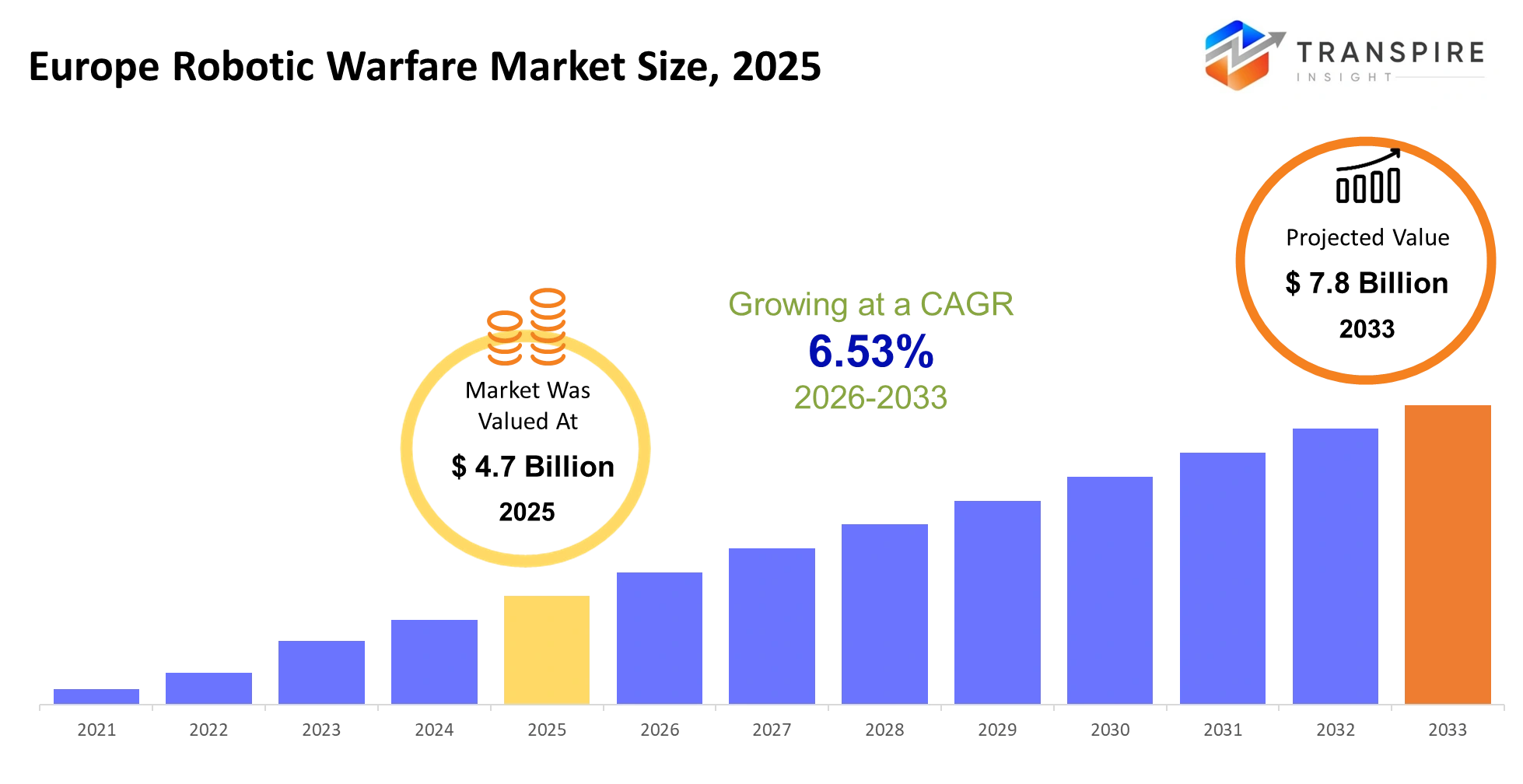
- Europe Robotic Warfare Market Size 2025: USD 4.7 Billion
- Europe Robotic Warfare Market Size 2033: USD 7.8 Billion
- Europe Robotic Warfare Market CAGR: 6.53%
- Europe Robotic Warfare Market Segments: By Type (Unmanned Ground Vehicles, Unmanned Aerial Vehicles, Unmanned Naval Systems, Combat Robots, Others), By Application (Surveillance, Combat Operations, Logistics, Reconnaissance, Others), By End-User (Defense Forces, Homeland Security, Others), By Technology (AI-based Systems, Remote Control Systems, Autonomous Systems, Others).
To learn more about this report,  Download Free Sample Report
Europe Robotic Warfare Market Summary:
The Europe Robotic Warfare Market size is estimated at USD 4.7 Billion in 2025 and is anticipated to reach USD 7.8 Billion by 2033, growing at a CAGR of 6.53% from 2026 to 2033. The Europe Robotic Warfare Market is changing military methods for conducting surveillance and guarding borders and clearing mines and performing electronic warfare operations and delivering combat support services which keep soldiers safe from operational danger. Governments use unmanned ground vehicles and autonomous naval systems and AI-enabled drones and coordinated battlefield robotics to achieve better operational speed and operational precision and improved battle performance in contested environments. The systems enable military forces to perform their tasks with fewer personnel requirements while they maintain operational capabilities for their missions across land and air and maritime domains.
The market has evolved during the past five years from its previous state of using remotely operated platforms to its current state of employing semi-autonomous systems which use AI to perform missions and process data in real time. The Russia-Ukraine conflict demonstrated how low-cost drones and autonomous targeting systems and electronic countermeasure systems can change battlefield economics and tactical outcomes which caused this transition to proceed faster. European defense ministries are using NATO modernization commitments to increase their spending which leads to procurement processes that shift from pilot programs to complete deployment contracts. The transition creates new revenue streams for sensor manufacturers and AI software companies and cybersecurity businesses and organizations that integrate autonomous systems throughout the defense industry in the region.
Key Market Insights
- The Europe Robotic Warfare Market in 2025 experienced its main market share which reached 46% because Western Europe received defense funding from Germany France and the UK.
- The Eastern Europe market which develops through 2032 will experience its most rapid growth because of border security enhancements and increasing geopolitical conflicts.
- Robotic warfare systems for military operations at sea now deploy their existence through NATO-supported modernization initiatives which include maritime monitoring and reconnaissance and self-operating combat missions.
- The European robotic defense industry researches AI-powered drones and unmanned ground vehicles and robotic naval systems as their main research area.
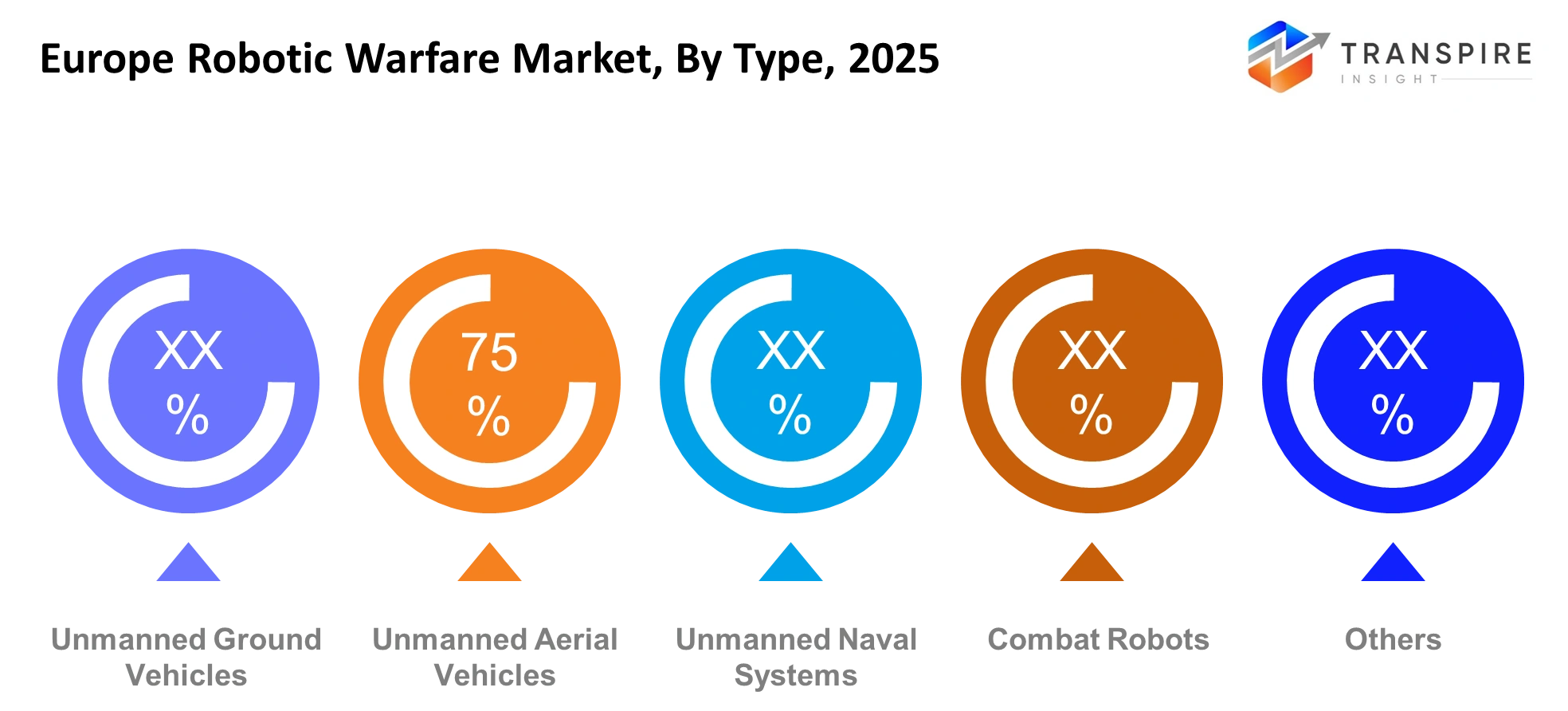
- The Europe Robotic Warfare Market created its main revenue stream through unmanned aerial vehicles which generated approximately 38% of total income during 2025 because these systems provided battlefield intelligence.
- Unmanned ground vehicles established themselves as the second biggest market segment because military organizations increased their usage of these systems for logistics and explosive ordnance disposal operations.
- The autonomous naval warfare industry expects to grow the most between 2026 and 2032 because companies will make major investments in maritime security.
- Defense organizations consider AI command-and-control software as a vital resource because it enables them to connect battlefield information with real-time data.
- The European robotic warfare industry for 2025 saw intelligence surveillance and reconnaissance systems reach a market share of approximately 41%.
- Emerging demand for combat support and tactical logistics applications arises from the need to decrease soldier exposure during high-risk military operations.
- The demand for electronic warfare systems is growing rapidly as governments develop more effective counter-drone and cyber-defense systems.
- The Mediterranean and Eastern European defense corridors currently expand their use of border monitoring and maritime patrol systems.
What are the Key Drivers, Restraints, and Opportunities in the Europe Robotic Warfare Market?
The defense modernization programs which developed after the Russia-Ukraine conflict constitute the main driving force which propels the growth of the European robotic warfare market. European governments increased military spending after recognizing the operational value of autonomous drones, loitering munitions, and AI-assisted surveillance systems in high-intensity warfare. NATO procurement policies together with its readiness objectives created conditions that allowed unmanned ground vehicles and robotic naval systems and electronic warfare platforms to achieve quicker acquisition processes. The defense manufacturing industry together with software development and sensor supply contracts experienced growth because of this development which reduced procurement delays associated with autonomous combat technologies.
The market’s largest structural barrier is the fragmented European defense procurement ecosystem. EU member states establish different certification requirements for military robotics programs which include national security limitations and interoperability standards. The differences between these systems create obstacles for international system deployment which leads to extended testing periods for autonomous technology. Defense platforms differ from commercial robotics markets because they need lengthy validation processes together with cybersecurity verification and battlefield performance assessment. Small businesses face operational restriction because companies must spend additional funds to achieve regulatory compliance while their business expansion efforts are being held back.
The upcoming generation of autonomous maritime warfare systems presents a significant opportunity for development throughout the Baltic and Mediterranean maritime areas. European naval forces are increasing investment in unmanned underwater vehicles and AI-enabled surveillance vessels to protect critical shipping corridors and offshore infrastructure. The combination of edge computing progress and real-time sensor fusion development has created new business opportunities for robotics integrators and defense AI providers who can now conduct commercialized extended autonomous naval operations.
What Has the Impact of Artificial Intelligence Been on the Europe Robotic Warfare Market?
The Europe Robotic Warfare Market receives transformation through artificial intelligence and advanced digital technologies which enhance battlefield automation and mission coordination and defense operations through autonomous decision-making. Military organizations use AI-enabled command-and-control platforms to achieve real-time automation of target identification and route planning and drone swarm coordination and threat prioritization. The development of autonomous combat systems now utilizes computer vision together with sensor fusion and edge computing to help operators who need to handle surveillance and reconnaissance missions.
The predictive capabilities of robotic warfare platforms gain enhancement through machine learning model development. Defense contractors utilize predictive analytics to track the operational status of unmanned aerial and ground vehicle components while monitoring battery condition and communication system performance and propulsion system operation. Military operators use these systems to achieve two goals which include decreasing unexpected maintenance shutdowns and increasing their ability to stay operational. The AI-assisted mission planning software creates battlefield simulations which enable users to optimize fuel usage and navigation paths and electronic countermeasure deployment for better mission performance at reduced operational costs.
Military exercises across Europe have shown that advanced robotics systems which employ adaptive AI technology can achieve higher accuracy in surveillance and better target tracking abilities and longer mission durations. The implementation of AI technology at present encounters a significant challenge because defense systems require expensive secure autonomous system integration into their existing military operations systems.
Key Market Trends
- Defense budgets for European countries experienced significant growth after 2022 which resulted in automatic drone procurement processes moving from their testing phase to their long-term operational contract phase.
- Military buyers shifted from standalone unmanned systems toward AI-connected robotic fleets that enable coordinated execution of surveillance operations and targeting missions and electronic warfare activities.
- European navies started investing more resources into autonomous underwater vehicles which they use to protect Baltic and Mediterranean maritime assets from hybrid warfare threats since 2021.
- Rheinmetall AG and BAE Systems established more AI software partnerships to develop autonomous battlefield decision-making systems that use AI technology.
- The Russia-Ukraine conflict produced battlefield information which NATO member nations used to increase their demand for affordable loitering munitions and swarm drone technologies.
- Defense agencies developed a greater emphasis on building cyber-resilient robotic systems which became essential after electronic jamming attacks stopped unmanned vehicles from functioning during military drills in 2023.
- European regulators created more strict interoperability standards for autonomous systems which required manufacturers to develop new communication systems that enable military organizations to operate across different countries.
- Robotic warfare manufacturers decreased their need for non-European semiconductor materials since 2020 because they wanted to improve defense supply chain protection and maintain component accessibility.
- Modern autonomous ground vehicles now provide threat detection and terrain mapping and remote combat functions while their previous systems only delivered logistics capabilities.
- Thales Group and Leonardo S.p.A. expanded their AI-enabled surveillance and counter-drone portfolios to secure larger NATO modernization contracts through their combined efforts.
Europe Robotic Warfare Market Segmentation
By Type
Defense agencies keep choosing unmanned aerial vehicles as their preferred option because these systems provide them with quick surveillance and accurate targeting and safe intelligence gathering abilities. The procurement of combat drones increased significantly after European military modernization programs demonstrated the effective operational performance of autonomous aerial systems during battles in contested areas. The use of unmanned ground vehicles has expanded to become the second most common category which includes their deployment for explosive ordnance disposal and border patrol operations.
European naval forces are increasing their spending on underwater surveillance and mine countermeasure operations which makes unmanned naval systems a rapidly growing market segment that will expand its presence throughout Baltic and Mediterranean areas. The high development expenses together with battlefield reliability issues prevent combat robots from achieving widespread use which keeps them as specialized technology. The future investment patterns will increase demand for modular multi-domain robotic systems that can perform missions across land air and maritime environments which will create business opportunities for companies that develop scalable autonomous systems with integrated sensor technologies.
To learn more about this report, Download Free Sample Report
By Application
The market now uses surveillance applications as its main solution because military forces need continuous intelligence operations that include border protection and current battlefield observation which brings no risk to their troops. The market for reconnaissance systems maintains its strong position because military organizations now prefer to use autonomous drones and robotic sensors for their operations in dangerous mission areas. The defense sector uses loitering munitions and AI-based targeting systems and autonomous strike platforms to develop tactical planning systems which make combat operations their fastest growing field of use. Military operators are increasingly using logistics systems which provide automated resupply and casualty evacuation and equipment transport capabilities to reduce personnel needs during long-term missions.
The current procurement process now prioritizes systems which can deliver surveillance and reconnaissance and tactical support functions through a unified platform design. The future market development will focus on robotic systems which can adapt to various missions and operate with better autonomous capabilities and reduced communication delays and complete electronic warfare systems so software developers will create operational flexibility through their software-based systems.
By End-User
Defense forces represent the largest end-user segment because national military modernization strategies continue directing substantial procurement budgets toward autonomous warfare technologies. The military branches of the army, navy, and air force adopted robotic systems at an accelerated pace because they needed to fulfill NATO readiness requirements and their battlefield operations developed new tactical doctrines. Homeland security agencies expanded their use of unmanned systems to monitor borders and conduct counter-terrorism operations and protect critical infrastructure throughout Eastern Europe and coastal security areas.
Compact autonomous platforms which can function in urban settings and underground spaces and electronic warfare environments have become the preferred choice of specialized tactical units. Security organizations that lack advanced integration infrastructure face adoption obstacles because budget constraints and lengthy procurement processes restrict their ability to acquire new technologies. Future growth is expected to shift toward joint operational ecosystems where military and homeland security agencies share interoperable robotic intelligence networks. The defense procurement programs will require more cybersecurity integration and encrypted communications and real-time data fusion capabilities because of this transition.
By Technology
The technology field is now controlled by AI-based systems because their autonomous target recognition and sensor fusion and battlefield predictive analytics capabilities enable faster operational decision-making. The ability to execute machine learning enabled intelligent robotic systems with adaptive mission execution and autonomous threat assessment functions gave them a competitive advantage. Defense organizations maintain human-operated combat systems as their primary operational method because remote control systems provide essential ethical and regulatory advantages. The development of edge computing and real-time navigation and swarm coordination technology has made autonomous systems the most rapidly expanding field in defense technology.
The defense industry faces major obstacles because autonomous systems require high integration expenses and they contain cybersecurity weaknesses and their older defense systems cannot connect with new technology. To solve regulatory problems and manage battlefield uncertainty technology suppliers now concentrate on developing hybrid systems that combine AI-powered autonomous functions with human system control. Organizations that want to compete successfully in the future need to establish secure software ecosystems and implement low-latency communication systems and develop artificial intelligence platforms that can handle multi-domain robotic operations.
What are the Key Use Cases Driving the Europe Robotic Warfare Market?
The primary function of European robotic warfare systems exists to provide assistance during surveillance and reconnaissance operations. Defense forces utilize unmanned aerial systems as vital equipment to monitor borders while they collect intelligence about battlefields and track targets in dangerous locations. The application creates the highest demand for product procurement because autonomous surveillance platforms optimize real-time situational awareness through their capability to decrease personnel exposure.
Army engineering units and homeland security agencies are experiencing steady growth in their requirement for logistics support and explosive ordnance disposal capabilities. Eastern European defense modernization programs now employ autonomous ground vehicles to perform ammunition transport and casualty evacuation and mine clearance operations. Naval forces are increasing their employment of unmanned underwater systems to perform coastal surveillance and mine countermeasure missions.
The development of new military applications includes autonomous drone swarms and AI-enabled electronic warfare systems which can perform coordinated operational missions. European defense agencies are currently testing collaborative robotic platforms which operate effectively in both contested communication environments and high-intensity combat situations.
|
Report Metrics |
Details |
|
Market size value in 2025 |
USD 4.7 Billion |
|
Market size value in 2026 |
USD 5.01 Billion |
|
Revenue forecast in 2033 |
USD 7.8 Billion |
|
Growth rate |
CAGR of 6.53% from 2026 to 2033 |
|
Base year |
2025 |
|
Historical data |
2021 - 2024 |
|
Forecast period |
2026 - 2033 |
|
Report coverage |
Revenue forecast, competitive landscape, growth factors, and trends |
|
Regional scope |
Europe (Germany, United Kingdom, France, Italy, Spain and Rest of Europe) |
|
Key company profiled |
Lockheed Martin, Northrop Grumman, Boeing, BAE Systems, General Dynamics, Elbit Systems, Thales Group, Saab, Rheinmetall, QinetiQ, Leonardo, Textron, AeroVironment, L3Harris, Israel Aerospace Industries. |
|
Customization scope |
Free report customization (country, regional & segment scope). Avail customized purchase options to meet your exact research needs. |
|
Report Segmentation |
By Type (Unmanned Ground Vehicles, Unmanned Aerial Vehicles, Unmanned Naval Systems, Combat Robots, Others), By Application (Surveillance, Combat Operations, Logistics, Reconnaissance, Others), By End-User (Defense Forces, Homeland Security, Others), By Technology (AI-based Systems, Remote Control Systems, Autonomous Systems, Others). |
Which Regions are Driving the Europe Robotic Warfare Market Growth?
The Western European countries dominate the robotic warfare industry because they possess advanced defense manufacturing capacities and sophisticated research facilities and they have made permanent commitments to NATO modernization programs. Germany France and the United Kingdom maintain their military budgets at high levels while they purchase autonomous aerial systems and naval systems and ground systems in large quantities. The region has established a defense ecosystem which includes defense contractors AI software developers semiconductor suppliers and cybersecurity companies that help companies speed up product testing and integration processes. The continuous government funding of defense innovation projects creates a constant need for advanced battlefield automation systems and robotic systems which operate across multiple domains.
Northern Europe stands as the second biggest regional contributor because its security needs Maritime Surveillance and Arctic defense and Protection of Critical Infrastructure. Sweden Norway and Finland dedicate their resources to developing autonomous naval systems and underwater robotics and electronic warfare systems which will enhance their ability to monitor coastal areas. The defense sector establishes predictable revenue streams for suppliers through stable defense budgets and long-term procurement plans which prevent spending swings that occur in larger markets. Defense agencies and technology companies in the region work together to implement AI military systems through their collaborative efforts.
The Eastern European region develops into the fastest expanding market because military modernization and border security programs received acceleration from recent geopolitical conflicts.
Who are the Key Players in the Europe Robotic Warfare Market and How Do They Compete?
The Europe Robotic Warfare Market operates with moderate market power as defense contractors control valuable acquisition projects while specialized robotic and AI companies develop their own autonomous system market segments. The present competition shifts its focus towards four main areas which include artificial intelligence, autonomous navigation systems, cybersecurity defense mechanisms and interoperability with NATO operational systems. Established defense companies maintain their market position through three main methods which include executing long-term government contracts and developing proprietary battlefield software ecosystems and building integrated multi-domain warfare systems. The smaller technology companies disrupt particular market segments which include drone swarming and autonomous sensing and electronic warfare analytics through their ability to deliver software innovations more quickly at reduced costs for system customization.
BAE Systems develops autonomous combat systems which integrate AI-based battlefield coordination technologies. The company establishes its competitive edge through its extensive partnerships with European defense ministries and its advanced sensor fusion technology which enables joint land, air, and naval operations. The Rheinmetall AG company develops modular unmanned ground vehicle systems which serve logistics, reconnaissance and combat support functions. The company developed its robotic warfare capabilities through closer ties with AI software developers and expanded its autonomous vehicle testing operations for NATO defense initiatives.
Thales Group provides cybersecurity-based autonomous defense systems and electronic warfare systems which enable secure communication on battlefields that face threats from hostile forces.
Company List
- Lockheed Martin
- Northrop Grumman
- Boeing
- BAE Systems
- General Dynamics
- Elbit Systems
- Thales Group
- Saab
- Rheinmetall
- QinetiQ
- Leonardo
- Textron
- AeroVironment
- L3Harris
- Israel Aerospace Industries
Recent Development News
In April 2026, Rheinmetall Wins Multibillion-Euro German Army Drone Contract: Germany-based defense company Rheinmetall secured a multibillion-euro framework agreement to supply the German military with FV-014 autonomous reconnaissance and strike drones. The deal marks one of Europe’s largest recent robotic warfare procurement programs and strengthens Rheinmetall’s position in AI-enabled battlefield systems.
Source: https://www.reuters.com
In February 2026, Germany Orders Strike Drones From Helsing and Stark Defence: German defense-tech startup Helsing and Stark Defence received contracts tied to a €536 million strike-drone order as Berlin accelerated military modernization efforts. The purchase focuses on loitering munitions and autonomous warfare technologies developed within Europe.
Source: https://www.reuters.com
What Strategic Insights Define the Future of the Europe Robotic Warfare Market?
The Europe Robotic Warfare Market is developing toward complete autonomous combat systems which use shared AI control networks to operate all unmanned aerial and naval and ground systems as unified combat systems. The military requires faster battlefield decision-making to reduce personnel risks and create deterrence capabilities which can operate in extended geopolitical conflicts. The procurement priorities of organizations will transition from acquiring hardware to building systems which use software-defined autonomy and sensor fusion and secure battlefield data infrastructure during the upcoming five to seven years.
The European defense market and its allied markets face a hidden danger because their defense AI and secure communication systems depend on a small number of semiconductor manufacturers. The supply of autonomous systems will face production bottlenecks because of supply concentration which will also create export restrictions and component shortages during geopolitical events. Governments are enhancing their security for subsea energy and communication networks in the Baltic and Arctic regions which creates an opportunity for developing autonomous underwater surveillance systems. To establish sustainable defense procurement positions market participants need to focus on creating AI software systems that work together and building regional supply networks.
Europe Robotic Warfare Market Report Segmentation
By Type
- Unmanned Ground Vehicles
- Unmanned Aerial Vehicles
- Unmanned Naval Systems
- Combat Robots
- Others
By Application
- Surveillance
- Combat Operations
- Logistics
- Reconnaissance
- Others
By End-User
- Defense Forces
- Homeland Security
- Others
By Technology
- AI-based Systems
- Remote Control Systems
- Autonomous Systems
- Others
Frequently Asked Questions
Find quick answers to common questions.
The approximate Europe Robotic Warfare Market size for the market will be USD 7.8 Billion in 2033.
The key segments of the Europe Robotic Warfare Market are By Type (Unmanned Ground Vehicles, Unmanned Aerial Vehicles, Unmanned Naval Systems, Combat Robots, Others), By Application (Surveillance, Combat Operations, Logistics, Reconnaissance, Others), By End-User (Defense Forces, Homeland Security, Others), By Technology (AI-based Systems, Remote Control Systems, Autonomous Systems, Others).
Major players in the Europe Robotic Warfare Market are Lockheed Martin, Northrop Grumman, Boeing, BAE Systems, General Dynamics, Elbit Systems, Thales Group, Saab, Rheinmetall, QinetiQ, Leonardo, Textron, AeroVironment, L3Harris, Israel Aerospace Industries.
The current market size of the Europe Robotic Warfare Market is USD 4.7 Billion in 2025.
The Europe Robotic Warfare Market CAGR is 6.53%.
- Lockheed Martin
- Northrop Grumman
- Boeing
- BAE Systems
- General Dynamics
- Elbit Systems
- Thales Group
- Saab
- Rheinmetall
- QinetiQ
- Leonardo
- Textron
- AeroVironment
- L3Harris
- Israel Aerospace Industries
Recently Published Reports
-
Apr 2026
Aerospace Fluoropolymers Market
Aerospace Fluoropolymers Market Size, Share & Analysis Report By Type (PTFE, FEP, PFA, ETFE, and Others), By Application (Electrical Insulation, Seals & Gaskets, Coatings, and Others), By End User (Commercial Aviation, Military Aviation, General Aviation, and Others), and Geography (North America, Europe, Asia-Pacific, Middle East and Africa, South and Central America), 2021 - 2031
-
Apr 2026
Airborne SATCOM System Market
Airborne SATCOM System Market Size, Share & Analysis Report By Type (SATCOM Terminals, Transceivers, Airborne Radio, Modems and Routers, SATCOM Radomes, and Other), By Application (Government and Defense and Commercial), and Geography (North America, Europe, Asia-Pacific, Middle East and Africa, South and Central America), 2021 – 2031
-
Apr 2026
Ship Leasing Market
Ship Leasing Market Size, Share & Analysis Report By Vessel Type (Container Ships, Bulk Carriers, Tankers, and Specialized Vessels), By Lease Duration (Short-Term Lease (Less than 1 year), Medium-Term Lease (1-5 years), and Long-Term Lease (More than 5 years)), By Lease Type (Bareboat Charter, Time Charter, Financial Lease, and Others), By End-User Industry (Oil and Gas, Manufacturing and Industrial, Automotive, Agriculture and Food, Retail and Consumer Goods, and Others), and Geography (North America, Europe, Asia-Pacific, Middle East and Africa, South and Central America), 2021 – 2031
-
Apr 2026
Thread Rolling Dies Market
Thread Rolling Dies Market Size, Share & Analysis Report By Type (Flat Thread Rolling Dies, Circular (Cylindrical) Dies, Tangential Thread Rolling Dies, Planetary Thread Rolling Dies, and Other Types), By Material Type (High-Speed Steel (HSS), Carbide, Tool Steel, Alloy Steel, and Other Specialized Alloys), By Distribution Channel (Direct Sales, Distributors and Dealers, and Online Platforms), By Application (Automotive Industry, Aerospace and Defense, Construction and Infrastructure, Industrial Machinery, Electronics and Electrical Components, Medical Devices, and Fastener Production), and Geography (North America, Europe, Asia-Pacific, Middle East and Africa, South and Central America), 2021 – 2031
Our Clients