

Europe Robo Advisory Market Summary
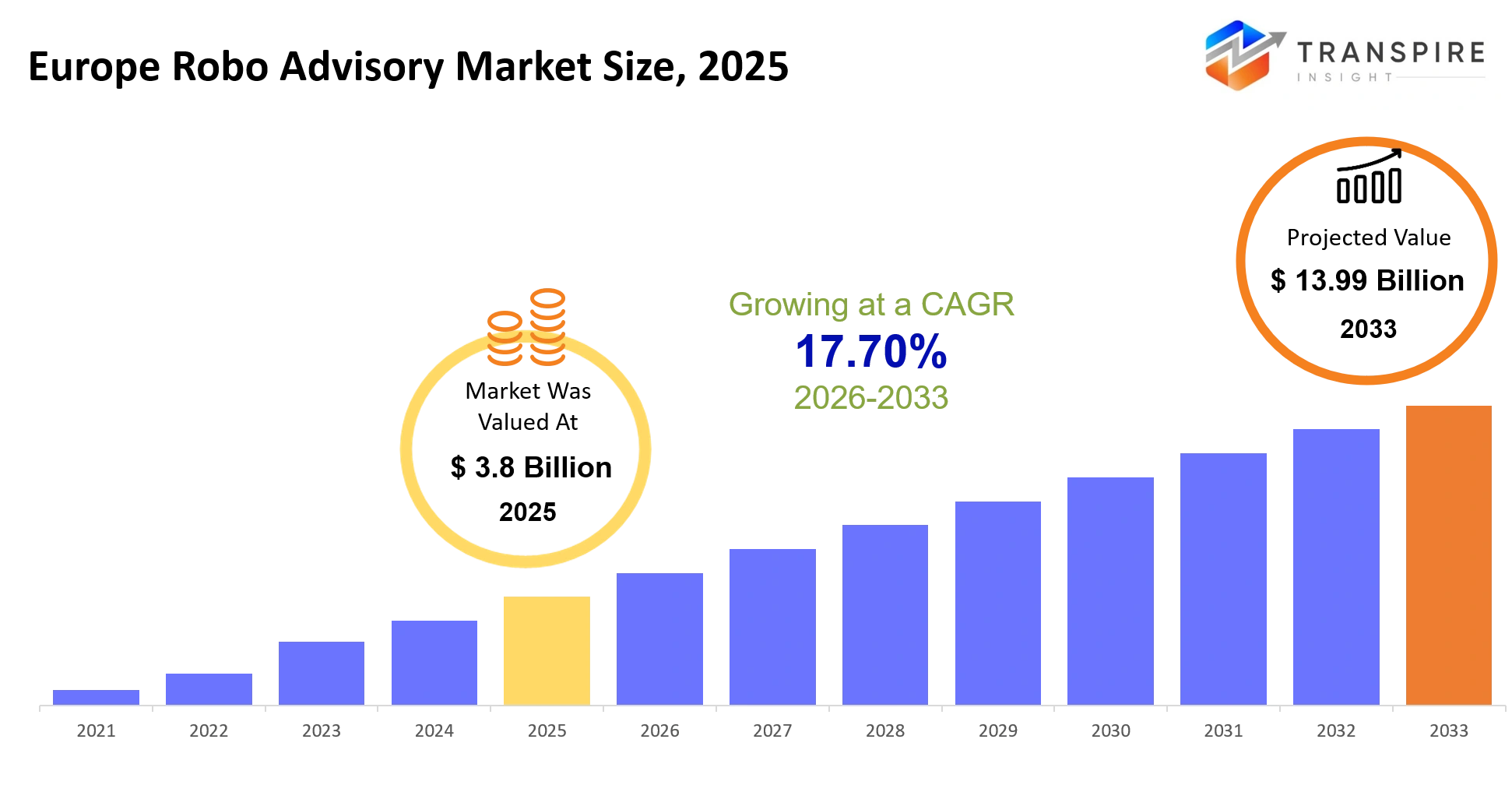
As per Transpire Insight Analysis the Europe Robo Advisory Market size is estimated at USD 3.8 Billion in 2025 and is anticipated to reach USD 13.99 Billion by 2033, growing at a CAGR of 17.70% from 2026 to 2033.
Europe’s robo advisory market kinda helps everyday individuals, wealth managers, and financial institutions deliver automated portfolio care, risk sensing, and investment guidance at lower operating costs, but also makes it easier to reach digital wealth solutions. Over the last three to five years, it seems the market has moved away from basic algorithm driven investing, toward hybrid advisory platforms that blend automation with human handholding and more advanced analytics, also including more individualized financial planning in the background . Then after the COVID-19 period, the adoption pattern changed again, like digital banking usage got accelerated, and so financial providers started expanding remote investment services. Regulatory developments around digital finance and investor protection also shaped how these platforms are designed, and how much they invest in compliance. And now, as European investors look for efficient, transparent, and easily scalable wealth management options, financial firms are using robo advisory tools to cut service costs, grow their customer reach, and also form new fee-based revenue channels.
Europe Robo Advisory Market Size & Forecast:
- Europe Robo Advisory Market Size 2025: USD 3.8 Billion
- Expected Market Value 2033: USD 13.99 Billion
- Forecast CAGR: 17.70%
- Leading country in 2025: United Kingdom (UK)
- Fastest-growing country: Germany
- Key Profile: Betterment, Wealthfront, Vanguard, Charles Schwab, BlackRock, Fidelity Investments, Nutmeg, Scalable Capital, BNY Mellon, Morgan Stanley, UBS, SoFi, eToro, Interactive Brokers, Allianz Global Investors.
Key Market Insights
- Western Europe kind of dominates with roughly 55% market share in 2025 , kinda led by the UK, Germany, France, Switzerland and Netherlands fintech ecosystems, you know.
- Northern Europe is the fastest-growing region during 2025–2033, and it’s supported by digital banking adoption in Sweden , Denmark, Norway,and Finland.
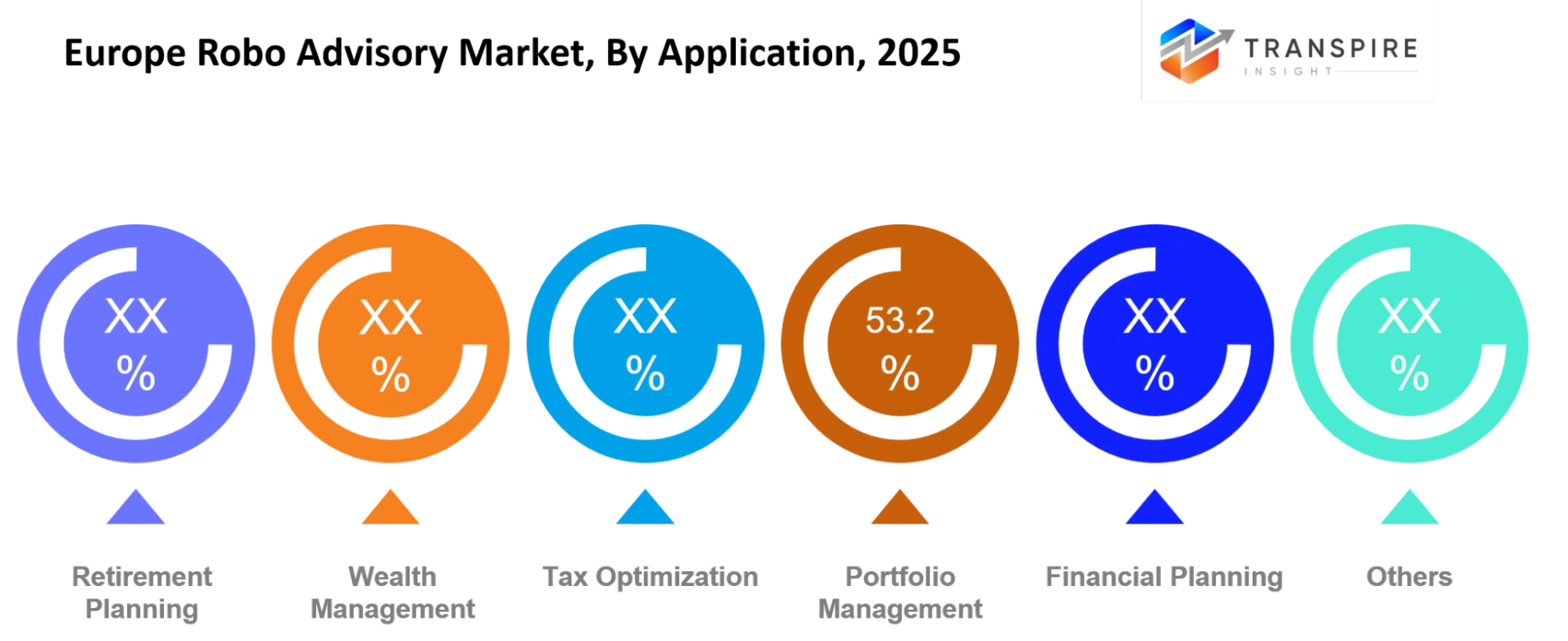
- Portfolio management services are leading with about 60% share in 2025, since investors seem to favor automated asset allocation and risk optimization more and more.
- Financial planning services take the second-largest slot, growing via integrated wealth management platforms that banks offer.
- Starting 2025, hybrid robo advisory models are looking like the fastest growing thing, because the providers mix AI automation with human advisory help, so it kinda covers more ground at once.
- In 2025, retail investors are still driving most of the apps, with almost 70% share, mostly because these services keep things accessible and low cost for investing, you know.
- Institutional applications are fastest-growing too, as asset managers adopt automated analytics and scalable portfolio management systems.
- Banks and financial institutions lead end-user adoption with more than 45% share , putting money into digital wealth transformation strategies.
- Independent wealth managers are the fastest-growing end-user category, through partnerships with fintech platforms and automation providers.
What are the Key Drivers, Restraints, and Opportunities in the Europe Robo Advisory Market?
The main growth driver is the shift toward automated wealth management that gets triggered by the expansion of digital banking and also the regulatory support for transparent investment services. European financial institutions are getting into robo advisory platforms more and more, because automation brings portfolio management costs down a lot and lets providers serve more customers even when the individual investment amounts are smaller. The uptake of AI based risk assessment and personalized recommendations is improving overall platform efficiency, and it’s also opening up extra revenue routes through subscription models and digital investment products.
The biggest restraint is still fragmented financial regulation across the European countries. When compliance requirements differ, development costs go up, and cross border expansion gets slowed for robo advisory providers. Smaller firms, in particular, often deal with delayed product launches because adapting a platform to multiple regulatory frameworks takes additional legal work, technology changes and security investments, it’s not a small thing. From the Transpire Insight review of regional procurement announcements and launch schedules, supply chain concentration remains the top execution risk. This kind of issue restricts quick scaling and can also reduce revenue opportunities in smaller European markets.
The key opportunity sits with AI powered hybrid advisory platforms, the ones that mix automation with human expertise. Investments in machine learning, cloud infrastructure, and behavioral analytics should help providers deliver more accurate financial recommendations, not just “good enough”. Countries like Germany, Sweden, and the Netherlands look particularly favorable because strong fintech ecosystems and high digital adoption create space for advanced wealth management solutions.
What Has the Impact of Artificial Intelligence Been on the Europe Robo Advisory Market?
Artificial intelligence and digital tech are kind of reshaping Europe's automated investment ecosystem, mostly by boosting portfolio analysis, tailoring customer experiences, and pushing up operational efficiency. AI systems are now automating client profiling, compliance checks, transaction monitoring, plus portfolio rebalancing tasks, so financial service providers get less manual work to do. At the same time, machine learning models look at market patterns, investor habits, and historical performance records, in order to refine asset allocation choices and produce more personalized suggestions that feel more “on time”.
Cloud platforms along with advanced analytics tools allow quicker processing of massive financial datasets while also backing up scalable digital advisory services.Financial institutions often lean on predictive models to spot portfolio risks, anticipate market moves, and tune investment strategies when conditions keep on shifting. In the real world, this usually helps, it makes reaction times faster, supports stronger compliance workflows, and can help vendors cut back on day to day operational costs.
However, even with AI adoption there are still some boundaries, mainly because the integration costs can be high, the input data quality might come in a bit uneven, and guaranteeing model accuracy is hard to lock down when the market does sudden, unexpected swings.
Smaller advisory firms often simply don’t have the needed resources to roll out advanced AI infrastructure, which then slows adoption in some regions of Europe.
Key Market Trends
- In 2024 , hybrid advisory models started showing up more, like providers mixed automated portfolios with human input at the same time, which helped nudge investor confidence, a lot.
- European banks upped their digital wealth spending after 2022, they leaned on robo platforms so advisory expenses stayed lower, and also so they could reach more customers, faster.
- After 2023 , AI powered personalization really took off, letting platforms deliver investment suggestions that feel more individual, using each person's risk profile and all that.
- Regulatory technology adoption also grew starting around 2021, as providers automated compliance monitoring across multiple jurisdictions in Europe, which was kind of the point.
- During 2024 , fintech partnerships grew across Europe, banks teamed with digital wealth platforms to speed up product innovation, and yes, it was a noticeable pattern.
- Younger investors seemed to influence platform design starting after 2022, pushing mobile first investment features, and making portfolio management feel simpler, or at least less fussy.
- Cloud based infrastructure adoption ramped up between 2021 and 2025 , it improved scalability too, while reducing the ongoing maintenance burden on teams.
- European providers added more ESG investment features after 2022, mainly because there was stronger demand for sustainable portfolio options, from clients who cared.
- Machine learning analytics advanced throughout 2023–2025, enabling firms to strengthen risk assessment and improve the accuracy of investment recommendation outputs.
- Competition got more intense as companies like Scalable Capital, Moneyfarm, and Vanguard expanded their digital wealth offerings across European markets, and it basically kept accelerating.
Europe Robo Advisory Market Segmentation
By Service Type :
Direct Robo Advisors support automated investment decisions via algorithmic portfolio suggestions, low fees, and digital account handling, kind of straightforward honestly. Hybrid Robo Advisors mix automated tools with professional assistance, so investors can get a steadier mix of technology and expert support without going fully solo. Full-Service Robo Advisors add more robust planning features, portfolio check ins, and tailored investment strategies for financial situations that are more intricate or complicated.
Goal-Based Advisory services center on specific outcomes, for instance retirement preparation, and also wealth accumulation. As a result the demand for personalized solutions will back up service innovation, because providers keep improving analytics, automation, plus customer engagement tools. Even other service models may get more attention, when specialized investment solutions and niche financial planning offerings become more common.
By Deployment :
Cloud-Based deployment enables flexible access, reduces infrastructure spending, and speeds up platform updates for financial service providers. Cloud adoption will keep growing as firms want scalable systems that can process huge investment data volumes, plus handle digital customer interactions at the same time. Meanwhile, On-Premise deployment still matters for institutions that want extra control over data management , and internal security systems.
Hybrid deployment blends cloud flexibility with internal infrastructure control, supporting organizations with strict compliance obligations. Other deployment models will keep evolving through technology upgrades and shifts in day to day operations across financial service providers. In the end deployment decisions depend on security baselines, cost control approaches, and how much they prioritize technology investment in the near term.
By Application :
Retirement Planning apps assist investors in building long term strategies by doing automated calculations, risk analysis, and suggested investments. Wealth Management applications matter a lot, because digital platforms offer wider access to professional investing help, sort of smoother than before. Tax Optimization tools also support smarter decisions through automated examination of tax related investment variables, not just guesses.
Portfolio Management applications tend to help with asset distribution, ongoing checking, and performance monitoring via advanced algorithms. Financial Planning solutions will keep growing , since people want a clear framework for saving, investing, and what comes next financially. Other apps should expand too, through specialized options that fit changing investment requirements, even when preferences shift quickly.
By End User :
Retail Investors are a big user group, mainly because they want affordable investing platforms, easy account access, and automated portfolio solutions that basically run in the background. High-Net-Worth Individuals lean on more advanced advisory services, needing tailored strategies, deeper analysis, and personalized investment planning. Financial Institutions adopt automated advisory platforms, to boost operational efficiency and also to extend digital wealth offerings to more clients.
SMEs are starting to use digital financial tools, to handle investment chores and improve their financial planning routines. Other end users will also contribute, through specialized take up across different customer types. The growth for end users will really hinge on technology acceptance, overall platform stability , and how easy the service feels to access.\
By Asset Class :
Equities stay as a preferred asset category, mostly because investors still show strong interest in market-driven growth prospects, and also because automated portfolio allocation makes it all feel more seamless, like less manual work. ETFs get a lot of attention too though , mainly on account of low costs, added diversification, and their overall fit with automated investing frameworks. Mutual Funds carry on backing diversified strategies as well, since those professionally managed portfolios tend to do the heavy lifting in a structured way.
Fixed Income products, on the other hand, offer stability leaning investment choices for clients that want balanced portfolios. The remaining asset classes will also see more traction as digital investment options keep expanding, alongside some alternative financial products that are getting more visibility. In the end, which asset class gets picked will shape platform strategy, since providers are building out broader portfolio solutions, for separate investment goals , not just one.
What are the Key Use Cases Driving the Europe Robo Advisory Market?
Automated portfolio management still acts as the main use case pushing Europe Robo Advisory Market adoption. Retail investors, and also financial institutions, buy digital portfolio solutions for reduced advisory costs, quicker investment decisions and more scalable wealth management services, which is why it keeps growing.
Retirement planning ,and tax optimization apps are getting more momentum among retail investors and wealth managers. Banks and other financial institutions rely on automated planning tools to raise customer service quality, satisfy compliance demands, and extend their digital advisory channels across several European markets.
AI driven financial coaching and personalized investment guidance count as newer, but promising, applications for what’s next. Fintech firms and regulated financial providers will likely test enhanced analytics for customized strategies, behavioral insights and even wider investor reach, overall.
|
Report Metrics |
Details |
|
Market size value in 2025 |
USD 3.8 Billion |
|
Market size value in 2026 |
USD 4.47 Billion |
|
Revenue forecast in 2033 |
USD 13.99 Billion |
|
Growth rate |
CAGR of 17.70% from 2026 to 2033 |
|
Base year |
2025 |
|
Historical data |
2021 - 2024 |
|
Forecast period |
2026 - 2033 |
|
Report coverage |
Revenue forecast, competitive landscape, growth factors, and trends |
|
Country scope |
Europe (Germany, United Kingdom, France, Italy, Spain and Rest of Europe) |
|
Key company profiled |
Betterment, Wealthfront, Vanguard, Charles Schwab, BlackRock, Fidelity Investments, Nutmeg, Scalable Capital, BNY Mellon, Morgan Stanley, UBS, SoFi, eToro, Interactive Brokers, Allianz Global Investors. |
|
Customization scope |
Free report customization (country, regional & segment scope). Avail customized purchase options to meet your exact research needs. |
|
Report Segmentation |
By Service Type (Direct Robo Advisors, Hybrid Robo Advisors, Full-Service Robo Advisors, Goal-Based Advisory, Others); By Deployment (Cloud-Based, On-Premise, Hybrid, Others); By Application (Retirement Planning, Wealth Management, Tax Optimization, Portfolio Management, Financial Planning, Others); By End User (Retail Investors, High-Net-Worth Individuals, Financial Institutions, SMEs, Others); By Asset Class (Equities, ETFs, Mutual Funds, Fixed Income, Others). |
Which Regions are Driving the Europe Robo Advisory Market Growth?
Western Europe basically runs the Europe Robo Advisory Market, with an estimated 55% share in 2025 . The mix feels pretty locked in by strong digital banking infrastructure, supportive fintech regulations, and a very mature investment ecosystem, which together make automated advisory platforms easier to grow . A lot of the region’s momentum comes from banks, fintech firms, and wealth management providers actively putting money into digital investment services. I n the end, leadership should keep going through 2033, since financial institutions keep rolling out automated solutions and then tacking on advanced analytics into their wealth management routines.
Central Europe, meanwhile, is more like steady revenue, helped by regulatory alignment, solid financial systems, and ongoing technology spending. Places such as Germany, Austria, and Switzerland offer dependable uptake chances because the banking networks are already well established and people still want efficient investment management tools . With an overall stable economic environment, plus structured compliance rules, platforms can keep getting adopted by financial institutions and also professional investors, without much drama.
Northern Europe is probably the fastest-growing piece . Countries like Sweden, Denmark, and Norway are pushing digital finance adoption harder, largely through fintech ecosystems that feel more advanced and a steady stream of technology-focused investments. Because mobile banking usage is rising , and automated financial services are becoming normal, robo advisory providers get more entry points for growth. From 2026 to 2033 this should also motivate new market entrants and investors to design tailored digital wealth solutions across Northern European markets , kind of in a more localized way, depending on the needs there.
Who are the Key Players in the Europe Robo Advisory Market and How Do They Compete?
Competition in the Europe Robo Advisory Market is still kinda fragmented, with fintech companies, banks, and wealth management providers going head to head using technology know-how, different pricing models, and more or less personalized service choices. Meanwhile, the big “old” financial players are improving their digital advisory channels, while fintech firms are shaking things up via cheaper platforms and automated investing tools. Also, things like service agility, integration of artificial intelligence, and the overall customer experience have basically turned into the main competitive levers.
Scalable Capital competes by pushing tech powered portfolio management and automated investment solutions. It really leans into scalable digital wealth services, mixing low cost investing with advanced portfolio utilities to pull in retail investors across European markets. Moneyfarm is more about bespoke investment portfolios plus digital advisory offerings, and it’s expanding access to managed investments using technology centric solutions.
Vanguard keeps pressure on the market with low fee investment products and digital advisory capabilities, backed by deep asset management know how. BlackRock, on the other hand, is extending its technology led investment offerings using analytics platforms and institutional investment tools. Nutmeg targets customized portfolios and a more intuitive digital experience, helping broader adoption among individual investors.
Company List
- Betterment
- Wealthfront
- Vanguard
- Charles Schwab
- BlackRock
- Fidelity Investments
- Nutmeg
- Scalable Capital
- BNY Mellon
- Morgan Stanley
- UBS
- SoFi
- eToro
- Interactive Brokers
- Allianz Global Investors
Recent Development News
In June 2025, Scalable Capital raised €155 million in a funding round led by Sofina and Noteus Partners. The investment strengthened the company’s digital investment platform expansion strategy, supporting technology development and broader European wealth management services.
Source: https://de.scalable.capital/
In August 2025, Scalable Capital launched its AI-powered “Insights” feature. The generative AI tool provides real-time investment information within the platform interface, improving investor education and strengthening technology-driven advisory capabilities across European digital investment services.
Source: https://nl.scalable.capital/
What Strategic Insights Define the Future of the Europe Robo Advisory Market?
Europe's Robo Advisory Market is likely to drift toward more integrated digital wealth platforms, sort of blending artificial intelligence, automation and tailor-made investment guidance over the next five to seven years. The big structural turn is expected when financial institutions want scalable advisory models that bring down operational costs and also lift customer engagement, even if it looks simple from the outside. There’s also a quieter danger, market concentration, because only a handful of technology providers and financial platforms can end up holding stronger influence over the whole digital investment infrastructure.
On the other hand , there’s a clear chance in AI-driven financial coaching tools, especially across Southern and Northern Europe , helped by improving digital finance regulations plus growing investor uptake. For market participants, the practical approach is to put resources into flexible technology architecture, build regulatory know-how properly, and run localized services that fit different regions, so growth sticks over time while dependency on outside platforms stays lower.
Europe Robo Advisory Market Report Segmentation
By Service Type
- Direct Robo Advisors
- Hybrid Robo Advisors
- Full-Service Robo Advisors
- Goal-Based Advisory
By Deployment
- Cloud-Based
- On-Premise
- Hybrid
By Application
- Retirement Planning
- Wealth Management
- Tax Optimization
- Portfolio Management
- Financial Planning
By End User
- Retail Investors
- High-Net-Worth Individuals
- Financial Institutions
- SMEs
By Asset Class
- Equities
- ETFs
- Mutual Funds
- Fixed Income
Frequently Asked Questions
Find quick answers to common questions.
The expected Europe Robo Advisory Market size for the market will be USD 13.99 Billion in 2033.
Key segments for the Europe Robo Advisory Market are By Service Type (Direct Robo Advisors, Hybrid Robo Advisors, Full-Service Robo Advisors, Goal-Based Advisory, Others); By Deployment (Cloud-Based, On-Premise, Hybrid, Others); By Application (Retirement Planning, Wealth Management, Tax Optimization, Portfolio Management, Financial Planning, Others); By End User (Retail Investors, High-Net-Worth Individuals, Financial Institutions, SMEs, Others); By Asset Class (Equities, ETFs, Mutual Funds, Fixed Income, Others).
Major Europe Robo Advisory Market players are Betterment, Wealthfront, Vanguard, Charles Schwab, BlackRock, Fidelity Investments, Nutmeg, Scalable Capital, BNY Mellon, Morgan Stanley, UBS, SoFi, eToro, Interactive Brokers, Allianz Global Investors.
The Europe Robo Advisory Market size is USD 3.8 Billion in 2025.
The Europe Robo Advisory Market CAGR is 17.70% from 2026 to 2033.
- Betterment
- Wealthfront
- Vanguard
- Charles Schwab
- BlackRock
- Fidelity Investments
- Nutmeg
- Scalable Capital
- BNY Mellon
- Morgan Stanley
- UBS
- SoFi
- eToro
- Interactive Brokers
- Allianz Global Investors
About the Authors

Mayur Shinde
I am Mayur Shinde, a Senior Research Analyst at Transpire Insight, specializing in the Automotive & Transportation and Information & Communication Technology (ICT) Industry. My work focuses on analyzing emerging market trends, technological advancements, competitive landscapes, and industry developments to deliver accurate, data-driven insights. I am passionate about transforming complex market information into clear, actionable content that helps businesses, professionals, and decision-makers stay informed and make confident strategic decisions.

Chakradhar Khansole
Chakradhar serves as the Research Director at Transpire Insight, bringing over 8 years of experience in technology, innovation, and strategic market intelligence. He specializes in transforming complex market data into actionable business insights that enable organizations to make informed, growth-oriented decisions. Recognized for his strategic vision and analytical expertise, Chakradhar leads high-impact research initiatives, delivering comprehensive market assessments, competitive intelligence, and forward-looking industry analysis.
Recently Published Reports
-
Apr 2026
3D Optical Profiler Market
3D Optical Profiler Market Size, Share & Analysis Report By Type (Desktop 3D Optical Profiler, and Portable 3D Optical Profiler), By Technology (Confocal Technology, and White Light Interference), By End-Use Industry (Manufacturing, Research Institutions, Automotive, Aerospace and Defense, Medical Devices, and Other), and Geography (North America, Europe, Asia-Pacific, Middle East and Africa, South and Central America), 2021 - 2031
-
Apr 2026
Depth Sensor Market
Depth Sensor Market Size, Share & Analysis Report By Type (Infrared Depth Sensors, Time-of-Flight (ToF) Sensors, Stereo Vision Sensors, Structured Light Sensors, Ultrasonic Depth Sensors), By Application (Automotive, Robotics, Gaming, Consumer Electronics, Industrial Automation, Healthcare, Security & Surveillance, Others), By End Users (Automotive Manufacturers, Consumer Electronics Companies, Healthcare Providers, Industrial Companies, Security Agencies, Gaming Companies, Robotics Companies, Others), and Geography (North America, Europe, Asia-Pacific, Middle East and Africa, South and Central America), 2021 – 2031
-
Apr 2026
Digital Manufacturing Market
Digital Manufacturing Market Size, Share & Analysis Report By Component (Hardware, Software, and Services), By Technology (Robotics, 3D Printing, Internet of Things (IoT), and Others), By Application (Automotive and Transportation, Aerospace and Defense, Consumer Electronics, Industrial Machinery, and Others), By Process Type (Computer-Based Designing, Computer-Based Simulation, Computer 3D Visualization, Analytics, and Others), and Geography (North America, Europe, Asia-Pacific, Middle East and Africa, South and Central America), 2021 – 2031
-
Apr 2026
Digital Visa Services Market
Digital Visa Services Market Size, Share & Analysis Report By Type (Individual Travelers, Group Travelers), By Application (Tourism, Business Travel, Others), and Geography (North America, Europe, Asia-Pacific, Middle East and Africa, South and Central America), 2021 – 2031