
Europe RF Test Equipment Market Size & Forecast:
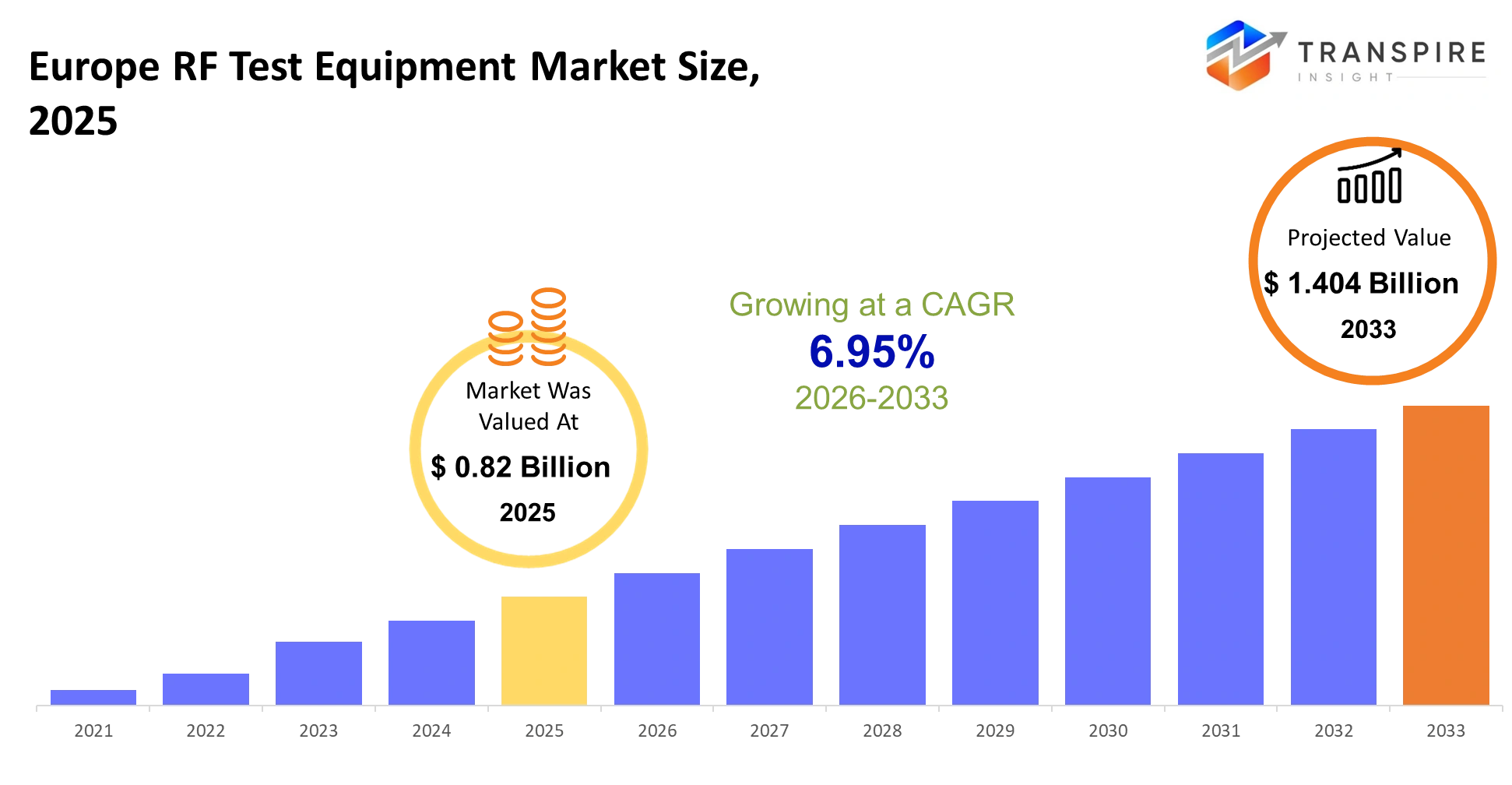
- Europe RF Test Equipment Market Size 2025: USD 0.82 Billion
- Europe RF Test Equipment Market Size 2033: USD 1.404 Billion
- Europe RF Test Equipment Market CAGR: 6.95%
- Europe RF Test Equipment Market Segments: By Type (Signal Generators, Spectrum Analyzers, Network Analyzers, Others); By Application (Telecom, Aerospace, Automotive, Electronics, Others); By End-User (Manufacturers, Telecom Operators, Research Institutes, Others); By Frequency (Low, Mid, High, Others)
To learn more about this report,  Download Free Sample Report
Europe RF Test Equipment Market Summary
The Europe RF Test Equipment Market was valued at USD 0.82 Billion 2025. It is forecast to reach USD 1.404 Billion by 2033. That is a CAGR of 6.95% over the period.
The RF test equipment market in Europe operates as the central component that tests all wireless systems which include 5G base stations and satellite links to verify their performance in actual operational environments. The testing equipment enables engineers to check signal quality and find interference problems while establishing network standards which must be met before deployment tests begin. The telecommunications industry has developed a new testing method because 5G networks and preliminary research into 6G have mandated testing of higher frequency bands. The transition to millimeter-wave testing requirements has created a need for advanced testing systems which use software to manage test operations. The 5G spectrum auctions which European countries conducted at an accelerated pace created a requirement for telecom companies and equipment manufacturers to complete their network testing processes.
The testing process requires more equipment because networks now use denser software-defined systems. Vendors gain financial advantages through increased equipment use and their ongoing need to calibrate devices and their capabilities to generate income over time.
Key Market Insights
- The Europe RF Test Equipment Market sees Western Europe as its leading market because Western Europe holds 45 percent of the total market share during 2024 through its extensive telecom network systems.
- Germany leads its regional market because the country has strong demand for automotive electronics together with industrial Internet of Things technology in its manufacturing industries.
- Eastern Europe becomes the most rapidly expanding area which will see substantial growth until 2030 because of its telecommunications system upgrades.
- The RF test equipment market sees network analyzers become its largest segment which holds a 35 percent market share because they serve as essential tools for validating 5G networks.
- The second largest market segment which includes spectrum analyzers shows growth because organizations need to monitor radio frequencies while searching for potential interference problems.
- The market segment for signal generators will experience the highest growth rate between now and 2026 because the demand for mmWave testing capabilities grows.
- The telecommunications sector maintains its leading position as the main application area which will account for more than 50 of total market share during 2024 because 5G networks continue to expand and telecommunication networks increase their coverage area.
- Automotive electronics become the most rapidly expanding application area which manufacturers develop to support advanced driver assistance systems together with vehicle-to-everything communication and connected vehicle assessment.
- The telecom equipment manufacturing industry provides more than 40 percent of total end-user demand because companies require network infrastructure installation and testing activities to meet their operational needs.
- The aerospace and defense sector has become a fast expanding user group because organizations increase their budgets for developing radar systems and satellite technology and secure communication networks.
What are the Key Drivers, Restraints, and Opportunities in the Europe RF Test Equipment Market?
The Europe RF Test Equipment Market experiences its most rapid growth because 5G infrastructure develops quickly and 6G research enters its initial stages. The spectrum auctions which took place between 2019 and 2022 forced telecom operators and vendors to speed up their deployment schedules for services. The testing methods which existed before became ineffective when networks started using millimeter wave and other high frequency bands. The need for advanced RF test systems which handle complex modulation and dense network environments resulted in increased spending. Testing cycles now occur more frequently across development and deployment phases, which enables vendors to generate more equipment sales and recurring service revenues.
The Europe RF Test Equipment Market faces structural challenges because high capital costs and technical complexity exist as permanent obstacles. Advanced RF systems require enterprises to invest substantial amounts of money while hiring specialized engineers who must operate these systems. The issue remains persistent because it involves essential complexity that exists within the design of new wireless technology systems. Budget constraints prevent smaller companies and regional networks from adopting new technologies, which results in slower market growth and reduced financial gains from low-cost markets.
The automotive and industrial IoT ecosystems increasingly use RF testing, which creates a major opportunity for future development. European car manufacturers, who develop connected and self-driving vehicles, require vehicle-to-everything communication testing as a mandatory requirement for their programs. The demand creates new requirements for compact RF testing solutions which use software to validate embedded systems in real-time.
What Has the Impact of Artificial Intelligence Been on the Europe RF Test Equipment Market?
The Europe RF test equipment market experiences transformation through automated testing processes which advanced digital technologies and artificial intelligence bring into their testing operations. Test platforms now use AI-driven control systems to automate signal calibration, spectrum scanning, and compliance verification, which decreases the need for human operators during complicated 5G and satellite testing procedures. Engineers can perform validation tests that enable software to modify its settings according to actual signal patterns, which helps them achieve better results during high-frequency testing operations.
Machine learning models provide organizations with capabilities for predicting upcoming events. Vendors use algorithms to study historical test records, which helps them predict when equipment will malfunction and when components will degrade and when measurement errors will occur. The system enables organizations to schedule predictive maintenance, which leads to a 15–25% increase in equipment availability while decreasing unexpected downtime during critical testing processes in telecommunications and aerospace industries. AI-enabled analytics assist organizations in designing optimal testing procedures, which leads to shorter validation periods and decreased testing expenses.
The technologies lead to accelerated certification processes, improved regulatory adherence, and increased efficiency in using costly RF testing equipment. The process of choosing to adopt this technology still faces one major obstacle. AI systems require large volumes of high-quality training data, and many testing environments lack standardized datasets across different frequency bands and use cases, which constrains model accuracy and scalability.
Key Market Trends
- The demand for portable and real-time radio frequency measurement solutions has grown because telecom operators now conduct test operations in actual field conditions instead of their previous laboratory methods which they used since 2020.
- The need for improved testing systems arose because manufacturers had to modify their equipment when 5G spectrum auctions introduced millimeter wave frequencies which required advanced signal processing capabilities and greater precise measurements.
- Between 2021 and 2025 companies like Rohde and Schwarz and Keysight adopted AI-driven automation which resulted in almost 30 percent less time needed for manual calibration work in their advanced testing operations.
- After 2022 automotive original equipment manufacturers increased their radio frequency testing budget to validate vehicle-to-everything systems and advanced driver assistance systems which created new testing requirements beyond existing telecommunications tests.
- Buyers increasingly prefer software-defined test platforms which allow distant system updates and rapid system changes to match new wireless standards therefore hardware-dependent testing systems no longer meet user needs.
- Supply chain disruptions during 2020 through 2022 made vendors start using local sources for their components which resulted in shorter delivery times and less reliance on semiconductor suppliers outside of Europe.
- The regulatory requirements for spectrum efficiency and interference management have grown more strict since 2021 which has resulted in increased compliance testing for both telecom companies and defense organizations.
- The collaborative ecosystems between chipset producers and test equipment manufacturers have expanded their operations which results in faster product testing processes and shorter times needed to introduce new products into the market.
- After 2023 cloud-connected testing environments became available which permit distributed teams to receive real-time data while they manage testing operations from different locations.
Europe RF Test Equipment Market Segmentation
By Type:
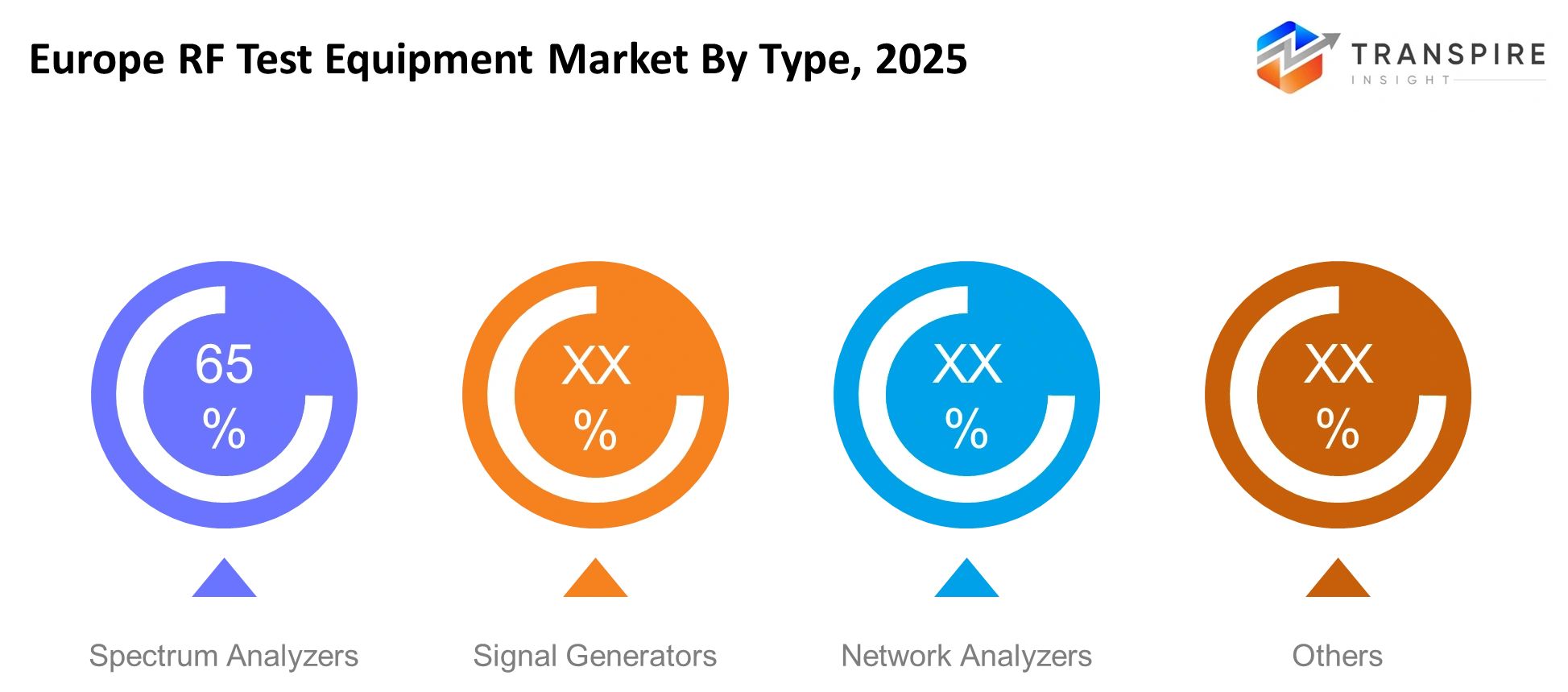
The categories show their presence through their main identification method which organizations use to select their appropriate operational methods. Network analyzers hold the leading position with an estimated share above 30% due to critical use in validating impedance, signal integrity, and high-frequency performance in 5G infrastructure. Spectrum analyzers follow closely supported by widespread deployment in interference detection and spectrum management across telecom and defense environments. The market for signal generators has decreased but currently shows growth because testing experts need to create exact signal duplications for their sophisticated testing processes.
The demand for network analyzers has increased because millimeter wave technologies have become more common which requires precise multi-port measurements. Spectrum analyzers gain advantages because authorities now enforce stricter regulations which require monitoring of frequency bands. The signal generators market grows because R&D activities related to wireless standards continue to expand. The forecast period will see software-defined and modular systems transform product development processes because these systems will enable vendors to develop products which can adapt to upcoming testing requirements.
To learn more about this report, Download Free Sample Report
By Application:
The telecom sector holds the biggest market share which exceeds 50% because 5G networks continue to expand and urban areas require more base stations. The aerospace and defense sector holds a strong second position because their organizations keep spending money on radar and satellite communication and secure transmission system development. The automotive and electronics sectors show consistent growth because testing requirements have increased with the rising number of connected devices and smart systems.
The telecom industry requires multiple validation tests because network systems need to adapt to increased frequency and reduced latency requirements. Vehicle-to-everything communication testing enables automotive applications to progress while creating new challenges for validation. Product developers create solutions for future demands which will require systems that work across multiple industries and capacity for testing that occurs in real time.
By End-User:
Manufacturers represent the largest end-user group, accounting for over 40% share due to extensive use of RF testing during product development and quality assurance stages. Telecom operators follow, as they continue to monitor their operational networks and extend their existing network infrastructure. Research institutes contribute a smaller share but remain important for innovation and early-stage validation of emerging technologies.
Manufacturers depend on RF testing to verify their products meet performance standards at commercial launch, which generates steady equipment requirements. The rising network complexity results in telecom operators needing more network tracking which leads to increased system usage. The demand from research institutes will grow because funding for 6G and advanced communication systems will increase, which will lead vendors to develop solutions with greater precision and expertise.
By Frequency:
The mid-frequency range currently stands as the leading choice for 4G and 5G networks because it provides both adequate coverage and sufficient performance. The high-frequency segment is becoming more popular because millimeter wave technology develops for both urban environments and research facilities. The share of low-frequency testing remains small because it functions mainly for traditional systems and extended-distance communication.
High-frequency testing experiences growth because modern applications require both increased bandwidth and faster data processing speeds. The existing network infrastructure depends on mid-frequency technology which maintains stable demand throughout time. The high-frequency market will experience rapid growth throughout the forecast period, which will lead companies to develop advanced testing solutions while driving vendors to create new precision measurement and signal analysis technologies.
What are the Key Use Cases Driving the Europe RF Test Equipment Market?
Telecom infrastructure testing serves as the primary application which operators use to test 5G base stations and small cells and backhaul links during their pre-deployment and post-deployment testing. Network designers need to conduct actual signal tests to assess their system capabilities under high-frequency conditions which their dense network systems and high-frequency bands introduce. Advanced RF testing systems will continue to receive demand because these systems need to perform accurate signal tests and ongoing performance assessments.
The automotive and aerospace industries are expanding to develop new applications which can operate as adjacent use cases. Automotive manufacturers use RF testing to confirm their vehicles can operate with all forms of vehicle-to-everything technology and all advanced driver assistance systems. Aerospace and defense organizations use these tools for radar calibration, satellite communication testing, and secure signal validation in mission-critical environments.
Industry IoT applications and private 5G networks are emerging as new use cases that manufacturing plants now adopt. Smart factories now require real-time wireless validation to achieve reliable machine-to-machine communication which creates new demand for compact software-driven RF testing solutions.
|
Report Metrics |
Details |
|
Market size value in 2025 |
USD 0.82 Billion |
|
Market size value in 2026 |
USD 0.877 Billion |
|
Revenue forecast in 2033 |
USD 1.404 Billion |
|
Growth rate |
CAGR of 6.95% from 2026 to 2033 |
|
Base year |
2025 |
|
Historical data |
2021 - 2024 |
|
Forecast period |
2026 - 2033 |
|
Report coverage |
Revenue forecast, competitive landscape, growth factors, and trends |
|
Regional scope |
Europe (Germany, United Kingdom, France, Italy, Spain, Rest of Europe) |
|
Key company profiled |
Keysight Technologies, Rohde & Schwarz, Anritsu, Tektronix, National Instruments, Advantest, Cobham, Viavi Solutions, EXFO, Yokogawa, B&K Precision, Chroma ATE, Teledyne LeCroy, Giga-tronics, Good Will Instrument |
|
Customization scope |
Free report customization (country, regional & segment scope). Avail customized purchase options to meet your exact research needs. |
|
Report Segmentation |
By Type (Signal Generators, Spectrum Analyzers, Network Analyzers, Others); By Application (Telecom, Aerospace, Automotive, Electronics, Others); By End-User (Manufacturers, Telecom Operators, Research Institutes, Others); By Frequency (Low, Mid, High, Others) |
Which Regions are Driving the Europe RF Test Equipment Market Growth?
Western Europe holds the top position within the regional market because its countries maintain strong telecom policy frameworks and their early 5G spectrum distribution between Germany, France, and the United Kingdom. The governments established fixed rollout schedules which required telecom operators to complete their network verification and compliance assessment processes at a faster pace. The existing telecom vendor ecosystem together with semiconductor companies and research institutions maintains ongoing development in RF testing technology. The high infrastructure density combined with strict regulatory requirements creates permanent needs for sophisticated testing equipment which public and private networks both require.
Northern Europe stands as a dependable source of innovation with Sweden and Finland making substantial investments in communication technology development. The region distinguishes itself from Western Europe through its dedication to research-based development methods instead of large-scale system implementation. The close partnership between telecom companies and universities establishes a continuous flow of resources which assists in evaluating upcoming wireless technologies. The area maintains economic durability together with ongoing funding for research and development which establishes a dependable market demand that differs from markets which experience rapid deployment.
Eastern Europe has become the most rapidly expanding area because recent telecom modernization efforts combined with increased EU funding for digital infrastructure development. Poland and Romania have achieved faster 5G deployment since 2022 which has created fresh requirements for RF testing solutions. The rising adoption of industrial automation together with private network implementation has increased the demand for testing capabilities which need to occur at local facilities. The period from 2026 through 2033 will create significant opportunities for new market participants and investors who seek affordable and expandable testing solutions.
Who are the Key Players in the Europe RF Test Equipment Market and How Do They Compete?
The competitive landscape shows a moderately consolidated structure where a few established players control a significant share through deep technological expertise. The main focus of competition involves three elements which include precise measurements and the ability to operate in different frequency ranges and the capacity to integrate software systems. The market requires established companies to defend their market position by creating high-frequency testing platforms which use artificial intelligence technology while new companies develop specialized solutions for automotive radio frequency testing and small testing equipment. The market rewards companies that can combine hardware accuracy with flexible software-defined architectures.
Rohde & Schwarz establishes its unique position through its precise measurement instruments and its extensive experience in testing aerospace and defense systems which operate under strict reliability requirements. The company expands through collaborations with European telecom operators and continuous upgrades in millimeter wave testing platforms. Keysight Technologies concentrates on developing software innovations which create cloud-based testing environments that support remote validation and faster deployment cycles. The wireless ecosystem gains better integration through strategic partnerships which connect with chipset manufacturers.
Anritsu Corporation builds advantage through early development of 5G and emerging 6G testing solutions especially in the areas of protocol and network simulation. The Tektronix company develops its products through modular design which creates user-friendly systems that function effectively in both mid-sized laboratories and industrial environments. National Instruments uses a platform-based system which combines software tools that users can customize to achieve quick adaptations for testing purposes in both automotive and industrial Internet of Things environments.
Company List
- Keysight Technologies
- Rohde & Schwarz
- Anritsu
- Tektronix
- National Instruments
- Advantest
- Cobham
- Viavi Solutions
- EXFO
- Yokogawa
- B&K Precision
- Chroma ATE
- Teledyne LeCroy
- Giga-tronics
- Good Will Instrument
Recent Development News
In May 2026, Rohde & Schwarz announced the RF Testing Innovations Forum 2026 virtual event. The initiative brings together industry partners to address advanced RF validation challenges, supporting faster product development and time-to-market improvements.https://www.rohde-schwarz.com
In April 2026, Keysight Technologies launched enhanced AI-driven test automation capabilities for 5G and next-generation wireless validation. The update improves testing efficiency and reduces manual calibration time, strengthening adoption of software-defined RF platforms.https://www.keysight.com
What Strategic Insights Define the Future of the Europe RF Test Equipment Market?
The Europe RF Test Equipment Market is shifting towards testing environments which use software-based systems to automatically perform tests because wireless technologies now operate at higher frequency bands and more advanced system designs. The underlying force is the convergence of 5G expansion, early 6G research, and the rise of private industrial networks, all of which require continuous and adaptive validation rather than periodic testing. The industry will move toward this new direction because vendors need to build systems which can maintain cloud connections while using AI technologies to analyze data.
Companies face an invisible risk because they rely more on special semiconductor manufacturers who provide advanced components needed for high-frequency production. Central and Eastern Europe manufacturing hubs present businesses with a new chance to create private 5G networks and edge networks, which have not yet developed their testing requirements for local operations.
Market participants should invest in modular, upgradeable systems that support multiple frequency bands and industries, allowing faster adaptation to shifting standards while reducing long-term customer acquisition costs.
Europe RF Test Equipment Market Report Segmentation
By Type
- Signal Generators
- Spectrum Analyzers
- Network Analyzers
- Others
By Application
- Telecom
- Aerospace
- Automotive
- Electronics
- Others
By End-User
- Manufacturers
- Telecom Operators
- Research Institutes
- Others
By Frequency
- Low
- Mid
- High
- Others
Frequently Asked Questions
Find quick answers to common questions.
The Europe RF Test Equipment Market size is USD 1.404 Billion in 2033.
Key segments for the Europe RF Test Equipment Market are By Type (Signal Generators, Spectrum Analyzers, Network Analyzers, Others); By Application (Telecom, Aerospace, Automotive, Electronics, Others); By End-User (Manufacturers, Telecom Operators, Research Institutes, Others); By Frequency (Low, Mid, High, Others).
Major Europe RF Test Equipment Market players are Keysight Technologies, Rohde & Schwarz, Anritsu, Tektronix, National Instruments, Advantest, Cobham, Viavi Solutions, EXFO, Yokogawa, B&K Precision, Chroma ATE, Teledyne LeCroy, Giga-tronics, Good Will Instrument.
The Europe RF Test Equipment Market size is USD 0.82 Billion in 2025.
The Europe RF Test Equipment Market CAGR is 6.95% from 2026 to 2033.
- Keysight Technologies
- Rohde & Schwarz
- Anritsu
- Tektronix
- National Instruments
- Advantest
- Cobham
- Viavi Solutions
- EXFO
- Yokogawa
- B&K Precision
- Chroma ATE
- Teledyne LeCroy
- Giga-tronics
- Good Will Instrument
Recently Published Reports
-
Apr 2026
Handling and Lifting Equipment Market
Handling and Lifting Equipment Market Size, Share & Analysis Report By Product (Cranes and Hoists, Forklifts, Conveyor Systems, Aerial Work Platforms, Others), By Application (E-Commerce, Automotive and Railway, Food and Beverages, Aviation, Others), and Geography (North America, Europe, Asia-Pacific, Middle East and Africa, South and Central America), 2021 - 2031
-
Apr 2026
HVAC Equipment Market
HVAC Equipment Market Size, Share & Analysis Report By Heating Equipment Type (Boilers and Furnaces, Heat Pumps, and Unitary Heaters), By Ventilation Equipment (Air Handling Units, Humidifiers and Dehumidifiers, Air Filters, and Fan Coiling Units), By Air Conditioning Equipment (Unitary Air Conditioners, Room Air Conditioners, Packaged Terminal Air Conditioners, and Chillers), By End User (Commercial, Residential, Industrial, and others), and Geography (North America, Europe, Asia-Pacific, Middle East and Africa, South and Central America), 2021 – 2031
-
Apr 2026
Refrigeration Valves Market
Refrigeration Valves Market Size, Share & Analysis Report By Type (Solenoid Valves, Expansion Valves, Check Valves, Service Valves, Others), By Application (Commercial Refrigeration, Industrial Refrigeration, Transport Refrigeration, Residential Refrigeration, Air Conditioning Systems), By End User (Food and Beverage Industry, Pharmaceutical Industry, HVAC Industry, Chemical Industry, Others), and Geography (North America, Europe, Asia-Pacific, Middle East and Africa, South and Central America), 2021 – 2031
-
Apr 2026
E-Commerce Packaging Materials Market
E-Commerce Packaging Materials Market By Material Type (Corrugated Boxes, Paper & Paperboard, Foam & Cushioning Materials, Plastic Packaging, Flexible Packaging, Protective Packaging, Others), By Product(Primary Packaging, Secondary Packaging, Tertiary Packaging), By Packaging Function (Protective Packaging, Branding & Presentation Packaging, Transit & Logistic Packaging, Sustainable Packaging, Tamper Evidence Packaging), By End-User (Retail & Consumer Goods, Electronic Appliances, Food & Beverages, Healthcare & Pharmaceutical, Fashion & Apparel, Home & Furnishing, Others); By Industry Analysis, Size, Share, Growth, Trends, and Forecasts 2021-2033