
Europe Remote Weapon Station Market Size & Forecast:
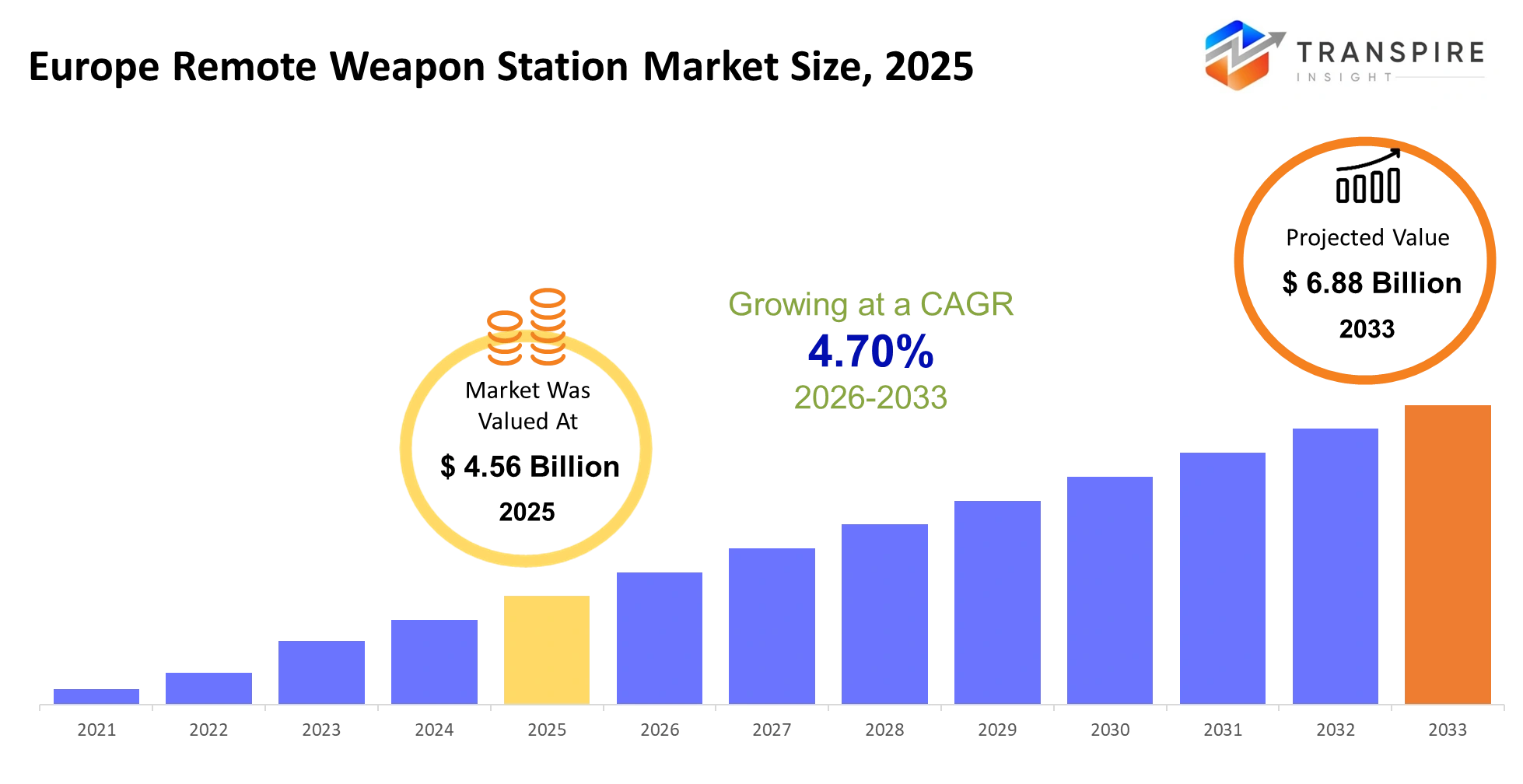
- Europe Remote Weapon Station Market Size 2025: USD 4.56 Billion
- Europe Remote Weapon Station Market Size 2033: USD 6.88 Billion
- Europe Remote Weapon Station Market CAGR: 4.70%
- Europe Remote Weapon Station Market Segments: By Type (Land-based, Naval-based, Airborne, Vehicle-mounted, Static Systems, Others); By Application (Defense, Border Security, Surveillance, Combat, Law Enforcement, Others); By Component (Weapons, Sensors, Control Systems, Cameras, Software, Others); By End-User (Military, Defense Agencies, Govt, Homeland Security, Law Enforcement, Others).
To learn more about this report,  Download Free Sample Report
Europe Remote Weapon Station Market Summary:
The Europe Remote Weapon Station Market size is estimated at USD 4.56 Billion in 2025 and is anticipated to reach USD 6.88 Billion by 2033, growing at a CAGR of 4.70% from 2026 to 2033. The Europe remote weapon station market in the defense and security sector will be unique as a niche industry driven by new purchasing practices and warfare tactics. It will embody the need for precision strikes, minimal personnel vulnerability, and computerized command systems for armoured combat vehicles and warships. New developments in detection technologies, stabilization, and target recognition will change the design specifications of weapons, and regulations on international trade and standardization among European military forces will affect deployment trends. Weapon systems designers will concentrate on flexible designs and software updates to adapt to dynamic operations, since defense budgets will favour network-enabled weapon systems worldwide
What Has the Impact of Artificial Intelligence Been on the Europe Remote Weapon Station Market?
The Europe remote weapon station market is steady-going through artificial intelligence, restructuring the way forward to analyze, govern, and progress the accurate way to data-driven decision-making in the defense company. AI in Europe remote weapon station market research will style up large-scale datasets for interpretation on procurement trends, battlefield requirements, and competitor standings. So using predictive analytics and machine learning, one could see cyclic demand, trace noticeable market trends, and further refine their strategies for future planning based upon even lesser uncertainty.
On the other hand, AI in Europe remote weapon station market activities will transform the dynamics of production and supply chains: henceforth, vendor automation will enable hand-to-machine communication, manufacturing workflows will be streamlined, quality control will be indubitably enhanced, and machine-operated supply chain optimization will help manage in real-time any system that might cause off-logistical delays to result in incremental operational costs. These attributes are aligned to amplify delivery response timing and improved resource allocations, particularly as defense contracts grow complex and necessitate a sped-up delivery schedule.
Artificial intelligence in Europe remote weapon station market would be instrumental in other aspects beyond efficiency to further innovation and distinct competitive iteration. Al hardware can be promoted to make responsible for AI, implying the foremost exigency in allied systems such as topology optimization, social media-provided-a cognitive learning-center, supported by a vast array of corresponding technology for acquiring better information in highly computational and intensive environments. Therefore, organizations built around artificial intelligence in Europe remote weapon station market strategies will have that thin, built-in progressive edge, offering a more responsive, intelligent, and solution-ready stance always within the prescribed operational environment.
Key Market Trends & Insights:
- The Europe remote weapon station market is primarily dominated by Western Europe, with almost 48% market share in 2025 owing to huge defense expenditure.
- The fastest-growing region is Eastern Europe, which is forecasted to grow above 7.2% CAGR until 2030 due to escalating political unrest.
- Land-based remote weapon systems lead with over 55% market share on account of advanced initiatives for improving armored vehicles in NATO countries.
- The naval remote weapon stations follow second with significant market share owing to maritime security improvements and installation in patrol boats.
- Airborne remote weapon stations are the fastest-growing application growing above 8% CAGR owing to mounting installations of weapons in UAVs & helicopters.
- The defense application leads the Europe remote weapon station market in terms of market share at over 70% as military deployments have increased in land and naval areas.
- The border security & surveillance application holds maximum potential for growth at a fast pace.
- The military continues to be the major end-user category in the remote weapon station market of Europe, accounting for more than 68% of the overall demand in this sector.
- Agencies for homeland security have been growing at a fast pace because of innovations in intelligent automation and AI-based surveillance systems.
- Companies such as Kongsberg Gruppen, Rheinmetall AG, BAE Systems, Leonardo S.p.A., and Thales Group are key players in the remote weapon station market of Europe.
- Product innovation is a strategy that involves the incorporation of artificial intelligence in targeting systems and stabilization technologies.
- Partnerships with defense ministries and NATO programs enhance market share and contract pipelines.
Europe Remote Weapon Station Market Segmentation
By Type
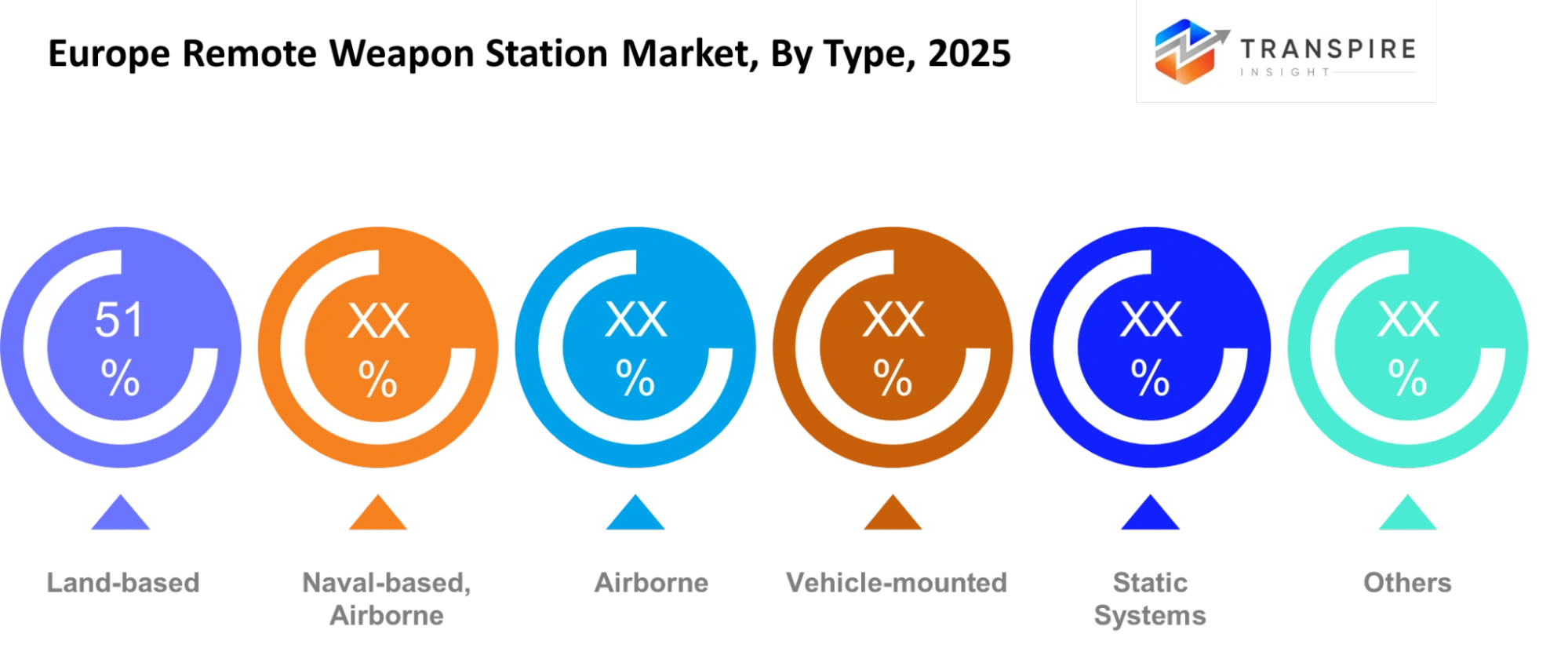
Land-based systems are likely to experience high levels of demand because they will be used on armored vehicles and ground defensive configurations. Naval-based systems will be useful for ensuring that there is security at sea in cases of patrol boats and coastal surveillance. Airborne systems will experience steady growth in the market and will find applications on helicopters and UAVs.
Static systems will be necessary for securing static locations such as borders and infrastructural assets where surveillance is constant. Other categories of systems will be developed depending on mission requirements. The major aspects of the various systems will center around stability, precision, and adaptation to different environments. There will be ongoing advancements in targeting and control systems.
To learn more about this report, Download Free Sample Report
By Application
Defense is expected to remain the main purpose, as remote weapon stations will be employed in preparing for combat situations and conducting missions. In combat scenarios, the use of such equipment will ensure rapid reaction and protection from harm for personnel involved. Surveillance is another area that will see growth as a result of the increasing requirement for surveillance of dangerous territories.
The area of border security will become increasingly relevant due to growing tensions between borders and the requirement to control migration. Law-enforcement authorities will start using such technologies in risky cases when it is necessary to have more control over the situation. There may be other possible applications depending on security challenges within regions.
By Component
The weapons would be the most crucial element, which includes machine guns and any other mountable weapons made for remote control. The sensors would aid in the detection of movements and the recognition of targets in varying environmental settings. The control systems would aid in the efficient functioning of the weapons. Cameras would provide vision with their capability to operate during day and night.
The software would serve as the foundation and facilitate the process of integrating other systems into a network, processing data and controlling interfaces. There will be several other parts like other hardware parts, which can boost efficiency and reliability. Software would get updated regularly to make the system smarter.
By End-User
The military will be the primary users of this technology because there is always a need to have modern combat systems and enhance the level of safety. The departments of defense will facilitate procurement and development of these systems so that they can meet national security requirements. The government will fund them to protect infrastructure and plan for emergencies.
The law enforcement agencies will embrace remote weapon systems in very special cases where engagement must be regulated. Other users will be special task forces with particular needs. Everyone will emphasize functionality, ease of operation, and rapid deployment.
What are the Main Challenges for the Europe Remote Weapon Station Market Growth?
Operational and technical problems still pose significant challenges in the Europe remote weapon station market development and application. Stability in adverse climatic and battlefield conditions still proves difficult, particularly when the mission spans several hours. Integrating the device with existing military vehicles will need extensive modifications, leading to delays in deployment. Also, logistical disruptions and reliance on specific electronic parts will constrain the scalability and steady manufacture of products in the Europe remote weapon station market.
Production and marketing problems also define the growth obstacles in the Europe remote weapon station market. Expensive manufacturing processes, involving high-tech mechanics and electronics, will prevent mass adoption due to cost constraints in modest defense spending. Stringent compliance laws and export restrictions in various European nations will result in prolonged approval procedures and slow market entry. The market boundaries will also cover lengthy trials and certifications periods, delaying the product release process.
Adoption issues will continue to be relevant, especially in areas that do not have much defense technology and technical knowledge. Training and staffing issues will become problematic, especially since training is a major issue in these locations. Financial constraints in developing countries will also become an issue that limits procurement capabilities, affecting demand for the Europe remote weapon station market. These issues will affect the adoption rate in various regions.
There is also the competitive threat from other defense products that could compete against remote weapons stations. Competing prices from companies within the market will create slim profit margins. Technological changes will also require frequent changes to the products. This issue will make the Europe remote weapon station market highly volatile.
Regional Insights
In Western Europe, there will be leadership because of high levels of defense spending, highly advanced research institutions, and rapid incorporation of remote weapons into their armed forces. Some of the countries that will be seen making investments in upgrading and modernizing their equipment include Germany, France, and United Kingdom.
In Eastern Europe, there will be more rapid growth because of growing security threats and defense readiness. The major countries that will be seen investing in securing their borders and military response equipment include Poland and Romania. Additionally, the growth will be facilitated through collaboration with suppliers from the west.
Recent Development News
In February 2026, Kongsberg Defence & Aerospace announced a contract agreement. The company secured a €140 million deal with Patria to supply Protector RS4 remote weapon stations for Germany and Sweden’s CAVS 6×6 program, strengthening European defense collaboration.
Source: https://www.kongsberg.com
In January 2026, Saab AB announced a contract award. The company received an order worth approximately SEK 1.5 billion from Sweden’s Defence Materiel Administration for Trackfire remote weapon stations, supporting future amphibious and army capabilities.
Source: https://www.saab.com
|
Report Metrics |
Details |
|
Market size value in 2025 |
USD 4.56 Billion |
|
Market size value in 2026 |
USD 4.99 Billion |
|
Revenue forecast in 2033 |
USD 6.88 Billion |
|
Growth rate |
CAGR of 4.70% from 2026 to 2033 |
|
Base year |
2025 |
|
Historical data |
2021 - 2024 |
|
Forecast period |
2026 - 2033 |
|
Report coverage |
Revenue forecast, competitive landscape, growth factors, and trends |
|
Regional scope |
Europe (Germany, United Kingdom, France, Italy, Spain, Rest of Europe) |
|
Key company profiled |
Kongsberg, Rafael Advanced Defense Systems, BAE Systems, Rheinmetall, Elbit Systems, FN Herstal, Leonardo, Saab, General Dynamics, Lockheed Martin, Northrop Grumman, Thales, Aselsan, Denel, ST Engineering. |
|
Customization scope |
Free report customization (country, regional & segment scope). Avail customized purchase options to meet your exact research needs. |
|
Report Segmentation |
By Type (Land-based, Naval-based, Airborne, Vehicle-mounted, Static Systems, Others); By Application (Defense, Border Security, Surveillance, Combat, Law Enforcement, Others); By Component (Weapons, Sensors, Control Systems, Cameras, Software, Others); By End-User (Military, Defense Agencies, Govt, Homeland Security, Law Enforcement, Others). |
How Can New Companies Establish a Strong Foothold in the Europe Remote Weapon Station Market?
Any new player entering the Europe remote weapon station market should adopt a targeted strategy that focuses on niche positioning and technology differentiation. Unlike major military organizations, small businesses will have an edge through the identification of areas that require development, such as light remote weapon stations for unmanned vehicles or affordable weapons for border patrol. Innovations that align well with existing trends in the industry will be highly sought-after in the Europe remote weapon station market. These trends include automation and AI integration into target engagement, whose demands are steadily rising.
Technology innovations will have an important part to play in securing a position in the Europe remote weapon station market. Businesses that design modularity in their products, incorporate sensors fusion, and offer predictive maintenance services will be the ones that stand out in procurement processes. For instance, Estonia-based company Milrem Robotics is innovating by merging autonomous ground platforms and remote weapon stations, which provides good examples of what innovation looks like. One of the innovative approaches that startups can pursue involves developing control software for remote stations.
The formation of strategic alliances will play an important role in the entrance to the market and further expansion as well. New companies will benefit from working together with already well-known suppliers of defense systems, government organizations, and research organizations since the latter will enable them to understand how the regulatory framework operates and to obtain pilot orders. The Europe remote weapon station market will tend to give preference to those companies who will create their credibility through strategic alliances and collaboration in terms of technology.
Finally, overcoming some specific problems of the industry is the key to success in the long term run. In this context, innovative solutions related to system robustness, integration with existing systems, and reduction of costs are very important.
Key Europe Remote Weapon Station Market Company Insights
The competition is expected to be tough as the existing firms would be concentrating on more advanced targeting systems, modularity, and digitization. The companies like Kongsberg Gruppen and Rheinmetall AG will invest in developing their products in order to sustain their technological superiority. The innovations would also assist in securing long-term deals and partnerships for defense purposes.
Some of the strategic actions that the firms will undertake will include partnering, geographical diversification, and investments in artificial intelligence control systems. The firms like BAE Systems and Thales Group will increase their market presence through governmental dealings and joint ventures.
Company List
- Kongsberg
- Rafael Advanced Defense Systems
- BAE Systems
- Rheinmetall
- Elbit Systems
- FN Herstal
- Leonardo
- Saab
- General Dynamics
- Lockheed Martin
- Northrop Grumman
- Thales
- Aselsan
- Denel
- ST Engineering
What are the Key Use-Cases Driving the Growth of the Europe Remote Weapon Station Market?
There is an increasing impetus on the Europe remote weapon station market owing to its growing importance in current military engagements that demand a high level of operator safety and remote engagement. Land combat platforms have started incorporating this technology in their platforms for delivering accurate fire power without putting their soldiers in danger. This aspect is aiding the growth of the Europe remote weapon station market. Digital battlefield networks are being incorporated in the Europe remote weapon station market.
The navy is another segment that could provide a boost to the Europe remote weapon station market as this segment needs remote weapon stations for patrolling activities and handling security breaches at coastal regions. Such installations will be helpful in tackling maritime crime issues like piracy. Border security organizations are another segment for remote weapon stations as constant surveillance will enable detection of any threat through remote weapon stations.
It is expected that the possibility of utilizing unmanned systems will contribute towards the growth in the European market for remote weapon stations. The application of remote weapon stations can develop in unmanned systems as well as unmanned aerial vehicles (drones). These remote weapon stations may assist unmanned systems and drones in executing their reconnaissance operations or other hazardous operations.
Europe Remote Weapon Station Market Report Segmentation
By Type
- Land-based
- Naval-based
- Airborne
- Vehicle-mounted
- Static Systems
- Others
By Application
- Defense
- Border Security
- Surveillance
- Combat
- Law Enforcement
- Others
By Component
- Weapons
- Sensors
- Control Systems
- Cameras
- Software
- Others
By End-User
- Military
- Defense Agencies
- Govt
- Homeland Security
- Law Enforcement
- Others
Frequently Asked Questions
Find quick answers to common questions.
The approximate Europe Remote Weapon Station Market size for the market will be USD 6.88 Billion in 2033.
Key segments for the Europe Remote Weapon Station Market are By Type (Land-based, Naval-based, Airborne, Vehicle-mounted, Static Systems, Others); By Application (Defense, Border Security, Surveillance, Combat, Law Enforcement, Others); By Component (Weapons, Sensors, Control Systems, Cameras, Software, Others); By End-User (Military, Defense Agencies, Govt, Homeland Security, Law Enforcement, Others).
Major Europe Remote Weapon Station Market players are Kongsberg, Rafael Advanced Defense Systems, BAE Systems, Rheinmetall, Elbit Systems, FN Herstal, Leonardo, Saab, General Dynamics, Lockheed Martin, Northrop Grumman, Thales, Aselsan, Denel, ST Engineering.
The Europe Remote Weapon Station Market size is USD 4.56 Billion in 2025.
The Europe Remote Weapon Station Market CAGR is 4.70%.
- Kongsberg
- Rafael Advanced Defense Systems
- BAE Systems
- Rheinmetall
- Elbit Systems
- FN Herstal
- Leonardo
- Saab
- General Dynamics
- Lockheed Martin
- Northrop Grumman
- Thales
- Aselsan
- Denel
- ST Engineering
Recently Published Reports
-
Apr 2026
Aerospace Fluoropolymers Market
Aerospace Fluoropolymers Market Size, Share & Analysis Report By Type (PTFE, FEP, PFA, ETFE, and Others), By Application (Electrical Insulation, Seals & Gaskets, Coatings, and Others), By End User (Commercial Aviation, Military Aviation, General Aviation, and Others), and Geography (North America, Europe, Asia-Pacific, Middle East and Africa, South and Central America), 2021 - 2031
-
Apr 2026
Airborne SATCOM System Market
Airborne SATCOM System Market Size, Share & Analysis Report By Type (SATCOM Terminals, Transceivers, Airborne Radio, Modems and Routers, SATCOM Radomes, and Other), By Application (Government and Defense and Commercial), and Geography (North America, Europe, Asia-Pacific, Middle East and Africa, South and Central America), 2021 – 2031
-
Apr 2026
Ship Leasing Market
Ship Leasing Market Size, Share & Analysis Report By Vessel Type (Container Ships, Bulk Carriers, Tankers, and Specialized Vessels), By Lease Duration (Short-Term Lease (Less than 1 year), Medium-Term Lease (1-5 years), and Long-Term Lease (More than 5 years)), By Lease Type (Bareboat Charter, Time Charter, Financial Lease, and Others), By End-User Industry (Oil and Gas, Manufacturing and Industrial, Automotive, Agriculture and Food, Retail and Consumer Goods, and Others), and Geography (North America, Europe, Asia-Pacific, Middle East and Africa, South and Central America), 2021 – 2031
-
Dec 2025
Thread Rolling Dies Market
Thread Rolling Dies Market Size, Share & Analysis Report By Type (Flat Thread Rolling Dies, Circular (Cylindrical) Dies, Tangential Thread Rolling Dies, Planetary Thread Rolling Dies, and Other Types), By Material Type (High-Speed Steel (HSS), Carbide, Tool Steel, Alloy Steel, and Other Specialized Alloys), By Distribution Channel (Direct Sales, Distributors and Dealers, and Online Platforms), By Application (Automotive Industry, Aerospace and Defense, Construction and Infrastructure, Industrial Machinery, Electronics and Electrical Components, Medical Devices, and Fastener Production), and Geography (North America, Europe, Asia-Pacific, Middle East and Africa, South and Central America), 2021 – 2031
Our Clients