
Europe Plant-based Milk Market Size & Forecast:
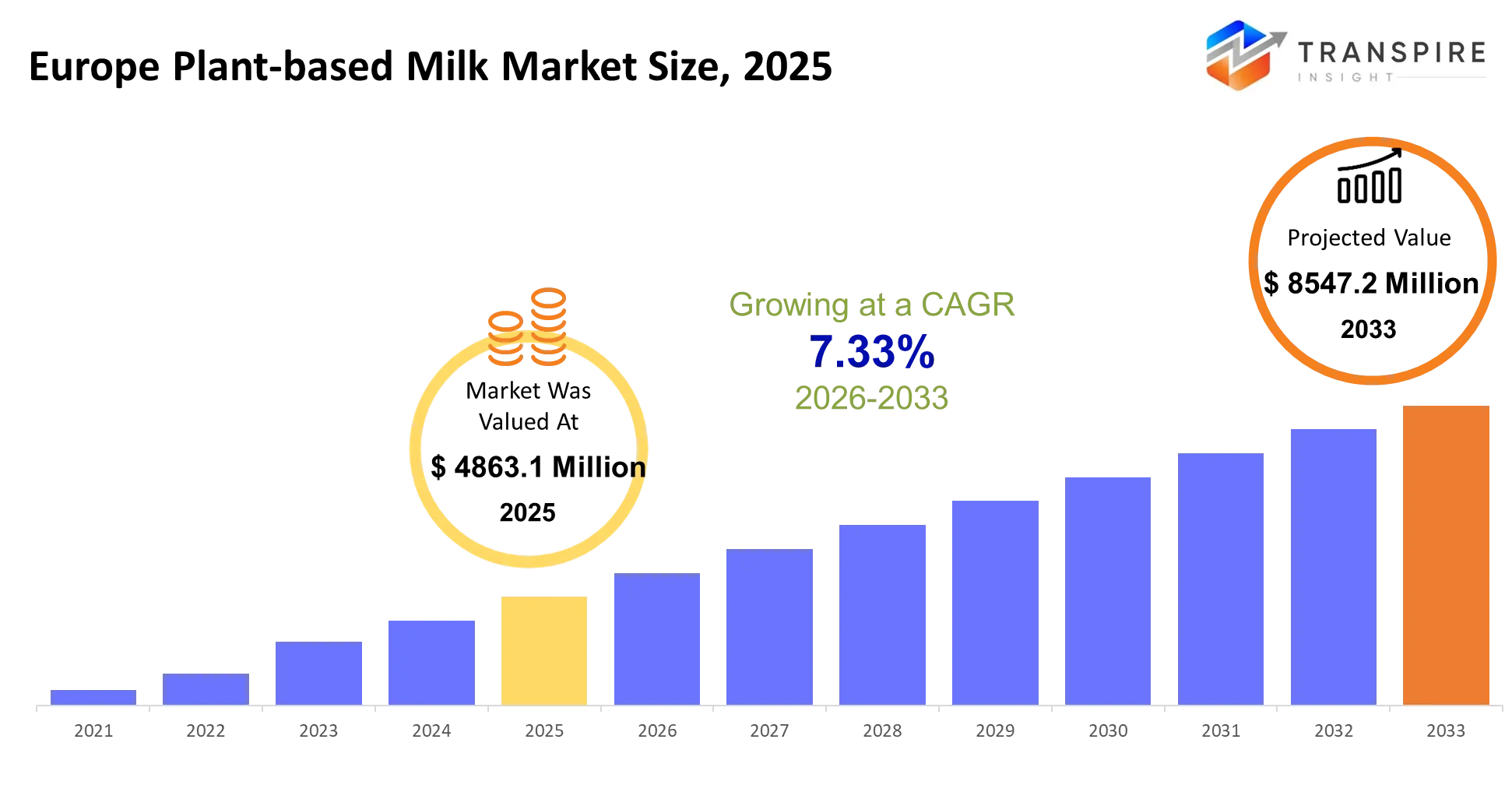
- Europe Plant-based Milk Market Size 2025: USD 4863.1 Million
- Europe Plant-based Milk Market Size 2033: USD 8547.2 Million
- Europe Plant-based Milk Market CAGR: 7.33%
- Europe Plant-based Milk Market Segments: By Type (Almond Milk, Soy Milk, Oat Milk, Coconut Milk, Rice Milk, Cashew Milk, Others), By Application (Beverages, Food Processing, Dairy Alternatives, Bakery, Coffee Applications, Others), By End-User (Consumers, Food Industry, Retailers, Cafes, Restaurants, Others), By Distribution (Supermarkets, Online, Specialty Stores, Convenience Stores, Others).
To learn more about this report,  Download Free Sample Report
Europe Plant-based Milk Market Summary:
The Europe Plant-based Milk Market size is estimated at USD 4863.1 Million in 2025 and is anticipated to reach USD 8547.2 Million by 2033, growing at a CAGR of 7.33% from 2026 to 2033. European plant-based milk market offers an appropriate substitute for cow milk which people use throughout their daily activities and food production processes while businesses can meet their special dietary needs and lactose-intolerant requirements and sustainability targets without disrupting their product delivery operations. It allows beverage companies and coffee shops and food service businesses to present milk substitutes which work well with coffee and cereal and ready-to-eat products.
The market has evolved during the previous 3 to 5 years from its original soy-based products into a market that now offers multiple options which include oat and almond and hybrid products because of better taste and barista-quality performance. COVID-19 supply chain problems disrupted operations which revealed weaknesses in standard dairy distribution systems and compelled retailers to shift their stock focus towards plant-based items with extended shelf life.
The new elements have changed how organizations approach their buying activities. Foodservice chains and private-label retailers are expanding plant-based SKUs because they reduce dependency on volatile dairy inputs while aligning with tightening EU sustainability and labeling frameworks which create new adoption opportunities and increase profit potential.
Key Market Insights
- The European Plant-based Milk Market of 2024 is controlled by Western Europe which holds more than 55% of the market share and Germany, the UK and France serve as its key market drivers.
- The Northern European region will experience its fastest growth until 2030 because sustainability policies create demand for plant-based products which people in the region consume at high levels.
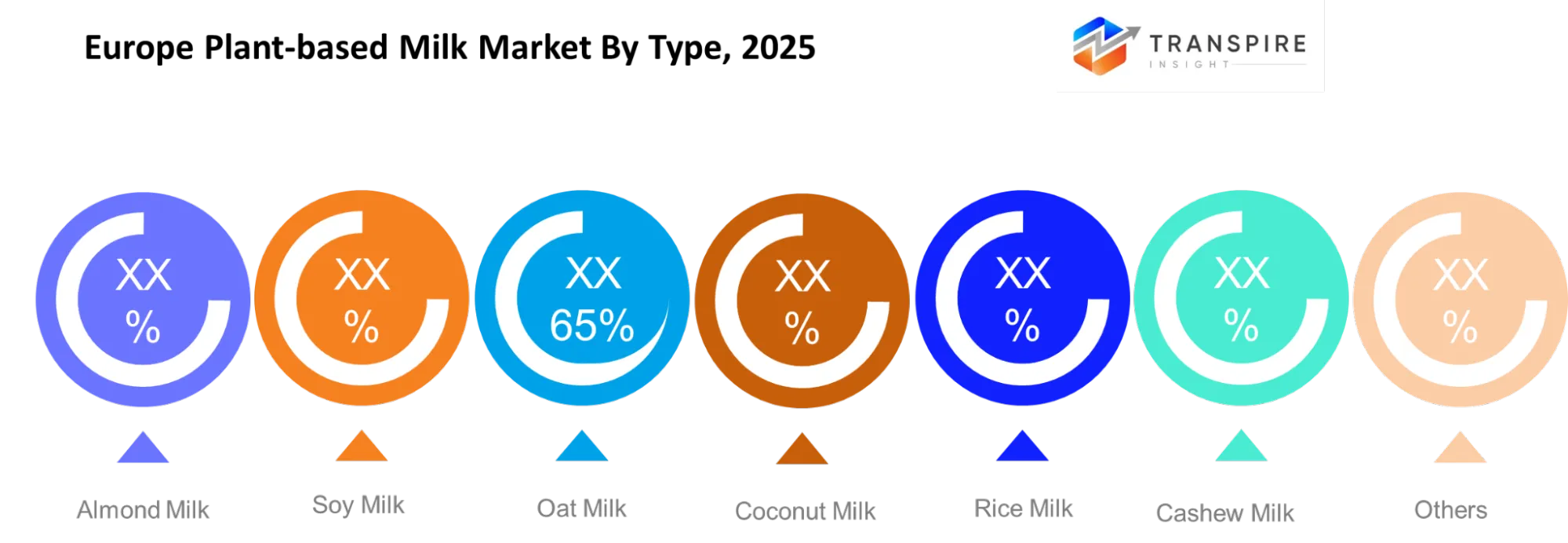
- Oat milk leads the market with a 35% share in 2024 because it has become a preferred choice for baristas who can obtain it from local sources.
- Almond milk holds the second-largest share at around 25% because consumers know the product well and it stores widely in retail locations.
- The pea and blended plant milk markets will experience their strongest growth during 2025 to 2030 period because producers use protein fortification to create allergen-free products.
- Retail consumption for households reaches a maximum of 65% which supermarkets boost through their private-label products.
- The foodservice industry experiences its most rapid growth through café chains which now serve plant-based milk as their standard beverage choice.
- Over 70% of total demand comes from individual consumers who change their dietary choices because of their preferred dietary patterns and their current way of life.
- The fastest-growing end-user category through 2030 consists of commercial users which include cafés and quick-service restaurants.
What are the Key Drivers, Restraints, and Opportunities in the Europe Plant-based Milk Market?
The Europe Plant-based Milk Market experiences its primary growth driver through the implementation of stricter EU climate and agricultural policies which began after the 2020 reforms that followed the Common Agricultural Policy and Green Deal objectives. Dairy producers face increased compliance costs because regulations require them to report emissions while they must change their livestock-based subsidy systems. Retailers and foodservice chains now buy plant-based milk products because it helps them secure stable supply while minimizing their compliance risks. The organization increased its product displays which included new private-label items that resulted in faster product sales which led to revenue growth for both oat and blended milk products.
The ongoing price difference between plant-based milk and traditional dairy products acts as the main barrier for consumers because the plant-based milk industry lacks unified access to raw materials and production capabilities. Plant-based alternatives need both imported almonds and specialized oat processing plants whereas dairy products enjoy advantages from established support systems and developed infrastructure which has been built over multiple decades. The cost difference which exists between two options creates a sustained market barrier that prevents Southern and Eastern European customers from buying products which need time to achieve full market penetration.
The next growth stage for precision fermentation technology will bring significant business opportunities. Companies that create dairy-identical proteins operate without livestock to produce hybrid plant-based foods which provide better taste and nutritional content. The German and Netherlands markets are currently establishing their initial scaling operations which will lead to decreased product expenses and new opportunities for dairy products to reach mainstream markets.
What Has the Impact of Artificial Intelligence Been on the Europe Plant-based Milk Market?
Artificial intelligence and advanced digital technologies are becoming essential tools for companies that operate in the European plant-based milk market which includes manufacturing processes and supply chain operations and product development activities. Producers now use AI-based process control systems to automate three main tasks which include blending and homogenization and quality monitoring throughout oat and almond milk production lines. The system maintains batch production stability while maintaining production capacity through its ongoing control of three crucial factors which include temperature and viscosity and enzyme activity.
Machine learning models are now used to create two types of operational systems which include predictive maintenance and demand forecasting tools. Manufacturers use sensor data from their processing equipment to identify potential failures which will cause production interruptions while AI-based demand forecasting models enable retailers and producers to manage their inventory more effectively while decreasing waste from perishable plant-based beverages. The approach resulted in measurable results which included better plant operation times and reduced waste of raw materials and improved distribution planning efficiency within European retail systems.
Companies use energy optimization methods to achieve better cost management results while they maintain their operations at water- and energy-intensive oat milk production facilities. The main obstacle continues to be the expensive implementation of AI systems which need complete integration with established food processing systems that use outdated technology while the industry lacks standardized datasets that cover all types of plant materials which would enable accurate model performance assessment and complete market acceptance.
Key Market Trends
- Retailers between 2020 and 2024 raised their private-label plant-based milk offerings by more than 30 percent which resulted in diminished control for traditional dairy suppliers.
- Café chains in the UK and Germany have eliminated oat milk surcharges since 2021 which has established plant-based options as standard choices for everyday consumer behavior.
- Supermarkets expanded their shelf space for long-life plant-based milk products between 2020 and 2022 because post-COVID supply disruptions made them less dependent on fresh dairy supply chains.
- Oatly and Alpro developed new product lines that combined oat and other ingredients for better taste and better use of local ingredient resources instead of their previous focus on soy products.
- From 2022 onward the European Union dairy labeling debates required brands to develop new packaging solutions and brand identities which resulted in higher marketing expenditures.
- Scandinavia and Germany established local oat supplies between 2021 and 2025 which decreased their need for imports while keeping input expenses stable against almond supply chain costs.
- Foodservice distributors have changed their procurement processes since 2023 by making plant-based milk products a standard requirement which distributors must include in their contracts.
- Enzyme processing technology improvements since 2022 have created better texture and foam stability for barista-grade products which coffee shops are now using.
- Retail growth in Eastern Europe has accelerated since 2023 because modern trade has expanded but consumers still prefer budget-friendly options over expensive goods.
Europe Plant-based Milk Market Segmentation
By Type
Oat milk maintains its status as the top milk alternative throughout Europe because it matches regional crop production and provides better performance for coffee preparation than other options. The second-largest market segment after oat milk consists of almond milk which people already know but its costs fluctuate because the business depends on international shipments. The market share of soy milk keeps decreasing because consumers choose different flavors while allergic reactions to soy continue to restrict its usage.
Coconut milk and rice milk and cashew milk function as specialty products which people use either for their taste or their specific health requirements. Manufacturers are turning to blended formulations because they want to achieve an optimal balance between protein content and flavor and cost efficiency. The market will develop through hybrid products and fortified products which require manufacturers to create domestic supply networks and processing systems that enhance their risk management and operational capacity.
By Application
To learn more about this report, Download Free Sample Report
The market for plant-based milk products reaches its highest point through their use in breakfast cereals and coffee beverages according to consumer habits. Urban markets show increased demand for coffee products because barista-grade formulations create a distinctive experience which encourages customers to make repeat purchases. The food processing industry operates as an expanding market which includes dairy-free yogurt and dessert products that manufacturers use to create new recipes based on updated ingredient standards.
The adoption of plant-based ingredients in packaged products has increased through bakery applications which now exist as a smaller market segment. Companies in this segment have achieved growth through their product development efforts, which resulted in superior texture and stability features that now enable their products to be used across multiple product categories. The success of future growth initiatives requires the development of new formulations which will produce reliable results during industrial food processing operations, thus enabling their implementation in packaged food supply chains.
By End-User
Retail consumers represent the largest user group because their household purchases through stores lead to their increased participation. Retailers function as essential middlemen who help grow private-label products and establish product placement through their store display practices. Cafés and restaurants are making plant-based milk products a must-have item on their menus. The processed food sector shows rising acceptance of processed food products but faces limitations because consumers prioritize prices.
Different regions show different demand patterns because Western Europe leads in premium product adoption while Eastern markets show price sensitivity. The market will grow when prices stabilize and foodservice operations expand which will prompt suppliers to develop product designs and pricing methods that suit both retail and commercial customers.
By Distribution
Supermarkets and hypermarkets control the market because they operate through their own private brands and attract many customers who purchase their products. Online retail has grown rapidly after 2020 because subscription models and direct-to-consumer strategies help brands reach more customers. Specialty stores continue to operate because they provide premium and organic products which attract specific consumer groups.
Convenience stores face market limitations because their operational space and product pricing systems restrict their business capacity. Companies now adopt distribution strategies that use omnichannel models to help their manufacturers achieve business growth through wholesale relationships while maintaining profit margins through their online sales. The future holds tighter retailer partnerships together with logistics optimization which enables inventory control through smooth product delivery across multiple European markets.
What are the Key Use Cases Driving the Europe Plant-based Milk Market?
The primary application of this solution focuses on people drinking beverages throughout their daily routines which includes their morning coffee and breakfast meals. The café chains and quick-service outlets produce high sales volumes because barista-grade oat milk allows them to maintain consistent foam and flavor while customers frequently order their items which contain oat milk.
Packaged food manufacturing now uses plant-based milk to create yogurts and desserts and ready-to-drink beverages which expands their product development capabilities. Food processors and private-label retailers adopt these inputs to meet reformulation targets and extend shelf life across large retail networks.
The market now sees hybrid dairy products which combine precision-fermented proteins with fortified clinical nutrition drinks as their newest application. The healthcare nutrition and sports recovery market has started to use these products which will lead to higher-profit product lines that will focus on functional needs throughout the upcoming period.
|
Report Metrics |
Details |
|
Market size value in 2025 |
USD 4863.1 Million |
|
Market size value in 2026 |
USD 5208.6 Million |
|
Revenue forecast in 2033 |
USD 8547.2 Million |
|
Growth rate |
CAGR of 7.33% from 2026 to 2033 |
|
Base year |
2025 |
|
Historical data |
2021 - 2024 |
|
Forecast period |
2026 - 2033 |
|
Report coverage |
Revenue forecast, competitive landscape, growth factors, and trends |
|
Regional scope |
Europe (Germany, United Kingdom, France, Italy, Spain and Rest of Europe) |
|
Key company profiled |
Oatly, Alpro, Danone, Nestle, Califia Farms, Ripple Foods, Blue Diamond, Pacific Foods, Elmhurst, Silk, Minor Figures, Vitasoy, Pureharvest, So Delicious, Plenish |
|
Customization scope |
Free report customization (country, regional & segment scope). Avail customized purchase options to meet your exact research needs. |
|
Report Segmentation |
By Type (Almond Milk, Soy Milk, Oat Milk, Coconut Milk, Rice Milk, Cashew Milk, Others), By Application (Beverages, Food Processing, Dairy Alternatives, Bakery, Coffee Applications, Others), By End-User (Consumers, Food Industry, Retailers, Cafes, Restaurants, Others), By Distribution (Supermarkets, Online, Specialty Stores, Convenience Stores, Others) |
Which Regions are Driving the Europe Plant-based Milk Market Growth?
The market is dominated by Western European countries which include Germany, the United Kingdom, and France as the primary drivers who create both advanced consumption patterns and technological breakthroughs. Retailers and foodservice operators have increased their plant-based product offerings because sustainability regulations and agricultural policy changes created a framework which supports their business operations. The combination of a fully developed retail system and modern food processing facilities enables businesses to achieve extensive product distribution together with stable product delivery. Manufacturers benefit from this integrated supply chain which enables them to grow their operations while they keep their product standards and market prices consistent.
The development of Northern Europe shows high stability which makes it one of the world most advanced regions. The region experiences growth through its Western European population base who show high consumer engagement and consume more than average. Producers face predictable demand because consumers maintain their dietary traditions while they start using alternative protein products. The agricultural sector in this region benefits from ongoing investments in local oat farming and processing because they decrease supply fluctuations which results in stable market revenues.
Eastern Europe shows rapid growth because modern retail networks expand and urban residents change their consumption habits. The period after 2022 has seen multinational companies and private label retailers increase their investments which resulted in better product availability and improved pricing conditions. Countries such as Poland and Romania now present new business opportunities because they have expanded their plant-based product selection. The region will experience market growth between 2026 and 2033 which will enable new businesses to enter the market through localized pricing methods and distribution alliances.
Who are the Key Players in the Europe Plant-based Milk Market and How Do They Compete?
The plant-based milk market in Europe operates with moderate competition because multinational food companies and dedicated plant-based companies both compete in retail and foodservice markets. Existing market players protect their market share through two strategies which involve expanding their product range and adjusting their product prices. New market entrants compete through two main advantages which include their ability to develop specific products and their dedication to eco-friendly practices.
Organizations now compete in the market through their product performance capabilities and their ability to manage their production network which includes all processes involved in oat procurement and oat processing. Businesses which achieve a successful balance among flavor and mouthfeel and affordable production costs will enhance their market presence through permanent agreements with coffee shops and retail stores.
Oatly specializes in oat-based products which use its patented enzyme technology to produce uniform foam results suitable for barista use. This technical advantage has established business relationships with major coffee chains throughout Europe which help increase brand recognition in places where customers buy coffee frequently. Danone uses its extensive product range which includes Alpro and other brands to establish its market presence while delivering plant-based products through its current dairy distribution system. The distribution network enables all products to reach customers in different regions while it enables multiple product lines to achieve cost savings.
Nestlé uses a hybrid business model which combines its plant-based product development with its existing beverage brands to create new retail products and ready-to-drink items. Minor Figures develops coffee products which target specific markets while its partnerships with independent cafés enable it to establish a strong presence in high-end urban areas. The different business strategies demonstrate that companies can gain a competitive edge through two main methods which include expanding their distribution network and delivering products with exceptional performance features.
Company List
- Oatly
- Alpro
- Danone
- Nestle
- Califia Farms
- Ripple Foods
- Blue Diamond
- Pacific Foods
- Elmhurst
- Silk
- Minor Figures
- Vitasoy
- Pureharvest
- So Delicious
- Plenish
Recent Development News
In February 2026, Oatly loses Supreme Court battle to call plant-based drinks ‘milk’: A major legal ruling against Oatly confirmed that terms like “milk” cannot be used for oat-based beverages in marketing. Industry analysts say the decision will force rebranding across European plant-based milk categories, especially in supermarkets and café supply chains.
Source: https://www.thetimes.com
In February 2026, Oatly banned from using word ‘milk’ to market plant-based products in UK: Swedish oat drink giant Oatly lost a UK Supreme Court ruling preventing it from using the word “milk” in branding such as “Post Milk Generation.” The court held that dairy terminology must be reserved for animal milk products, forcing plant-based brands to rework marketing language across Europe.
Source: https://www.theguardian.com
What Strategic Insights Define the Future of the Europe Plant-based Milk Market?
The Europe plant-based milk market is experiencing a structural transition which leads to product formulation convergence that enables plant-based products to compete with dairy products based on their taste and nutritional value and their product price. The current development is driven by people who create proteins through bioengineering and who obtain their agricultural materials from nearby farms and who operate under retailer requirements to make their products available in all of their retail products. The marketplace will develop into a competitive environment which evaluates organizations based on their operational costs and their capacity to deliver essential functions instead of their ability to create distinctive product identities.
The organization faces a hidden danger because it depends on specific raw materials which include oats and almonds because climate changes and regional farming methods will lead to unexpected input costs and decreasing profit margins. Precision fermentation has become an important opportunity because it produces dairy-identical proteins which do not require animal resources and it enables creation of hybrid products which attract regular customers.
Market players need to focus on backward integration for their raw material acquisition while they should spend resources on developing advanced processing solutions which will enable them to maintain material availability while achieving product uniformity and competitive pricing.
Europe Plant-based Milk Market Report Segmentation
By Type
- Almond Milk
- Soy Milk
- Oat Milk
- Coconut Milk
- Rice Milk
- Cashew Milk
- Others
By Application
- Beverages
- Food Processing
- Dairy Alternatives
- Bakery
- Coffee Applications
- Others
By End-User
- Consumers
- Food Industry
- Retailers
- Cafes
- Restaurants
- Others
By Distribution
- Supermarkets
- Online
- Specialty Stores
- Convenience Stores
- Others
Frequently Asked Questions
Find quick answers to common questions.
The approximate Europe Plant-based Milk Market size for the market will be USD 8547.2 Million in 2033.
The key segments of the Europe Plant-based Milk Market are By Type (Almond Milk, Soy Milk, Oat Milk, Coconut Milk, Rice Milk, Cashew Milk, Others), By Application (Beverages, Food Processing, Dairy Alternatives, Bakery, Coffee Applications, Others), By End-User (Consumers, Food Industry, Retailers, Cafes, Restaurants, Others), By Distribution (Supermarkets, Online, Specialty Stores, Convenience Stores, Others).
Major players in the Europe Plant-based Milk Market are Oatly, Alpro, Danone, Nestle, Califia Farms, Ripple Foods, Blue Diamond, Pacific Foods, Elmhurst, Silk, Minor Figures, Vitasoy, Pureharvest, So Delicious, Plenish.
The current market size of the Europe Plant-based Milk Market is USD 4863.1 Million in 2025.
The Europe Plant-based Milk Market CAGR is 7.33%.
- Oatly
- Alpro
- Danone
- Nestle
- Califia Farms
- Ripple Foods
- Blue Diamond
- Pacific Foods
- Elmhurst
- Silk
- Minor Figures
- Vitasoy
- Pureharvest
- So Delicious
- Plenish
Recently Published Reports
-
Apr 2026
Baby Infant Formula Market
Baby Infant Formula Market Size, Share & Analysis Report By ype (Infant Milk, Follow On Milk, Specialty Baby Milk, Growing-Up Milk), By Ingredient (Carbohydrate, Fat, Protein, Minerals, Vitamins, and Others), By Product Form (Powder, Liquid, and Ready-to-feed), By Distribution Channels (Supermarket/Hypermarket, Specialty Store, Pharmacies, Online Retail, and Others), and Geography (North America, Europe, Asia-Pacific, Middle East and Africa, South and Central America), 2021 - 2031
-
Apr 2026
Edible Insects for Animal Feed Market
Edible Insects for Animal Feed Market Size, Share & Analysis Report By Type (Insect Powder, Insect Meal, Insect Bar, Insect Paste, Insect Oil, and Others), By Insect Type (Beetles, Cricket, Caterpillar, Hymenoptera, Orthoptera, Tree Bugs, and Others), By Application (Livestock, Pet Food, and Aquaculture), By Livestock Type (Poultry, Swine, and Others), and Geography (North America, Europe, Asia-Pacific, Middle East and Africa, South and Central America), 2021 - 2031
-
Apr 2026
Food Industry Disinfection and Bacterial Control Market
Food Industry Disinfection and Bacterial Control Market Size, Share & Analysis Report By Type (Chemical Disinfectants, Physical Disinfectants, and Biocides and Antimicrobials), By Application (Food Processing Equipment Surface Disinfection, Food Preparation Areas Surface Disinfection, Storage Areas Surface Disinfection, Anti-microbial Coatings Food Preservation, and Preservative Solutions Food Preservation), By End User (Meat and Poultry Processing, Dairy Processing, Seafood Processing, Bakery and Confectionery, Restaurants and Commercial Kitchens, and Food Service Providers), By Sales Channel (Online, Offline), and Geography (North America, Europe, Asia-Pacific, Middle East and Africa, South and Central America), 2021 - 2031
-
Apr 2026
Freeze Dried Food Market
Freeze Dried Food Market Size, Share & Analysis Report By Product Type (Fruits, Vegetables, Freeze-Dried Dairy Products, Freeze-Dried Meat and Seafood, Freeze-Dried Pet Food, and Prepared Meal), By Nature (Organic, and Conventional), By Form (Powdered, Granules, and Diced), By End Use (Breakfast Cereals, Dairy Products, Bakery & Confectionery, Nutritional Bars & Supplements, Powdered Beverages, Snacks, and Retail (Household)), and Geography (North America, Europe, Asia-Pacific, Middle East and Africa, South and Central America), 2021 - 2031