
Europe Nuclear Fusion Market Size & Forecast:
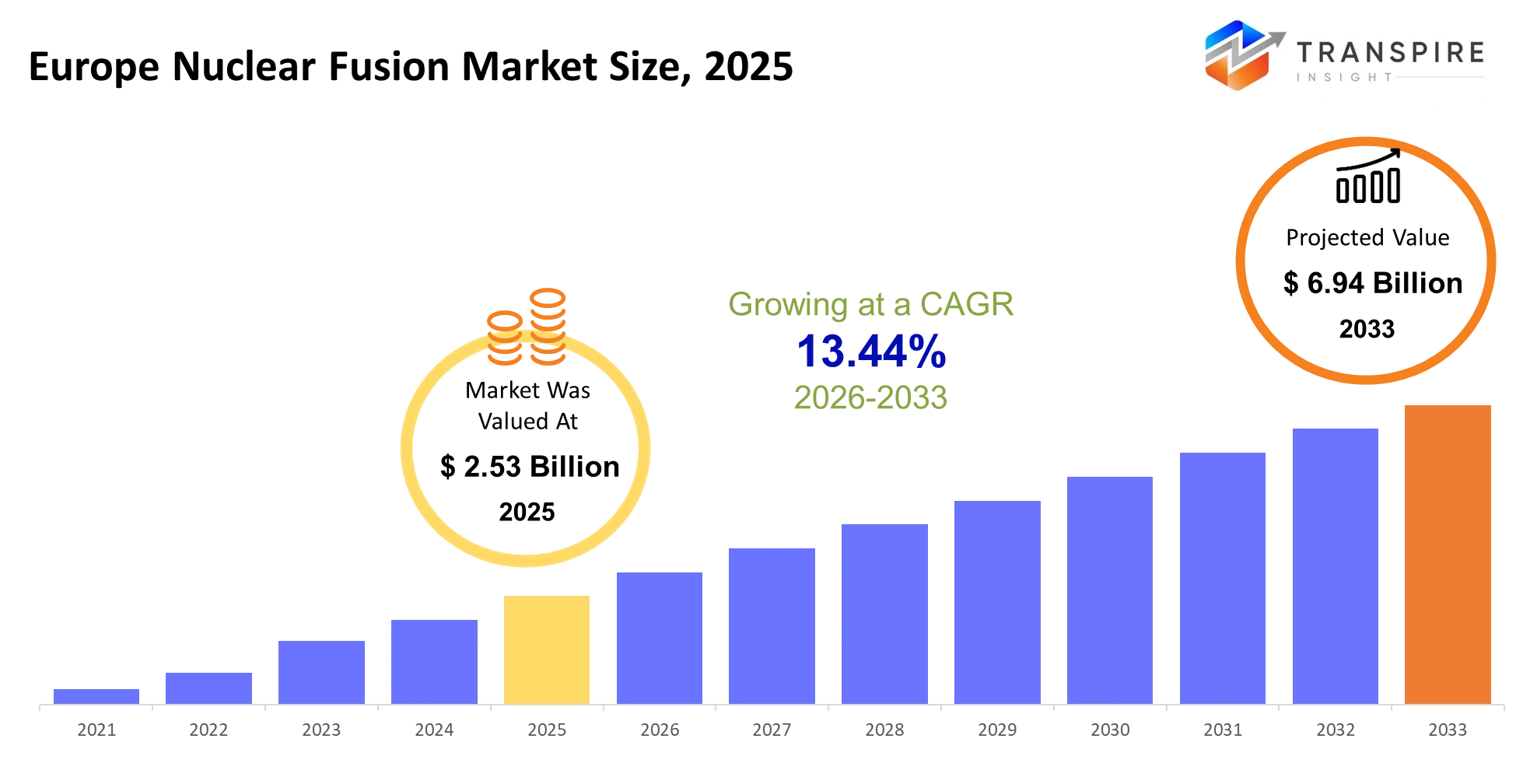
- Europe Nuclear Fusion Market Size 2025: USD 2.53 Billion
- Europe Nuclear Fusion Market Size 2033: USD 6.94 Billion
- Europe Nuclear Fusion Market CAGR: 13.44%
- Europe Nuclear Fusion Market Segments: By Type (Magnetic Confinement, Inertial Confinement, Stellarators, Tokamaks, Others), By Application (Energy Generation, Research, Defense, Others), By End-User (Government, Research Institutes, Energy Companies, Others), By Technology (Plasma Systems, Laser Systems, Superconducting Magnets, Others).
To learn more about this report,  Download Free Sample Report
Europe Nuclear Fusion Market Summary:
The Europe Nuclear Fusion Market size is estimated at USD 2.53 Billion in 2025 and is anticipated to reach USD 6.94 Billion by 2033, growing at a CAGR of 13.44% from 2026 to 2033. The European nuclear fusion industry has transformed from its original research phase into an advanced industrial energy solution which provides carbon-free base load electricity for essential operations while eliminating the need for imported fossil fuels. The development of fusion systems enables heavy industrial operations to maintain power supply to hydrogen production facilities and energy-intensive manufacturing processes which do not use renewable energy sources.
The market has transitioned during the last five years from its initial research funding phase to its current state of private investment in reactor development through advanced materials engineering and high-performance computing capabilities. European countries developed this response to the crisis because the Russia-Ukraine energy crisis confirmed Europe needed to secure its natural gas supplies and control its electricity costs. The government initiatives for clean energy independence received additional funding which established new reactor development programs for future energy solutions. Fusion businesses and component manufacturers and superconducting technology companies now partner with industrial clients during their early product development stages. The market is undergoing a revenue model transformation which requires companies to deploy prototypes and create grid connection strategies while developing procedures for safeguarding energy supply.
Key Market Insights
- The European nuclear fusion market from 2025 experienced Western Europe as its primary market region with France Germany and the United Kingdom controlling over 62% of total market share.
- France maintains its status as the top fusion research center because of its ITER project funding, development of superconducting magnets, and government-sponsored clean energy initiatives.
- The decarbonization objectives and advanced grid modernization projects drive Northern Europe to become the fastest expanding regional market until 2035.
- Germany expands its plasma physics and fusion engineering research programs to establish energy independence from foreign natural gas resources.
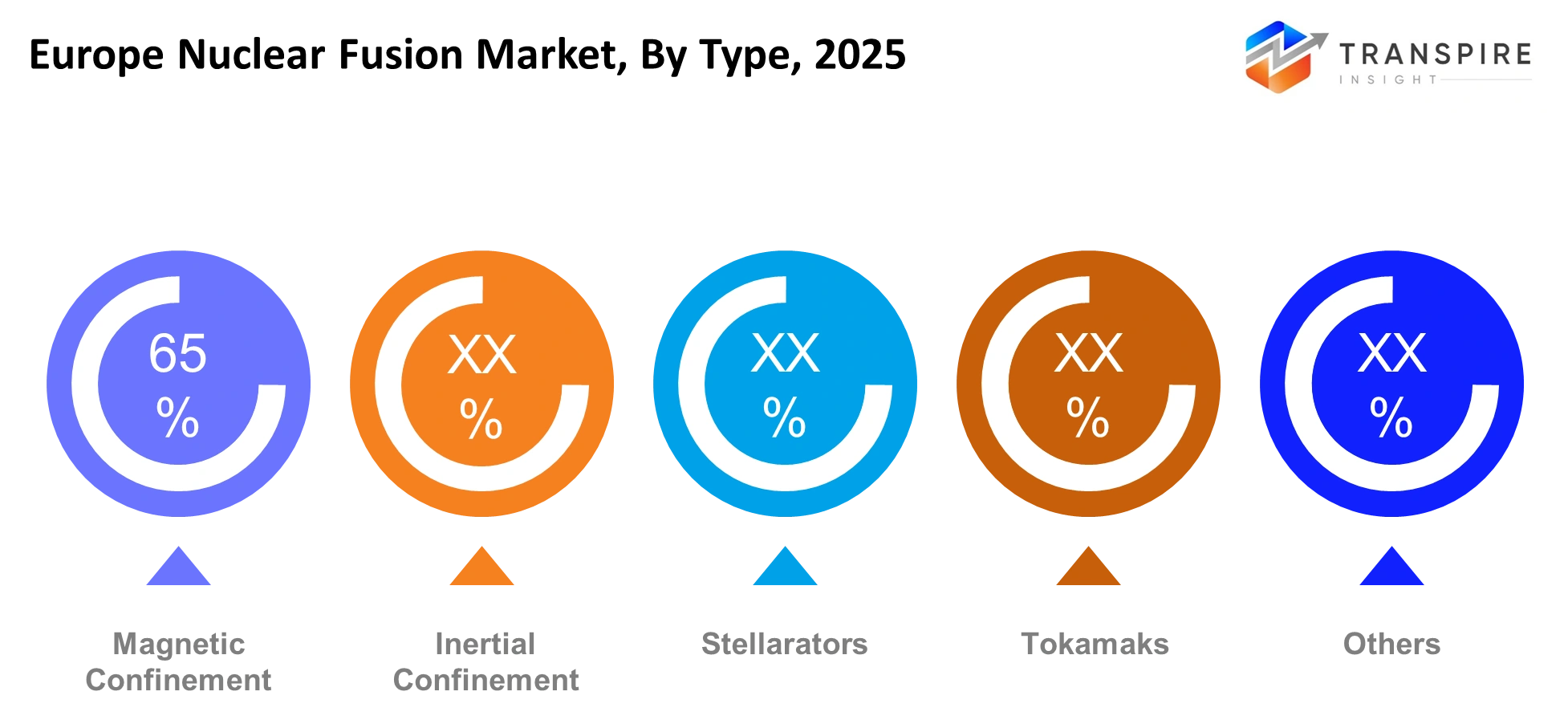
- The European nuclear fusion market in 2025 achieved its largest market size through magnetic confinement fusion technology which generated about 68% of total revenue.
- The European nuclear fusion market recognized tokamak reactor systems as its second most important market segment because these systems received substantial funding from institutions and demonstrated successful experimental scalability.
- Between 2026 and 2035 stellarator-based systems will become the most rapidly expanding market segment because they provide better operational stability than competing technologies.
- European reactor developers increased their demand for superconducting magnet technologies because they needed these technologies to meet their commercial prototype development requirements.
- The European fusion energy ecosystem saw grid-scale electricity generation become its most requested application which achieved about 57% market share during 2025.
- Industrial decarbonization and green fuel investments drive hydrogen production applications to experience their fastest growth rate through 2035.
- Industrial heat generation shows strong potential as an application for the steel chemicals and heavy manufacturing industries that operate throughout Europe.
- Government research organizations accounted for nearly 49% of Europe Nuclear Fusion Market revenue in 2025 through long-term reactor development programs.
What are the Key Drivers, Restraints, and Opportunities in the Europe Nuclear Fusion Market?
The nuclear fusion market development receives its strongest momentum from Europe's commitment to achieve permanent energy independence. The Russia-Ukraine energy crisis demonstrated how imported natural gas dependence creates financial and industrial dangers which particularly affect energy-intensive industries that include chemicals production, steel manufacturing, and advanced manufacturing processes. The European governments responded by increasing their financial support for fusion research projects and creating programs which improve grid stability and develop clean energy infrastructure. The new policy brought in extra investment to support private fusion companies and superconducting magnet manufacturers and plasma control technology firms. Public-private partnerships begin their transition from laboratory research to pilot reactor development as the market enters its initial revenue generation phase through engineering contracts and component manufacturing and reactor design services.
The most significant barrier for the market exists because commercial reactor development requires both technical expertise and financial resources which exceed typical industry standards. Fusion systems need advanced materials which can endure extreme neutron radiation and maintain secure plasma containment and operate under extensive cryogenic cooling systems. The existing development requirements force projects to exceed the standard development timeframes established for traditional energy investment schedules. The current situation leads to postponed product launch activities which result in minimal short-term earnings while institutional investors delay their market entry process because they want stable revenue streams. The existing structural limitation prevents utilities from adopting fusion technology because they need to implement upcoming power resource acquisition methods.
Industrial hydrogen production needs sustainable business growth through power generated from fusion to increase its production capacity. Germany and France are investing more funds into green hydrogen systems to achieve decarbonization in their heavy transportation and manufacturing sectors. Fusion power provides a reliable solution for producing consistent electricity which delivers high output capacity while eliminating the operational challenges faced by renewable hydrogen production systems.
What Has the Impact of Artificial Intelligence Been on the Europe Nuclear Fusion Market?
The European nuclear fusion sector uses artificial intelligence together with advanced digital technologies to develop its operational activities especially for plasma control and reactor stability and predictive system management. Fusion developers use AI-based control platforms to manage huge real-time data streams generated by their magnetic confinement systems and superconducting magnets and plasma diagnostics systems. The systems provide automatic reactor parameter modifications which operators use to sustain plasma stability while minimizing expensive experimental disruptions.
Fusion infrastructure benefits from machine learning models which enhance predictive maintenance operations. The algorithms use temperature changes and material stress patterns and electromagnetic performance data to determine when components will fail before they actually break down. This approach helps to decrease unexpected equipment outages while extending the operational life of equipment and decreasing maintenance expenses for essential reactor components. Engineers use digital twin technology to design reactors which simulate plasma movement and energy production across different operational states to optimize reactor performance before actual construction.
Experimental research tracks have received acceleration from advanced computing systems which now complete simulation processes that used to need weeks for human assessment. The limited access to extensive operational fusion datasets at present creates a significant barrier for organizations that want to adopt AI technology. The absence of large-scale operational commercial fusion reactors we present day requires predictive models to depend on experimental data and simulated data which results in inaccurate predictions of actual performance in real-world settings.
Key Market Trends
- European governments increased their fusion research funding through the year 2022 because natural gas supply interruptions demonstrated how industrial sectors depend on foreign fossil fuels for essential operations.
- Private fusion startups shifted from university-linked research models toward venture-backed commercialization strategies which led to multi-million-euro investments between 2021 and 2025.
- The ITER Organization developed supplier partnerships after European manufacturers increased their production capacity for superconducting magnets and cryogenic components beginning in 2023.
- AI-based systems for plasma stabilization replaced manual calibration methods which operated at reduced speed. This change enabled experimental processes to run without interruptions while improving reactor control accuracy in pilot facilities.
- The German and French governments raised their financial commitment toward hydrogen production through fusion research because heavy industries required reliable sources of carbon-free power after 2022.
- European utilities shifted from observing fusion research programs to participating in long-term grid integration planning and early infrastructure partnerships since 2024.
- The development of stellarator reactors gained speed because operational stability problems made people doubt the effectiveness of deploying traditional tokamak systems for pilot testing.
- European reactor developers increased their material sourcing from European suppliers between 2023 and 2025 which resulted in higher levels of reactor supply chain production.
- Fusion companies established more partnerships with AI and high-performance computing companies to achieve faster simulation results and plasma behavior assessment.
- Regulatory authorities began using fusion energy in their future decarbonization plans which demonstrates increasing governmental backing for commercial reactor implementation after 2030.
Europe Nuclear Fusion Market Segmentation
By Type
The market currently recognizes magnetic confinement systems as the leading technology because European funding sources allocate their financial resources primarily to tokamak-based reactor programs. The existing superconducting magnet technologies enable researchers to study operational research for decades which established plasma control models through their associated research. Industries now show growing interest in stellarators because their advanced magnetic field designs provide better plasma stability while reducing disruption risks during long-term operations. The market share of inertial confinement systems remains low because high-energy laser systems demand both major financial backing and specialized knowledge for their operation.
Current demand trends show a preference for technologies which can deliver continuous industrial power generation instead of technologies which only produce power for limited testing periods. The upcoming market development will lead manufacturers to adopt hybrid development strategies which involve building multiple reactor designs instead of sticking to their initial single-reactor concepts. Investors will show preference for platforms which can scale up their operations while requiring less time to enter the market, while buyers will keep choosing technologies which provide dependable performance and simple upkeep and ability to function within power grid systems for extended periods.
To learn more about this report, Download Free Sample Report
By Application
The energy generation sector serves as the primary use case because European industrial nations need constant carbon-free base load power to enable their manufacturing operations and electrification of transportation and hydrogen production processes. The market maintains its activity level through research applications which need reactor physics and plasma behavior and advanced material testing to reach commercial deployment at large scale. Selective government bodies show interest in defense applications which involve high-energy physics and advanced propulsion research even though these fields maintain limited demand. The different application categories contain unique elements which create their own demand drivers.
Research institutions develop their experimental validation and reactor optimization processes while commercial energy projects focus on their efficiency and scalability and extended operational periods. Recent geopolitical disruptions have created demands for stronger energy independence which has resulted in increased development of grid-connected fusion systems. Future opportunities are expected to expand around industrial hydrogen production and high-temperature industrial heat applications. The development strategies of technology suppliers and reactor developers now match the product requirements of utility operators and heavy manufacturing groups who want to maintain their energy reliability.
By End-User
The public sector represents the main consumer group because European countries continue to develop nuclear power plants through national energy programs and their public research initiatives. Research institutes maintain strong market influence through their work in plasma diagnostics and reactor simulation and materials engineering which they conduct together with academic and multinational partners. The energy sector has become the most rapidly expanding customer group because utility companies prepare to incorporate fusion power into their ongoing energy production plans.
European countries have seen a substantial rise in private sector participation since energy security concerns became more serious after natural gas supply interruptions. Investment patterns show a gradual transition from research-led procurement toward commercially focused infrastructure planning and component manufacturing partnerships. The government sector maintains its focus on energy sovereignty while industrial customers assess fusion technology as a sustainable solution for achieving decarbonization targets. The upcoming market structure will feature utility companies and technology startups and advanced manufacturing firms working together to establish their presence in next-generation energy infrastructure.
By Technology
Superconducting magnets dominate the technology segment because magnetic confinement reactors require extremely powerful and stable magnetic fields for plasma containment. Plasma systems also maintain a strong presence because their operational stability and accuracy have been enhanced through ongoing development of diagnostic tools and real-time monitoring systems and AI-based control systems. Laser systems maintain their importance in inertial confinement research although researchers face difficulties with implementation because of both the complicated nature of the necessary infrastructure and the expensive costs associated with running the systems.
Developers who want to achieve faster reactor optimization while decreasing their need for testing time have created a strong demand for new digital simulation software and advanced computing resources. Technology suppliers are making substantial investments in automation and predictive maintenance software and digital twin modeling techniques to achieve faster product development and greater equipment lifespan. Future competitive advantage will likely depend on material innovation and thermal resistance capabilities and computational efficiency. The deployment of pilot reactors across Europe will create business opportunities for manufacturers who can combine advanced magnet systems with advanced reactor control systems.
What are the Key Use Cases Driving the Europe Nuclear Fusion Market?
The European Nuclear Fusion Market primarily serves grid-scale electricity generation needs because industrial economies depend on stable baseload power to meet their demands for heavy manufacturing and electrified transport systems and hydrogen production infrastructure. Utility operators choose to implement fusion systems because those systems deliver extended power output capabilities which do not depend on fuel supplies thereby helping to maintain national energy security during periods of gas supply interruptions. The government and energy company stakeholders who prioritize long-term grid stability investments dedicate their largest funding resources to this specific application.
The steel manufacturing and chemical processing and refining industries are establishing new use cases for industrial hydrogen production and high-temperature process heat. Energy companies and large industrial end-users are testing fusion-linked hydrogen pathways to decarbonize operations that cannot fully transition to intermittent renewable electricity. Research institutes and private technology developers are developing hybrid systems that generate electricity through fusion power and electrolysis facilities to achieve better performance and decreased energy waste during operations.
High-energy physics applications related to defense and advanced propulsion research have emerged as new use cases which currently exist at low deployment levels but possess essential technical capabilities. Aerospace agencies and specialized government laboratories are evaluating fusion-driven propulsion concepts for deep-space missions and high-density energy systems. The applications are currently undergoing preliminary experimental testing but the field has attracted interest because of new developments in plasma control systems and superconducting magnet technology and high-performance simulation systems.
|
Report Metrics |
Details |
|
Market size value in 2025 |
USD 2.53 Billion |
|
Market size value in 2026 |
USD 2.87 Billion |
|
Revenue forecast in 2033 |
USD 6.94 Billion |
|
Growth rate |
CAGR of 13.44% from 2026 to 2033 |
|
Base year |
2025 |
|
Historical data |
2021 - 2024 |
|
Forecast period |
2026 - 2033 |
|
Report coverage |
Revenue forecast, competitive landscape, growth factors, and trends |
|
Regional scope |
Europe (Germany, United Kingdom, France, Italy, Spain and Rest of Europe) |
|
Key company profiled |
ITER Organization, General Fusion, Tokamak Energy, Commonwealth Fusion Systems, TAE Technologies, First Light Fusion, Helion Energy, Zap Energy, Marvel Fusion, Kyoto Fusioneering, Hyperjet Fusion, HB11 Energy, Fusion for Energy, UKAEA, ENEA. |
|
Customization scope |
Free report customization (country, regional & segment scope). Avail customized purchase options to meet your exact research needs. |
|
Report Segmentation |
By Type (Magnetic Confinement, Inertial Confinement, Stellarators, Tokamaks, Others), By Application (Energy Generation, Research, Defense, Others), By End-User (Government, Research Institutes, Energy Companies, Others), By Technology (Plasma Systems, Laser Systems, Superconducting Magnets, Others). |
Which Regions are Driving the Europe Nuclear Fusion Market Growth?
The European Nuclear Fusion Market in Western Europe shows its strongest development because the region possesses numerous national fusion initiatives and state-of-the-art research facilities and permanent government financial support. The United Kingdom and France and Germany operate key testing centers which create supply chains that enable reactor development and superconducting technology production. France-based ITER projects attract global experts and funding which boosts the region's international research capabilities. The system develops through close collaboration between universities, national research institutions, and private fusion startups which brings new products to market more quickly.
Northern Europe maintains itself as a dependable region because its energy policies remain constant while its industrial engineering abilities stay strong. Advanced materials, precision engineering and digital reactor modeling are research priorities for Sweden, Finland and the Netherlandsinstead of developing extensive testing facilities. The region develops through its dedicated innovation path which receives support from established regulatory rules and organizations that plan their financial commitments across multiple years. Research organizations and energy-intensive industries in these nations work together to demonstrate how fusion technology will power future low-carbon energy systems, which maintains their continuous involvement in worldwide research development.
The European Union decarbonization funding programs have enabled Eastern Europe to evolve into its fastest developing area after the region implemented new energy diversification methods.
Who are the Key Players in the Europe Nuclear Fusion Market and How Do They Compete?
The Europe Nuclear Fusion Market displays a hybrid competitive environment which enables public research consortia and private startups to function independently without creating an entire unified market. The primary form of competition between companies depends on their ability to develop superior technologies which improve plasma confinement efficiency and superconducting magnet performance and reactor scalability. Established government-funded programs maintain their competitive position through access to extensive research facilities and their capacity to conduct experiments over extended durations, whereas emerging companies create disruptions by developing smaller reactor systems which they bring to market at an accelerated pace. In Europe, organizations continue to work together while competition grows stronger for control over financial resources and engineering professionals and testing program implementations.
The ITER Organization establishes its authority through its extensive tokamak facility development projects and its international agreements which set global testing standards. Eurofusion enhances its competitive position by managing research initiatives that span multiple countries and by unifying national research institutions through common plasma physics development plans. Tokamak Energy establishes its unique identity through its development of compact spherical tokak systems which enable faster implementation of new reactor technologies.
First Light Fusion develops cost-effective solutions through its research on inertial confinement technology, which uses projectile-based compression to minimize the need for expensive laser systems. The company develops laser-driven fusion technologies through its partnerships with universities and engineering companies which help it to accelerate its experimental research projects.
Company List
- ITER Organization
- General Fusion
- Tokamak Energy
- Commonwealth Fusion Systems
- TAE Technologies
- First Light Fusion
- Helion Energy
- Zap Energy
- Marvel Fusion
- Kyoto Fusioneering
- Hyperjet Fusion
- HB11 Energy
- Fusion for Energy
- UKAEA
- ENEA
Recent Development News
In May 2026, Type One Energy and Tokamak Energy Plan UK Commercial Fusion Plant: U.S.-based fusion company Type One Energy partnered with UK-based Tokamak Energy and engineering firm Aecom to develop the United Kingdom’s first commercial fusion power plant. The project targets a 400MW facility by the mid-2030s, marking one of Europe’s most ambitious fusion commercialization initiatives in 2026.
Source: https://www.ft.com
In March 2026, EU Announces €330 Million Fusion Energy Investment Program: The European Commission launched a major funding initiative aimed at accelerating commercial nuclear fusion development across Europe. The package supports fusion grid integration, advanced reactor research, and workforce development, strengthening the region’s position in next-generation clean energy technologies. The announcement directly benefits European fusion startups and research partnerships pursuing commercialization.
Source: https://ec.europa.eu
What Strategic Insights Define the Future of the Europe Nuclear Fusion Market?
The Europe Nuclear Fusion Market is entering its first commercial stage because pilot reactors and grid integration planning will become more important than experimental research within the next five to seven years. The new developments which are occurring now result from two main factors, which include Europe's energy security plans and ongoing funding for high-temperature superconducting technology that enables smaller reactor designs and better plasma handling capabilities.
The supply chain for vital fusion components faces an undiscovered danger because advanced superconducting materials and high-precision cryogenic systems depend on a small group of expert manufacturers. The commercialization process will face delays when technical goals are reached because any disruptions or export restrictions of these materials will halt progress.
Fusion-powered hydrogen production hubs are developing as new business opportunities in Germanyand the Nordic region. The hydrogen production facilities will develop because industrial decarbonization policies create favorable conditions for implementing large-scale electrolysis systems. Market participants should choose modular reactor designs which allow direct connections to hydrogen systems and industrial heating systems. The establishment of early utility partnerships will function as a strategic method to acquire long-term offtake agreements, which will provide first-mover advantages for commercial deployment ecosystems.
Europe Nuclear Fusion Market Report Segmentation
By Type
- Magnetic Confinement
- Inertial Confinement
- Stellarators
- Tokamaks
- Others
By Application
- Energy Generation
- Research
- Defense
- Others
By End-User
- Government
- Research Institutes
- Energy Companies
- Others
By Technology
- Plasma Systems
- Laser Systems
- Superconducting Magnets
- Others
Frequently Asked Questions
Find quick answers to common questions.
The approximate Europe Nuclear Fusion Market size for the market will be USD 6.94 Billion in 2033.
The key segments of the Europe Nuclear Fusion Market are By Type (Magnetic Confinement, Inertial Confinement, Stellarators, Tokamaks, Others), By Application (Energy Generation, Research, Defense, Others), By End-User (Government, Research Institutes, Energy Companies, Others), By Technology (Plasma Systems, Laser Systems, Superconducting Magnets, Others).
Major players in the Europe Nuclear Fusion Market are ITER Organization, General Fusion, Tokamak Energy, Commonwealth Fusion Systems, TAE Technologies, First Light Fusion, Helion Energy, Zap Energy, Marvel Fusion, Kyoto Fusioneering, Hyperjet Fusion, HB11 Energy, Fusion for Energy, UKAEA, ENEA.
The current market size of the Europe Nuclear Fusion Market is USD 2.53 Billion in 2025.
The Europe Nuclear Fusion Market CAGR is 13.44%.
- ITER Organization
- General Fusion
- Tokamak Energy
- Commonwealth Fusion Systems
- TAE Technologies
- First Light Fusion
- Helion Energy
- Zap Energy
- Marvel Fusion
- Kyoto Fusioneering
- Hyperjet Fusion
- HB11 Energy
- Fusion for Energy
- UKAEA
- ENEA
Recently Published Reports
-
Apr 2026
Active Power Filter Market
Active Power Filter Market Size, Share & Analysis Report By Type (Shunt Active Power Filters, Series Active Power Filter, Hybrid Active Power Filter), By Application (Harmonics Mitigation, Reactive Power Compensation, Voltage Regulation, Power Factor Correction), By Phase (Single Phase, Three Phase), By End-User Industry (Manufacturing, Healthcare, Commercial, Automotive, Oil and Gas, Others), and Geography (North America, Europe, Asia-Pacific, Middle East and Africa, South and Central America), 2021 - 2031
-
Apr 2026
Electrical Transformer Market
Electrical Transformer Market Size, Share & Analysis Report By Core (Closed, Shell, and Berry), By Insulation (Gas, Oil, Solid, Air, and Other), By Phase (Single, and Three), By Rating (100 MVA to 500 MVA, 501 MVA to 800 MVA, and 801 MVA to 1200 MVA), and Geography (North America, Europe, Asia-Pacific, Middle East and Africa, South and Central America), 2021 – 2031
-
Apr 2026
Hydraulic Piston Pumps Market
Hydraulic Piston Pumps Market Size, Share & Analysis Report By Type (Axial Piston Pumps, Radial Piston Pumps), By Operating Pressure (Low Pressure, Medium Pressure, High Pressure), By Application (Construction, Mining, Agriculture, Automotive, Oil & Gas, Industrial Machinery, Others), By End-User (OEMs, Aftermarket), and Geography (North America, Europe, Asia-Pacific, Middle East and Africa, South and Central America), 2021 – 2031
-
Apr 2026
Laboratory Gas Generators Market
Laboratory Gas Generators Market Size, Share & Analysis Report By Product (Nitrogen Gas Generator, Hydrogen Gas Generator, Zero Air Gas Generator, Purge Gas Generator, TOC Gas Generators, Others), By Application (Gas Chromatography, Liquid Chromatography-mass Spectrometry (LC-MS), Gas Analyzers, Others), By End-user (Life Science, Chemical & Petrochemical, Food & Beverage, Others), and Geography (North America, Europe, Asia-Pacific, Middle East and Africa, South and Central America), 2021 – 2031