

Europe Non-Dispersive Infrared Market Size & Forecast:
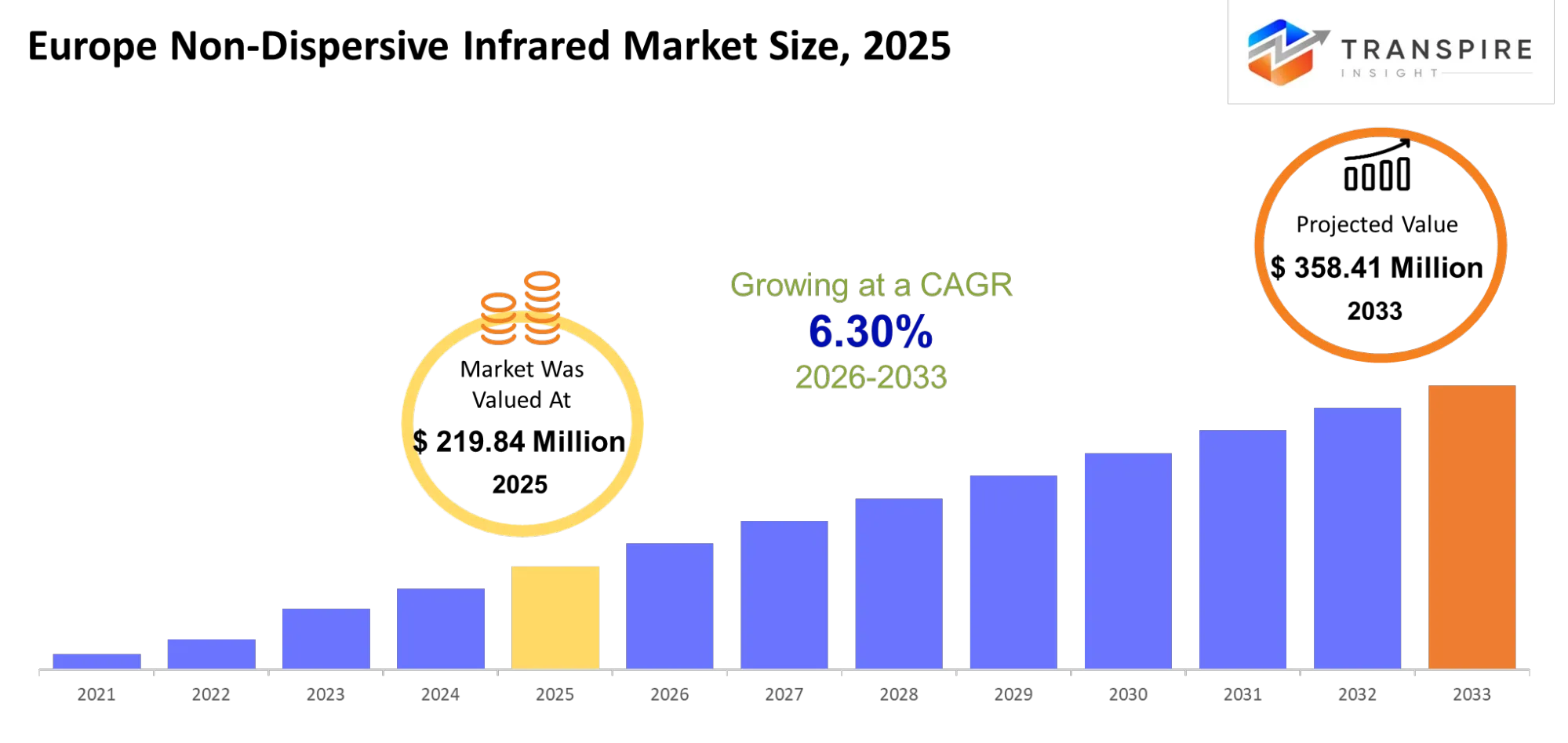
- Europe Non-Dispersive Infrared Market Size 2025: USD 219.84 Million
- Europe Non-Dispersive Infrared Market Size 2033: USD 358.41 Million
- Europe Non-Dispersive Infrared Market CAGR: 6.30%
- Europe Non-Dispersive Infrared Market Segments: By Type (Gas Sensors, Analyzers, Modules, Portable Devices, Others); By Application (Environmental Monitoring, Industrial Safety, Healthcare, Automotive Emissions, Others); By End-User (Industries, Labs, Healthcare, Automotive, Others); By Technology (NDIR Sensors, Optical Sensors, Infrared Modules, Others)
To learn more about this report,  Download Free Sample Report
Europe Non-Dispersive Infrared Market Summary
The Europe Non-Dispersive Infrared Market was valued at USD 219.84 Mn in 2025. It is forecast to reach USD 358.41 Million by 2033. That is a CAGR of 6.30% over the period.
The monitoring systems which use non-dispersive infrared technology to detect gases play an essential function in European industrial and commercial facilities by tracking carbon dioxide, methane, and hydrocarbon emissions from factories and transportation centers and medical institutions and smart buildings. The systems enable operators to achieve air quality standards through their monitoring capabilities which establish real-time environmental control. The industry experienced a transformation during the past five years when it shifted from using independent gas detection equipment to adopting connected sensor systems which work together with automation and cloud-based data analysis platforms.
European authorities implemented new indoor air quality regulations together with industrial emissions control measures which created a significant organizational transformation in commercial and manufacturing sectors. The energy cost increase which followed the Russia-Ukraine conflict created an urgent need for advanced HVAC systems and energy management technologies. Building owners and industrial operators had to install automated monitoring systems which would decrease excess ventilation requirements while their operations needed to meet compliance standards. The demand for low-power NDIR sensors and predictive monitoring software and integrated environmental management platforms increased throughout public and private infrastructure project execution.
Key Market Insights
- The Western European market controlled almost half of the Europe Non-Dispersive Infrared Market in 2025 because strict emissions regulations and advanced heating ventilation air conditioning systems.
- Eastern Europe emerged as the fastest-growing regional market between 2026 and 2033 following EU-funded industrial modernization and urban air quality monitoring investments.
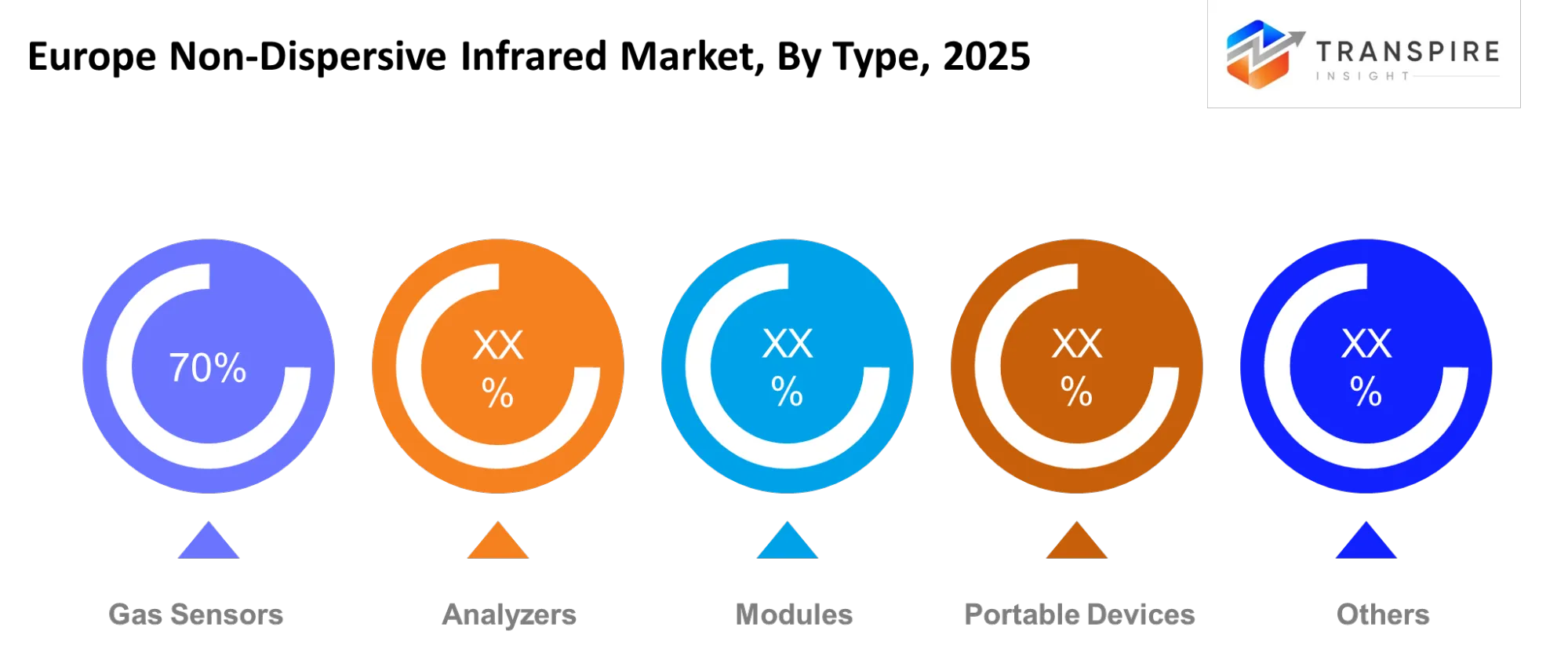
- Gas sensors captured the largest industry share in 2025 as factories, transportation hubs, and smart commercial buildings expanded continuous CO₂ monitoring deployment.
- Infrared modules became the quickest expanding product segment after automotive and battery manufacturers raised their need for small integrated sensing solutions.
- Environmental monitoring accounted for more than 34% of total application demand in 2025 because European regulators tightened industrial and public air quality standards.
- Industrial safety applications gained significant momentum after hydrogen infrastructure and chemical processing facilities expanded leak detection and enclosed-space monitoring requirements.
- Industrial end-users maintained the dominant market position with approximately 41% revenue share because manufacturing facilities needed to replace sensors from compliance requirements.
- Healthcare and laboratory environments showed accelerating demand after hospitals increased investment in respiratory monitoring and sterile air management technologies since 2024.
- Honeywell International Inc. strengthened its competitive position through AI-enabled industrial gas monitoring systems which provide predictive maintenance and operational efficiency improvements.
- Siemens AG expanded smart building partnerships which combine NDIR sensing with their cloud-based energy optimization and automatic ventilation control systems.
What are the Key Drivers, Restraints, and Opportunities in the Europe Non-Dispersive Infrared Market?
The implementation of non-dispersive infrared sensing systems receives its main driving force from the strict European air quality regulations together with energy efficiency regulations. The new building performance standards together with industrial emissions monitoring requirements forced commercial infrastructure operators and manufacturers to implement continuous CO₂ monitoring and gas monitoring systems throughout their office spaces and transportation hubs and factories and healthcare facilities. The smart HVAC systems experienced higher adoption rates because European energy prices increased during the 2022 to 2024 period which made automated ventilation control systems more cost-effective. The shift in demand resulted in higher procurement needs for compact NDIR sensors and integrated monitoring platforms and cloud-connected building management systems.
The market penetration process experiences delays because high integration costs together with retrofit expenses affect older industrial facilities in Eastern and Southern Europe. Many facilities still operate legacy automation systems that lack compatibility with modern digital sensing platforms and remote calibration tools. Organizations need to invest heavily in system replacement or upgrade activities which will cause their operations to halt until they acquire special technical knowledge. The structural barrier creates a delay for modernization projects while it prevents small and medium-sized industrial operators from adopting new technologies because they must handle initial costs for deployment.
Advanced gas sensing companies see hydrogen infrastructure development as a major opportunity which will create long-term business prospects. Germany, the Netherlands, and Nordic countries continue investing in hydrogen transport, storage, and industrial processing facilities that require continuous leak detection and enclosed-space monitoring.This emergent ecosystem increasingly demands high-definition infrared sensing platforms optimized for safety-critical energy applications.
What Has the Impact of Artificial Intelligence Been on the Europe Non-Dispersive Infrared Market?
European non-dispersive infrared sensing systems undergo transformation through artificial intelligence together with advanced digital technologies which enhance automation capabilities while providing better emissions tracking and increased operational performance throughout industrial and environmental monitoring systems. Smart control platforms now use AI-driven analytics to automate ventilation balancing, gas concentration adjustments, and emissions monitoring in commercial buildings, manufacturing plants, and energy facilities. Industrial operators increasingly integrate NDIR sensors with cloud-based monitoring systems that track air quality compliance and optimize energy consumption in real time. Companies such as Siemens AG and Honeywell International Inc. have expanded digital building management platforms which enable energy-efficient building operation by monitoring HVAC equipment needs through their adaptive sensing algorithms.
Machine learning models enhance both predictive maintenance capabilities and calibration management functions across gas detection systems. Advanced analytics platforms evaluate historical sensor drift patterns, environmental exposure conditions, and equipment usage cycles to predict maintenance needs before failures occur. Industrial facilities that implement predictive monitoring systems experience measurable decreases in both downtime and maintenance interruptions especially within continuous manufacturing operations which must comply with emissions regulations. The high costs required for AI system integration together with inconsistent data quality from existing industrial systems present challenges that hinder AI technology implementation. The absence of standard sensor connectivity in legacy facilities diminishes AI-based monitoring and forecasting systems' ability to function accurately under actual operating circumstances.
Key Market Trends
- The European Union indoor air quality regulations required commercial building operators to adopt NDIR-based smart HVAC systems which replaced traditional ventilation controls starting in 2023.
- European manufacturers shifted investment toward miniaturized low-power sensors between 2024 and 2026 as portable monitoring demand accelerated across industrial safety applications.
- Hydrogen infrastructure projects in Germany and Nordic countries created new demand for methane and leak detection sensors which had been used exclusively in petrochemical facilities.
- Since 2025, buyers increasingly prioritized cloud-connected monitoring platforms instead of standalone sensors, pushing suppliers to expand software and predictive analytics capabilities.
- Honeywell, Siemens, and Vaisala expanded their industrial partnerships after industrial customers required integrated sensing systems which worked with factory automation and energy management networks.
- Environmental monitoring contracts increasingly favored long calibration-cycle sensors after municipalities sought lower maintenance costs across public transportation and urban air quality programs.
- European vehicle manufacturing priorities shifted from automotive emissions testing applications toward hybrid and battery production monitoring between 2024 and 2026.
- Eastern European adoption accelerated after EU sustainability funding supported factory modernization and smart infrastructure upgrades in Poland, Romania, and neighboring manufacturing hubs.
- Greenhouse operators started using NDIR CO₂ monitoring systems in 2024 to enhance their crop yield efficiency while they faced increased energy and resource optimization demands.
- Sensor suppliers gradually reduced dependence on commodity hardware margins through their development of lifecycle maintenance services and removable hardware.
Europe Non-Dispersive Infrared Market Segmentation
By Type:
The particular market segment maintains its dominance because industrial facilities and commercial buildings and transportation systems need continuous gas detection which operates at low expenses. The HVAC control systems and industrial safety applications create strong demand which drives high deployment rates throughout Western and Northern Europe. The laboratory research and environmental compliance testing processes use analyzers to deliver essential functions which require precise measurement and multiple gas detection capabilities. The market for portable devices shows slow growth which will continue to increase because industries need to protect workers who work in dangerous industrial spaces and emergency situations.
Different product categories experience distinct growth patterns. Gas sensors receive advantages from their broad adoption in both smart buildings and their automated ventilation systems, while portable devices receive increasing usage because of new chemical plant and mining operation regulations, which restrict worker exposure. The automotive emissions systems and battery manufacturing equipment industry attracts OEM manufacturers who want to develop compact infrared modules for their products. The product development process will undergo transformation through the upcoming years because miniaturization and wireless connectivity have become essential design elements, which will lead suppliers to concentrate on developing energy-efficient solutions that deliver instant data analysis and require extended periods between equipment checks.
To learn more about this report, Download Free Sample Report
By Application:
The primary application field for environmental monitoring exists because European regulatory bodies demand increasingly strict standards for measuring air quality and controlling industrial emissions. The requirement for ongoing monitoring European urban infrastructure systems and manufacturing facilities and public transit systems creates continuous purchasing needs. The industrial safety sector generates substantial revenue because energy facilities and chemical processing plants and hydrogen infrastructure projects increasingly implement gas leak detection systems. The need for respiratory monitoring systems and controlled air management in hospitals and diagnostic laboratories creates steady demand for healthcare applications.
The operational needs of different applications create distinct patterns of development. Public-sector funding and regulatory compliance requirements create the main financial support needed for environmental monitoring projects while industrial safety spending requires companies to meet risk management needs and insurance-based operational standards. The automotive industry is expanding its emissions testing procedures because vehicle manufacturers are implementing upgraded diagnostic systems that support hybrid and low-emission vehicle technologies. Application-specific solutions with integrated software capabilities will drive future demand, which creates business prospects for suppliers who combine sensing accuracy with predictive analytics and cloud-based monitoring functions.
By End-User:
The highest share of market demand comes from industrial end-users who need continuous gas sensing for their manufacturing facilities and energy plants and commercial infrastructure operations which require operational safety and environmental compliance. The sensor manufacturers receive stable revenue from large industrial buyers who maintain their regular replacement cycles. Healthcare institutions present a smaller market segment that requires advanced technology for their precise respiratory monitoring and air quality control systems. Automotive companies continue expanding adoption as emissions testing and battery production monitoring requirements become more complex.
The end-user categories show complete differences in their purchasing patterns. Industrial operators choose their equipment based on three main factors which include its ability to withstand use and its accuracy in maintaining calibration and its capability to work with existing plant automation systems. Healthcare buyers increasingly seek compact and highly reliable sensing systems for patient monitoring and sterile environments. The end-user market will demand connected monitoring systems during the forecast period which will push suppliers to spend on remote diagnostics and software integration and lifecycle service contracts instead of selling individual hardware components.
By Technology:
The NDIR sensors control the primary market segment because their technology provides accurate gas detection which requires minimal maintenance and operates for extended periods. The market position of the company stays strong because its products receive widespread adoption in HVAC systems, industrial safety equipment, and environmental monitoring platforms. Optical sensors maintain a growing presence in high-precision industrial and scientific applications where advanced detection sensitivity is essential. The market for infrared modules keeps growing because manufacturers integrate their products into portable monitoring devices and automotive systems and compact electronics.
The competition between technologies has shifted to focus on the ability of sensors to operate efficiently and connect with other systems instead of their capacity to detect basic elements. The NDIR sensors become more affordable for use in extensive commercial facilities while optical sensing technologies serve industrial clients who need specific detection capabilities and rapid operational performance. The demand for infrared modules grows because customers want smaller and lighter sensing technologies that their automated manufacturing systems can use. The upcoming technology advancements will develop multi-gas detection systems, create AI-based calibration tools, and establish energy-efficient systems which will generate funding possibilities for software-based sensing technology and advanced semiconductor systems.
What are the Key Use Cases Driving the Europe Non-Dispersive Infrared Market?
European countries use NDIR technology mainly for commercial building ventilation systems and indoor air quality monitoring purposes. The highest demand exists for smart HVAC systems which offices and hospitals and schools and transportation hubs use to meet regulatory requirements for continuous CO₂ monitoring that improves energy efficiency and occupant safety.
The market for industrial gas detection systems and environmental monitoring systems shows continuous growth. NDIR sensors work in manufacturing plants and food processing facilities and pharmaceutical sites to control operational conditions and meet workplace emissions requirements. The agriculture industry shows increased adoption of greenhouse automation systems which need accurate carbon dioxide measurements to enhance crop growth.
Hydrogen infrastructure systems and battery manufacturing plants create new use cases because they connect to Europe’s clean energy transition. NDIR sensors have become popular for hydrogen transport networks which need leak detection and enclosed-space monitoring. Electric vehicle battery plants are investigating advanced air quality detection systems which will help maintain worker safety and process stability during the upcoming period.
|
Report Metrics |
Details |
|
Market size value in 2025 |
USD 219.84 Million |
|
Market size value in 2026 |
USD 233.69 Million |
|
Revenue forecast in 2033 |
USD 358.41 Million |
|
Growth rate |
CAGR of 6.30% from 2026 to 2033 |
|
Base year |
2025 |
|
Historical data |
2021 - 2024 |
|
Forecast period |
2026 - 2033 |
|
Report coverage |
Revenue forecast, competitive landscape, growth factors, and trends |
|
Regional scope |
Europe (Germany, United Kingdom, France, Italy, Spain, Rest of Europe) |
|
Key company profiled |
ABB, Siemens, Honeywell, Emerson, Thermo Fisher, Teledyne, Vaisala, Amphenol, Figaro Engineering, Dynament, Senseair, Edinburgh Sensors, Nova Analytical, Fuji Electric, Yokogawa |
|
Customization scope |
Free report customization (country, regional & segment scope). Avail customized purchase options to meet your exact research needs. |
|
Report Segmentation |
By Type (Gas Sensors, Analyzers, Modules, Portable Devices, Others); By Application (Environmental Monitoring, Industrial Safety, Healthcare, Automotive Emissions, Others); By End-User (Industries, Labs, Healthcare, Automotive, Others); By Technology (NDIR Sensors, Optical Sensors, Infrared Modules, Others) |
Which Regions are Driving the Europe Non-Dispersive Infrared Market Growth?
Western European countries control the European Non-Dispersive Infrared (NDIR) market because their strict emissions regulations together with their developed industrial automation systems create market conditions for their control. The combination of indoor air quality standards and industrial emissions standards protects advanced gas sensing technologies against permanent market decline. The area maintains operational manufacturing facilities which function through existing heating, ventilation, and air conditioning systems while using advanced building technologies that operate NDIR measurement systems. Western Europe maintains its market dominance through a comprehensive network of sensor manufacturers and industrial automation companies and research facilities and certification organizations, which together support the development of future sensing technologies.
Northern Europe contributes a smaller share of overall revenue, but it provides one of the market’s most stable demand environments. The countries of Sweden and Finland and Denmark create sustainable energy-efficient buildings through their climate-based construction standards, which lead to ongoing demands for advanced NDIR sensors that require precise measurements. Northern Europe requires companies to complete their industrial operations through sustainability procurement methods because they do not have Western European industrial facilities, which provide European industrial production capabilities. Regional buyers show a preference for sensors that demonstrate reliability under extremely cold and highly humid conditions, which benefits sensor manufacturers who possess advanced calibration and environmental testing abilities.
The rapid modernization of industries together with growing environmental compliance programs has made Eastern Europe the fastest developing market in the region. The European Union sustainability funding has helped Poland and Romania to invest more in their manufacturing facilities and commercial buildings and urban air quality monitoring systems since the year 2024. The shift to modern NDIR solutions has spread to all factory operations and public infrastructure systems and transportation networks that used older detection systems. The time frame from 2026 to 2033 will see Eastern Europe attract new businesses which aim to grow their operations through partnerships with companies that can deliver both affordable sensor solutions and regulatory compliance.
Who are the Key Players in the Europe Non-Dispersive Infrared Market and How Do They Compete?
The Europe Non-Dispersive Infrared (NDIR) market maintains its market structure Because its main players compete through their ability to produce accurate sensors which maintain calibration performance over time while meeting new European environmental regulations. The major industrial sensing companies protect their market position through unified monitoring systems and strong original equipment manufacturer partnerships, while smaller companies focus on specific markets which include indoor air quality and greenhouse monitoring and hydrogen safety systems. Technology innovation has become the primary basis of competition, particularly in low-power miniaturized sensors and multi-gas detection capabilities, although regional service support and customization remain important differentiators in industrial deployments.
Honeywell International Inc. uses its extensive industrial systems and approved gas detection solutions to compete in dangerous environment applications. The company creates operational efficiency advantages for its customers through its system which integrates NDIR sensing technology with complete plant automation and predictive maintenance solutions. The company has expanded its European footprint through new industrial gas monitoring launches aimed at hydrogen and energy-transition infrastructure.
Senseair AB concentrates on specific markets which require monitoring solutions for indoor air quality and agricultural practices. The company uses its low-power NDIR CO₂ modules which function in humid and confined spaces to establish its competitive advantage, which smart buildings and precision farming systems increasingly adopt. Siemens AG uses its complete building automation systems which integrate NDIR sensors with energy management software to create a unique market position for its commercial building solutions.Vaisala Oyj establishes measurement reliability as its core value which it demonstrates through its ability to function in extreme industrial environments and demanding weather conditions. The company uses its advanced calibration system together with its extended product lifespan to fulfill customer needs in environmental monitoring and research market.
Company List
- ABB
- Siemens
- Honeywell
- Emerson
- Thermo Fisher
- Teledyne
- Vaisala
- Amphenol
- Figaro Engineering
- Dynament
- Senseair
- Edinburgh Sensors
- Nova Analytical
- Fuji Electric
- Yokogawa
Recent Development News
“In September 2025, Senseair launched the S88 GH CO₂ sensor module designed specifically for greenhouse and indoor farming environments. The new NDIR-based sensor expanded high-humidity agricultural monitoring capabilities, positioning Senseair to benefit from growing European investment in precision agriculture and controlled-environment farming.https://senseair.com
“In March 2026, Honeywell launched the NDIR Hydrocarbon Gas Sensor for industrial gas detection applications. The product uses non-dispersive infrared (NDIR) technology to detect methane, propane, and butane leaks, strengthening Honeywell’s position in industrial safety and emissions monitoring across Europe’s energy and petrochemical sectors.https://www.honeywell.com
What Strategic Insights Define the Future of the Europe Non-Dispersive Infrared Market?
The Europe Non-Dispersive Infrared (NDIR) market will develop its operational framework during the upcoming five to seven years to function as a core element of industrial decarbonization and smart environmental monitoring systems. The market will experience growth through two main factors which include the requirement of emissions compliance and the need for real-time air quality analytics and energy efficiency regulations and automated systems in manufacturing and transportation and building operations. The real danger to premium industrial applications which need high accuracy and compact design because of new laser-based sensing technology will create market threats that organizations must face. The development of hydrogen infrastructure throughout Germany and the Nordic region has created an early business opportunity which enables NDIR-based gas monitoring systems to offer safety and leakage detection solutions. Market participants should prioritize investment in application-specific sensor calibration software and strategic OEM partnerships, as differentiation is shifting from hardware performance alone toward integrated sensing intelligence and long-term service capabilities.
Europe Non-Dispersive Infrared Market Report Segmentation
By Type
- Gas Sensors
- Analyzers
- Modules
- Portable Devices
- Others
By Application
- Environmental Monitoring
- Industrial Safety
- Healthcare
- Automotive Emissions
- Others
By End-User
- Industries
- Labs
- Healthcare
- Automotive
- Others
By Technology
- NDIR Sensors
- Optical Sensors
- Infrared Modules
- Others
Frequently Asked Questions
Find quick answers to common questions.
The Europe Non-Dispersive Infrared Market size is USD 358.41 Million in 2033.
Key segments for the Europe Non-Dispersive Infrared Market are By Type (Gas Sensors, Analyzers, Modules, Portable Devices, Others); By Application (Environmental Monitoring, Industrial Safety, Healthcare, Automotive Emissions, Others); By End-User (Industries, Labs, Healthcare, Automotive, Others); By Technology (NDIR Sensors, Optical Sensors, Infrared Modules, Others).
Major Europe Non-Dispersive Infrared Market players are ABB, Siemens, Honeywell, Emerson, Thermo Fisher, Teledyne, Vaisala, Amphenol, Figaro Engineering, Dynament, Senseair, Edinburgh Sensors, Nova Analytical, Fuji Electric, Yokogawa.
The Europe Non-Dispersive Infrared Market size is USD 219.84 Million in 2025.
The Europe Non-Dispersive Infrared Market CAGR is 6.30% from 2026 to 2033.
- ABB
- Siemens
- Honeywell
- Emerson
- Thermo Fisher
- Teledyne
- Vaisala
- Amphenol
- Figaro Engineering
- Dynament
- Senseair
- Edinburgh Sensors
- Nova Analytical
- Fuji Electric
- Yokogawa
Recently Published Reports
-
Apr 2026
Fiber Optic Faceplates Market
Fiber Optic Faceplates Market Size, Share & Analysis Report By Type (< 300 mm2, 300-350 mm2, and > 350 mm2, By Application (Night Vision, Holographic Imaging, Medical, and Others), and Geography (North America, Europe, Asia-Pacific, Middle East and Africa, South and Central America), 2021 - 2031
-
Apr 2026
High Temperature Superconductors Market
High Temperature Superconductors Market Size, Share & Analysis Report By Type (1G HTS, and 2G HTS), By Application (Power Cable, Fault Current Limiter, and Transformer), and Geography (North America, Europe, Asia-Pacific, Middle East and Africa, South and Central America), 2021 - 2031
-
Apr 2026
Industrial Plugs and Socket Market
Industrial Plugs and Socket Market Size, Share & Analysis Report By Type (Industrial Plugs, Industrial Sockets), By Current (Up to 32 A, 32 to 125 A, Above 125 A), By Protection (Dustproof and Splash Proof, Waterproof, Explosion Proof), By End User (Heavy Industries, Oil and Gas, Chemicals and Pharmaceuticals, Power Generation, Others), and Geography (North America, Europe, Asia-Pacific, Middle East and Africa, South and Central America), 2021 - 2031
-
Apr 2026
InGaAs Avalanche Photodiodes Market
InGaAs Avalanche Photodiodes Market Size, Share & Analysis Report By Type (1100 - 1700 nm, and 1000 - 1600 nm), By Application (Missile Warning System, Muzzle Flash Detection, Wafer Defect Inspection, Laser Rangefinders, and Others), and Geography (North America, Europe, Asia-Pacific, Middle East and Africa, South and Central America), 2021 - 2031