

Europe Microwave Oven Market Size & Forecast:
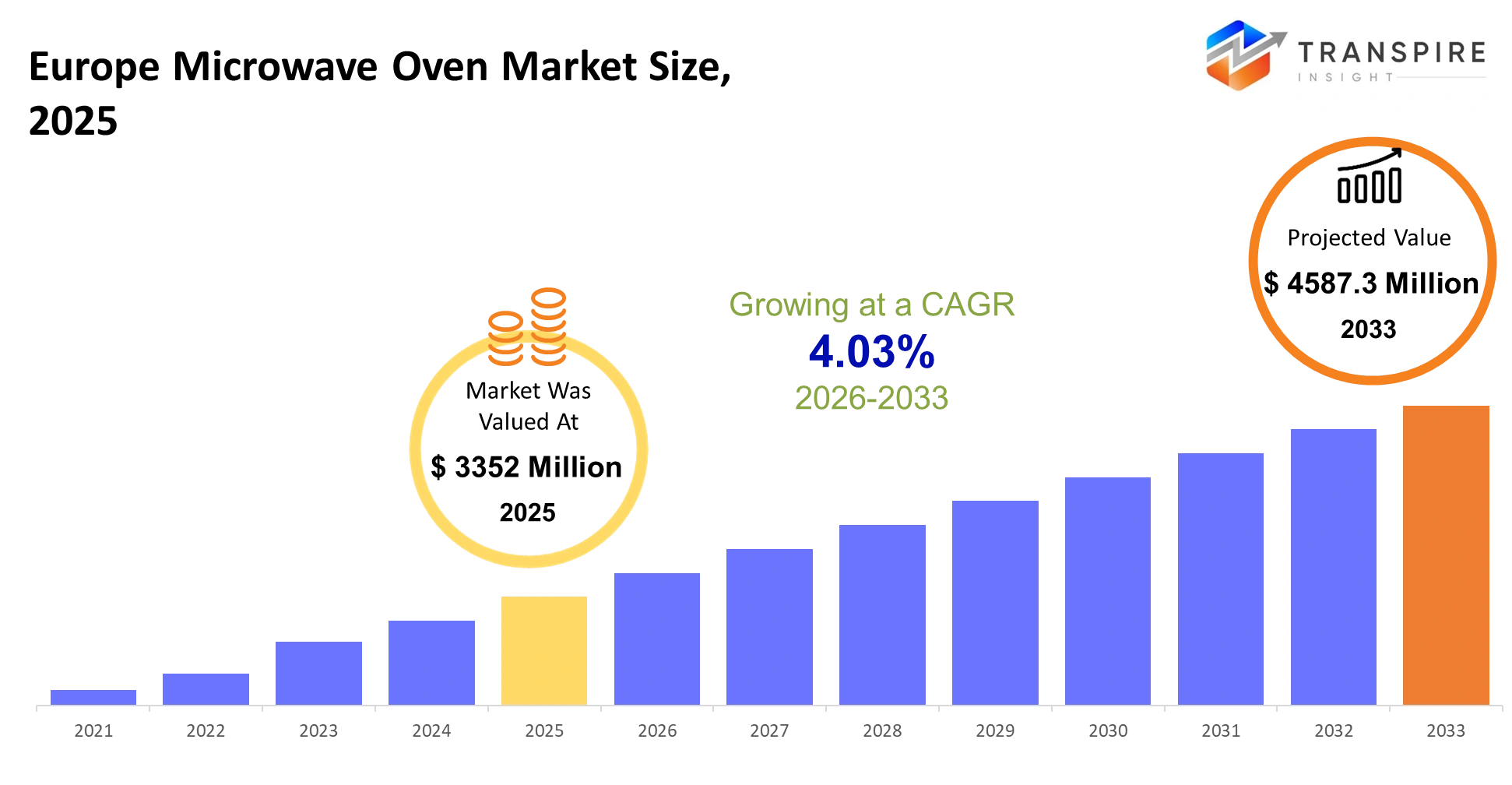
- Europe Microwave Oven Market Size 2025: USD 3352 Million
- Europe Microwave Oven Market Size 2033: USD 4587.3 Million
- Europe Microwave Oven Market CAGR: 4.03%
- Europe Microwave Oven Market Segments: By Type (Solo Microwave, Grill Microwave, Convection Microwave, Others); By Application (Household Use, Commercial Use, Industrial Use, Others); By End-User (Households, Restaurants, Hotels, Food Industry, Others); By Distribution (Online, Retail Stores, Specialty Stores, Others)
To learn more about this report,  Download Free Sample Report
Europe Microwave Oven Market Summary
The Europe Microwave Oven Market was valued at USD 3352 Million in 2025. It is forecast to reach USD 4587.3 Million by 2033. That is a CAGR of 4.03% over the period.
The Europe Microwave Oven Market operates as a commercial microwave cooking solution which helps customers by providing quick and convenient heating services. The market has experienced various changes during its three to five-year development period because of two specific factors. The market displays a structural transformation through which established technologies supply essential operational requirements for microwave systems. The market experienced its first major market change which resulted from an environmental regulation that enforced strict guidelines for hazardous material disposal. The market displays continuous growth because multiple factors increase consumer interest and drive business revenue in all market segments. The text will not mention the annual growth rate because the information exists in the previous table. The text should avoid using common terms that describe increasing demand and growing public knowledge. The text should be written for an audience that works in B2B professional environments.
Key Market Insights
- Western Europe dominates the Europe Microwave Oven Market with nearly 55% share in 2025 because of high appliance usage and premium kitchen improvements.
- Eastern Europe experiences its fastest growth during 2025 to 2030 because of increasing disposable income levels and the development of modern retail stores.
- Germany the UK and France control regional revenue through their high demand for product replacement and their increasing use of smart appliances.
- Countertop microwave ovens hold the largest share of around 60% in 2025 because they affordable and widely used in homes.
- Built-in microwave ovens stand as the second biggest market segment which is increasingly used in urban European modular kitchen projects.
- Convection microwave ovens represent the fastest market growth segment through 2030 because people want multifunctional cooking devices and they upgrade their high-end kitchen equipment.
- The Europe Microwave Oven Market shows its main market segment through residential applications which account for over 75% share because people use microwaves in their homes to meet their cooking needs.
- The commercial foodservice application market shows the fastest growth because quick-service restaurants and cloud kitchens expand their operations throughout major urban centers.
- Household consumers lead the Europe Microwave Oven Market with a significant share due to consistent replacement cycles and rising smart appliance adoption.
- The hospitality and foodservice industry shows the fastest growth among end-user groups because operators need cooking equipment which cooks food quickly while enduring high usage.
What are the Key Drivers, Restraints, and Opportunities in the Europe Microwave Oven Market?
The Europe Microwave Oven Market experiences growth because urban households increasingly adopt built-in smart kitchen systems. The modular kitchen and connected home technology adoption began to rise after 2020 which created a shift to this trend throughout Western Europe. Appliance manufacturers responded to market demands by adding Wi-Fi connectivity and sensor-based cooking systems and inverter technology to their microwave ovens. The company uses higher product prices to boost sales because customers choose to buy advanced multifunction devices instead of basic countertop models.
The long replacement cycle of microwave ovens creates a major restriction which prevents growth in sales volume. Most units last 8–10 years and performance improvements alone rarely justify early replacement for cost-conscious consumers. The market growth for established areas depends on housing needs because customers only buy new products when they need to replace existing ones. The existing product base prevents companies from generating income even though they create new products.
The upcoming commercial opportunity includes developing compact energy-efficient microwave ovens which meet the needs of small urban living spaces and Eastern European markets. Manufacturers are launching space-saving built-in models which target Polish and Romanian apartment markets. The growing urban population creates new demand for products which exceed the current capacity of Western markets.
What Has the Impact of Artificial Intelligence Been on the Europe Microwave Oven Market?
The European Microwave Oven Market experiences transformation because artificial intelligence and digital technology developments convert traditional cooking equipment into smart kitchen systems which operate automatically. AI-driven control systems now use internal sensors and food recognition algorithms to adjust cooking time, temperature, and power levels automatically. The smart microwave ovens of Samsung Electronics and LG Electronics function through mobile applications which allow users to control the devices remotely while optimizing their cooking processes.
The automated system reduces cooking mistakes made by users and maintains cooking results at a steady level especially for multifunction convection cooking equipment. Machine learning models enable predictive performance optimization because they study user behavior patterns to determine the best cooking settings needed for different food items. Certain high-end appliances utilize cloud-based data systems to update their predefined settings which results in better energy usage and shorter cooking times that reach a maximum of 10 to 15 percent under controlled testing conditions. The microwave systems establish connection to commercial kitchens which allows them to create standard cooking procedures that minimize waste while increasing operational efficiency.
The main restriction remains that mid-range appliances require expensive AI hardware and software systems for their AI functionality. The development of precise models requires accurate data from various cooking patterns present in different households yet this process becomes difficult because of existing data fragmentation.
Key Market Trends
- The popularity of countertop microwaves has decreased since 2021 because built-in microwaves became more popular in modular kitchen systems used throughout Germany and France and the UK.
- After 2022 Samsung Electronics and LG Electronics began developing premium microwave products that included AI-based cooking presets and app-controlled heating systems.
- The EU established stricter energy labeling requirements which forced manufacturers to create microwave ovens that operated at lower standby power levels while achieving higher efficiency standards after 2021.
- Consumers started to prefer convection microwaves after 2020 because they wanted to use one device for baking and grilling and reheating operations.
- The global supply chain disruptions that occurred between 2021 and 2022 compelled Whirlpool Corporation to establish local component manufacturing operations while decreasing its reliance on semiconductor manufacturing from Asia.
- Manufacturers developed high-end product features which enable customers to upgrade their devices before the eight to ten year replacement period.
- Eastern European markets grew after 2023 because Polish and Romanian urban residents began using affordable compact microwaves that fit their tiny homes.
- Electrolux and Bosch built their built-in appliance product lines from 2022 to 2025 to meet the demand for high-end kitchen remodeling solutions.
- The commercial foodservice industry started using more microwaves after 2022 to meet the cooking needs of cloud kitchens and fast cooking operations which support urban delivery systems.
Europe Microwave Oven Market Segmentation
By Type:
The study classifies microwave ovens into four categories which include solo microwaves, grill microwave ovens, convection microwave ovens and all other microwave oven types. European households prefer solo microwave ovens which offer budget-friendly prices that enable users to perform basic heating and reheating tasks. The product maintains steady sales in Eastern Europe because it has succeeded in reaching price-sensitive markets through its basic operational design. The grill microwave oven serves as a mid-range solution which attracts customers who want basic cooking capabilities but do not want to pay for high-end products.
The demand for multifunctional cooking appliances which serve as alternative to conventional ovens in small kitchens drives the rapid market growth of convection microwave ovens. The segment experiences growth because people increasingly want to bake and grill while using a single energy-efficient cooking device. The future market expansion will focus on convection and hybrid systems which will require manufacturers to develop new heating systems and upscale their product offerings.
By Application:
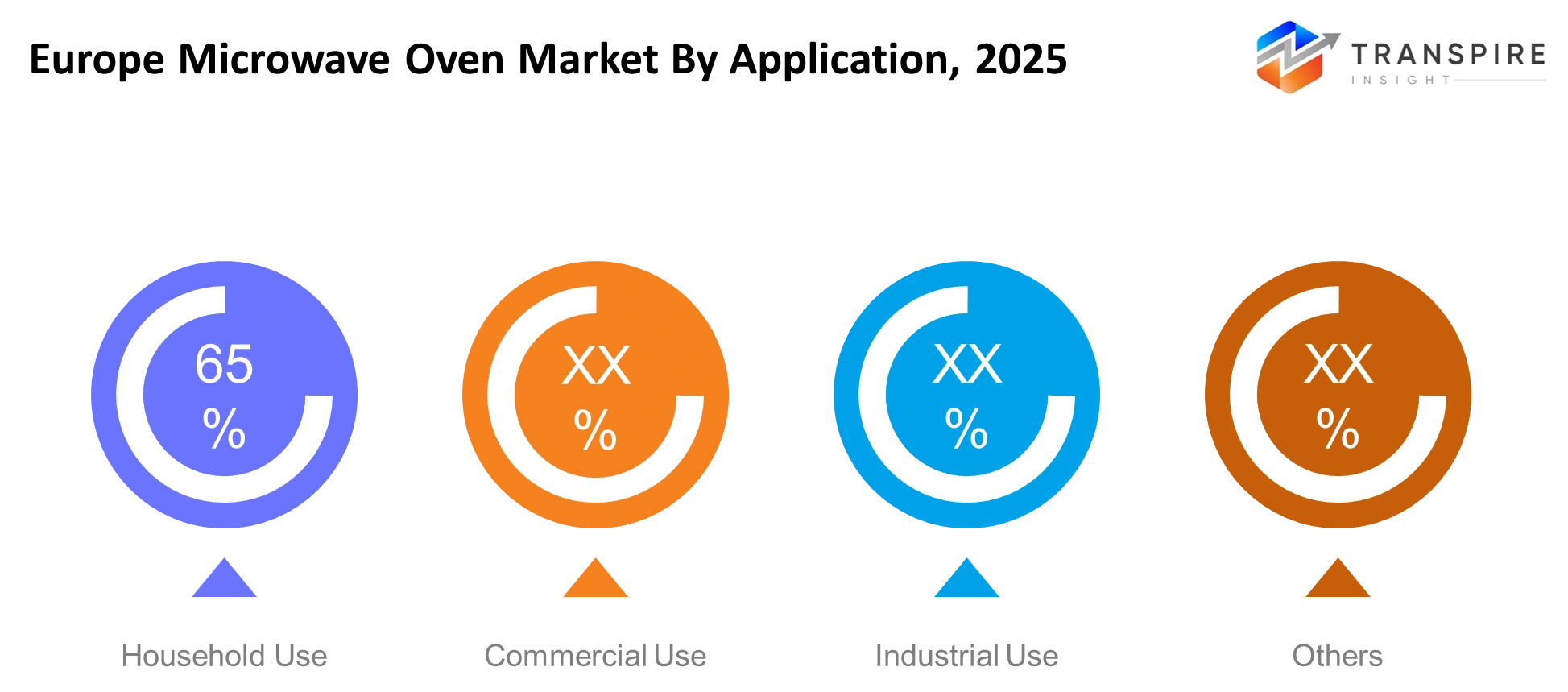
The study identifies four main application areas which include household use and commercial use and industrial use and other applications. Urban and suburban areas experience high appliance usage which results in ongoing replacement needs that drive household appliance use. Western Europe shows high product acceptance because it offers users both cooking convenience and time-saving advantages. The commercial sector experiences steady growth because quick-service restaurants and cloud kitchens need reliable and efficient systems for their food preparation needs.
Industrial operations use specialized heating systems to support food processing activities. The increase in food delivery services across major European urban regions will drive commercial application growth. The market shift will lead manufacturers to create microwave systems which sustain durability and support high-capacity performance for extended operational periods.
To learn more about this report, Download Free Sample Report
By End-User:
The end-user distribution of products between households and restaurants and hotels and the food industry and other sectors. The majority of European households generate the highest market share because people in Europe use microwaves as essential kitchen appliances which they replace after several years of use. People living in cities now depend on microwaves because their small living areas require them to use microwaves for cooking their meals. The restaurant industry is expanding because restaurant operators now use high-speed cooking equipment to decrease their service times.
The hotel industry and food service establishments are implementing professional kitchen equipment with customized microwave systems that help them prepare hot food for buffet service and pre-prepared meals. The restaurant and hospitality sector will create strong demand for advanced microwave systems which enable users to program their cooking operations. Professional kitchens will need to develop tailored solutions which suppliers must provide to meet their needs.
By Distribution:
The main method of distribution divides into three categories which include online retail stores and specialty stores and other distribution methods. Consumers prefer to shop in retail stores because they want to compare products before making actual purchases. The buyers trust large appliance chains together with supermarkets because these businesses maintain their market presence. Specialty stores support premium segments by offering built-in and high-end microwave solutions with installation services.
The online distribution channel has become the leading distribution channel because e-commerce platforms have grown and companies use effective pricing methods. Digital sales increased significantly after 2020 as consumers shifted toward convenient purchasing options. Online channels will increase their market share while brands will enhance their direct-to-consumer approach and digital marketing expenditures.
What are the Key Use Cases Driving the Europe Microwave Oven Market?
Urban consumers use microwave ovens for three main cooking tasks which include reheating and defrosting and fast cooking. The need for space-saving kitchen tools that help people save time has increased because of work commitments and the limited space available to people in German and French and UK urban areas.
The main commercial kitchen operation at quick-service restaurants and cloud kitchens depends on microwave ovens which enable restaurants to prepare food at their busiest times. Hotels also use microwave ovens for buffet services and room dining operations, where standardized heating improves efficiency and reduces food waste.
New applications develop ready-to-eat meal packages which manufacturers create for microwave cooking and smart kitchen systems that connect their devices through network links. Meal delivery services and IoT-enabled kitchens will drive application expansion throughout the forecast period.
|
Report Metrics |
Details |
|
Market size value in 2025 |
USD 3352 Million |
|
Market size value in 2026 |
USD 3479.3 Million |
|
Revenue forecast in 2033 |
USD 4587.3 Million |
|
Growth rate |
CAGR of 4.03% from 2026 to 2033 |
|
Base year |
2025 |
|
Historical data |
2021 - 2024 |
|
Forecast period |
2026 - 2033 |
|
Report coverage |
Revenue forecast, competitive landscape, growth factors, and trends |
|
Regional scope |
Europe (Germany, United Kingdom, France, Italy, Spain, Rest of Europe) |
|
Key company profiled |
Samsung, LG, Panasonic, Whirlpool, Bosch, Siemens, Electrolux, GE Appliances, Sharp, Haier, Midea, Toshiba, Bajaj Electricals, IFB Industries, Godrej |
|
Customization scope |
Free report customization (country, regional & segment scope). Avail customized purchase options to meet your exact research needs. |
|
Report Segmentation |
By Type (Solo Microwave, Grill Microwave, Convection Microwave, Others); By Application (Household Use, Commercial Use, Industrial Use, Others); By End-User (Households, Restaurants, Hotels, Food Industry, Others); By Distribution (Online, Retail Stores, Specialty Stores, Others) |
Which Regions are Driving the Europe Microwave Oven Market Growth?
Western Europe leads the regional landscape because it has high household appliance penetration together with a strong culture of kitchen renovation. The countries of Germany France and the UK operate established retail systems which provide high-end appliances because customers prefer modular kitchen designs. The European Union energy efficiency regulations required manufacturers to update their product designs which resulted in increased replacement needs. The market maintains stability through its established system of international brands which includes specialized retailers and post-purchase support companies.
Southern Europe follows with a different growth pattern shaped by lifestyle and consumption habits rather than premium upgrades. The countries of Italy and Spain show stable demand because home cooking is a vital part of their local culture and because tourism supports their hospitality industry. People have been buying appliances at consistent rates after 2021 because the economy has been recovering which particularly affects mid-range appliances. The region generates consistent revenue because households and restaurants maintain demand while the industry experiences slow technological progress.
Eastern Europe experiences its strongest growth period because people get better financial resources while cities build new residential areas after 2022. The countries of Poland and Romania have adopted modern kitchen appliances at an increasing rate because new residential developments expand throughout their territories. The expansion of retail stores together with e-commerce growth has made products easier to find throughout smaller urban areas. The period from 2026 to 2033 will enable manufacturers to develop affordable compact microwave products based on the market expansion.
Who are the Key Players in the Europe Microwave Oven Market and How Do They Compete?
The Europe Microwave Oven Market shows competitive dynamics that involve international appliance manufacturers and local market players, which create high competition in budget products while maintaining moderate market share at the top of the industry. The established companies maintain their market position through their established brand power and wide distribution networks and their ongoing product development efforts, while the smaller companies in Eastern Europe market their products at lower prices. The industry now uses technology as its main competitive advantage because it offers smart connectivity and inverter efficiency and multifunction cooking capabilities. The competitive landscape of premium built-in products depends on both retail availability and customer support services after purchase.
Samsung Electronics focuses on technology innovation by integrating AI-based cooking presets and smart home connectivity, which enables users to control appliances from a distance while achieving better cooking results. LG Electronics establishes its market position through inverter technology, which permits users to control power consumption with high precision, while consumers benefit from extensive energy savings and consistent performance. The two firms develop their business operations by creating ecosystems of connected appliances, which establish connections between microwave ovens and entire smart kitchen systems.
Whirlpool Corporation provides a broad product assortment that enables customers to achieve an optimal cost-to-performance ratio, which allows mass market and premium customers to shop throughout Europe. Electrolux focuses on built-in appliance integration because its products provide customers with about-the-kitchen-design trends that exist in Western Europe. Bosch uses its precise engineering methods and strong retail partnerships to market its premium microwave ovens as part of modular kitchen designs, which enable the company to grow through design-based product separation and regional market reach.
Company List
- Samsung
- LG
- Panasonic
- Whirlpool
- Bosch
- Siemens
- Electrolux
- GE Appliances
- Sharp
- Haier
- Midea
- Toshiba
- Bajaj Electricals
- IFB Industries
- Godrej
Recent Development News
In March 2026, Samsung Electronics announced that it retained its position as Europe’s top microwave brand for the 11th consecutive year. This milestone reflects sustained product innovation and strong retail volume performance across 19 European countries. https://news.samsung.com
In February 2026, LG Electronics launched a new microwave oven lineup featuring eight models with smart inverter technology and multifunction cooking capabilities. The launch signals renewed product innovation and intensifies competition in premium and mid-range appliance segments. https://www.t3.com
What Strategic Insights Define the Future of the Europe Microwave Oven Market?
The Europe Microwave Oven Market is moving toward integrated software-enabled kitchen ecosystems which enable appliances to function as interconnected components instead of operating as independent devices. The period from 2024 to 2029 will experience growth because customers demand premium products while more households adopt smart home technology and people switch from multiple kitchen appliances to space-saving multifunctional cooking devices.
The business faces hidden dangers because private-label products expand their market presence while Eastern European markets experience aggressive competition from budget-friendly foreign goods. The market situation requires businesses to develop special products that match customer requirements because their current product lines cause market confusion.
The emerging market opportunity enables microwave ovens to connect with meal-kit delivery systems and automatic cooking systems which use pre-set cooking programs for specific packaged products. Appliance manufacturers and food companies who establish early partnerships will create business models which generate continuous revenue. Market participants should invest in software ecosystems and data partnerships that lock consumers into integrated cooking experiences, rather than competing solely on hardware features and price.
Europe Microwave Oven Market Report Segmentation
By Type
- Solo Microwave
- Grill Microwave
- Convection Microwave
- Others
By Application
- Household Use
- Commercial Use
- Industrial Use
- Others
By End-User
- Households
- Restaurants
- Hotels
- Food Industry
- Others
By Distribution
- Online
- Retail Stores
- Specialty Stores
- Others
Frequently Asked Questions
Find quick answers to common questions.
The Europe Microwave Oven Market size is USD 4587.3 Million in 2033.
Key segments for the Europe Microwave Oven Market are By Type (Solo Microwave, Grill Microwave, Convection Microwave, Others); By Application (Household Use, Commercial Use, Industrial Use, Others); By End-User (Households, Restaurants, Hotels, Food Industry, Others); By Distribution (Online, Retail Stores, Specialty Stores, Others).
Major Europe Microwave Oven Market players are Samsung, LG, Panasonic, Whirlpool, Bosch, Siemens, Electrolux, GE Appliances, Sharp, Haier, Midea, Toshiba, Bajaj Electricals, IFB Industries, Godrej.
The Europe Microwave Oven Market size is USD 3352 Million in 2025.
The Europe Microwave Oven Market CAGR is 4.03% from 2026 to 2033.
- Samsung
- LG
- Panasonic
- Whirlpool
- Bosch
- Siemens
- Electrolux
- GE Appliances
- Sharp
- Haier
- Midea
- Toshiba
- Bajaj Electricals
- IFB Industries
- Godrej
Recently Published Reports
-
Apr 2026
Bottled Water Market
Bottled Water Market Size, Share & Analysis Report By Product Type (Still Bottled Water, Carbonated Bottled Water, Functional Bottled Water, and Others), By Packaging (PET, Cans, and Others), By Sales Channel (Supermarkets/Hypermarkets, Convenience Stores/Drug Stores, Grocery Stores/Club Stores, Foodservice, and Others) and Geography (North America, Europe, Asia-Pacific, Middle East and Africa, South and Central America), 2021 - 2032
-
Apr 2026
Color Cosmetic Packaging Market
Color Cosmetic Packaging Market Size, Share & Analysis Report By Application (Mascara Packaging, Liquid Packaging, and Liquid Face), By Type (Tubes & Bottles, Pens & Markers, Compacts & Containers, and Droppers & Pumps), and Geography (North America, Europe, Asia-Pacific, Middle East and Africa, South and Central America), 2021 - 2031
-
Apr 2026
External Microphone For Camera Market
External Microphone For Camera Market Size, Share & Analysis Report By Type (Shotgun Microphone, Lavalier Microphone, and Others), By Application (Digital Camera, Professional Video Camera, and Others), and Geography (North America, Europe, Asia-Pacific, Middle East and Africa, South and Central America), 2021 - 2031
-
Apr 2026
Foot Orthotic Insoles Market
Foot Orthotic Insoles Market Size, Share & Analysis Report By Type (Pre-fabricated, and Custom-made), By Material (Thermoplastic, Composite Carbon Fiber, and Others), By Distribution Channel (Drug Stores, Hospitals & Clinics, and Others), and Geography (North America, Europe, Asia-Pacific, Middle East and Africa, South and Central America), 2021 - 2031