
Europe Men Wear Market Size & Forecast:
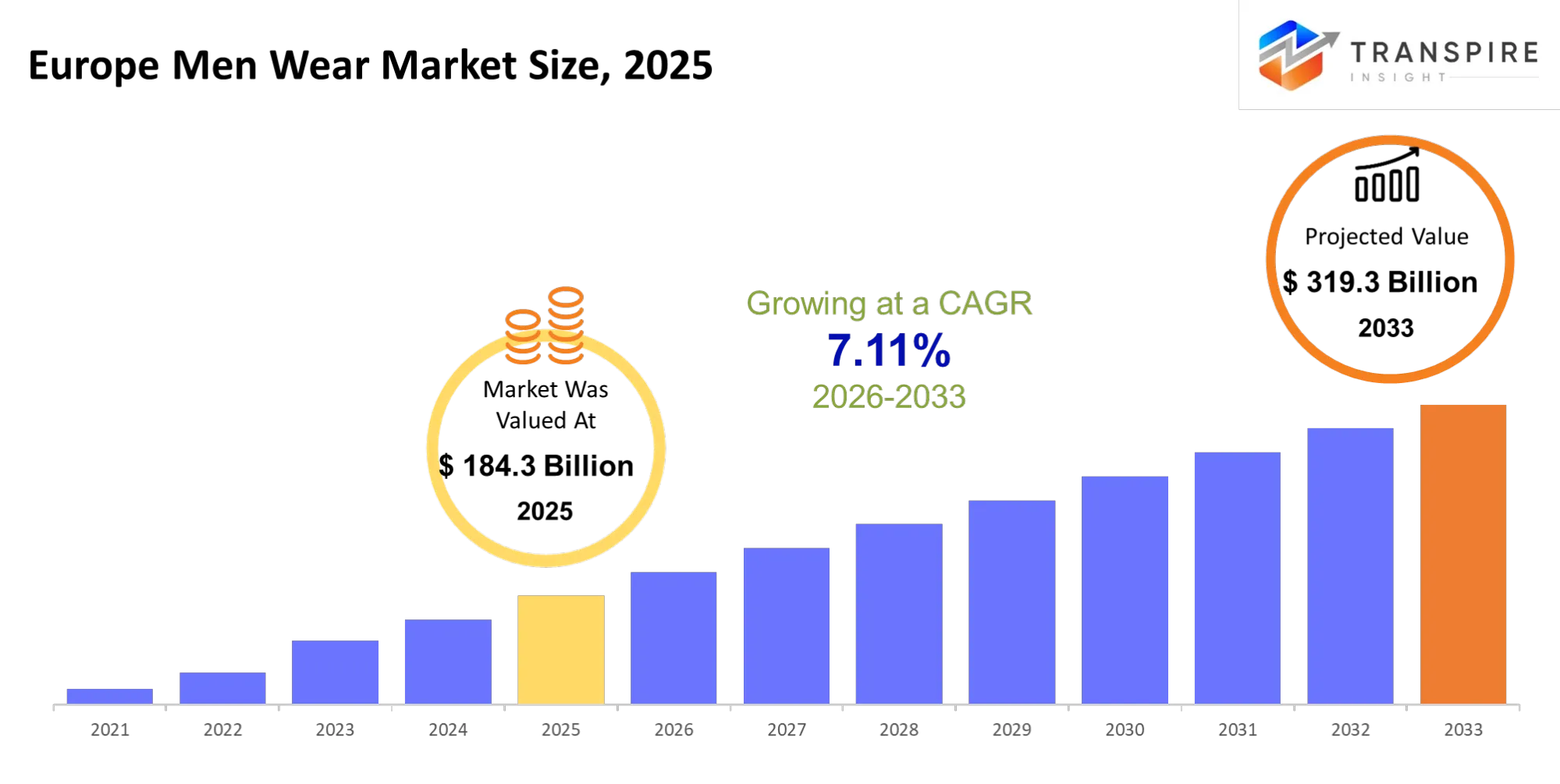
- Europe Men Wear Market Size 2025: USD 184.3 Billion
- Europe Men Wear Market Size 2033: USD 319.3 Billion
- Europe Men Wear Market CAGR: 7.11%
- Europe Men Wear Market Segments:By Product Type (Shirts, T-Shirts, Trousers, Suits, Sportswear, Others); By Distribution Channel (Online Retail, Specialty Stores, Supermarkets, Brand Stores, Others); By Price Range (Economy, Mid-Range, Premium, Others); By Fabric (Cotton, Polyester, Wool, Others); By Age Group (Youth, Adults, Seniors, Others); By End User (Individual Consumers, Corporate Buyers, Others)
Europe Men Wear Market Summary
The Europe Men Wear Market was valued at USD 184.3 billion in 2025. It is forecast to reach USD 319.3 billion by 2033. That is a CAGR of 7.11% over the period.
The Europe Men Wear Market provides people with the clothes they need for life and for special occasions. It helps people show who they are and look good at work. The Europe Men's Wear Market also helps people buy clothes that're right for the time of year. It does this through a lot of stores, websites and other places where people can buy clothes. This way the people who make the clothes can see what people want to buy and make those things.Over the few years the way people buy clothes has changed a lot.This meant that companies had to start selling things to people and they had to be able to change what they were selling quickly.
Now the European Men Wear Market is growing because people want new clothes often. They also want clothes that're good for work and for casual occasions. This means that companies can make money if they can make clothes quickly and get them to the right places. The Europe Men Wear Market is doing well for companies that can do this. They can make clothes that people want to buy and get them to the stores quickly. This is good for the Europe Men Wear Market. It is good for the people who buy the clothes.
Key Market Insights
- The Europe Men Wear Market is mostly controlled by Western Europe with 46 percent share in 2025. Western Europe has a good premium fashion retail system and a lot of big brands are based in Western Europe.
- This is why Western Europe is so important in the Europe Men Wear Market.
- Eastern Europe is going to grow fast from 2026 to 2033. People in Eastern Europe have money to spend now and they are really into online fashion platforms.
- This is making the Europe Men Wear Market in Eastern Europe grow fast.
- When we talk about the European Men Wear Market, casual wear is what people like to buy. It has over 40 percent share because many people work from home now and they do not need to wear office clothes much.
- The Europe Men Wear Market has wear as the popular product.
- The second popular product in the Europe Men Wear Market is formal wear. Many companies, in the finance, legal and institutional sectors still want their employees to wear formal clothes to work.
- This is why formal wear is still important in the Europe Men Wear Market.The fastest growing product in the Europe Men Wear Market is fabric apparel. Many European consumers want to buy clothes that're good for the environment.
- The Europe Men Wear Market is growing fast in fabric apparel.People still like buying clothes from stores but online shopping is getting more popular.
- Many people shop using their phones. They see things in the media and want to buy them.Online shopping is now a part of the Europe Men Wear Market.
- Most people who buy clothes in this market are adults.They like to follow fashion trends.
What are the Key Drivers, Restraints, and Opportunities in the Europe Men's Wear Market?
Drivers
The European Men Wear Market is doing well because of the way people buy things now. People like to shop in stores and online at the time. They use both ways to buy things. This is happening because people use their phones a lot and they see what is popular in the media. What people see in the media helps them decide what to buy. So companies that sell things online and in stores are doing better. The Europe Men Wear Market companies are doing well because they can show clothes faster and give people what they want. The Europe Men Wear Market is. Companies need to change too.
Restraints
One big problem in the Europe Men Wear Market is that companies have many clothes they cannot sell. This happens because people want clothes all the time and it is hard to know what they will want next. The weather and what people see on the media can change what people want to wear really fast. So companies have many clothes and have to sell them cheap which means they do not make as much money. This makes it hard for small companies to grow, in Europe where people are very careful about how much they spend.
Opportunity
There is a chance for companies to grow if they make clothes in a way that is good for the earth and only make what people want. Some countries like Germany and the Netherlands are helping companies make clothes locally which means they can get them to people faster and do not waste much. This helps companies keep up with the fashion trends and make more money. It is an opportunity for companies that make men's clothes in Europe to grow and be successful.
What Has the Impact of Artificial Intelligence Been on the Europe Men's Wear Market?
The European Men Wear Market is changing because of intelligence and new digital technologies. They are making demand forecasting and inventory planning better. They are also making retail execution easier across offline channels.
Artificial intelligence is used to make merchandising systems better. These systems look at what consumers are doing in real time on e-commerce platforms and social media. They use this information to adjust stock allocation across stores. This helps reduce overstock conditions and improve sell-through rates. Retail automation tools also make pricing decisions easier. They allow for discounting which improves inventory turnover and revenue efficiency.
Brands are using machine learning models to predict demand for products. This helps them get ready for shifts and reduce production wastage. Predictive analytics tools are also used to improve supply chain planning. They identify delays in fabric sourcing and manufacturing bottlenecks. This leads to production scheduling and improved operational continuity. Many big retailers have seen a 10–20% reduction in inventory levels after using artificial intelligence based planning systems. They have also seen product replenishment cycles across European distribution hubs.
However there is a problem. The cost of integrating intelligence systems across retail networks is very high. This is especially true for -sized apparel brands. The data from stores and digital platforms is not consistent. This reduces the accuracy of the models and limits full-scale automation. This creates a situation where big global brands can adopt intelligence faster than regional players. This slows down the transformation of the Europe Men Wear Market.
Key Market Trends
- Western Europe has relied less on retail since 2020. This led to fashion sales making up more than 45% of major apparel markets.
- Eastern Europe has seen growth in demand for Menwear. This growth is due to rising incomes and easier access to -border e-commerce, which has improved fashion availability since 2022.
- Fashion brands now release designs weekly rather than seasonally. This fast fashion cycle forces brands to quickly. Produce clothes across the Europe Men Wear Market.
- The use of apparel has greatly increased since 2021, when EU regulations pushed brands to use recycled fabrics and low-carbon textile sourcing strategies.
- After 2020 workplace changes led to a shift in wardrobe composition. Casualwear is now more popular than formalwear among European consumers.
- Online retail platforms now have pricing power than offline stores. This change has reshaped discount strategies and promotional cycles for brands.
- AI-driven demand forecasting has helped leading retailers reduce inventory waste by 15–20% between 2022 and 2025.
- Influencer-driven purchasing behavior has increased significantly. Gen Z consumers are now more likely to make purchases based on trends on social platforms.
- Brands, like Zara and H&M have digitized their supply chains. This helps them reduce production lead times and respond faster to micro-trends.
Europe Men Wear Market Segmentation
By Product Type
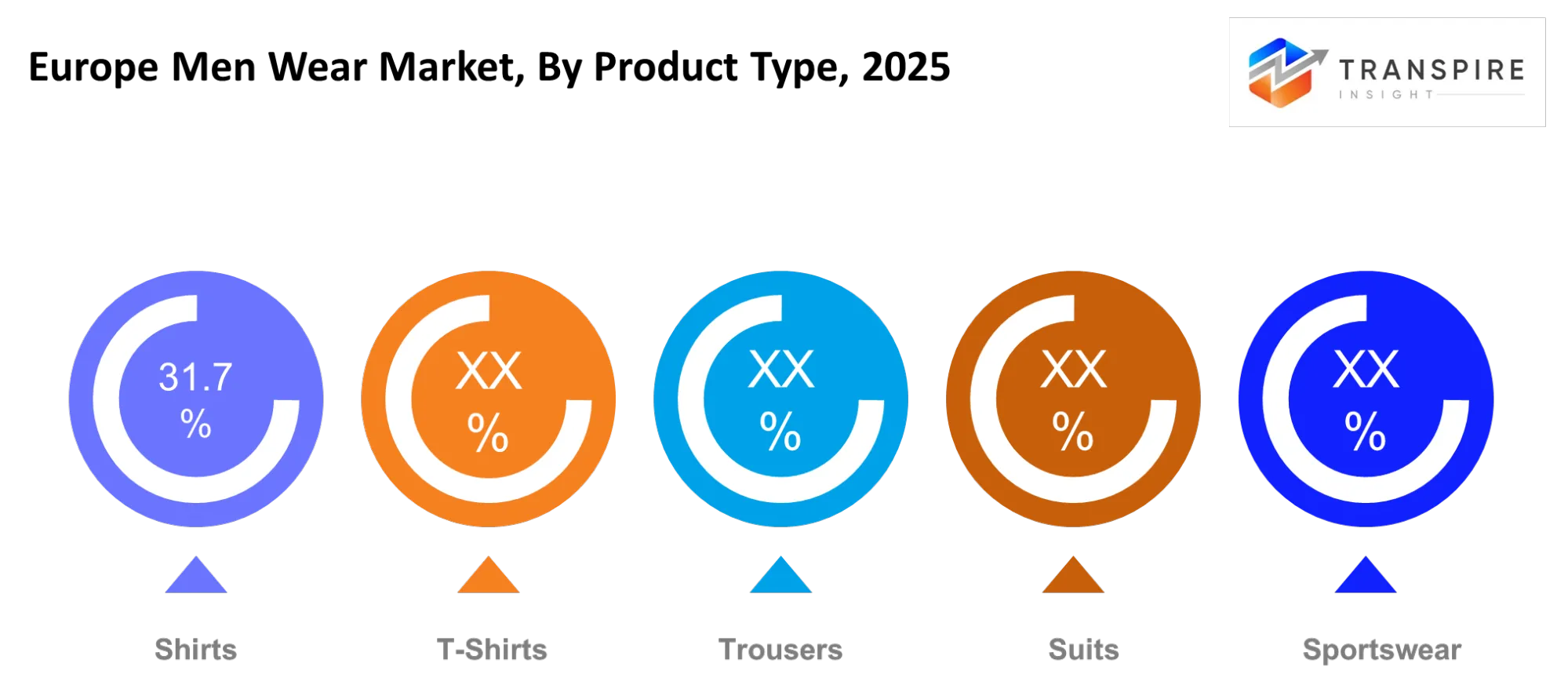
Shirts and trousers are very important for the Europe Men Wear Market. This is because people always need them for casual events. Suits are still popular for business and official meetings in the finance and legal fields. Sportswear is becoming more popular as people start to dress in a relaxed way. T-shirts are in demand because of fast fashion and online shopping. Companies are making different products to keep up with what consumers want in different parts of Europe.
By Distribution Channel
Online shopping is growing fast in the Europe Men Wear Market. This is because people like to shop on their phones and are influenced by the media. Brand stores are still popular because they give customers an experience and interact with them directly. Specialty stores sell designer products that are carefully chosen. Supermarkets help people buy clothes at prices. By selling products in different ways companies can reach more people and sell their products faster across Europe.
By Price Range
Most people in the Europe Men Wear Market buy products that're not too expensive and not too cheap. They want quality products that they can wear every day. Some people are willing to pay more for premium products because they like branded fashion and lifestyle. There are also people who look for options especially in cities and towns. Companies are differentiating themselves by pricing their products based on quality and design. This helps them sell products to people with incomes in Europe.
By Fabric
Cotton is the popular fabric in the Europe Men Wear Market because it is comfortable and durable. People use it to make shirts and casual clothes. Polyester is used more in sportswear and clothes that need to perform. Wool is still used in winter clothes and formal wear. Companies are trying to make fabrics more sustainable by using materials. They are also focusing on making clothes that're comfortable and efficient.
By Age Group
The European Men Wear Market is doing well because of people. Young people really like to buy the fashion trends and they want to wear what is popular. Adults purchase clothes because they need them for work and their daily life. Older people prefer to buy clothes that're comfortable and easy to wear.Companies are trying to reach people on the internet and through people who have a lot of followers on the internet. Europe Men Wear Market companies look at the age of their customers so they can make clothes that're just right for the Europe Men Wear Market customers and keep up with what is popular in the Europe Men Wear Market.
By End User
Most people in the European Men Wear Market buy clothes for themselves. Some companies buy clothes for their employees to wear as uniforms. There are also industries, like hotels and services that need clothes. Individuals are buying clothes because of shopping and personalized fashion.By selling to types of customers Europe Men Wear Market companies can make money from many different sources, in the Europe Men Wear Market.
What are the Key Use Cases Driving the Europe Men Wear Market?
The Europe Men Wear Market is really taking off because men need clothes for work events in the city. A lot of adults want clothes that're good for working from home and the office since the rules about what to wear are changing. Europe Men Wear Market has a lot of people buying shirts, trousers and T-shirts because they are comfortable, affordable and look good every day.
Companies are starting to use uniforms and clothes with their brand on them in hotels, stores and restaurants. Europe Men Wear Market has specialty stores and brand stores that help with this by selling clothes that fit well and are quality. Young people are also buying sportswear because they like to stay fit and dress in a way that shows their lifestyle.
There are some things happening in the Europe Men Wear Market like clothes that can control temperature and are durable which is good for when the weather is changing. People are also starting to care more about the environment so they are buying clothes made from materials and things that do not hurt the planet. The Europe Men Wear Market is getting better at making clothes that're both functional and look good, which is what men in Europe want.
|
Report Metrics |
Details |
|
Market size value in 2025 |
USD 184.3 Billion |
|
Market size value in 2026 |
USD 197.4 Billion |
|
Revenue forecast in 2033 |
USD 319.3 Billion |
|
Growth rate |
CAGR of 7.11% from 2026 to 2033 |
|
Base year |
2025 |
|
Historical data |
2021 - 2024 |
|
Forecast period |
2026 - 2033 |
|
Report coverage |
Revenue forecast, competitive landscape, growth factors, and trends |
|
Regional scope |
Europe |
|
Key company profiled |
Zara, H&M, Hugo Boss, Adidas, Nike, Puma, Levi Strauss, Marks & Spencer, Uniqlo, Primark, Next, Tommy Hilfiger, Ralph Lauren, Mango, Jack & Jones |
|
Customization scope |
Free report customization (country, regional & segment scope). Avail customized purchase options to meet your exact research needs. |
|
Report Segmentation |
By Product Type (Shirts, T-Shirts, Trousers, Suits, Sportswear, Others); By Distribution Channel (Online Retail, Specialty Stores, Supermarkets, Brand Stores, Others); By Price Range (Economy, Mid-Range, Premium, Others); By Fabric (Cotton, Polyester, Wool, Others); By Age Group (Youth, Adults, Seniors, Others); By End User (Individual Consumers, Corporate Buyers, Others) |
Which Regions are Driving the Europe Men Wear Market Growth?
Western Europe leads the Europe Men Wear Market due to strong retail infrastructure, high fashion consciousness, and established global apparel brands. Countries such as Germany, France, and the United Kingdom support strong demand through dense urban populations and mature shopping ecosystems. Well-developed logistics networks and premium retail clusters strengthen product availability and brand visibility. Strict sustainability regulations across the European Union also encourage premium and eco-friendly Menwear adoption, reinforcing leadership in value and innovation.
Southern Europe remains a stable contributor driven by tourism-based retail consumption and strong seasonal fashion demand. Countries such as Italy and Spain show consistent purchasing behavior supported by family-owned retail networks and strong domestic textile traditions. Unlike Western Europe, growth here is influenced more by seasonal visitor spending and lifestyle-driven fashion rather than large-scale corporate retail ecosystems. This creates steady but less volatile revenue contribution, supported by mid-range pricing preferences and strong cultural fashion identity.
Eastern Europe records the fastest growth due to rising disposable income and rapid expansion of online fashion platforms. Recent investments in digital infrastructure and cross-border e-commerce access have improved product availability across smaller cities. Increased entry of global fast-fashion brands has accelerated consumer adoption of trend-based clothing. This momentum positions Eastern Europe as a key expansion zone for brands targeting volume growth between 2026 and 2033.
Who are the Key Players in the Europe Men Wear Market and How Do They Compete?
The Europe Men Wear Market shows moderate consolidation, with global fashion groups and fast-fashion retailers controlling a significant share while regional brands compete in niche and premium segments. Competition is driven mainly by speed-to-market, pricing efficiency, and digital retail capability rather than geography alone. Incumbent players defend market share through supply chain optimization and rapid product refresh cycles, while new entrants focus on direct-to-consumer models and social media-driven branding that reduces reliance on traditional retail channels.
Zara focuses on cost-efficient fast-fashion innovation, using vertically integrated production to shorten design-to-shelf cycles and respond quickly to shifting consumer trends. This model allows rapid inventory turnover and stronger alignment with real-time demand signals. Expansion continues through digital storefront upgrades and increased penetration in Eastern European urban markets.
H&M differentiates through sustainability-led product lines and large-scale affordability, supported by recycled fabric collections and global sourcing networks. Its competitive advantage comes from balancing mass-market pricing with increasing ESG compliance requirements across Europe. The company is expanding its circular fashion initiatives and strengthening online retail presence.Hugo Boss focuses on premium positioning and formalwear specialization, targeting professional and luxury segments with strong brand identity. Its differentiation lies in high-quality tailoring and strong European heritage appeal. Expansion is supported through flagship store upgrades and selective partnerships in high-income urban markets.
Company List
- Zara
- H&M
- Hugo Boss
- Adidas
- Nike
- Puma
- Levi Strauss
- Marks & Spencer
- Uniqlo
- Primark
- Next
- Tommy Hilfiger
- Ralph Lauren
- Mango
- Jack & Jones
Recent Development News
“In March 2026, H&M Group launched its AI-powered digital merchandising and demand forecasting system across key European markets. The rollout improves inventory precision and reduces overproduction risk, strengthening fast-fashion responsiveness and margin efficiency in the competitive European Menwear segment.”https://about.hm.com
“In February 2026, Inditex (Zara) expanded its European logistics automation program with new micro-fulfilment centers in France and Germany. The initiative accelerates same-day and next-day delivery capabilities for Menwear collections, increasing supply-chain agility and strengthening market share in premium fast fashion.”https://www.inditex.com
“In December 2025, Hugo Boss AG entered a strategic licensing and distribution partnership with a Middle Eastern luxury retail group to expand Boss Menwear presence across high-growth European tourist retail hubs. The collaboration enhances brand visibility and strengthens premium positioning in key European destination markets.”https://group.hugoboss.com
What Strategic Insights Define the Future of the Europe Men Wear Market?
The Europe Men's Wear Market will move toward digitally integrated, sustainability-led apparel systems over the next 5–7 years, driven by rapid e-commerce expansion and tighter European Union environmental regulations on textile waste and carbon emissions. Demand will shift toward agile production models that reduce inventory risk and support faster response to micro-trends. Growth will increasingly concentrate in brands that combine data-driven design with localized manufacturing networks across Europe.
A less obvious risk lies in overdependence on algorithm-driven fast fashion cycles, which may intensify inventory volatility and margin pressure if consumer trend signals weaken or become too fragmented. This could create structural inefficiencies for mid-sized retailers that lack advanced forecasting infrastructure, leading to consolidation pressure in the competitive landscape.
A key opportunity will emerge from circular fashion ecosystems supported by textile recycling technologies and resale platforms, particularly in Germany and the Netherlands where sustainability regulations are strongest. AI-enabled demand planning combined with recycled fabric innovation will unlock new profit pools. Market participants should invest early in closed-loop supply chains and digital design systems that reduce production waste while improving responsiveness to localized demand shifts across European cities.
Europe Men Wear Market Report Segmentation
By Product Type
- Shirts
- T-Shirts
- Trousers
- Suits
- Sportswear
- Others
By Distribution Channel
- Online Retail
- Specialty Stores
- Supermarkets
- Brand Stores
- Others
By Price Range
- Economy
- Mid-Range
- Premium
- Others
By Fabric
- Cotton
- Polyester
- Wool
- Others
By Age Group
- Youth
- Adults
- Seniors
- Others
By End User
- Individual Consumers
- Corporate Buyers
- Others
Frequently Asked Questions
Find quick answers to common questions.
The expected Europe Men Wear Market size for the market will be USD 319.3 Billion in 2033.
Key segments for the Europe Men Wear Market are By Product Type (Shirts, T-Shirts, Trousers, Suits, Sportswear, Others); By Distribution Channel (Online Retail, Specialty Stores, Supermarkets, Brand Stores, Others); By Price Range (Economy, Mid-Range, Premium, Others); By Fabric (Cotton, Polyester, Wool, Others); By Age Group (Youth, Adults, Seniors, Others); By End User (Individual Consumers, Corporate Buyers, Others).
Major Europe Men Wear Market players are Zara, H&M, Hugo Boss, Adidas, Nike, Puma, Levi Strauss, Marks & Spencer, Uniqlo, Primark, Next, Tommy Hilfiger, Ralph Lauren, Mango, Jack & Jones.
The Europe Men Wear Market size is USD 184.3 Billion in 2025.
The Europe Men Wear Market CAGR is 7.11% from 2026 to 2033.
- Zara
- H&M
- Hugo Boss
- Adidas
- Nike
- Puma
- Levi Strauss
- Marks & Spencer
- Uniqlo
- Primark
- Next
- Tommy Hilfiger
- Ralph Lauren
- Mango
- Jack & Jones
About the Authors

Chetan Dhatrak
I’m Chetan Dhatrak, a Senior Research Analyst at Transpire Insight, specializing in the Consumer Goods, Foods and Beverages industry. I focus on analyzing market trends, consumer behavior, competitive landscapes, and industry developments to deliver accurate, data-driven insights. My research at Transpire Insight is built on credible sources and in-depth analysis, helping businesses and readers better understand market dynamics, emerging opportunities, and evolving consumer preferences. I’m committed to creating reliable, well-researched content that supports informed decision-making and reflects the latest developments in the consumer goods and food & beverage sectors.

Chakradhar Khansole
Chakradhar serves as the Research Director at Transpire Insight, bringing over 8 years of experience in technology, innovation, and strategic market intelligence. He specializes in transforming complex market data into actionable business insights that enable organizations to make informed, growth-oriented decisions. Recognized for his strategic vision and analytical expertise, Chakradhar leads high-impact research initiatives, delivering comprehensive market assessments, competitive intelligence, and forward-looking industry analysis.
Recently Published Reports
-
Apr 2026
Bottled Water Market
Bottled Water Market Size, Share & Analysis Report By Product Type (Still Bottled Water, Carbonated Bottled Water, Functional Bottled Water, and Others), By Packaging (PET, Cans, and Others), By Sales Channel (Supermarkets/Hypermarkets, Convenience Stores/Drug Stores, Grocery Stores/Club Stores, Foodservice, and Others) and Geography (North America, Europe, Asia-Pacific, Middle East and Africa, South and Central America), 2021 - 2032
-
Apr 2026
Color Cosmetic Packaging Market
Color Cosmetic Packaging Market Size, Share & Analysis Report By Application (Mascara Packaging, Liquid Packaging, and Liquid Face), By Type (Tubes & Bottles, Pens & Markers, Compacts & Containers, and Droppers & Pumps), and Geography (North America, Europe, Asia-Pacific, Middle East and Africa, South and Central America), 2021 - 2031
-
Apr 2026
External Microphone For Camera Market
External Microphone For Camera Market Size, Share & Analysis Report By Type (Shotgun Microphone, Lavalier Microphone, and Others), By Application (Digital Camera, Professional Video Camera, and Others), and Geography (North America, Europe, Asia-Pacific, Middle East and Africa, South and Central America), 2021 - 2031
-
Apr 2026
Foot Orthotic Insoles Market
Foot Orthotic Insoles Market Size, Share & Analysis Report By Type (Pre-fabricated, and Custom-made), By Material (Thermoplastic, Composite Carbon Fiber, and Others), By Distribution Channel (Drug Stores, Hospitals & Clinics, and Others), and Geography (North America, Europe, Asia-Pacific, Middle East and Africa, South and Central America), 2021 - 2031