
Europe IT Devices Market Size & Forecast:
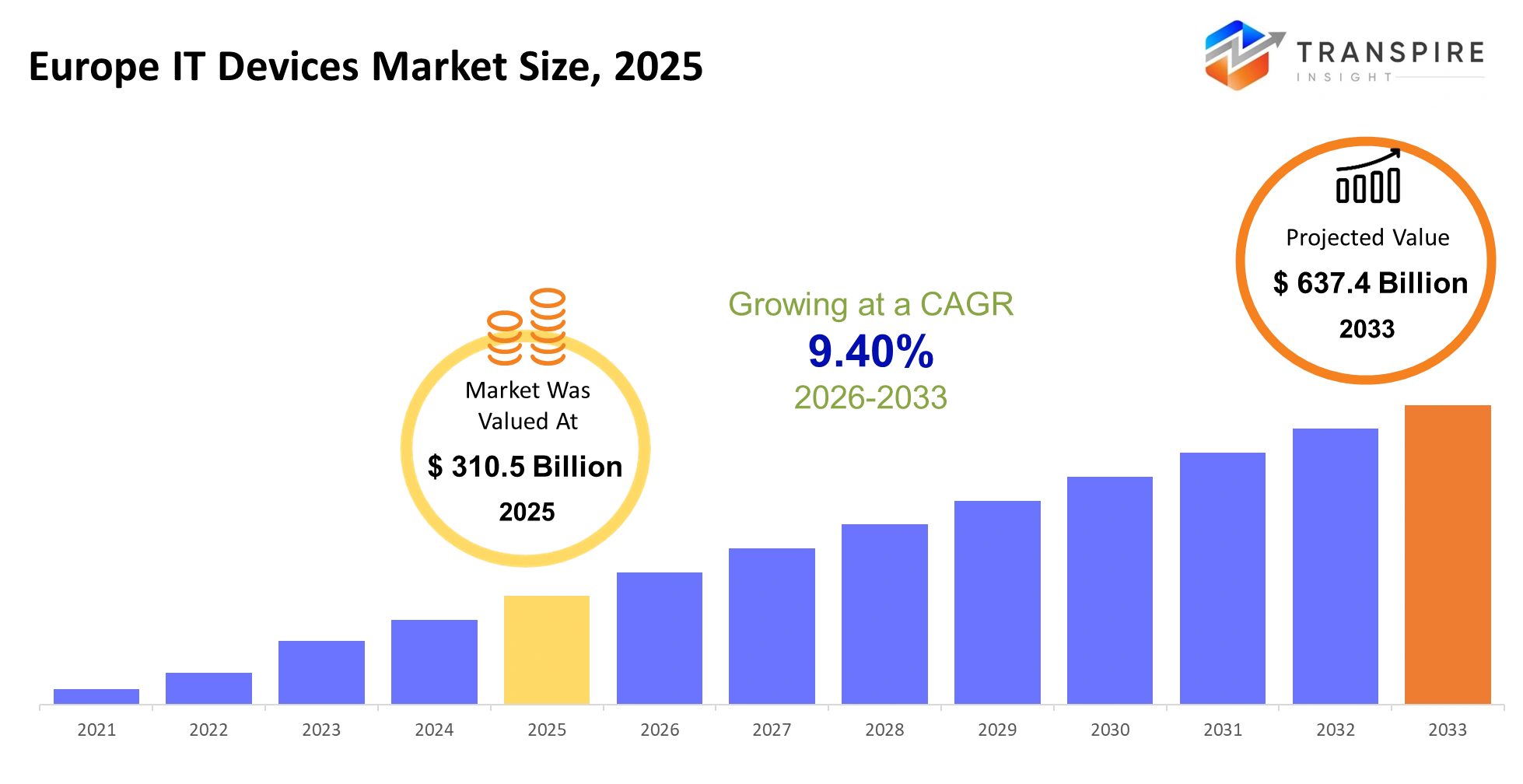
- Europe IT Devices Market Size 2025: USD 310.5 Billion
- Europe IT Devices Market Size 2033: USD 637.4 Billion
- Europe IT Devices Market CAGR: 9.40%
- Europe IT Devices Market Segments: By Type (Laptops, Desktops, Tablets, Smartphones, Others), By Application (Personal Use, Business Use, Education, Gaming, Others), By End-User (Consumers, Enterprises, Educational Institutions, Government, Others), By Distribution (Online, Retail Stores, Direct Sales, Others).
To learn more about this report,  Download Free Sample Report
Europe IT Devices Market Summary:
The Europe IT Devices Market size is estimated at USD 310.5 Billion in 2025 and is anticipated to reach USD 637.4 Billion by 2033, growing at a CAGR of 9.40% from 2026 to 2033. The Europe IT devices market supplies all equipment needed for businesses to operate their digital systems because it includes both mobile workforce laptops and tablets and industrial servers and edge devices that control their operational networks. The devices provide multiple sectors with the ability to make decisions in real time while they work together remotely and process data throughout manufacturing and maritime logistics and energy sectors.
The past 3–5 years have witnessed a major change as businesses start using distributed computing through their adoption of edge-enabled devices which can operate without relying on their centralized data centers. The COVID-19 pandemic created a need for businesses to implement remote work solutions which caused them to adopt new work methods that revealed their outdated IT systems.
The global semiconductor shortages created major supply chain problems which made companies change their approach to managing supplier relationships and product life cycles. Organizations are currently making investments to build stronger device systems which will help them maintain revenue growth through ongoing product replacement cycles.
Key Market Insights
- Western Europe controls more than 45% of the European IT Devices Market which will reach this amount in 2025 because German and French and British enterprise customers drive the market growth.
- The fastest expanding region until 2030 will be Eastern Europe which will experience growth because of digital infrastructure funding and increased technology use among small and medium enterprises.
- The market distribution for laptops and notebooks reaches 40% because business needs drive companies to implement mobility solutions that support their hybrid workforce.
- The desktop market maintains its second highest position because industrial operations and fixed workstation needs create ongoing demand for desktops.
- The industrial IoT and real-time analytics applications create the fastest expansion in edge computing devices which will grow until 2030.
- The enterprise IT infrastructure market constitutes more than 50% of the market share because businesses adopt cloud services and cybersecurity improvements and digital workplace implementations.
- The industrial automation and edge analytics technologies have emerged as the most rapidly expanding applications which receive funding from smart manufacturing and logistics optimization.
- The Europe IT Devices Market will see large enterprises control about 60% of the market share in 2025 because they continue to spend on IT modernization.
- The fastest expansion in small and medium enterprises happens because they implement affordable and adaptable IT devices that enable their digital business operations.
What are the Key Drivers, Restraints, and Opportunities in the Europe IT Devices Market?
Europe IT devices market experiences its primary growth factor from businesses that adopt hybrid work models and develop distributed enterprise systems. Organizations needed to provide employees with secure and portable high-performance equipment during the COVID-19 pandemic because remote work became mandatory. The temporary solution developed into a permanent operational process because it required businesses to create standardized device inventories which they needed to replace at shorter intervals. Companies need more powerful equipment which they need to update frequently because they incorporate collaboration tools and endpoint security systems and cloud-based solutions into their regular operational activities. The company experience revenue growth because its unit shipments increase and average selling prices rise.
The structural constraint exists because the region depends on global manufacturing centers for semiconductor supply while facing semiconductor supply chain disruptions. The European market faces Security risks Because it lacks adequate domestic chip manufacturing facilities. The construction of semiconductor ecosystems requires substantial financial investment and extensive time periods which create obstacles for short-term solutions. The organization faces challenges with obtaining devices which leads to extended equipment acquisition processes and postponed implementation of business operations that have a negative effect on immediate revenue generation.
Industrial sectors benefit from edge computing deployment because it creates new business prospects for the future. Germany is expanding its Industry 4.0 programs which need special edge devices for their local data processing requirements. Manufacturing facilities are turning to real-time analytics and automation systems which will increase their demand for durable low-latency IT hardware solutions that create new business opportunities.
What Has the Impact of Artificial Intelligence Been on the Europe IT Devices Market?
Artificial intelligence together with advanced digital technologies create new operational methods for IT hardware used in industrial and maritime systems throughout Europe. Marine emission control systems use AI-powered controllers which onboard computing systems to perform scrubber monitoring through automatic flow control and chemical dispensing and temperature management based on incoming sensor data. The systems automatically track emissions data which they log for regulatory audits to decrease the need for manual work while enhancing compliance monitoring. Centralized systems operate fleet functions through edge-linked IT equipment which collects ship data to generate automatic reports that decrease administrative tasks while enhancing visibility.
Machine learning models enhance predictive capabilities through their ability to examine historical data together with current information from scrubber performance systems. Operators use advanced monitoring systems to predict equipment deterioration and identify irregularities in exhaust gas cleaning systems while estimating emissions production based on different operational scenarios. The system enables maintenance teams to execute preventive work by stopping equipment failure which leads to higher equipment availability and less unplanned work stoppages during operations. Industrial facilities use predictive systems to improve equipment operation which results in longer equipment life and decreased overall maintenance expenses.
Artificial intelligence adoption encounters its primary obstacle because maritime operations depend on inconsistent sea-based connectivity throughout their operations. The system restricts real-time data transmission and model updates through its limited bandwidth which creates two problems because it decreases prediction accuracy and slows down critical operational response times.
Key Market Trends
- Since enterprises began their hybrid work model in 2020 they have reduced their device replacement cycle from 4 to 5 years to a period of about 3 years because they need to install security updates
- From 2021 until 2025 edge-enabled IT devices gained market share because manufacturers developed real-time analytics systems for both industrial and logistics operations
- After 2022 companies began using device-as-a-service procurement methods which allowed them to change their capital expenditure into stable operating expenses
- After semiconductor shortages between 2021 and 2023 OEMs expanded their supplier relationships while building extra inventory in different areas to protect against upcoming disruptions
- By 2024 more than 60 percent of large companies implemented endpoint security through hardware solutions which combined biometric authentication with firmware threat detection
- The demand for products changed when SMEs started using enterprise-grade laptops together with cloud-connected devices to maintain their digital operational competitiveness
- Dell Technologies and HP Inc. expanded their AI-enabled PC product lines by including on-device processing systems which enable users to make faster decisions without needing internet access
- After 2023 EU regulations created stricter sustainability demands which required manufacturers to develop devices that used recyclable materials and energy-efficient components
- By 2025 buyers would choose IT devices which offered modular and upgradeable features because these options decreased total ownership costs and matched circular economy procurement practices.
Europe IT Devices Market Segmentation
By Type
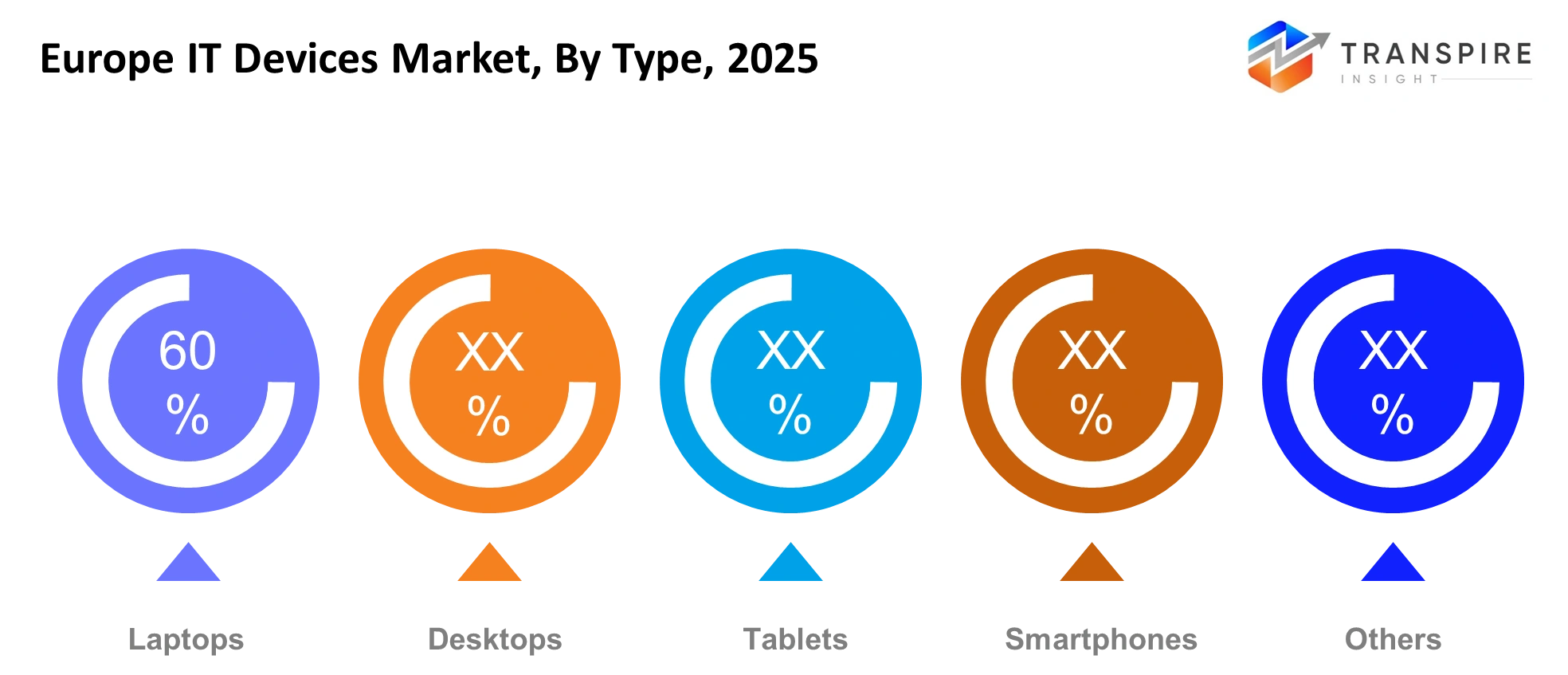
Laptops exist as the most important computer type because businesses need their workers to operate from anywhere and because European countries have started implementing hybrid work systems. Desktops maintain their usefulness in industrial environments and permanent workstation spaces because these areas require dependable performance and capacity to upgrade their systems. Tablets and smartphones enable field operations and logistics tracking and perform basic computing functions, but their usage in enterprises remains limited.
Organizations after 2020 started demanding devices which combined portability and security with high-performance capabilities, which resulted in manufacturers needing to update their laptop products more frequently. Organizations make purchasing choices based on two factors, which include their budget limits and the current availability of essential desktop components. Devices with edge processing abilities and built-in artificial intelligence will drive upcoming market expansion as manufacturers work to develop products which provide processing capabilities and energy-saving features and flexible designs for both business and industrial needs.
To learn more about this report, Download Free Sample Report
By Application
Business organizations drive the most significant application usage through their extensive enterprise implementations that span across manufacturing and logistics and financial services. The public maintains consistent demand for personal use because people now work from home and adopt digital technologies. The education sector experienced a major increase in digital learning usage because of pandemic-related educational digital transition programs. The gaming device market functions as a specialized market which generates high revenue for the industry through its performance enhancements and dedicated equipment.
The market demand for software solutions now shows increased need for integration with the following systems collaboration tools and cybersecurity measures and cloud computing access. Companies need devices which enable their personnel to connect without interruptions while they can maintain these devices throughout their entire operational lifespan. The future will bring tighter links between hardware systems and enterprise software ecosystems which will drive vendors to create integrated product packages that boost user efficiency while safeguarding data across all software systems.
By End-User
The end-user category of enterprises holds the biggest market share because they keep investing in their digital infrastructure and workforce productivity tools and cybersecurity frameworks. The consumer market maintains consistent demand through personal computing and entertainment needs while educational institutions increased their device usage during remote learning periods. Government organizations implement secure IT systems that follow standardized protocols to deliver public services and manage administrative functions.
The different segments of the market have distinct demand drivers because enterprises prioritize scalable solutions with lifecycle management capabilities while consumers base their decisions on the performance-to-price ratio. The purchasing decisions of institutions get affected by their budget limitations and their procurement schedules. Small and medium enterprises will drive future growth through their adoption of advanced devices which will enable vendors to provide affordable scalable solutions that meet different operational requirements.
By Distribution
Direct sales channels control enterprise procurement because organizations select direct sales for their customized configuration needs and their long-term contract requirements and their need for complete service solutions. Retail stores maintain their ability to fulfill consumer needs because they provide products for immediate purchase and display items for customer comparison while online shopping platforms experienced considerable growth after 2020 because they offered customers convenient access to a greater selection of products.
Manufacturers developed new channel strategies through their investments in digital sales platforms and their creation of partner ecosystems which allowed them to access various customer segments. Companies established multiple distribution networks while enabling inventory flexibility because supply chain interruptions required them to do so. The future shows that online distribution and hybrid distribution models will become more important because vendors will spend money on digital resources and data-based sales methods and customer relationship management to boost their profit margins and their ability to keep customers.
What are the Key Use Cases Driving the Europe IT Devices Market?
The primary application of enterprise workplace computing continues to operate as the main use case because large organizations provide their staff members with secure laptops and desktops which they use for their everyday work activities. The banking sector together with manufacturing companies and logistics firms depends on these devices to operate their enterprise software systems and handle their workflow processes and maintain their hybrid operational systems which results in substantial acquisition rates.
Industrial automation and education technology sectors are developing new applications which are currently being studied. Manufacturing companies use rugged edge devices to track their production processes through real-time analytical capabilities while educational institutions invest in tablets and affordable laptops to create digital classroom environments and remote education systems.
New applications are developing for two technologies which combine AI-based edge computing with smart city systems. The deployment of connected devices by utilities and urban authorities for traffic control and security monitoring and energy management needs will generate demand for advanced IT equipment which operates at high speeds with minimal delays.
|
Report Metrics |
Details |
|
Market size value in 2025 |
USD 310.5 Billion |
|
Market size value in 2026 |
USD 339.8 Billion |
|
Revenue forecast in 2033 |
USD 637.4 Billion |
|
Growth rate |
CAGR of 9.40% from 2026 to 2033 |
|
Base year |
2025 |
|
Historical data |
2021 - 2024 |
|
Forecast period |
2026 - 2033 |
|
Report coverage |
Revenue forecast, competitive landscape, growth factors, and trends |
|
Regional scope |
Europe (Germany, United Kingdom, France, Italy, Spain and Rest of Europe) |
|
Key company profiled |
Apple, Samsung, Dell, HP, Lenovo, Asus, Acer, Microsoft, Huawei, Xiaomi, Sony, Toshiba, Panasonic, LG, Fujitsu. |
|
Customization scope |
Free report customization (country, regional & segment scope). Avail customized purchase options to meet your exact research needs. |
|
Report Segmentation |
By Type (Laptops, Desktops, Tablets, Smartphones, Others), By Application (Personal Use, Business Use, Education, Gaming, Others), By End-User (Consumers, Enterprises, Educational Institutions, Government, Others), By Distribution (Online, Retail Stores, Direct Sales, Others). |
Which Regions are Driving the Europe IT Devices Market Growth?
The market exists under Western Europe because the region has strong regulatory enforcement and advanced digital policies and developed enterprise IT systems. Germany and France enable industrial automation through their extensive cloud integration projects which serve as their primary method of technology adoption. The persistent need for advanced IT equipment remains active because multinational companies possess an extensive data system and networking capacity. The organization sustains its leading position through its extensive vendor connections and its network of system integration partners.
The Northern European region maintains stability through its digital resilience and sustainability-driven IT projects in Sweden and Denmark. The region establishes a boundary that separates it from Western Europe through its focus on energy-saving technologies and its commitment to managing product lifecycles throughout extended periods of time. Public and private sectors work together to provide ongoing financial support which enables both digital infrastructure development and enterprise modernization efforts. The combination of consistent regulatory practices and advanced technology understanding results in predictable demand behavior that spans multiple business sectors.
Eastern Europe has become the fastest-growing area because of its rapid growth in digital infrastructure and its rising rate of business adoption of information technology systems. EU funding programs help Poland and Romania develop their digital economies as part of their ongoing development efforts. Recent data center investments together with industrial enhancement activities have increased the market need for economical yet expandable IT solutions. The period from 2026 to 2033 will enable vendors to enter new markets while investors can access developing yet uncharted markets.
Who are the Key Players in the Europe IT Devices Market and How Do They Compete?
The Europe IT devices market display moderate competition because a few global OEMs maintain crucial market control while regional assemblers and niche vendors fight for dominance in particular market segments. Existing companies maintain their market position through their business size and their ability to manage supply chains and acquire enterprise contracts whereas new companies establish themselves in specific fields like edge computing and rugged device development. Businesses compete with each other through security integrated performance metrics and service life management capabilities which have become more important than price requirements. Vendors who supply managed device ecosystems attract buyers because their systems need software interoperability and device maintenance assistance.
Dell Technologies creates its market difference through enterprise solutions which combine hardware components with endpoint protection and device management systems for extensive IT operations. HP Inc. establishes its market position through environmentally friendly product design and device-as-a-service solutions which help businesses handle their expenses while achieving their sustainability objectives. Lenovo uses its cost advantages together with its production capabilities to create affordable devices which meet performance standards especially in the commercial laptop market.
Apple Inc. creates products which combine hardware and software components to create integrated systems that attract enterprise customers and creative professionals who need secure and dependable performance. Acer Inc. expands its educational market entry by developing low-cost scalable products which it distributes through distributor and regional reseller partnerships throughout Europe.
Company List
Recent Development News
In April 2026, the EU eases merger rules impacting European IT hardware consolidation: The European Union has proposed a major overhaul of its merger regulations to allow stronger justification of large-scale tech and infrastructure deals. This is expected to directly influence European IT device and hardware companies through easier consolidation and cross-border scaling.
Source: https://www.reuters.com
In April 2026, the EU is to seek feedback on merger rules overhaul from Thursday, the antitrust chief says: The European Commission launched a formal consultation on updated merger guidelines, aiming to support innovation-driven consolidation in Europe’s technology and IT sectors, including hardware manufacturers and digital infrastructure providers.
Source: https://www.reuters.com
What Strategic Insights Define the Future of the Europe IT Devices Market?
The Europe IT devices market is currently transitioning toward hardware ecosystems that provide integrated services through which devices operate as cloud and edge and AI-based system components. The enterprise market demands real-time data processing capabilities together with improved endpoint cybersecurity protections and better hardware-software system integration. The next five to seven years will see businesses create value through lifecycle management and embedded intelligence and interoperability solutions instead of relying on traditional device sales.
A less visible risk emerges from increasing reliance on a few global component manufacturers who will gain market control while forcing customers to deal with frequent product shortages. Eastern Europe industrial corridors present a developing chance to implement AI-enabled edge devices because digital infrastructure development is increasing but still needs to reach full market share.
Market participants should focus on developing modular device platforms that can be upgraded through built-in AI functions while establishing diverse supply chain systems to lessen risk and obtain long-term business agreements.
Europe IT Devices Market Report Segmentation
By Type
- Laptops
- Desktops
- Tablets
- Smartphones
- Others
By Application
- Personal Use
- Business Use
- Education
- Gaming
- Others
By End-User
- Consumers
- Enterprises
- Educational
- Institutions Government
- Others
By Distribution
- Online
- Retail Stores
- Direct Sales
- Others
Frequently Asked Questions
Find quick answers to common questions.
The approximate Europe IT Devices Market size for the market will be USD 637.4 Billion in 2033.
The key segments of the Europe IT Devices Market are By Type (Laptops, Desktops, Tablets, Smartphones, Others), By Application (Personal Use, Business Use, Education, Gaming, Others), By End-User (Consumers, Enterprises, Educational Institutions, Government, Others), By Distribution (Online, Retail Stores, Direct Sales, Others).
Major players in the Europe IT Devices Market are Apple, Samsung, Dell, HP, Lenovo, Asus, Acer, Microsoft, Huawei, Xiaomi, Sony, Toshiba, Panasonic, LG, Fujitsu.
The current market size of the Europe IT Devices Market is USD 310.5 Billion in 2025.
The Europe IT Devices Market CAGR is 9.40%.
- Apple
- Samsung
- Dell
- HP
- Lenovo
- Asus
- Acer
- Microsoft
- Huawei
- Xiaomi
- Sony
- Toshiba
- Panasonic
- LG
- Fujitsu
Recently Published Reports
-
Apr 2026
Fiber Optic Faceplates Market
Fiber Optic Faceplates Market Size, Share & Analysis Report By Type (< 300 mm2, 300-350 mm2, and > 350 mm2, By Application (Night Vision, Holographic Imaging, Medical, and Others), and Geography (North America, Europe, Asia-Pacific, Middle East and Africa, South and Central America), 2021 - 2031
-
Apr 2026
High Temperature Superconductors Market
High Temperature Superconductors Market Size, Share & Analysis Report By Type (1G HTS, and 2G HTS), By Application (Power Cable, Fault Current Limiter, and Transformer), and Geography (North America, Europe, Asia-Pacific, Middle East and Africa, South and Central America), 2021 - 2031
-
Apr 2026
Industrial Plugs and Socket Market
Industrial Plugs and Socket Market Size, Share & Analysis Report By Type (Industrial Plugs, Industrial Sockets), By Current (Up to 32 A, 32 to 125 A, Above 125 A), By Protection (Dustproof and Splash Proof, Waterproof, Explosion Proof), By End User (Heavy Industries, Oil and Gas, Chemicals and Pharmaceuticals, Power Generation, Others), and Geography (North America, Europe, Asia-Pacific, Middle East and Africa, South and Central America), 2021 - 2031
-
Apr 2026
InGaAs Avalanche Photodiodes Market
InGaAs Avalanche Photodiodes Market Size, Share & Analysis Report By Type (1100 - 1700 nm, and 1000 - 1600 nm), By Application (Missile Warning System, Muzzle Flash Detection, Wafer Defect Inspection, Laser Rangefinders, and Others), and Geography (North America, Europe, Asia-Pacific, Middle East and Africa, South and Central America), 2021 - 2031