

Europe Industrial Mezzanines Market Summary
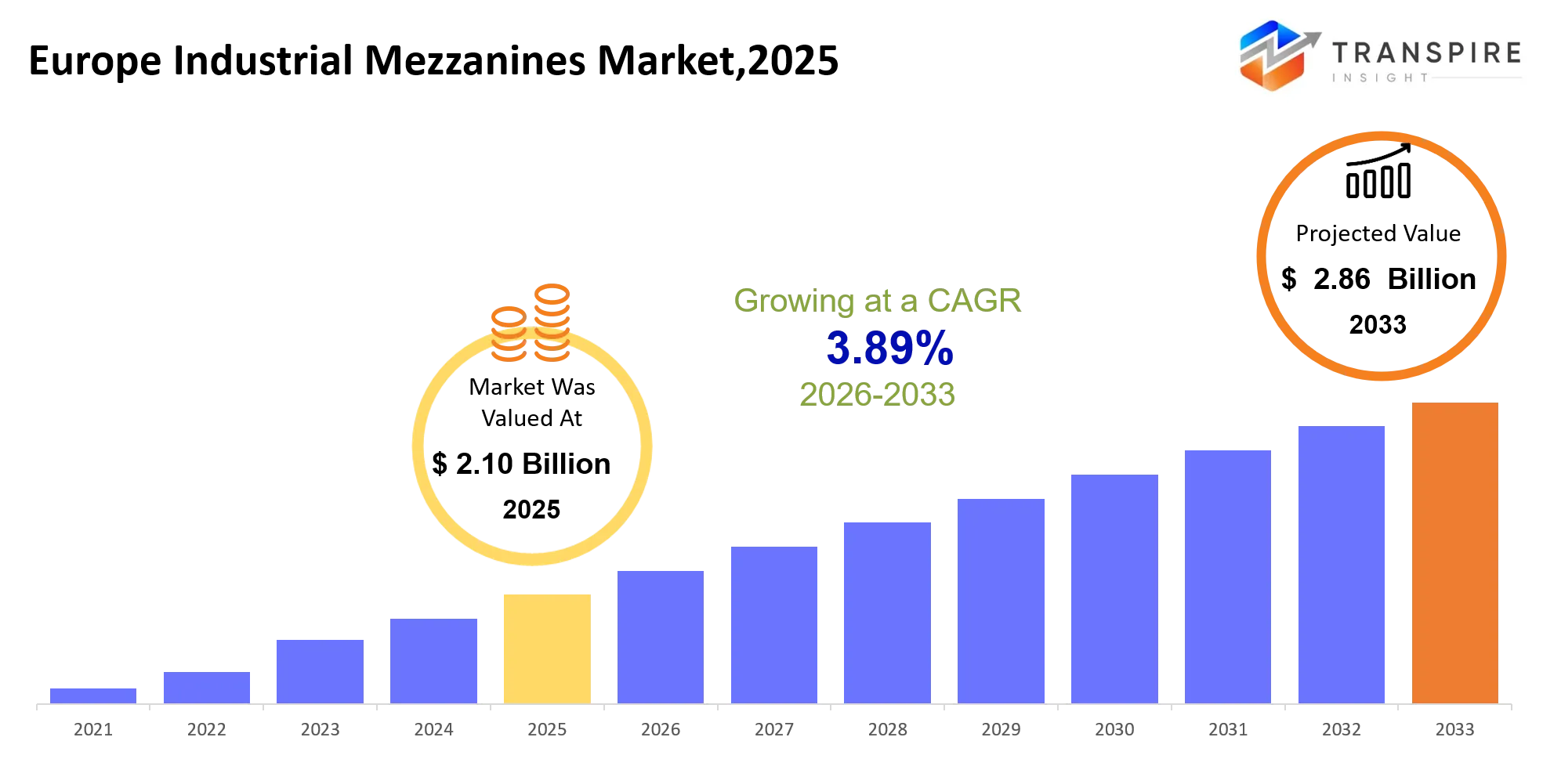
As per Transpire Insight Analysis the Europe Industrial Mezzanines Market size is estimated at USD 2.10 Billion in 2025 and is anticipated to reach USD 2.86 Billion by 2033, growing at a CAGR of 3.89% from 2026 to 2033.
European industrial mezzanines support warehouses, plants, and distribution hubs that need more working space. They add floors and platforms without moving to a new site or doing a large building job. Steel decks can be used for extra storage, order picking, light production, staff offices, and parts of automation. This turns unused vertical height into space that can be used every day.
In the past few years, the market moved away from simple storage levels. Many buyers now ask for modular systems that fit newer tools. These setups often match conveyor lines, robotics, and automated storage. Prices for land and construction have pushed firms to look upward. E-commerce also favors fast picking and efficient layouts. Operators want plans that can be changed later, not fixed designs that are hard to update.
A clear pressure point has been short space in warehouses. At the same time, labor has been harder to secure, and costs to run facilities keep rising. That combo makes vertical build outs a better option than adding another building. For companies that supply these projects, this trend can mean bigger engineered jobs. It can also favor designs made for future automation and retrofit work. The market is expected to be USD 2.10 billion in 2025. By 2033, it is forecast to reach USD 2.86 billion.
Europe Industrial Mezzanines Market Size & Forecast:
- Europe Industrial Mezzanines Market Size 2025: USD 2.10 Billion
- Expected Market Value 2033: USD 2.86 Billion
- Forecast CAGR: 3.89%
- Leading country in 2025: Germany
- Fastest Growing country: Spain
- Key Profile: Mecalux, SSI SCHAEFER, Jungheinrich, Dematic, Daifuku, Constructor Group, AR Racking, Stow Group, Dexion, NEDCON, MiTek, Redirack, Gonvarri Material Handling, Frazier Industrial, Penco Products
Key Market Insights
- Germany is setting the pace in the region. Its manufacturing base is strong, and logistics systems are backed by solid infrastructure and more warehouse automation spending.
- Spain looks like the next mover. Growth is picking up as more logistics sites open along the biggest e-commerce and distribution routes.
- Land and building costs are not small. Because of that, many firms are choosing higher vertical warehouse plans and multi-level layouts instead of spreading out.
- Mezzanines that are built for automation are getting more attention. As conveyors, AS/RS systems, and robots become common, the structures need extra support.
- Warehousing and distribution still sit at the center of demand. At the same time, e-commerce keeps pushing buyers to use layouts that pack more storage into the same space.
- Steel is still a top choice for materials. It holds up well under heavy use, and it can handle the loads typical in tough industrial settings.
- Designs are changing too. Multi-level setups and rack-linked builds are being considered more often, especially when teams want more capacity without adding more footprint.
- Planning tools are now part of the process. BIM, IoT sensors, and warehouse software links are shaping mezzanine design with more data.
- In the UK, MiTek has also leaned into these trends. It said it held 28% of the market in 2025, backed by steel platform work that fits automation.
- Overall, warehouse automation is on the rise. Europe’s automation market is expected to grow at a 17.86% CAGR from 2026 to 2031.
What are the Key Drivers, Restraints, and Opportunities in the Europe Industrial Mezzanines Market?
Driver: Tight industrial space is a key structural reason. When land is costly and new builds run high, going up can be a smarter option than relocating to a bigger site. Mezzanine floors let warehouses and factories add more storage or improve picking and production. They can do this without shutting down the current location. With automation becoming common, the argument gets stronger. Today’s mezzanines can take conveyors, AS/RS units, and robotic tools.
Restraint: Engineering rules and approval steps still hold things back. Teams must do load checks, fire protection review, and structural safety work. Permits and local building sign offs add time. They can also push budgets higher. Steel price swings can further disturb the plan. And if the site is being modified after the fact, retrofits may need tight work with the existing power, sprinkler setup, and material handling equipment.
Opportunity: There is a strong growth chance with automation-ready stainless steel. Many warehouses now need layouts built for robots, conveyors, and automated storage from day one. MiTek’s recent work with AutoStore shows how mezzanine suppliers can win better projects. They can link the structural platform with the automated intralogistics system from the start.
What Has the Impact of Artificial Intelligence Been on the Europe Industrial Mezzanines Market?
AI is affecting mezzanine projects mostly through how sites run day to day. The biggest influence is warehouse automation, layout tuning, and predictive upkeep. The steel frame itself is not the main target.AI tools in warehouses can look at order history and see how stock moves. They also track workflow logs. From that, systems decide where conveyors should run, where robots should work, where picking points fit, and how storage areas should be arranged. Because of this, the mezzanine platform often needs a more exact plan. The structure has to match the paths for access and the spots needed for servicing the equipment.In Europe, money spent on warehouse automation shows this same trend. New sites and upgrades are more likely to include AI-driven robotics and software. Those pieces are treated as part of the core build, not as add-ons.
Digital twins and BIM can help teams plan with fewer surprises. They can test a layout in a model before any work starts. This can also lower the chance of conflicts between steel parts and automation hardware. IoT sensors add another layer by watching load conditions, checking signs of structural wear, and tracking how space is used. That supports predictive maintenance and safer management during day-to-day operations.
Even with these gains, one issue stands out. The cost of linking everything is still high. This is more likely to hit older warehouses. Many of them do not have matching digital systems or clean facility data. Some smaller operators may start with simpler automation first. They may wait on AI monitoring until the payback looks clearer.
Key Market Trends
- Operators are leaning into vertical growth. Land is tight, and building a new site costs more.
- So they are looking up, not out.Mezzanines that fit automation have started to matter more. Modern warehouses now use conveyors, AS/RS, and robotics as normal setups.
- That has raised the bar for the spaces that support those systems.E-commerce is also changing layout choices. Planners want higher density on the floor.
- They also add more picking levels to handle volume in smaller footprints.More buyers now want mezzanines that can be adjusted later. They ask for structures that can take new equipment.
- They also want room to tweak the workflow without a full rebuild.Multi-level floors are picking up. Operators want more usable area.
- They do not want to add to the building footprint to do it.Engineering work has become more focused. Automated machines bring tighter rules. Teams must manage vibration, deflection, and the needed load capacity.
- Planning software is used more often now. BIM and IoT data are entering the design process for mezzanines. Automation information also feeds those workflows.MiTek reported 24% sales growth and 28% market share in the UK in 2025.
- They said automation-led mezzanine jobs helped drive the results.Smaller sites are getting access to new tech too. Modular automation and flexible mezzanine options can lower the risk.
- That makes phased upgrades easier to start.Sustainability is shaping decisions as well. Many operators prefer retrofits. They improve how an existing building is used, instead of starting from scratch.
Europe Industrial Mezzanines Market Segmentation
By Type
Free standing mezzanines sit on their own posts. They add extra floor area in warehouses and factories, and they do not rely on the existing rack system.Rack supported mezzanines use the storage racks as the main structure. This option works well when a site needs very dense storage. Structural mezzanines use strong steel frames. These frames are built for storage, production, and other heavy work spaces in industrial buildings.Modular mezzanines are made from set parts. Using standard pieces can speed up the job. It also makes it easier to grow the space later or shift it for new needs.Catwalk mezzanines give people higher walkways. They also create access paths over storage zones.
Equipment mezzanines hold machinery, conveyors, and other industrial gear. They keep usable open space on the ground level for day to day work.Office mezzanines add new staff or admin rooms. They fit well in facilities with high ceilings.Automated mezzanines are built to work with automated systems. They can support conveyors, robots, and other auto storage equipment.More sites are leaning toward designs built around automation. This lines up with the way warehouses now use advanced material handling.
By Material
Structural steel is strong and can carry heavy loads for storage units, machines, and other production setups. Aluminum is lighter, so it works well when you want less added weight on the structure.
Stainless steel resists corrosion. It fits places where rust would be a problem, and where cleanliness standards are higher. Composite materials can cut weight. They also offer enough strength for certain uses. Concrete gives solid support for fixed industrial buildings. Reinforced steel is used when the job needs high strength and tough performance. Galvanized steel adds a corrosion barrier. It also helps materials last longer in harsh conditions. Lightweight steel lowers the mass of the structure. It still keeps useful strength for storage and industrial needs. The best material depends on the load, site conditions, operating setting, and project cost.
By Application
Warehousing keeps using mezzanines. They add shelf space and picking areas, and they do not force new land. Manufacturing sites also use raised floors. These levels help with the main production areas, plus work areas and machines. Distribution centers rely on mezzanines too. They fit the work for picking and packing, and they help keep material moving in order.
Retail buildings use mezzanine space in the back. It gives extra storage and room for daily operations. For E-commerce, multi-level setups are common. They raise how much can be picked at once, which helps with quick order handling. In Logistics work, mezzanines help pack more storage into less space. They also support a clearer flow for materials. Automotive plants use strong platforms for parts storage. They also support assembly tasks and hold production tools in place. Food and Beverage sites use mezzanines for storage. They also support processing steps and make equipment easier to reach. Automation keeps growing, and fulfillment models keep shifting. This keeps pushing the demand for layouts that can change when needs change.
By Load Capacity
Below 250 kg/m², these setups are best for light holding, simple office use, and places that do not carry much weight. 250 to 500 kg/m² works for average storage and the usual jobs in a warehouse. 500 to 750 kg/m² is a good match when the stock is heavier and the area sees more movement during the day. 750 to 1,000 kg/m² is meant for tough storage duties and busy operational zones that need extra strength.
1,000 to 1,500 kg/m² should be used for heavy inventory, machinery, and industrial tasks. 1,500 to 2,000 kg/m² fits when the load is high and production settings require solid support. 2,000 to 3,000 kg/m² is intended for very heavy equipment and industrial materials. Over 3,000 kg/m² is for special heavy-duty work where the demands are extreme. Pick the load level based on the weight of your goods, the loads from your equipment, how traffic moves through the area, and what the building structure can take.
By Configuration
Single-Level mezzanines add just one floor above the main level. They work well when you need simple storage or a small work area.Multi-Level mezzanines add a few floors. This approach makes better use of height and increases how much you can fit vertically.Full-Floor mezzanines span most of the building area. They give a lot of extra space for many needs.
Partial-Floor mezzanines only cover certain zones. The rest of the ground level stays open for other activities.Multi-Tier setups use multiple linked storage levels. They fit best for tasks that need high density.Rack-Integrated layouts tie the mezzanine into storage racks. This helps the full plan use space more efficiently.Conveyor-Integrated designs add support for moving goods by conveyor. This supports automated material flow.Automated Storage-Integrated systems link raised platforms with AS/RS and other automation tools. These setups are becoming more common as warehouse teams mix vertical space with automated handling.
By End User
Some logistics firms add mezzanines inside their distribution sites. The goal is to store more items and speed up picking. Other companies also add elevated work areas. These setups help a warehouse gain space without pushing out the building walls. Manufacturers may install mezzanines to support production needs. They can hold parts and place key gear in a safer way. Retailers sometimes use mezzanines to gain extra back-room space. They also use the added area for work tasks and day to day operations.
E-commerce businesses often choose multi level layouts. This supports fast picking and steady order work. In automotive plants, mezzanines are used for parts movement and setup help. They also support inventory storage. Food related businesses may use mezzanines for storage and support tasks. They also provide better access to certain equipment. Third party logistics providers may pick modular mezzanine systems. This lets them change a facility to fit different clients. It also helps when inventory needs shift.Having room to grow still matters for many occupiers. More of them want sites that can expand later. They also want options for automation.
What are the Key Use Cases Driving the Europe Industrial Mezzanines Market?
Warehousing is still the main reason people install these elevated floors. They add room for storage and picking. You can do it without building a fresh structure. In many places land is expensive. Space for factories and depots is also tight. So growing upward often makes more sense for distribution sites.
Online retail and logistics teams are putting these systems to work in more ways now. They can run pick and pack tasks on several levels. Material handling can be done with automation too. Some manufacturers and auto suppliers also add mezzanines. They use them for support areas, parts storage, and placing tools or machines.
Robots and automated storage are starting to show up as newer options. Mezzanines can be built to match conveyors, AS/RS units, and robot lines. That setup can help with upgrades later. It also lets the building carry more work without spreading out.
|
Report Metrics |
Details |
|
Market size value in 2025 |
USD 2.10 Billion |
|
Market size value in 2026 |
USD 2.19 Billion |
|
Revenue forecast in 2033 |
USD 2.86 Billion |
|
Growth rate |
CAGR of 3.89% from 2026 to 2033 |
|
Base year |
2025 |
|
Historical data |
2021 - 2024 |
|
Forecast period |
2026 - 2033 |
|
Report coverage |
Revenue forecast, competitive landscape, growth factors, and trends |
|
Regional scope |
Europe |
|
Key company profiled |
Mecalux, SSI SCHAEFER, Jungheinrich, Dematic, Daifuku, Constructor Group, AR Racking, Stow Group, Dexion, NEDCON, MiTek, Redirack, Gonvarri Material Handling, Frazier Industrial, Penco Products |
|
Customization scope |
Free report customization (country, regional & segment scope). Avail customized purchase options to meet your exact research needs. |
|
Report Segmentation |
By Type (Free-Standing Mezzanines, Rack-Supported Mezzanines, Structural Mezzanines, Modular Mezzanines, Catwalk Mezzanines, Equipment Mezzanines, Office Mezzanines, Automated Mezzanines); By Material (Structural Steel, Aluminum, Stainless Steel, Composite Materials, Concrete, Reinforced Steel, Galvanized Steel, Lightweight Steel); By Application (Warehousing, Manufacturing, Distribution Centers, Retail, E-Commerce, Logistics, Automotive, Food & Beverage); By Load Capacity (Below 250 kg/m², 250–500 kg/m², 500–750 kg/m², 750–1,000 kg/m², 1,000–1,500 kg/m², 1,500–2,000 kg/m², 2,000–3,000 kg/m², Above 3,000 kg/m²); By Configuration (Single-Level, Multi-Level, Full-Floor, Partial-Floor, Multi-Tier, Rack-Integrated, Conveyor-Integrated, Automated Storage-Integrated); By End User (Logistics Companies, Warehouses, Manufacturers, Retailers, E-Commerce Companies, Automotive Companies, Food Companies, Third-Party Logistics Providers) |
Which Regions are Driving the Europe Industrial Mezzanines Market Growth?
Germany is the biggest regional market. It has a big manufacturing sector. It also has solid logistics systems and a lot of warehouse automation work. In 2025, Germany made up 29.35% of Europe’s warehouse automation sales. That points to strong money being put into logistics. Mezzanine vendors see demand from cars, factories, online sales, and distribution sites.
The UK looks different. Retail and e-commerce keep pushing more activity. That helps drive efforts to use warehouse space better. In 2025, MiTek had a stated 28% share in the UK mezzanine market. This was backed by steel levels made for automated intralogistics setups. So in the UK, buyers tend to want structures that are ready for automation. They also want options that can work when projects are already underway.
Spain shows good growth chances. Logistics routes keep expanding near main distribution corridors. E-commerce is a key factor too. The warehouse automation sector in Spain is expected to rise by 19.3% each year until 2031. This should favor mezzanine systems that fit with robotics and automated storage. Spain’s growth from now through 2026 to 2033 can help suppliers that offer modular builds. It also supports fast retrofit work.
Who are the Key Players in the Europe Industrial Mezzanines Market and How Do They Compete?
Competition is still somewhat split. Big material handling firms sit next to smaller, focused platform makers.Most deals seem to hinge on what engineers can do. Buyers also care about load strength, how well the system connects to automation, how fast it can be installed, and what happens after the sale. Price for bare steel alone is not the main deciding factor.Many buyers now want mezzanines that fit current needs and can grow later. They may need conveyors, AS/RS, and robotics. They also want room for future layout changes.
Mecalux pairs storage setups with warehouse automation. That can make it easier to link a mezzanine build to wider material handling plans. SSI SCHAEFER sells integrated storage plus automation. The idea is a single source for racking, platforms, and automated warehouse tech. Jungheinrich leans on its larger intralogistics range. It can tie the building structure to handling equipment and automation.
Dematic concentrates on automated distribution and fulfillment work. That supports mezzanine designs that fit conveyors and automated storage. MiTek focuses on steel mezzanine platforms for automated intralogistics. It also points to a UK market share of 28% in 2025. Some projects mention AutoStore.In short, suppliers that handle automation links, offer real engineering help, and support upgrades tend to win more value. Firms that only sell standard storage platforms face a narrower set of opportunities.
Company List
- Mecalux
- SSI SCHAEFER
- Jungheinrich
- Dematic
- Daifuku
- Constructor Group
- AR Racking
- Stow Group
- Dexion
- NEDCON
- MiTek
- Redirack
- Gonvarri Material Handling
- Frazier Industrial
- Penco Products
Recent Development News
In April 2025, MiTek highlighted multi-level mezzanine solutions designed to maximize warehouse space and support automation. The company showcased flexible steel platforms for retail and logistics applications, reflecting the shift toward automation-ready warehouse infrastructure.http://www.mezzanine.co.uk/news/save-floor-space-and-enable-efficient-automation.html (MiTek).
In January 2025, MiTek was reported as holding a 28% UK mezzanine market share. The company reported 24% sales growth and highlighted projects integrating mezzanines with AutoStore automation, strengthening its position in automated warehouse infrastructure.http://www.logisticsmatters.co.uk/product/mitek-mezzanine-market-leader/ (Logistics Matters).
What Strategic Insights Define the Future of the Europe Industrial Mezzanines Market?
The market seems to be shifting toward vertical building setups that work with automation, not just standard storage systems. One big driver is the cost of industrial land. Another is that many warehouses do not have enough space. On top of that, companies are spending more money on automation. Mezzanines that fit right into conveyor lines, AS/RS systems, robots, and digital planning should bring more value to each project.
There is also a risk that people may miss. Future automation may not match the mezzanine that was built today. A cheaper mezzanine made for current storage loads might need costly upgrades later. This is especially true once a warehouse adds robotics or automated storage. That situation can lower a buyer’s desire to update their site. It can also slow down the timeline for new installs.
At the same time, there is a newer chance to win here. Modular mezzanines can be built for step by step automation. A team can put in a basic platform first. Later, they can add conveyors, robots, or automated storage as needs grow. Industry players should use common structural parts with room to adjust load ratings. They should also match digital design tools and allow for easy add-ons. This can cut retrofit spending and make mezzanine projects easier to choose for logistics firms that expect their capacity needs to change.
Europe Industrial Mezzanines Market Report Segmentation
By Type
- Free-Standing Mezzanines
• Rack-Supported Mezzanines
• Structural Mezzanines
• Modular Mezzanines
• Catwalk Mezzanines
• Equipment Mezzanines
• Office Mezzanines
• Automated Mezzanines
By Material
- Structural Steel
• Aluminum
• Stainless Steel
• Composite Materials
• Concrete
• Reinforced Steel
• Galvanized Steel
• Lightweight Steel
By Application
- Warehousing
• Manufacturing
• Distribution Centers
• Retail
• E-Commerce
• Logistics
• Automotive
• Food & Beverage
By Load Capacity
- Below 250 kg/m²
• 250–500 kg/m²
• 500–750 kg/m²
• 750–1,000 kg/m²
• 1,000–1,500 kg/m²
• 1,500–2,000 kg/m²
• 2,000–3,000 kg/m²
• Above 3,000 kg/m²
By Configuration
- Single-Level
• Multi-Level
• Full-Floor
• Partial-Floor
• Multi-Tier
• Rack-Integrated
• Conveyor-Integrated
• Automated Storage-Integrated
By End User
- Logistics Companies
• Warehouses
• Manufacturers
• Retailers
• E-Commerce Companies
• Automotive Companies
• Food Companies
• Third-Party Logistics Providers
Frequently Asked Questions
Find quick answers to common questions.
The expected Europe Industrial Mezzanines Market size for the market will be USD 2.86 Billion in 2033.
Key segments for the Europe Industrial Mezzanines Market are By Type (Free-Standing Mezzanines, Rack-Supported Mezzanines, Structural Mezzanines, Modular Mezzanines, Catwalk Mezzanines, Equipment Mezzanines, Office Mezzanines, Automated Mezzanines); By Material (Structural Steel, Aluminum, Stainless Steel, Composite Materials, Concrete, Reinforced Steel, Galvanized Steel, Lightweight Steel); By Application (Warehousing, Manufacturing, Distribution Centers, Retail, E-Commerce, Logistics, Automotive, Food & Beverage); By Load Capacity (Below 250 kg/m², 250–500 kg/m², 500–750 kg/m², 750–1,000 kg/m², 1,000–1,500 kg/m², 1,500–2,000 kg/m², 2,000–3,000 kg/m², Above 3,000 kg/m²); By Configuration (Single-Level, Multi-Level, Full-Floor, Partial-Floor, Multi-Tier, Rack-Integrated, Conveyor-Integrated, Automated Storage-Integrated); By End User (Logistics Companies, Warehouses, Manufacturers, Retailers, E-Commerce Companies, Automotive Companies, Food Companies, Third-Party Logistics Providers)
Major Europe Industrial Mezzanines Market players are Mecalux, SSI SCHAEFER, Jungheinrich, Dematic, Daifuku, Constructor Group, AR Racking, Stow Group, Dexion, NEDCON, MiTek, Redirack, Gonvarri Material Handling, Frazier Industrial, Penco Products
The Europe Industrial Mezzanines Market size is USD 2.10 Billion in 2025.
The Europe Industrial Mezzanines Market CAGR is 3.89% from 2026 to 2033.
- Mecalux
- SSI SCHAEFER
- Jungheinrich
- Dematic
- Daifuku
- Constructor Group
- AR Racking
- Stow Group
- Dexion
- NEDCON
- MiTek
- Redirack
- Gonvarri Material Handling
- Frazier Industrial
- Penco Products
About the Authors

Kartik bhong
I am Kartik Bhong, a Senior Research Analyst at Transpire Insight, specializing in the Packaging, Manufacturing, and Construction industry. My work focuses on analyzing market trends, emerging technologies, industry regulations, and competitive landscapes to deliver accurate, data-driven insights. I am passionate about transforming complex industry information into clear, practical content that helps businesses, professionals, and decision-makers stay informed and make confident strategic decisions. Through continuous research and a strong commitment to accuracy, I strive to create reliable, well-researched content that reflects the latest developments across these dynamic industries and supports the vision of Transpire Insight in delivering valuable market intelligence.

Chakradhar Khansole
Chakradhar serves as the Research Director at Transpire Insight, bringing over 8 years of experience in technology, innovation, and strategic market intelligence. He specializes in transforming complex market data into actionable business insights that enable organizations to make informed, growth-oriented decisions. Recognized for his strategic vision and analytical expertise, Chakradhar leads high-impact research initiatives, delivering comprehensive market assessments, competitive intelligence, and forward-looking industry analysis.
Recently Published Reports
-
Apr 2026
Handling and Lifting Equipment Market
Handling and Lifting Equipment Market Size, Share & Analysis Report By Product (Cranes and Hoists, Forklifts, Conveyor Systems, Aerial Work Platforms, Others), By Application (E-Commerce, Automotive and Railway, Food and Beverages, Aviation, Others), and Geography (North America, Europe, Asia-Pacific, Middle East and Africa, South and Central America), 2021 - 2031
-
Apr 2026
HVAC Equipment Market
HVAC Equipment Market Size, Share & Analysis Report By Heating Equipment Type (Boilers and Furnaces, Heat Pumps, and Unitary Heaters), By Ventilation Equipment (Air Handling Units, Humidifiers and Dehumidifiers, Air Filters, and Fan Coiling Units), By Air Conditioning Equipment (Unitary Air Conditioners, Room Air Conditioners, Packaged Terminal Air Conditioners, and Chillers), By End User (Commercial, Residential, Industrial, and others), and Geography (North America, Europe, Asia-Pacific, Middle East and Africa, South and Central America), 2021 – 2031
-
Apr 2026
Refrigeration Valves Market
Refrigeration Valves Market Size, Share & Analysis Report By Type (Solenoid Valves, Expansion Valves, Check Valves, Service Valves, Others), By Application (Commercial Refrigeration, Industrial Refrigeration, Transport Refrigeration, Residential Refrigeration, Air Conditioning Systems), By End User (Food and Beverage Industry, Pharmaceutical Industry, HVAC Industry, Chemical Industry, Others), and Geography (North America, Europe, Asia-Pacific, Middle East and Africa, South and Central America), 2021 – 2031
-
Apr 2026
E-Commerce Packaging Materials Market
E-Commerce Packaging Materials Market By Material Type (Corrugated Boxes, Paper & Paperboard, Foam & Cushioning Materials, Plastic Packaging, Flexible Packaging, Protective Packaging, Others), By Product(Primary Packaging, Secondary Packaging, Tertiary Packaging), By Packaging Function (Protective Packaging, Branding & Presentation Packaging, Transit & Logistic Packaging, Sustainable Packaging, Tamper Evidence Packaging), By End-User (Retail & Consumer Goods, Electronic Appliances, Food & Beverages, Healthcare & Pharmaceutical, Fashion & Apparel, Home & Furnishing, Others); By Industry Analysis, Size, Share, Growth, Trends, and Forecasts 2021-2033