
Europe Hearing Aids Market Size & Forecast:
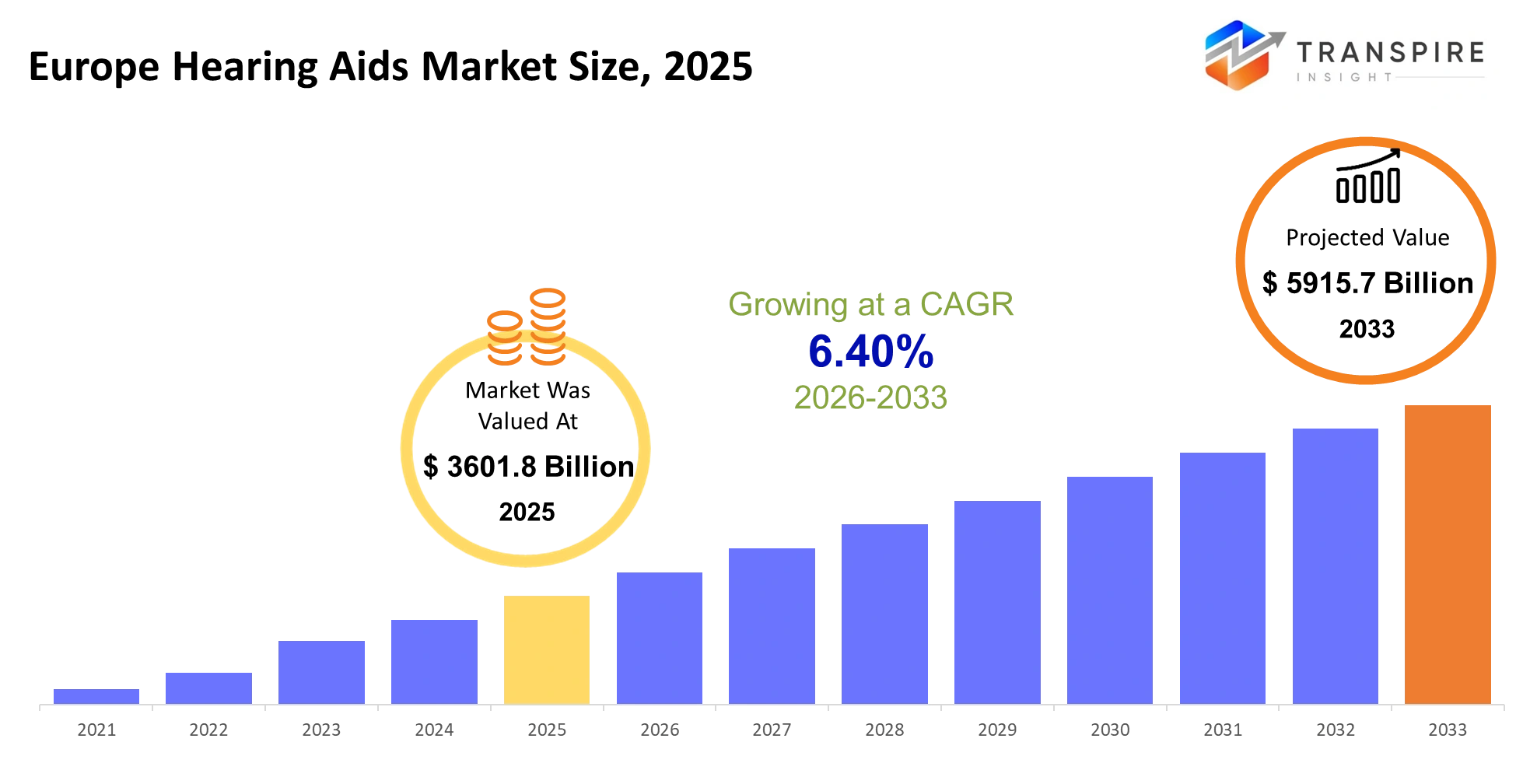
- Europe Hearing Aids Market Size 2025: USD 3601.8 Billion
- Europe Hearing Aids Market Size 2033: USD 5915.7 Billion
- Europe Hearing Aids Market CAGR: 6.40%
- Europe Hearing Aids Market Segments: By Type (Behind-the-Ear, In-the-Ear, Receiver-in-Canal, Completely-in-Canal, Others), By Application (Hearing Loss Treatment, Tinnitus Management, Others), By End-User (Adults, Geriatric Population, Pediatrics, Others), By Distribution (Online, Retail Clinics, Audiology Centers, Others).
To learn more about this report,  Download Free Sample Report
Europe Hearing Aids Market Summary:
The Europe Hearing Aids Market size is estimated at USD 3601.8 Billion in 2025 and is anticipated to reach USD 5915.7 Billion by 2033, growing at a CAGR of 6.40% from 2026 to 2033. The Europe hearing aids market provides essential support which enables elderly individuals to maintain their social relationships and job responsibilities while decreasing their need for permanent nursing support. Modern hearing aids work today as advanced intelligent health monitoring devices which assist users with speech comprehension and cognitive load management and smartphone and digital health system connection. The current practical application of this technology results in people using it for base hearing loss treatment because it can enhance their daily functioning abilities.
The market transitioned during the past 3 to 5 years from traditional analog hearing devices and independent hearing products toward contemporary hearing systems that use artificial intelligence and support rechargeable and Bluetooth wireless technology. The development of tele-audiology services together with reimbursement changes throughout various European regions created better patient access and improved treatment results during the course of this transition.
The pandemic created supply chain disruptions which showed that Europe depended on imported semiconductor and microelectronics products which led manufacturers to develop multiple sourcing options and build local product assembly facilities. The business changes create new revenue streams through increased frequency of product upgrades and customers choosing higher tier products and expansion into markets which were previously unserved.
Key Market Insights
- Western Europe held more than 58% of the Europe Hearing Aid Market in 2025 with Germany, the UK, and France as the main market drivers.
- Northern Europe shows the highest market growth to 2030 because of its strong healthcare system and its implementation of digital audiology technologies.
- The German hearing aid market has achieved significant development because its reimbursement system benefits the elderly population, which constitutes a substantial portion of its residents.
- The UK hearing device market experiences consistent growth because the National Health Service supports hearing assessment programs, which enhance patient treatment and diagnostic capabilities.
- Digital hearing aids controlled almost 72% of the Europe Hearing Aids Market in 2025 because they provide advanced sound processing features.
- Behind-the-ear hearing aids remained the second-largest segment because of their low price and long-lasting nature and their effectiveness at treating users with moderate to severe hearing loss.
- The period from 2025 to 2030 will see rechargeable hearing aids become the most rapidly expanding product segment because users favor products which offer both sustainability and ease of use.
- AI-powered smart hearing aids are succeeding in the market because they provide users with two essential functions which include live noise cancellation and smartphone pairing capabilities.
- European hearing aids market roughly 64% of its total sales to products designed for treating sensorineural hearing loss.
- The application segment for treating mild to moderate hearing impairment represents the most rapid market growth section because of increasing use of early hearing diagnostic methods.
- Tele-audiology services are experiencing fast growth throughout Europe because they enable better remote patient fitting and monitoring as well as their post-purchase relationship with patients.
- The market analysis from 2025 shows that adults who are 65 years and older represented the biggest end-user segment with 61% market share.
What are the Key Drivers, Restraints, and Opportunities in the Europe Hearing Aids Market?
The Europe Hearing Aids Market experiences its strongest growth because Western European countries adopt artificial intelligence hearing devices that can be recharged and currently available reimbursement programs. The governments and healthcare systems of Germany France and the UK expanded their digital hearing solution coverage after research showed that untreated hearing loss leads to cognitive decline and social isolation and increased healthcare expenses. The combination of these technologies and policies led to different consumer purchasing patterns. Consumers increasingly switch from their outdated analog devices to advanced smart hearing aids which provide Bluetooth functionality and automatic sound adjustments and smartphone compatibility. The manufacturing companies achieve better financial outcomes through increased average selling prices while audiology facilities obtain continuous income through their remote fitting services and software-based adjustment capabilities.
The market continues to face its biggest structural obstacle through the total hearing care expenses which encompass all elements from devices to diagnostic testing and fitting procedures and maintenance and expert consultations. The problem exists because Europe lacks enough qualified audiologists who can provide services while different countries maintain various systems for reimbursing these professionals. The number of patients who require treatment in Southern and Eastern Europe continues to decline because they wait several years before seeking medical assistance which affects their ability to receive treatment at an early stage and decreases the amount of revenue that manufacturers generate from product replacements.
Tele-audiology platforms offer the most promising potential for future development. Eastern Europe and Scandinavia now experience better access to hearing assessment and cloud-based device tuning services because remote assessment technologies have implemented their digital health solutions.
What Has the Impact of Artificial Intelligence Been on the Europe Hearing Aids Market?
The European Hearing Aids Market experiences a complete transformation because artificial intelligence and digital technologies create adaptive wearable hearing devices that function as health devices instead of traditional hearing aids. The manufacturers now utilize artificial intelligence sound processing systems which adapt their output by enhancing speech comprehension and reducing background noise and controlling sound direction through automatic functions. The systems track sound environments which include restaurants and public transport and office areas to adjust audio settings without requiring human input. The system enables users to have a better experience because it minimizes the time needed for audiologist modifications.
The application of machine learning models enables better predictions of hearing care outcomes. The cloud-based hearing systems gather non-personalized data which shows how users interact with the devices to estimate battery loss and discover operational failures and suggest maintenance actions before users experience performance issues. Multiple high-end hearing aid manufacturers now provide users with remote diagnostic capabilities and software tuning options through their mobile applications which results in fewer clinic appointments and better device performance. Digital audiology platforms assist clinics in managing patients more effectively while they also decrease time spent on fitting procedures and enhance individual treatment options.
The technologies lead to improved patient retention in Europe together with quicker device replacement periods and increased sales of high-end products. The process of AI implementation in digital hearing solutions encounters its primary obstacle because these systems require expensive system integration together with cybersecurity measures and authentic audio recordings from actual environments to achieve precise performance across different sound settings.
Key Market Trends
- The period between 2021 and 2025 saw rechargeable hearing aids become the standard for premium product categories when sustainability regulations and user preferences for convenience became stronger.
- The United Kingdom and Germany expanded their reimbursement systems after 2022 which resulted in increased adoption of initial hearing treatments and faster replacement of hearing devices.
- Sonova and Demant dedicated more resources to artificial intelligence sound processing technologies which helped them create distinct high-end products.
- Tele-audiology systems have decreased the need for in-person fitting sessions since 2023 by offering remote device adjustments and online patient tracking solutions.
- Users under 65 years old began to adopt Bluetooth hearing systems after the introduction of smartphone compatibility which became their primary reason to purchase these devices.
- European manufacturers expanded their semiconductor supplier networks because pandemic-related supply chain disruptions showed them which vulnerabilities existed in advanced hearing device production.
- Social stigma about visible hearing aids began to fade between 2020 and 2025 which led consumers to prefer miniaturized behind-the-ear devices over other types.
- Retail hearing care chains opened multiple locations throughout Southern and Eastern Europe which they used to provide hearing support through subscription services to areas that lacked such resources.
- AI-based speech enhancement technology helped users in loud environments which led to higher adoption rates of premium devices by office workers and people living in cities.
- Since 2024, regulators and healthcare providers have increasingly linked untreated hearing loss with cognitive decline, reshaping preventive hearing care policies across Europe.
Europe Hearing Aids Market Segmentation
By Type
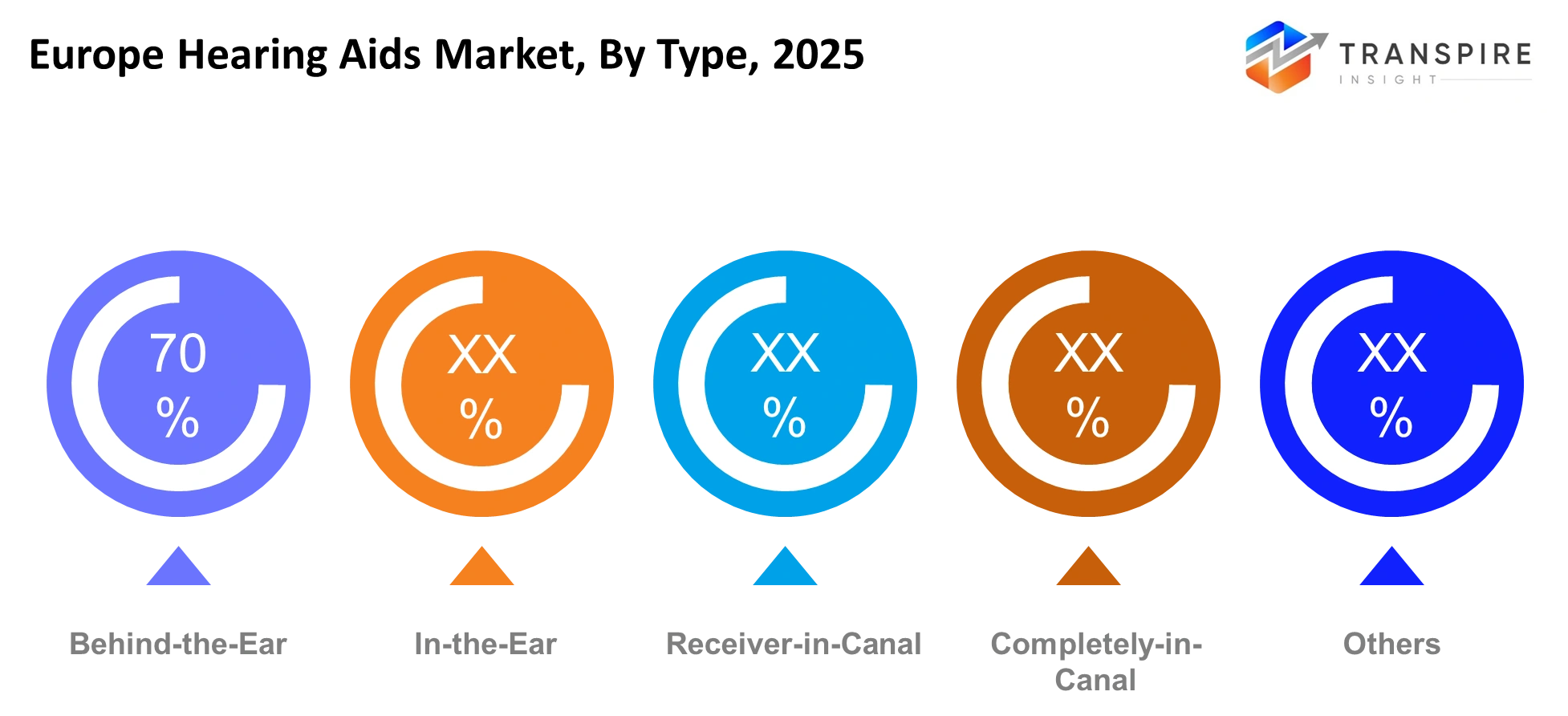
The type segment maintains its main market position because behind-the-ear devices produce excellent results across all three hearing impairment levels. Healthcare providers prefer these models because they enable easier fitting and provide longer battery life and they work with advanced digital processing systems. Receiver-in-canal products have gained substantial traction over the last five years as consumers increasingly prioritize compact designs which enable smartphone connectivity. Users who want discreet solutions continue to choose in-the-ear and completely-in-canal devices because these products meet their needs but maintenance requirements and battery limitations restrict their market reach.
Manufacturers use rechargeable technology and AI-based sound optimization and miniaturized components to create unique product lines. The software integration and remote tuning functions together with personalized hearing solutions will become the main competitive elements in this market segment. The premiumization trend will increase average selling prices while generating higher profit margins for manufacturers and creating difficulties for suppliers of low-cost analog devices.
To learn more about this report, Download Free Sample Report
By Application
Hearing aids continue to function as the main non-surgical treatment option for both age-related hearing loss and sensorineural hearing loss. The treatment of hearing loss through its existing diagnostic and digital hearing system solutions in Western European healthcare systems has developed into more effective personalized treatment methods. Tinnitus management applications represent a smaller but expanding category as manufacturers introduce sound therapy functions and AI-assisted acoustic masking features within premium devices. The demand for tinnitus solutions has increased because medical professionals now recognize the existence of chronic auditory stress and its effects on mental health.
The development of temporary hearing support and occupational hearing assistance applications shows slow progress because these solutions receive less reimbursement support and their usage spreads through disorganized implementation methods. The application sectors will achieve market growth through successful clinical proof and software-based treatment advancements and tele-audiology systems that will enhance patient maintenance and recurring income streams for hearing care providers.
By End-User
The need for permanent listening devices stems from hearing loss which affects both adult and elderly people as their primary medical condition.The geriatric segment maintains the strongest revenue contribution because of three factors: higher diagnosis rates, broader reimbursement eligibility, and greater dependence on advanced hearing assistance technologies. Product development strategies now focus on adult users who are not yet eligible for retirement because demand has shifted to discreet Bluetooth-enabled devices that can be used in workplace environments.
European countries show a major difference in pediatric hearing aid use because of how their diagnosis pathways and device fitting processes and reimbursement systems operate. However, early screening initiatives and school-based hearing programs are gradually improving access for younger populations. Companies now create products for specific age groups which include special software settings together with improved speech understanding and remote surveillance functions. The coming years will bring growth to end-user categories as digitally connected hearing ecosystems become popular because they offer hearing assistance together with cognitive wellness tracking and app-based personalization through a unified system.
By Distribution
Retail clinics remain the primary distribution channel because customers need to access professional hearing evaluations and customized fittings and subsequent device modifications before they make their permanent hearing aid selection. Audiology centers maintain a strong market position due to specialized diagnostic expertise and integration with hospital networks, particularly in Germany, France, and Nordic countries. The online distribution market achieved rapid growth after 2020 because urban users started to accept digital consultations and direct-to-consumer hearing tests and remote fitting platforms.
Online channels have gained market share among technology-focused consumers because they offer better pricing information and shopping ease than traditional retail stores. The industry maintains existing clinical channels because customers still doubt fitting precision and post-purchase assistance. The remote areas that lack hearing services now receive new delivery methods which include pharmacy partnerships and mobile hearing care units. Future channel development will likely combine digital commerce with hybrid clinical support models, allowing manufacturers and providers to improve geographic reach while reducing operational costs and patient acquisition expenses.
What are the Key Use Cases Driving the Europe Hearing Aids Market?
The primary use case that drives hearing aid adoption in Europe needs to treat age-related hearing loss. The elderly population displays high demand because they need extended support for speech comprehension during their everyday interactions and medical appointments and social activities. Digital hearing aids become more accessible through public reimbursement programs which exist in Germany and France and the UK.
The demand for workplace hearing assistance and tinnitus management solutions continues to grow among working professionals in urban environments. Office environments now use Bluetooth hearing systems to enable users to communicate through virtual meetings and stream audio from their smartphones. Audiology clinics experience increasing demand for sound therapy devices which enable patients to treat their chronic tinnitus condition.
Cognitive health assessment and AI-powered remote hearing solutions represent new application areas. Hearing device manufacturers develop products which allow users to monitor their listening habits while digital wellness platforms deliver preventive cognitive health solutions. The combination of remote diagnostics and cloud-based hearing adjustments shows excellent potential to benefit people who live in remote areas throughout Eastern and Northern Europe.
|
Report Metrics |
Details |
|
Market size value in 2025 |
USD 3601.8 Billion |
|
Market size value in 2026 |
USD 3832.3 Billion |
|
Revenue forecast in 2033 |
USD 5915.7 Billion |
|
Growth rate |
CAGR of 6.40% from 2026 to 2033 |
|
Base year |
2025 |
|
Historical data |
2021 - 2024 |
|
Forecast period |
2026 - 2033 |
|
Report coverage |
Revenue forecast, competitive landscape, growth factors, and trends |
|
Regional scope |
Europe (Germany, United Kingdom, France, Italy, Spain and Rest of Europe) |
|
Key company profiled |
Sonova, Demant, GN Store Nord, Starkey, Widex, Cochlear, WS Audiology, Amplifon, MED-EL, Rion, Sebotek, Audina, Beltone, Eargo, Zounds Hearing. |
|
Customization scope |
Free report customization (country, regional & segment scope). Avail customized purchase options to meet your exact research needs. |
|
Report Segmentation |
By Type (Behind-the-Ear, In-the-Ear, Receiver-in-Canal, Completely-in-Canal, Others), By Application (Hearing Loss Treatment, Tinnitus Management, Others), By End-User (Adults, Geriatric Population, Pediatrics, Others), By Distribution (Online, Retail Clinics, Audiology Centers, Others). |
Which Regions are Driving the Europe Hearing Aids Market Growth?
The market of Western Europe continues to be the leading regional market because Germany and the UK and France operate their reimbursement systems and audiology treatment facilities at high standards. The public healthcare systems in these nations provide funding for initial hearing tests and professional hearing evaluations and they give partial financial support for high-quality digital hearing devices. The area possesses multiple audiology clinics which connect with hospitals and establish distribution systems that major manufacturers control. Research capabilities exist throughout the region while companies like Sonova and Demant establish themselves as market leaders who drive product development.
Northern Europe serves as the second most important regional market because its growth rate develops in a different manner compared to Western Europe. Countries including Denmark Sweden and Norway depend more on their capacity to implement technology and handle digital health services together with their prevention programs for hearing loss than they do on expanding their reimbursement system. People create a steady need for new hearing solutions because they continue to accept connected medical technologies while healthcare spending remains constant. Regional buyers also show higher adoption of tele-audiology services and AI-enabled hearing aids which lead to predictable revenue streams that continue to exist in areas with less population.
The healthcare modernization programs which help increase access to hearing services have made Eastern Europe the fastest growing region at present. The private healthcare sector along with government agencies has been building diagnostic facilities and retail hearing centers and digital health systems since 2023.
Who are the Key Players in the Europe Hearing Aids Market and How Do They Compete?
The Europe Hearing Aids Market remains moderately consolidated, with a small group of multinational manufacturers controlling a substantial share of premium device sales and audiology networks. The competition now focuses on digital sound processing quality AI-based personalization rechargeable technology and remote hearing care functions instead of using price as the only comparison point. The existing companies use vertically integrated service models which combine device manufacturing, software platforms, hearing clinics, and post-purchase support to protect their market share. Online hearing care providers and direct-to-consumer digital brands are currently disrupting traditional distribution models which use remote fitting methods to deliver affordable products to their younger customers.
Sonova implements complete integration between its hearing aids, cochlear implant technologies, and audiology services which operate through cloud connections to establish its unique market position. The company maintains its strong investment in AI-based speech enhancement and remote diagnostics development to enhance its premium brand presence throughout Germany, France, and the Nordic region. WS Audiology produces hearing devices with advanced Bluetooth technology and operates extensive retail hearing care services throughout Europe to deliver broad product access to consumers. The company increases customer retention and service revenue through its development of hearing clinic networks and digital hearing assessment services.
Demant uses its deep audiology expertise and complete system connection between diagnostic tools and hearing products to create its competitive advantage. The system increases fitting accuracy and establishes enduring business relationships between hearing professionals and their customers.
Company List
- Sonova
- Demant
- GN Store Nord
- Starkey
- Widex
- Cochlear
- WS Audiology
- Amplifon
- MED-EL
- Rion
- Sebotek
- Audina
- Beltone
- Eargo
- Zounds Hearing
Recent Development News
In February 2026, GN expands ReSound hearing aid portfolio with next-gen connectivity: GN introduced new ReSound Savi custom hearing aids and upgraded fitting software (Smart Fit 2.3), enhancing personalization and speech clarity in noise. The launch strengthens GN’s position in Europe’s premium hearing solutions segment through advanced Auracast-enabled connectivity.
Source: https://www.gn.com
In March 2026, GN Store Nord sells hearing division to Amplifon: GN signed a €17 billion agreement to sell its Hearing business to Italy-based Amplifon, creating a vertically integrated European audiology leader. The deal includes cash and shares and is expected to close by end-2026, reshaping competition across Europe’s hearing aid market.
Source: https://www.globenewswire.com
What Strategic Insights Define the Future of the Europe Hearing Aids Market?
The Europe Hearing Aids Market is currently evolving into integrated digital hearing ecosystems which utilize AI sound processing and remote diagnostics and cognitive health monitoring and cloud-based patient management systems. The underlying force driving this transition is the convergence of aging demographics with healthcare digitization policies across Europe. The next five to seven years will determine which businesses gain competitive advantage through their software capabilities and their ability to maintain service models and their patient engagement platforms.
The first risk which needs to be examined involves the rising market concentration which centers around a limited number of multinational companies that control both hearing device production and audiology product distribution. The consolidation will restrict healthcare systems from setting prices freely while they will face increased pressure from European markets which focus on cost control. The dependency on semiconductor supply which especially affects advanced microelectronics designed for AI hearing systems presents a new challenge which has emerged.
The most important opportunity now exists because tele-audiology services are expanding into Eastern European and rural areas of Europe which receive increasing funding for healthcare digitalization. Businesses which choose to fund their hybrid care model development will achieve better market placement and more affordable patient acquisition expenses through their investment in remote fitting and app-based monitoring and their establishment of local clinical partnerships.
Europe Hearing Aids Market Report Segmentation
By Type
- Behind-the-Ear
- In-the-Ear
- Receiver-in-Canal
- Completely-in-Canal
- Others
By Application
- Hearing Loss Treatment
- Tinnitus Management
- Others
By End-User
- Adults
- Geriatric Population
- Pediatrics
- Others
By Distribution
- Online
- Retail Clinics
- Audiology Centers
- Others
Frequently Asked Questions
Find quick answers to common questions.
The approximate Europe Hearing Aids Market size for the market will be USD 5915.7 Billion in 2033.
The key segments of the Europe Hearing Aids Market are By Type (Behind-the-Ear, In-the-Ear, Receiver-in-Canal, Completely-in-Canal, Others), By Application (Hearing Loss Treatment, Tinnitus Management, Others), By End-User (Adults, Geriatric Population, Pediatrics, Others), By Distribution (Online, Retail Clinics, Audiology Centers, Others).
Major players in the Europe Hearing Aids Market are Sonova, Demant, GN Store Nord, Starkey, Widex, Cochlear, WS Audiology, Amplifon, MED-EL, Rion, Sebotek, Audina, Beltone, Eargo, Zounds Hearing.
The current market size of the Europe Hearing Aids Market is USD 3601.8 Billion in 2025.
The Europe Hearing Aids Market CAGR is 6.40%.
- Sonova
- Demant
- GN Store Nord
- Starkey
- Widex
- Cochlear
- WS Audiology
- Amplifon
- MED-EL
- Rion
- Sebotek
- Audina
- Beltone
- Eargo
- Zounds Hearing
Recently Published Reports
-
Apr 2026
AI in Diabetic Retinopathy Market
AI in Diabetic Retinopathy Market Size, Share & Analysis Report By Type (Screening AI Systems, Diagnostic AI Systems, and Predictive AI Models), By Application Segment (Hospitals, Ophthalmology Clinics, Diagnostic Centers, and Research and Development), and Geography (North America, Europe, Asia-Pacific, Middle East and Africa, South and Central America), 2021 - 2031
-
Apr 2026
Psychometric Tests Market
Psychometric Tests Market Size, Share & Analysis Report By Type (Personality Tests, Ability/Aptitude Tests, Skill/Knowledge Tests, and Others), By Application (Talent Acquisition and Talent Management), and Geography (North America, Europe, Asia-Pacific, Middle East and Africa, South and Central America), 2021 – 2031
-
Apr 2026
Rare Biological Sample Collection Market
Rare Biological Sample Collection Market Size, Share & Analysis Report By Type (Isolation Kits & Reagent, Blood Collection Tubes, and Others), By Application (Oncology, Transcriptomics, Pharmacogenomics, and Others), and Geography (North America, Europe, Asia-Pacific, Middle East and Africa, South and Central America), 2021 – 2031
-
Apr 2026
Patient Lift Pendant Market
Patient Lift Pendant Market By Product Type (Wired Pendants, Wireless, Programmable), By Operation Type(Manual, Electric), By End-Users (Healthcare Professionals, Patients), By Application (Hospitals, Homecare, Rehabilitation Centers, Others), By Industry Analysis, Size, Share, Growth, Trends, and Forecasts 2021-2033
Our Clients
.jpg)