
Europe Geospatial Solutions Market Size & Forecast:
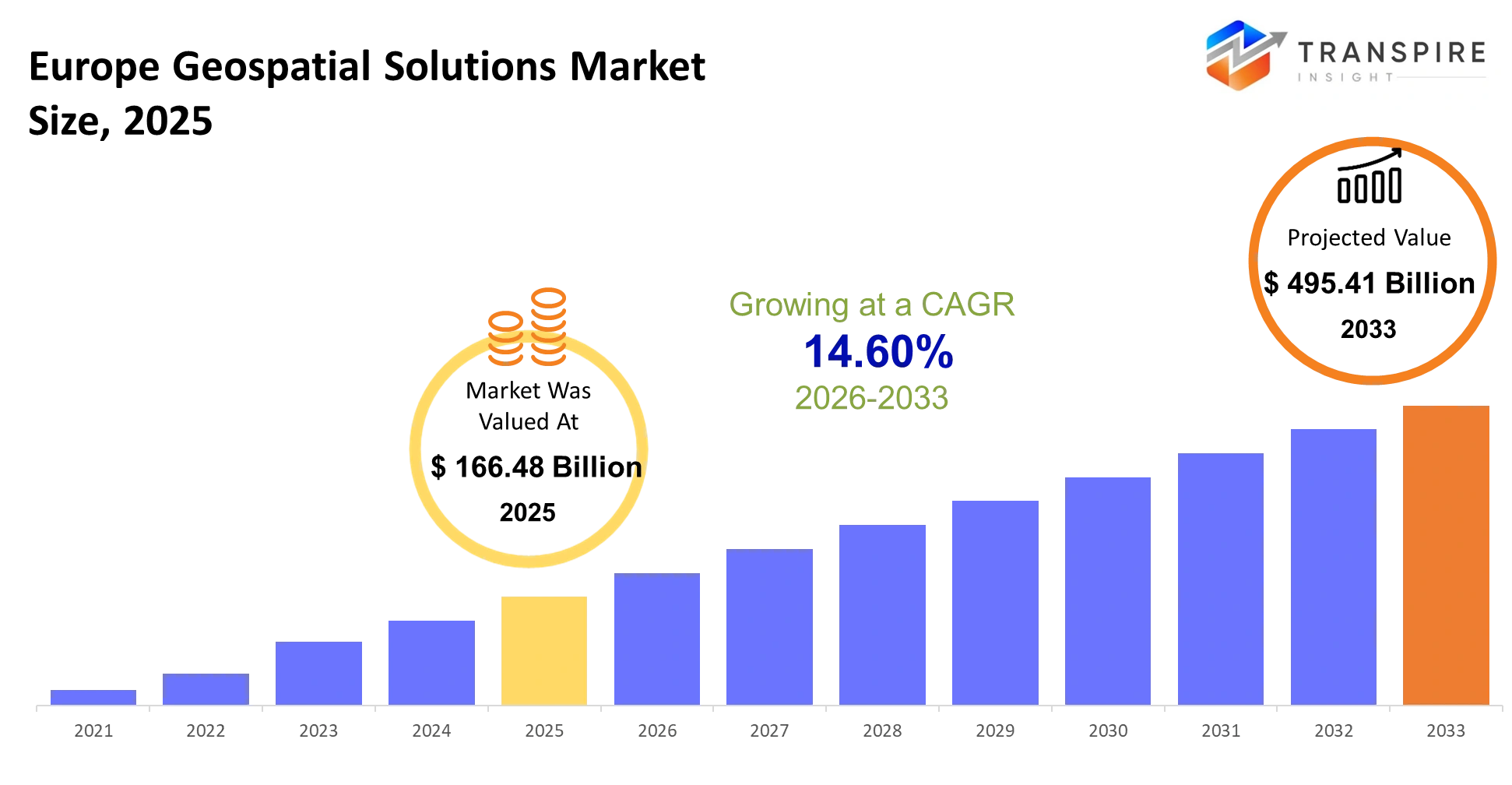
- Europe Geospatial Solutions Market Size 2025: USD 166.48 Billion
- Europe Geospatial Solutions Market Size 2033: USD 495.41 Billion
- Europe Geospatial Solutions Market CAGR: 14.60%
- Europe Geospatial Solutions Market Segments: By Type (GIS, Remote Sensing, GNSS, LiDAR, Mapping Software, Others); By Application (Urban Planning, Agriculture, Defense, Transportation, Utilities, Others); By End-User (Government, Enterprises, Defense, Agriculture, Utilities, Others); By Deployment (Cloud, On-premises, Hybrid, SaaS, Platforms, Others)
To learn more about this report,  Download Free Sample Report
Europe Geospatial Solutions Market Summary:
The Europe Geospatial Solutions Market size is estimated at USD 166.48 Billion in 2025 and is anticipated to reach USD 495.41 Billion by 2033, growing at a CAGR of 14.60% from 2026 to 2033. The europe geospatial solutions market in the context of the overall digital mapping and spatial intelligence industry will be driven by a paradigm shift to a new generation of decision-making environment where decisions are made based on the sensitivity of data. The market will be determined not only by how firms acquire location data but how they interpret such information to achieve greater accuracy in the use of real-time location services like climate observation, logistics tracking, and mobility planning. With growing expectations of hyper-local data from consumers, the competition within the industry will be compelled to improve its proficiency in terms of satellite imaging technology, artificial intelligence-based maps, and geospatial analytics using edge computing technology. The data protection policies formulated by European authorities will play a pivotal role in developing such platforms.
What Has the Impact of Artificial Intelligence Been on the Europe Geospatial Solutions Market?
Artificial intelligence technology has completely transformed the europe geospatial solutions market through innovation in the processing and management of spatial data and information in industries. The role of artificial intelligence in europe geospatial solutions market applications will allow for the speedy acquisition of data from satellites, drones, and IoT devices, revolutionizing market research and analysis capabilities. The machine learning tools will be able to detect hidden trends in spatial data, helping firms analyze the data and draw accurate conclusions while minimizing the need for human interference. Therefore, AI in europe geospatial solutions market environments will enhance decision-making processes by leveraging scalable real-time intelligence.
The introduction of predictive analytics and automation technology is expected to increase the accuracy of forecasts and predictions in the europe geospatial solutions market. Through machine learning models, AI will be able to forecast urban growth, environmental impacts, and infrastructure needs with increased precision. At the same time, production efficiencies have been enhanced by using AI-powered mapping, image analysis, and classification of data in the europe geospatial solutions market environment.
Apart from efficiency, use of artificial intelligence in the europe geospatial solutions market has become instrumental in bringing about innovations as well as competitive advantages among firms. The companies are adopting AI-enabled geospatial systems in order to offer custom-made location-based services, improve their supply chain logistics, and increase accuracy in route planning. This has become aligned with the wider trends within the market such as customization, sustainability, and digitization.
Key Market Trends & Insights:
- Western Europe makes up the largest share in the europe geospatial solutions market at an estimated 45%, as a result of improved infrastructures and stringent regulations for data collection.
- Eastern Europe is anticipated to be the fastest-growing region, registering a compound annual growth rate above 14% till 2030 because of the drive towards digitization.
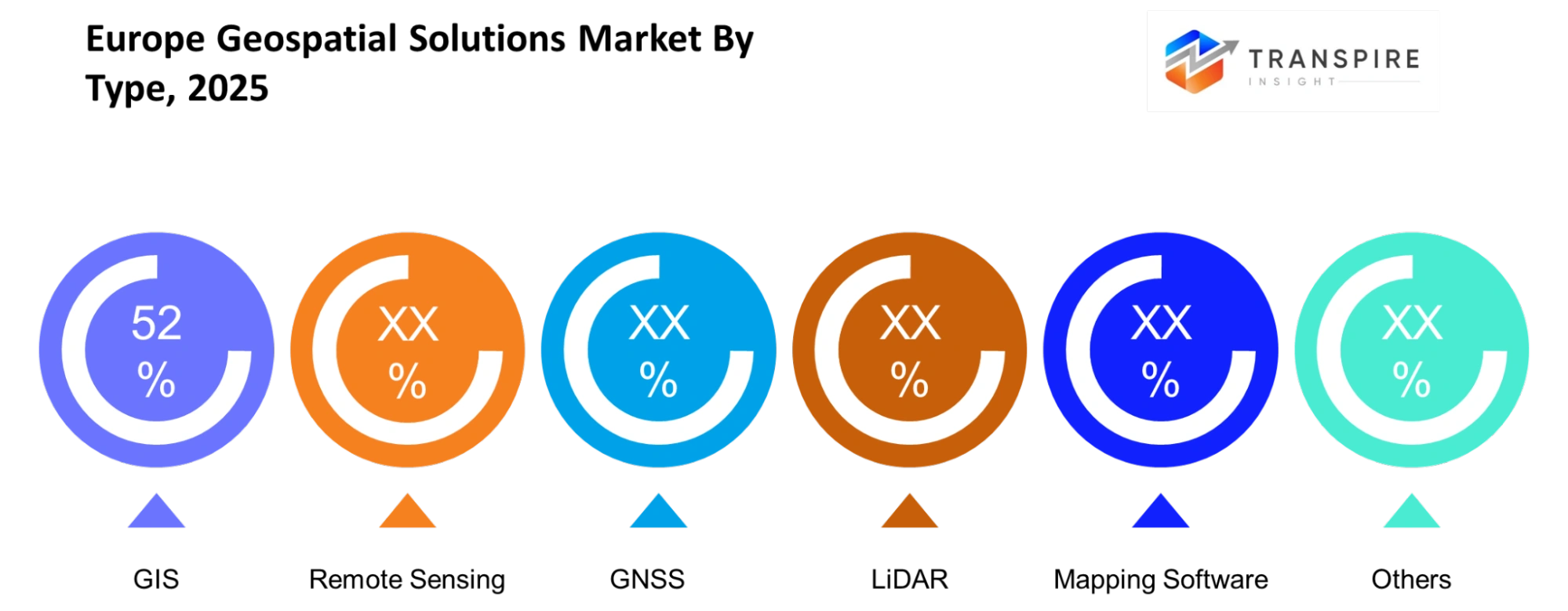
- The GIS software sub-segment is the leading market segment, accounting for about 40% market share as a result of demands for enhanced geographic information system solutions.
- The second most dominating application area in terms of share is remote sensing services, which benefit from satellite imagery solutions.
- Location-based analytics emerges as the fastest growing area with over 15% CAGR growth, aided by artificial intelligence applications in GIS.
- The dominant application areas are urban planning and infrastructure management with around 30% of share because of their wide applicability in smart cities.
- The rapidly growing application areas in europe geospatial solutions market include climate monitoring and disaster management solutions.
- Over 35% share in the europe geospatial solutions market is held by governments/public sectors.
Europe Geospatial Solutions Market Segmentation
By Type
GIS is expected to continue being the primary tool for analyzing and visualizing spatial data. The use of remote sensing will increase as it involves the use of satellite and drone images. It is used to analyze the earth surface, weather changes, and infrastructure development. GNSS will be used as a source of highly accurate location data in various applications. LiDAR will also receive more attention because of its ability to generate 3D maps.
AI-powered mapping software will be one of the tools used by GIS developers. Other solutions include tools for conducting spatial analysis and data management systems for efficient decision making. Organizations will need integrated solutions that combine the different technologies discussed above. This segment will reflect steady advancement through improved accuracy and automation.
To learn more about this report, Download Free Sample Report
By Application
Demand will be generated using urban planning that will be assisted with initiatives of a smart city and infrastructure development. Demand for agricultural produce will be facilitated with precision agriculture that makes use of geospatial technology. The military will make use of spatial intelligence for surveillance and threat analysis among others. used in utilities for purposes such as mapping, asset management, and maintenance planning. Environmental monitoring, as well as disaster management, will involve the use of spatial technology to aid in making decisions that can be beneficial when responding to the problem at hand.
By End-User
Geospatial technologies will definitely be one of the early adopters in the government sphere where geospatial technologies will be used to facilitate the policymaking process, the administration of lands, and public safety awareness campaigns. Businesses will also use geospatial technologies to facilitate more efficient business operations through better targeted marketing. The military will be utilizing geospatial technologies in order to conduct intelligence gathering and planning efforts.
Agricultural sector users will be interested in leveraging their geospatial solutions for the purpose of boosting their productivity. Utilities will employ geospatial solutions to effectively manage their resources and provide uninterrupted services. Other potential end users of the technology will be institutions engaged in academic research or involved in environmental protection efforts.
By Deployment
Cloud deployment will become very popular as it is highly scalable, flexible, and provides remote access possibilities. On-premise solutions will continue being used by those who need strict data management and protection. The hybrid option will integrate both solutions in order to provide optimal performance and data management. The SaaS approach will make geospatial software easier to access without the requirement for complex hardware.
The platform approach will allow integrating different geospatial services within one ecosystem. Other deployment methods may include the creation of customized solutions designed specifically for particular organizations. Cloud deployment will speed up innovation and cooperation processes.
What are the Main Challenges for the Europe Geospatial Solutions Market Growth?
The Europe geospatial solutions market experiences major technical problems and operational difficulties which hinder its ability to expand and maintain stable operations. The process of merging spatial data from satellites and drones and IoT devices results in delays and compatibility problems. Multiple platforms face difficulties in delivering real-time analytics because their systems need excessive computational resources and their current infrastructure cannot support this function. The European geospatial solutions market faces deployment problems which lead to operational inefficiencies that affect users.
The Europe geospatial solutions market must spend substantial resources on product development while meeting strict security regulations and data protection requirements during its commercialization process. European data protection regulations create additional operational challenges for organizations that need to share data between different countries. The requirement to invest heavily in advanced technologies which include AI-based mapping and LiDAR systems creates additional financial challenges for businesses. The barriers to growth impede product introductions while restricting market development for smaller businesses.
Organizations face difficulties with product adoption because digital technologies remain underdeveloped in areas with limited infrastructure and insufficient trained workers. The Europe geospatial solutions market needs trained professionals who can operate complex spatial tools but the existing skills gap prevents effective market adoption. Public sector projects face budget limitations which postpone project-related spending and create additional market constraints.
Moreover, increased rivalry among alternative analytical tools and competitive pricing in the leading companies present future challenges for the industry. Rapid advancements in technology necessitate regular improvements, which is a challenge for cost considerations in the europe geospatial solutions market.
Regional Insights
Western Europe maintains a strong position because it possesses advanced digital infrastructure together with its strict enforcement of data protection regulations. The smart city projects and environmental monitoring initiatives in Germany and France and the United Kingdom will create demand through their combined efforts. The persistent development of all sectors will receive support from organizations that invest heavily in AI-powered mapping and spatial analytics technologies.
Eastern Europe will experience rapid growth because of its enhanced digital transformation efforts and the completion of government-funded infrastructure development initiatives. Poland and Romania will implement geospatial technologies to improve their urban planning systems and agricultural efficiency operations. The rising public understanding of spatial data advantages will lead to increased adoption of spatial data technology in both public and private organizations.
The Nordic countries Sweden Norway and Finland will concentrate their efforts on environmental sustainability and sustainability monitoring activities. The need for climate monitoring together with renewable energy development requires governments to implement geospatial technologies. Organizations can achieve effective data handling through their advanced digital systems which support data combination and analysis processes.
Southern Europe will experience moderate economic development through its tourism management efforts together with its urban development initiatives which Spain and Italy lead. Geospatial solutions will help infrastructure development projects and emergency response operations. The digital transformation projects which government organizations are developing will lead to greater technology adoption.
Recent Development News
In March 2026, Energy Aspects announced an acquisition. The company agreed to acquire Kayrros to strengthen satellite-based geospatial data and advanced analytics capabilities.https://www.energyaspects.com
In April 2026, Rocket Lab completed the acquisition. The company finalized the acquisition of Mynaric to expand satellite communication and geospatial data transmission capabilities in Europe.https://spacewatch.global
|
Report Metrics |
Details |
|
Market size value in 2025 |
USD 166.48 Billion |
|
Market size value in 2026 |
USD 190.79 Billion |
|
Revenue forecast in 2033 |
USD 495.41 Billion |
|
Growth rate |
CAGR of 14.60% from 2026 to 2033 |
|
Base year |
2025 |
|
Historical data |
2021 - 2024 |
|
Forecast period |
2026 - 2033 |
|
Report coverage |
Revenue forecast, competitive landscape, growth factors, and trends |
|
Regional scope |
Europe (Germany, United Kingdom, France, Italy, Spain, Rest of Europe) |
|
Key company profiled |
ESRI, Hexagon, Trimble, HERE Technologies, TomTom, Autodesk, Bentley Systems, SAP, Oracle, Google, Microsoft, Maxar, Planet Labs, Leica Geosystems, Garmin |
|
Customization scope |
Free report customization (country, regional & segment scope). Avail customized purchase options to meet your exact research needs. |
|
Report Segmentation |
By Type (GIS, Remote Sensing, GNSS, LiDAR, Mapping Software, Others); By Application (Urban Planning, Agriculture, Defense, Transportation, Utilities, Others); By End-User (Government, Enterprises, Defense, Agriculture, Utilities, Others); By Deployment (Cloud, On-premises, Hybrid, SaaS, Platforms, Others) |
How Can New Companies Establish a Strong Foothold in the Europe Geospatial Solutions Market?
The newly formed companies can enter the europe geospatial solutions market effectively through targeted marketing in niches, where the demand is growing, but the competition is not yet significant. The use case of geospatial technology will be an effective tool for solving problems related to smart cities, precision agriculture, and climate change tracking. In this way, start-ups will be able to create specific solutions rather than offering general products to their clients. It corresponds with the current trends in the industry, when customers seek customized geospatial solutions to solve their particular issues. Thus, clear positioning of products will enable emerging companies to win in the europe geospatial solutions market.
Technological innovations will also be the key factor for differentiation among competing companies. Innovative approaches include the implementation of machine learning technologies for satellite mapping, real-time analysis, and development of cloud-based geospatial services. For instance, Descartes Labs, a startup founded in New Mexico in 2013, uses innovative methods for processing satellite imagery, which allows predicting the behavior of consumers and improving the efficiency of the delivery of goods in the health care sector.
Strategic alliances would provide even greater advantage in market penetration through access to data ecosystem and customers. Strategic partnerships with government organizations, telecom companies, or infrastructure companies would enhance acceptance and credibility. New players such as Satellogic illustrate the power of strategic partnerships along with satellite-based systems. Through unique market positioning, technology differentiation, and strategic partnerships, new entrants can compete in the europe geospatial solutions market successfully.
Key Europe Geospatial Solutions Market Company Insights
Existing firms like Esri, Hexagon AB, and HERE Technologies will retain their dominant position through innovation of product offerings and geographic footprint worldwide. Continued investments in intelligent mapping and spatial analytics using AI will create leadership positions and facilitate dependable service provision to all industries.
Merger, acquisition, and collaboration activities will characterize strategic initiatives of successful players. Use of AI, machine learning algorithms, and cloud computing services will optimize products. Increased R&D investment is key for constant improvements in data analytics for spatial data processing.
Use of intelligent technologies, including AI-based analytics, LiDAR-based mapping, and live data platforms will determine competitive advantages for businesses. Use of automation and prediction technologies will increase precision and save time during the analysis. Improved user interface platforms will foster wide-scale adoption.
Company List
- ESRI
- Hexagon
- Trimble
- HERE Technologies
- TomTom
- Autodesk
- Bentley Systems
- SAP
- Oracle
- Microsoft
- Maxar
- Planet Labs
- Leica Geosystems
- Garmin
What are the Key Use-Cases Driving the Growth of the Europe Geospatial Solutions Market?
The European geospatial solutions market is expanding through high-impact use-cases in urban planning and smart infrastructure development. City planners and government organizations utilize geospatial analytics for creating traffic systems and utility management, and real-time population density monitoring. The applications deliver essential benefits to contemporary city management because they enhance decision-making precision while minimizing operational inefficiencies. The europe geospatial solutions market will experience higher public sector adoption because smart city investments will rise.
The European geospatial solutions market in transportation and logistics sector develops through route optimization and fleet tracking and last-mile delivery efficiency. Real-time mapping and predictive analytics enable companies to decrease fuel expenses while delivering products more quickly. The use-case directly improves supply chain operations while supporting increasing demand from e-commerce businesses. AI-based system integration will enable these features to expand their reach into multiple business sectors.
The market develops through agriculture and environmental monitoring activities. Precision farming methods employ satellite imagery and spatial data for tracking crop health and improving irrigation systems and managing land resources. Climate monitoring solutions enable organizations to evaluate the risks associated with floods and wildfires and pollution. The applications enable companies to achieve sustainability targets while driving continuous market growth.
The healthcare and enterprise sectors appear to be significant factors in the adoption process. The use of geospatial technology in disease surveillance, resource distribution, and emergency management planning enhances the effectiveness of public health initiatives. Enterprises have begun using geospatial information technology for customer profiling and facility location, generating fresh sources of income.
Europe Geospatial Solutions Market Report Segmentation
By Type
- GIS
- Remote Sensing
- GNSS
- LiDAR
- Mapping Software
- Others
By Application
- Urban Planning
- Agriculture
- Defense
- Transportation
- Utilities
- Others
By End-User
- Government
- Enterprises
- Defense
- Agriculture
- Utilities
- Others
By Deployment
- Cloud
- On-premises
- Hybrid
- SaaS
- Platforms
- Others
Frequently Asked Questions
Find quick answers to common questions.
The approximate Europe Geospatial Solutions Market size for the market will be USD 495.41 Billion in 2033.
Key segments for the Europe Geospatial Solutions Market are By Type (GIS, Remote Sensing, GNSS, LiDAR, Mapping Software, Others); By Application (Urban Planning, Agriculture, Defense, Transportation, Utilities, Others); By End-User (Government, Enterprises, Defense, Agriculture, Utilities, Others); By Deployment (Cloud, On-premises, Hybrid, SaaS, Platforms, Others).
Major Europe Geospatial Solutions Market players are ESRI, Hexagon, Trimble, HERE Technologies, TomTom, Autodesk, Bentley Systems, SAP, Oracle, Google, Microsoft, Maxar, Planet Labs, Leica Geosystems, Garmin.
The Europe Geospatial Solutions Market size is USD 166.48 Billion in 2025.
The Europe Geospatial Solutions Market CAGR is 14.60%.
- ESRI
- Hexagon
- Trimble
- HERE Technologies
- TomTom
- Autodesk
- Bentley Systems
- SAP
- Oracle
- Microsoft
- Maxar
- Planet Labs
- Leica Geosystems
- Garmin
Recently Published Reports
-
Apr 2026
3D Optical Profiler Market
3D Optical Profiler Market Size, Share & Analysis Report By Type (Desktop 3D Optical Profiler, and Portable 3D Optical Profiler), By Technology (Confocal Technology, and White Light Interference), By End-Use Industry (Manufacturing, Research Institutions, Automotive, Aerospace and Defense, Medical Devices, and Other), and Geography (North America, Europe, Asia-Pacific, Middle East and Africa, South and Central America), 2021 - 2031
-
Feb 2025
Depth Sensor Market
Depth Sensor Market Size, Share & Analysis Report By Type (Infrared Depth Sensors, Time-of-Flight (ToF) Sensors, Stereo Vision Sensors, Structured Light Sensors, Ultrasonic Depth Sensors), By Application (Automotive, Robotics, Gaming, Consumer Electronics, Industrial Automation, Healthcare, Security & Surveillance, Others), By End Users (Automotive Manufacturers, Consumer Electronics Companies, Healthcare Providers, Industrial Companies, Security Agencies, Gaming Companies, Robotics Companies, Others), and Geography (North America, Europe, Asia-Pacific, Middle East and Africa, South and Central America), 2021 – 2031
-
Feb 2025
Digital Manufacturing Market
Digital Manufacturing Market Size, Share & Analysis Report By Component (Hardware, Software, and Services), By Technology (Robotics, 3D Printing, Internet of Things (IoT), and Others), By Application (Automotive and Transportation, Aerospace and Defense, Consumer Electronics, Industrial Machinery, and Others), By Process Type (Computer-Based Designing, Computer-Based Simulation, Computer 3D Visualization, Analytics, and Others), and Geography (North America, Europe, Asia-Pacific, Middle East and Africa, South and Central America), 2021 – 2031
-
Feb 2025
Digital Visa Services Market
Digital Visa Services Market Size, Share & Analysis Report By Type (Individual Travelers, Group Travelers), By Application (Tourism, Business Travel, Others), and Geography (North America, Europe, Asia-Pacific, Middle East and Africa, South and Central America), 2021 – 2031