

Europe Food Texturants Market Size & Forecast:
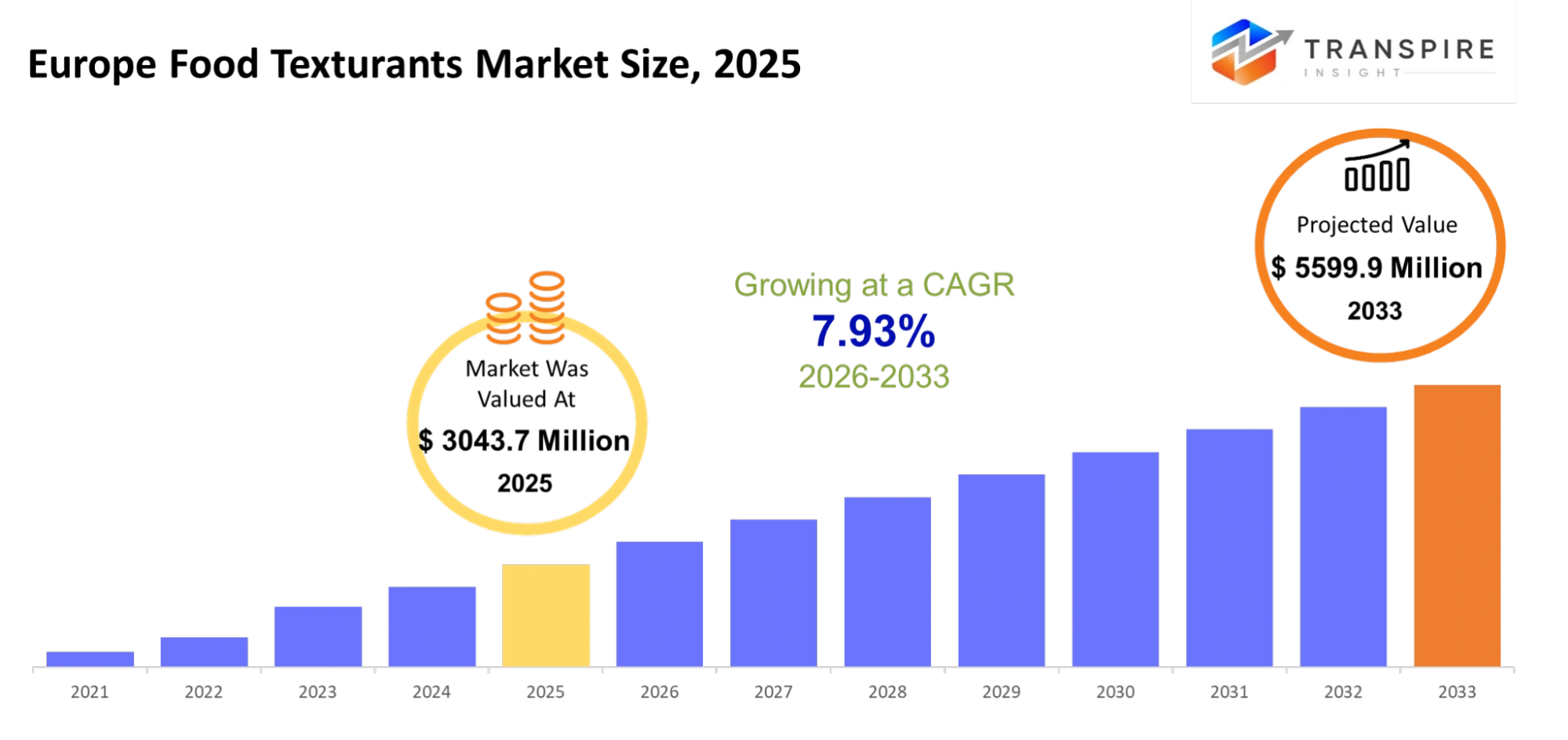
- Europe Food Texturants Market Size 2025: USD 3043.7 Million
- Europe Food Texturants Market Size 2033: USD 5599.9 Million
- Europe Food Texturants Market CAGR: 7.93%
- Europe Food Texturants Market Segments: By Type (Hydrocolloids, Emulsifiers, Starches), By Application (Bakery, Dairy, Confectionery, Beverages), By End-User (Food & Beverage Industry)
To learn more about this report,  Download Free Sample Report
Europe Food Texturants Market Summary:
Europe Food Texturants Market size was estimated at USD 3043.7 Millionin 2025 and is anticipated to reach USD 5599.9 Million by 2033, growing at a CAGR of 7.93% from 2026 to 2033.
The European food texturants market within the food ingredients sector will operate as an unassuming market segment that determines how products appear and the way they behave on dining plates. The market will develop through changing consumer preferences that demand products with transparent labeling and common ingredient elements which will require manufacturers to develop new methods for stabilizer and thickener production. People who buy products will demand textures which simulate the texture of homemade products yet packaged products will lead to minor texture adjustments in bakery products and dairy products and plant-based products.
Producers will achieve better texture control through new processing methods which require fewer chemical alterations while regulatory bodies will impose stricter rules about additive disclosure and source verification. The market will promote plant-based gums together with plant-based fibers and starch mixtures which support environmental sustainability objectives. Texture remains an essential product characteristic for convenience foods which affects customer buying behavior beyond their taste preferences
Key Market Trends & Insights:
- The Europe Food Texturants Market demonstrates consistent progress toward adopting clean label products because consumers show a strong preference for products that contain only basic natural ingredients. Food producers will replace synthetic additives with plant-based texturants such as pectin, starch, and agar. Transparent product labeling will create consumer trust which affects their purchasing choices in bakery and dairy and processed food markets.
- The European Food Texturants Market benefits from increasing plant-based dietary habits and vegan product adoption throughout its key markets. Texture plays a key role in meat substitutes and dairy-free products, where hydrocolloids and proteins help achieve desired mouthfeel. The continuous introduction of new products within this category will create ongoing demand for texturants that offer both novel features and functional capabilities.
- The European Food Texturants Market advances through better processing methods, which enhance both processing and product development procedures. Advanced blending and stabilization technologies will enhance consistency, shelf life, and sensory appeal. Manufacturers will invest in research to create multifunctional texturants that perform under varying temperature and pH conditions across diverse food applications.
- The European Food Texturants Market expands because people increasingly lead active lives and demand more convenient eating options. Texturants maintain stability while creating thickness and visual effects in processed food products, sauces, and frozen food items. The expansion of urban centers together with changing consumer dining preferences will create ongoing demand for products that preserve their quality during distribution and storage.
- The European Food Texturants Market functions through regulatory systems which maintain safety and quality standards. Authorities require manufacturers to use only approved ingredients and to implement proper labeling procedures. The manufacturers will develop their products according to regional regulations while they keep product performance standards which will allow them to create new food products through approved methods.
Europe Food Texturants Market Segmentation
By Type :
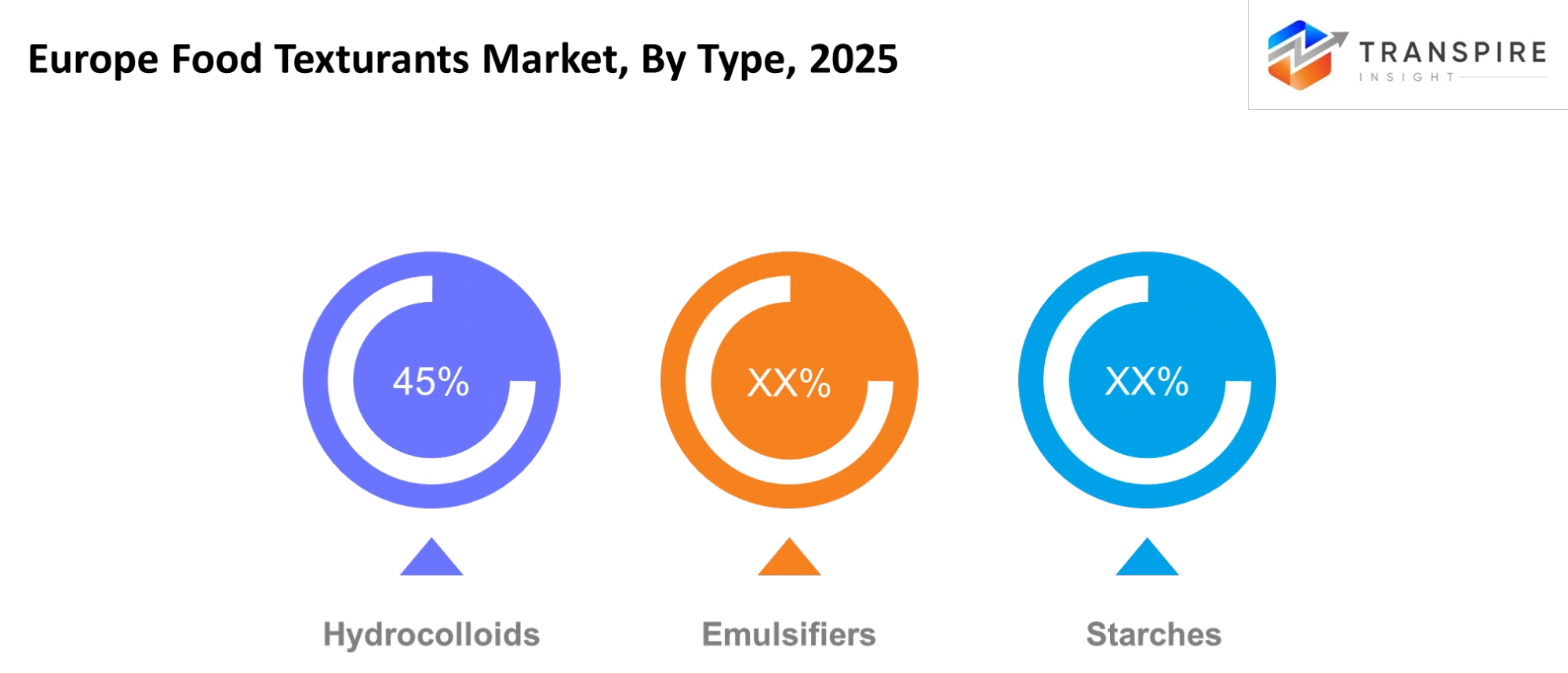
- Hydrocolloids: Hydrocolloids function as essential components of the Europe Food Texturants Market because they provide food products with essential thickness control and mixture stabilization and mouthfeel enhancement. The combination of pectin and gelatin and agar creates products which maintain their texture while increasing their shelf stability. Demand will increase because consumers prefer products with clean label ingredients.
- Emulsifiers: Emulsifiers enable the combination of ingredients which would otherwise remain separate because they create an essential component for the production of processed foods. Emulsifiers enhance the texture and stability and visual appeal of food products in the Europe Food Texturants Market. The increasing demand for packaged foods will create consistent requirements for various product types.
- Starches: Starches serve multiple functions in food products because they improve texture and create binding effects and prevent moisture loss. The Europe Food Texturants Market uses both native and modified starches as common ingredients in sauces and soups and ready meals. The growing demand for convenience food will drive increased utilization of starch-based solutions for product development purposes.
To learn more about this report, Download Free Sample Report
By Application :
- Bakery: The Europe Food Texturants Market exhibits strong demand from bakery applications because texturants enable baked goods to achieve better softness and greater volume and extended shelf life. The dough stability and consistency of products require both emulsifiers and hydrocolloids as essential components. The growing trend of fresh food consumption by customers will lead to increased sales of packaged bakery products that maintain fresh food quality.
- Dairy: Dairy products use texturants to create smooth and creamy textures while maintaining product stability. The Europe Food Texturants Market uses these ingredients in yogurt and cheese and dessert products to maintain product integrity and achieve desired mouthfeel. The increasing popularity of plant-based dairy alternatives will drive up the need for efficient texturizing solutions.
- Confectionery: Confectionery products depend on texturants to achieve desired chewiness, firmness, and structure. The Europe Food Texturants Market benefits from growing demand for candies, gummies, and chocolates with consistent texture and extended shelf life. Manufacturers will continue using specialized ingredients to meet changing taste preferences and product innovation.
- Beverages: The beverage industry uses texturants in its products to improve both suspension abilities and viscosity and the complete drinking experience. The Europe Food Texturants Market supplies essential components for smoothies and flavored drinks and functional beverages. The rising consumer preference for health-focused beverages will drive the demand for natural texturizing agents that provide effective results.
By End-User :
- Food & Beverage Industry: The food and beverage industry remains the primary end user in the Europe Food Texturants Market, driven by the need for consistent product quality and improved sensory appeal. Manufacturers will use texturants to fulfill consumer needs and extend product shelf life and develop new products for both traditional and modern food categories.
Country Insights
- The Germany Europe Food Texturants Market experiences persistent demand because of its strong processed food industry and high manufacturing capabilities. Food manufacturers use stabilizers and emulsifiers to maintain product texture and shelf life. Product development now follows clean label requirements, which drive continuous product consumption in bakery and dairy markets. The United Kingdom Europe Food Texturants Market shows increasing demand for both convenience foods and plant-based foods. The ready meal and dairy substitute markets show growing demand for ingredients that enhance texture. The combination of clear regulations and new food science advancements enables product development, while consumers drive the adoption of natural and functional texturants.
- The France Europe Food Texturants Market derives its advantages from the country's traditional culinary practices and contemporary food production methods. The need for high-quality products with appealing sensory features drives the demand for natural thickeners and gelling agents. The bakery, confectionery, and dairy sectors show stable product needs, while manufacturers choose ingredients based on clean label trends and organic product demands.
- The Italian Food Texturants Market in Europe exhibits its development through the strong market demand for traditional artisanal food products. The essential role of texture in pasta and sauces and dairy products results in higher usage of stabilizers and hydrocolloids. Food producers balance authenticity with modern processing needs, supporting gradual growth in ingredient adoption across packaged food categories.The European Food Texturants Market in Spain demonstrates growth because of increasing demand for processed foods and the development of export-based manufacturing facilities. The bakery industry and meat processing sector and ready meal production need cost-effective ingredients that provide efficient performance. The food industry uses different texturizing agents because of two factors which include product development innovations and the increasing need for product quality assurance.
Recent Development News
EU tightens rules on texturants in infant and medical foods (2026)
- The European Commission introduced Regulations (EU) 2026/189 and 2026/196, significantly tightening the use of texturants such as guar gum, locust bean gum, pectin, and modified starch in infant and medical nutrition products. Some uses—like guar gum in infant formula—are being phased out entirely due to safety concerns.
Reduction in maximum levels of hydrocolloids
- New EU rules reduce allowable levels of common texturants including locust bean gum and pectins, especially in foods for young children. This signals a broader regulatory shift toward limiting exposure to stabilizers in sensitive populations.
|
Report Metrics |
Details |
|
Market size value in 2025 |
USD 3043.7 Million |
|
Market size value in 2026 |
USD 3283.4 Million |
|
Revenue forecast in 2033 |
USD 5599.9 Million |
|
Growth rate |
CAGR of 7.93% from 2026 to 2033 |
|
Base year |
2025 |
|
Historical data |
2021 - 2024 |
|
Forecast period |
2026 - 2033 |
|
Report coverage |
Revenue forecast, competitive landscape, growth factors, and trends |
|
Country scope |
Europe (Germany, United Kingdom, France, Italy, Spain, Rest of Europe) |
|
Key company profiled |
Cargill Incorporated, Archer Daniels Midland Company, Kerry Group plc, Ingredion Incorporated, Tate & Lyle plc, DuPont de Nemours Inc., DSM-Firmenich, CP Kelco U.S. Inc., Ashland Global Holdings Inc., BASF SE, Roquette Frères, Givaudan SA, Sensient Technologies Corporation, Nexira SAS, Palsgaard A/S. |
|
Customization scope |
Free report customization (country, regional & segment scope). Avail customized purchase options to meet your exact research needs. |
|
Report Segmentation |
By Type (Hydrocolloids, Emulsifiers, Starches), By Application (Bakery, Dairy, Confectionery, Beverages), By End-User (Food & Beverage Industry) |
Key Europe Food Texturants Company Insights
- The Europe Food Texturants Market experiences constant growth because food producers establish texture and stability and eating quality as their main focus points. The bakery and dairy and confectionery and processed food segments show increasing demand because their products require consistent structure and mouthfeel to gain consumer acceptance. Clean label preference encourages the use of natural texturants such as pectin and starch and gelatin alternatives. The regulatory standards which exist in European countries direct companies to choose safer ingredients which have complete documentation. Plant-based formulations display innovation because they require specific texture development to match traditional product standards. Manufacturers conduct research to create functional products which do not change taste while reaching optimal performance in multiple uses.
- The Europe Food Texturants Company Insights show how global and regional companies create a competitive environment which depends on their product quality and technical capabilities. Major companies strengthen market position through product innovation, partnerships, and expansion of production capacity within Europe. The company aims to create multifunctional texturants which extend product shelf life while preserving product texture. Regional players provide specialized solutions which match local food customs and comply with local food regulations. Companies achieve sustainable growth through research facility development and sustainable sourcing while maintaining customer focus to solve food manufacturers' specific formulation issues across various industry sectors.
Europe Food Texturants Market Companies:
- Cargill Incorporated
- Archer Daniels Midland Company
- Kerry Group plc
- Ingredion Incorporated
- Tate & Lyle plc
- DuPont de Nemours Inc.
- DSM-Firmenich
- CP Kelco U.S. Inc.
- Ashland Global Holdings Inc.
- BASF SE
- Roquette Frères
- Givaudan SA
- Sensient Technologies Corporation
- Nexira SAS
- Palsgaard A/S
Europe Food Texturants Market Segmentation
By Type
- Hydrocolloids
- Emulsifiers
- Starches
By Application
- Bakery
- Dairy
- Confectionery
- Beverages
By End-User
- Food & Beverage Industry
Frequently Asked Questions
Find quick answers to common questions.
The Approximate Europe Food Texturants Market size for the Market will be USD 5599.9 Million in 2033.
Key Segments for the Europe Food Texturants Market are By Type (Hydrocolloids, Emulsifiers, Starches), By Application (Bakery, Dairy, Confectionery, Beverages), By End-User (Food & Beverage Industry).
Major Europe Food Texturants Market Players are Cargill Incorporated, Archer Daniels Midland Company, Kerry Group plc, Ingredion Incorporated, Tate & Lyle plc, DuPont de Nemours Inc., DSM-Firmenich, CP Kelco U.S. Inc., Ashland Global Holdings Inc., BASF SE, Roquette Frères, Givaudan SA, Sensient Technologies Corporation, Nexira SAS, Palsgaard A/S.
The Current Europe Food Texturants Market size is USD 3043.7 Million in 2025.
The Europe Food Texturants Market CAGR is 7.93%.
- Cargill Incorporated
- Archer Daniels Midland Company
- Kerry Group plc
- Ingredion Incorporated
- Tate & Lyle plc
- DuPont de Nemours Inc.
- DSM-Firmenich
- CP Kelco U.S. Inc.
- Ashland Global Holdings Inc.
- BASF SE
- Roquette Frères
- Givaudan SA
- Sensient Technologies Corporation
- Nexira SAS
- Palsgaard A/S
Recently Published Reports
-
Apr 2026
Baby Infant Formula Market
Baby Infant Formula Market Size, Share & Analysis Report By ype (Infant Milk, Follow On Milk, Specialty Baby Milk, Growing-Up Milk), By Ingredient (Carbohydrate, Fat, Protein, Minerals, Vitamins, and Others), By Product Form (Powder, Liquid, and Ready-to-feed), By Distribution Channels (Supermarket/Hypermarket, Specialty Store, Pharmacies, Online Retail, and Others), and Geography (North America, Europe, Asia-Pacific, Middle East and Africa, South and Central America), 2021 - 2031
-
Apr 2026
Edible Insects for Animal Feed Market
Edible Insects for Animal Feed Market Size, Share & Analysis Report By Type (Insect Powder, Insect Meal, Insect Bar, Insect Paste, Insect Oil, and Others), By Insect Type (Beetles, Cricket, Caterpillar, Hymenoptera, Orthoptera, Tree Bugs, and Others), By Application (Livestock, Pet Food, and Aquaculture), By Livestock Type (Poultry, Swine, and Others), and Geography (North America, Europe, Asia-Pacific, Middle East and Africa, South and Central America), 2021 - 2031
-
Apr 2026
Food Industry Disinfection and Bacterial Control Market
Food Industry Disinfection and Bacterial Control Market Size, Share & Analysis Report By Type (Chemical Disinfectants, Physical Disinfectants, and Biocides and Antimicrobials), By Application (Food Processing Equipment Surface Disinfection, Food Preparation Areas Surface Disinfection, Storage Areas Surface Disinfection, Anti-microbial Coatings Food Preservation, and Preservative Solutions Food Preservation), By End User (Meat and Poultry Processing, Dairy Processing, Seafood Processing, Bakery and Confectionery, Restaurants and Commercial Kitchens, and Food Service Providers), By Sales Channel (Online, Offline), and Geography (North America, Europe, Asia-Pacific, Middle East and Africa, South and Central America), 2021 - 2031
-
Apr 2026
Freeze Dried Food Market
Freeze Dried Food Market Size, Share & Analysis Report By Product Type (Fruits, Vegetables, Freeze-Dried Dairy Products, Freeze-Dried Meat and Seafood, Freeze-Dried Pet Food, and Prepared Meal), By Nature (Organic, and Conventional), By Form (Powdered, Granules, and Diced), By End Use (Breakfast Cereals, Dairy Products, Bakery & Confectionery, Nutritional Bars & Supplements, Powdered Beverages, Snacks, and Retail (Household)), and Geography (North America, Europe, Asia-Pacific, Middle East and Africa, South and Central America), 2021 - 2031