
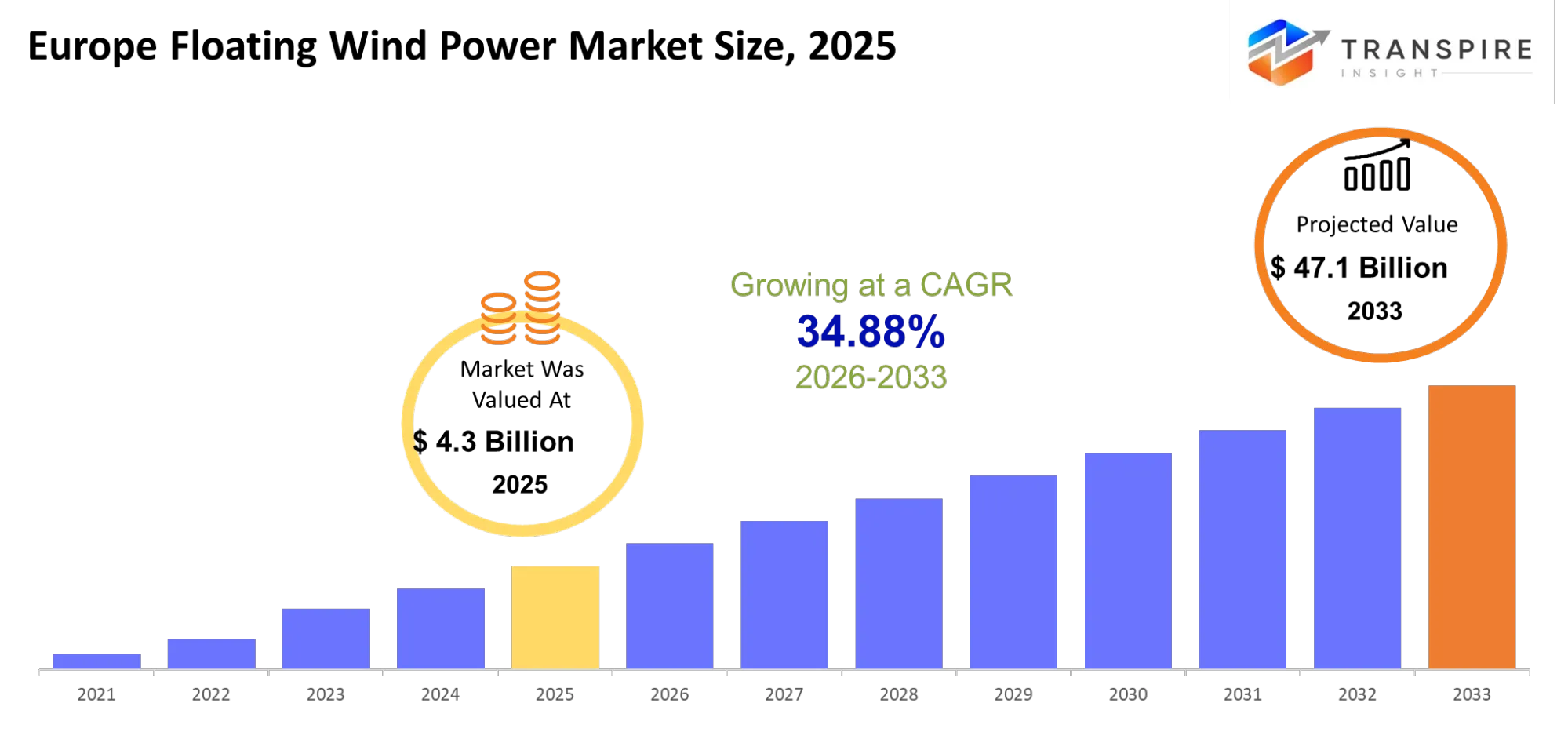
Europe Floating Wind Power Market Size & Forecast:
- Europe Floating Wind Power Market Size 2025: USD 4.3 Billion
- Europe Floating Wind Power Market Size 2033: USD 47.1 Billion
- Europe Floating Wind Power Market CAGR: 34.88%
- Europe Floating Wind Power Market Segments: By Type (Spar-buoy, Semi-submersible, Tension Leg Platform, Others); By Application (Utility-scale Power Generation, Offshore Wind Farms, Hybrid Energy Systems, Others); By End-User (Energy Companies, Governments, Utilities, Industrial Firms, Investors, Others); By Capacity (Below 5 MW, 5–10 MW, Above 10 MW, Others)
To learn more about this report,  Download Free Sample Report
Europe Floating Wind Power Market Summary:
The Europe Floating Wind Power Market size is estimated at USD 4.3 Billion in 2025 and is anticipated to reach USD 47.1 Billion by 2033, growing at a CAGR of 34.88% from 2026 to 2033.
The European floating wind power market will develop through offshore energy and marine engineering because countries with coastal territories will prioritize their energy security needs. The industry will transition from using fixed-bottom turbines to developing wind farms in deeper ocean waters which offer superior wind resources and reduced competition. The developers will implement modular platforms together with digital monitoring and hybrid grid connections to handle their operational variability needs. The consumers will demand environmentally friendly electricity that does not disturb coastal areas, which will compel developers to build their facilities at greater distances from shorelines. The regulators will establish stricter permitting requirements, but they will provide financial incentives to organizations that want to protect biodiversity while achieving their decarbonization targets. The supply chains will move to local markets while ports will upgrade their facilities to accommodate bigger floating structures and their unique maintenance schedules.
What Has the Impact of Artificial Intelligence Been on the Europe Floating Wind Power Market?
Artificial intelligence is changing the operations of all stakeholders within the European floating wind power market which now enables more precise decision-making and long-term strategic planning. The European floating wind power market operations of companies use AI technology to create market research and data analysis solutions that provide instant access to environmental and operational data. The machine learning models will use wind patterns together with ocean conditions and turbine performance data to deliver superior results compared to traditional methods which will enable developers to conduct site evaluations and investment risk assessments. The industry has developed new strategic approaches that create capital investment certainty for organizations working in this field.
Artificial intelligence in europe floating wind power market applications is also enhancing demand forecasting and market trends analysis. Predictive analytics will enable energy providers to forecast electricity demand changes which will help them optimize their energy generation output. The operational process of smart automation technology enables floating structures to be monitored independently which leads to improved production efficiency because it allows for early detection of faults that result in reduced downtime and lower maintenance expenses. AI-based supply chain optimization systems handle logistics operations which start from component sourcing and continue until installation scheduling to decrease project delays and total project costs.
The European floating wind power market experiences increased competition which drives its participants to use AI technology for product innovation and competitive advantage. Advanced analytics will support tailored energy solutions which will enable energy providers to match their power production with the needs of different regions while complying with current regulatory requirements. Systems that integrate intelligent systems will improve performance while providing organizations with a new performance level.
Key Market Trends & Insights:
- The floating wind power market in Europe faces its highest market competition from Northern Europe, which will reach a 60% market share in 2025 through its two main countries, the UK and Norway.
- Southern Europe will experience its strongest growth between 2026 and 2032, with a compound annual growth rate that will exceed 22%.
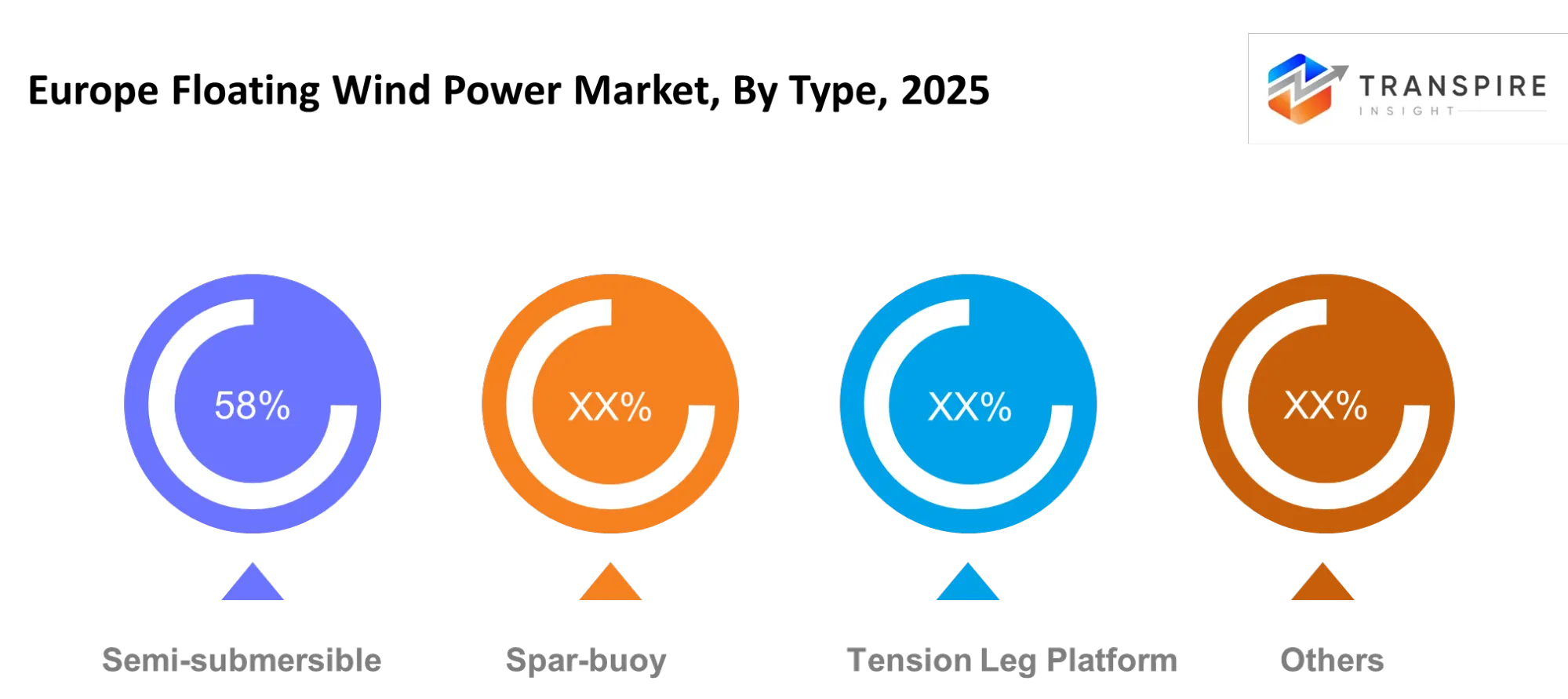
- Semi-submersible platforms hold the leading position in the market with their 45% market share, which results from their ability to maintain stable operations while expanding their capacity to operate in deep-water locations.
- The second largest share of the market belongs to spar-type floating structures because their successful deployment has been demonstrated in extreme ocean conditions.
- The tension-leg platforms represent the most rapidly expanding market sector because their adoption increases through better technology and lower operational costs, which will become effective by 2030.
- Utility-scale power generation dominates applications, contributing over 70% of total demand due to large-scale offshore projects.
- Hydrogen production emerges as a new application which experiences rapid expansion because European countries develop renewable integration methods.
- Energy utilities lead the market with approximately 65% share, driven by large investments and long-term power purchase agreements.
- The industrial sector represents the most rapidly expanding market segment because manufacturing and heavy industries show increasing need for clean energy.
- The operational efficiency of companies and their competitive position receive improvements from technology advancements, which include AI-based monitoring systems and predictive maintenance tools.
Europe Floating Wind Power Market Segmentation
By Type:
Spar-buoy systems require deep drafts and strong stability for operation at extreme ocean conditions. The installation process of semi-submersible designs will show better results because they provide both flexible operation and simplified installation procedures. Tension leg platforms will use anchored systems for reduced motion, while other emerging concepts will explore cost and deployment improvements.
To learn more about this report, Download Free Sample Report
By Application:
Utility-scale power generation will dominate because it requires large projects which need to connect to the power grid. Offshore wind farms will expand as clustered installations grow. Hybrid energy systems will combine wind with storage or hydrogen production, while other applications will test new commercial and research-driven uses.
By End-User:
Energy companies will lead development through technical expertise and capital strength. Governments will drive policy and funding support. The distribution system will be under the control of utilities while industrial companies will search for renewable energy solutions. Investors will provide financial backing, and other participants will explore niche opportunities.
By Capacity:
The initial testing and early implementation stages will use projects which have less than 5 MW capacity. The 5–10 MW range will balance efficiency and cost for mid-scale projects. Above 10 MW turbines will drive large-scale output and efficiency gains, while other capacities will address specialized or experimental project needs.
What are the Main Challenges for the Europe Floating Wind Power Market Growth?
The europe floating wind power market struggles with major technical and operational issues that hinder its ability to achieve large-scale installation. Deep water floating turbines maintain stability problems because extreme weather conditions create difficulties for their long-term operation and their maintenance cycles. The project timeline extends because the installation process requires complex activities such as anchoring and grid connection. The supply chain restrictions for specialized components like mooring systems and floating substructures create bottlenecks which prevent different regions from expanding their operations.
The european floating wind power market faces strong growth obstacles because manufacturing and commercialization barriers exist. Floating platforms require advanced engineering and high-cost materials and specialized shipyard infrastructure for their production which remains rare in most locations. The regulatory approval process together with environmental compliance requirements causes project delays which result in increased costs. The market constraints create obstacles for new market entrants while established companies must decrease their expenses and speed up their product introduction process.
The europe floating wind power market faces adoption challenges which particularly affect areas without offshore infrastructure. Port facilities often lack the capacity to handle large floating structures, and there is a shortage of skilled labor for installation and maintenance. The requirement for high upfront investment together with funding gaps prevents project expansion in developing coastal markets.
Pricing and innovation face increased pressure from competition between fixed-bottom offshore wind and other renewable energy technologies. The combination of developing regulations and unpredictable policy support creates added risks which complicate long-term investment choices.
Regional Insights
The Europe Floating Wind Power Market keeps growing at coastal locations because of existing policies and available resources and developed facilities. The different regions will experience different results because of their investment patterns and ability to access power lines and their knowledge of offshore operations. The market will develop through its established northern sites and new southern regions which will develop in different ways and add capacity at different times.
Northern Europe will lead due to strong offshore experience, established supply chains, and consistent policy backing, especially across the United Kingdom and Norway. The Southern European markets of Spain Portugal and Italy will experience rapid expansion because of their increasing investments and their favorable wind conditions and their developing port infrastructure for floating installations.
Western Europe will progress at a steady pace because France and its neighboring countries introduce both pilot and commercial-scale operations. The Baltic Sea areas will draw interest because of their shallow-to-deep water transitions while Eastern Europe will remain at its initial phase which focuses on regulatory compliance and feasibility studies and gradual development of offshore renewable energy.
Recent Development News
In April 2026, Siemens Gamesa reported earnings growth. The company narrowed quarterly losses and improved margins, signaling progress toward its 2026 break-even target amid offshore wind expansion. https://renewablesnow.com
In January 2026, Equinor faced a project setback. The company’s 750 MW floating offshore wind project failed to secure a government support contract, highlighting regulatory and funding risks in large-scale floating wind developments. https://www.windtech-international.com
|
Report Metrics |
Details |
|
Market size value in 2025 |
USD 4.3 Billion |
|
Market size value in 2026 |
USD 5.8 Billion |
|
Revenue forecast in 2033 |
USD 47.1 Billion |
|
Growth rate |
CAGR of 34.88% from 2026 to 2033 |
|
Base year |
2025 |
|
Historical data |
2021 - 2024 |
|
Forecast period |
2026 - 2033 |
|
Report coverage |
Revenue forecast, competitive landscape, growth factors, and trends |
|
Regional scope |
Europe (Germany, United Kingdom, France, Italy, Spain, Rest of Europe) |
|
Key company profiled |
Equinor, Siemens Gamesa, Vestas, GE Renewable Energy, Principle Power, Iberdrola, Ørsted, Shell, TotalEnergies, RWE, EDF Renewables, MingYang, Hitachi Energy, ABB, Enel Green Power |
|
Customization scope |
Free report customization (country, regional & segment scope). Avail customized purchase options to meet your exact research needs. |
|
Report Segmentation |
By Type (Spar-buoy, Semi-submersible, Tension Leg Platform, Others); By Application (Utility-scale Power Generation, Offshore Wind Farms, Hybrid Energy Systems, Others); By End-User (Energy Companies, Governments, Utilities, Industrial Firms, Investors, Others); By Capacity (Below 5 MW, 5–10 MW, Above 10 MW, Others) |
How Can New Companies Establish a Strong Foothold in the Europe Floating Wind Power Market?
New entrants aiming to build a presence in the europe floating wind power market require a focused and unique business approach which needs to differ from established market players. The company can fulfill project requirements by targeting advanced mooring systems and digital monitoring platforms and hybrid energy integration as its specific market segments. The europe floating wind power market develops through strong market growth which enables specialized solutions to deliver operational improvements and cost reductions and increased deep-water turbine stability.
The europe floating wind power market needs innovation to achieve market growth. The market will recognize companies that develop lightweight materials and modular floating designs and AI-powered predictive maintenance systems as their unique competitive advantages. Principle Power shows how platform design innovations attract major partnerships, while Hexicon develops multi-turbine floating systems that boost site energy production. The innovation strategies which drive our research efforts will support cost optimization through their scalable industry applications.
New companies entering the europe floating wind power market must establish strategic partnerships to succeed. The company will achieve its goals through partnerships between existing energy companies and shipyards and technology developers. The combination of joint ventures and government partnerships with research organizations enables organizations to achieve project deployment and secure funding and regulatory approvals.
The company needs to resolve supply chain delays and high installation costs and limited offshore infrastructure problems to create successful market positioning. The European floating wind power market will benefit from companies that provide integrated solutions which combine engineering and data analytics and lifecycle services.
Key Europe Floating Wind Power Market Company Insights
The Europe Floating Wind Power Market will experience ongoing growth through its competitive landscape and its strategic planning and its continuous funding of offshore energy projects. To achieve their long-term goals market participants will dedicate resources toward enhancing operational efficiency and decreasing expenses and developing additional project opportunities. The competitive environment will be shaped by three elements which include new developments and business partnerships and the growth of different market regions.
Siemens Gamesa and Vestas and Equinor and Shell will enhance their market positions through the development of major projects and the implementation of their advanced turbine technologies. The organization will achieve improved operational results through its ongoing funding of research and engineering activities and its collaborations with local suppliers who will help expedite offshore installation processes and maintain budget control.
The upcoming companies together with technology development organizations will develop particular solutions which include floating platform architecture and digital tracking systems and maintenance workflows. The organization will establish funding sources through its partnerships with government entities and energy companies while its expansion into Southern Europe will enable business development. A business will gain its competitive edge through its ability to develop new solutions which can be implemented at scale while maintaining efficient project execution.
Company List
- Equinor
- Siemens Gamesa
- Vestas
- GE Renewable Energy
- Principle Power
- Iberdrola
- Ørsted
- Shell
- TotalEnergies
- RWE
- EDF Renewables
- MingYang
- Hitachi Energy
- ABB
- Enel Green Power
What are the Key Use-Cases Driving the Growth of the Europe Floating Wind Power Market?
The european floating wind power market experiences growth because utility-scale electricity generation requires deep-water wind resources which provide reliable and abundant renewable energy output. The projects enable countries to decrease their fossil fuel usage while achieving their environmental objectives. The application of this technology in European floating wind power projects enables offshore facilities to achieve higher capacity rates which assist with dependable electricity distribution.
The European floating wind power market develops through offshore wind farms which use floating turbines in areas where traditional fixed-bottom systems cannot operate. Floating structures enable construction in deeper ocean regions which experience higher wind speeds. The current approach enables energy producers to improve their operational efficiency while customers receive greater value through increased energy production.
The European floating wind power market sees hybrid energy systems emerging as a developing technology. The combination of floating wind turbines with hydrogen production systems and energy storage technologies establishes new industrial business models which depend on constant access to clean power. These systems will enable manufacturing and heavy industrial sectors to reduce carbon emissions while they gain wider acceptance in the market.
Floating wind systems enable remote coastal communities and island regions to gain better energy access while decreasing their need for imported fuels. The practical application of this use-case enables local power generation which creates potential for widespread deployment, leading to further market expansion across Europe.
Europe Floating Wind Power Market Report Segmentation
By Type
- Spar-buoy
- Semi-submersible
- Tension Leg Platform
- Others
By Application
- Utility-scale Power Generation
- Offshore Wind Farms
- Hybrid Energy Systems
- Others
By End-User
- Energy Companies
- Governments
- Utilities
- Industrial Firms
- Investors
- Others
By Capacity
- Below 5 MW
- 5–10 MW
- Above 10 MW, Others)
Frequently Asked Questions
Find quick answers to common questions.
The approximate Europe Floating Wind Power Market size for the market will be USD 47.1 Billion in 2033.
Key segments for the Europe Floating Wind Power Market are By Type (Spar-buoy, Semi-submersible, Tension Leg Platform, Others); By Application (Utility-scale Power Generation, Offshore Wind Farms, Hybrid Energy Systems, Others); By End-User (Energy Companies, Governments, Utilities, Industrial Firms, Investors, Others); By Capacity (Below 5 MW, 5–10 MW, Above 10 MW, Others).
Major Europe Floating Wind Power Market players are Equinor, Siemens Gamesa, Vestas, GE Renewable Energy, Principle Power, Iberdrola, Ørsted, Shell, TotalEnergies, RWE, EDF Renewables, MingYang, Hitachi Energy, ABB, Enel Green Power.
The Europe Floating Wind Power Market size is USD 4.3 Billion in 2025.
The Europe Floating Wind Power Market CAGR is 34.88%.
- Equinor
- Siemens Gamesa
- Vestas
- GE Renewable Energy
- Principle Power
- Iberdrola
- Ørsted
- Shell
- TotalEnergies
- RWE
- EDF Renewables
- MingYang
- Hitachi Energy
- ABB
- Enel Green Power
Recently Published Reports
-
Apr 2026
Active Power Filter Market
Active Power Filter Market Size, Share & Analysis Report By Type (Shunt Active Power Filters, Series Active Power Filter, Hybrid Active Power Filter), By Application (Harmonics Mitigation, Reactive Power Compensation, Voltage Regulation, Power Factor Correction), By Phase (Single Phase, Three Phase), By End-User Industry (Manufacturing, Healthcare, Commercial, Automotive, Oil and Gas, Others), and Geography (North America, Europe, Asia-Pacific, Middle East and Africa, South and Central America), 2021 - 2031
-
Apr 2026
Electrical Transformer Market
Electrical Transformer Market Size, Share & Analysis Report By Core (Closed, Shell, and Berry), By Insulation (Gas, Oil, Solid, Air, and Other), By Phase (Single, and Three), By Rating (100 MVA to 500 MVA, 501 MVA to 800 MVA, and 801 MVA to 1200 MVA), and Geography (North America, Europe, Asia-Pacific, Middle East and Africa, South and Central America), 2021 – 2031
-
Apr 2026
Hydraulic Piston Pumps Market
Hydraulic Piston Pumps Market Size, Share & Analysis Report By Type (Axial Piston Pumps, Radial Piston Pumps), By Operating Pressure (Low Pressure, Medium Pressure, High Pressure), By Application (Construction, Mining, Agriculture, Automotive, Oil & Gas, Industrial Machinery, Others), By End-User (OEMs, Aftermarket), and Geography (North America, Europe, Asia-Pacific, Middle East and Africa, South and Central America), 2021 – 2031
-
Apr 2026
Laboratory Gas Generators Market
Laboratory Gas Generators Market Size, Share & Analysis Report By Product (Nitrogen Gas Generator, Hydrogen Gas Generator, Zero Air Gas Generator, Purge Gas Generator, TOC Gas Generators, Others), By Application (Gas Chromatography, Liquid Chromatography-mass Spectrometry (LC-MS), Gas Analyzers, Others), By End-user (Life Science, Chemical & Petrochemical, Food & Beverage, Others), and Geography (North America, Europe, Asia-Pacific, Middle East and Africa, South and Central America), 2021 – 2031