
Europe EV Platform Market Size & Forecast:
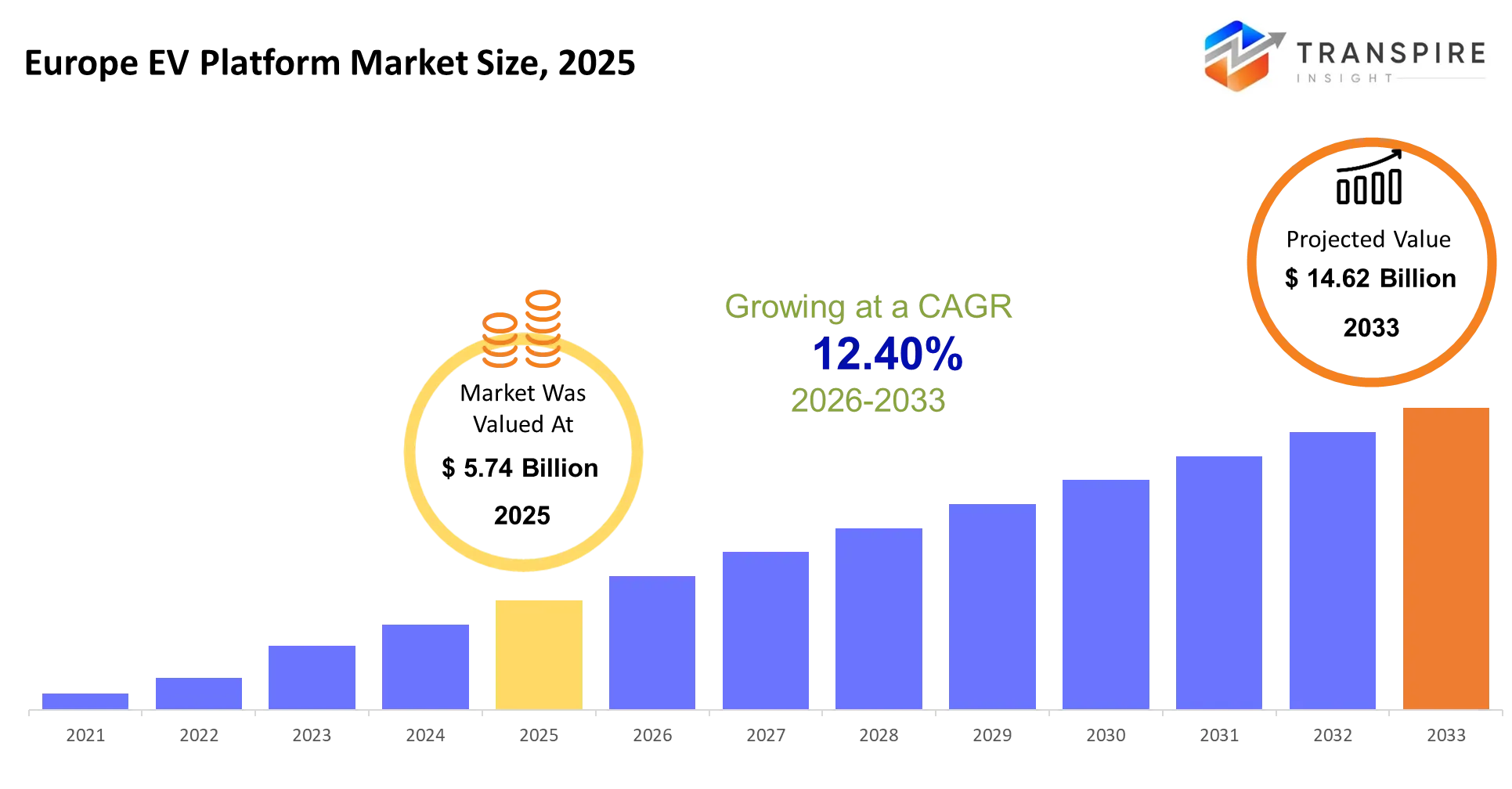
- Europe EV Platform Market Size 2025: USD 5.74 Billion
- Europe EV Platform Market Size 2033: USD 14.62 Billion
- Europe EV Platform Market CAGR: 12.40%
- Europe EV Platform Market Segments: By Type (Skateboard Platform, Modular Platform, Others), By Application (Passenger EVs, Commercial EVs, Others), By End-User (Automotive OEMs, Fleet Operators, Others), By Component (Battery, Motor, Software, Others).
To learn more about this report,  Download Free Sample Report
Europe EV Platform Market Summary:
The Europe EV Platform Market size is estimated at USD 5.74 Billion in 2025 and is anticipated to reach USD 14.62 Billion by 2033, growing at a CAGR of 12.40% from 2026 to 2033. The Europe EV platform market enables the development of standardized electric vehicle architectures that integrate battery systems, drivetrains, and software into a unified base for multiple vehicle models. The system enables automotive manufacturers and transportation companies to establish shorter product development timelines which lead to easier manufacturing processes and better management of electric vehicle production across their passenger and commercial vehicle lineups.
The market has undergone a fundamental transformation during the last three to five years because automotive manufacturers have abandoned traditional combustion engine chassis systems in favor of modular electric vehicle platforms which use centralized electronic components and battery-first engineering methods. Framework requirements under the Fit for 55 regulations led to European Union CO2 emission standards becoming stricter which caused original equipment manufacturers to speed up their transition to electric vehicles. The manufacturing industry experienced a shift in its production methods because of the 2022 energy crisis and supply chain problems which originated from geopolitical conflicts. The current platform standardization process enables organizations to control expenses while meeting regulatory requirements and achieving faster product availability than their rivals do.
Key Market Insights
- The European electric vehicle platform market is currently developing unified skateboard designs which combine battery systems and drivetrain components and software systems to create expandable electric vehicle platforms.
- The European electric vehicle platform market is primarily controlled by Germany which will hold almost 30 to 35 percent market share in 2025 because of its strong original equipment manufacturer base and its extensive production capabilities.
- The Nordic countries will become the fastest expanding area between 2026 and 2032 because they have achieved high electric vehicle adoption and they implement strict zero-emission transportation initiatives.
- France and the United Kingdom experience consistent growth because public charging infrastructure investments and fleet electrification programs continue to increase.
- Skateboard electric vehicle platforms dominate the European electric vehicle platform market with approximately 45 percent market share because they provide designers with extensive design options and they maintain cost-effective operations.
- The modular electric vehicle systems control approximately 30 percent market share which enables manufacturers to build multiple vehicle types including passenger cars and light commercial vehicles.
- The software-defined electric vehicle systems represent the most rapidly expanding market segment which combines artificial intelligence vehicle control with over-the-air software updates.
- The passenger electric vehicle market segment controls almost 70 percent of the European electric vehicle platform market because consumers increasingly switch to electric vehicles.
- The commercial electric vehicle platforms experience their most rapid development because logistics companies start to adopt electric-powered solutions for delivery operations and urban transportation services.
- Automotive original equipment manufacturers hold approximately 65 percent market share because they use platform standardization to decrease research and development expenses while they speed up product development processes.
- Fleet operators and mobility service providers represent the most rapidly expanding customer base because of the growing demand for electric delivery operations and shared transportation services.
What are the Key Drivers, Restraints, and Opportunities in the Europe EV Platform Market?
The European Union's strict CO2 emission standards together with its plans to ban internal combustion engine vehicles have created a regulatory environment that drives demand for the European Electric Vehicle Platform Market. The new policy has compelled automobile manufacturers to develop their product lines using electric vehicle platforms because they need dedicated platforms for electric vehicles instead of using their existing system models. Vehicle manufacturers now develop their electric vehicles based on modular electric vehicle platforms because these platforms help them decrease production expenses while they develop new vehicles. The platform has gained greater market acceptance because revenue growth now depends on companies' capacity to produce different electric vehicle models from one platform base which they use for both passenger vehicles and commercial vehicles.
The Europe EV Platform Market experiences limitations because of the high initial investment needs which companies require to develop their platforms through re-engineering and create their local battery manufacturing facilities. The barrier to entry for this particular item exists at a structural level because it requires companies to spend multi-billion-euro amounts on gigafactories and software ecosystems and supplier realignment efforts which will take an extended period to recover their costs. The electrification process for smaller OEMs and Tier-2 manufacturers will take more time which will prevent them from accessing the market during the next few months and stop them from generating revenue even when policies support their business activities.
Software-defined electric vehicle platforms present a new business possibility through their capacity to deliver remote software updates and predictive maintenance solutions and energy management systems based on artificial intelligence. The Volkswagen Group makes substantial financial commitments towards developing their SSP (Scalable Systems Platform) which serves as a foundation for creating cross-brand vehicles through their scalable architecture. The Central and Eastern European region has evolved into an essential manufacturing center because its lower production expenses and European Union-sponsored environmental sustainability movement have created new opportunities for platform implementation while driving the region's next development stage.
What Has the Impact of Artificial Intelligence Been on the Europe EV Platform Market?
The combination of artificial intelligence with advanced digital technologies creates new operational methods for scrubber performance systems and all other emission control systems which rely on exhaust gas removal. Modern marine emission control systems use AI control platforms to track SOx and NOx emissions while they automatically adjust scrubber settings based on real-time fuel sulfur content and engine power usage. The system maintains consistent compliance with IMO 2020 regulations because it requires minimal operator control in European shipping routes which experience heavy traffic.
Predictive maintenance now uses machine learning models to examine vibration patterns and corrosion rates and sensor abnormalities because these models can predict when components will break down. The technology helps shipping operators decrease unexpected equipment failures while extending equipment durability, which results in a 10–20% reduction of maintenance costs and better system uptime performance according to industry deployments.
Digital twin simulations help maritime operations achieve better fuel efficiency by 3 to 7 percent through their use of simulation systems which model various operational conditions to analyze fleet emissions. The system faces a major obstacle because it cannot obtain high-quality real-time maritime data consistently. The presence of connectivity gaps in offshore areas together with sensor calibration problems in extreme sea weather prevents model accuracy, which hinders the complete implementation of AI systems that European fleet operators currently support.
Key Market Trends
- European OEMs abandoned their traditional internal combustion engine systems which they had used since 2020 to create electric vehicle designs based on dedicated platforms such as MEB and STLA.
- The 2023 EU Fit for 55 regulations required automakers to create new vehicle lineups which would meet their zero-emission vehicle needs through platform electrification.
- The geopolitical changes after 2022 created new conditions for battery supply chains which led Volkswagen and Stellantis to make large financial commitments toward building European gigafactories.
- The growth of software-defined EV platforms since 2021 developed through Tesla's OTA updates together with its main vehicle computing system.
- The period between 2019 and 2025 saw European EV production costs decrease because of declining lithium-ion battery prices which enabled better platform scalability.
- The 2024 introduction of BMW Neue Klasse and Stellantis STLA platforms created new competition through their ability to support multiple electric vehicle brands through modular design.
- European logistics fleets started to use electric vehicle systems for their last-mile delivery operations because of urban emission rules which began to take effect in 2023.
- The 2024-2025 period saw Chinese electric vehicle companies establish operations in Europe which forced local manufacturers to speed up their product development processes.
- The 2021 semiconductor shortages caused temporary delays in electric vehicle platform development because they exposed weaknesses in supply chains which remained until the market stabilized in 2023.
Europe EV Platform Market Segmentation
By Type
The Europe EV Platform Market is primarily dominated by skateboard platforms because their flat design enables the construction of expandable base systems which combine battery packs and drivetrains and structural chassis components. Modular platforms follow closely because OEMs demand flexible systems which allow them to build different vehicle models with various sizes and designs.
Manufacturers are discontinuing legacy platforms which require combustion-based design rules to be used because they are moving away from older design methods. The cost efficiency and faster assembly times and software-defined vehicle system compatibility of skateboard systems drive their growth. Modular designs enable large OEM groups with multiple brands to operate their different brands across multiple markets. The segment is moving toward full standardization of EV architectures which will produce higher manufacturing output while shortening the development time for new vehicle models throughout the European automotive industry.
By Application
Passenger electric vehicles which make up the largest share of the Europe electric vehicle platform market. The market exists because consumers prefer the vehicles and charging infrastructure keeps expanding and cities create regulations which restrict urban emissions. The fastest expanding market segment for commercial electric vehicles involves light-duty delivery fleets because logistics companies start using electric vehicles for their last-mile delivery operations.
Niche utility vehicles represent one of the other application areas which maintains limited use but shows growth through its development in particular industrial applications. Incentives and decreasing battery costs drive passenger electric vehicle growth while fleet cost savings and low-emission zone restrictions drive commercial vehicle adoption in major European cities. The segment will develop into new demand patterns which centers on fleet operations because commercial applications will use platforms more frequently.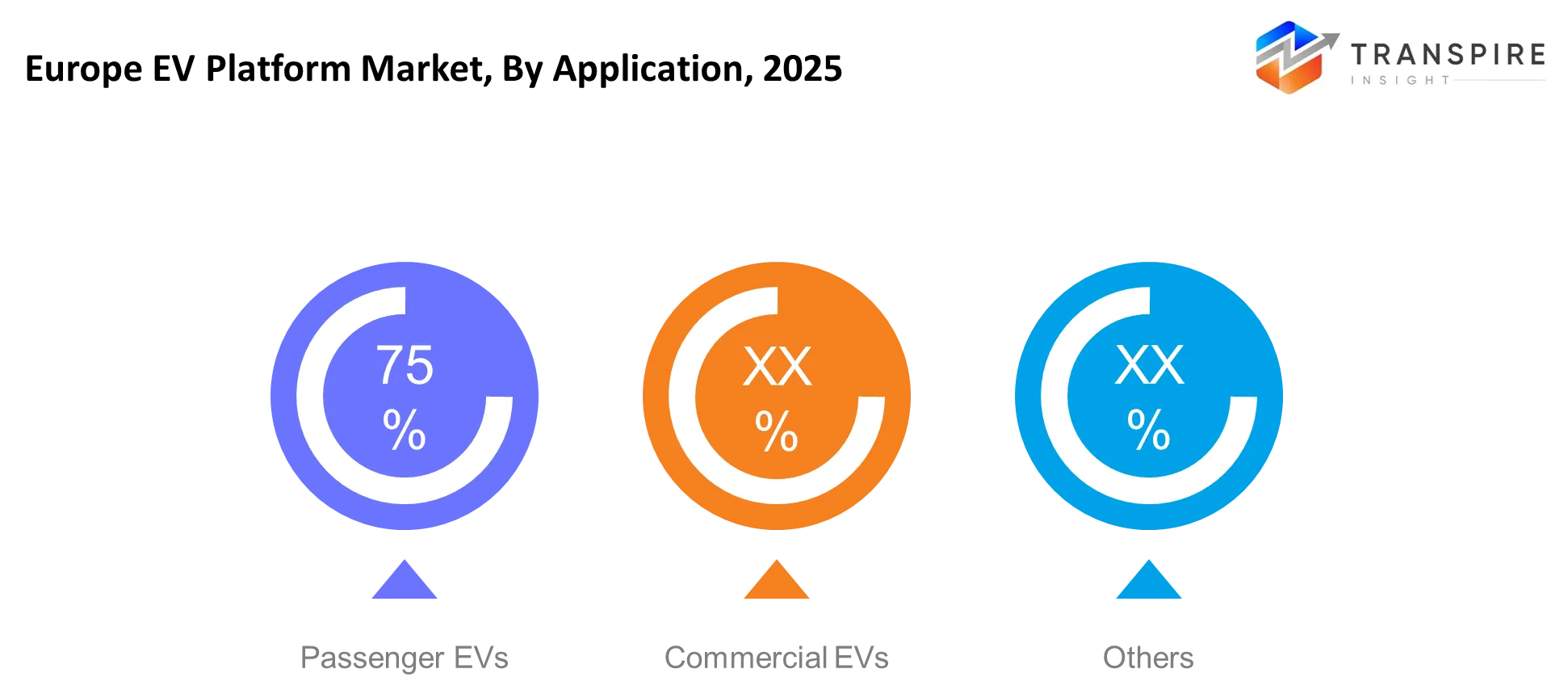
To learn more about this report, Download Free Sample Report
By End-User
The Europe EV Platform Market shows its largest share to automotive OEMs because End-Users control platform development and they own manufacturing facilities and their supply chains work together. Companies in logistics and ride-hailing and delivery services are becoming an increasingly important market segment because they need to electrify their operations to comply with regulations and decrease their expenses.
Government fleets and niche mobility providers form a smaller market segment which holds strategic value for pilot deployments. OEMs maintain their market power by continuously funding their exclusive electric vehicle systems and their strategies for controlling all business operations. Fleet operators are requesting platforms which provide both low maintenance requirements and fixed operating expenses across their entire lifespan. The segment has entered a new phase in which OEMs and mobility service providers work together to create their platform systems.
By Component
The Europe EV Platform Market awards its primary market share to battery systems which exist as the most expensive element that determines the driving distance and operational capabilities of electric vehicles. The second largest component segment of electric vehicles consists of electric motors which benefit from improved efficiency and compact drivetrain systems. The component category of software experiences its fastest growth because vehicles are adopting software-defined systems which use over-the-air updates and centralized control systems. Thermal management systems and structural materials function as essential components that enhance performance but they do not create significant value to the overall system.
The driving force behind battery demand exists because energy density improvements and gigafactory construction activities spread throughout Europe. The growth of software development accelerates because vehicle manufacturers need to establish more vehicle connections and advanced automation systems. The segment is moving toward higher software and battery integration which creates new design requirements for platform development that manufacturers and investors need to follow.
What are the Key Use Cases Driving the Europe EV Platform Market?
European Union electric vehicle platforms market development depends mostly on passenger electric transportation because car manufacturers want to build platforms which support large-scale production of electric vehicles. The strongest demand exists because these platforms enable manufacturers to launch new vehicle models at a rapid pace while they fulfill EU emission requirements and achieve affordable production costs for various vehicle models.
The logistics and ride-hailing and urban delivery services sectors drive commercial fleet electrification adoption as its principal new use case. Fleet operators adopt standardized EV platforms to lower total cost of ownership, meet low-emission zone restrictions, and improve operational predictability in dense European cities.
Shared autonomous mobility and electric light commercial off-road vehicles create new applications for existence within ports and industrial zones. The current use cases represent their initial development stage, but they proceed to gain strength because digital vehicle platforms now support autonomous driving software while governments implement zero-emission requirements for logistics infrastructure.
|
Report Metrics |
Details |
|
Market size value in 2025 |
USD 5.74 Billion |
|
Market size value in 2026 |
USD 6.45 Billion |
|
Revenue forecast in 2033 |
USD 14.62 Billion |
|
Growth rate |
CAGR of 12.40% from 2026 to 2033 |
|
Base year |
2025 |
|
Historical data |
2021 - 2024 |
|
Forecast period |
2026 - 2033 |
|
Report coverage |
Revenue forecast, competitive landscape, growth factors, and trends |
|
Regional scope |
Europe (Germany, United Kingdom, France, Italy, Spain and Rest of Europe) |
|
Key company profiled |
Tesla, Volkswagen, BMW, Mercedes-Benz, Hyundai, BYD, Rivian, NIO, Stellantis, Ford, GM, Lucid, Geely, SAIC, Magna |
|
Customization scope |
Free report customization (country, regional & segment scope). Avail customized purchase options to meet your exact research needs. |
|
Report Segmentation |
By Type (Skateboard Platform, Modular Platform, Others), By Application (Passenger EVs, Commercial EVs, Others), By End-User (Automotive OEMs, Fleet Operators, Others), By Component (Battery, Motor, Software, Others) |
Which Regions are Driving the Europe EV Platform Market Growth?
The European electric vehicle platform market shows its highest development in Germany because the country hosts numerous luxury automotive manufacturers which operate within a unified engineering framework. European Union emission regulations require strict compliance which forces companies like Volkswagen and BMW to develop dedicated electric vehicle platforms through extensive research and development efforts. The country maintains multiple research and development centers together with complete supplier networks and production facilities that enable manufacturers to develop new products at an accelerated pace. Germany functions as the main center for electric vehicle platform development because its system enables businesses to fund their modular system development work.
The second main regional contributor comes from France and the United Kingdom because these nations maintain steady industrial policies while they keep funding programs to electrify their transportation systems. These markets depend more on government-supported fleet updates and international original equipment manufacturer partnerships than Germany which uses its manufacturing base for economic growth. The French automotive industry receives government assistance for its transition initiatives while the United Kingdom benefits from its substantial financial support for electric vehicle startup companies and battery supply chain initiatives. The system establishes constant growth patterns because it develops various paths which will lead to electric vehicle platform adoption in the future.
Eastern Europe emerges as the most rapidly developing area because foreign direct investment increases in affordable manufacturing centers throughout Poland and Hungary and the Czech Republic. EU-funded green industrial expansion programs US-based automotive manufacturers to establish platform assembly and battery integration facilities at locations that are more convenient within this area. The production industry has experienced faster movement of operations since 2023 because organizations are taking advantage of decreased labor expenses and better transport facilities.This growth signals strong opportunities for new entrants and suppliers seeking cost-efficient manufacturing bases within the Europe EV Platform Market over 2026–2033.
Who are the Key Players in the Europe EV Platform Market and How Do They Compete?
The Europe EV Platform Market demonstrates a unified competitive environment which European automotive manufacturers control through their established brands while new software companies enter the market to introduce innovative design methods. The competition focuses on three elements which include EV architecture efficiency and battery integration and software-defined vehicle capabilities rather than vehicle sales. Companies that exist in the market today protect their market share by transitioning from their traditional combustion engines to electric platforms which enable them to produce models at lower expenses and higher production rates. Companies now need to maintain their market edge through two critical elements which include their ability to control battery supply chains and their possession of exclusive vehicle operational systems.
Tesla implements its software-centric approach by creating a system that connects its vehicle operating system with its exclusive battery and drivetrain technologies which allows for rapid software updates and extensive model compatibility. Volkswagen Group achieves its growth objectives through MEB and SSP platforms which enable cost reduction and faster electrification by sharing architectural designs among its various brands. Stellantis develops its STLA platforms which enable cost-effective modular design that lets the company create different vehicle types for its worldwide brand distribution. BMW Group uses its Neue Klasse platform to create a unique market position which focuses on energy-efficient design and advanced computing capabilities needed for premium electric vehicle development.
Mercedes-Benz Group uses its MB.EA electric architecture to compete at the high end of the market because it provides luxury performance and advanced driver assistance systems. The Renault Group uses its Ampere electric vehicle division to build affordable platforms across Europe through partnerships while following a cost-efficient and regional business approach. The two companies enhanced their market position through the establishment of joint battery operations and local production facilities which enabled them to secure their supply chains while reducing product development time.
Company List
- Tesla
- Volkswagen
- BMW
- Mercedes-Benz
- Hyundai
- BYD
- Rivian
- NIO
- Stellantis
- Ford
- GM
- Lucid
- Geely
- SAIC
- Magna
Recent Development News
In April 2026, Volkswagen Accelerates EV Platform Restructuring Amid Profit Pressure : Volkswagen revealed plans to accelerate restructuring of its EV operations, including reductions in European production capacity and streamlining of vehicle platforms. The strategy aims to reduce manufacturing costs and improve efficiency as competition intensifies from Chinese EV manufacturers in Europe.
Source: https://www.wsj.com
In May 2026, Renault Reports Sharp Rise in European EV Demand Following Oil Price Shock: Renault reported a major increase in consumer demand for electric vehicles across Europe after oil price spikes linked to Middle East tensions. The company stated that EV inquiries rose sharply during April, strengthening Renault’s position in Europe’s rapidly evolving EV platform and mobility ecosystem.
Source: https://www.theguardian.com
What Strategic Insights Define the Future of the Europe EV Platform Market?
The Europe EV Platform Market is transitioning toward vehicle architectures which use software-based solutions together with standardized components that connect hardware systems and battery packages and digital control systems into complete manufacturing platforms. This development path results from increasing EU emissions reduction requirements which force automotive manufacturers to shorten their product development times while creating multiple vehicle models from one basic design. Platform consolidation among different automotive brands will determine market competition during the upcoming five to seven years more than new vehicle technologies.
The increasing concentration of platform intellectual property ownership among major global OEMs creates a hidden danger which will weaken supplier negotiating power and decrease the range of available ecosystem options. The system creates vulnerability to material shortages which prevents faster innovation spread among smaller manufacturing companies.
Eastern Europe presents a significant opportunity through its emerging electric vehicle manufacturing corridor which receives EU support for green industrial development that aids local platform production and battery system development. The area is developing into a cost-effective manufacturing solution which competes with expensive production facilities found in Western markets.
Market participants should prioritize flexible platform architectures which enable cross-brand and cross-regional adaptations while decreasing their reliance on specific battery and software systems from single suppliers.
Europe EV Platform Market Report Segmentation
By Type
- Skateboard Platform
- Modular Platform
- Others
By Application
- Passenger EVs
- Commercial EVs
- Others
By End-User
- Automotive OEMs
- Fleet Operators
- Others
By Component
- Battery
- Motor
- Software
- Others
Frequently Asked Questions
Find quick answers to common questions.
The Approximate Europe EV Platform Market size for the Market will be USD 14.62 Billion in 2033.
The key Segments of the Europe EV Platform Market are By Type (Skateboard Platform, Modular Platform, Others), By Application (Passenger EVs, Commercial EVs, Others), By End-User (Automotive OEMs, Fleet Operators, Others), By Component (Battery, Motor, Software, Others).
Major Players in the Europe EV Platform Market are Tesla, Volkswagen, BMW, Mercedes-Benz, Hyundai, BYD, Rivian, NIO, Stellantis, Ford, GM, Lucid, Geely, SAIC, Magna.
The Current Market size of the Europe EV Platform Market is USD 5.74 Billion in 2025.
The Europe EV Platform Market CAGR is 12.40%.
- Tesla
- Volkswagen
- BMW
- Mercedes-Benz
- Hyundai
- BYD
- Rivian
- NIO
- Stellantis
- Ford
- GM
- Lucid
- Geely
- SAIC
- Magna
Recently Published Reports
-
Apr 2026
ATV & UTV Market
ATV & UTV Market Size, Share & Analysis Report By Type (ATV, and UTV), By Variants (Less Than 400 CC, 400 CC To 800 CC, and More Than 800 CC), and Geography (North America, Europe, Asia-Pacific, Middle East and Africa, South and Central America), 2021 - 2031
-
Apr 2026
Automotive Central Gateway Module Market
Automotive Central Gateway Module Market Size, Share & Analysis Report By Type (Ethernet Central Gateway Module, CAN Central Gateway Module, LIN Central Gateway Module, and FlexRay), By Application (Powertrain Control, Body Control, Infotainment System, Advanced Driver Assistance Systems (ADAS), and Others), By End User (Passenger Vehicles, and Commercial Vehicles), and Geography (North America, Europe, Asia-Pacific, Middle East and Africa, South and Central America), 2021 - 2031
-
Apr 2026
Automotive Engine Oil Filter Market
Automotive Engine Oil Filter Market Size, Share & Analysis Report By Filter Type (Fuel Filter, Engine Oil Filter, Hydraulic Oil Filter, and Others), By Filter Media (Cellulose, Synthetic, and Micro), By Sales Channel (OEMs, and Aftermarket), By Vehicle Type (Passenger Cars, Light Commercial Vehicles, Heavy Duty Trucks, Buses and Coaches, and Off-road Vehicles), and Geography (North America, Europe, Asia-Pacific, Middle East and Africa, South and Central America), 2021 - 2031
-
Apr 2026
Automotive Parts Aluminium Die Casting Market
Automotive Parts Aluminium Die Casting Market Size, Share & Analysis Report By Production Process (Pressure Die Casting, Vacuum Die Casting, Squeeze Die Casting, Gravity Die Casting), By Application (Body Parts, Engine Parts, Transmission Parts, Battery And Related Components, Other Application Types), and Geography (North America, Europe, Asia-Pacific, Middle East and Africa, South and Central America), 2021 - 2031
Our Clients