

Europe Ethyl Linalool Market Size & Forecast:
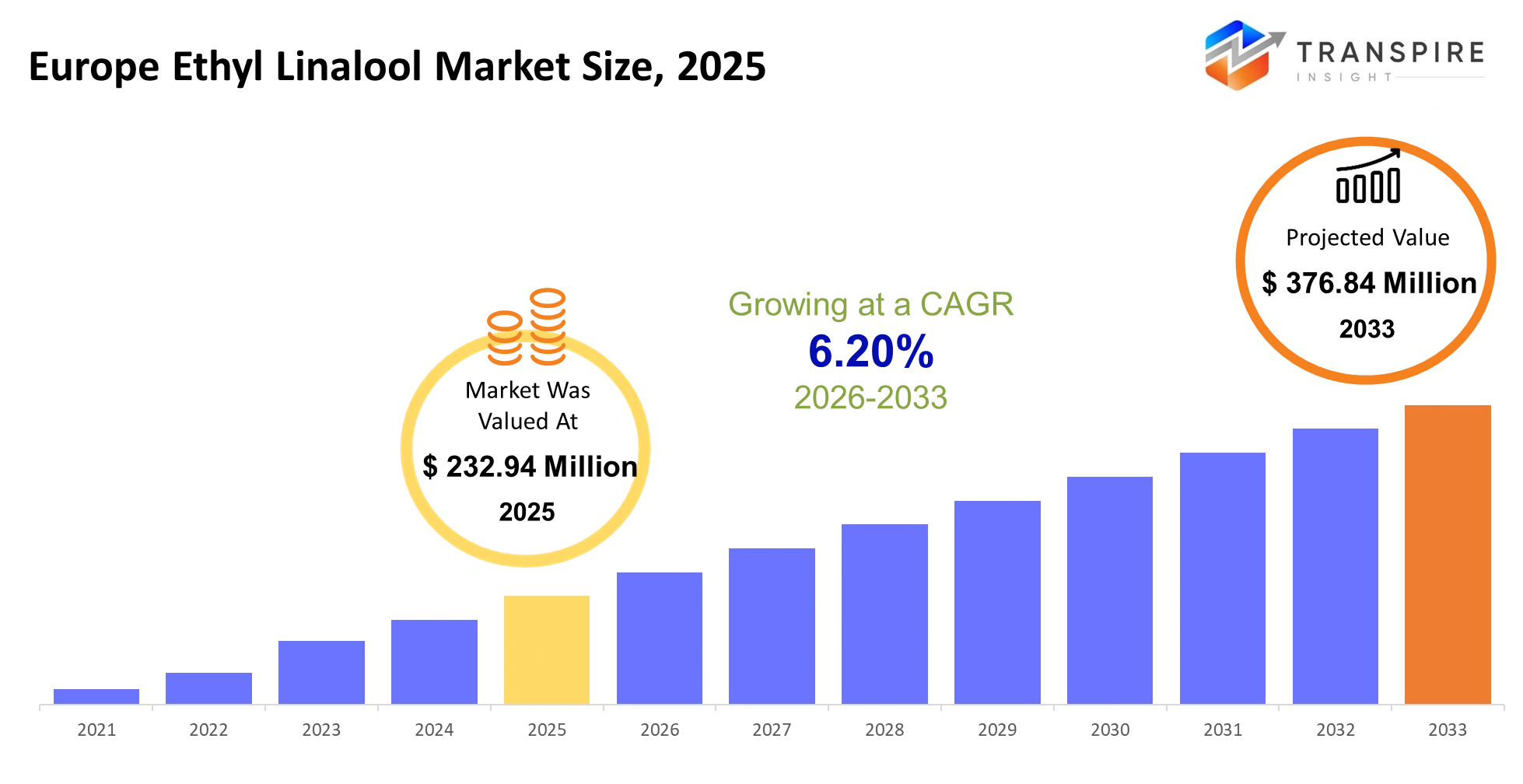
- Europe Ethyl Linalool Market Size 2025: USD 232.94 Million
- Europe Ethyl Linalool Market Size 2033: USD 376.84 Million
- Europe Ethyl Linalool Market CAGR: 6.20%
- Europe Ethyl Linalool Market Segments: By Type (Natural Ethyl Linalool, Synthetic Ethyl Linalool, Bio-based Linalool, Others); By Application (Fragrances, Cosmetics, Personal Care, Food & Beverages, Aromatherapy, Others); By End-User (Cosmetics Industry, Food Industry, Pharma Industry, Perfume Industry, Others); By Form (Liquid, Powder, Concentrates, Others).
To learn more about this report,  Download Free Sample Report
Europe Ethyl Linalool Market Summary
The Europe Ethyl Linalool Market was valued at USD 232.94 Million in 2025. It is forecast to reach USD 376.84 Million by 2033. That is a CAGR of 6.20% over the period.
The Europe Ethyl Linalool Market serves as essential input material for all perfume and functional scent systems which manufacturers use in their personal care and home care and fine perfumery products to create standardized floral-citrus scent profiles across their complete product range. The solution provides the industry with high-purity allergen-free aroma materials which meet strict European cosmetic safety requirements while preserving their ability to function in intricate product mixtures.
The market during the past three to five years has undergone a complete transformation towards cleaner-label and bio-based fragrance chemistry because manufacturers now use higher-purity and renewable feedstock options instead of traditional synthetic methods. The stricter EU REACH compliance requirements and the new fragrance allergen disclosure regulations have pushed brands to create new product formulations which accelerated this market transition. The combination of regulatory requirements and supply chain interruptions from the pandemic period for citrus-derived materials led companies to switch their buying methods and start importing goods from European countries. The traceable production and advanced purification methods which producers are currently developing will create higher-value products which will enhance their profit margins throughout all certified supply chain networks.
Key Market Insights
- Western Europe holds nearly 48% share in the Europe Ethyl Linalool Market (2025), which French and German and Swiss fragrance manufacturing hubs enable.
- Eastern Europe is the fastest-growing region (2025-2030) because of its affordable contract manufacturing services and increasing aroma intermediate export business.
- The market for Purified ethyl linalool leads with more than 55% market share because regulations now require fragrance products to meet allergen control and high-purity standards.
- The segment of Bio-based ethyl linalool will grow at the fastest rate until 2030 because European Ethyl Linalool Market adopts enzymatic synthesis and uses renewable feedstock.
- The personal care industry leads the market with almost 42% share because cosmetic brands develop clean fragrances and display product ingredients.
- Home care applications are the quickest-growing application area between 2025 and 2030 because people want aromatic products that last long and have low VOC emissions.
- Cosmetic manufacturers use more than 50% of ethyl linalool because they need it to create floral and citrus scents.
- Contract fragrance formulators represent the quickest-growing end-user group because businesses now show interest in outsourcing and creating unique scents.
- Givaudan and DSM-Firmenich and BASF lead the market through their research and development spending which focuses on developing sustainable aroma chemistry solutions and advanced formulation methods.
- Symrise and IFF use strategic expansion to build their competitive advantage in the Europe Ethyl Linalool Market through their bio-based product development efforts.
What are the Key Drivers, Restraints, and Opportunities in the Europe Ethyl Linalool Market?
The EU REACH revisions and accompanying fragrance allergen declaration regulations which began enforcement in 2022 serve as the main element driving the ethyl linalool market in Europe. The regulations required perfume and personal care product manufacturers to develop new formulas which used only traceable and pure aroma substances instead of their previous formulas. The market now demands certified-grade ethyl linalool which contains fewer impurities than standard products thus increasing purchase requirements for certified vendors while they gain market strength through their regulated cosmetic product sales.
European specialty chemical facilities use two different types of production systems to create their specialty products thus creating a fundamental constraint which limits their production capabilities. Most mid-sized manufacturers continue to use batch processing systems which lack complete digital control therefore they face challenges when trying to create standardized purification methods and maintain uniform product quality. The organization suffers from structural inefficiency which raises production costs for each individual unitwhile also extending the product certification processwith major fragrance companies such as Givaudan and Firmenich. The organization needs stable demand for its products to generate revenue growth.
The development of bio-fermentation and green chemistry through investment initiatives within Germany and Switzerland provides companies with a strong opportunity for growth. The pilot facilities in these two countries now proceed to develop enzymatic pathways which produce aroma molecules through their operational expansion. BASF and its research partners are currently investigating renewable feedstock methods which aim to decrease citrus-based intermediate requirements. The platforms have the potential to create carbon-efficient supply networks which will enable cosmetics and home care products from Europe to achieve premium value through their clean-label fragrance lines.
What Has the Impact of Artificial Intelligence Been on the Europe Ethyl Linalool Market?
European ethyl linalool value chain operations benefit from artificial intelligence and advanced digital systems because these technologies help aroma chemical plants optimize production management and emissions control systems and quality assurance processes. AI-based control systems in contemporary facilities use real-time data to manage reactor temperature and distillation rate and catalyst dosage operations, which leads to more consistent product output and diminished production inconsistencies. Automated monitoring platforms are being established at VOC scrubbers and exhaust gas cleaning units, which use machine vision technology and sensor fusion systems to identify performance deviations that require immediate system adjustments for EU emission threshold compliance.
The machine learning-based predictive maintenance models use vibration and pressure and throughput measurements to predict equipment failures in distillation columns and compressors, which enables plants to achieve a 10 to 15 percent decrease in unplanned downtime. Emissions forecasting tools optimize the production schedule because they enable operators to move high-intensity operations to times when regulatory costs and energy prices are lower, which results in a 6 to 9 percent improvement in operational efficiency.
The high expenses needed for system integration together with the incomplete legacy infrastructure that exists across European specialty chemical sites prevent organizations from implementing new technologies. Many systems still lack sufficient high-quality, labeled emissions and process data, which limits model accuracy under real-world chemical variability and slows broader deployment of fully autonomous control loops.
Key Market Trends
- Since 2021 premium fragrance houses have started using bio-based ethyl linalool sources instead of petrochemical intermediates which they used before to meet sustainability requirements.
- Manufacturers need to reformulate their products after 2023 because EU REACH compliance requirements have become stricter which leads to them discontinuing higher impurity-grade linalool derivatives.
- Personal care brands have expanded adoption of ethyl linalool in "clean fragrance" lines because they want to replace synthetic musky notes with lighter floral aroma profiles.
- Swiss and French aroma chemical producers have established partnerships with mid-tier suppliers through consolidation which helps them minimize procurement network disruptions that affect essential oil derivative availability.
- Manufacturers have developed high-purity distillation technologies for ethyl linalool because consumer demand for allergen-free products has increased starting from 2021.
- Eastern European contract manufacturers have expanded their production capacity since 2022 to provide Western European fragrance formulators with their services at reduced operating costs.
- Digital fragrance design tools which perfumers have adopted since 2023 help them achieve better results through ethyl linalool blends by reducing their excessive use which results in improved efficiency of their formulations.
- Major EU aroma chemical companies have started backward integration into raw material extraction because they face supply instability in citrus-derived feedstock since 2020.
- The need for VOC emission control started in 2024 leads to industrial fragrance blends choosing ethyl linalool to replace aromatic solvents that have greater environmental effects.
- The market competition starts from 2022 as niche biotech startups enter the industry which leads to new competition between them and traditional petrochemical companies that produce aroma through fermentation.
Europe Ethyl Linalool Market Segmentation
By Type :
The market for synthetic ethyl linalool in Europe gives synthetic ethyl linalool its leading market position because it provides cost-effective solutions with dependable product availability and permanent fragrance standards which large-scale perfume makers need. The existing petrochemical infrastructure in Germany and France enables industrial operations to continue which makes this industry the top option for producing personal care products and household products that need mass distribution.
The market for natural ethyl linalool remains limited because manufacturers face difficulties in obtaining sufficient raw materials while their customers show strong sensitivity to product pricing. Bio-based linalool is becoming more popular because European Union sustainability regulations and business environmental social governance requirements are becoming more demanding. The market segment operates through fermentation methods which use renewable feedstock materials to minimize the need for petrochemical resources. The industry faces inconsistent growth because production expenses exceed those of standard products but premium fragrance companies show increasing demand for their products.
The implementation of stricter compliance regulations during the upcoming assessment period will lead to the incremental market share acquisition by bio-based products. Product developers will need to balance formulation stability with sustainability credentials. Investors will prefer to invest in scalable fermentation platforms instead of funding traditional synthetic capacity expansion projects.
By Application:
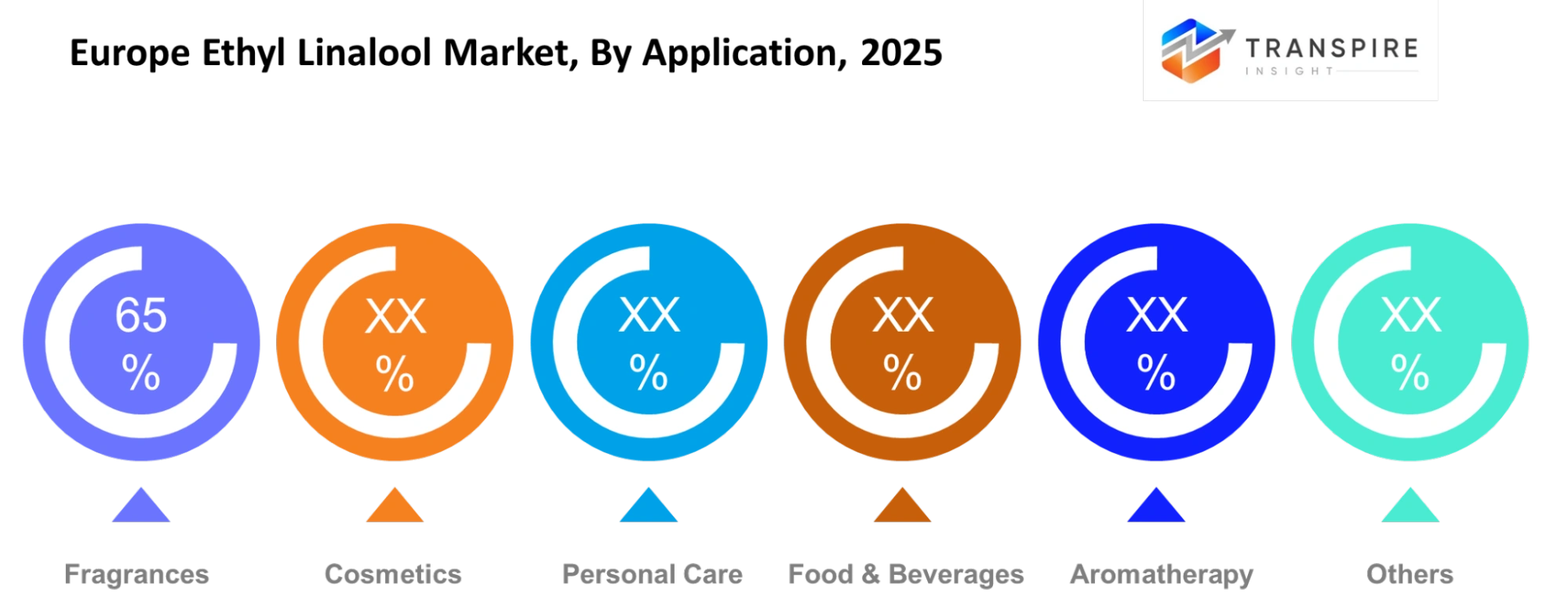
The application segment of fragrances serves as the dominant market category because it generates substantial sales through both high-end perfume and retail fragrance products. The product experiences high demand because it functions as a modifier which improves both floral and citrus fragrances while meeting EU allergen regulations. The personal care market segment operates through constant introduction of new products which personal care brands implement.
The second main application area of cosmetics and personal care products exists because consumers demand skincare and hygiene products that contain skin-friendly compounds and contain mild scented fragrances. The food and beverage industry uses the product in a limited way which maintains its consistent market presence. Urban European markets are showing increased wellness-based consumption which leads to gradual growth for aromatherapy services.
The cosmetics and wellness markets will experience growth because consumers show interest in products that provide sensory experiences together with clean label products. The manufacturers must create product formulas which achieve both safety regulations and effective sensory results. Buyers will increasingly select aroma ingredients which serve multiple purposes and comply with different product category regulations.
To learn more about this report, Download Free Sample Report
By End-User:
The perfume industry holds the largest share due to concentrated demand from luxury fragrance houses in France, Switzerland, and Italy. The players depend on stable supplier partnerships and constant aroma quality because these factors create a predictable procurement process. The cosmetics industry experiences strong demand from major personal care companies that operate throughout Western Europe.
The food industry uses the product at a smaller scale which maintains its stable market presence because flavor systems for processed foods and beverages face regulation. The pharmaceutical industry has started to use the product but its current use remains minor because it serves mainly as a masking agent for oral medicine. Other niche end-users include household cleaning brands and specialty wellness companies.
The upcoming growth of the business will depend on the cosmetics and perfume markets because their sustainable product changes create new ways to use their ingredients. The pharmaceutical industry will experience gradual adoption when companies discover better ways to develop excipients. To stay competitive suppliers must improve their compliance documentation while building systems that work across different industry sectors.
By Form:
The market for liquid products exists because this form allows easy blending while providing high fragrance solubility and matching current manufacturing systems. The industry adopts this format for perfumes and cosmetics and household products because it enables fast formulation development. High-intensity fragrance applications use concentrates which maintain a small market presence.
Powder form remains limited due to processing constraints and lower demand in fragrance-heavy applications. Specialists use other forms to create industrial systems and encapsulated delivery systems which deliver controlled-release formulations. Liquid products maintain their market position because supply chains exist for this product category which requires simple handling procedures.
Liquid formulations will continue to dominate future demand while there will be growth in premium products and functional products that require stabilized and encapsulated formats. Product developers will focus on improving volatility control and shelf-life stability. Investors will likely prioritize technologies that enhance formulation efficiency rather than diversify physical form factors.
What are the Key Use Cases Driving the Europe Ethyl Linalool Market?
The European market uses ethyl linalool mainly for fine fragrance and personal care products because it functions as a floral scent that includes a slight citrus scent which perfume and deodorant and skincare products use. The demand exists because EU allergen labeling regulations require formulators to select high-purity aroma materials that maintain consistent safety standards.
Home care applications are expanding their reach because premium detergents and surface cleaners in Western Europe enable brands to use scent differentiation as a marketing strategy. Food flavoring use in confectionery and beverages is increasing according to regulated limits because packaged goods use clean-label positioning as a marketing strategy.
The market shows emerging demand for functional cosmetics and bio-based industrial fragrance systems which obtain sustainability certifications through EU Green Deal frameworks. Natural-identical aroma compounds find early use in aromatherapy and wellness products because they serve therapeutic functions.
|
Report Metrics |
Details |
|
Market size value in 2025 |
USD 232.94 Million |
|
Market size value in 2026 |
USD 247.38 Million |
|
Revenue forecast in 2033 |
USD 376.84 Million |
|
Growth rate |
CAGR of 6.20% from 2026 to 2033 |
|
Base year |
2025 |
|
Historical data |
2021 - 2024 |
|
Forecast period |
2026 - 2033 |
|
Report coverage |
Revenue forecast, competitive landscape, growth factors, and trends |
|
Regional scope |
Europe (Germany, United Kingdom, France, Italy, Spain, Rest of Europe) |
|
Key company profiled |
Givaudan, Firmenich, IFF, Symrise, BASF, DSM, Takasago, Mane, Robertet, Sensient, Kerry Group, Ajinomoto, T. Hasegawa, Solvay, Kao. |
|
Customization scope |
Free report customization (country, regional & segment scope). Avail customized purchase options to meet your exact research needs. |
|
Report Segmentation |
By Type (Natural Ethyl Linalool, Synthetic Ethyl Linalool, Bio-based Linalool, Others); By Application (Fragrances, Cosmetics, Personal Care, Food & Beverages, Aromatherapy, Others); By End-User (Cosmetics Industry, Food Industry, Pharma Industry, Perfume Industry, Others); By Form (Liquid, Powder, Concentrates, Others). |
Which Regions are Driving the Europe Ethyl Linalool Market Growth?
The ethyl linalool market in Europe operates as its primary market because the region possesses both a vast fragrance production network and a complete European Union chemical compliance system. The countries of France and Germany and Switzerland contain main aroma chemical producers and top perfume manufacturers which create ongoing requirements for their high-purity intermediate products. The advanced logistics network from Rotterdam and Antwerp ports enables the smooth import process of feedstocks together with the export operation of complete fragrance products. The European industrial complex enables Europe to control both its product development standards and its research progress.
The North American market functions as a steady second-tier market which receives backing from ongoing customer requirements in personal care products and home care items and premium cosmetics. European markets compete with North America because consumer brands operate at a large scale while companies choose to establish long-term contracts for their product needs. The area benefits from substantial research and development resources which support flavor and fragrance solutions, especially in the United States where companies focus on making their product creation process more effective and getting better cost evaluation results. North America generates dependable income because its market situation remains constant through various global demand shifts.
The Asia Pacific region experiences rapid growth because of increasing middle-class spending power and the fast expansion of cosmetic manufacturing capabilities in China and India. The recent chemical production cluster investments and port infrastructure developments have enhanced local aroma ingredient supply capabilities, which now let the area depend less on imported products. The new product safety regulations have prompted companies to implement fragrance intermediate quality controls, which have resulted in higher product quality standards.For market entrants and investors, this shift signals strong volume-driven expansion potential between 2026 and 2033, especially for companies that localize production and distribution networks early.
Who are the Key Players in the Europe Ethyl Linalool Market and How Do They Compete?
The Europe ethyl linalool market shows a moderately consolidated upper tier which large aroma chemical and fragrance houses control while specialty and regional producers create market fragmentation through their intermediate supply operations. Businesses establish competition through their ability to meet regulations which includes maintaining consistent aroma profiles and obtaining both renewable and petrochemical feedstocks. Companies defend their market share by using integrated supply chains to strengthen their partnerships with downstream fragrance formulators while specialty ingredient vendors force them to develop new bio-based and high-purity grade products.
BASF maintains its competitive advantage through operational cost savings and thorough system integration of its European Verbund network which enables the company to maintain consistent aroma chemical production while decreasing supply fluctuations for its customers. Symrise uses its formulation-based differentiation approach to develop proprietary scent architectures which are more difficult to replace through co-development partnerships with perfumery clients. DSM-Firmenich uses bio-based chemical production methods through its fermentation and biotechnology platforms to establish its presence in sustainability-based procurement systems.
Givaudan strengthens its position through high-margin fine fragrance partnerships which create ingredient stickiness through exclusive agreements with luxury brands. IFF operates through two main strategies which involve making purchasing decisions based on operational volume and creating efficient methods for distributing aroma materials worldwide. MANE develops its market position through its unique aroma chemical products and its ability to create custom aroma solutions for European fragrance manufacturers.
Company List
- Givaudan
- Firmenich
- IFF
- Symrise
- BASF
- DSM
- Takasago
- Mane
- Robertet
- Sensient
- Kerry Group
- Ajinomoto
- T. Hasegawa
- Solvay
- Kao
Recent Development News
In April 2026, BASF announced the start of commercial production at its expanded Ludwigshafen aroma ingredients site, including linalool as part of a new world-scale menthol and fragrance intermediate complex. The investment strengthens European supply security for key fragrance molecules, improving downstream availability for ethyl linalool-based formulations and reducing dependency on constrained imports.
Source: https://www.basf.com
In April 2026, BASF commissioned and ramped up integrated production of menthol and linalool at its Ludwigshafen Verbund site as part of a multi-plant expansion across Germany and China. The development enhances cost efficiency and stable output of core aroma alcohols, reinforcing the European fragrance supply chain and indirectly supporting ethyl linalool formulation stability for perfumery manufacturers.
Source: https://www.perfumerflavorist.com
What Strategic Insights Define the Future of the Europe Ethyl Linalool Market?
The Europe ethyl linalool market will develop into a more environmentally sustainable segment which satisfies regulations and produces optimal formulations during the coming five to seven years because EU chemical regulations become stricter and consumers increasingly prefer natural and bio-based fragrance materials. The value of personal care products and fine fragrances will increase through reformulation cycles which create new product formulas instead of relying solely on increasing production output. The organization faces a hidden threat because its operations depend on feedstock supply while regulatory authorities reevaluate fragrance allergens which will drive up operational costs according to demand levels. A new opportunity exists in the market for bio-fermentation methods which produce linalool with environmentally sustainable benefits and consistent purity. Businesses operating in the market need to focus on establishing direct control over sustainable terpene production while they work together with leading fragrance companies to create environmentally friendly product solutions which will result in permanent contract agreements for product development.
Europe Ethyl Linalool Market Report Segmentation
By Type
- Natural Ethyl Linalool
- Synthetic Ethyl Linalool
- Bio-based Linalool
- Others
By Application
- Fragrances
- Cosmetics
- Personal Care
- Food & Beverages
- Aromatherapy
- Others
By End-User
- Cosmetics Industry
- Food Industry
- Pharma Industry
- Perfume Industry
- Others
By Form
- Liquid
- Powder
- Concentrates
- Others
Frequently Asked Questions
Find quick answers to common questions.
The Europe Ethyl Linalool Market size is estimated to be USD 376.84 Million in 2033.
Key segments for the Europe Ethyl Linalool Market are By Type (Natural Ethyl Linalool, Synthetic Ethyl Linalool, Bio-based Linalool, Others); By Application (Fragrances, Cosmetics, Personal Care, Food & Beverages, Aromatherapy, Others); By End-User (Cosmetics Industry, Food Industry, Pharma Industry, Perfume Industry, Others); By Form (Liquid, Powder, Concentrates, Others).
Major Europe Ethyl Linalool Market players are Givaudan, Firmenich, IFF, Symrise, BASF, DSM, Takasago, Mane, Robertet, Sensient, Kerry Group, Ajinomoto, T. Hasegawa, Solvay, Kao.
The Europe Ethyl Linalool Market size is USD 232.94 Million in 2025.
The Europe Ethyl Linalool Market CAGR is 6.20% from 2026 to 2033.
- Givaudan
- Firmenich
- IFF
- Symrise
- BASF
- DSM
- Takasago
- Mane
- Robertet
- Sensient
- Kerry Group
- Ajinomoto
- T. Hasegawa
- Solvay
- Kao
Recently Published Reports
-
Apr 2026
Healthcare Polymer Packaging Market
Healthcare Polymer Packaging Market Size, Share & Analysis Report By Packaging Type (Syringes, IV Bottles and Pouches, Clamshells, Blisters, Bottles & Jars, Containers, Tubes, IV Parental Packaging, Others), By Type (Regulated, Non-regulated), By Polymer Type (LDPE (Low-Density Polyethylene), HDPE (High-Density Polyethylene), Homo-polymer (Homo), Random Copolymer (Random), Block Copolymer (Block), PET, Polystyrene, Polyvinyl Chloride, Polyamide/EVOH, Others), and Geography (North America, Europe, Asia-Pacific, Middle East and Africa, South and Central America), 2021 - 2031
-
Apr 2026
Hydrophilic Tape (Waterstop) Market
Hydrophilic Tape (Waterstop) Market Size, Share & Analysis Report By Type (Bentonite-Based Hydrophilic Tape, Rubber-Based Hydrophilic Tape), By Application (Residential Buildings, Commercial Buildings, Infrastructure Projects), and Geography (North America, Europe, Asia-Pacific, Middle East and Africa, South and Central America), 2021 - 2031
-
Apr 2026
Metalens Market
Metalens Market Size, Share & Analysis Report By Type (Visible Light Metalens, and Infrared Metalens), By Application (Consumer Electronics, Automotive Electronics, Industrial, Medical, and Others), and Geography (North America, Europe, Asia-Pacific, Middle East and Africa, South and Central America), 2021 - 2031
-
Apr 2026
PBT Resin Market
PBT Resin Market Size, Share & Analysis Report By Type (Reinforced PBT Resin, Unreinforced PBT Resin), By Processing Method (Injection Molding, Extrusion, Blow Molding, Others), By End-User (Automotive, Electrical & Electronics, Consumer Appliances, Industrial Machinery, Medical Devices, Packaging, Others), and Geography (North America, Europe, Asia-Pacific, Middle East and Africa, South and Central America), 2021 - 2031