

Europe Egg Albumin Protein Market Size & Forecast:
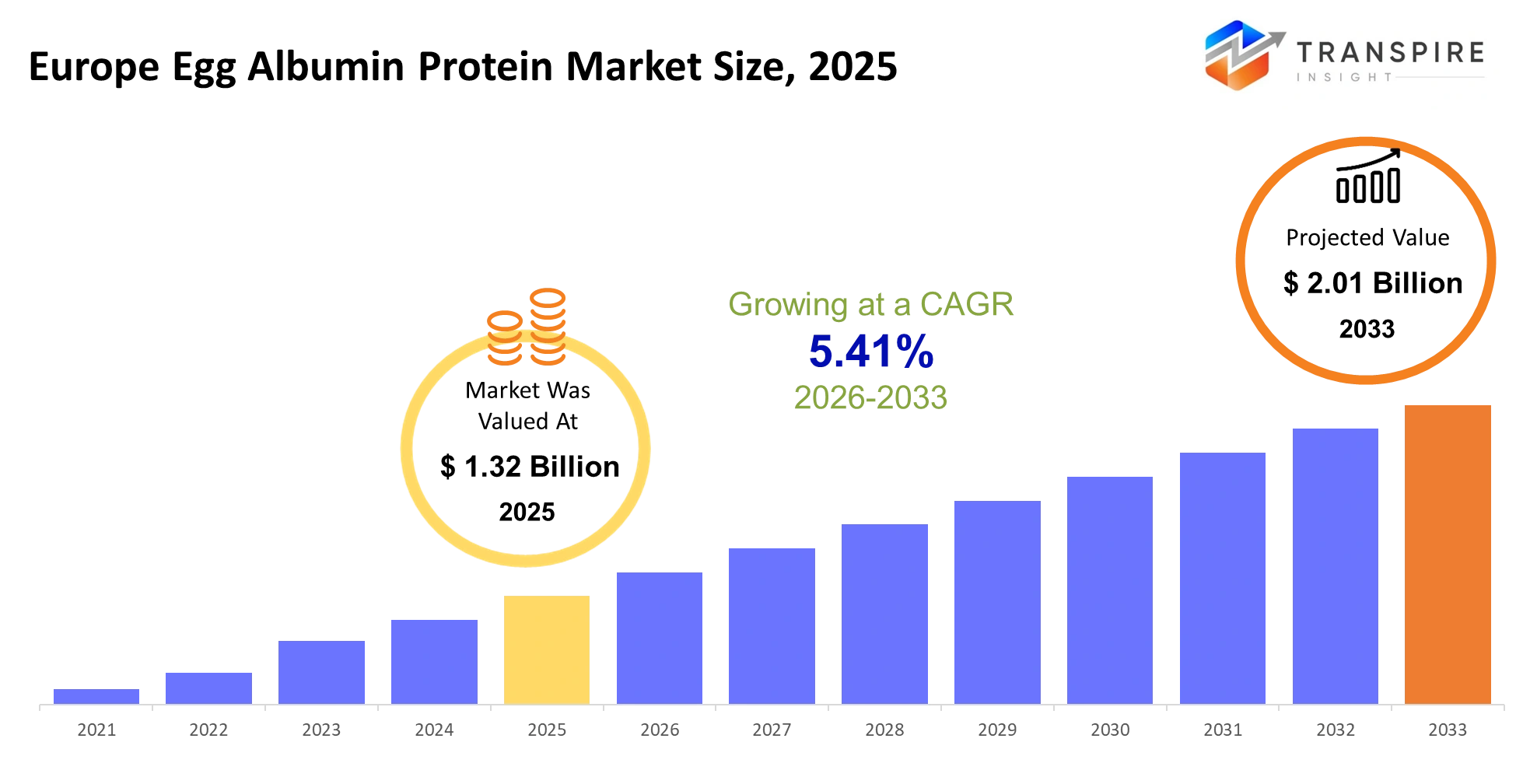
- Europe Egg Albumin Protein Market Size 2025: USD 1.32 Billion
- Europe Egg Albumin Protein Market Size 2033: USD 2.01 Billion
- Europe Egg Albumin Protein Market CAGR: 5.41%
- Europe Egg Albumin Protein Market Segments: By Type (Liquid Albumin, Powder Albumin, Freeze-dried Albumin, Organic Albumin, Others), By Application (Food Processing, Bakery, Pharmaceuticals, Nutraceuticals, Others), By End-User (Food Industry, Pharma Companies, Nutrition Companies, Others), By Form (Powder, Liquid, Granules, Others).
To learn more about this report,  Download Free Sample Report
Europe Egg Albumin Protein Market Summary:
The Europe Egg Albumin Protein Market size is estimated at USD 1.32 Billion in 2025 and is anticipated to reach USD 2.01 Billion by 2033, growing at a CAGR of 5.41% from 2026 to 2033. The Europe egg albumin protein market serves multiple industries through its protein ingredient which demonstrates excellent foaming and binding and gelling capabilities. Manufacturers depend on egg albumin to maintain stability in their baking products while enhancing the texture of processed foods and delivering protein content which meets clean-label requirements without significant impact on taste and viscosity. The product provides pharmaceutical and nutraceutical companies with a solution to create high-protein products that require both digestibility and amino acid quality.
The market has changed during the past five years from basic ingredient supply to specific protein systems designed for use in sports nutrition and medical foods and high-end bakery products. The post-pandemic focus on immune health and protein fortification accelerated this transition, while supply disruptions linked to avian influenza outbreaks exposed vulnerabilities in Europe’s egg supply chain. The unpredictable market conditions forced processors to spend money on traceable sourcing systems and automation technology and protein fractions that generate higher profits. As food manufacturers reformulate products around protein claims and cleaner ingredient lists, egg albumin suppliers are capturing stronger pricing power and deeper integration into value-added product pipelines.
Key Market Insights
- Germany maintained its market leadership in the Europe Egg Albumin Protein Market through 2025 by achieving almost 24 percent market share which resulted from its advanced food processing systems and high production capacity of nutraceuticals.
- The period from 2026 until 2031 shows Western Europe as the largest regional market while Eastern Europe experiences the fastest market growth throughout this period.
- The bakery and confectionery industry used food-grade egg albumin protein which made up more than 48 percent of the market share in 2025 because manufacturers needed this protein for its ability to maintain texture stability and create foam.
- The second largest market segment for pharmaceutical-grade egg albumin developed through the rising use of clinical nutrition and vaccine production across Europe.
- The demand for sports recovery formulations drives the growth of hydrolyzed egg albumin protein which will continue to increase until 2031 because it offers better digestibility.
- The bakery and confectionery industry achieved its market lead in 2025 by holding about 38 percent market share because manufacturers created new products which used high-protein functional ingredients.
- The sports nutrition market experiences its quickest growth because customers prefer protein-rich beverages and ready-to-mix supplements and active lifestyle products.
- The European egg protein industry in 2025 found its main end-user sector in food and beverage manufacturers who accounted for over 45 percent of total revenue.
- The nutraceutical sector shows its highest growth rate because European customers now demand both high-quality protein supplements and medical nutrition products.
- The Europe Egg Albumin Protein Market undergoes transformation through clean-label product development which drives manufacturers to obtain natural protein ingredients while stopping their use of synthetic stabilizers.
What are the Key Drivers, Restraints, and Opportunities in the Europe Egg Albumin Protein Market?
The primary factor driving growth in the European Egg Albumin Protein Market stems from the ongoing trend of processed food and sports nutrition product reformulations which emphasize high-protein ingredients and clean-label products. European food manufacturers have entirely stopped using synthetic stabilizers and multi-ingredient emulsifier systems since retail and regulatory channels started enforcing stricter ingredient transparency requirements. Egg albumin enables multiple formulation solutions by enhancing foaming capabilities and texture stability improvements and protein enrichment features which maintain existing flavor profiles. Manufacturers use this functionality to develop premium products for bakery and beverage and clinical nutrition markets which enable them to achieve higher profit margins while increasing their revenue from suppliers and their long-term procurement contracts.
The market’s biggest structural barrier remains raw material volatility caused by recurring avian influenza outbreaks and concentrated egg production networks across Europe. Egg albumin production depends heavily on stable shell egg availability, yet disease-related culling disrupts supply chains for months rather than weeks. Processing companies face difficulties in switching to alternative protein sources because the three factors of product functionality and regulatory approvals and formulation performance show major differences. The unstable situation causes businesses to face higher costs for acquiring supplies while their production schedules become suspended and smaller food companies that operate with minimal profits stop using the solution.
The future holds significant potential for hydrolyzed and pharmaceutical-grade egg albumin proteins which will serve medical nutrition needs and support active aging populations. Germany and the Netherlands increase their investments in clinical nutrition manufacturing while protein digestibility and bioavailability emerge as essential factors that differentiate their products. Manufacturers can now use advanced enzymatic processing technologies to develop specialized albumin ingredients which serve elderly nutrition needs and recovery beverages and high-performance supplements, thereby accessing premium healthcare-related revenue streams.
What Has the Impact of Artificial Intelligence Been on the Europe Egg Albumin Protein Market?
The Europe Egg Albumin Protein Market experiences transformation through artificial intelligence and advanced digital technologies which enhance production efficiency and maintain quality standards while providing better supply chain tracking capabilities throughout egg processing operations. AI-powered vision inspection systems have become essential tools for manufacturers because these systems enable automatic egg grading and simultaneous detection of shell defects and contamination hazards before albumin extraction proceeds. The automated control systems which industrial facilities install work together with their IoT sensors to track drying temperatures and protein concentration and moisture levels during albumin production; this system approach results in stable production outcomes and decreased material waste.
Machine learning models work together with production yield forecasts to enable maintenance schedule optimization for spray dryers and filtration systems and pasteurization equipment. Processors can enhance operational uptime and decrease unplanned downtime through the analysis of vibration patterns and temperature changes and equipment performance records. European facilities have achieved energy savings and processing loss reductions through the implementation of predictive analytics in their protein extraction operations. Digital traceability platforms enable businesses to comply with regulations by monitoring egg origins and processing methods and food safety records throughout their international supply chains.
The AI implementation process for organizations remains impeded because of two main challenges which include expensive system integration requirements and the presence of outdated operational systems in established processing facilities. The absence of standardized production data among mid-sized manufacturers leads to decreased algorithm performance which results in extended periods before digital transformation investments achieve their expected returns.
Key Market Trends
- European bakery brands during the period from 2021 to 2025 discontinued synthetic stabilizers in favor of egg albumin proteins which helped them achieve cleaner ingredient listings and market their products as premium offerings.
- The French, Polish, and Dutch Avian influenza outbreaks which began after 2022, disrupted egg supply chains, which forced processors to establish new sourcing contracts, while they developed new inventory management methods.
- Sports nutrition manufacturers increased their hydrolyzed egg protein usage because it helps them create recovery-focused supplements which show better results through faster product absorption.
- Sanovo Technology Group and other companies increased their investments in automated drying and filtration systems which help them minimize protein losses during their industrial processing activities.
- European clinical nutrition producers developed high-protein product lines for aging patients and recovery treatment products which drove up demand for pharmaceutical-grade albumin after 2021.
- Dutch and German processors raised their traceability spending by over 30% since 2022 to meet new retailer requirements which demand more detailed information about egg product origins.
- Mid-sized food manufacturers established permanent protein supply agreements because they faced profit losses during the 2022 supply chain disruptions which resulted from unpredictable egg price changes.
- European processing facilities adopted AI-powered quality inspection systems after 2023, which helped them decrease contamination dangers, while they achieved better production results in their albumin extraction processes.
- Eastern Europe became an affordable processing center between 2022 and 2025 because Western European markets experienced soaring costs for labor and utilities.
- Ingredient suppliers to nutraceutical and medical nutrition manufacturers shifted their competitive strategies from price-based volume selling toward establishing specialized formulation partnerships which provided customized protein solutions.
Europe Egg Albumin Protein Market Segmentation
By Type
The type segment leads with powder albumin because food processors and nutrition manufacturers select this product due to its extended shelf life and convenient transportation and safe storage capabilities. The powder version enables food manufacturers to produce baked goods and dietary supplements because it allows them to achieve exact protein levels and maintain uniform mixing results. Industrial bakeries prefer liquid albumin because it integrates into production lines more rapidly than other options, even though its cold-chain requirements result in higher transportation expenses. The pharmaceutical and clinical nutrition markets increasingly choose freeze-dried albumin because its high protein purity and better stability make it suitable for premium medical formulations.
The organic albumin market segment remains small yet continues to expand because European sourcing regulations drive demand for high-quality products. The type category will experience future growth through specialized products which offer additional value instead of typical commodity-grade items. Manufacturers who develop hydrolyzed pharmaceutical-grade traceable albumin products will achieve better profit margins because customers demand both formula performance and regulatory compliance information.
By Application
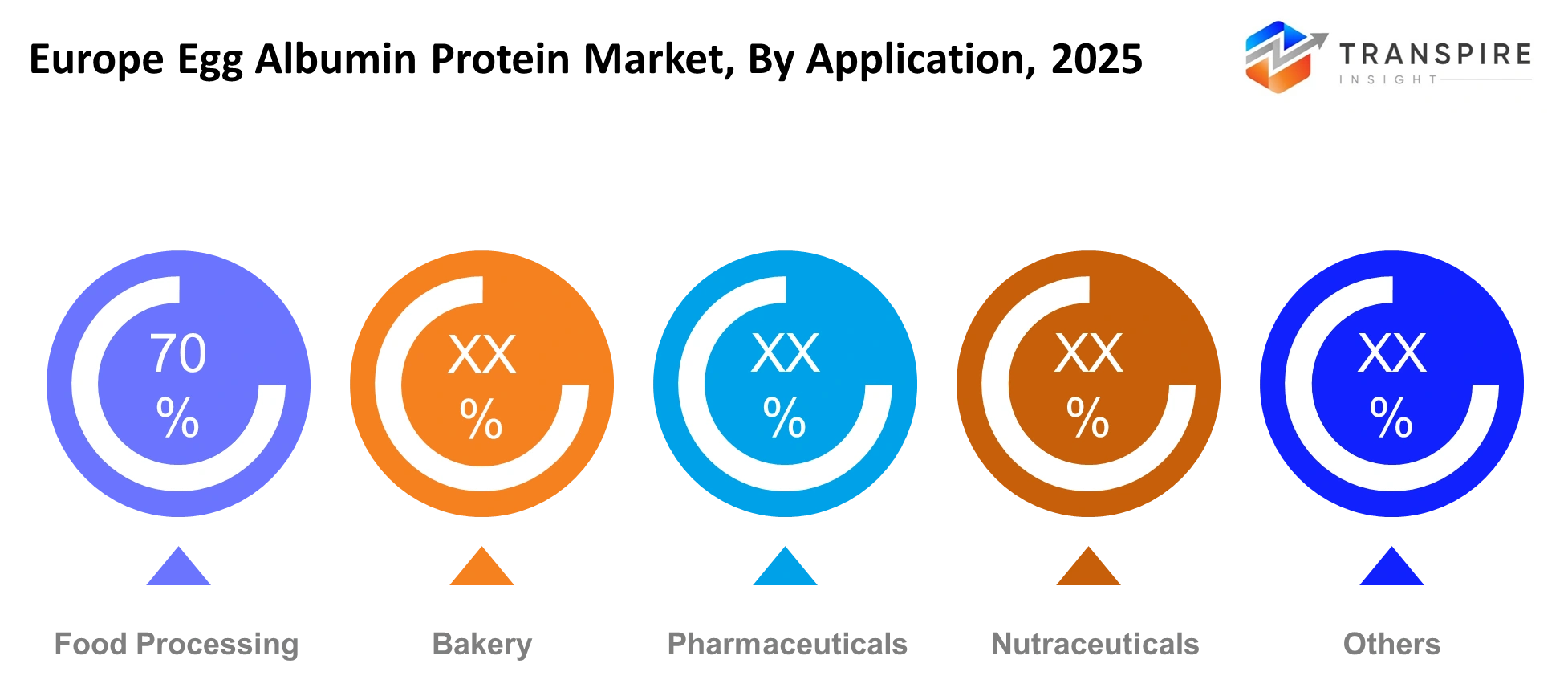
The primary industry that uses egg albumin as its main ingredient because of its various technical properties which include foaming and emulsification and texture stabilization and protein enrichment capabilities. Bakery applications account for a major share within food processing since industrial producers require stable aeration and moisture retention in cakes, pastries, and confectionery products. The rapid growth of nutraceutical applications after 2021 occurred because sports nutrition and recovery beverage manufacturers started using high-biological-value protein ingredients.
The pharmaceutical industry expanded because clinical nutrition products and therapeutic formulations for elderly patients and recovery care patients required more pharmaceuticals. The development of niche applications in cosmetics and biotechnology will proceed at a slow speed because the process of obtaining regulatory approvals and completing formulation testing requires extended periods before products can enter the market. The future investment trends will move toward applications that need albumin proteins because these products help companies create unique market offerings which protect them from raw material price fluctuations and product pricing uncertainties.
To learn more about this report, Download Free Sample Report
By End-User
The food industry exists as the biggest customer segment because large manufacturers require large quantities of albumin for their production of bakery goods processed food items confectionery products and ready-to-eat meals. Food producers continue prioritizing multifunctional protein ingredients that reduce formulation complexity while supporting premium labeling strategies. Pharma companies represent the second-largest end-user group as clinical nutrition and therapeutic protein formulations expand across Western Europe.
The nutrition sector experiences its fastest growth because sports nutrition brands now highlight their products' digestibility and amino acid quality and clean-label protein attributes as main points of differentiation. The research laboratories and biotechnology firms that make up smaller end-user categories select high-value albumin products based on their unique needs. Future competition among suppliers will increase through customized formulation support and long-term supply reliability which will become more important than price competition. End-users will prefer processors who can deliver both traceability and disease-control protections together with stable protein quality during times of supply disruption.
By Form
The powder form holds the leading position in the form category because industrial clients require storage solutions that optimize space and reduce shipping expenses while working with systems that handle automated blending. The powder products enable European nations to conduct international business because their shelf stability decreases inventory problems that occur during lengthy shipping operations. Industrial bakeries and foodservice production facilities depend on liquid form because it provides essential processing speed which costs more than refrigeration. The granule form represents an emerging market segment which manufacturers of nutraceuticals and supplements use to create products that need specific handling and controlled product distribution.
Businesses use restricted product ranges because they prefer to implement processing systems which provide both productive results and cost-effective operations. The form segment of the market shows increasing automation patterns that manufacturing plants in Europe use to develop their energy-saving systems. The manufacturers who adopt moisture control technologies and modern drying equipment can achieve better productivity results while decreasing their waste output. Buyers are also expected to favor formats that simplify traceability compliance and support flexible integration across multiple food and nutrition applications.
What are the Key Use Cases Driving the Europe Egg Albumin Protein Market?
The primary application of egg albumin proteins throughout Europe is found in bakery and processed food manufacturing. Industrial bakeries use albumin to create stable foams and maintain moisture levels while providing consistent texture across their cake and pastry and confectionery and ready-to-eat dessert products. The largest food processing companies create the greatest need for albumin because it enhances their production processes and enables them to create high-protein products with clean-label attributes.
Nutraceutical companies and pharmaceutical manufacturers are showing increasing interest in clinical nutrition and sports nutrition applications. Protein beverage manufacturers choose hydrolyzed albumin as their main ingredient for recovery drinks and meal replacement products because it delivers fast absorption and contains essential amino acids. Clinical nutrition suppliers use albumin in their nutritional products for elderly patients and post-surgery patients.
The biotechnology industry develops two new applications which include biotechnology media production and premium pet nutrition products. Research-focused biotech firms are evaluating pharmaceutical-grade albumin for cell culture and specialized laboratory formulations, while premium pet food manufacturers are testing high-purity egg proteins in performance-oriented animal nutrition products.
|
Report Metrics |
Details |
|
Market size value in 2025 |
USD 1.32 Billion |
|
Market size value in 2026 |
USD 1.39 Billion |
|
Revenue forecast in 2033 |
USD 2.01 Billion |
|
Growth rate |
CAGR of 5.41% from 2026 to 2033 |
|
Base year |
2025 |
|
Historical data |
2021 - 2024 |
|
Forecast period |
2026 - 2033 |
|
Report coverage |
Revenue forecast, competitive landscape, growth factors, and trends |
|
Regional scope |
Europe (Germany, United Kingdom, France, Italy, Spain and Rest of Europe) |
|
Key company profiled |
Sanovo Technology, Eurovo Group, Bouwhuis Enthoven, Rose Acre Farms, Rembrandt Foods, Igreca, Ovostar Union, SKM Egg Products, Venkys, Farm Pride, Cal-Maine Foods, Interovo, Wulro, Eggriculture, Pulviver. |
|
Customization scope |
Free report customization (country, regional & segment scope). Avail customized purchase options to meet your exact research needs. |
|
Report Segmentation |
By Type (Liquid Albumin, Powder Albumin, Freeze-dried Albumin, Organic Albumin, Others), By Application (Food Processing, Bakery, Pharmaceuticals, Nutraceuticals, Others), By End-User (Food Industry, Pharma Companies, Nutrition Companies, Others), By Form (Powder, Liquid, Granules, Others). |
Which Regions are Driving the Europe Egg Albumin Protein Market Growth?
The market in Western Europe operates as the leading region because of its developed food processing infrastructure and its strict regulatory system and its many large bakery and nutraceutical production facilities. The three countries Germany France and the Netherlands operate their production systems at full capacity because they use complete egg supply chains together with their advanced cold storage distribution networks. European food safety regulations create mandatory requirements which food processors must follow to establish traceability systems together with their premium albumin product lines and automated quality control measurement systems. The existing ingredient supplier network and processing equipment manufacturer system and research institution ecosystem work together to maintain regional market control while generating new product development solutions for extended time periods.
Northern Europe stands as the second biggest regional contributor yet its growth patterns show complete divergence from Western European growth patterns. Scandinavian countries value stable operations and responsible livestock practices and they commit to developing food technology research instead of focusing on production capacity alone. Regional manufacturers achieve their success through two factors: customer spending patterns which remain strong and the rising demand for high-protein products which customers buy through retail stores and clinical nutrition programs. Northern Europe generates dependable revenue streams because its food manufacturing facilities maintain regulatory compliance while using advanced digital technologies despite their smaller production output.
The fast growth rate of Eastern Europe emerges from investments in egg processing which now target manufacturing sites with lower operational costs. The three countries of Poland Romania and Hungary expanded their processing capacity because energy costs and labor costs started to increase in Western Europe after 2022.
Who are the Key Players in the Europe Egg Albumin Protein Market and How Do They Compete?
The market remains moderately fragmented because multinational egg processors and regional ingredient specialists and technology-focused suppliers compete across food and nutraceutical and pharmaceutical markets. The competition now operates through different methods which use technological abilities and supply network dependability instead of production capacity and market pricing authority. Established processors maintain their market position through automation systems and high-quality product creation while mid-sized companies pursue specific markets which include hydrolyzed proteins and organic albumin and clinical nutrition products.
Sanovo Technology Group establishes its unique identity through its development of processing technology which boosts protein extraction output and minimizes waste output during their large-scale albumin production process. The corporation emphasizes automation and digital monitoring solutions which enable processors to achieve better product quality control and reduced manufacturing waste. Eurovo Group competes by using its vertically integrated supply chain and custom ingredient solutions which meet the specific needs of bakery and nutrition production companies. Eurovo maintains complete control over its regional supply networks which enables the company to track product movement and respond quickly to raw material shortages.
Kewpie Corporation expands through high-functionality protein ingredients designed for premium foodservice and nutraceutical formulations. The company's specialized knowledge in texture optimization and emulsification provides it with a competitive edge for creating value-added products but not for selling basic commodity protein products.
Company List
- Sanovo Technology
- Eurovo Group
- Bouwhuis Enthoven
- Rose Acre Farms
- Rembrandt Foods
- Igreca
- Ovostar Union
- SKM Egg Products
- Venkys
- Farm Pride
- Cal-Maine Foods
- Interovo
- Wulro
- Eggriculture
- Pulviver
Recent Development News
In February 2026,SANOVO Introduces Vision Weighing Technology for Egg Grading Efficiency: SANOVO TECHNOLOGY GROUP launched an upgraded VisionAI-based contactless weighing system designed to improve precision egg grading at industrial scale.This innovation enhances egg classification accuracy used in downstream egg albumin (egg white protein) separation and processing, reducing mechanical stress and improving yield efficiency for European egg processing plants.
Source: https://www.sanovogroup.com
In April 2026, Rose Acre Farms names Becker new board chair: Rose Acre Farms confirmed a governance update with the appointment of Becker as new board chair, reinforcing leadership continuity in one of the largest U.S. egg producers. The move supports long-term supply chain stability across shell egg and egg-derived protein segments, including albumin-based processing inputs used globally in food manufacturing.
Source: https://www.wattagnet.com
What Strategic Insights Define the Future of the Europe Egg Albumin Protein Market?
The Europe Egg Albumin Protein Market is structurally shifting toward high-functionality and healthcare-linked protein applications rather than volume-driven commodity supply. The next five to seven years will see growth from clinical nutrition and active aging formulations and specialized sports recovery products which require protein digestibility and traceability and formulation precision to gain commercial value. European food and healthcare companies are now willing to pay higher prices for dependable proteins because of the growing demand for ingredient transparency.
The fast growth of precision fermentation and plant-based protein research which produces future egg protein substitutes presents a concealed danger because these proteins develop without the risk of livestock disease outbreaks. If cost parity improves faster than expected, conventional albumin processors could face margin compression in premium food applications. Eastern Europe offers new business possibilities because governments and private investors are establishing automatic protein processing plants and facilities that produce food for export.
Market participants should establish vertically integrated sourcing networks while making early investments in pharmaceutical-grade and hydrolyzed protein technologies because these areas will provide the strongest competitive advantages and pricing power for the long term.
Europe Egg Albumin Protein Market Report Segmentation
By Type
- Liquid Albumin
- Powder Albumin
- Freeze-dried Albumin
- Organic Albumin
- Others
By Application
- Food Processing
- Bakery
- Pharmaceuticals
- Nutraceuticals
- Others
By End-User
- Food Industry
- Pharma Companies
- Nutrition Companies
- Others
By Form
- Powder
- Liquid
- Granules
- Others
Frequently Asked Questions
Find quick answers to common questions.
The approximate Europe Egg Albumin Protein Market size for the market will be USD 2.01 Billion in 2033.
The key segments of the Europe Egg Albumin Protein Market are By Type (Liquid Albumin, Powder Albumin, Freeze-dried Albumin, Organic Albumin, Others), By Application (Food Processing, Bakery, Pharmaceuticals, Nutraceuticals, Others), By End-User (Food Industry, Pharma Companies, Nutrition Companies, Others), By Form (Powder, Liquid, Granules, Others).
Major players in the Europe Egg Albumin Protein Market are Sanovo Technology, Eurovo Group, Bouwhuis Enthoven, Rose Acre Farms, Rembrandt Foods, Igreca, Ovostar Union, SKM Egg Products, Venkys, Farm Pride, Cal-Maine Foods, Interovo, Wulro, Eggriculture, Pulviver.
The current market size of the Europe Egg Albumin Protein Market is USD 1.32 Billion in 2025.
The Europe Egg Albumin Protein Market CAGR is 5.41%.
- Sanovo Technology
- Eurovo Group
- Bouwhuis Enthoven
- Rose Acre Farms
- Rembrandt Foods
- Igreca
- Ovostar Union
- SKM Egg Products
- Venkys
- Farm Pride
- Cal-Maine Foods
- Interovo
- Wulro
- Eggriculture
- Pulviver
Recently Published Reports
-
Apr 2026
Baby Infant Formula Market
Baby Infant Formula Market Size, Share & Analysis Report By ype (Infant Milk, Follow On Milk, Specialty Baby Milk, Growing-Up Milk), By Ingredient (Carbohydrate, Fat, Protein, Minerals, Vitamins, and Others), By Product Form (Powder, Liquid, and Ready-to-feed), By Distribution Channels (Supermarket/Hypermarket, Specialty Store, Pharmacies, Online Retail, and Others), and Geography (North America, Europe, Asia-Pacific, Middle East and Africa, South and Central America), 2021 - 2031
-
Apr 2026
Edible Insects for Animal Feed Market
Edible Insects for Animal Feed Market Size, Share & Analysis Report By Type (Insect Powder, Insect Meal, Insect Bar, Insect Paste, Insect Oil, and Others), By Insect Type (Beetles, Cricket, Caterpillar, Hymenoptera, Orthoptera, Tree Bugs, and Others), By Application (Livestock, Pet Food, and Aquaculture), By Livestock Type (Poultry, Swine, and Others), and Geography (North America, Europe, Asia-Pacific, Middle East and Africa, South and Central America), 2021 - 2031
-
Apr 2026
Food Industry Disinfection and Bacterial Control Market
Food Industry Disinfection and Bacterial Control Market Size, Share & Analysis Report By Type (Chemical Disinfectants, Physical Disinfectants, and Biocides and Antimicrobials), By Application (Food Processing Equipment Surface Disinfection, Food Preparation Areas Surface Disinfection, Storage Areas Surface Disinfection, Anti-microbial Coatings Food Preservation, and Preservative Solutions Food Preservation), By End User (Meat and Poultry Processing, Dairy Processing, Seafood Processing, Bakery and Confectionery, Restaurants and Commercial Kitchens, and Food Service Providers), By Sales Channel (Online, Offline), and Geography (North America, Europe, Asia-Pacific, Middle East and Africa, South and Central America), 2021 - 2031
-
Apr 2026
Freeze Dried Food Market
Freeze Dried Food Market Size, Share & Analysis Report By Product Type (Fruits, Vegetables, Freeze-Dried Dairy Products, Freeze-Dried Meat and Seafood, Freeze-Dried Pet Food, and Prepared Meal), By Nature (Organic, and Conventional), By Form (Powdered, Granules, and Diced), By End Use (Breakfast Cereals, Dairy Products, Bakery & Confectionery, Nutritional Bars & Supplements, Powdered Beverages, Snacks, and Retail (Household)), and Geography (North America, Europe, Asia-Pacific, Middle East and Africa, South and Central America), 2021 - 2031