
Europe Display Material Market Size & Forecast:
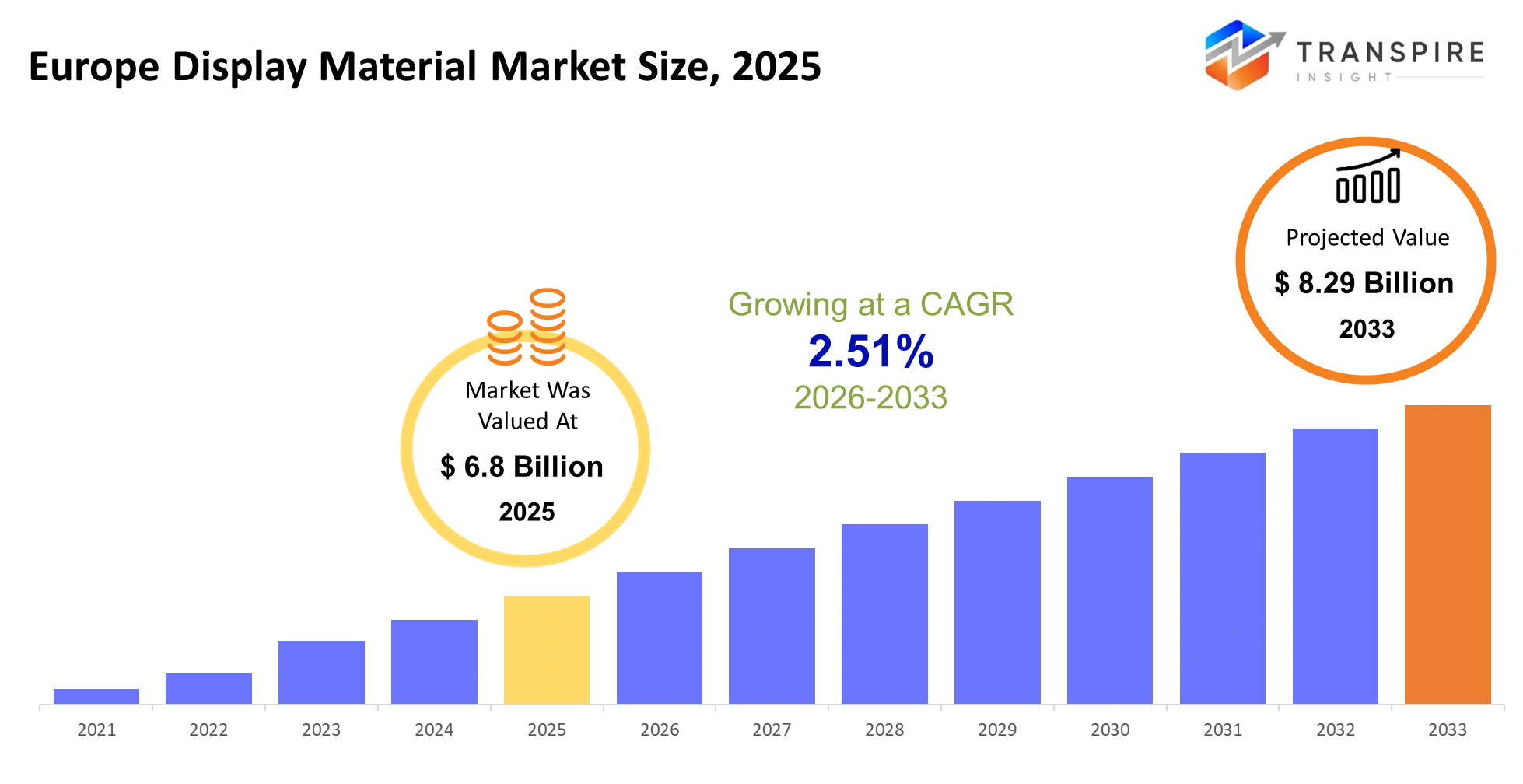
- Europe Display Material Market Size 2025: USD 6.8 Billion
- Europe Display Material Market Size 2033: USD 8.29 Billion
- Europe Display Material Market CAGR: 2.51%
- Europe Display Material Market Segments: By Type (OLED Materials, LCD Materials, Quantum Dot Materials, Others), By Application (Televisions, Smartphones, Laptops, Wearables, Automotive Displays, Others), By End-User (Electronics Manufacturers, Automotive Companies, Display Manufacturers, Others), By Component (Substrates, Polarizers, Color Filters, Others).
To learn more about this report,  Download Free Sample Report
Europe Display Material Market Summary:
The Europe Display Material Market size is estimated at USD 6.8 Billion in 2025 and is anticipated to reach USD 8.29 Billion by 2033, growing at a CAGR of 2.51% from 2026 to 2033. Modern screens use display materials as their main component which transforms electrical signals into visible images that can be seen on smartphones and automotive dashboards and industrial control panels and medical devices. The materials determine four essential properties which include brightness and energy efficiency and durability and physical design which all affect how well information travels through difficult environments.
The display market has undergone a fundamental transformation during the last three to five years as it transitioned from conventional LCD systems to OLED and new mini-LED display technologies which provide advantages of thinner design and flexible usage and energy savings. The pandemic supply chain disruption served as the primary catalyst which demonstrated to Europe that it depended on Asian material supplies and forced original equipment manufacturers to find new sources while shifting production to their local facilities.
Researchers have increased their funding for advanced development of coatings and substrates and emissive materials because of this trend. Material innovation has enabled European manufacturers to create energy-efficient products which help them achieve design flexibility while producing higher-value components that result in better margins throughout their entire supply chain.
Key Market Insights
- The Display Material Market in Europe is controlled by Western Europe which will reach 45% market share in 2025 because the region has strong electronics and automotive manufacturing centers.
- Germany leads regional demand , supported by advanced automotive display integration and industrial automation investments.
- Eastern Europe is the fastest-growing region which will grow at more than 6% compound annual growth rate until 2030 because of electronics assembly relocation.
- The OLED materials market will reach almost 40% market share in 2025 because premium smartphones and automotive displays use these materials.
- The LCD materials segment holds the second-largest position in the market because industrial and commercial display applications use cost-sensitive solutions.
- The market for Mini-LED and quantum dot materials is expanding rapidly because these materials have become the fastest-growing segment which will continue to develop until 2028.
- The European market designates consumer electronics as its primary application which holds more than 50% market share because smartphones tablets and smart TVs drive their usage across the continent.
- The automotive display market represents the fastest-growing sector because digital cockpit systems and electric vehicle adoption drive its expansion.
- Industrial display systems experience consistent growth because manufacturing automation systems and control panels require their deployment.
- The Europe Display Material Market will reach approximately 48% end-user demand from consumer electronics manufacturers who will become the leading buyers in 2025.
- The connected vehicle and electric vehicle display needs of automotive original equipment manufacturers drive their development as the fastest-growing end-user market.
- The display industry needs high-precision low-power display materials which healthcare device manufacturers are beginning to require.
What are the Key Drivers, Restraints, and Opportunities in the Europe Display Material Market?
The Europe Display Material Market experiences its highest growth rate because advanced display technology now gets used in both automotive and industrial applications. The industry shifted to electric vehicles and software-defined vehicles which made digital cockpits and heads-up displays and touch interfaces required components for all vehicles. European automakers now specify OLED and mini-LED materials to achieve higher contrast and lower power consumption and design flexibility. The process creates direct material value increases which will raise supplier income streams to their highest levels. The market expansion starts to multiply when vehicle display area increases because material usage grows at a higher rate.
Europe faces a major structural challenge because it needs to import all its raw materials and processing operations which exist mainly in Asia. Europe lacks the large-scale manufacturing capabilities required to produce high-purity chemicals and emissive compounds and specialty substrates. The necessary capital and technical knowledge and time resources make it impossible to build these capabilities within a short time frame. Manufacturing plants must deal with supply disruption and pricing challenges because of their dependence on raw materials from outside sources. This situation causes delays in manufacturing processes which restrict the speed at which industries can implement new display technologies.
The development of microLED and flexible display materials creates an important business opportunity which European semiconductor and photonics ecosystem investments support. The pilot projects which Germany and France conduct work on microLED mass transfer and substrate development. The growing technological maturity of these systems will enable their use in high-efficiency permanent display systems which can benefit automotive aerospace and industrial sectors.
What Has the Impact of Artificial Intelligence Been on the Europe Display Material Market?
Artificial intelligence and advanced digital technologies are increasingly integrated into the European display material manufacturing system, which affects both production methods and quality assessment practices. Manufacturers of OLED emitters and photoresists and specialty substrates now use AI-powered vision technology to automate defect detection at micron levels during coating and deposition processes. The system allows shorter inspection intervals which results in higher yield consistency and reduced material waste and production expenses. The digital twin system of fabrication lines enables manufacturers to control production processes by adjusting temperature and pressure and chemical composition through automated methods.
Machine learning models provide equipment maintenance predictions for high-precision tools which include vapor deposition systems. The models predict upcoming equipment failures by analyzing process deviations and vibration patterns which result in better operational efficiency and decreased unplanned equipment shutdowns. Some facilities report double-digit reductions in maintenance costs and measurable gains in throughput efficiency.
AI with its ability to simulate material behavior under different luminance and thermal conditions improves performance modeling, which accelerates R&D cycles for next-generation displays.
High integration expenses and disconnected data systems continue to limit adoption. The existing production lines from the past lack common data systems which prevents AI models from operating effectively in real-world manufacturing environments.
Key Market Trends
- European automakers have begun to implement OLED technology in their digital cockpits since 2021 which has created a new demand for emissive and flexible materials instead of traditional LCD components.
- The 2020-2022 supply disruptions led manufacturers to implement multiple sourcing methods which enabled them to decrease their reliance on single-region suppliers while establishing more ties with local material suppliers.
- The period from 2022 to 2025 saw mini-LED backlighting technology become more common in premium displays which created a need for advanced phosphors and precision optical films.
- Display panel manufacturers have begun to design their products with thinner and flexible features since 2021 which has created new opportunities for developing polymer substrates and encapsulation materials.
- The European Union established stricter energy efficiency standards after 2022 which forced manufacturers to use display materials that consume less energy during device operation.
- The companies Merck KGaA and BASF SE have increased their research activities on next-generation emissive materials which will enhance brightness and lifespan since 2023.
- The industrial automation sector has experienced growth since 2022 which created a need for display materials that can handle extreme temperatures and vibrations during ongoing operation.
- European electronics original equipment manufacturers developed stronger partnerships with Asian material innovators between 2021 and 2024 to speed up their access to new advanced display chemistries.
- Sustainability regulations established after 2022 required material suppliers to change their product formulations which resulted in reduced hazardous chemical content and enhanced display component recyclability.
Europe Display Material Market Segmentation
By Type
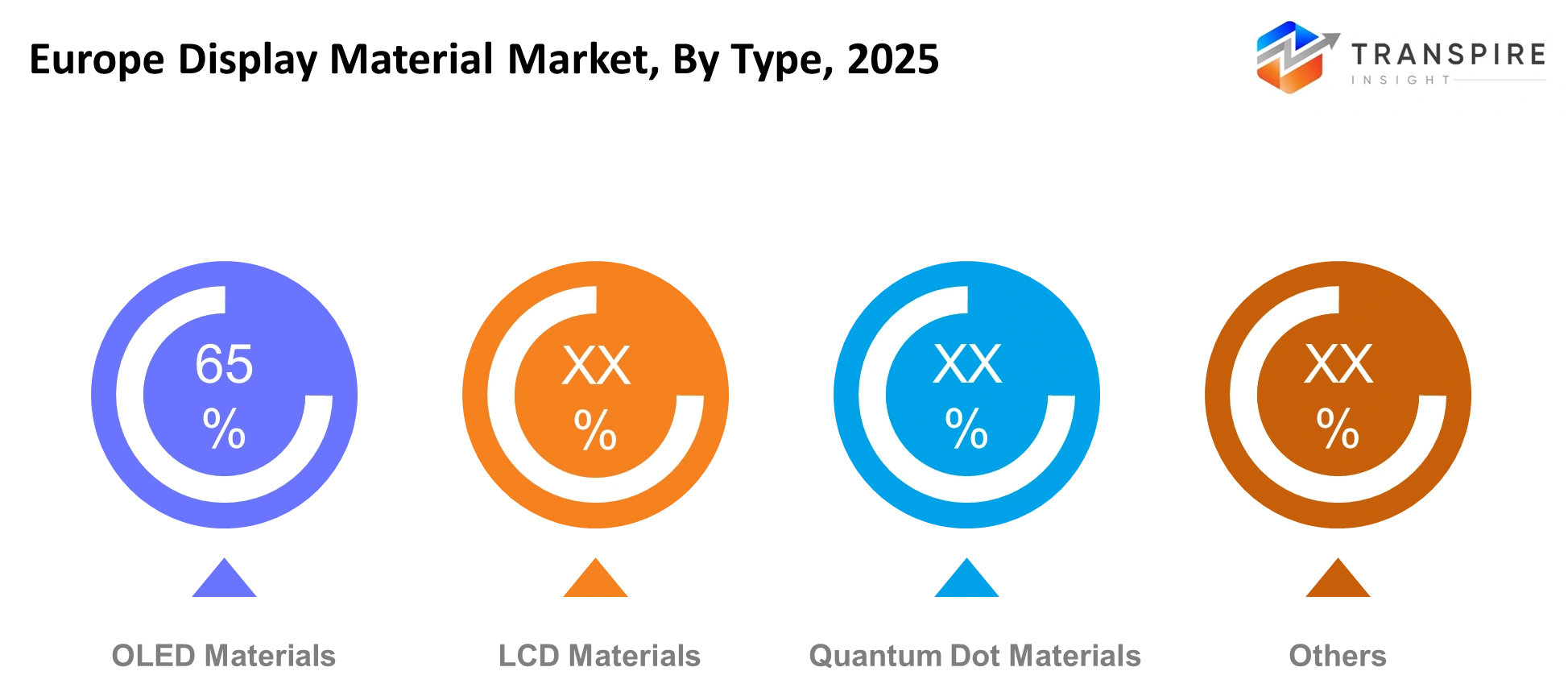
The performance of OLED materials establishes them as the top choice because they provide better contrast and flexible design capabilities and operate with lower energy consumption which meets the needs of high-end devices and automotive displays. The industrial sector and mid-range market segments continue to use LCD materials because these materials offer cost benefits and manufacturers have developed reliable supply networks. Manufacturers increasingly adopt quantum dot materials because they want to improve color output while maintaining their current display systems.
The different segments of this market develop according to two factors which include product performance requirements and customer price variations. The production of OLED devices will increase through better manufacturing processes while LCD products will maintain their market presence in price-sensitive sectors. Display systems that already exist provide financial backing for quantum dot development because this technology enables new display enhancements. The future of development will require businesses to find an equilibrium between their production expenses and product capabilities while their suppliers will develop hybrid systems that deliver both energy efficiency and production capacity.
To learn more about this report, Download Free Sample Report
By Application
Manufacturers make smartphones and televisions their primary products because customers want better display technology while manufacturers need to make products in large quantities. The automotive industry experiences its highest growth rate through digital cockpits which become standard features in all vehicle types. People keep using laptops and wearables because these devices combine portable design with energy-efficient operation. Different application fields show unique adoption patterns which arise from user requirements and product lifecycle stages.
Consumer electronics products focus on creating high visual performance together with lightweight slim designs, while automotive applications need products that maintain durability throughout extended operational periods. Industrial organizations and specialized markets require products which can operate under extreme operational challenges. Automotive and specialized applications will drive future demand, which will lead material suppliers to develop solutions that maintain performance stability throughout extended product lifecycles.
By End-User
The electronics industry assigns its biggest market share to manufacturers who produce consumer devices with advanced display technologies because they need to manufacture their products at high volumes. Display manufacturers follow closely as key intermediaries who establish material requirements while selecting their suppliers. The automotive industry has become the fastest expanding market because automotive manufacturers have started to implement display systems into their vehicle models. Each group drives demand differently based on production scale and performance priorities.
Electronics manufacturers aim to reduce production costs while increasing their product development speed, whereas display manufacturers focus on achieving production compatibility and maximizing their output rate. Automotive companies establish their main business focus on developing products which meet reliability standards and safety regulations. The future business environment will establish stronger partnerships between material suppliers and automotive companies because both need customized solutions and extended supply contracts to manage intricate display systems.
By Component
The display performance and structural stability of the system depend on substrates and polarizers, which make up most components. LCD systems require color filters, but modern technology needs additional components to work with OLED and mini-LED systems. Different technology developments and performance needs drive the development of each component type.
Substrate development works on creating materials that can bend and withstand heat whereas polarizer technology focuses on achieving better light output and angle of view. The use of color filters will decline because emissive display technologies need fewer conventional display components. The industry will concentrate on material efficiency and system integration as manufacturers develop products that use fewer components to build better display systems.
What are the Key Use Cases Driving the Europe Display Material Market?
The primary application of display materials in consumer electronics continues to focus on smartphones and televisions which create the highest demand for these materials. The combination of high refresh rates and brightness levels and power efficiency features determines user experience, which leads manufacturers to use OLED technology and advanced optical films for their products.
The fields of automotive displays and industrial control systems currently see increasing development of new applications. European automotive OEMs integrate larger digital cockpits and infotainment panels, increasing material intensity per vehicle. Industrial equipment manufacturers deploy rugged displays in automation systems, which need substrates that can withstand heavy use and need to maintain reliable performance throughout their operational lifetime.
The field of emerging use cases examines both augmented reality devices and medical imaging systems. AR headsets demand ultra-light, high-resolution materials, while advanced diagnostic displays require precise color accuracy and long-term reliability, which creates new chances to develop specialized materials.
|
Report Metrics |
Details |
|
Market size value in 2025 |
USD 6.8 Billion |
|
Market size value in 2026 |
USD 6.97 Billion |
|
Revenue forecast in 2033 |
USD 8.29 Billion |
|
Growth rate |
CAGR of 2.51% from 2026 to 2033 |
|
Base year |
2025 |
|
Historical data |
2021 - 2024 |
|
Forecast period |
2026 - 2033 |
|
Report coverage |
Revenue forecast, competitive landscape, growth factors, and trends |
|
Regional scope |
Europe (Germany, United Kingdom, France, Italy, Spain and Rest of Europe) |
|
Key company profiled |
Samsung Display, LG Display, BOE Technology, AUO, Innolux, Corning, Sumitomo Chemical, Merck KGaA, BASF, DuPont, Nitto Denko, Toray, JNC, Universal Display, 3M. |
|
Customization scope |
Free report customization (country, regional & segment scope). Avail customized purchase options to meet your exact research needs. |
|
Report Segmentation |
By Type (OLED Materials, LCD Materials, Quantum Dot Materials, Others), By Application (Televisions, Smartphones, Laptops, Wearables, Automotive Displays, Others), By End-User (Electronics Manufacturers, Automotive Companies, Display Manufacturers, Others), By Component (Substrates, Polarizers, Color Filters, Others). |
Which Regions are Driving the Europe Display Material Market Growth?
The market is primarily driven by Western European countries which include Germany, France, and the Netherlands. The strict environmental and energy efficiency regulations force manufacturers to use advanced low-power display materials in both the automotive and electronics industries. The chemical supply network together with research institutions and original equipment manufacturers creates an environment that enables material development and quick market entry. The region maintains its dominant position because of its established production facilities which enable material suppliers to work closely with their customers.
The strength profile of Northern Europe develops through its stable conditions and its focus on long-term industrial development. Countries such as Sweden and Finland benefit from consistent investment in high-tech manufacturing and display integration in industrial equipment. The market for this product remains stable because customers require reliable performance during extreme working conditions. This region generates stable income because of its structured regulatory implementation and the strong cooperation between business and government policies.
Eastern Europe currently experiences the highest growth rate because of recent changes in electronics production methods and supply chain network expansion. Manufacturers have been diversifying their operations in Poland and Hungary and the Czech Republic since 2022 to decrease their reliance on international supply networks. The local market has begun using advanced display materials because of decreased production expenses and enhanced facility development. The growth in this sector will create opportunities for suppliers and investors who want to establish economical manufacturing operations in new industrial areas until 2033.
Who are the Key Players in the Europe Display Material Market and How Do They Compete?
The European display material market experiences competition through two main forces which include market consolidation as the primary power and specialized companies which create independent businesses. The chemical and material science industry maintains control over important market segments which include OLED emitters and advanced coatings while smaller companies serve specific market needs through their niche products and manufacturing materials. The success of a company depends on their technology leadership because improvements in brightness and efficiency and lifespan determine which OEMs will choose their products. European buyers now view supply security as an essential factor for choosing business partners because they want to work with companies that can provide uninterrupted service after recent supply chain problems.
Merck KGaA establishes its market position by investing heavily in OLED material chemistry research which aims to develop high-efficiency emitters that increase device lifetime. The company achieves early access to future display technologies by working closely with panel manufacturers to develop new display stack systems. BASF SE establishes its market position through its extensive production capacity and specialized production knowledge which enables the company to maintain affordable prices and deliver superior products throughout its extensive manufacturing operations. The company grows its business through strategic partnerships which allow its materials to be used throughout various electronics production networks.
LG Chem uses its display manufacturing vertical integration with its display production partners to speed up the process of introducing new materials to the market. DuPont develops high-performance films and substrates which serve applications that demand both durability and thermal stability. Samsung SDI develops new emissive materials while working closely with device manufacturers to increase its market share in high-end display markets.
Company List
- Samsung Display
- LG Display
- BOE Technology
- AUO
- Innolux
- Corning
- Sumitomo Chemical
- Merck KGaA
- BASF
- DuPont
- Nitto Denko
- Toray
- JNC
- Universal Display
- 3M
Recent Development News
In April 2026, LG Display announces $745M OLED infrastructure expansion: LG Display has announced a major $744.9 million investment to expand OLED infrastructure, strengthening its European supply capabilities for premium display panels used in TVs, automotive displays, and high-end devices. The move is aimed at boosting production efficiency and supporting rising European OEM demand for advanced display materials.
Source: https://www.reuters.com/
In April 2026, Move over, Bang & Olufsen: Germany's Loewe is expanding to the US and it's bringing its super-premium OLED TVs: Germany-based Loewe has expanded its OLED TV portfolio in European and international markets, using customized LG Display OLED panels. The company is focusing on ultra-premium display systems, increasing demand for high-grade OLED materials and specialized optical layers in Europe’s display ecosystem.
Source: https://www.techradar.com
What Strategic Insights Define the Future of the Europe Display Material Market?
The Europe Display Material Market is structuring its development toward materials which deliver high value and exceptional performance for OLED and microLED and flexible design applications. The automotive industry now uses digital technology while premium consumer electronics develop new products because material performance creates distinct product differences which impact pricing authority. The market trend toward emissive energy-efficient materials for multiple applications will continue because OLED devices experience rapid adoption while device yields reach better levels ([IMARC Group][1]). Suppliers who provide materials with better efficiencyand longer material life andready-to-use integration solutions will achieve greater market success during the upcoming 5–7 year period.
The hidden danger from upstream material extraction and technological control stands as a less visible threat. Europe handles high-value chemical exports while obtaining display panels through imports which creates a fundamental trade imbalance that restricts Europe from controlling all aspects of product development and market pricing ([IndexBox][2]). Local suppliers face a threat of being pushed into secondary positions if Asian panel manufacturers adopt tandem OLED and microLED technologies at a faster pace than European material systems can respond.
France and Germany will develop microLED and advanced photonics production clusters through their semiconductor policy incentives. These initiatives enable Europe to transform from a materials exporter into a co-innovator who develops advanced display stack technologies. Market participants should establish strategic partnerships with panel manufacturers while developing pilot-scale production capabilities to achieve initial entry into emerging value chains.
Europe Display Material Market Report Segmentation
By Type
- OLED Materials
- LCD Materials
- Quantum Dot Materials
- Others
By Application
- Televisions
- Smartphones
- Laptops
- Wearables
- Automotive Displays
- Others
By End-User
- Electronics Manufacturers
- Automotive Companies
- Display Manufacturers
- Others
By Component
- Substrates
- Polarizers
- Color Filters
- Others
Frequently Asked Questions
Find quick answers to common questions.
The approximate Europe Display Material Market size for the market will be USD 8.29 Billion in 2033.
The key segments of the Europe Display Material Market are By Type (OLED Materials, LCD Materials, Quantum Dot Materials, Others), By Application (Televisions, Smartphones, Laptops, Wearables, Automotive Displays, Others), By End-User (Electronics Manufacturers, Automotive Companies, Display Manufacturers, Others), By Component (Substrates, Polarizers, Color Filters, Others).
Major players in the Europe Display Material Market are Samsung Display, LG Display, BOE Technology, AUO, Innolux, Corning, Sumitomo Chemical, Merck KGaA, BASF, DuPont, Nitto Denko, Toray, JNC, Universal Display, 3M.
The current market size of the Europe Display Material Market is USD 6.8 Billion in 2025.
The Europe Display Material Market CAGR is 2.51%.
- Samsung Display
- LG Display
- BOE Technology
- AUO
- Innolux
- Corning
- Sumitomo Chemical
- Merck KGaA
- BASF
- DuPont
- Nitto Denko
- Toray
- JNC
- Universal Display
- 3M
Recently Published Reports
-
Apr 2026
Fiber Optic Faceplates Market
Fiber Optic Faceplates Market Size, Share & Analysis Report By Type (< 300 mm2, 300-350 mm2, and > 350 mm2, By Application (Night Vision, Holographic Imaging, Medical, and Others), and Geography (North America, Europe, Asia-Pacific, Middle East and Africa, South and Central America), 2021 - 2031
-
Apr 2026
High Temperature Superconductors Market
High Temperature Superconductors Market Size, Share & Analysis Report By Type (1G HTS, and 2G HTS), By Application (Power Cable, Fault Current Limiter, and Transformer), and Geography (North America, Europe, Asia-Pacific, Middle East and Africa, South and Central America), 2021 - 2031
-
Apr 2026
Industrial Plugs and Socket Market
Industrial Plugs and Socket Market Size, Share & Analysis Report By Type (Industrial Plugs, Industrial Sockets), By Current (Up to 32 A, 32 to 125 A, Above 125 A), By Protection (Dustproof and Splash Proof, Waterproof, Explosion Proof), By End User (Heavy Industries, Oil and Gas, Chemicals and Pharmaceuticals, Power Generation, Others), and Geography (North America, Europe, Asia-Pacific, Middle East and Africa, South and Central America), 2021 - 2031
-
Apr 2026
InGaAs Avalanche Photodiodes Market
InGaAs Avalanche Photodiodes Market Size, Share & Analysis Report By Type (1100 - 1700 nm, and 1000 - 1600 nm), By Application (Missile Warning System, Muzzle Flash Detection, Wafer Defect Inspection, Laser Rangefinders, and Others), and Geography (North America, Europe, Asia-Pacific, Middle East and Africa, South and Central America), 2021 - 2031