
Europe Cryogenic Valve Market Summary
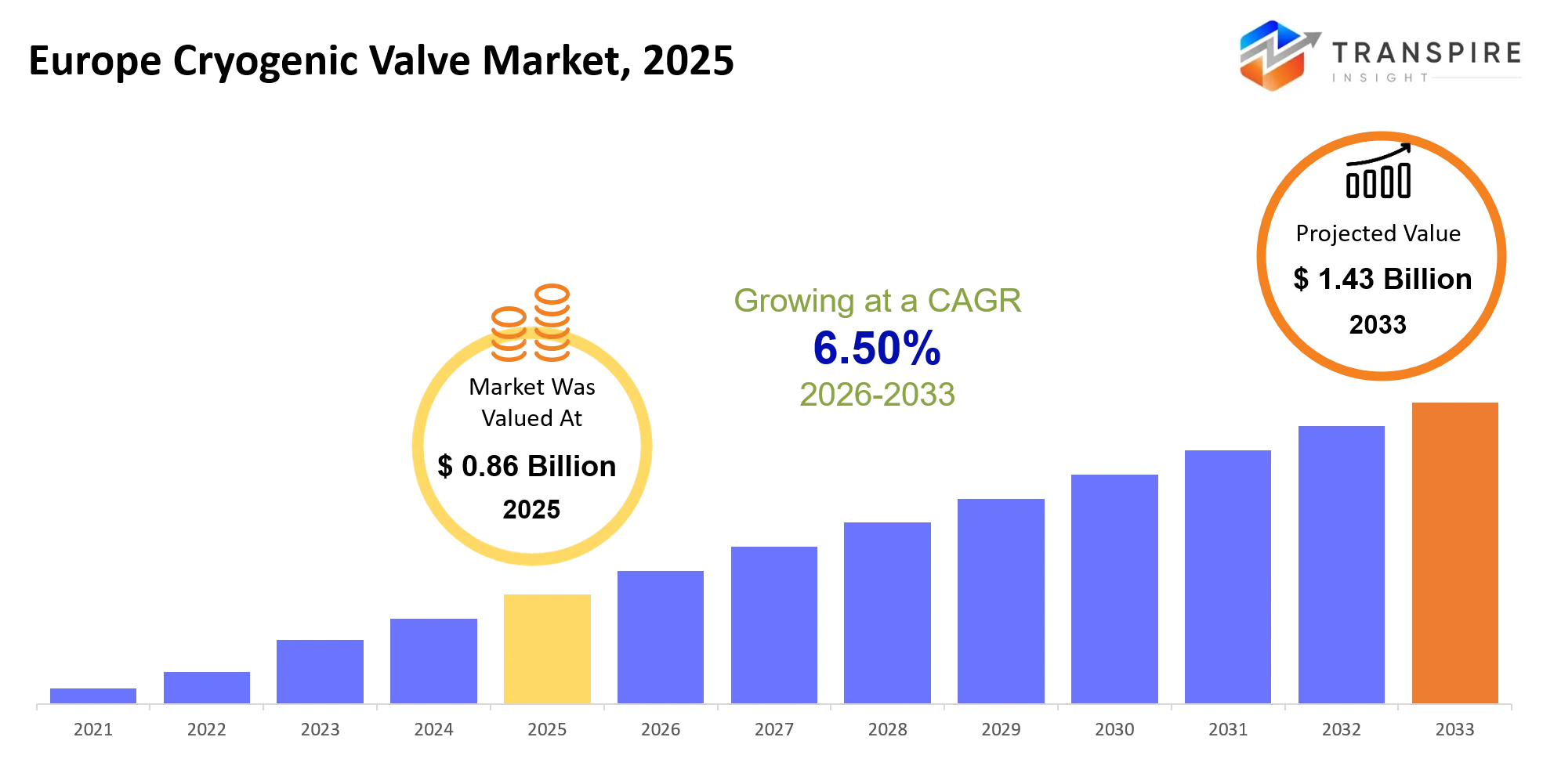
As per Transpire Insight Analysis the Europe Cryogenic Valve Market size is estimated at USD 0.86 Billion in 2025 and is anticipated to reach USD 1.43 Billion by 2033, growing at a CAGR of 6.50% from 2026 to 2033.
Air freight software supports airlines, freight forwarders, airports, and ground teams. It lets them handle bookings, cargo paperwork, shipment updates, space planning, rules and compliance, and daily operations data. These tasks run better when the systems are linked and the work moves through digital steps.
In the past three to five years, the industry changed. Many groups moved away from scattered emails and paper work. They began using cloud systems. They also adopted APIs, e-AWBs, and common ways to share data.IATA also set ONE Record as the cargo data sharing standard. The plan is to make it the preferred standard starting January 2026. Airlines make up over 70 percent of the world air waybill flow. That means most carriers are likely to adopt it soon.
Other factors added pressure too. Supply issues and tough cross border paperwork pushed operators to want live visibility. Many teams also wanted more automated work to cut delays and errors.Today, growth keeps coming. The main driver is less hand work. Another driver is the need to connect many cargo partners. There is also more focus on digital compliance. As a result, more money is going into tools for cargo handling, reporting and analytics, document work, and system integration services.
Europe Cryogenic Valve Market Size & Forecast:
- Europe Cryogenic Valve Market Size 2025: USD 0.86 Billion
- Expected Market Value 2033: USD 1.43 Billion
- Forecast CAGR: 6.50%
- Leading region in 2025:Germany
- Fastest Growing region:Norway
- Key Profile: Flowserve, Emerson, Parker Hannifin, Velan, Bray International, HEROSE, Cryofab, Habonim, KITZ, Samson, IMI, Baker Hughes, KSB, Metso, Weir Group
Key Market Insights
- In 2025, Germany was the biggest player in the regional air cargo market. Frankfurt played a key role as a main cargo entry point. Exports stayed strong in both pharmaceuticals and automotive.
- France is set to grow faster next. Airline digitization is picking up. More firms are adopting cloud tools. Cargo data exchange is becoming more standard, too.
- Most companies prefer cloud tools for day to day work. Cargo operators are leaving older stand alone setups. They want systems that can scale. They also want access through APIs.
- Cargo management software is still central in this space. It helps with bookings. It supports capacity planning. It manages paperwork. It processes shipments. It also helps teams coordinate daily operations.
- Tracking and visibility tools are now a bigger deal. Freight forwarders want shipment updates in real time. They need this across airlines, ground handlers, airports, and other logistics partners.
- Airlines are a main group buying these tools. At the same time, freight forwarders and ground handlers are spending more on software. They want help with document work and smoother handoffs between teams.
- Since January 2026, ONE Record has been the main data sharing standard. Over 70% of global air waybill volume is on a path to use it.
- AI document automation is moving ahead of the pilot stage. CHAMP A2Z Scan is one example. It cut AWB capture time at WFS Dublin from four minutes to 30 seconds.
- IATA said global air cargo demand rose 5.6% year over year in January 2026. That adds pressure for tools that can plan cargo at scale and show shipments clearly.
- More and more, firms are pairing platform software with AI automation. They also use APIs. They form partnerships to make integration easier across split parts of the supply chain.
What are the Key Drivers, Restraints, and Opportunities in the Europe Cryogenic Valve Market?
Driver: Digital standardization is a key structural force. IATA plans for ONE Record as the go-to way to share cargo data starting in January 2026. Most airlines, at over 70% of the global air waybill volume, are already working to adopt it. This change cuts down on scattered messages and the need to fix mismatched data by hand. It also makes it easier for airlines, forwarders, and handlers to put money into cargo tools that work well together, including APIs and system links.
Restraint: Old systems still slow progress. In Europe, cargo networks tie together airlines, airports, handlers, customs teams, forwarders, and logistics firms. Each group often uses its own software and its own data layout. Moving to a new approach means a lot of setup and checks. Teams must do integration tasks, add security controls, train staff, and run real-world tests. As a result, rollout takes longer, and software vendors may see delayed revenue.
Opportunity: Smarter automation is the next big chance. CHAMP A2Z Scan has shown how value can come from automated document handling. At WFS in Dublin, it cut AWB capture time from four minutes down to about 30 seconds. There are similar uses for customs forms, handling of exceptions, shipment checks, planning of capacity, and forecasting. These can support new software parts and also boost day-to-day output. When European players use AI and also align with ONE Record compatible tools, vendors that offer modular and plug-in friendly solutions should find a better market.
What Has the Impact of Artificial Intelligence Been on the Europe Cryogenic Valve Market?
AI is changing how air cargo software works. It is shifting tasks from simple transaction steps to tools that help people decide faster, and with less work.Airlines and ground teams already use AI plus OCR. They pull key fields from the Air Waybill. Then they check one record against another. When things do not match, the system flags it. That cuts down on typing by hand.
CHAMP A2Z Scan is a clear example. In a Dublin warehouse, WFS brought AWB capture from four minutes down to 30 seconds. That is a gain of over 85%. IAG Cargo also started using A2Z Scan in 2025. The goal was to handle paper AWB and document conversion with less manual work.Machine learning can help with shipment forecasts. It can also support capacity plans. It can spot odd cases, help with revenue choices, and review day to day operations.
Real time cargo data matters here. As ONE Record grows through the network, it can make these forecasts more useful. Still, AI rollouts have costs. Legacy data is often uneven. There are also strict checks needed for operational documents.Another issue is that trading partners do not all use the same standards. That can limit model results. It can also slow down deployment across busy cargo routes in Europe.
Key Market Trends
- Since 2024, many airlines and freight agents have moved to cargo platforms that can work together. They no longer rely as much on separate message tools and repeated data entry.
- Starting in January 2026, ONE Record is set to become the main standard for sharing cargo details. That shift is pushing more money into shared digital systems.
- Document work that uses AI has also changed. In 2025, CHAMP and IAG Cargo rolled out more automated AWB flows. The effort moved past early trials.
- WFS reported big gains after it sped up AWB capture. The time dropped from four minutes to about 30 seconds. It said the result was better than 85% in efficiency
- Shipments are getting more attention for real-time tracking. When cargo data is split across tools, teams end up doing the same work again. That can cause delays and also raise compliance risk.
- Online trade has added pressure too. E-commerce keeps growing, and companies want software that can line up house waybill data with the airline master waybill.
- For ONE Record, the numbers look strong. Over 70% of global air waybill volume is expected to follow the ONE Record rollout. This is likely to keep demand high for secure shared platforms.
- Air cargo demand in January 2026 rose by 5.6% versus the prior year. That growth supports more investment in tools for planning and cargo operations.
- Vendors are also leaning on partnerships. The goal is to link transport-management systems, cargo platforms, eAWBs, and agreed data-sharing rules.
- AI is doing more than reading documents now. It is being used for forecasts, spotting odd patterns, improving capacity use, supporting revenue actions, and making routine operational choices automatically.
Europe Cryogenic Valve Market Segmentation
By Valve Type
Globe valves are used to control flow and throttle in cryogenic setups. Gate valves are meant for full isolation, and they keep pressure drop low. Ball valves shut fast and seal well, so they fit LNG service, industrial gas lines, and hydrogen systems. Butterfly valves are compact and light. Check valves stop backflow in cryogenic piping and plant gear. Safety valves guard the system if pressure rises too much during unusual operation.
Control valves handle flow, pressure, and temperature changes with careful tuning. Relief valves vent extra pressure to help protect storage tanks, pipe runs, and processing units. Picking the right valve type depends on the temperature, the pressure, what the fluid is like, the needed flow rate, how tight the leakage limits must be, and the site layout. The need for valve designs made for tough service will keep growing with LNG facilities, hydrogen work, industrial gas output, medical use, and aerospace programs.
By Cryogenic Temperature
When temperatures drop under −196°C, valve designs have to keep sealing tight, even in very harsh cold. The key point is how the valve holds pressure. It also has to keep the seal steady over time.From −196°C down to −150°C, valves are mainly for cryogenic liquids. Common examples are liquid nitrogen and liquid oxygen.From −150°C to −100°C, the work is more about intermediate low temperature service. The requirements still stay in the cold range, but they are not at the deepest end.From −100°C to −50°C, valves are used for industrial transfer tasks that need careful handling at low temperature. From −50°C to −20°C, the conditions are not as severe. Still, the system fits within a cryogenic type range.
The LNG Temperature Range covers valves meant for liquefied natural gas. This covers storage, transport, and processing.The Hydrogen Temperature Range looks at valve parts and seals made for hydrogen service. Hydrogen raises strict leakage demands. It can also create issues with material compatibility.Ultra-Low Temperature use cases show up in scientific, medical, aerospace, and other industrial systems. These systems run under extreme cold. How the temperature level is set guides which materials are chosen. It also affects how the valve is made, what insulation is used, which seal type is selected, and how pressure is controlled during operation.
By Application
LNG work is a major use case for cryogenic valves. These valves show up at liquefaction sites, storage terminals, transport links, and regasification plants. Industrial Gases also depend on cryogenic valves. They use them for oxygen, nitrogen, argon, and other gases. This happens in production steps, storage setups, and distribution. Hydrogen needs valve designs that support safe service. Those valves are used in making hydrogen, storing it, moving it, and dispensing it. In healthcare and medical work, cryogenic valves serve gas system lines. They support oxygen systems and medical units built for special treatment.
Cryogenic Research relies on specialized valves. Labs and testing rooms use them. You also see them in superconducting setups and other scientific tools. Food Processing uses cryogenic systems for fast freezing and chilling. It also helps with steps that require a controlled temperature. Aerospace needs valves that are light and dependable. These valves fit fuel systems and propulsion test work. They also handle tough thermal conditions. Chemical Processing uses cryogenic valves for low temperature steps. They support gas handling, separation runs, and storage systems. These setups need controlled flow and steady isolation.
By Material
Stainless steel is known for strong resistance to rust, good strength, and steady use when it is very cold. That is why it is a common choice for cryogenic work.Carbon steel can be a solid option when the job does not push the temperature too far. It brings good strength along with lower cost. Brass and bronze can work well in some cold settings. They also tend to cut well in machining. They help when corrosion resistance is needed, but the range is limited.Aluminum is light and it handles heat in a useful way. Because of that, it can fit some specialized cryogenic equipment.Nickel alloys are made for tough temperature conditions. They hold up with high strength and strong corrosion resistance.
Monel is another nickel-based option. It resists corrosion well and it works in fluids that can be hard on materials.Special alloys are used when the demands are high. These cases may need careful balance of strength, corrosion resistance, stable behavior with cold, and compatibility with the materials in contact.Choosing the right metal depends on many factors. You look at the operating temperature and pressure. You also consider the fluid type, the mechanical loads, how much corrosion is expected, and how long the part must last.
By End User
Oil and gas firms put cryogenic valves into LNG sites. You will see them during production, tank storage, transport, and regas work.Industrial gas providers also need special valves. They handle oxygen, nitrogen, argon, and other industrial gases.
In healthcare, cryogenic tools and valves show up in medical gas supply. They also support systems that must stay at set low temperatures.Chemical companies use cryogenic valves for low temp steps. This includes processing, separation, tank storage, and controlled runs.Energy firms use these valves in LNG and hydrogen work. They also use them in other cold energy setups.Aerospace teams rely on valves for demanding duty. These fit propulsion systems, fuel handling, and tests. They also serve other specialized aerospace uses.Food companies use cryogenic setups for fast freezing and cooling. They also use them for food steps that need tight temperature control.Research groups use precise cryogenic valves in labs. They support experiments, superconducting gear, and other cold research systems.
By Region
Germany matters in Europe due to solid factory output, chemical work, strong engineering, and stable energy systems. France brings aerospace work, industrial gas uses, energy projects, and specific engineering needs. In the UK, oil and gas are well set, and there is also work in industrial gas, healthcare, aerospace, and research that fits cryogenic valves. Italy also sees demand from making goods, chemical processing, food work, and energy uses.
Norway stands out for LNG, power and energy setup, offshore work, and industrial needs. The Netherlands has big energy infrastructure, industrial gas plants, chemical processing, and strong transport links. Spain gets support from energy infrastructure plus industrial making, healthcare, and food processing. Sweden has active industry and engineering, healthcare services, energy work, and research that calls for special low temperature gear and dependable valve systems.
What are the Key Use Cases Driving the Europe Cryogenic Valve Market?
Cargo booking and shipment control are still key needs for airlines, freight forwarders, and cargo terminal operators. Digital booking tools help airlines place capacity better, cut down on back and forth, and share shipment details with different teams. Live tracking also matters, especially when volumes are high. It lets people see updates and exceptions sooner.
Freight forwarders and ground handling firms are using more software for paperwork tasks, warehouse work, customs steps, and eAir Waybill handling. Tools that automate documents have shown real results. At a Dublin warehouse, WFS cut the time to capture an AWB by over 85%. Airlines are also rolling out connected systems for income management, planning of capacity, and day to day reporting.
New work is expected to focus on ONE Record data sharing, AI help for handling exceptions, predictive analytics, and automated compliance flows. Starting in January 2026, ONE Record has become the go-to standard for cargo data exchange. This opens the door for platforms that link airlines, forwarders, handlers, airports, and regulators. The link is built on shared, real time data.
|
Report Metrics |
Details |
|
Market size value in 2025 |
USD 0.86 Billion |
|
Market size value in 2026 |
USD 0.92 Billion |
|
Revenue forecast in 2033 |
USD 1.43 Billion |
|
Growth rate |
CAGR of 6.50% from 2026 to 2033 |
|
Base year |
2025 |
|
Historical data |
2021 - 2024 |
|
Forecast period |
2026 - 2033 |
|
Report coverage |
Revenue forecast, competitive landscape, growth factors, and trends |
|
Regional scope |
Europe |
|
Key company profiled |
Flowserve, Emerson, Parker Hannifin, Velan, Bray International, HEROSE, Cryofab, Habonim, KITZ, Samson, IMI, Baker Hughes, KSB, Metso, Weir Group |
|
Customization scope |
Free report customization (country, regional & segment scope). Avail customized purchase options to meet your exact research needs. |
|
Report Segmentation |
By Valve Type (Globe Valves, Gate Valves, Ball Valves, Butterfly Valves, Check Valves, Safety Valves, Control Valves, Relief Valves); By Cryogenic Temperature (Below −196°C, −196°C to −150°C, −150°C to −100°C, −100°C to −50°C, −50°C to −20°C, LNG Temperature Range, Hydrogen Temperature Range, Ultra-Low Temperature); By Application (LNG, Industrial Gases, Hydrogen, Healthcare & Medical, Cryogenic Research, Food Processing, Aerospace, Chemical Processing); By Material (Stainless Steel, Carbon Steel, Brass, Bronze, Aluminum, Nickel Alloys, Monel, Special Alloys); By End User (Oil & Gas, Industrial Gas Companies, Healthcare, Chemical Companies, Energy Companies, Aerospace Companies, Food Companies, Research Institutes); By Region (Germany, France, UK, Italy, Norway, Netherlands, Spain, Sweden) |
Which Regions are Driving the Europe Cryogenic Valve Market Growth?
Germany is the top name in the European cryogenic valve space. The country has strong engineering work, major industrial gas output, and wide use of chemical processing. LNG and hydrogen plans keep adding new demand too. In 2024, Germany’s cryogenic valve assembly market was worth USD 248 million. By 2029, it is expected to reach USD 352.4 million.
Germany also has a lot of support around manufacturing. There are major industrial hubs and well-developed production sites. Buyers often follow tight rules for equipment used at low temperatures. This helps companies that make specialized control parts for cryogenic service. On top of that, money going into hydrogen systems and LNG terminals keeps driving valve changes, new installs, and related aftermarket work.
The UK is another key market in the region. Yet its growth does not match Germany in the same way. Demand there is tied more to existing energy networks. It also comes from industrial gas use. Aerospace work and offshore engineering matter as well. The UK has a mature industrial setup, so replacement and upkeep keep coming in on a steady basis. It does not depend only on big new build projects.
UK suppliers can also draw on long-standing technical skills. They serve cryogenic needs in LNG, healthcare, and industrial gases. With ongoing industrial spending and upgrades, the UK should keep contributing to European revenue in a steady way.
Norway is growing faster than the others. The main drivers are LNG facilities, hydrogen efforts, and offshore energy work. Norway is also still putting funds into energy sites. In 2025, Norwegian oil and gas investment was NOK 273 billion. That is an 8.7% rise from 2024. Plans for 2026 still point to high levels of spending.
Who are the Key Players in the Europe Cryogenic Valve Market and How Do They Compete?
Europe is still deciding cryogenic valve winners by performance. The top firms try to stand out with longer seal life, stable operation at very low heat, and meeting the needed certifications. They also offer hands on engineering support. In some cases, they build options for one job, not one size for all.
Flowserve, Emerson, Parker Hannifin, Velan, and HEROSE often show up in the same industry segments. Common areas include LNG, industrial gas work, hydrogen systems, and other cold temperature needs. Even with that overlap, the fight is not just about price. Project fit and proven engineering results count more now.If a job requires long qualification work at extreme cold, the older names often hold an edge. They have a history in safety critical installs. They tend to manage big and complex orders with fewer timing issues.Emerson promotes linked flow control. It markets cryogenic valves for LNG, hydrogen, air separation, and chemical processing. The range covers top entry valves and metal seated designs.
Parker Hannifin points to the Bestobell line. Some valves there are meant for very low liquid hydrogen conditions, as low as minus 253°C. It also provides listed applications tied to transport, storage, and processing.Velan applies its cryogenic valve skills to nuclear and aerospace work. Its plants in France also support LNG projects. The company also mentions space and research work.HEROSE focuses on valves made for LNG and hydrogen. The listings say the valves can be used down to minus 255°C. It also mentions certification for pressure equipment in strict duty conditions.
Company List
- Flowserve
- Emerson
- Parker Hannifin
- Velan
- Bray International
- HEROSE
- Cryofab
- Habonim
- KITZ
- Samson
- IMI
- Baker Hughes
- KSB
- Metso
- Weir Group
Recent Development News
"In April 2026, Emerson launched the Fisher IC2 Cryogenic Top-Entry Control Valve. The new valve operates at temperatures as low as −269°C and targets cold-box applications in air separation, hydrogen liquefaction, and LNG production, strengthening Emerson’s position in extreme-temperature flow control.https://www.emerson.com/en/corporate/news/2026/emersons-new-top-entry-cryogenic-valve-limits-leakage-fisher-ic2 (Emerson)."
"In February 2026, Flowserve announced the acquisition of Trillium Flow Technologies’ Valves Division for $490 million. The transaction expanded Flowserve’s engineered valve portfolio and aftermarket capabilities across power generation and critical infrastructure, strengthening its broader flow-control platform.https://www.flowserve.com/company/blog/flowserve-expands-leadership-nuclear-other-power-end-markets-strategic-acquisition-trillium-flow-technologies-valves-division (Flowserve)."
What Strategic Insights Define the Future of the Europe Cryogenic Valve Market?
In Europe, the cryogenic valve market is shifting toward equipment that fits a specific job and costs more. LNG plants, hydrogen systems, industrial gas production, and very cold research all push for less leakage and tougher materials.Investment in energy security and hydrogen buildout will drive much of the change. Still, the numbers can mask a real issue. Many hydrogen projects struggle with expensive production, unclear buyers, and slow decisions on new spending.There is also a smaller, newer area of work. This involves valves made for liquid hydrogen lines. Those lines can run near −253°C. At that level, materials must match the service well.
Parker Bestobell already makes cryogenic valves for liquid hydrogen use at these temperatures. That points to hydrogen hardware moving past only lab trials. To stay on track, buyers should focus on products that are cleared for hydrogen use. They should also look for seal systems that hold up over time. Support for European approval matters too.Suppliers should build ties with EPC contractors and energy project developers. Firms that have real technical depth and local repair support should be in a stronger position to win both new job work and service business through 2033.
Europe Cryogenic Valve Market Report Segmentation
By Valve Type
- Globe Valves
- Gate Valves
- Ball Valves
- Butterfly Valves
- Check Valves
- Safety Valves
- Control Valves
- Relief Valves
By Cryogenic Temperature
- Below −196°C
- −196°C to −150°C
- −150°C to −100°C
- −100°C to −50°C
- −50°C to −20°C
- LNG Temperature Range
- Hydrogen Temperature Range
- Ultra-Low Temperature
By Application
- LNG
- Industrial Gases
- Hydrogen
- Healthcare & Medical
- Cryogenic Research
- Food Processing
- Aerospace
- Chemical Processing
By Material
- Stainless Steel
- Carbon Steel
- Brass
- Bronze
- Aluminum
- Nickel Alloys
- Monel
- Special Alloys
By End User
- Oil & Gas
- Industrial Gas Companies
- Healthcare
- Chemical Companies
- Energy Companies
- Aerospace Companies
- Food Companies
- Research Institutes
By Region
- Germany
- France
- UK
- Italy
- Norway
- Netherlands
- Spain
- Sweden
Frequently Asked Questions
Find quick answers to common questions.
The expected Europe Cryogenic Valve Market size for the market will be USD 1.43 Billion in 2033.
Key segments for the Europe Cryogenic Valve Market are By Valve Type (Globe Valves, Gate Valves, Ball Valves, Butterfly Valves, Check Valves, Safety Valves, Control Valves, Relief Valves); By Cryogenic Temperature (Below −196°C, −196°C to −150°C, −150°C to −100°C, −100°C to −50°C, −50°C to −20°C, LNG Temperature Range, Hydrogen Temperature Range, Ultra-Low Temperature); By Application (LNG, Industrial Gases, Hydrogen, Healthcare & Medical, Cryogenic Research, Food Processing, Aerospace, Chemical Processing); By Material (Stainless Steel, Carbon Steel, Brass, Bronze, Aluminum, Nickel Alloys, Monel, Special Alloys); By End User (Oil & Gas, Industrial Gas Companies, Healthcare, Chemical Companies, Energy Companies, Aerospace Companies, Food Companies, Research Institutes); By Region (Germany, France, UK, Italy, Norway, Netherlands, Spain, Sweden)
Major Europe Cryogenic Valve Market players are Flowserve, Emerson, Parker Hannifin, Velan, Bray International, HEROSE, Cryofab, Habonim, KITZ, Samson, IMI, Baker Hughes, KSB, Metso, Weir Group
The Europe Cryogenic Valve Market size is USD 0.86 Billion in 2025.
The Europe Cryogenic Valve Market CAGR is 6.50% from 2026 to 2033.
- Flowserve
- Emerson
- Parker Hannifin
- Velan
- Bray International
- HEROSE
- Cryofab
- Habonim
- KITZ
- Samson
- IMI
- Baker Hughes
- KSB
- Metso
- Weir Group
About the Authors

Kartik bhong
I am Kartik Bhong, a Senior Research Analyst at Transpire Insight, specializing in the Packaging, Manufacturing, and Construction industry. My work focuses on analyzing market trends, emerging technologies, industry regulations, and competitive landscapes to deliver accurate, data-driven insights. I am passionate about transforming complex industry information into clear, practical content that helps businesses, professionals, and decision-makers stay informed and make confident strategic decisions. Through continuous research and a strong commitment to accuracy, I strive to create reliable, well-researched content that reflects the latest developments across these dynamic industries and supports the vision of Transpire Insight in delivering valuable market intelligence.

Chakradhar Khansole
Chakradhar serves as the Research Director at Transpire Insight, bringing over 8 years of experience in technology, innovation, and strategic market intelligence. He specializes in transforming complex market data into actionable business insights that enable organizations to make informed, growth-oriented decisions. Recognized for his strategic vision and analytical expertise, Chakradhar leads high-impact research initiatives, delivering comprehensive market assessments, competitive intelligence, and forward-looking industry analysis.
Recently Published Reports
-
Apr 2026
Handling and Lifting Equipment Market
Handling and Lifting Equipment Market Size, Share & Analysis Report By Product (Cranes and Hoists, Forklifts, Conveyor Systems, Aerial Work Platforms, Others), By Application (E-Commerce, Automotive and Railway, Food and Beverages, Aviation, Others), and Geography (North America, Europe, Asia-Pacific, Middle East and Africa, South and Central America), 2021 - 2031
-
Apr 2026
HVAC Equipment Market
HVAC Equipment Market Size, Share & Analysis Report By Heating Equipment Type (Boilers and Furnaces, Heat Pumps, and Unitary Heaters), By Ventilation Equipment (Air Handling Units, Humidifiers and Dehumidifiers, Air Filters, and Fan Coiling Units), By Air Conditioning Equipment (Unitary Air Conditioners, Room Air Conditioners, Packaged Terminal Air Conditioners, and Chillers), By End User (Commercial, Residential, Industrial, and others), and Geography (North America, Europe, Asia-Pacific, Middle East and Africa, South and Central America), 2021 – 2031
-
Apr 2026
Refrigeration Valves Market
Refrigeration Valves Market Size, Share & Analysis Report By Type (Solenoid Valves, Expansion Valves, Check Valves, Service Valves, Others), By Application (Commercial Refrigeration, Industrial Refrigeration, Transport Refrigeration, Residential Refrigeration, Air Conditioning Systems), By End User (Food and Beverage Industry, Pharmaceutical Industry, HVAC Industry, Chemical Industry, Others), and Geography (North America, Europe, Asia-Pacific, Middle East and Africa, South and Central America), 2021 – 2031
-
Apr 2026
E-Commerce Packaging Materials Market
E-Commerce Packaging Materials Market By Material Type (Corrugated Boxes, Paper & Paperboard, Foam & Cushioning Materials, Plastic Packaging, Flexible Packaging, Protective Packaging, Others), By Product(Primary Packaging, Secondary Packaging, Tertiary Packaging), By Packaging Function (Protective Packaging, Branding & Presentation Packaging, Transit & Logistic Packaging, Sustainable Packaging, Tamper Evidence Packaging), By End-User (Retail & Consumer Goods, Electronic Appliances, Food & Beverages, Healthcare & Pharmaceutical, Fashion & Apparel, Home & Furnishing, Others); By Industry Analysis, Size, Share, Growth, Trends, and Forecasts 2021-2033