
Europe Cash in Transit Bags Market Summary
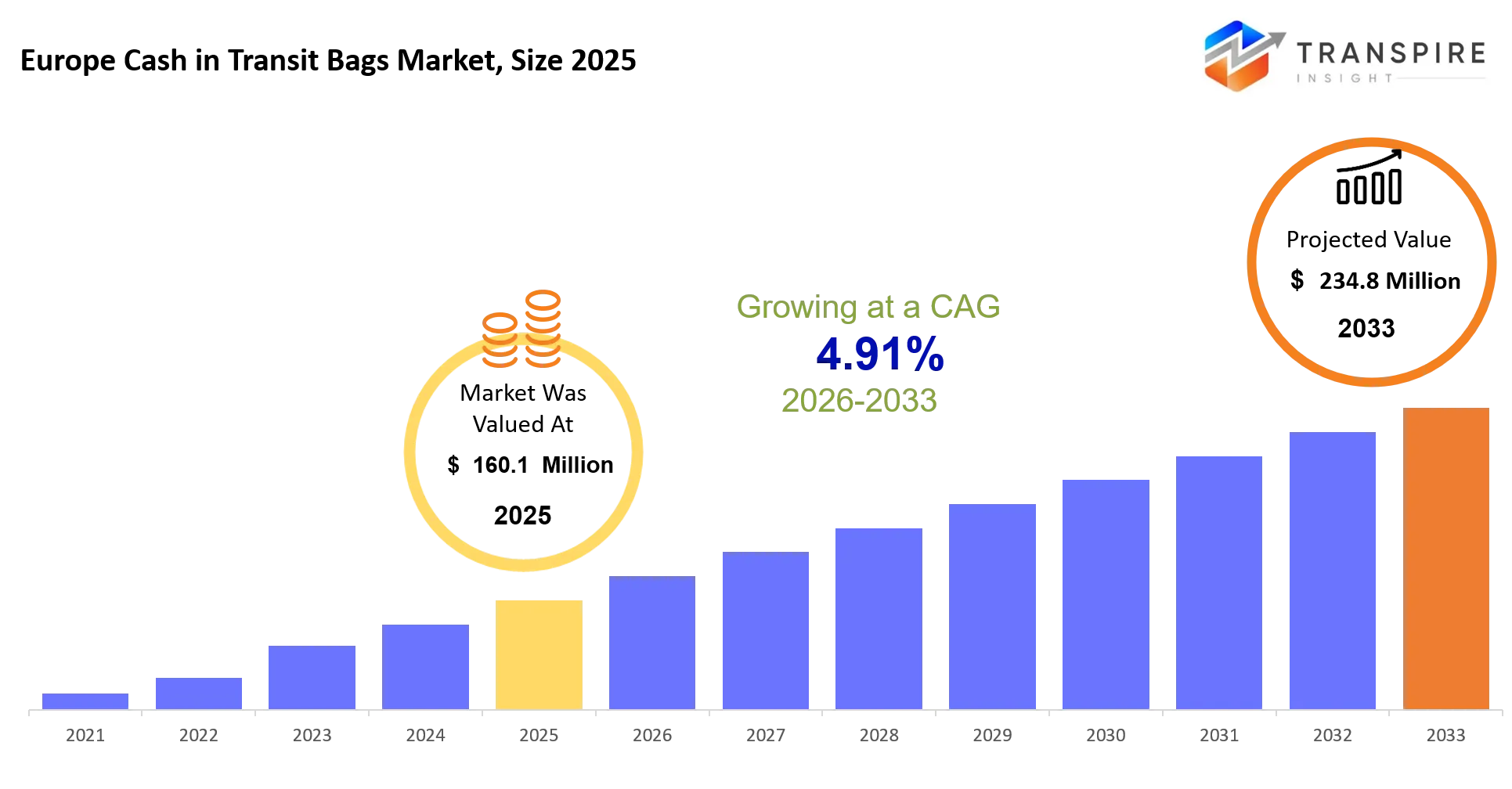
As per Transpire Insight Analysis, the Europe Cash in Transit Bags Market size is estimated at USD 160.1 Million in 2025 and is anticipated to reach USD 234.8 Million by 2033, growing at a CAGR of 4.91% from 2026 to 2033.
The Europe Cash in Transit Bags Market actually supports banks, retailers, cash handlers, as well as security service providers by helping with the safe pickup, transport, and short term holding of physical currency and valuable assets during usual day to day financial work. In the last 3–5 years, the market has moved, but not in a simple way, because many companies started leaning more into safer, traceable, and tamper-resistant packing choices, often with digital tracking features worked in. Because of that, smart security components, like RFID enabled identification and advanced seals, have really reshaped the way organizations handle cash transit, and also how they keep people accountable for it.
One big spark was the COVID-19 disruption, along with changes that happened across retail cash routines, which basically forced operators to tighten security protocols and improve operational control , sometimes quickly. Going forward, as financial institutions and retailers keep fine tuning cash logistics, the need for robust and regulation friendly transit products should keep increasing, and that opens room for manufacturers who focus on security innovation and tailored designs.
Europe Cash in Transit Bags Market Size & Forecast:
- Europe Cash in Transit Bags Market Size 2025: USD 160.1 Million
- Expected Market Value 2033: USD 234.8 Million
- Forecast CAGR: 4.91%
- Leading region in 2025: Germany, the United Kingdom, France, and the Netherlands
- Fastest Growing region: Poland, Czech Republic, Romania, Hungary, and Bulgaria
- Key Profile: Coveris, Versapak, Truseal, Harcor Security Seals, Dynaflex, Ampac Holdings, ProAmpac, Initial Packaging Solutions, Packaging Horizons, Security Packaging, ITW Envopak, Mega Fortris, Nelmar Security Packaging, Sealed Air, A. Rifkin Co.
Key Market Insights
- Western Europe basically takes over the industry size with roughly 58% market share in 2025, and it looks like Germany UK France and Netherlands are doing most of the heavy lifting there.
- Eastern Europe becomes the fastest growing area during 2025–2033, mostly because Poland, Romania and Hungary are upgrading their cash handling setups, step by step.
- In terms of products reusable cash bags seem to lead the pack with close to 45% share, mostly backed by cost savings and that repeated institutional usage thing across Europe, yes it matters.
- Disposable cash bags sit in the second largest segment, largely because they are convenient for retail, and also because high-volume cash operations like the easy handling.
- Smart-enabled transit bags are predicted to be the fastest-growing segment from 2026–2033, driven by RFID and digital tracking adoption becoming more common.
- For applications, banking institutions dominate, about 50% in 2025, mainly due to strict currency security requirements that cannot be skipped.
- On the other hand retail cash management is the quickest growing application, since supermarkets and other companies improve secure collection procedures over time.
- When it comes to end users Banks and financial institutions lead with more than 45% share, largely because they have extensive cash movement networks already in place.
- Retail chains are the fastest-growing end-user category too, as automated cash collection systems keep expanding across Europe.
What are the Key Drivers, Restraints, and Opportunities in the Europe Cash in Transit Bags Market?
A big growth driver is the move toward digitally enabled security setups. New compliance demands , plus tech upgrades, kinda pushed adoption of RFID tracking , tamper detection, and automated monitoring things. With this kind of setup cash logistics providers can cut down on handling mistakes , boost asset visibility, and also tighten customer obligations. Since banks and retailers keep asking for higher accountability , manufacturers that bring integrated security solutions are starting to see more revenue chances.
The main restraint is that the supply chain stays fragmented , and there’s heavy dependence on specialized security material suppliers. Manufacturing can drag out , component availability can be thin, and regional certification rules often slow actual rollout. These obstacles are not easy to fix fast, because suppliers need long qualification cycles . The knock-on effects show up as postponed contracts, delayed innovation releases, and fewer expansion options for smaller manufacturers.
The next growth phase should come from connected transit solutions that mix smart sensors with digital cash management platforms. Money for automated retail systems and banking infrastructure across Eastern Europe is creating openings for advanced reusable bags with tracking capabilities. Firms that build interoperable solutions stand to gain when future procurement shifts happen.
What Has the Impact of Artificial Intelligence Been on the Europe Cash in Transit Bags Market?
Artificial intelligence and digital technologies are slowly, kind of, transforming cash logistics by boosting monitoring , security control, and compliance management. With AI- based platforms, organizations can sift through transit data, spot unusual motion patterns, and even help with automated reporting for financial institutions and security teams. Then there are digital identification systems that get tied in with smart cash bags, so operators can track asset movement more precisely, and maybe lessen the amount of manual checking they need to do. At the same time machine learning models are getting used for demand forecasting , which supports service providers to fine-tune inventory levels, guess replacement cycles better, and strengthen day to day operational planning. All these features tend to improve how resources get used and can cut down delays in cash handling routines. Advanced analytics also has the potential to refine route planning and service coordination, leading to efficiency gains across collection networks. Still, AI adoption stays somewhat restricted by expensive integration work, patchy data availability, and occasional connectivity trouble in certain operational areas. A lot of organizations end up putting in major investment just to link older cash management systems with newer digital platforms. As the underlying infrastructure keeps getting better, AI powered solutions will likely take on a bigger part in security optimization and performance management.
Key Market Trends
- RFID-enabled cash bags kinda got a lot more attention after 2022, and security providers started folding tracking into what used to be fairly standard transit solutions, so it felt like a change in the usual setup.
- Reusable bag adoption seemed to climb between 2021 and 2025, mainly because organizations wanted lower replacement expenses and a better sustainability score, not just the “security part” alone.
- European banks upped their spending on automated cash management systems after 2020, which helped push demand for more advanced security packaging , especially where efficiency mattered.
- Digital seal technologies came into the picture during 2023–2025, and that improved tamper detection while also giving chain-of-custody processes a stronger kind of grip.
- Loomis expanded tech-driven cash handling services across Europe, which basically points to a shift toward integrated security platforms, rather than isolated offerings.
- Retailers started using smarter collection solutions after 2022, because cash processing automation became a strategic operational focus, you know, the “must do” priority.
- Supply chain diversification became more of a deal after the 2021 disruptions, since those events exposed dependency risks among security packaging suppliers , and nobody wanted that again.
- In Eastern Europe, the adoption momentum looked stronger from 2024, as banking modernization programs rolled out, and the timing lined up well.
- Manufacturers in 2025 also leaned harder into durable reusable designs, to hit cost optimization goals as well as environmental targets, at the same time.
Europe Cash in Transit Bags Market Segmentation
By Product Type :
Tamper-evident bags still feel important for secure currency movement, because advanced sealing approaches help to lower the likelihood of unauthorized access and all that. Deposit bags support the everyday cash collection routines across banks, retailers and service operators, mainly through dependable storage features. Security bags give stronger protection for high-value transfers, using durable builds and adding improved tracking compatibility.
Coin bags keep showing up for businesses managing large volumes of coins, most notably retail setups and financial service locations. Courier bags handle document passing and valuable item transfers where controlled movement is basically required. Other product categories will get more attention too, with custom layouts that match the particular security needs. Product innovation tends to drift toward stronger materials, reusable structures, and better identification features, so the system stays consistent.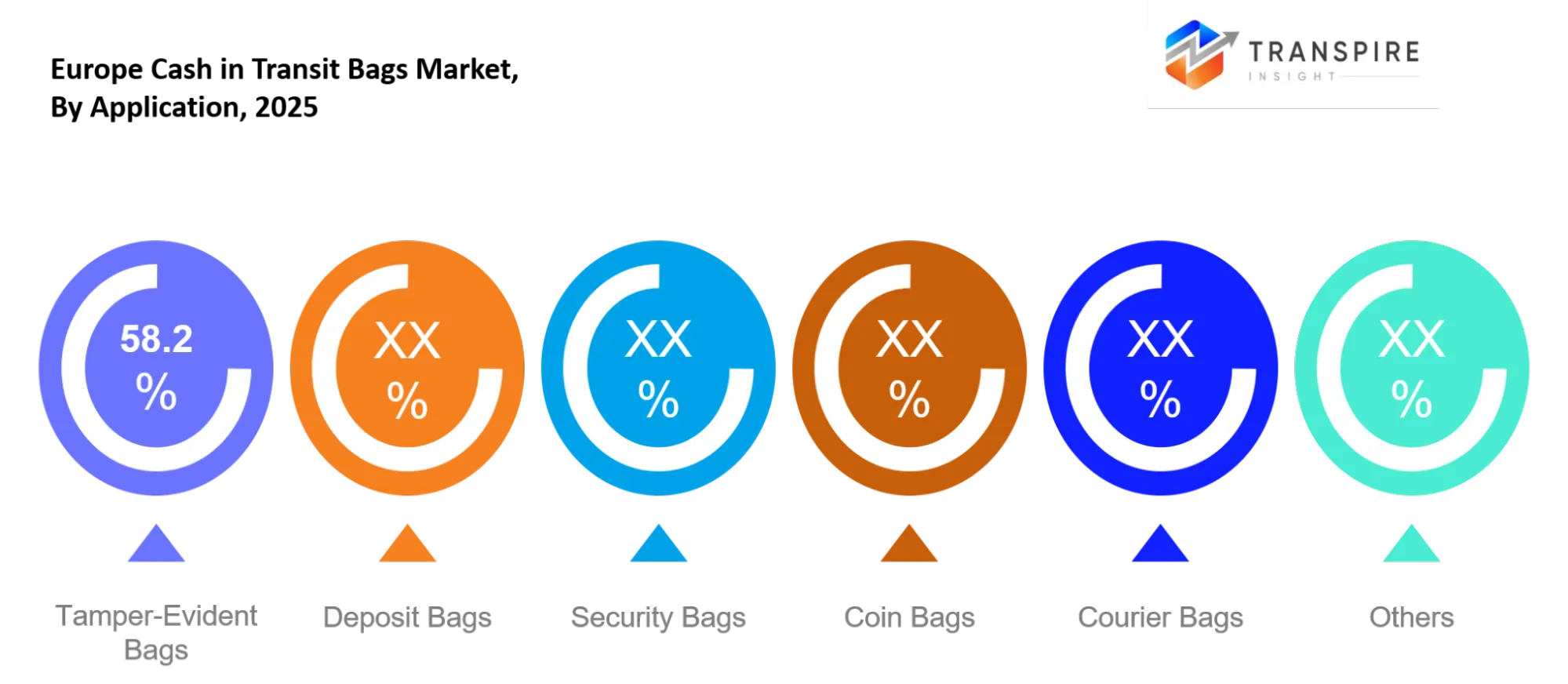
By Material :
Plastic materials remain widely used because lightweight construction plus durability, and cost efficiency really supports mass production. Polyethylene materials bring flexibility, and resistance against tearing, which is why these types are practical for repeated handling. Paper materials still handle short-term cash transfer needs too, especially where lower-cost solutions are preferred and nobody wants to overcomplicate it.
Fabric materials can work well for reusable security bags with improved strength and longer service life. Composite materials will likely see more adoption, because they combine multiple material benefits into advanced protection features. Material selection depends on security requirements, operational conditions, and the sustainability goals. Manufacturers will focus on upping durability while still keeping practical handling characteristics, not making everything too stiff or annoying to manage.
By Application :
Banking applications kind of show up a lot because financial institutions need secure movement of physical currency between branches, and also processing facilities. Retail applications keep expanding too, as supermarkets, stores, and commercial outlets improve how they handle cash collection. Cash logistics operations lean on secure bags so the transfers stay controlled while transportation is happening, kind of continuously through the day.
Government applications often use security packaging for controlled financial work and sensitive cash movements. Hospitality businesses also apply secure bags for daily cash management across hotels and service locations, even when traffic gets busy. Other uses will still show up as organizations improve internal security practices over time. Digital tracking integration will help with better monitoring across multiple areas, without as much guesswork.
By End User :
Banks stay the leading end users because they regularly handle currency, and they must follow strict security standards. Retail chains keep adopting secure cash transfer solutions as store networks grow, and centralized cash management becomes more common. Cash-in-transit companies depend on reliable bags to shield valuable shipments, and still keep operational control.
Casinos need specialized security solutions because high-value cash movements demand careful monitoring procedures. Government agencies use secure bags for controlled financial transactions as well as administrative operations. Other end users will adopt improved solutions as security expectations rise. Future adoption will depend on product reliability, compliance needs, and operational efficiency improvements overall.
By Distribution Channel :
Direct sales still feel like a top choice for a while, since big organizations usually need tailored solutions and they tend to stick with suppliers for the long run, so relationships matter. Security equipment distributors , in a way, help you get broader reach through networks that are already in place, and those networks cover financial as well as commercial customers. At the same time online retail channels are picking up speed, especially when smaller businesses want an easy and convenient way to buy.
Digital purchasing platforms will likely make it easier to compare products quickly and find security packaging solutions without much hassle. Meanwhile, other distribution routes will grow via specialized suppliers and regional partnerships. In the end channel expansion should let manufacturers connect with different buyer groups across multiple European countries. Their distribution strategies will probably keep leaning on service quality, steady availability, and meeting customer specific requirements, not just selling the hardware and moving on.
What are the Key Use Cases Driving the Europe Cash in Transit Bags Market?
Banking operations kinda are the center use case, with banks buying secure bags for branch transfers, cash handling, and moving regulated currency around. There are strict security rules, audit obligations, and a lot of transactions, so financial institutions and cash processing providers become the main buyers, like the strongest demand basically.
Retail chains are also pushing more adoption, driven by in store cash collection plus centralized processing activities. Cash in transit providers further lean on these advanced bags for controlled transportation services, so commercial clients can get secure movement and better compliance oversight, or whatever you wanna call it.
Newer uses are starting to show up too, like government cash services, and hotel cash management. Public organizations and hotel groups are looking at improved security packaging, since digital traceability functions and tighter compliance requirements get more common during the forecast window.
|
Report Metrics |
Details |
|
Market size value in 2025 |
USD 160.1 Million |
|
Market size value in 2026 |
USD 167.9 Million |
|
Revenue forecast in 2033 |
USD 234.8 Million |
|
Growth rate |
CAGR of 4.91% from 2026 to 2033 |
|
Base year |
2025 |
|
Historical data |
2021 - 2024 |
|
Forecast period |
2026 - 2033 |
|
Report coverage |
Revenue forecast, competitive landscape, growth factors, and trends |
|
Country scope |
Europe (Germany, United Kingdom, France, Italy, Spain and Rest of Europe) |
|
Key company profiled |
Coveris, Versapak, Truseal, Harcor Security Seals, Dynaflex, Ampac Holdings, ProAmpac, Initial Packaging Solutions, Packaging Horizons, Security Packaging, ITW Envopak, Mega Fortris, Nelmar Security Packaging, Sealed Air, A. Rifkin Co. . |
|
Customization scope |
Free report customization (country, regional & segment scope). Avail customized purchase options to meet your exact research needs. |
|
Report Segmentation |
By Product Type (Tamper-Evident Bags, Deposit Bags, Security Bags, Coin Bags, Courier Bags, Others); By Material (Plastic, Polyethylene, Paper, Fabric, Composite Materials, Others); By Application (Banking, Retail, Cash Logistics, Government, Hospitality, Others); By End User (Banks, Retail Chains, Cash-in-Transit Companies, Casinos, Government Agencies, Others); By Distribution Channel (Direct Sales, Security Equipment Distributors, Online Retail, Others) |
Which Regions are Driving the Europe Cash in Transit Bags Market Growth?
Western Europe kind of owns the dominant spot in the Europe Cash in Transit Bags Market , with roughly 58% market share by 2025. This comes from strong banking rules, very strict cash protection standards, and well-developed financial infrastructure, so adoption stays higher across Germany, the United Kingdom, France, and the Netherlands. The area also has established cash logistics providers, security gear manufacturers, and ongoing spending on automated cash handling systems that keep getting more mature. Overall leadership should keep going through 2033, because mature financial networks keep asking for secure, compliant and technology enabled transport arrangements , basically the same theme continues.
Southern Europe looks like a stable revenue contributor, mainly because banking work stays consistent, cash management is regulated, and commercial activity moves steadily. Nations like Italy, Spain, and Portugal keep steady demand through retail channels, banking institutions , and even tourism-related organizations that need careful cash transport. Investment there supports gradual take up of reusable, plus tamper-resistant options. So with financial services and retail infrastructure remaining solid, market participation should persist across the forecast window , without big disruption.
Eastern Europe is the fastest-growing region. Countries such as Poland, Romania, Hungary, and the Czech Republic are improving banking infrastructure and modernizing cash handling methods. In the last period there were upgrades in retail automation, security renovations, and operational streamlining, which opened up fresh adoption possibilities. This growth, from 2026 to 2033, will likely pull in manufacturers and investors , looking for room to expand via partnerships, regional distribution routes , and newer security product offerings that feel more advanced.
Who are the Key Players in the Europe Cash in Transit Bags Market and How Do They Compete?
Competition in the Europe Cash in Transit Bags Market stays moderately fragmented , so yeah, manufacturers still go head to head using a mix of product durability and security technology, plus customization options and distribution ability . Some of the well known players are basically focused on keeping the old customer ties strong , while the more specialized ones keep pushing reusable designs, tracking features, and a bit of tailored security problem solving . Even with that , price efficiency, material innovation and compliance support continue to be the things buyers keep circling back to.
Loomis , for instance, shows up with integrated cash management services and secure handling solutions, where transportation, processing, and technology support get bundled together. G4S tends to lean on its wider security operations and logistics skills, and it leans on a large service network to match cash movement needs. Prosegur differentiates by putting more weight on technology investment, digital monitoring tools, and customized security procedures aimed at both financial and commercial customers.
Gunnebo AB builds security equipment that is pretty specialized, with an emphasis on protective systems and tailored solutions for financial settings. Versapak meanwhile strengthens its position with reusable transit bag concepts, tough materials, and sustainability oriented product development . Overall, these moves help the companies grab demand from banks, retailers, and cash logistics providers, the ones that want dependable security packaging, not just any ordinary bag .
Company List
- Coveris
- Versapak
- Truseal
- Harcor Security Seals
- Dynaflex
- Ampac Holdings
- ProAmpac
- Initial Packaging Solutions
- Packaging Horizons
- Security Packaging
- ITW Envopak
- Mega Fortris
- Nelmar Security Packaging
- Sealed Air
- A. Rifkin Co.
Recent Development News
In February 2026, Brink’s announced an agreement to acquire NCR Atleos for $6.6 billion. The transaction expands Brink’s cash management infrastructure and ATM service capabilities, strengthening its position in secure cash logistics operations that rely on transport and protection solutions such as cash in transit bags. Source https://investors.brinks.com/
In 2025, Versapak International Ltd was acquired by a family investment group with experience in retail, security, and logistics. The acquisition supports Versapak’s expansion as a global supplier of tamper-evident security products, including reusable cash in transit bags, by providing investment backing for product development and market growth.
Source https://versapak.co.uk/
What Strategic Insights Define the Future of the Europe Cash in Transit Bags Market?
Europe Cash in Transit Bags Market is expected to lean toward higher value security solutions over the next 5–7 years, and you can already see demand turning away from basic protective packaging to more digitally enabled, reusable, and trackable systems. This shift is mostly pushed by tighter security requirements , as well as cash handling modernization efforts that are happening across multiple channels.
There is also a not so obvious risk though, like technology substitution, because as cashless payments keep expanding and automated cash management platforms get more common, the long run demand for the older style transit bags could quietly shrink. In other words, the market may face pressure from new workflows, not only from competitors.
On the opportunity side, smart tamper evident bags baked with RFID, IoT tracking and compliance monitoring are starting to look very promising especially across parts of Western Europe, where security standards are still strongly enforced.
Market participants should probably focus on spending more into connected bag technologies, using sustainable materials , and improving their certification capabilities, because that combination should help them keep a stronger competitive position and win future business with banks, retailers, and cash logistics providers.
Europe Cash in Transit Bags Market Report Segmentation
By Product Type
- Tamper-Evident Bags
- Deposit Bags
- Security Bags
- Coin Bags
- Courier Bags
By Material
- Plastic
- Polyethylene
- Paper
- Fabric
- Composite Materials
By Application
- Banking
- Retail
- Cash Logistics
- Government
- Hospitality
By End User
- Banks
- Retail Chains
- Cash-in-Transit Companies
- Casinos
- Government Agencies
By Distribution Channel
- Direct Sales
- Security Equipment Distributors
- Online Retail
Frequently Asked Questions
Find quick answers to common questions.
The Expected Europe Cash in Transit Bags Market size for the Market will be USD 234.8 Million in 2033.
Key segments for the Europe Cash in Transit Bags Market are By Product Type (Tamper-Evident Bags, Deposit Bags, Security Bags, Coin Bags, Courier Bags, Others); By Material (Plastic, Polyethylene, Paper, Fabric, Composite Materials, Others); By Application (Banking, Retail, Cash Logistics, Government, Hospitality, Others); By End User (Banks, Retail Chains, Cash-in-Transit Companies, Casinos, Government Agencies, Others); By Distribution Channel (Direct Sales, Security Equipment Distributors, Online Retail, Others).
Major Europe Cash in Transit Bags Market players are Coveris, Versapak, Truseal, Harcor Security Seals, Dynaflex, Ampac Holdings, ProAmpac, Initial Packaging Solutions, Packaging Horizons, Security Packaging, ITW Envopak, Mega Fortris, Nelmar Security Packaging, Sealed Air, A. Rifkin Co.
The Current Europe Cash in Transit Bags Market size is USD 160.1 Million in 2025.
The Europe Cash in Transit Bags Market CAGR is 4.91% from 2026 to 2033.
- Coveris
- Versapak
- Truseal
- Harcor Security Seals
- Dynaflex
- Ampac Holdings
- ProAmpac
- Initial Packaging Solutions
- Packaging Horizons
- Security Packaging
- ITW Envopak
- Mega Fortris
- Nelmar Security Packaging
- Sealed Air
- A. Rifkin Co.
About the Authors

Chetan Dhatrak
I’m Chetan Dhatrak, a Senior Research Analyst at Transpire Insight, specializing in the Consumer Goods, Foods and Beverages industry. I focus on analyzing market trends, consumer behavior, competitive landscapes, and industry developments to deliver accurate, data-driven insights. My research at Transpire Insight is built on credible sources and in-depth analysis, helping businesses and readers better understand market dynamics, emerging opportunities, and evolving consumer preferences. I’m committed to creating reliable, well-researched content that supports informed decision-making and reflects the latest developments in the consumer goods and food & beverage sectors.

Chakradhar Khansole
Chakradhar serves as the Research Director at Transpire Insight, bringing over 8 years of experience in technology, innovation, and strategic market intelligence. He specializes in transforming complex market data into actionable business insights that enable organizations to make informed, growth-oriented decisions. Recognized for his strategic vision and analytical expertise, Chakradhar leads high-impact research initiatives, delivering comprehensive market assessments, competitive intelligence, and forward-looking industry analysis.
Recently Published Reports
-
Apr 2026
Bottled Water Market
Bottled Water Market Size, Share & Analysis Report By Product Type (Still Bottled Water, Carbonated Bottled Water, Functional Bottled Water, and Others), By Packaging (PET, Cans, and Others), By Sales Channel (Supermarkets/Hypermarkets, Convenience Stores/Drug Stores, Grocery Stores/Club Stores, Foodservice, and Others) and Geography (North America, Europe, Asia-Pacific, Middle East and Africa, South and Central America), 2021 - 2032
-
Apr 2026
Color Cosmetic Packaging Market
Color Cosmetic Packaging Market Size, Share & Analysis Report By Application (Mascara Packaging, Liquid Packaging, and Liquid Face), By Type (Tubes & Bottles, Pens & Markers, Compacts & Containers, and Droppers & Pumps), and Geography (North America, Europe, Asia-Pacific, Middle East and Africa, South and Central America), 2021 - 2031
-
Apr 2026
External Microphone For Camera Market
External Microphone For Camera Market Size, Share & Analysis Report By Type (Shotgun Microphone, Lavalier Microphone, and Others), By Application (Digital Camera, Professional Video Camera, and Others), and Geography (North America, Europe, Asia-Pacific, Middle East and Africa, South and Central America), 2021 - 2031
-
Apr 2026
Foot Orthotic Insoles Market
Foot Orthotic Insoles Market Size, Share & Analysis Report By Type (Pre-fabricated, and Custom-made), By Material (Thermoplastic, Composite Carbon Fiber, and Others), By Distribution Channel (Drug Stores, Hospitals & Clinics, and Others), and Geography (North America, Europe, Asia-Pacific, Middle East and Africa, South and Central America), 2021 - 2031