
Europe Bupropion Hydrochloride MarketSize & Forecast:
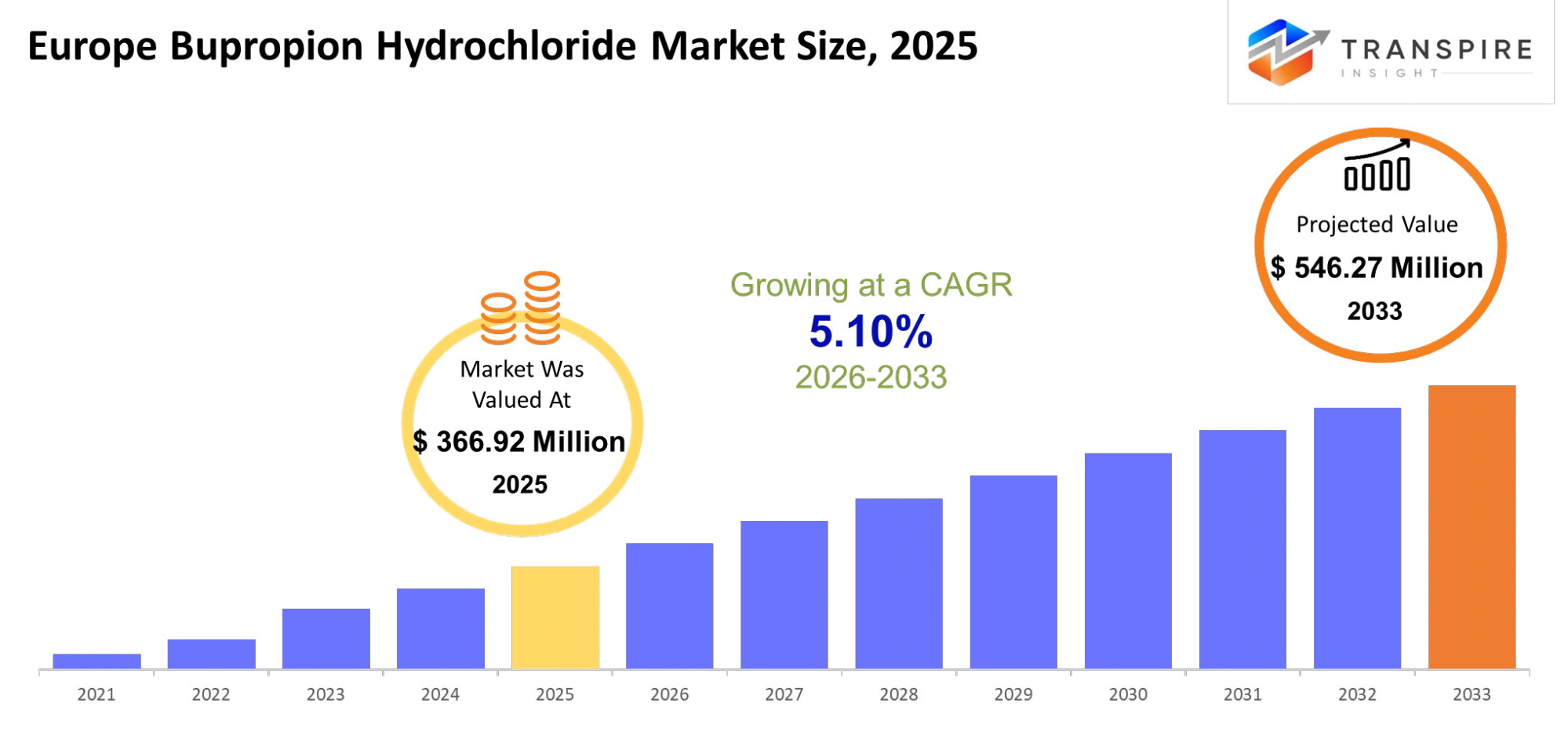
- Europe Bupropion Hydrochloride Market Size 2025: USD 366.92 Million
- Europe Bupropion Hydrochloride Market Size 2033: USD 546.27 Million
- Europe Bupropion Hydrochloride Market CAGR: 5.10%
- Europe Bupropion Hydrochloride Market Segments: By Type (Extended Release, Sustained Release, Immediate Release, Others); By Application (Depression Treatment, Smoking Cessation, ADHD Treatment, Others); By End-User (Hospitals, Clinics, Pharmacies, Homecare, Others); By Distribution (Hospital Pharmacies, Retail Pharmacies, Online Pharmacies, Others)
To learn more about this report,  Download Free Sample Report
Europe Bupropion Hydrochloride Market Summary
The Europe Bupropion Hydrochloride Marketwas valued at USD 366.92 Million in 2025. It is forecast to reach USD 546.27 Million by 2033. That is a CAGR of 5.10% over the period.
The Europe bupropion hydrochloride market serves a practical clinical role by helping physicians manage depression and support smoking cessation especially for patients who do not respond to first-line treatments and need to avoid specific side effects. The system provides doctors with an additional treatment method which enables them to create personalized treatment plans that enhance patient compliance.
Clinical practice patterns have evolved during the past three to five years because doctors now choose mental health treatments based on the specific needs and health conditions of their patients. The pandemic mental health crisis created a demand for treatment which revealed deficiencies in current healthcare delivery systems.
The combination of these factors has led to increased usage of non-SSRI treatments which include bupropion. The healthcare industry now requires better recovery outcomes and extended benefits for patients which results in continuous prescription demand. Manufacturers who maintain reliable supply chains and comply with regulations will achieve stronger market positions.
Key Market Insights
-
Western Europe dominates the Europe Bupropion Hydrochloride Market with a 65% market share which will reach this level in 2025 through the combined efforts of Germany , France and the UK.
-
Eastern Europe represents the fastest-growing region, with projected growth above 6% through 2030 due to improving healthcare access and diagnosis rates.
-
Sustained-release (SR) formulations hold the leading segment with over 45% share, driven by better patient compliance and controlled dosing benefits.
-
Extended-release (XL) formulations rank as the second-largest segment, widely prescribed for long-term depression management across European healthcare systems.
-
Immediate-release formulations show the fastest growth from 2024 to 2030, supported by niche clinical use cases and flexible dosing requirements.
-
The treatment of depression accounts for almost 70% of all applications because more cases receive clinical diagnosis and patients begin longer treatment periods.
-
Smoking cessation becomes the fastest-growing application through government-supported public health initiatives and tobacco reduction programs which European countries implement.
-
The Europe Bupropion Hydrochloride Market is led by hospitals and specialty clinics which control approximately 55% of the market through their structured psychiatric treatment programs and prescription monitoring practices.
-
Retail and online pharmacies are rapidly growing, expanding access and improving prescription fulfillment rates across urban and semi-urban populations.
-
Advanced manufacturing and supply chain resilience strategies enable companies to deliver their products continuously while protecting their market position.
What are the Key Drivers, Restraints, and Opportunities in the Europe Bupropion Hydrochloride Market?
The European Bupropion Hydrochloride Market experiences its main growth driver from the post-pandemic development of mental health treatment systems which European Union member states have built into their healthcare systems. The government agencies started to boost their financial support for mental health treatment facilities after the COVID-19 pandemic revealed the shortcomings of existing depression treatment systems which included methods for managing depression and preventing relapses. The existing policy framework caused doctors to choose different treatment methods which included medical solutions beyond standard SSRIs because they needed to treat patients who did not respond to initial therapy or suffered from adverse drug effects. The usage of bupropion as a treatment option became more common in medical practices that used it as an additional treatment for patients who needed second-line therapy. The result of this practice creates a situation where generic drug manufacturers achieve two benefits which include increased prescription sales and consistent income generation through their products that receive national reimbursement benefits.
European countries enforce tight regulations together with pricing rules which create the main obstacle that prohibits companies from conducting pharmaceutical business operations. National health authorities impose tight price controls and reference pricing systems that compress margins for off-patent drugs like bupropion hydrochloride. The system creates limited motivation for manufacturers to develop new products or create distinct marketable items. The different approval processes and reimbursement guidelines which each country follows create delays that affect companies trying to establish their products in new markets. The structural barriers prevent revenue growth while also stopping the process of market expansion which especially affects smaller markets and those with limited budgets.
The development of smoking cessation programs throughout Central and Eastern Europe presents a valuable business opportunity because tobacco use rates remain high in those regions. The medical industry is implementing its treatment programs through government agencies which extend their funding for prescription drugs. Bupropion stands to benefit as a non-nicotine option within these programs. The public health programs in Poland and Romania now include prescription-based cessation support which will help them establish new revenue streams through increased program participation.
What Has the Impact of Artificial Intelligence Been on the Europe Bupropion Hydrochloride Market?
The European bupropion hydrochloride market benefits from AI and digital technologies which help manufacturers and distributors optimize their production processes and quality assurance methods and their ability to track supply chain activities. Companies use AI-driven process control systems to automate their active pharmaceutical ingredient synthesis and tablet formulation processes which results in decreased batch variation and enhanced yield stability. Digital twins and real-time monitoring platforms enable manufacturers to track production parameters which helps them maintain Good Manufacturing Practice compliance while reducing expensive production errors.
Companies increasingly use machine learning models for their demand forecasting and inventory planning needs. The systems use prescription trends and smoking cessation program seasonal patterns and regional healthcare data to achieve more precise order volume predictions. The system decreases stockouts and overproduction which leads to better working capital efficiency and improved service levels throughout European distribution networks.
Firms achieve improved production uptime and cost efficiency through their operational activities which lead to measurable production advantages with some sites achieving waste and energy usage reductions of 10 to 15 percent through AI-based optimization. The manufacturing industry faces an adoption challenge because companies must deal with expensive integration costs and they must work with historical manufacturing systems that use separate data systems. The system hinders mid-sized generic drug manufacturers because they need to operate under strict margin limits.
Key Market Trends
- The shift in antidepressant prescribing patterns away from standardized treatments has resulted in clinicians choosing bupropion as their second-line treatment option since 2020.
- The generic drug market reached 60% penetration by 2024, which created new pricing conditions that compelled manufacturers to compete through maintaining product availability and producing economical goods.
- The post-pandemic mental health funding in Germany, France, and the UK enabled more people to access treatment, which resulted in higher prescription rates and better long-term therapy retention.
- The evolution of smoking cessation programs after 2021 saw Poland and other countries adopt prescription therapies, which led to increased usage of bupropion-based treatments.
- GlaxoSmithKline and Viatris now concentrate on portfolio optimization because they believe high-volume generics provide better value than their niche branded products.
- The period from 2022 to 2025 saw supply chain strategies shift towards regional sourcing methods as companies sought to decrease their reliance on Asian API suppliers whom they depended on before COVID.
- Digital prescription systems spread throughout Europe to enhance patient access, which resulted in increased refill rates for chronic depression management therapies.
- Companies have implemented lean manufacturing and automation technologies because regulatory tightening on pharmaceutical pricing since 2021 has decreased their profit margins.
- Eastern Europe became a frontier for growth after 2023 because improved healthcare infrastructure allowed for better disease diagnosis and treatment procedures to start.
Europe Bupropion Hydrochloride Market Segmentation
By Type:
The extended-release formulations maintain their second position because they account for almost one-third of total volume while their once-daily dosing system supports long-term depression treatment. The sustained-release products maintain their market dominance because they account for almost half of all prescriptions which doctors know how to use and patients can adjust their dosage. The immediate-release products have a market share that remains under one-fifth because they operate only in controlled clinical environments that need special quick dosage changes. The other formulations make only small contributions because they are usually connected to specialized or research delivery methods.
Different growth strategies exist for each delivery method. The outpatient treatment expansion together with adherence-based care models enable extended-release products to achieve increasing market acceptance. The dual application of sustained-release products for both depression treatment and smoking cessation maintains their market position.
By Application:
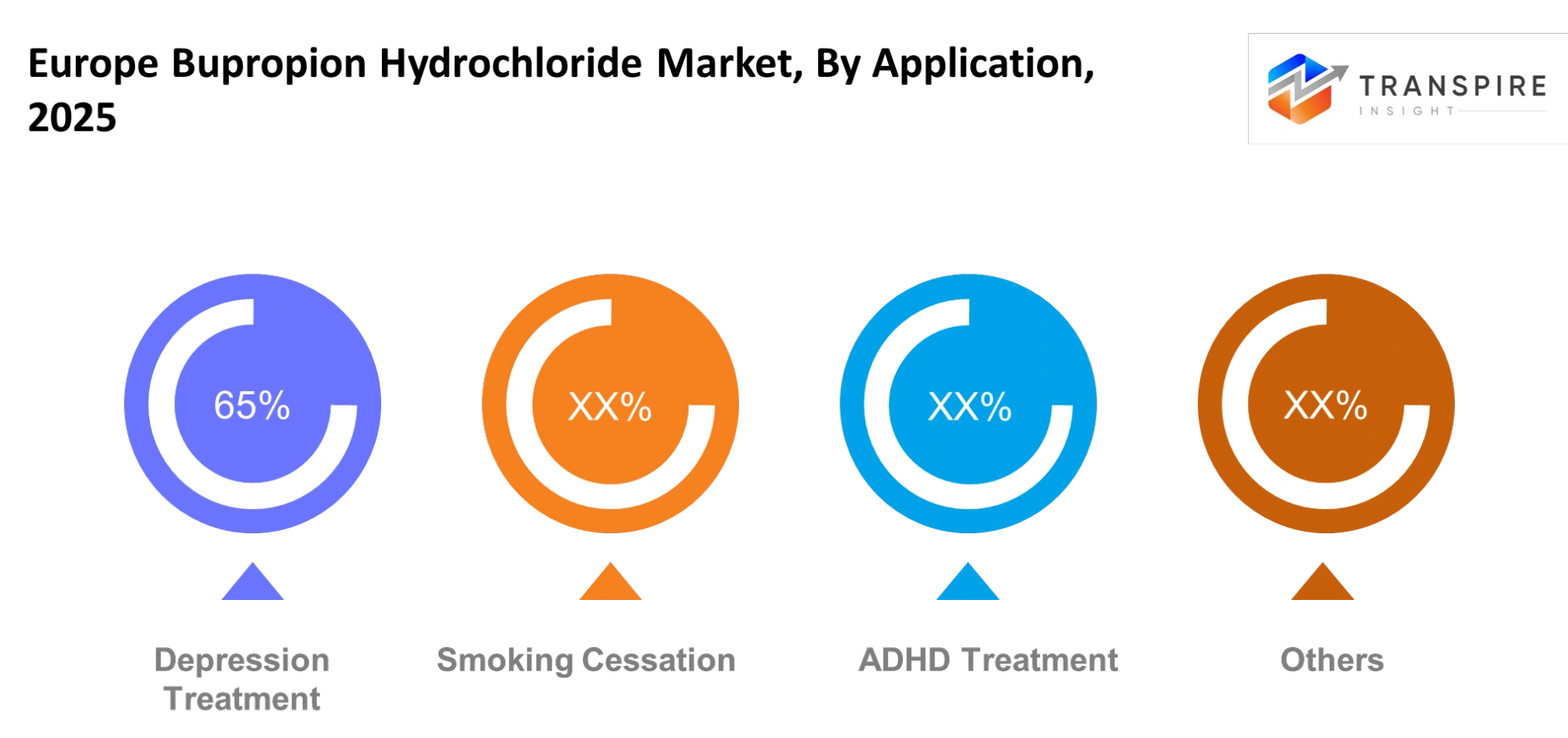
The application market for depression treatment holds 70% share because it requires extended treatment periods and doctors widely use it in medical settings. Public health initiatives provide organized support which helps people stop smoking, although this field remains smaller than other treatment areas. Patients with ADHD still face treatment limitations because other drugs exist as preferred initial treatment options, which results in minimal usage of additional treatment methods.
Each application shows unique patterns of development that create distinct growth trajectories for its respective operations. Depression treatment benefits from medical professionals who prescribe antidepressants to patients with mental health disorders and treat depression as a part of their ongoing medical care. Government-sponsored programs and partial refunding in specific nations drive the expansion of smoking cessation services. Clinicians prefer stimulant medications because they consider them the most effective treatment option for ADHD. The European market will create new revenue streams for suppliers through the establishment of smoking cessation programs in emerging European territories.
To learn more about this report, Download Free Sample Report
By End-User:
Hospitals and clinics together represent the leading end-user segment which accounts for more than half of total utilization because they use structured diagnosis and prescription control. Retail pharmacies and their associated outlets are expanding their market share because outpatient medical services are increasing. Homecare services remain less important yet they are becoming more important because people require ongoing medical treatment outside of hospital facilities. Other end-users contribute minimal volume.
The expansion of end-user segments demonstrates how healthcare delivery systems have evolved. Hospitals control the medical field because they employ specialists who handle patient evaluation processes while clinics provide healthcare services to people living in cities and surrounding areas. Pharmacies gain advantages from customers who need to refill their prescriptions and the ongoing need for medication which they prescribe for their patients. Homecare services for patients are experiencing slow growth because of the implementation of digital health solutions which include remote patient monitoring systems. The healthcare system will increase its use of decentralized care systems which will lead to a greater dependence on pharmacies and home-based medical care.
By Distribution Channel:
Hospital pharmacies dominate the distribution market because they maintain active connections to both inpatient services and specialized medical treatments. The market distribution of retail pharmacies shows a strong increase because of their ability to provide easy access to customers who need to refill their prescriptions. The share of online pharmacies in the market is small but they are experiencing rapid growth in markets that have advanced digital development. The market presence of other distribution methods stays restricted at this time.
Every distribution channel develops through its own unique path. Hospital pharmacies maintain their authority over initial drug distribution and their management of difficult medical situations while retail pharmacies handle chronic patient treatment through their ongoing drug distribution. The convenience of online platforms combined with e-prescriptions and better regulatory understanding in Germany and the Netherlands has led to their increasing popularity. The online and retail channels will drive future growth which will lead distributors to enhance their digital systems and their ability to deliver packages to customers.
What are the Key Use Cases Driving the Europe Bupropion Hydrochloride Market?
The primary application for depression treatment demonstrates its strongest performance through European healthcare systems because it generates the most prescription drugs. Clinicians use Bupropion Hydrochloride to treat patients who need an alternative to SSRI-based therapies during their extended outpatient treatment. The structured diagnosis process combined with repeat prescriptions from hospitals and specialty clinics creates ongoing demand for this service.
Public health initiatives and primary care facilities increasingly use smoking cessation as their secondary application. Tobacco reduction programs in Germany and Poland now include pharmacological support as part of their government initiatives. The retail pharmacy network together with clinics provides patients with access to healthcare services through government-backed programs which drive their actual healthcare service usage.
Healthcare organizations need to develop new applications for two emerging use cases which include off-label treatment of attention disorders and combination therapy for patients with treatment-resistant depression. Research facilities and dedicated psychiatric hospitals are testing these treatment methods. The expansion of clinical research evidence combined with guideline updates will create pathways for developing specialized applications into standard prescription practices.
|
Report Metrics |
Details |
|
Market size value in 2025 |
USD 366.92 Million |
|
Market size value in 2026 |
USD 385.65 Million |
|
Revenue forecast in 2033 |
USD 546.27 Million |
|
Growth rate |
CAGR of 5.10% from 2026 to 2033 |
|
Base year |
2025 |
|
Historical data |
2021 - 2024 |
|
Forecast period |
2026 - 2033 |
|
Report coverage |
Revenue forecast, competitive landscape, growth factors, and trends |
|
Regional scope |
Europe (Germany, United Kingdom, France, Italy, Spain, Rest of Europe) |
|
Key company profiled |
GlaxoSmithKline, Pfizer, Teva, Mylan, Sun Pharma, Cipla, Lupin, Aurobindo Pharma, Dr Reddy’s, Zydus, Torrent Pharma, Hikma, Apotex, Sandoz, Endo |
|
Customization scope |
Free report customization (country, regional & segment scope). Avail customized purchase options to meet your exact research needs. |
|
Report Segmentation |
By Type (Extended Release, Sustained Release, Immediate Release, Others); By Application (Depression Treatment, Smoking Cessation, ADHD Treatment, Others); By End-User (Hospitals, Clinics, Pharmacies, Homecare, Others); By Distribution (Hospital Pharmacies, Retail Pharmacies, Online Pharmacies, Others) |
Which Regions are Driving the Europe Bupropion Hydrochloride Market Growth?
The funding models which support healthcare services in Western Europe and its early implementation of organized mental health systems make the region the most developed area in Europe. The prescription systems of Germany and France and the United Kingdom operate through established reimbursement frameworks which professional guidelines back. Bupropion Hydrochloride maintains steady usage because of two factors: the presence of high diagnosis rates and the development of established psychiatric care networks. The ecosystem maintains its regional leadership through three components which include policy backing and the availability of specialists and digital prescription systems.
Northern Europe exists as a permanent yet different permanent support system which developed through its use of preventive healthcare systems and its commitment to precise medication distribution. Swedish and Danish markets prioritize patient outcomes which they achieve through monitoring adherence to treatment instead of developing their customer base. The regional healthcare systems depend on continuous guideline revisions together with effective main healthcare system links which result in dependable patient demand for medical services. The business maintains steady income through its operational framework which eliminates unpredictable income changes found in markets with multiple competing companies.
The fastest growth rates in Europe occur in Central and Eastern Europe because better healthcare access and new policies which address mental health needs drive development. After 2021 Poland and Romania developed their psychiatric care systems through funding and treatment programs which included more medical services for patients. The increasing rate of diagnoses together with expanded access to medication through public health initiatives drives faster implementation. The growth trajectory provides manufacturers along with investors the chance to extend their market reach through new distribution routes which will drive demand from 2026 to 2033.
Who are the Key Players in the Europe Bupropion Hydrochloride Marketand How Do They Compete?
The Europe Bupropion Hydrochloride Market sees moderate market fragmentation because of two factors: strong generic drug availability, and the strict pricing regulations that governments implement in their healthcare systems. Companies that already exist in the market protect their market position by offering lower costs and dependable product delivery, because their products lack patent protection which prevents them from charging higher prices. The competition between companies depends on their ability to produce products at large quantities, meet different European Union market regulations, and establish permanent supply agreements with both distributors and hospitals. New companies must overcome two obstacles: existing companies' distribution networks and the need to understand specific regulations needed for each country market.
GlaxoSmithKline maintains brand distinction because people recognize its long-standing brands which medical professionals trust due to their clinical history, especially in Western Europe where doctors still make prescriptions based on past practices. Teva Pharmaceutical Industries operates under a cost leadership strategy which enables the company to establish volume-based contracts through its extensive generic production facilities and its wide-ranging European distribution network. Viatris uses portfolio optimization to enhance its market position by merging its Mylan heritage with its current regional partnerships that help it grow in both Western and Eastern European markets.
Sandoz establishes its market position by meeting strict regulatory requirements and delivering consistent product quality, which enables the company to enter highly controlled markets like Germany. Dr. Reddy’s Laboratories expands through targeted entry into price-sensitive regions, using competitive pricing and localized partnerships to gain traction. The market analysis demonstrates that companies achieve their competitive advantage through their business size and ability to meet regulations and their capacity to operate in multiple locations more than their ability to create new products.
Company List
- GlaxoSmithKline
- Pfizer
- Teva
- Mylan
- Sun Pharma
- Cipla
- Lupin
- Aurobindo Pharma
- Dr Reddy’s
- Zydus
- Torrent Pharma
- Hikma
- Apotex
- Sandoz
- Endo
Recent Development News
“In February 2026, Teva Pharmaceutical Industries ramped up production of bupropion hydrochloride generics. This scale-up helped stabilize supply across Europe after shortages in 2023–2024, improving product availability and supporting prescription continuity. https://www.medfinder.com
“In February 2026, Lupin and Cipla increased manufacturing output of bupropion formulations. Expanded production capacity reduced localized stockouts and strengthened supply chain resilience for key European markets. https://www.medfinder.com
What Strategic Insights Define the Future of the Europe Bupropion Hydrochloride Market?
The Europe Bupropion Hydrochloride Market is currently establishing itself as a volume-based operation because pricing regulations and high generic drug availability limit its potential for value growth. The next five to seven years will see growth through public health program integration, which includes smoking cessation programs and second-line treatment for depression, instead of through new premium product development. The current shift benefits manufacturers who can maintain product quality and meet regulatory requirements while operating their businesses in multiple countries.
The hidden danger comes from stricter pharmacovigilance requirements and changing treatment guidelines, which will prompt doctors to prescribe newer combination therapies and different drug classes. Central and Eastern Europe presents a new opportunity as countries expand their reimbursement systems and develop new mental health policies. To establish market presence in emerging markets, companies must form local partnerships and develop adaptable supply networks while keeping their costs low in established markets.
Europe Bupropion Hydrochloride Market Report Segmentation
By Type
- Extended Release
- Sustained Release
- Immediate Release
- Others
By Application
- Depression Treatment
- Smoking Cessation
- ADHD Treatment
- Others
By End-User
- Hospitals
- Clinics
- Pharmacies
- Homecare
- Others
By Distribution
- Hospital Pharmacies
- Retail Pharmacies
- Online Pharmacies
- Others
Frequently Asked Questions
Find quick answers to common questions.
The Europe Bupropion Hydrochloride Market size is USD 546.27 Million in 2033.
Key segments for the Europe Bupropion Hydrochloride Market are By Type (Extended Release, Sustained Release, Immediate Release, Others); By Application (Depression Treatment, Smoking Cessation, ADHD Treatment, Others); By End-User (Hospitals, Clinics, Pharmacies, Homecare, Others); By Distribution (Hospital Pharmacies, Retail Pharmacies, Online Pharmacies, Others).
Major Europe Bupropion Hydrochloride Marketplayers are GlaxoSmithKline, Pfizer, Teva, Mylan, Sun Pharma, Cipla, Lupin, Aurobindo Pharma, Dr Reddy’s, Zydus, Torrent Pharma, Hikma, Apotex, Sandoz, Endo.
The Europe Bupropion Hydrochloride Marketsize is USD 366.92 Million in 2025.
The Europe Bupropion Hydrochloride Market CAGR is 5.10% from 2026 to 2033.
- GlaxoSmithKline
- Pfizer
- Teva
- Mylan
- Sun Pharma
- Cipla
- Lupin
- Aurobindo Pharma
- Dr Reddy’s
- Zydus
- Torrent Pharma
- Hikma
- Apotex
- Sandoz
- Endo
Recently Published Reports
-
Apr 2026
AI in Diabetic Retinopathy Market
AI in Diabetic Retinopathy Market Size, Share & Analysis Report By Type (Screening AI Systems, Diagnostic AI Systems, and Predictive AI Models), By Application Segment (Hospitals, Ophthalmology Clinics, Diagnostic Centers, and Research and Development), and Geography (North America, Europe, Asia-Pacific, Middle East and Africa, South and Central America), 2021 - 2031
-
Apr 2026
Psychometric Tests Market
Psychometric Tests Market Size, Share & Analysis Report By Type (Personality Tests, Ability/Aptitude Tests, Skill/Knowledge Tests, and Others), By Application (Talent Acquisition and Talent Management), and Geography (North America, Europe, Asia-Pacific, Middle East and Africa, South and Central America), 2021 – 2031
-
Apr 2026
Rare Biological Sample Collection Market
Rare Biological Sample Collection Market Size, Share & Analysis Report By Type (Isolation Kits & Reagent, Blood Collection Tubes, and Others), By Application (Oncology, Transcriptomics, Pharmacogenomics, and Others), and Geography (North America, Europe, Asia-Pacific, Middle East and Africa, South and Central America), 2021 – 2031
-
Apr 2026
Patient Lift Pendant Market
Patient Lift Pendant Market By Product Type (Wired Pendants, Wireless, Programmable), By Operation Type(Manual, Electric), By End-Users (Healthcare Professionals, Patients), By Application (Hospitals, Homecare, Rehabilitation Centers, Others), By Industry Analysis, Size, Share, Growth, Trends, and Forecasts 2021-2033
Our Clients
.jpg)