
Europe Bridge Shock Absorbers and Isolators Market Size & Forecast:
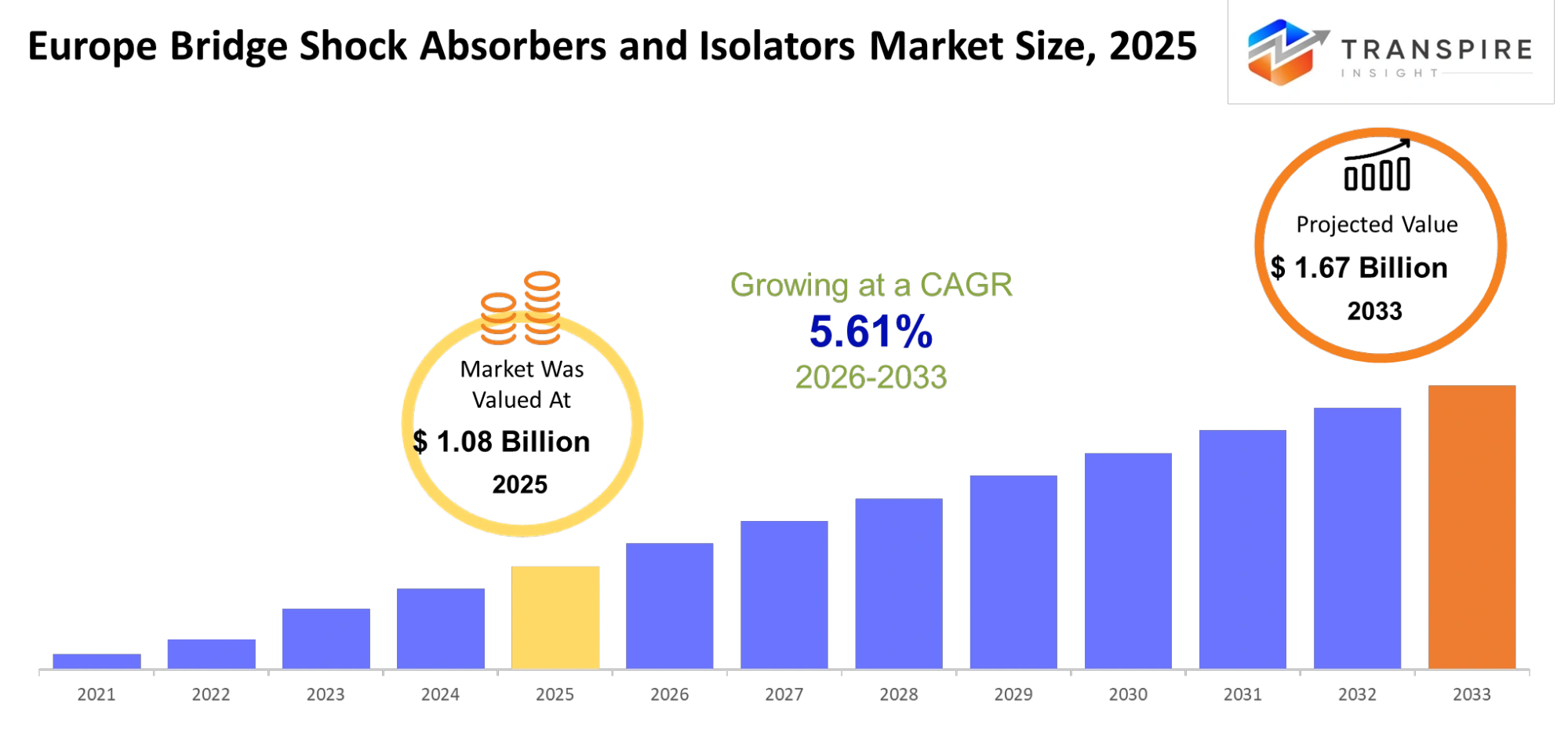
- Europe Bridge Shock Absorbers and Isolators Market Size 2025: USD 1.08 Billion
- Europe Bridge Shock Absorbers and Isolators Market Size 2033: USD 1.67 Billion
- Europe Bridge Shock Absorbers and Isolators Market CAGR: 5.61%
- Europe Bridge Shock Absorbers and Isolators Market Segments: By Type (Elastomeric Bearings, Hydraulic Dampers, Tuned Mass Dampers, Others); By Application (Road Bridges, Railway Bridges, Suspension Bridges, Seismic Protection, Others); By End-User (Government, Infrastructure Developers, Construction Firms, Transport Authorities, Others); By Material (Rubber, Steel, Composite Materials, Others)
To learn more about this report,  Download Free Sample Report
Europe Bridge Shock Absorbers and Isolators Market Summary:
The Europe Bridge Shock Absorbers and Isolators Market size is estimated at USD 1.08 Billion in 2025 and is anticipated to reach USD 1.67 Billion by 2033, growing at a CAGR of 5.61% from 2026 to 2033.
The civil engineering and infrastructure sector will have a dedicated market segment for European bridge shock absorbers and isolators which will focus on maintaining structural safety and durability. The demand for vibration control systems will increase because European construction standards and seismic safety regulations will enforce stricter requirements for their implementation. Engineers will select materials that provide better load distribution and stress reduction during both vehicle operations and environmental conditions. The development of new technologies will create advanced damping systems which operate with greater accuracy and extended operational periods. Infrastructure owners need dependable performance which meets regulations while manufacturers compete by delivering high-quality products that meet testing requirements and demonstrate durability in challenging bridge environments.
What Has the Impact of Artificial Intelligence Been on the Europe Bridge Shock Absorbers and Isolators Market?
Artificial intelligence is currently transforming the analysis process of infrastructure data in the European bridge shock absorbers and isolators market, which affects how decisions get made in that sector. The European bridge shock absorbers and isolators market research process uses AI to enable engineers to decode structural performance data at a quicker pace while discovering patterns about vibration control and material fatigue. Through its machine learning capabilities and predictive analytics features, artificial intelligence enables European bridge shock absorbers and isolators market forecasting to enhance demand prediction accuracy, which helps stakeholders synchronize their production schedules with forthcoming infrastructure development and maintenance activities.
The European bridge shock absorbers and isolators market benefits from enhanced operational efficiency because manufacturing facilities now implement smart automation systems into their production workflows. AI-driven systems bring better accuracy to product design and testing procedures, which results in fewer defects and stable performance across different load requirements. The supply chain optimization process benefits from predictive analytics, which helps identify possible disruptions and decreases delays, resulting in lower costs and faster delivery times. The artificial intelligence applications for bridge shock absorbers and isolators market products will drive innovation through their growing use, which enables companies to develop tailored solutions while establishing competitive advantages in advanced infrastructure technology.
Key Market Trends & Insights:
- The market for bridge shock absorbers and isolators exists as Western Europe's leading segment because the region holds more than 50% market share in 2025 due to its advanced infrastructure and protective safety regulations.
- The region of Eastern Europe experiences its fastest development until 2030 because new bridge construction projects and increased public infrastructure funding continue to support its growth.
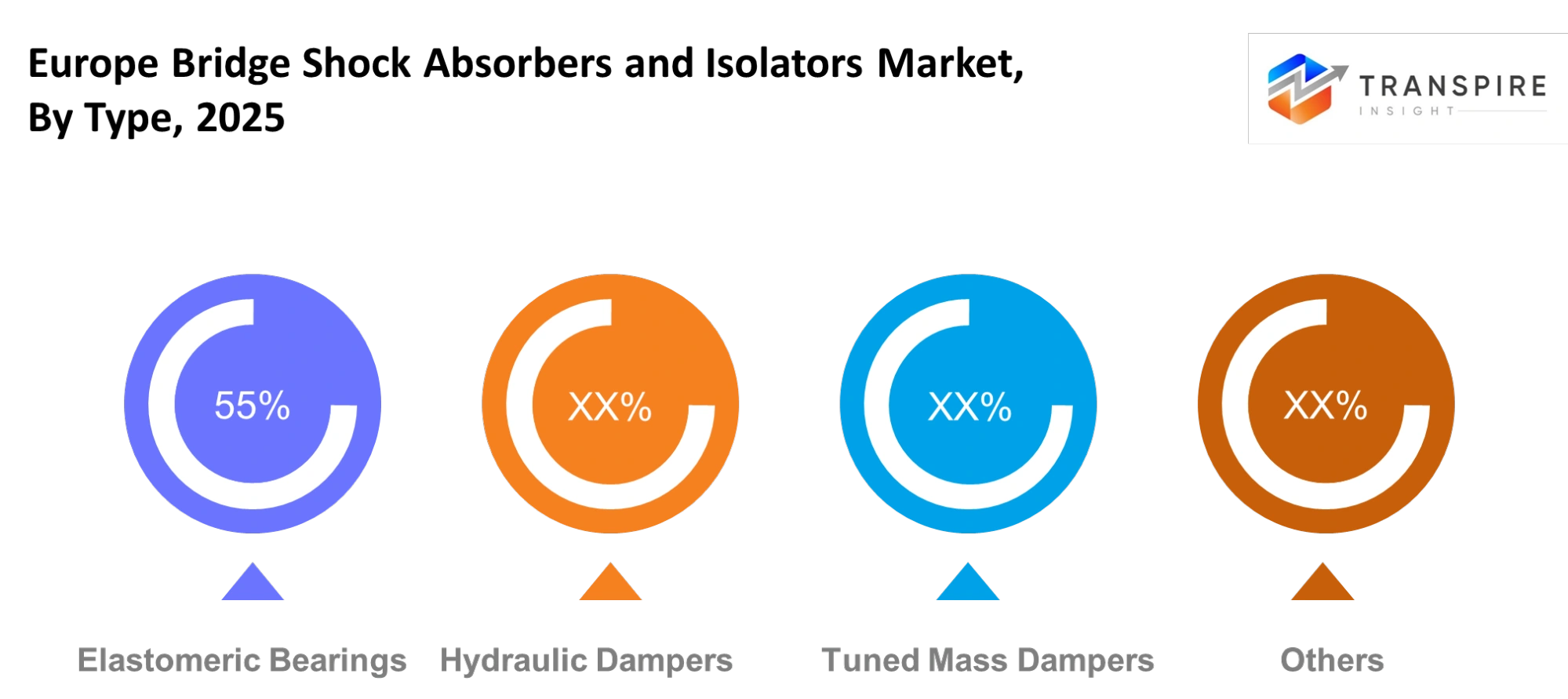
- Elastomeric bearings maintain their market leadership with approximately 45% market share because they provide long-lasting performance and affordable solutions for vibration control needs.
- The market for hydraulic shock absorbers includes the second-largest segment, which depends on their ability to perform in bridge structures with heavy weight requirements.
- The demand for friction pendulum systems has reached its highest level since 2025 and will continue to grow until 2030 because of increasing requirements for seismic safety.
- The highway bridge system handles more than 60% of transportation needs because infrastructure upgrades create constant demand for its services.
- The application segment for railway bridges experiences its fastest growth rate because rail networks continue to expand and modernization programs proceed.
- The government and public infrastructure agencies control approximately 70% of the market because they fund major bridge construction and maintenance initiatives.
- The sector of private infrastructure development shows its fastest growth rate because public-private partnership programs create new business opportunities.
- Companies establish their competitive edge through ongoing regional growth and investments in smart monitoring technology.
Europe Bridge Shock Absorbers and Isolators Market Segmentation
By Type:
The classification system uses four types which include elastomeric bearings and hydraulic dampers and tuned mass dampers and additional equipment. The use of elastomeric bearings will be the preferred choice because they provide flexible performance at lower costs for managing structural movements. The hydraulic dampers will enable the system to manage heavy loads while using hydraulic dampers to release energy. The tuned mass dampers will become essential for advanced bridge designs which need accurate vibration management whereas other types will meet particular engineering needs.
To learn more about this report, Download Free Sample Report
By Application:
The demand for road bridges will exceed all other bridge types because of the widespread transportation network and ongoing bridge upkeep requirements. The modernization of rail infrastructure will lead to an increase in railway bridges. Advanced damping systems will become necessary for suspension bridges while the demand for seismic protection will increase because safety regulations will tighten in areas that are vulnerable to earthquakes.
By End-User:
Government bodies will lead adoption due to large-scale public infrastructure investments. Infrastructure developers will follow with increasing participation in long-term projects. The construction companies will use these systems during their project work while transport authorities will handle maintenance tasks and safety improvements for bridge networks.
By Material:
Rubber will maintain its popularity because it provides flexible and durable vibration absorption capabilities. Steel provides strong structural support needed for heavy building projects. Composite materials will become more popular because they offer both lightweight capabilities and protection against corrosion whereas other materials will meet distinct environmental and engineering challenges.
What are the Main Challenges for the Europe Bridge Shock Absorbers and Isolators Market Growth?
The europe bridge shock absorbers and isolators market requires more than three technical and operational limitations to achieve its complete growth potential. Performance consistency under varying environmental conditions remains a key concern, as extreme temperatures and heavy loads can impact durability. The absence of standardization across projects together with the complex installation process will result in operational inefficiencies. The deployment challenges which exist in the market of European bridge shock absorbers and isolators will delay project execution while making it harder to expand operations.
The European bridge shock absorbers and isolators market will face additional challenges because of manufacturing and commercialization obstacles. The production process needs manufacturers to maintain exact engineering standards and execute complete quality tests which will increase their operational costs. European safety regulations and environmental standards will impose additional compliance requirements which will result in longer product approval times and extended time-to-market periods. Established market players will gain a competitive advantage because smaller firms will find it difficult to enter the market.
Regions that lack infrastructure funding and technical expertise will face ongoing challenges which will hinder their ability to adopt new technologies. Public infrastructure projects will face budget constraints which will prevent their large-scale implementation while the shortage of skilled professionals will decrease installation and maintenance quality. The European bridge shock absorbers and isolators market will continue to experience adoption challenges which will affect its development in developing regions.
The growth of the market will face additional obstacles because of competition from different vibration control technologies and existing price pressures. Companies must invest heavily in research and development because they must fulfill continuous innovation needs while adapting to changing regulatory standards which increase their operational risks.
Regional Insights
Western Europe will emerge as the leading region because it possesses established bridge networks and enforces strict safety regulations. The three countries of Germany, France, and the UK will spend money on maintenance work and system upgrades because they need continuous operational capacity. The implementation of advanced vibration control systems will be mandatory for all new construction work and renovation activities because of strong regulatory frameworks.
Northern Europe will experience stable market demand because it focuses on building sustainable infrastructure that uses materials which last for extended periods. The implementation of smart monitoring systems together with resilient construction techniques will proceed through its implementation phase. The design and maintenance practices of bridges in Sweden and Norway will emphasize two main aspects, which are durability and environmental performance.
Eastern Europe will experience slow economic expansion because infrastructure projects progress and funding resources become more accessible. The two countries of Poland and Romania will concentrate their efforts on building new bridges and upgrading existing structures. The adoption of solutions will occur through cost-effective approaches and increased international investments, but actual progress will hinge on the availability of technical skills and the ability to execute projects.
Recent Development News
In March 2026, MAURER SE announced the expansion of its seismic isolation solutions portfolio. The update introduced enhanced damping systems designed to improve bridge resilience under dynamic load conditions, supporting infrastructure safety upgrades across Europe. https://www.maurer.eu/en/news (Company press release)
In April 2026, mageba Group announced advancements in structural monitoring integration for bridge protection systems. The company highlighted new sensor-based technologies that will enable real-time performance tracking of shock absorbers and isolators in large infrastructure projects. https://www.mageba-group.com/news (Company website)
|
Report Metrics |
Details |
|
Market size value in 2025 |
USD 1.08 Billion |
|
Market size value in 2026 |
USD 1.14 Billion |
|
Revenue forecast in 2033 |
USD 1.67 Billion |
|
Growth rate |
CAGR of 5.61% from 2026 to 2033 |
|
Base year |
2025 |
|
Historical data |
2021 - 2024 |
|
Forecast period |
2026 - 2033 |
|
Report coverage |
Revenue forecast, competitive landscape, growth factors, and trends |
|
Regional scope |
Europe (Germany, United Kingdom, France, Italy, Spain, Rest of Europe) |
|
Key company profiled |
Freyssinet, Mageba, Maurer SE, Trelleborg, Bridgestone, Kawakin, Sumitomo Rubber, Granor Rubber, Canam Group, DYWIDAG, Arup, Vinci, Bouygues, SNC-Lavalin, AECOM |
|
Customization scope |
Free report customization (country, regional & segment scope). Avail customized purchase options to meet your exact research needs. |
|
Report Segmentation |
By Type (Elastomeric Bearings, Hydraulic Dampers, Tuned Mass Dampers, Others); By Application (Road Bridges, Railway Bridges, Suspension Bridges, Seismic Protection, Others); By End-User (Government, Infrastructure Developers, Construction Firms, Transport Authorities, Others); By Material (Rubber, Steel, Composite Materials, Others) |
How Can New Companies Establish a Strong Foothold in the Europe Bridge Shock Absorbers and Isolators Market?
The new companies entering the European bridge shock absorbers and isolators market must establish niche positions because they cannot compete with existing market players. The company should focus on specific markets which include seismic protection and railway bridge systems to meet existing infrastructure needs. The approach enables new market entrants to develop their knowledge base while they fulfill specific design needs through engineering solutions.
The European bridge shock absorbers and isolators market depends on innovation strategies to establish initial market presence. StructuraSense and VibraCore Technologies design intelligent damping solutions that include built-in sensor systems for better performance monitoring and maintenance scheduling. The solutions provide new market players with a worthwhile advantage because they solve two critical problems, which are unplanned structural strain and expensive upkeep requirements.
Market entry will gain additional support through strategic partnerships. The company will achieve quicker product validation and project integration by working together with construction companies and civil engineering firms and public infrastructure organizations. The European bridge shock absorbers and isolators market alliances will assist businesses in dealing with regulatory requirements and acquisition procedures in a more efficient manner.
Long-term market success requires businesses to establish technological distinctions. Companies that develop advanced materials and predictive maintenance systems and economical manufacturing processes will acquire market advantages. The company will achieve business growth through this approach, which meets current industry standards that demand safe and durable smart infrastructure systems.
Key Europe Bridge Shock Absorbers and Isolators Market Company Insights
Leading companies will maintain their market positions through their commitment to developing advanced damping technologies and delivering consistent product performance. Research funding and testing activities will establish trustworthy operational results for future research projects. Established companies will develop relationships with infrastructure authorities and contractors to achieve continuous demand for their bridge construction and maintenance services.
Mid-sized companies will establish their market presence through affordable solutions and their ability to produce goods according to customer needs. The organization will achieve its project goals through its dedication to developing customized product designs. The company will establish better market access through regional expansion and its partnerships with local construction companies while achieving better project delivery through improved operational efficiency and regulatory compliance.
New businesses will use innovative approaches and their application of intelligent technologies to create market presence. The organization will create distinct market offerings through its development of monitoring systems that use sensors and better material solutions. The organization will establish its credibility through strategic alliances with engineering companies while making targeted improvements to manufacturing processes for gradual entry into the competitive infrastructure sector.
Company List
- Freyssinet
- Mageba
- Maurer SE
- Trelleborg
- Bridgestone
- Kawakin
- Sumitomo Rubber
- Granor Rubber
- Canam Group
- DYWIDAG
- Arup
- Vinci
- Bouygues
- SNC-Lavalin
- AECOM
What are the Key Use-Cases Driving the Growth of the Europe Bridge Shock Absorbers and Isolators Market?
The European bridge shock absorber and isolator market receives its strongest demand from transport infrastructure improvements which particularly impact highway bridge systems. Governments are installing damping systems which achieve vibration reduction and structure protection since they need to enhance safety and build enduring infrastructure. The solutions extend bridge lifespan while they decrease maintenance expenses.
The European bridge shock absorber and isolator market experiences new demand because of railway expansion and modernization initiatives. High-speed rail systems need accurate vibration management to achieve both operational stability and safe passenger transportation. Shock absorbers and isolators function as essential components for rail infrastructure because they control dynamic forces while decreasing equipment deterioration throughout active transportation routes.
Seismic protection has developed into an important application area, particularly for locations that face ground movement hazards. The Europe bridge shock absorbers and isolators market receives benefits from safety regulations which mandate construction projects to use advanced isolation technologies for bridge building. During unpredicted situations these technologies safeguard structural integrity by absorbing seismic energies.
Smart infrastructure development creates new business prospects through its various impacts. The installation of sensor-enabled isolators will enable continuous bridge performance monitoring which will facilitate predictive maintenance approaches. The market will achieve enhanced operational efficiency through this transformation while advanced engineering solutions will become available at a larger scale.
Europe Bridge Shock Absorbers and Isolators Market Report Segmentation
By Type
- Elastomeric Bearings
- Hydraulic Dampers
- Tuned Mass Dampers
- Others
By Applicaion
- Road Bridges
- Railway Bridges
- Suspension Bridges
- Seismic Protection
- Others
By End-User
- Government
- Infrastructure Developers
- Construction Firms
- Transport Authorities
- Others
By Material
- Rubber
- Steel
- Composite Materials
- Others
Frequently Asked Questions
Find quick answers to common questions.
The approximate Europe Bridge Shock Absorbers and Isolators Market size for the market will be USD 1.67 Billion in 2033.
Key segments for the Europe Bridge Shock Absorbers and Isolators Market are By Type (Elastomeric Bearings, Hydraulic Dampers, Tuned Mass Dampers, Others); By Application (Road Bridges, Railway Bridges, Suspension Bridges, Seismic Protection, Others); By End-User (Government, Infrastructure Developers, Construction Firms, Transport Authorities, Others); By Material (Rubber, Steel, Composite Materials, Others).
Major Europe Bridge Shock Absorbers and Isolators Market players are Freyssinet, Mageba, Maurer SE, Trelleborg, Bridgestone, Kawakin, Sumitomo Rubber, Granor Rubber, Canam Group, DYWIDAG, Arup, Vinci, Bouygues, SNC-Lavalin, AECOM.
The Europe Bridge Shock Absorbers and Isolators Market size is USD 1.08 Billion in 2025.
The Europe Bridge Shock Absorbers and Isolators Market CAGR is 5.61%.
- Freyssinet
- Mageba
- Maurer SE
- Trelleborg
- Bridgestone
- Kawakin
- Sumitomo Rubber
- Granor Rubber
- Canam Group
- DYWIDAG
- Arup
- Vinci
- Bouygues
- SNC-Lavalin
- AECOM
Recently Published Reports
-
Apr 2026
Handling and Lifting Equipment Market
Handling and Lifting Equipment Market Size, Share & Analysis Report By Product (Cranes and Hoists, Forklifts, Conveyor Systems, Aerial Work Platforms, Others), By Application (E-Commerce, Automotive and Railway, Food and Beverages, Aviation, Others), and Geography (North America, Europe, Asia-Pacific, Middle East and Africa, South and Central America), 2021 - 2031
-
Apr 2026
HVAC Equipment Market
HVAC Equipment Market Size, Share & Analysis Report By Heating Equipment Type (Boilers and Furnaces, Heat Pumps, and Unitary Heaters), By Ventilation Equipment (Air Handling Units, Humidifiers and Dehumidifiers, Air Filters, and Fan Coiling Units), By Air Conditioning Equipment (Unitary Air Conditioners, Room Air Conditioners, Packaged Terminal Air Conditioners, and Chillers), By End User (Commercial, Residential, Industrial, and others), and Geography (North America, Europe, Asia-Pacific, Middle East and Africa, South and Central America), 2021 – 2031
-
Apr 2026
Refrigeration Valves Market
Refrigeration Valves Market Size, Share & Analysis Report By Type (Solenoid Valves, Expansion Valves, Check Valves, Service Valves, Others), By Application (Commercial Refrigeration, Industrial Refrigeration, Transport Refrigeration, Residential Refrigeration, Air Conditioning Systems), By End User (Food and Beverage Industry, Pharmaceutical Industry, HVAC Industry, Chemical Industry, Others), and Geography (North America, Europe, Asia-Pacific, Middle East and Africa, South and Central America), 2021 – 2031
-
Apr 2026
E-Commerce Packaging Materials Market
E-Commerce Packaging Materials Market By Material Type (Corrugated Boxes, Paper & Paperboard, Foam & Cushioning Materials, Plastic Packaging, Flexible Packaging, Protective Packaging, Others), By Product(Primary Packaging, Secondary Packaging, Tertiary Packaging), By Packaging Function (Protective Packaging, Branding & Presentation Packaging, Transit & Logistic Packaging, Sustainable Packaging, Tamper Evidence Packaging), By End-User (Retail & Consumer Goods, Electronic Appliances, Food & Beverages, Healthcare & Pharmaceutical, Fashion & Apparel, Home & Furnishing, Others); By Industry Analysis, Size, Share, Growth, Trends, and Forecasts 2021-2033