
Europe Bonded Leather Market Summary
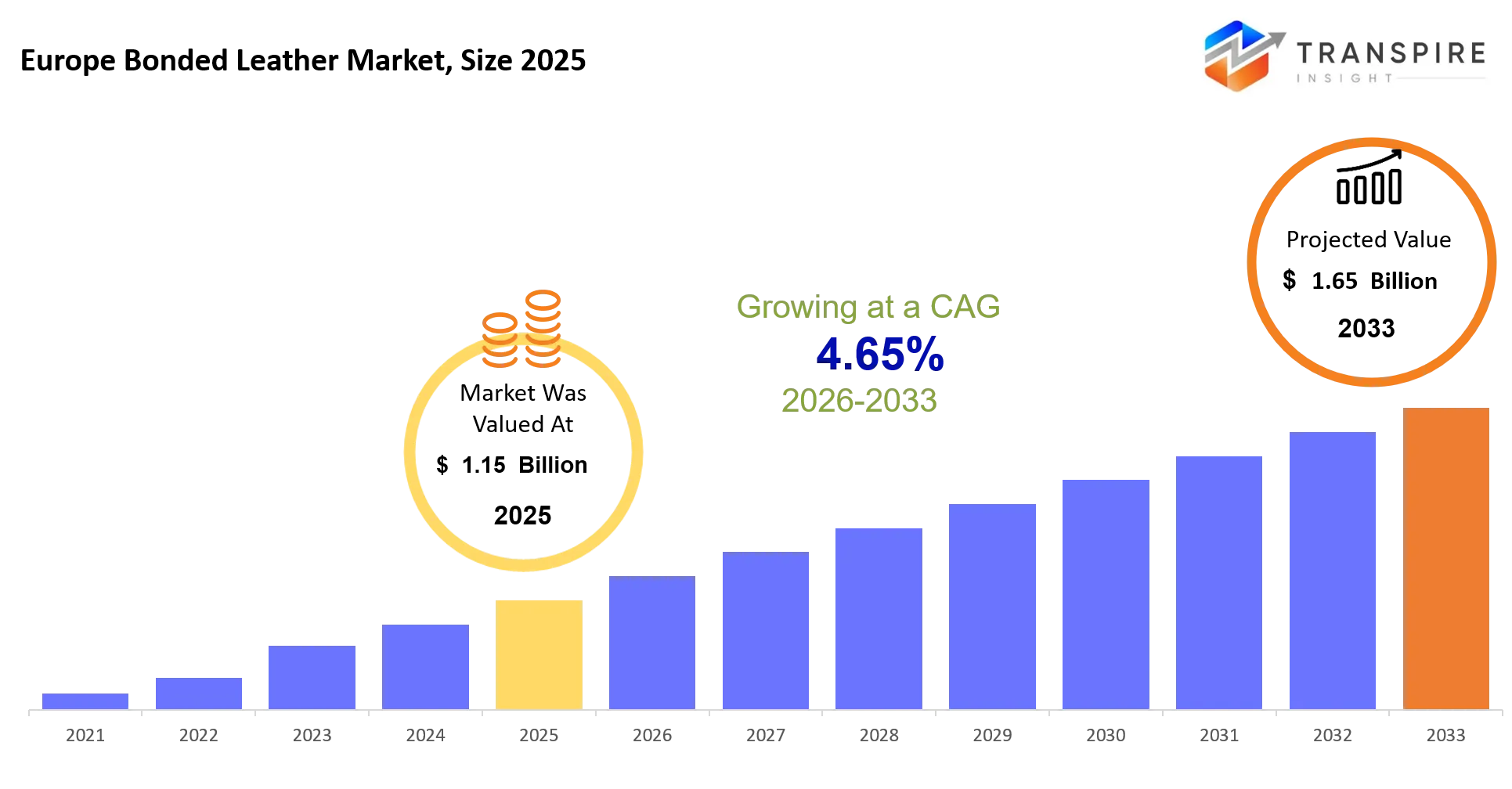
As per Transpire Insight Analysis, the Europe Bonded Leather Market size is estimated at USD 1.15 Billion in 2025 and is anticipated to reach USD 1.65 Billion by 2033, growing at a CAGR of 4.65% from 2026 to 2033.
The Europe bonded leather market kinda supports manufacturers who really need cost effective leather like materials for furniture, automotive interiors, footwear, accessories, and commercial use… all while lowering the dependence on fully processed animal hides. In real practice, bonded leather lets brands juggle appearance durability, material utilization and production costs, using a reconstituted material made from leather fibers and some binding agents.
Over the last 3–5 years, the market has been moving, as manufacturers leaned into upgraded fiber processing technologies and created more consistent finishing methods, so they can match the usual quality expectations people have now. At the same time sustainability policies, plus tighter material traceability rules across Europe, have nudged producers to squeeze more value out of waste, and to look into lower impact alternatives. Add supply chain disruptions, and the whole thing makes raw material availability feel less stable, which also pushes interest toward locally sourced approaches and engineered materials.
So, growth seems tied to makers hunting for scalable solutions that back circular production models, tighten cost control, and fit with shifting product design priorities.
Europe Bonded Leather Market Size & Forecast:
- Europe Bonded Leather Market Size 2025: USD 1.15 Billion
- Expected Market Value 2033: USD 1.65 Billion
- Forecast CAGR: 4.65%
- Leading region in 2025: Germany, Italy, France, and the United Kingdom
- Fastest Growing region: Poland, Romania, Czech Republic, Hungary, and Slovakia
- Key Profile: Salamander Group, Kuraray, San Fang Chemical, Alfatex Italia, FILWEL, Mayur Uniquoters, Toray Industries, Continental AG, BASF, Covestro, Teijin, Benecke-Kaliko, Nan Ya Plastics, Kiae Leather, Wanhua Chemical
Key Market Insights
- Western Europe kind of dominates overall, with about 58% market share in 2025, backed by Germany, Italy, France, and the UK manufacturing ecosystem. It feels like this area has the most momentum even early on.
- Eastern Europe shows the fastest growth in 2025–2033, pushed by production investments in Poland, Romania, Hungary, and Slovakia . You can see it in how factories are expanding.
- When it comes to product types, polyurethane bonded leather leads the way with nearly a 45% share. This is mostly due to durability, plus its fit for automotive interior use cases , which is pretty common.
- PVC bonded leather takes the second-largest position, mainly serving affordable furniture, footwear, and commercial upholstery markets, basically the everyday demand.
- Bio-based bonded leather is the fastest-growing segment from 2025–2033. Companies are adopting lower-impact material alternatives, and it’s becoming a kind of preferred direction.
- For applications, automotive interiors dominate with around 35% share in 2025, driven by cost-efficient vehicle finishing needs.
- Footwear and accessories are showing the fastest-growing adoption through 2033 because the materials enable flexible design , which matters for styles.
- On the end-user side, automotive manufacturers are the leading segment, with roughly 40% share across Europe. Meanwhile furniture brands , upholstery suppliers are the fastest-growing end users due to sustainable material sourcing strategies.
What are the Key Drivers, Restraints, and Opportunities in the Europe Bonded Leather Market?
The main growth driver is this kinda shift toward resource efficient material manufacturing across Europe. During 2020–2025, stricter waste management policies and sustainability targets were introduced, and they pushed manufacturers to get better at leather fiber utilization. As a result, raw material dependency went down and it also encouraged automotive and furniture producers to move toward bonded leather for cost controlled product lines. On top of that, improved processing technologies made output more consistent, so suppliers could grab larger contracts and open more revenue doors.
The biggest restraint is a bit tricky: inconsistent quality perception compared with premium leather alternatives. Even now, bonded leather producers still run into limits on durability, aging performance and also general consumer acceptance. Fixing those points needs substantial investment, in formulation upgrades, and in testing infrastructure. Those barriers kinda slow adoption for high value applications, and they end up restricting quicker revenue expansion across premium automotive and luxury segments.
The next opportunity sits in advanced bio based binders and digital material engineering. If investments keep flowing into sustainable polymers, and production automationEurope Bonded Leather Market especially across Germany, Italy, and Northern EuropeEurope Bonded Leather Market performance can improve while the environmental impact drops. In practice, these developments should support wider adoption in automotive interiors, furniture, and footwear markets.
What Has the Impact of Artificial Intelligence Been on the Europe Bonded Leather Market?
Artificial intelligence and digital technologies are getting better and better at pushing production efficiency in the bonded leather industry, kind of enabling smarter monitoring, quality supervision, and compliance management at the same time. Manufacturers are now rolling in AI-based vision systems to catch surface defects, recognize material irregularities and cut back on how much manual checking they need to do. At the same time, digital traceability platforms help suppliers watch production batches more closely, while also keeping records, so that European sustainability rules are met , more or less without the usual headache.
Machine learning models are also being used to anticipate material needs, fine-tune production timing, and foresee equipment failures before problems escalate. With these predictive features, processing facilities tend to reduce downtime, and they can place people and assets in the right places sooner. Automated analytics can further improve inventory planning by aligning production volumes with demand routines from automotive, furniture, and footwear markets.
Operationally the gains show up as better inspection precision, quicker quality assessments, and more stable production consistency. AI-driven systems can lower material waste as well, because they flag process deviations earlier and strengthen manufacturing controls. Still, the uptake is somewhat restrained by expensive integration work, not enough historical production data, and some practical issues when connecting older manufacturing equipment with advanced digital platforms.
Key Market Trends
- From 2021 to 2025, sustainability regulations sort of pressured bonded leather innovation, especially in Europe, where suppliers improved waste utilization, and also tightened material traceability a bit more than before.
- After 2022 automotive brands stepped up the use of alternative materials, and that apparently opened fresh doors for bonded leather in interior parts.
- Germany and Italy, kept pushing production capabilities after 2023, mainly via investments in more advanced leather processing technologies, rather than incremental upgrades.
- Then after 2024 bio-based binders showed up, and manufacturers started looking for lower-impact options to replace traditional synthetic bonding agents, not always overnight but pretty clearly.
- Between 2022 and 2025 digital inspection systems spread out, helping with defect detection, and reducing those annoying manufacturing inconsistencies that slow everything down.
- There were also supply chain disruptions between 2020 and 2023, which pushed European producers to craft localized material sourcing strategies, more directly.
- Furniture manufacturers started adopting bonded leather solutions after 2023, because they wanted affordability while sustainability expectations kept shifting, a lot.
- Automotive seating suppliers increased collaborations with material innovators during 2024, aiming for better durability and a cleaner finish quality.
- By 2025, Eastern European manufacturing hubs gained momentum, since companies pursued lower-cost production expansion, and yes they moved quickly.
- Artificial intelligence adoption climbed after 2024, and processors implemented predictive analytics for production optimization, which kind of made the process more predictable.
Europe Bonded Leather Market Segmentation
By Product Type :
PU Bonded Leather keeps a strong footing because manufacturers like the idea of flexibility, smooth touch up finishing, and cost efficiency for automotive interiors furniture and various accessories. PVC Bonded Leather also plays a role in affordable product lines, thanks to easy maintenance, and surfaces that stay consistent over time. Recycled Bonded Leather is getting more attention, since producers are now pushing material recovery and waste reduction practices.
Synthetic Bonded Leather still supports big manufacturing runs because supply stays steady and design adaptability works well. Beyond that, other categories fit specialized needs where unique textures, finishes, or performance characteristics have to show up. Picking the right product depends on durability expectations, production costs, environmental targets ,and the actual end use requirements across European industries.
By Application :
Furniture is still a major place where bonded leather gets used, mostly because it offers a decent compromise between look, toughness, and production affordability. Automotive Interiors rely on bonded leather for seat surfaces and interior panels, where consistent finishing and cost control help vehicle manufacturing goals. Footwear applications benefit from the material flexibility, and a wider set of design choices too.
Fashion accessories keep opening doors through handbags, wallets and smaller leather goods, especially when attractive finishes are needed while keeping prices competitive. In bookbinding, bonded leather is used for covers and for premium-looking publications. Other uses exist as well for niche requirements across commercial and consumer product categories.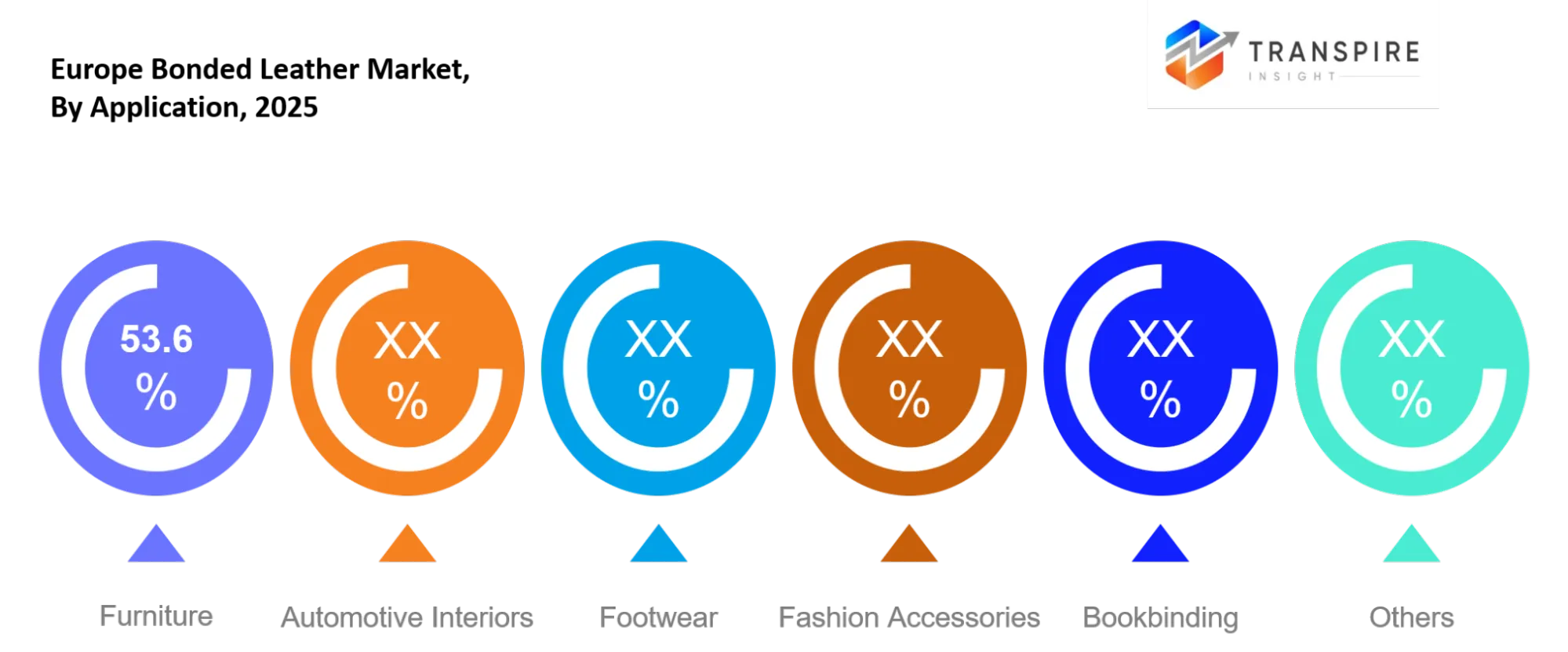
By End User :
Automotive Manufacturers really do stand out as a key end user group, mostly because there’s ongoing demand for interior materials that last, and still keep production costs in line. Residential users are also a big factor, since people buy furniture where bonded leather gives that leather-like look, but with easier cleaning and upkeep. In commercial settings, bonded leather shows up in offices, hospitality spaces and also in public areas where surfaces have to be practical, not overly delicate.
The Fashion Industry helps push adoption too, especially through accessory production and product diversification. Beyond that, there are other end user groups like specialized manufacturers who want an affordable route instead of traditional leather. In general, end user choices shift based on pricing strategies, specific design constraints, sustainability ambitions, and what they expect in terms of material performance.
By Distribution Channel :
Direct Sales still matter a lot for large manufacturers, because they often need customized supply arrangements and material volumes that stay consistent. Distributors help expand reach, by connecting producers with furniture makers, automotive supply partners, and smaller businesses in general. Meanwhile Online Retail channels are growing, mainly because digital purchasing platforms make it easier to find and order from material suppliers.
Specialty Stores serve buyers who care about particular textures, thickness options, and finishing styles for more targeted projects. Other distribution paths also cover regional purchasing needs, plus certain commercial requirements. Channel selection tends to depend on order volume, how much customization is required, delivery timing, and how solid the supplier relationship is.
By Thickness :
Below 1 mm bonded leather works well for lightweight tasks, fashion accessories included, decorative pieces, plus some specific upholstery uses that are more limited. The 1–2 mm bracket still gets a lot of attention, since that balanced thickness gives a flexible feel, solid strength, and a good fit for various manufacturing methods. When you go above 2 mm, the materials are more suitable for work that needs extra wear resistance and better structural performance, overall.
The other thickness groups cover more specialized production needs across different industries. Choosing thickness really depends on the real operating conditions, finishing approaches, the expected life of the product, and the exact manufacturing specifications. Through material engineering progress, wider adoption of different thickness options should grow across European production sectors, with more consistent outcomes over time.
What are the Key Use Cases Driving the Europe Bonded Leather Market?
Automotive interiors are kind of the main thing, as in the core use case, where vehicle manufacturers and seating suppliers lean on bonded leather for cost efficient, durable surface options. Demand stays strong also, because automotive buyers want uniform finishes, flexible layouts, and tighter control of material spend for really big scale production
Furniture manufacturing plus fashion accessories are getting more attention too. Residential furniture brands, commercial upholstery providers, and accessory makers use bonded leather to deliver affordable styling with a more pleasing look and easier upkeep
Newer use cases are also showing up, like greener product lines using recycled bonded leather and bio based materials. Some European manufacturers are testing these ideas to help with waste reduction aims and to match evolving material expectations across automotive and consumer goods markets
|
Report Metrics |
Details |
|
Market size value in 2025 |
USD 1.15 Billion |
|
Market size value in 2026 |
USD 1.20 Billion |
|
Revenue forecast in 2033 |
USD 1.65 Billion |
|
Growth rate |
CAGR of 4.65% from 2026 to 2033 |
|
Base year |
2025 |
|
Historical data |
2021 - 2024 |
|
Forecast period |
2026 - 2033 |
|
Report coverage |
Revenue forecast, competitive landscape, growth factors, and trends |
|
Country scope |
Europe (Germany, United Kingdom, France, Italy, Spain and Rest of Europe) |
|
Key company profiled |
Salamander Group, Kuraray, San Fang Chemical, Alfatex Italia, FILWEL, Mayur Uniquoters, Toray Industries, Continental AG, BASF, Covestro, Teijin, Benecke-Kaliko, Nan Ya Plastics, Kiae Leather, Wanhua Chemical . |
|
Customization scope |
Free report customization (country, regional & segment scope). Avail customized purchase options to meet your exact research needs. |
|
Report Segmentation |
By Product Type (PU Bonded Leather, PVC Bonded Leather, Recycled Bonded Leather, Synthetic Bonded Leather, Others); By Application (Furniture, Automotive Interiors, Footwear, Fashion Accessories, Bookbinding, Others); By End User (Residential, Commercial, Automotive Manufacturers, Fashion Industry, Others); By Distribution Channel (Direct Sales, Distributors, Online Retail, Specialty Stores, Others); By Thickness (Below 1 mm, 1–2 mm, Above 2 mm, Others) |
Which Regions are Driving the Europe Bonded Leather Market Growth?
Western Europe seems to take the biggest piece of the Europe bonded leather market, around 58% of regional revenue in 2025. Because of strict environmental rules, plus really advanced production expectations and clear recycling guidelines, material innovation and real factory adoption are getting easier across places like Germany, Italy, France, and the United Kingdom. You can also see a pretty mature ecosystem hereEurope Bonded Leather Market automotive makers, furniture producers, leather processors and technology suppliers all kind of connected together. With steady investment into greener manufacturing and higher-end product development, Western Europe should keep its lead through 2033, even if competition gets tighter.
Southern Europe, meanwhile, brings a steadier revenue base, mainly from long standing leather processing know-how, skilled making networks and dependable buyer demand from furniture and fashion. Italy and Spain in particular tend to benefit from regulatory alignment with broader European sustainability targets, and they also have resilient, export focused production systems. Add in dependable supplier channels and that specialized craftsmanship, and you get fairly consistent uptake across both commercial uses and consumer applications, not just one side.
Eastern Europe is moving the quickest, with Poland, Romania Hungary and Slovakia drawing manufacturing investment by leaning on lower production costs and growing automotive supply chains. After 2023, more industrial sites and local production expansion increased the need for low-cost interior materials. So growth across Eastern Europe should open doors for suppliers, technology providers, and investors who want manufacturing partnerships between 2026 and 2033.
Who are the Key Players in the Europe Bonded Leather Market and How Do They Compete?
Competition in the Europe bonded leather market is still kind of fragmented, and manufacturers keep pushing ahead using things like production efficiency, material innovation, regional sourcing reach and also customization services. Bigger, well known suppliers usually stay on top by tuning formulations further and rolling out sustainability plans, while the newer entrants start showing up with recycled materials and more advanced processing approaches, even if the whole setup feels a bit rushed.
Sappi zeroes in on material innovation by working on sustainable fiber based solutions that are meant to back lower impact production methods. They sort of stand out with renewable material know how, plus ongoing technology development that supports manufacturers to push for better environmental performance.
ECCO leans on specialized leather processing skills and material research, aiming to raise product quality, and overall performance. They reinforce their spot via leather technology innovation and controlled production systems, so quality stays steadier across batches.
BMW Group moves ahead with alternative interior materials through sustainability oriented vehicle design programs. Their material development spending helps tighten durability requirements, and it also fits with shifting automotive expectations that are getting more demanding.
Lear Corporation basically competes using automotive seating expertise and integrated supply solutions. They keep expanding through material partnerships and technologies shaped for vehicle interior uses, so the “fit” is better from supplier to end customer.
Company List
- Salamander Group
- Kuraray
- San Fang Chemical
- Alfatex Italia
- FILWEL
- Mayur Uniquoters
- Toray Industries
- Continental AG
- BASF
- Covestro
- Teijin
- Benecke-Kaliko
- Nan Ya Plastics
- Kiae Leather
- Wanhua Chemical
Recent Development News
In October 2025, Pact raised £16 million to commercialize its collagen-coated material technology as an alternative to plastic-based leather products. The funding will support a new production line in France and Italy, improving the company’s ability to supply advanced leather alternatives for fashion, interiors, automotive, and footwear applications.
Source https://www.thetimes.com/
In April 2026, Salvatore Ferragamo expanded leather traceability initiatives through improved material mapping and supplier data tracking. The development strengthens transparency across European leather supply chains and supports compliance with stricter sustainability requirements affecting material sourcing decisions. Source https://apnews.com/
What Strategic Insights Define the Future of the Europe Bonded Leather Market?
In the Europe bonded leather market, things are likely to tilt toward more high-value , resource-efficient material choices in the next 5–7 years. Manufacturers will probably keep pushing circular production, better durability, and also stay aligned with tougher sustainability rules that are coming up. Still, there’s a kind of unseen risk , competition from advanced bio-based and synthetic alternatives. If the performance gap gets smaller, then traditional bonded leather could see demand cool down, even if it’s used in the same places.
On the other hand, an emerging opportunity is pretty clear too: recycled fiber formulations , along with bio-based binders. This seems especially relevant across Germany, Italy and some Eastern European manufacturing hubs, where spending on material innovation is moving upward. Market participants should therefore tighten technology partnerships and put money into traceable production systems, so they can strengthen product credibility, satisfy changing buyer expectations, and lock in long-term deals across automotive, furniture, and consumer goods.
Europe Bonded Leather Market Report Segmentation
By Product Type
- PU Bonded Leather
- PVC Bonded Leather
- Recycled Bonded Leather
- Synthetic Bonded Leather
By Application
- Furniture
- Automotive Interiors
- Footwear
- Fashion Accessories
- Bookbinding
By End User
- Residential
- Commercial
- Automotive Manufacturers
- Fashion Industry
By Distribution Channel
- Direct Sales
- Distributors
- Online Retail
- Specialty Stores
By Thickness
- Below 1 mm
- 1–2 mm
- Above 2 mm
Frequently Asked Questions
Find quick answers to common questions.
The Expected Europe Bonded Leather Market size for the Market will be USD 1.65 Billion in 2033.
Key segments for the Europe Bonded Leather Market are By Product Type (PU Bonded Leather, PVC Bonded Leather, Recycled Bonded Leather, Synthetic Bonded Leather, Others); By Application (Furniture, Automotive Interiors, Footwear, Fashion Accessories, Bookbinding, Others); By End User (Residential, Commercial, Automotive Manufacturers, Fashion Industry, Others); By Distribution Channel (Direct Sales, Distributors, Online Retail, Specialty Stores, Others); By Thickness (Below 1 mm, 1–2 mm, Above 2 mm, Others).
Major Europe Bonded Leather Market players are Salamander Group, Kuraray, San Fang Chemical, Alfatex Italia, FILWEL, Mayur Uniquoters, Toray Industries, Continental AG, BASF, Covestro, Teijin, Benecke-Kaliko, Nan Ya Plastics, Kiae Leather, Wanhua Chemical.
The Current Europe Bonded Leather Market size is USD 1.15 Billion in 2025.
The Europe Bonded Leather Market CAGR is 4.65% from 2026 to 2033.
- Salamander Group
- Kuraray
- San Fang Chemical
- Alfatex Italia
- FILWEL
- Mayur Uniquoters
- Toray Industries
- Continental AG
- BASF
- Covestro
- Teijin
- Benecke-Kaliko
- Nan Ya Plastics
- Kiae Leather
- Wanhua Chemical
About the Authors

Pankaj Ghogare Patil
I am Pankaj Ghogare Patil, a Senior Research Analyst at Transpire Insight, specializing in the Pharmaceutical, Chemicals & Materials, Healthcare IT, and Biotechnology industry. My expertise lies in conducting comprehensive market research, analyzing industry trends, evaluating competitive landscapes, and translating complex data into actionable insights. At Transpire Insight, I closely follow emerging technologies, regulatory developments, and market innovations to create accurate, well-researched, and informative content that helps businesses and professionals make informed decisions. I am committed to producing credible, evidence-based articles that reflect industry best practices while making technical topics accessible and valuable for a broad audience.

Chakradhar Khansole
Chakradhar serves as the Research Director at Transpire Insight, bringing over 8 years of experience in technology, innovation, and strategic market intelligence. He specializes in transforming complex market data into actionable business insights that enable organizations to make informed, growth-oriented decisions. Recognized for his strategic vision and analytical expertise, Chakradhar leads high-impact research initiatives, delivering comprehensive market assessments, competitive intelligence, and forward-looking industry analysis.
Recently Published Reports
-
May 2026
Healthcare Polymer Packaging Market
Healthcare Polymer Packaging Market Size, Share & Analysis Report By Packaging Type (Syringes, IV Bottles and Pouches, Clamshells, Blisters, Bottles & Jars, Containers, Tubes, IV Parental Packaging, Others), By Type (Regulated, Non-regulated), By Polymer Type (LDPE (Low-Density Polyethylene), HDPE (High-Density Polyethylene), Homo-polymer (Homo), Random Copolymer (Random), Block Copolymer (Block), PET, Polystyrene, Polyvinyl Chloride, Polyamide/EVOH, Others), and Geography (North America, Europe, Asia-Pacific, Middle East and Africa, South and Central America), 2021 - 2031
-
Apr 2026
Hydrophilic Tape (Waterstop) Market
Hydrophilic Tape (Waterstop) Market Size, Share & Analysis Report By Type (Bentonite-Based Hydrophilic Tape, Rubber-Based Hydrophilic Tape), By Application (Residential Buildings, Commercial Buildings, Infrastructure Projects), and Geography (North America, Europe, Asia-Pacific, Middle East and Africa, South and Central America), 2021 - 2031
-
Apr 2026
Metalens Market
Metalens Market Size, Share & Analysis Report By Type (Visible Light Metalens, and Infrared Metalens), By Application (Consumer Electronics, Automotive Electronics, Industrial, Medical, and Others), and Geography (North America, Europe, Asia-Pacific, Middle East and Africa, South and Central America), 2021 - 2031
-
Apr 2026
PBT Resin Market
PBT Resin Market Size, Share & Analysis Report By Type (Reinforced PBT Resin, Unreinforced PBT Resin), By Processing Method (Injection Molding, Extrusion, Blow Molding, Others), By End-User (Automotive, Electrical & Electronics, Consumer Appliances, Industrial Machinery, Medical Devices, Packaging, Others), and Geography (North America, Europe, Asia-Pacific, Middle East and Africa, South and Central America), 2021 - 2031