
Europe Behavior Biometrics Market Summary
Europe’s behavior biometrics market supports banks, payment firms, online stores, and digital services. It focuses on spotting risky accounts during live sessions. The approach looks at typing patterns, mouse movement, screen swipes, device handling, and other interaction cues. In the last three to five years, the shift has moved away from one-time checks. Teams now watch behavior all the time during authentication. This helps them catch account takeovers and automated attacks. It also helps stop payment scams that appear to be authorized. At the same time, it aims to avoid adding more login steps that slow users down. PSD2 Strong Customer Authentication played a big role. It pushed stronger payment checks across Europe. Fraud groups adapted quickly. They began leaning more on social tricks and device problems to get past older protections.
Today, AI and machine learning link user behavior with device details, transaction history, and network signals. That lets fraud teams decide risk while the session is still running. It also drives new software rollouts across financial services. For vendors, it can mean more recurring income from behavioral intelligence services.
Europe Behavior Biometrics Market Size & Forecast:
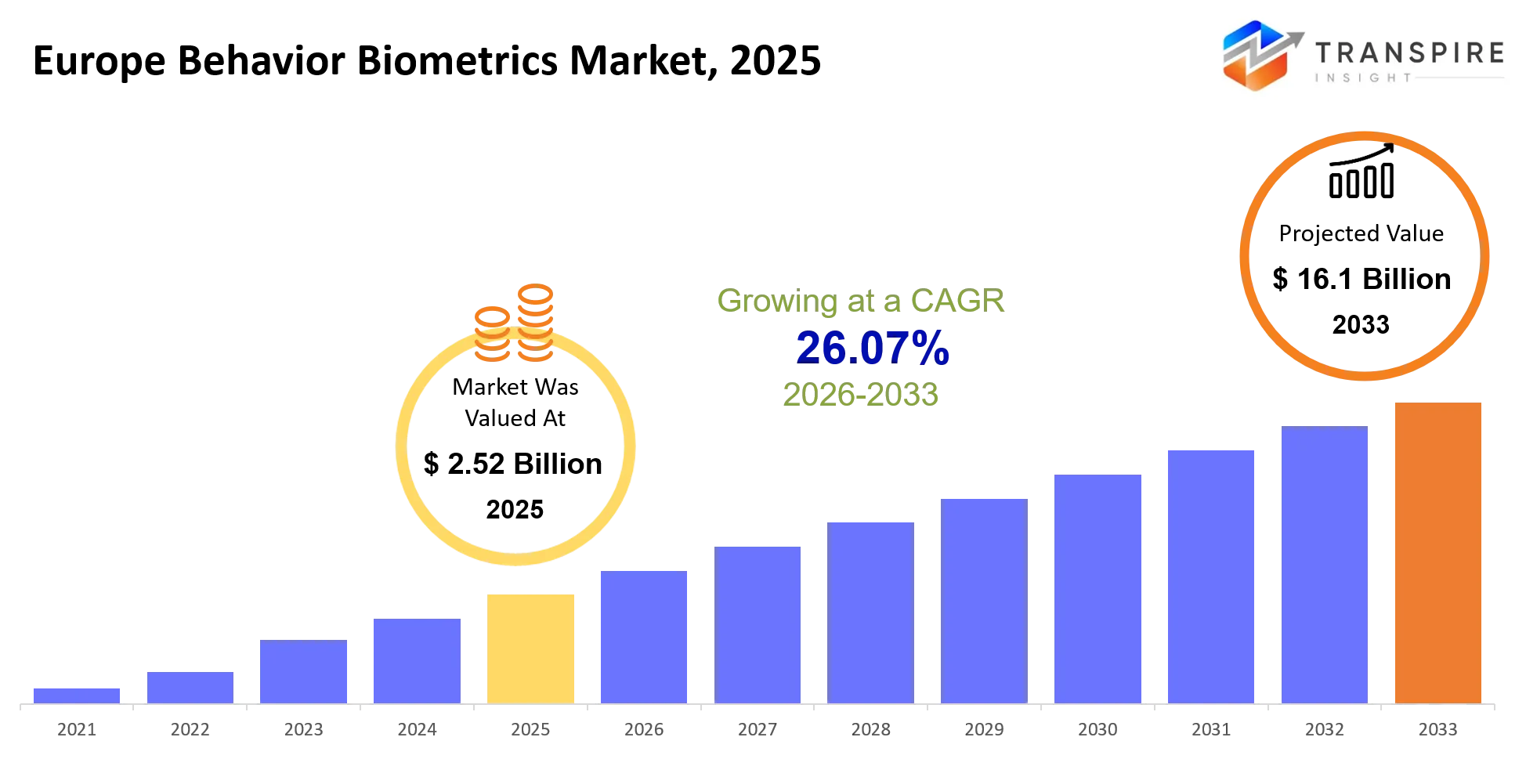
- Europe Behavior Biometrics Market Size 2025: USD 2.52 Billion
- Expected Market Value 2033: USD 16.1 Billion
- Forecast CAGR: 26.07%
- Leading region in 2025:UK
- Fastest Growing region:Germany
- Key Profile: BioCatch, BehavioSec, IBM, Mastercard, LexisNexis Risk Solutions, Nuance Communications, OneSpan, NICE Actimize, Experian, FICO, BioCatch, Callsign, ThreatMark, Featurespace, Transmit Security
Key Market Insights
- Europe’s behavior biometrics market is set to gain from continuous checks. Banks are moving past one-time login screens and using behavior risk review during each session.
- The UK leads in adoption. Strong digital banking systems help. Many financial firms also face tough rules for fraud response.
- Germany is growing quicker than the rest. More digital payments are coming. Banks, fintech groups, and online sellers are rolling out AI tools to cut fraud.
- These systems look at more than a password. They can track typing rhythm, mouse paths, touch actions, and how a device is handled. The goal is to spot odd behavior while the user is already active.
- In April 2025, Mastercard said almost half of its European online commerce buys used tokenization. That supports added protection for digital sign-in and payments.
- PSD2 also mattered. In places covered by those rules, Strong Customer Authentication rose above 70% of transactions. That lifted interest in controls that feel lighter for users.
- BioCatch says it reviews over four billion transactions each month. It uses behavioral biometrics and device intelligence to do this work.
- In use cases, BFSI is still the biggest area. At the same time, online retail, insurance, telecom, and software firms are bringing in these tools too.
- Continuous authentication is a major direction now. Teams want coverage after login. They do not want to rely only on the first identity check.
- More rivals now mix multiple signals. They pair behavioral analytics with device data, AI, network signals, and quick transaction choices in real time.
What are the Key Drivers, Restraints, and Opportunities in the Europe Behavior Biometrics Market?
The biggest change is moving away from one-off sign-in checks and toward ongoing fraud monitoring. PSD2 pushed stronger rules for online payments, but the rise in account takeovers and social engineering shows that a fixed password or a single verification step can miss what is really happening. New approaches watch how a user behaves while a session is in progress. That can include typing patterns, mouse motion, touch actions, and how the device is being used. With that view, banks can spot odd activity without stopping real customers again and again.
A key problem is rolling this kind of behavioral intelligence into bank systems that are split across many platforms. At the same time, privacy rules and governance expectations are strict. Behavioral signals can reveal sensitive details. Teams have to keep solid data controls, give clear reasons for risk decisions, and apply proper safeguards in line with European privacy and AI laws. The European AI Act also adds extra duties for some biometric use cases, which means more work for both vendors and end users.
There is also a strong upside in pairing behavioral biometrics with device context and fraud orchestration. Experian research reported that 71% of decision-makers in EMEA and APAC see AI and machine learning tools as vital to keep up with threats. The same report said 73% think fraud orchestration helps cut down onboarding friction. If providers join behavioral signals with payment details, device data, network signals, and identity records, they can fit into wider fraud budgets. They do not have to position behavioral authentication as the only product.
What Has the Impact of Artificial Intelligence Been on the Europe Behavior Biometrics Market?
Behavioral biometrics used to be mostly about matching patterns. Now it is used to read risk as it happens across several online inputs. Learning systems can track how a person normally behaves. They look at typing rhythm, mouse motion, touch actions, page paths, device use, and how transactions show up. BioCatch combines behavior signals and device data to flag fraud risk in real time. Mastercard uses similar behavior and device intelligence to tell risky actions from normal ones.
AI can also keep scoring risk while someone is logged in or paying. Instead of waiting for a bad password or a bad payment, the system may spot odd activity early. It can then ask for extra checks, pause a transaction for review, or step in with other controls. Featurespace builds adaptive behavioral analytics with machine learning for live transaction calls. A NatWest deployment reported a 3% lift in spotting fraud accounts. It also cut the number of fraudulent transactions per case, from three to two.
Even with these gains, the big weak point is still data quality and how hard the work is to connect systems. These models need enough past data and labels that are correct. At the same time, privacy rules can limit what data is collected and how it is shared across platforms. If older bank systems do not connect well, rollout can take longer, and the real time behavior signals may not deliver as much value.
Key Market Trends
- After PSD2 rolled out, many banks stopped leaning on the same repeated challenges. They started looking at how customers act in the background. This cuts friction for legit users.
- Instead of using one simple action as the main clue, systems now mix multiple signals. They watch typing, taps, mouse movement, and how the device behaves during the visit.
- By 2025, Mastercard said almost half of e-commerce in Europe used tokens. That supports the move toward smoother sign in and checkout
- In 2026, fraud vendors began linking behavior signals with device and network facts. The goal is to spot account takeover patterns that look coordinated.
- Fraud teams also changed their tooling. Models moved away from fixed rules and shifted toward ongoing risk scores. Decisions are updated while a customer is still in the session.
- Some financial firms also merged functions. Fraud and AML work are getting pulled together more often. Experian noted that 65% of companies across EMEA and APAC handle both areas.
- OneSpan went further too. In 2025 it backed ThreatFabric. That added mobile threat insights and a way to judge behavioral risk.
- Bad actors have used device spoofing, emulators, and automated browsers. Because of that, providers rely on more than behavior alone. They combine behavior with device and other intelligence.
- New tools are also changing the landscape. Agentic AI and automated shopping make it harder to tell real human use from machine-driven activity.
- Continuous authentication is set to help prevent account takeover. It can also aid scam spotting, payment monitoring, and extra checks for high-risk transactions.
Europe Behavior Biometrics Market Segmentation
By Solution Type
Keystroke Dynamics looks at how someone types. It checks typing speed, the rhythm between keys, short pauses, and how key presses move from one to another. This can show odd login or payment activity.
Mouse Dynamics focuses on what the pointer does. It uses cursor motion, the timing of clicks, scrolling behavior, and how a person moves through pages. It helps tell typical use apart from bot-like or hijacked sessions.
Touchscreen Behavior studies how touch input works. It looks at swipe speed, touch pressure, gesture shape, and how people tap and move on phones and tablets.
Gait Analysis uses walking behavior. It is used more in special access and identity setups. The way someone walks gives another behavioral cue.
Voice Biometrics evaluates speech traits. It considers cadence, pronunciation patterns, and other voice details. These are used for customer checks and for phone center security.
Signature Dynamics measures how a person writes on a screen. It watches writing speed, pressure, the order of strokes, and motion during a digital signature.
Device Interaction looks at how the device is used. It tracks how people move through apps, handle the device, and use security options.
Behavioral Profiling brings together several signals. It builds a baseline for each user and produces risk scores. These scores support fraud prevention, account protection, and ongoing authentication.
By Technology
Machine Learning looks at past behavior and transaction data. It then flags what seems normal and what seems off. Artificial Intelligence helps with risk calls that run on their own. It also updates fraud rules when attackers change their methods. Deep Learning works with bigger behavior datasets. It can find harder links between what a person does on a device and what shows up in the transaction feed. Pattern Recognition compares today’s behavior to known interaction patterns. Neural Networks help sort complicated signals gathered during digital sessions.
Behavioral Analytics reviews user actions over time. It turns activity logs into risk signals that teams can act on. Risk Scoring gives each session, account, device, or transaction a number. That number helps drive automated steps when needed. Continuous Authentication checks identity strength during the whole session. It does not wait only for the first login. Many financial firms now mix these tools with device data and transaction details. This helps them build layered fraud checks.
By Application
Fraud Detection looks for odd behavior early, so it can flag risky actions before money is lost.
Identity Verification brings extra behavior clues into the usual identity checks while someone signs up or logs in.
Account Takeover Prevention pays attention to what a user does over time. If the pattern suddenly shifts, it can point to stolen logins or a device that has been compromised.
Continuous Authentication keeps going after login. It checks ongoing activity, not just the first sign-in.
Insider Threat Detection watches for strange actions by staff across systems that should be protected.
Transaction Monitoring compares how people behave with what payments are being made. This helps spot transfers and purchases that do not look right.
Access Control uses behavior signals to make checks stronger when a person tries to use sensitive apps or enterprise tools.
Cybersecurity applies behavioral signals to spot bots, activity tied to malware, misuse of credentials, and logins that look out of the ordinary.
Mastercard combines behavior and device context across digital journeys to spot risky actions and aid fraud prevention.
By Deployment
Cloud deployment lets teams scale behavior checks without building a lot of equipment on site. On-premise deployment fits groups that want tighter control of where data sits, how security is set up, and how work is handled inside the company. A hybrid setup links cloud analytics with tools run on local systems, which helps when an organization uses both kinds of IT. With a SaaS model, you pay a subscription to use behavioral intelligence and fraud tools.
Private cloud means the environment stays under stronger control, mainly for firms with strict rules on security and governance. Public cloud gives room to handle heavy transaction volume and to grow into new regions fast. Edge processing can check behavior signals near the device, which cuts delay when decisions must be made quickly. Managed services let banks and other large firms hand off monitoring, model updates, and day to day support, while still keeping access to risk insights.
By End User
BFSI still matters most. Banks and other financial firms deal with account takeovers, payment scams, and social tricks that target users.
In E-Commerce, teams use behavior signals to spot odd checkout actions, bot style traffic, and hacked accounts. That helps flag risk sooner.
Healthcare focuses on log in and identity checks. These controls cover patient portals, clinical tools, and private digital files.
Government services also rely on behavior cues. The goal is safer sign ins for online services and tighter protection for core systems.
Telecom uses similar checks. It looks for signs that an account may be taken and for unusual digital activity.
Retail also benefits. It applies behavior based detection to online buys, loyalty accounts, and customer sign in.
Insurance adds behavior monitoring too. It supports digital claim flows, account access checks, and review of transactions.
Technology firms bring these signals into their products. This includes apps, security tools, identity services, and other digital offerings.
What happens next across all of these areas will hinge on how fast the systems can be connected. Privacy settings will also play a role. So will how much fraud risk is present, and whether behavior signals can be matched with device data and transaction details.
By Region
In the UK, adoption is helped by older digital banking systems, solid payment rails, and heavy fraud monitoring. Banks and payment firms here have built plenty of process over time.
In Germany, growth looks set to stay high. More banks and digital firms are expanding their AI based checks for risk. That kind of tooling is spreading fast.
In France, the base is already in place. Established banks, active e commerce, and tougher digital ID rules all push adoption forward.
The Netherlands is also a good fit for this shift. People use digital payments a lot, and the finance scene is built around tech. That supports rollout and uptake.
Spain should see gains as digital banking and online shopping keep expanding. More daily use tends to follow as services improve.
Italy has room to grow through fintech work and wider use of digital financial products. Adoption expands when new services become common.
Switzerland leans on premium security uses. Its concentrated banking and wealth management focus keeps pressure on strong protections.
Sweden benefits from a very online consumer base. Cashless habits are strong, which makes ongoing checks easier. Continuous authentication and behavioral risk reviews fit well with that culture.
What are the Key Use Cases Driving the Europe Behavior Biometrics Market?
Fraud spotting stays at the center of most deployments. Banks and payment firms want to catch risky patterns fast. They also do not want to push normal users through extra sign-ins again and again. With behavioral data, systems can watch live session details like what a user types, how they move through pages, what they touch, and how their device behaves. When these signals shift, the system can treat the session as risky. This is why it fits well for account takeover and payment fraud.
More teams are rolling out account takeover controls and ongoing transaction checks across BFSI and online retail. Mastercard looks at behavior and device signals to spot odd events during digital checkout and payment flows. Featurespace then uses behavioral analytics plus machine learning to help decide what to do in real time for transactions.
The next wave will likely target several new threats. That includes AI based bots, shopping actions run by agents, and fraud groups that coordinate with each other. If behavior is tracked over time, it becomes easier to tell real people from automation. It also helps link odd actions that show up across different devices, accounts, and payments. This can open doors for fintech, telecom, retail, and other tech firms.
|
Report Metrics |
Details |
|
Market size value in 2025 |
USD 2.52 Billion |
|
Market size value in 2026 |
USD 3.18 Billion |
|
Revenue forecast in 2033 |
USD 16.1 Billion |
|
Growth rate |
CAGR of 26.07% from 2026 to 2033 |
|
Base year |
2025 |
|
Historical data |
2021 - 2024 |
|
Forecast period |
2026 - 2033 |
|
Report coverage |
Revenue forecast, competitive landscape, growth factors, and trends |
|
Regional scope |
Europe |
|
Key company profiled |
BioCatch, BehavioSec, IBM, Mastercard, LexisNexis Risk Solutions, Nuance Communications, OneSpan, NICE Actimize, Experian, FICO, BioCatch, Callsign, ThreatMark, Featurespace, Transmit Security |
|
Customization scope |
Free report customization (country, regional & segment scope). Avail customized purchase options to meet your exact research needs. |
|
Report Segmentation |
By Solution Type (Keystroke Dynamics, Mouse Dynamics, Touchscreen Behavior, Gait Analysis, Voice Biometrics, Signature Dynamics, Device Interaction, Behavioral Profiling); By Technology (Machine Learning, Artificial Intelligence, Deep Learning, Pattern Recognition, Neural Networks, Behavioral Analytics, Risk Scoring, Continuous Authentication); By Application (Fraud Detection, Identity Verification, Account Takeover Prevention, Continuous Authentication, Insider Threat Detection, Transaction Monitoring, Access Control, Cybersecurity); By Deployment (Cloud-Based, On-Premise, Hybrid, SaaS, Private Cloud, Public Cloud, Edge-Based, Managed Services); By End User (BFSI, E-Commerce, Healthcare, Government, Telecom, Retail, Insurance, Technology Companies); By Region (UK, Germany, France, Netherlands, Spain, Italy, Switzerland, Sweden) |
Which Regions are Driving the Europe Behavior Biometrics Market Growth?
The UK is the top market in Europe for behavior biometrics. Part of the edge comes from how digital banking is already well used, plus the high rate of mobile payments. On top of that, banks have fraud guardrails in place. This gives lots of real cases to test continuous behavior checks. UK banks have dealt with account takeovers, authorized push payment issues, and mobile fraud risks. Those problems have driven spend on tools that look past passwords and device IDs.
BioCatch said UK mobile fraud rose by 11% in 2024. It also said suspected mule accounts among its UK banking customers went up three times from 2023 to 2024. With big banks, fintech that is already common, and fraud systems that are in place, the UK look set to keep its lead.
France sits next. It benefits from a wide banking setup and more people using online and app channels. It is not the same as the UK focus on payment-fraud controls. French banks and lenders still face tough threats like impersonation, account takeover, and social-engineering scams. That opens room for analytics that can work while a customer is active in a session. BioCatch keeps separate fraud work for France in 2025 and 2026. That points to steady attention as digital fraud changes there.
Germany is growing quicker than the rest. Its position is tied to the size of its economy and the steady rise of digital banking. The country also has heavy fraud exposure, which pushes firms to adopt stronger behavior checks. BioCatch reported that German consumers had €10.6 billion in scam losses over the 12 m
Who are the Key Players in the Europe Behavior Biometrics Market and How Do They Compete?
Competition is still mostly driven by technology, but it is more tied together now. It is not just about behavior biometrics on its own. Companies try to win by covering more types of behavioral signals. They also push for stronger machine learning results, quick risk scoring, and smarter device signals. Many efforts add fraud orchestration and connect to banking systems. BioCatch leans hard on behavioral intelligence. Mastercard uses behavior signals too, but it also brings in payment network data and device data. That wider view helps fraud teams judge risk with more transaction context.
BioCatch builds its edge on constant review of lots of interaction signals. This includes keystrokes, mouse movement, touch patterns, and device traits. These inputs are used to flag account takeover attempts, scams, and mule accounts. Mastercard goes further into payment decision workflows. It uses behavior, device clues, and transaction details to support fast fraud checks. OneSpan is growing by adding nearby fraud tools instead of relying only on login checks. In October 2025, OneSpan backed and teamed up with Dutch firm ThreatFabric. That step added mobile threat intelligence, malware detection, and behavioral risk checks. Featurespace competes with flexible behavioral analytics and real-time transaction monitoring. It connects machine learning models to payment fraud decisions. Overall, these moves point to fraud platforms that feel more connected. Behavior data is treated as one part of a larger system for identity and risk control.
Company List
- BioCatch
- BehavioSec
- IBM
- Mastercard
- LexisNexis Risk Solutions
- Nuance Communications
- OneSpan
- NICE Actimize
- Experian
- FICO
- Callsign
- ThreatMark
- Featurespace
- Transmit Security
Recent Development News
"In March 2026, BioCatch launched DeviceIQ. The new device identification and intelligence product combines device intelligence with behavioral signals to help financial institutions detect sophisticated device spoofing, emulators, cloaked browsers, and other fraud techniques. [https://www.biocatch.com/press-release/biocatch-unveils-deviceiq-redefines-how-banks-evaluate-device-risk-in-the-ai-era] ."
"In October 2025, OneSpan announced a strategic investment in and partnership with ThreatFabric. The investment added mobile threat intelligence, malware risk detection, and behavioral risk evaluation to OneSpan’s authentication portfolio, strengthening protection against mobile fraud and authorized push payment scams. [https://investors.onespan.com/news-releases/news-release-details/onespan-invests-threatfabric-advance-fraud-prevention-innovation] ."
"In June 2025, OneSpan announced the acquisition of Nok Nok Labs. The acquisition added FIDO passwordless authentication capabilities to OneSpan’s portfolio and expanded its options for secure software-based authentication across cloud and on-premise environments. [https://investors.onespan.com/news-releases/news-release-details/onespan-accelerates-fido-leadership-acquisition-nok-nok-labs] ."
What Strategic Insights Define the Future of the Europe Behavior Biometrics Market?
The market is moving toward ongoing trust checks that use more than one kind of signal. Instead of relying on a single check, teams will look at behavior along with device details, network clues, payment activity, and identity information.
What is driving this change is the move away from passwords and one-time checks. Fraud and scams keep getting smarter. Account takeovers and automated attacks adjust fast, so protections need to react in real time. There is also a risk that is easy to miss. If many groups use similar machine learning models, bad actors could learn how detection works. Then they could change their actions to slip past the scores.
At the same time, there is a chance here. Companies can use behavioral insight to support agent driven buying and selling. They will need ways to tell real customer actions helped by AI from harmful automated agents.
Experian points to continuous review of behavioral patterns, payment data, and context signals as part of these new agent led flows.
Market players should focus on tools that work well with other systems and respect privacy. Those platforms should link behavioral, device, and transaction intelligence. They should not spend on only one kind of behavioral scoring tool.
Europe Behavior Biometrics Market Report Segmentation
By Solution Type
- Keystroke Dynamics
• Mouse Dynamics
• Touchscreen Behavior
• Gait Analysis
• Voice Biometrics
• Signature Dynamics
• Device Interaction
• Behavioral Profiling
By Technology
- Machine Learning
• Artificial Intelligence
• Deep Learning
• Pattern Recognition
• Neural Networks
• Behavioral Analytics
• Risk Scoring
• Continuous Authentication
By Application
- Fraud Detection
• Identity Verification
• Account Takeover Prevention
• Continuous Authentication
• Insider Threat Detection
• Transaction Monitoring
• Access Control
• Cybersecurity
By Deployment
- Cloud-Based
• On-Premise
• Hybrid
• SaaS
• Private Cloud
• Public Cloud
• Edge-Based
• Managed Services
By End User
- BFSI
• E-Commerce
• Healthcare
• Government
• Telecom
• Retail
• Insurance
• Technology Companies
By Region
- UK
• Germany
• France
• Netherlands
• Spain
• Italy
• Switzerland
• Sweden
Frequently Asked Questions
Find quick answers to common questions.
The expected Europe Behavior Biometrics Market size for the market will be USD 16.1 Billion in 2033.
Key segments for the Europe Behavior Biometrics Market are By Solution Type (Keystroke Dynamics, Mouse Dynamics, Touchscreen Behavior, Gait Analysis, Voice Biometrics, Signature Dynamics, Device Interaction, Behavioral Profiling); By Technology (Machine Learning, Artificial Intelligence, Deep Learning, Pattern Recognition, Neural Networks, Behavioral Analytics, Risk Scoring, Continuous Authentication); By Application (Fraud Detection, Identity Verification, Account Takeover Prevention, Continuous Authentication, Insider Threat Detection, Transaction Monitoring, Access Control, Cybersecurity); By Deployment (Cloud-Based, On-Premise, Hybrid, SaaS, Private Cloud, Public Cloud, Edge-Based, Managed Services); By End User (BFSI, E-Commerce, Healthcare, Government, Telecom, Retail, Insurance, Technology Companies); By Region (UK, Germany, France, Netherlands, Spain, Italy, Switzerland, Sweden)
Major Europe Behavior Biometrics Market players are Bio Catch, Behavio Sec, IBM, Mastercard, LexisNexis Risk Solutions, Nuance Communications, One Span, NICE Actimize, Experian, FICO, Bio Catch, Callsign, Threat Mark, Feature space, Transmit Security
The Europe Behavior Biometrics Market size is USD 2.52 Billion in 2025.
The Europe Behavior Biometrics Market CAGR is 26.07% from 2026 to 2033
- BioCatch
- BehavioSec
- IBM
- Mastercard
- LexisNexis Risk Solutions
- Nuance Communications
- OneSpan
- NICE Actimize
- Experian
- FICO
- Callsign
- ThreatMark
- Featurespace
- Transmit Security
About the Authors

Mayur Shinde
I am Mayur Shinde, a Senior Research Analyst at Transpire Insight, specializing in the Automotive & Transportation and Information & Communication Technology (ICT) Industry. My work focuses on analyzing emerging market trends, technological advancements, competitive landscapes, and industry developments to deliver accurate, data-driven insights. I am passionate about transforming complex market information into clear, actionable content that helps businesses, professionals, and decision-makers stay informed and make confident strategic decisions.

Chakradhar Khansole
Chakradhar serves as the Research Director at Transpire Insight, bringing over 8 years of experience in technology, innovation, and strategic market intelligence. He specializes in transforming complex market data into actionable business insights that enable organizations to make informed, growth-oriented decisions. Recognized for his strategic vision and analytical expertise, Chakradhar leads high-impact research initiatives, delivering comprehensive market assessments, competitive intelligence, and forward-looking industry analysis.
Recently Published Reports
-
Apr 2026
3D Optical Profiler Market
3D Optical Profiler Market Size, Share & Analysis Report By Type (Desktop 3D Optical Profiler, and Portable 3D Optical Profiler), By Technology (Confocal Technology, and White Light Interference), By End-Use Industry (Manufacturing, Research Institutions, Automotive, Aerospace and Defense, Medical Devices, and Other), and Geography (North America, Europe, Asia-Pacific, Middle East and Africa, South and Central America), 2021 - 2031
-
Apr 2026
Depth Sensor Market
Depth Sensor Market Size, Share & Analysis Report By Type (Infrared Depth Sensors, Time-of-Flight (ToF) Sensors, Stereo Vision Sensors, Structured Light Sensors, Ultrasonic Depth Sensors), By Application (Automotive, Robotics, Gaming, Consumer Electronics, Industrial Automation, Healthcare, Security & Surveillance, Others), By End Users (Automotive Manufacturers, Consumer Electronics Companies, Healthcare Providers, Industrial Companies, Security Agencies, Gaming Companies, Robotics Companies, Others), and Geography (North America, Europe, Asia-Pacific, Middle East and Africa, South and Central America), 2021 – 2031
-
Apr 2026
Digital Manufacturing Market
Digital Manufacturing Market Size, Share & Analysis Report By Component (Hardware, Software, and Services), By Technology (Robotics, 3D Printing, Internet of Things (IoT), and Others), By Application (Automotive and Transportation, Aerospace and Defense, Consumer Electronics, Industrial Machinery, and Others), By Process Type (Computer-Based Designing, Computer-Based Simulation, Computer 3D Visualization, Analytics, and Others), and Geography (North America, Europe, Asia-Pacific, Middle East and Africa, South and Central America), 2021 – 2031
-
Apr 2026
Digital Visa Services Market
Digital Visa Services Market Size, Share & Analysis Report By Type (Individual Travelers, Group Travelers), By Application (Tourism, Business Travel, Others), and Geography (North America, Europe, Asia-Pacific, Middle East and Africa, South and Central America), 2021 – 2031