

Europe Automotive Gears Market Size & Forecast:
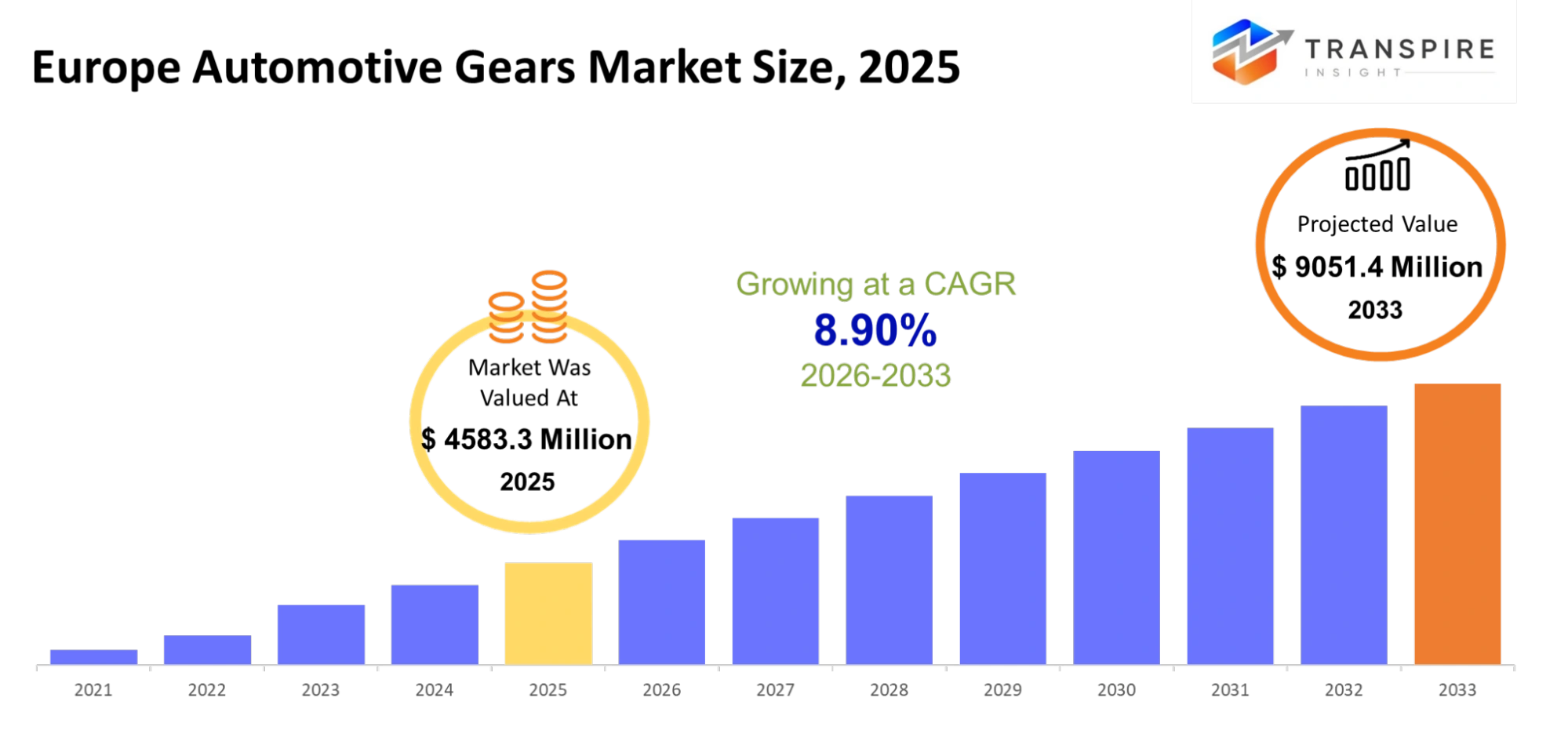
- Europe Automotive Gears Market Size 2025: USD 4583.3 Million
- Europe Automotive Gears Market Size 2033: USD 9051.4 Million
- Europe Automotive Gears Market CAGR: 8.90%
- Europe Automotive Gears Market Segments: By Type (Spur, Helical, Bevel), By Application (Transmission, Differential), By End-User (Automotive OEMs)
To learn more about this report,  Download Free Sample Report
Europe Automotive Gears Market Summary:
Europe Automotive Gears Market size was estimated at USD 4583.3 Millionin 2025 and is anticipated to reach USD 9051.4 Million by 2033, growing at a CAGR of 8.90% from 2026 to 2033.
Europe's automotive gears market exists within the larger automotive components sector, which will maintain its identity through its precision engineering capacity and its historical manufacturing practices. Gear production in Germany, France, and Italy will experience transformation through the enduring relationships between automotive manufacturers and their dedicated suppliers, who have developed expertise through many years. The market will maintain its historical legacy of mechanical excellence while advancing beyond its historical origins. The automotive industry needs gears that enable quieter, more efficient, and more advanced transmission systems with reduced vibration and noise output. The automotive industry requires manufacturers to assess their materials, surface treatments, and production tolerances. Consumer preferences will start to move toward driving comfort and efficiency which will create a gradual shift in gear design and integration methods. Electric mobility will create a strong impact because it will use simpler transmission systems that decrease vehicle gear requirements while increasing demand for specialized gear sets that can manage instant torque and work in near-silent mode.
The market will continue to develop according to European regulatory changes which will occur because environmental standards become stricter and sustainability targets reach higher levels. The manufacturing industry will face pressure to implement environmentally friendly production techniques that use recyclable materials, and this change will impact their cost systems and product design decisions. The production of gears will undergo a transformation, as digital manufacturing technologies now enable precision machining through real-time data and automated systems for quality assessment. Companies can now reduce testing methods through advanced simulation tools which enable them to forecast gear performance and wear characteristics before they start production. The development of lightweight components will become essential, as customers now demand products that enhance fuel efficiency in regular vehicles and extend the life of electric vehicle batteries. The market will transition towards a new system which combines established mechanical expertise with modern engineering methods that will transform traditional practices into innovative methods of operation.
Key Market Trends & Insights:
- Automakers in Europe are creating a stable automotive gears market because they want to decrease fuel consumption. The engine performance optimisation process depends on gear systems, which enhance vehicle fuel efficiency. European manufacturers will create lighter and better efficient gear systems because of the strict emission regulations that all European countries enforce.
- Electric vehicles have changed the European Automotive Gears Market as their adoption rate continues to expand. Electric drivetrains require fewer gears compared to traditional systems, yet demand high precision. The manufacturing industry will need to develop new production methods to create compact gear solutions for electric vehicles.
- The increasing adoption of automatic and dual-clutch transmission systems drives expansion in the European Automotive Gears Market. Consumers prefer smoother driving experience, leading to higher adoption. These systems require advanced gear assemblies, creating market demand for components that meet high standards of quality and durability.
- The Europe Automotive Gears Market experiences benefits from production technology advancements, which include both precision machining and new material developments. Better manufacturing methods will increase durability and reduce noise in gear systems. The progress enables companies to achieve their performance goals while keeping production expenses manageable.
- The aftermarket segment provides financial backing for the Europe Automotive Gears Market. The market will sustain its demand throughout time because maintenance requirements and gear replacements will create a continuous need. The ageing vehicle fleets in multiple European regions will create an ongoing need for spare parts, which will help maintain market stability for an extended period.
Europe Automotive Gears Market Segmentation
By Type :
- Spur: The European Automotive Gears Market displays spur gears, which feature a straightforward design that uses straight teeth which run parallel to the axis. The system enables basic automotive systems to operate efficiently through effective power distribution. The system maintains consistent performance in situations where sound reduction is not required, delivering affordable results and dependable performance across different types of vehicles.
- Helical: Europe Automotive Gears Market highlights helical gears due to their tooth configuration, which enables quieter operation through smoother gear engagement. The design of helical gears decreases vibration while load distribution improves, which makes them appropriate for modern vehicles that need both comfort and operational efficiency. The need for this product keeps increasing because people want better driving experiences that last longer.
- Bevel: Bevel gears in the European Automotive Gears Market function as a system to transmit power between two shafts that meet at right angles. The system enables power flow in multiple directions, making bevel gears vital for operating advanced automotive systems. The automotive industry shows strong demand for advanced vehicle design because it needs components which distribute torque effectively while occupying minimal space.
By Application :
- Transmission: The Europe Automotive Gears Market demonstrates high demand for gears because transmission systems require precise speed and torque control. Gears provide smooth transmission under changing engine power conditions which helps vehicles maintain stability while using less fuel. The ongoing development of new transmission technologies creates a steady requirement for premium gear products.
- Differential: The Europe Automotive Gears Market uses differential systems, which depend on gears to enable wheels to turn at different speeds during vehicle maneuvers. This function improves handling and safety. The automotive industry is reaching new performance heights with advanced stability systems, creating a growing need for robust yet effective gear components for differential assemblies.

To learn more about this report, Download Free Sample Report
By End-User :
- Automotive OEMs: The Europe Automotive Gears Market depends on automotive original equipment manufacturers who need high-performance gears for their vehicle production needs. Original equipment manufacturers need to deliver high-quality, durable products that work efficiently to satisfy demanding industry requirements. The rising demand for advanced gear solutions will continue because vehicle production and automotive design innovation progress.
Country Insights
- Germany maintains a dominant position in the European Automotive Gears Market because its automotive industry produces high-quality vehicles and its engineers follow established technical standards. The market will see stable demand, as car manufacturers produce vehicles that require both performance and durable components. The market will experience growth because transmission system upgrades continue and domestic factories focus on improving fuel efficiency.
- The United Kingdom maintains its position in the European Automotive Gears Market because automotive design and component innovation continue to develop. Market demand will be shaped by gradual transitions toward hybrid vehicles and efficient drivetrains. The production of goods through local facilities and imported products will create market demand while emission regulations will force manufacturers to enhance gear efficiency and vehicle performance capabilities.France maintains its position in the European Automotive Gears Market through a combination of domestic manufacturing and technological development. The country’s emissions-reduction efforts and vehicle-efficiency improvements will determine demand for its products. Automotive manufacturers will continue to invest in advanced transmission systems, supporting consistent need for refined gear solutions across passenger and light commercial vehicles.
- Italy contributes significantly to the European automotive gears market through its strong connections to performance vehicles and precision engineering. Market demand will increase because customers require high-quality gear systems that can perform in both luxury cars and regular vehicles. Local manufacturers will maintain their traditional craftsmanship skills while they develop modern transmission systems which will help the market grow steadily. Spain is increasingly relevant in the European automotive gears market due to its expanding vehicle production facilities and growing export business. The demand will increase because production levels rise and automotive infrastructure develops. The manufacturers will prioritize development of affordable gear solutions which meet quality requirements to help the nation establish its position in the European automotive supply chain.
Recent Development News
European suppliers warn of massive job losses
Major suppliers like Valeo warn that up to 350,000 jobs could be lost by 2030 due to competition and EV transition pressures.
Gear manufacturers, being part of the drivetrain supply chain, are especially vulnerable because EVs typically use fewer moving mechanical parts, reducing demand for traditional gear systems.
Possible delay of petrol/diesel ban to 2040
Reports suggest the EU could delay the ICE ban to 2040, giving automakers more flexibility.
This extends the lifecycle of traditional gear technologies such as manual and automatic transmission gear sets, slowing the decline of conventional gear demand.
|
Report Metrics |
Details |
|
Market size value in 2025 |
USD 4583.3 Million |
|
Market size value in 2026 |
USD 4982.1 Million |
|
Revenue forecast in 2033 |
USD 9051.4 Million |
|
Growth rate |
CAGR of 8.90% from 2026 to 2033 |
|
Base year |
2025 |
|
Historical data |
2021 - 2024 |
|
Forecast period |
2026 - 2033 |
|
Report coverage |
Revenue forecast, competitive landscape, growth factors, and trends |
|
Country scope |
Europe (Germany, United Kingdom, France, Italy, Spain, Rest of Europe) |
|
Key company profiled |
ZF Friedrichshafen, GKN Automotive, BorgWarner, Dana, Aisin, Magna, Schaeffler, Eaton, American Axle, Linamar, NSK, JTEKT, Hyundai WIA, Hitachi Astemo, Showa |
|
Customization scope |
Free report customization (country, regional & segment scope). Avail customized purchase options to meet your exact research needs. |
|
Report Segmentation |
By Type (Spur, Helical, Bevel), By Application (Transmission, Differential), By End-User (Automotive OEMs) |
Key Europe Automotive Gears Company Insights
- The Europe Automotive Gears Market displays a strong presence of established manufacturers who have developed their engineering skills throughout many years while they continue to enhance their products. The companies develop their products through precise engineering work which delivers durable components that enable efficient performance to meet the increasing demands of vehicle operation. Advanced manufacturing process investments will establish stable production standards which enable businesses to compete effectively in both domestic markets and international export markets.
- The Europe Automotive Gears Market shows rising interest in electric mobility which drives companies to modify their gear designs for silent operation and better energy efficiency. Research activities will continue to align with changing drivetrain structures. Automotive manufacturers will form partnerships which will improve supply chain operations by providing on-time delivery while achieving cost efficiency and product dependability.
Europe Automotive Gears Market Companies:
- ZF Friedrichshafen
- GKN Automotive
- BorgWarner
- Dana
- Aisin
- Magna
- Schaeffler
- Eaton
- American Axle
- Linamar
- NSK
- JTEKT
- Hyundai WIA
- Hitachi Astemo
- Showa
Europe Automotive Gears Market Segmentation
By Type
- Spur
- Helical
- Bevel
By Application
- Transmission
- Differential
By End-User
- Automotive OEMs
Frequently Asked Questions
Find quick answers to common questions.
The Approximate Europe Automotive Gears Market size for the Market will be USD 9051.4 Million in 2033.
Key Segments for the Europe Automotive Gears Market are By Type (Spur, Helical, Bevel), By Application (Transmission, Differential), By End-User (Automotive OEMs).
Major Europe Automotive Gears Market Players are ZF Friedrichshafen, GKN Automotive, BorgWarner, Dana, Aisin, Magna, Schaeffler, Eaton, American Axle, Linamar, NSK, JTEKT, Hyundai WIA, Hitachi Astemo, Showa.
The Current Europe Automotive Gears Market size is USD 4583.3 Million in 2025.
The Europe Automotive Gears Market CAGR is 8.90%.
- ZF Friedrichshafen
- GKN Automotive
- BorgWarner
- Dana
- Aisin
- Magna
- Schaeffler
- Eaton
- American Axle
- Linamar
- NSK
- JTEKT
- Hyundai WIA
- Hitachi Astemo
- Showa
Recently Published Reports
-
Apr 2026
Handling and Lifting Equipment Market
Handling and Lifting Equipment Market Size, Share & Analysis Report By Product (Cranes and Hoists, Forklifts, Conveyor Systems, Aerial Work Platforms, Others), By Application (E-Commerce, Automotive and Railway, Food and Beverages, Aviation, Others), and Geography (North America, Europe, Asia-Pacific, Middle East and Africa, South and Central America), 2021 - 2031
-
Apr 2026
HVAC Equipment Market
HVAC Equipment Market Size, Share & Analysis Report By Heating Equipment Type (Boilers and Furnaces, Heat Pumps, and Unitary Heaters), By Ventilation Equipment (Air Handling Units, Humidifiers and Dehumidifiers, Air Filters, and Fan Coiling Units), By Air Conditioning Equipment (Unitary Air Conditioners, Room Air Conditioners, Packaged Terminal Air Conditioners, and Chillers), By End User (Commercial, Residential, Industrial, and others), and Geography (North America, Europe, Asia-Pacific, Middle East and Africa, South and Central America), 2021 – 2031
-
Apr 2026
Refrigeration Valves Market
Refrigeration Valves Market Size, Share & Analysis Report By Type (Solenoid Valves, Expansion Valves, Check Valves, Service Valves, Others), By Application (Commercial Refrigeration, Industrial Refrigeration, Transport Refrigeration, Residential Refrigeration, Air Conditioning Systems), By End User (Food and Beverage Industry, Pharmaceutical Industry, HVAC Industry, Chemical Industry, Others), and Geography (North America, Europe, Asia-Pacific, Middle East and Africa, South and Central America), 2021 – 2031
-
Apr 2026
E-Commerce Packaging Materials Market
E-Commerce Packaging Materials Market By Material Type (Corrugated Boxes, Paper & Paperboard, Foam & Cushioning Materials, Plastic Packaging, Flexible Packaging, Protective Packaging, Others), By Product(Primary Packaging, Secondary Packaging, Tertiary Packaging), By Packaging Function (Protective Packaging, Branding & Presentation Packaging, Transit & Logistic Packaging, Sustainable Packaging, Tamper Evidence Packaging), By End-User (Retail & Consumer Goods, Electronic Appliances, Food & Beverages, Healthcare & Pharmaceutical, Fashion & Apparel, Home & Furnishing, Others); By Industry Analysis, Size, Share, Growth, Trends, and Forecasts 2021-2033