

Europe Analog Front End Market Summary
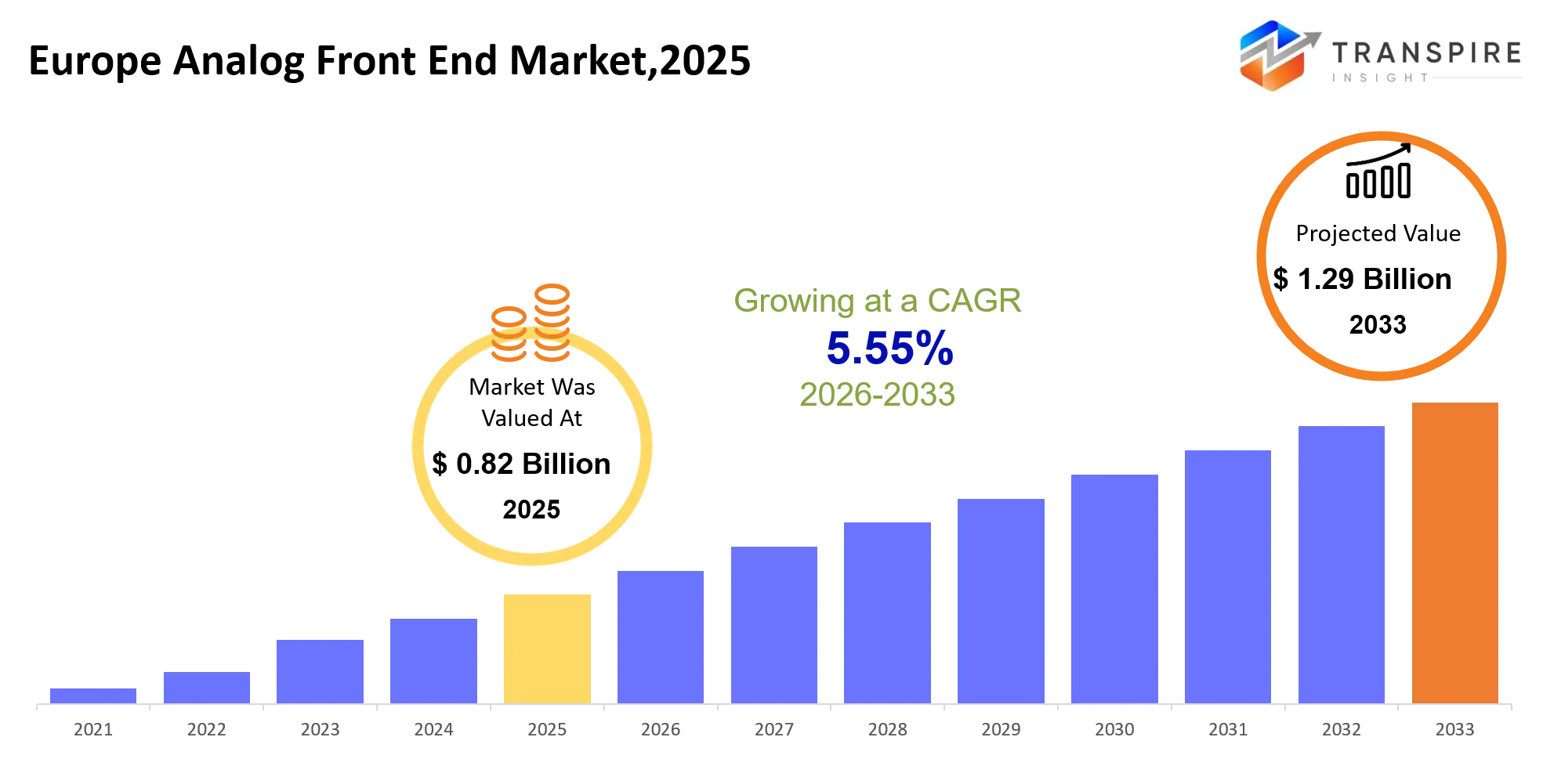
As per Transpire Insight Analysis the Europe Analog Front End Market size is estimated at USD 0.82 Billion in 2025 and is anticipated to reach USD 1.29 Billion by 2033, growing at a CAGR of 5.55% from 2026 to 2033.
An analog front end, or AFE, takes faint and noisy sensor signals from the real world and turns them into signals that digital chips can read. These circuits show up in many European fields, like cars, factory automation, healthcare devices, data links, and power systems. Before any software or digital processing starts, the AFE must handle gain, noise reduction, basic signal setup, and the switch from analog to digital.
Over the last three to five years, many designs have moved toward parts that do more in one place and can be set up in software. Builders want fewer outside components, even as they add more sensors and more connected features. In cars, electrification and advanced driver help have pushed this trend forward. At the same time, chip delivery problems have made it clear that relying on a tight group of suppliers can be risky. Because of that, European teams are putting more weight on nearby support for chip supply and on parts that are already approved.
STMicroelectronics and Infineon keep adding analog and mixed-signal strengths aimed at automotive and industrial use. This direction can help create higher value products. As sensing gets more complex, signal capture needs to be more accurate. That need raises the share of AFE in each full system.
Europe Analog Front End Market Size & Forecast:
- Europe Analog Front End Market Size 2025: USD 0.82 Billion
- Expected Market Value 2033: USD 1.29 Billion
- Forecast CAGR: 5.55%
- Leading region in 2025:Germany
- Fastest Growing region:Netherlands
- Key Profile: Texas Instruments, Analog Devices, STMicroelectronics, NXP Semiconductors, Infineon Technologies, Renesas Electronics, Microchip Technology, Maxim Integrated, onsemi, Broadcom, Qualcomm, Skyworks Solutions, ams OSRAM, ROHM Semiconductor, Silicon Labs
Key Market Insights
- Germany leads the regional market due to its auto sector, industrial automation know-how, and semiconductor output.
- The Netherlands could see quicker gains because more firms are putting money into chip tools, modern production, and higher-end electronics.
- Automotive electronics still drives big AFE demand. For European analog ICs used in cars, sales are expected to hit EUR 2.86 billion in 2026.
- That is up from EUR 2.23 billion in 2022. Sensor and actuator chips are forecast to rise about 9.58% per year from 2023 to 2026. This growth should raise the need for more signal conditioning.
- More teams are moving to integrated AFE designs.They try to pack gain, conversion, filtering, and fault checks into a smaller set of parts.
- In cars, AFE solutions help with battery management, current sensing, ADAS features, steering needs, and powertrain work. They also support vehicle networking.
- In factories, industrial automation is using more precise and flexible AFE setups. These support sensor use, motor control, process checks, and equipment diagnostics. In 2024, Infineon had 14.1% of Europe’s automotive semiconductor market.
- That helped its standing in auto electronics.Rivalry is now focused on distinct analog and mixed-signal platforms. Firms are pairing sensor links, power control, connectivity, and processing in one approach.
What are the Key Drivers, Restraints, and Opportunities in the Europe Analog Front End Market?
Electric drive systems keep growing, and the control electronics behind them are getting more complex too. Modern EVs and related platforms need good readings for voltage, current, and temperature. They also rely on sensor data from areas like battery control, ADAS functions, steering logic, and vehicle connectivity.
To handle that demand, European chip makers are building more integrated analog and mixed-signal parts. The goal is to use fewer outside components, while still meeting functional safety rules. STMicroelectronics, for instance, sells automotive analog solutions for battery management, current sensing, steering, powertrain control, and safety functions. With more electronics in each car, the need for advanced analog front ends rises, and the market shifts toward higher value semiconductor sales.
Still, swapping out an AFE is not quick or cheap. Development work is expensive, and qualification rules are strict. In both auto and medical uses, buyers want long service lives, heavy reliability testing, and checks that match each specific application. Moving to a new AFE setup then becomes slow, and it drains time and budget. This tends to favor current vendors, even if it also slows take-up of newer designs. It can also limit short-term sales for newer entrants.
At the same time, there is room to grow in sensor and signal handling. Better sensor pairing can expand work across automotive, industrial tools, and medical devices. Infineon’s move in 2026 to acquire ams OSRAM’s non optical analog and mixed-signal sensor line, set at €570 million, adds to its integrated sensing strengths. When sensing, analog processing, and on chip intelligence work together, the overall system can get simpler. That also means more semiconductor content per product, not less.
What Has the Impact of Artificial Intelligence Been on the Europe Analog Front End Market?
AI is changing AFE needs. It is asking for more sensor data, and that data must be better. In factories, AI powered equipment uses readings from temperature, vibration, pressure, current, and position sensors. Those signals help spot odd behavior early. They also help with predictive upkeep. Before those readings reach the machine learning step, the AFE circuits handle gain, filtering, and signal conversion. As models depend on clean inputs, the signal chain matters more now. Infineon points to analog and mixed signal work as key for motor control, industrial uses, IoT gear, and car electronics.
Car AI brings similar gains. It shows up in ADAS, battery checks, steering, and vehicle diagnostics. With better analog measurements, control units can notice smaller shifts in current, voltage, temperature, and motion. That can mean quicker detection of faults and tighter control. STMicroelectronics already adds analog sensing and diagnostic parts in some car products, including current sensing and temperature monitoring. AI could improve predictive maintenance and day to day efficiency. Still, there is a big roadblock. Training data must stay consistent as conditions change. That includes shifts in temperature, vibration, electromagnetic noise, and other operating states. If the sensor signal is weak at the AFE stage, the model can end up less accurate even if the AI method is strong.
Key Market Trends
- Sales of analog ICs for cars are expected to climb from EUR 2.23 billion in 2022 to EUR 2.86 billion by 2026.
- Sensor and actuator chip revenue is set to rise at about 9.58% each year through 2026. This helps drive more need for accurate signal interface parts.
- More European makers are linking analog sensing with digital control. They are also cutting the number of outside parts. At the same time, system checks and fault finding can get better.
- In 2024, Infineon reached a 14.1% share of European automotive semiconductors. That points to tougher competition in the region for auto electronics.
- STMicroelectronics has been widening its automotive analog lineup. The focus is on battery management, steering, sensing, powertrain work, and safety uses.
- Many teams are moving from fixed AFE designs to programmable AFE setups. This fits when companies want sensor links that can change. It can also shorten development timelines.
- Vehicle designers are blending analog sensing with high-voltage and digital functions in smaller control boxes.
- Infineon’s purchase of ams OSRAM for €570 million suggests more consolidation around combined analog and mixed-signal sensing.
- Industrial IoT is also changing what AFE must do. It now pushes lower power use, ongoing monitoring, connected systems, and data work at the edge.
- Chip vendors are trying to stand out with full application support. Instead of only selling single AFE pieces, they aim to help customers integrate designs and win more design-in work.
Europe Analog Front End Market Segmentation
By Component
Amplifiers boost weak signals from sensors so the next stage can work well. Analog to Digital Converters take the analog readings and turn them into numbers. Digital to Analog Converters do the reverse. They turn digital commands into analog outputs used by control systems. Filters cut out noise and unwanted frequency content. This helps the signal stay cleaner.
Multiplexers let more than one sensor line use the same processing hardware. That reduces the number of separate circuits needed. Signal conditioning circuits tune things like voltage and current. They also set gain and add the right filtering. This supports steady measurement. Data converters help move data between analog and digital forms. You see this in cars, factories, and medical devices, and in other systems too.Voltage references give a fixed baseline value. That baseline matters for correct conversion and measurement. Battery systems in vehicles, control units in industry, medical instruments, and communication gear all need solid reference behavior. This must hold up as conditions change. As sensor counts grow, the design has to handle more work. That means better amplification, filtering, and conversion. With integrated parts working together, designs can get smaller. Power use can drop. System setup can also be simpler.
By Type
Low-Noise AFE is made for setups that need quiet, clean readings from delicate sensors. High-Speed AFE is for signals that change fast, like in link communications, imaging, and test gear. Precision AFE is for cases where voltage and current must be measured with tight accuracy. Programmable AFE lets you set it up for different sensor types and different operating settings. Integrated AFE puts several signal tasks inside one small chip, so there are fewer outside parts.
Wireless AFE fits radio equipment and connected sensing systems where the signal link must stay small. Sensor AFE conditions signals for many kinds of sensors, such as temperature, pressure, motion, and current. This is used in both industrial systems and vehicles. Biomedical AFE is for health care monitoring. It focuses on getting biological signals in a careful and accurate way. If these blocks are used in a more unified way, makers can save space on the board. It can also make the whole system easier to adapt and keep the measurement results steady.
By Application
Consumer Electronics often uses AFE circuits to handle sensing and audio tasks, plus imaging, power tracking, and devices that connect to networks.
For Automotive work, the same AFE approach is needed for battery checks, current measurement, steering, ADAS features, powertrain functions, and overall vehicle control.
In Industrial Automation, teams rely on signal interfaces for machine watch, process control, robotics, and sensor units in plants.
Healthcare needs careful signal capture for patient monitoring and for devices used in diagnosis.
In Communications, AFE circuits support radio and data transfer work, where signal quality matters.
Aerospace and Defense programs depend on steady signal capture for sensors, navigation, links, and control loops.
In Energy, AFE technology shows up in power monitoring, renewable power setups, storage hardware, and grid management.
Test and Measurement gear depends on clean amplification, conversion, filtering, and stable reference signals for lab and factory checks.Automotive and industrial segments should stay key for revenue, since electronic control systems keep gaining more sensing features.
By Technology
CMOS lets engineers build small analog front ends that use little power. It also stays a key choice in products made in large quantities. BiCMOS is a mix of bipolar and CMOS parts. It is used when a design needs fast timing, good accuracy, and strong analog behavior. BCD joins bipolar, CMOS, and power devices in one process. It is often chosen for car systems and factory control gear. SiGe supports higher frequency designs. It helps with tough radio and communication work where signal quality matters. GaAs can be used for RF work that needs low noise. It fits cases where strong RF results are required. SOI gives built-in electrical isolation. This supports advanced chip designs.
FD-SOI is known for low power use. It also helps teams build systems that need both digital and analog blocks with better energy efficiency. There are also other process options. Some are made for sensing, power stages, RF needs, and industrial use. Which technology to pick depends on many factors. These include speed, power use, frequency range, reliability, cost to build, and any qualification rules tied to the target application.
By End User
Original equipment makers put AFE parts inside the devices they sell. They also want smaller solutions that fit each use case.Semiconductor firms design and build AFE devices. They spend effort on production methods, sensor links, and mixed-signal circuit work. Car makers need AFE circuits for many jobs. These include vehicle sensing, battery monitoring, safety-related control, and powertrain electronics. Medical product makers rely on AFE work for more careful measurement. It shows up in patient checks, scans, tests, and hand-held medical tools.
Factories and plant builders use AFE circuits in automation. They add them to machines, robots, and control and process systems. In telecom, AFE is used in wireless sites. It also shows up in communication gear and in RF signal paths. For aircraft, teams need steady analog connections. These support navigation, sensing, communication, and control tasks. For consumer electronics, AFE circuits appear in smart gadgets. You can also find them in audio gear, camera systems, and connected products.
More built-in integration helps customers cut the number of circuit boards. It also helps them handle more sensors and run newer digital functions.
By Region
Germany has a solid car and industrial making setup. That helps AFE take root in a big way. The UK has demand too, backed by space work, defense work, cars, telecom links, and newer industrial electronics. France also has openings, especially in space, auto, energy, and industrial tech work. In Italy, the push comes from car component firms, factory automation, machine building, and electronics production. The Netherlands stands out with a strong chip scene and more advanced electronics production.
Switzerland leans on precision work, health tech, industrial tools, and niche electronics. Sweden sees support from car tech, industrial automation, telecom, and electric projects. Finland supports AFE use through telecom tech, industrial electronics, car tech, and special sensing uses. Future regional growth will hinge on chip spending, car output, factory automation, research work, and building newer electronic systems.
What are the Key Use Cases Driving the Europe Analog Front End Market?
Automotive electronics are a big use case. Electric cars and ADAS rely on fast and exact readings for current, voltage, temperature, and sensor signals. AFE circuits help by cleaning and scaling those inputs before any digital work. This is key for safe operation and steady control. STMicroelectronics backs these needs in areas like battery management, current sensing, steering, and powertrain functions. It uses analog and mixed-signal products for this.
Other markets are growing too. In industrial automation, factory lines use AFE parts to track vibration, pressure, temperature, motors, and ongoing process data. In healthcare, medical gear must capture signals from body sensors with high care. At the same time, Industrial IoT brings more connected sensors. That pushes demand for links that use less power and work well with mixed signal paths.
New work is also showing up. Companies are looking at AI-based predictive maintenance, better battery checks, sensing at the edge, and smarter ways to run energy. These ideas depend on analog measurements that hold up well, since machine learning will only be as good as the data it gets. More joining of sensing with mixed-signal blocks should help shrink device size, improve smart features, and cut power use during the period ahead.
|
Report Metrics |
Details |
|
Market size value in 2025 |
USD 0.82 Billion |
|
Market size value in 2026 |
USD 0.87 Billion |
|
Revenue forecast in 2033 |
USD 1.29 Billion |
|
Growth rate |
CAGR of 5.55% from 2026 to 2033 |
|
Base year |
2025 |
|
Historical data |
2021 - 2024 |
|
Forecast period |
2026 - 2033 |
|
Report coverage |
Revenue forecast, competitive landscape, growth factors, and trends |
|
Regional scope |
Europe |
|
Key company profiled |
Texas Instruments, Analog Devices, STMicroelectronics, NXP Semiconductors, Infineon Technologies, Renesas Electronics, Microchip Technology, Maxim Integrated, onsemi, Broadcom, Qualcomm, Skyworks Solutions, ams OSRAM, ROHM Semiconductor, Silicon Labs |
|
Customization scope |
Free report customization (country, regional & segment scope). Avail customized purchase options to meet your exact research needs. |
|
Report Segmentation |
By Component (Amplifiers, Analog-to-Digital Converters, Digital-to-Analog Converters, Filters, Multiplexers, Signal Conditioning Circuits, Data Converters, Voltage References); By Type (Low-Noise AFE, High-Speed AFE, Precision AFE, Programmable AFE, Integrated AFE, Wireless AFE, Sensor AFE, Biomedical AFE); By Application (Consumer Electronics, Automotive, Industrial Automation, Healthcare, Communications, Aerospace & Defense, Energy, Test & Measurement); By Technology (CMOS, BiCMOS, BCD, SiGe, GaAs, SOI, FD-SOI, Other Semiconductor Technologies); By End User (OEMs, Semiconductor Companies, Automotive Manufacturers, Medical Device Companies, Industrial Manufacturers, Telecom Companies, Aerospace Companies, Consumer Electronics Manufacturers); By Region (Germany, UK, France, Italy, Netherlands, Switzerland, Sweden, Finland) |
Which Regions are Driving the Europe Analog Front End Market Growth?
Germany is likely to stay at the top in Europe. One big reason is the steady mix of car production, industrial automation, and chip making. That mix gives AFE suppliers a solid starting point. Germany also has big chip projects already underway. Infineon’s Dresden Smart Power Fab is backed by about €1 billion from the EU Chips Act and IPCEI help. The full amount planned for the site is near €5 billion. In addition, the country has many automotive OEMs, makers of industrial gear, and electronics suppliers. That setup keeps demand coming for precise signal parts and mixed-signal devices. It also helps AFE vendors win designs for cars, factory automation, energy systems, and connected products.
France looks like the next major market. Its rise is driven more by aerospace, electronics research, energy systems, and semiconductor work than by a car-first base. STMicroelectronics plans to boost the French chip network with a new packaging and test pilot line in Tours. This effort includes a $60 million investment and joint local R&D. With strong research work, advanced manufacturing, and public support, the environment stays steady for analog and mixed-signal efforts. As a result, suppliers can serve a wider set of customers. That wider demand lowers risk from relying on just one type of industry.
The Netherlands has strong growth as well. It is gaining momentum due to advanced chip manufacturing tools, electronics engineering, and high-value supply chains. These factors make it easier to support more advanced AFE uses. There is also a clear focus around semiconductor technology and industrial electronics. That focus supports the need for fast, accurate, and integrated signal interfaces.
Who are the Key Players in the Europe Analog Front End Market and How Do They Compete?
Big-name analog and mixed-signal chip makers compete in a fairly tight field. Their edge usually comes from measurable specs, tighter integration, low power use, car-grade validation, and the ability to keep parts flowing for a long time.
Texas Instruments leans on a wide analog lineup plus its large factory footprint. It serves customers in cars, industry, and telecom. In Europe, its distribution setup helps parts move faster. Its distribution site near Frankfurt can handle up to 7,500 orders each day, which helps it respond more quickly across the region.
Infineon is pushing its reach with more automotive features and sensor add-ons. In 2025, it said it held the top global spot for automotive semiconductors. It also pointed to strong standing in Europe. Infineon bought ams OSRAM’s non optical analog and mixed signal sensor line for €570 million. That deal is meant to widen its work in auto, industrial, and medical uses.
STMicroelectronics competes with sensor integration and what it calls edge processing. It mentions biosensors that pair a vertical analog front end with MEMS sensing and machine learning compute. NXP Semiconductors puts heavy focus on automotive and industrial connectivity. Analog Devices differentiates with precise, high performance signal work and measurement tools.
Company List
- Texas Instruments
- Analog Devices
- STMicroelectronics
- NXP Semiconductors
- Infineon Technologies
- Renesas Electronics
- Microchip Technology
- Maxim Integrated
- onsemi
- Broadcom
- Qualcomm
- Skyworks Solutions
- ams OSRAM
- ROHM Semiconductor
- Silicon Labs
Recent Development News
"In February 2026, Infineon Technologies announced the acquisition of ams OSRAM’s non-optical analog/mixed-signal sensor portfolio for €570 million. The transaction expands Infineon’s sensor capabilities across automotive, industrial, and medical applications and adds approximately €230 million in expected 2026 revenue.https://www.infineon.com/press-release/2026/infxx202602-0431 (Infineon Technologies)."
"In April 2026, Infineon Technologies reported that the company retained the global number-one automotive semiconductor position for the sixth consecutive year, while maintaining market leadership in Europe. The result strengthens Infineon’s competitive position in automotive analog, sensing, power, and mixed-signal applications.https://www.infineon.com/press-release/2026/infatv202604-078 (Infineon Technologies)."
"In April 2025, Texas Instruments launched new automotive lidar, clock, and radar chips for advanced driver assistance systems. The portfolio expands high-speed analog and sensing capabilities, including an integrated lidar laser driver and new millimeter-wave radar technology for vehicle safety applications.https://www.ti.com/about-ti/newsroom/news-releases/2025/2025-04-15-ti-enables-automakers-to-advance-vehicle-autonomy-and-safety-with-new-chips-in-its-automotive-portfolio.html (Texas
What Strategic Insights Define the Future of the Europe Analog Front End Market?
The market keeps shifting toward one-piece AFE designs. These designs bring sensing, signal conversion, health checks, and more local compute into the same stack. We also see more focus on edge intelligence, not just data capture.Cars are changing fast. Electric drives, software-defined features, and smarter factory control all raise demand for better signal links. Connected medical tools add to that as well. Because of this, chip makers are pushed to sell higher value interfaces, not only stand alone parts.
There is a risk that is easy to miss. If European OEMs rely on just a few analog suppliers, they can face supply limits. This can happen when car or industrial chip cycles turn tight. In those moments, even a normal build plan can get blocked by allocation.Substitution adds pressure too. New sensor blocks and system-on-chip designs can take over jobs that used to belong to separate AFE units. So the old product boundaries keep shrinking.
A bright opening is still there. Low power sensor interfaces for edge AI matter most when compute is done near the sensor. That can cut back on data links and shorten the wait time for results.What companies should do next is practical. Build plans around use case reference designs. Lock in long term supply terms early. At the same time, fund AFE platforms that meet automotive and industrial needs, and that can carry across several product cycles.
Europe Analog Front End Market Report Segmentation
By Component
- Amplifiers
• Analog-to-Digital Converters
• Digital-to-Analog Converters
• Filters
• Multiplexers
• Signal Conditioning Circuits
• Data Converters
• Voltage References
By Type
- Low-Noise AFE
• High-Speed AFE
• Precision AFE
• Programmable AFE
• Integrated AFE
• Wireless AFE
• Sensor AFE
• Biomedical AFE
By Application
- Consumer Electronics
• Automotive
• Industrial Automation
• Healthcare
• Communications
• Aerospace & Defense
• Energy
• Test & Measurement
By Technology
- CMOS
• BiCMOS
• BCD
• SiGe
• GaAs
• SOI
• FD-SOI
• Other Semiconductor Technologies
By End User
- OEMs
• Semiconductor Companies
• Automotive Manufacturers
• Medical Device Companies
• Industrial Manufacturers
• Telecom Companies
• Aerospace Companies
• Consumer Electronics Manufacturers
By Region
- Germany
• UK
• France
• Italy
• Netherlands
• Switzerland
• Sweden
• Finland
Frequently Asked Questions
Find quick answers to common questions.
The expected Europe Analog Front End Market size for the market will be USD 1.29 Billion in 2033.
Key segments for the Europe Analog Front End Market are By Component (Amplifiers, Analog-to-Digital Converters, Digital-to-Analog Converters, Filters, Multiplexers, Signal Conditioning Circuits, Data Converters, Voltage References); By Type (Low-Noise AFE, High-Speed AFE, Precision AFE, Programmable AFE, Integrated AFE, Wireless AFE, Sensor AFE, Biomedical AFE); By Application (Consumer Electronics, Automotive, Industrial Automation, Healthcare, Communications, Aerospace & Defense, Energy, Test & Measurement); By Technology (CMOS, BiCMOS, BCD, SiGe, GaAs, SOI, FD-SOI, Other Semiconductor Technologies); By End User (OEMs, Semiconductor Companies, Automotive Manufacturers, Medical Device Companies, Industrial Manufacturers, Telecom Companies, Aerospace Companies, Consumer Electronics Manufacturers); By Region (Germany, UK, France, Italy, Netherlands, Switzerland, Sweden, Finland)
Major Europe Analog Front End Market players are Texas Instruments, Analog Devices, STMicroelectronics, NXP Semiconductors, Infineon Technologies, Renesas Electronics, Microchip Technology, Maxim Integrated, onsemi, Broadcom, Qualcomm, Skyworks Solutions, ams OSRAM, ROHM Semiconductor, Silicon Labs
The Europe Analog Front End Market size is USD 0.82 Billion in 2025
The Europe Analog Front End Market CAGR is 5.55% from 2026 to 2033.
- Texas Instruments
- Analog Devices
- STMicroelectronics
- NXP Semiconductors
- Infineon Technologies
- Renesas Electronics
- Microchip Technology
- Maxim Integrated
- onsemi
- Broadcom
- Qualcomm
- Skyworks Solutions
- ams OSRAM
- ROHM Semiconductor
- Silicon Labs
About the Authors

Avinash Kumar
I’m Avinash Kumar, a Senior Research Analyst at Transpire Insight, with expertise in the Electronics and Semiconductor and Energy & Power industry. My work focuses on analyzing emerging technologies, market trends, industry developments, and innovation across these sectors. I specialize in transforming complex technical and market insights into clear, research-backed content that helps professionals, businesses, and decision-makers stay informed. Through continuous industry research and data-driven analysis, I strive to deliver accurate, reliable, and practical perspectives on the latest advancements shaping the semiconductor and energy landscape.

Chakradhar Khansole
Chakradhar serves as the Research Director at Transpire Insight, bringing over 8 years of experience in technology, innovation, and strategic market intelligence. He specializes in transforming complex market data into actionable business insights that enable organizations to make informed, growth-oriented decisions. Recognized for his strategic vision and analytical expertise, Chakradhar leads high-impact research initiatives, delivering comprehensive market assessments, competitive intelligence, and forward-looking industry analysis.
Recently Published Reports
-
Apr 2026
Fiber Optic Faceplates Market
Fiber Optic Faceplates Market Size, Share & Analysis Report By Type (< 300 mm2, 300-350 mm2, and > 350 mm2, By Application (Night Vision, Holographic Imaging, Medical, and Others), and Geography (North America, Europe, Asia-Pacific, Middle East and Africa, South and Central America), 2021 - 2031
-
Apr 2026
High Temperature Superconductors Market
High Temperature Superconductors Market Size, Share & Analysis Report By Type (1G HTS, and 2G HTS), By Application (Power Cable, Fault Current Limiter, and Transformer), and Geography (North America, Europe, Asia-Pacific, Middle East and Africa, South and Central America), 2021 - 2031
-
Apr 2026
Industrial Plugs and Socket Market
Industrial Plugs and Socket Market Size, Share & Analysis Report By Type (Industrial Plugs, Industrial Sockets), By Current (Up to 32 A, 32 to 125 A, Above 125 A), By Protection (Dustproof and Splash Proof, Waterproof, Explosion Proof), By End User (Heavy Industries, Oil and Gas, Chemicals and Pharmaceuticals, Power Generation, Others), and Geography (North America, Europe, Asia-Pacific, Middle East and Africa, South and Central America), 2021 - 2031
-
Apr 2026
InGaAs Avalanche Photodiodes Market
InGaAs Avalanche Photodiodes Market Size, Share & Analysis Report By Type (1100 - 1700 nm, and 1000 - 1600 nm), By Application (Missile Warning System, Muzzle Flash Detection, Wafer Defect Inspection, Laser Rangefinders, and Others), and Geography (North America, Europe, Asia-Pacific, Middle East and Africa, South and Central America), 2021 - 2031