Europe Airport Baggage Handling System Market Summary
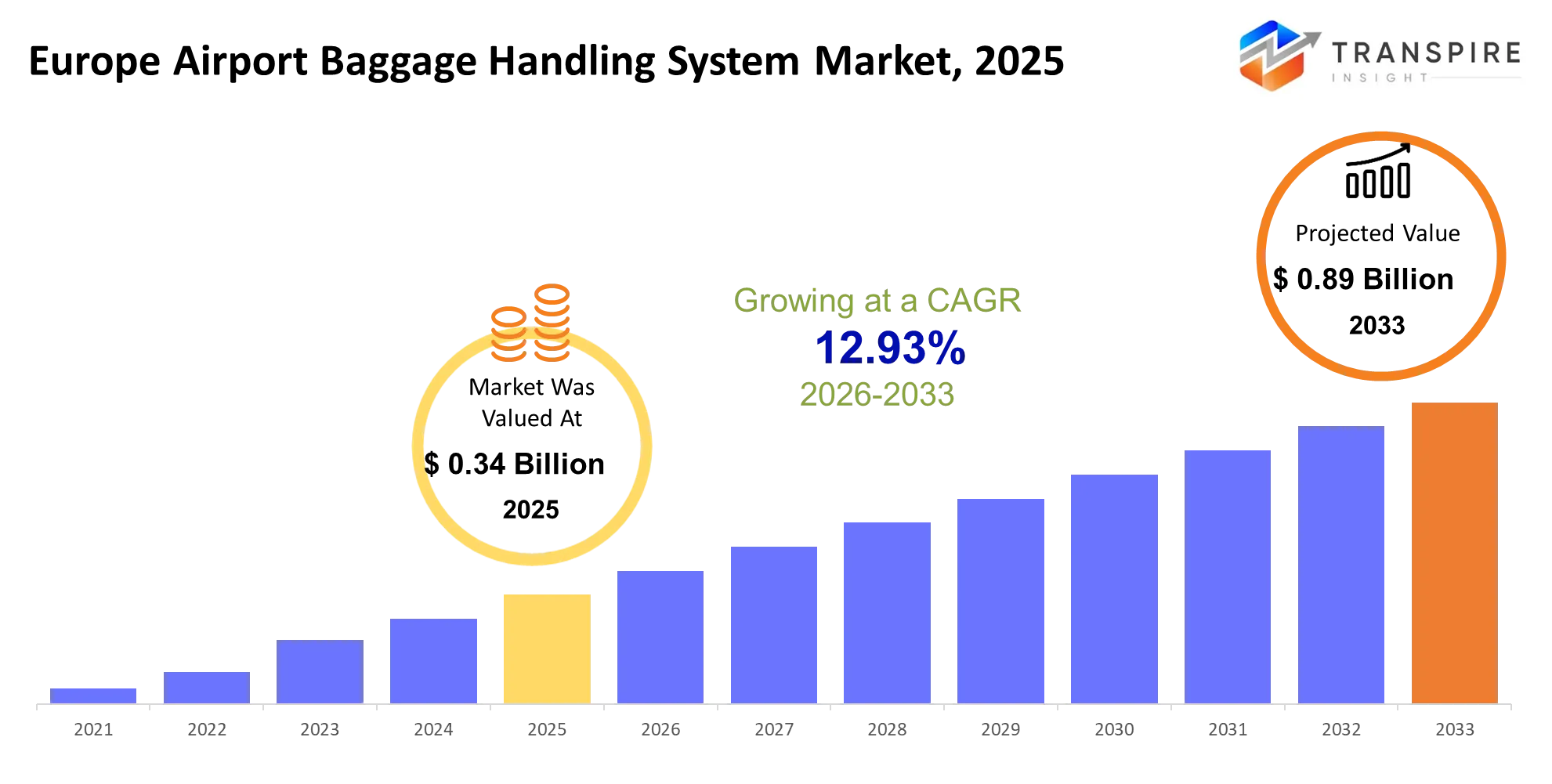
As per Transpire Insight Analysis the Europe Airport Baggage Handling System Market size is estimated at USD 0.34 Billion in 2025 and is anticipated to reach USD 0.89 Billion by 2033, growing at a CAGR of 12.93% from 2026 to 2033.
In most airports, baggage systems move checked bags in a set path. A worker drops the suitcase at the desk area. The bag then goes through screening. After that, it enters sorting bays. From there it moves across transfer zones. Finally it is loaded onto the aircraft.
Once the flight is done, the same suitcases show up on the reclaim belt for pickup. If the process runs smoothly, fewer people miss their connections. Less manual handling is needed by staff. That can also mean fewer broken items. Fewer problems usually means fewer complaints too. With that kind of reliability, planes can be ready to depart sooner.
Over the last few years, many European airports adjusted how these networks operate. A lot of places that once used mostly manual lines have started to shift toward linked systems. Newer setups may use RFID tags to identify bags. Some use camera checks during movement. Automated sorters are common in newer plans. In some cases, airports add robotic handling. Teams rely on fast updates, so they can check a bag location right away.
After the pandemic, travel picked up. As flights and demand rose, upgrades started to feel necessary. Airports also faced a harder job. They had to move more bags and still keep their schedules.
SITA added that fewer bags are being mishandled. In 2024, the rate was 6.3 incidents for every 1,000 passengers. In 2023 it was 6.9 incidents, so the trend moved in the right direction. The drop may be tied to earlier spending on better systemsLooking ahead, more automation is likely to push money toward further upgrades. Money may go to software, tracking tools, and the related infrastructure. It will also support ongoing service plans for maintenance over time related infrastructure. It will also support ongoing service plans for maintenance over time
Europe Airport Baggage Handling System Market Size & Forecast:
- Europe Airport Baggage Handling System Market Size 2025: USD 0.34 Billion
- Expected Market Value 2033: USD 0.89 Billion
- Forecast CAGR: 12.93%
- Leading region in 2025: Germany
- Fastest Growing region: Spain
- Key Profile: Siemens Logistics, Vanderlande, BEUMER Group, SITA, Daifuku, Alstef Group, Leidos, Honeywell, Collins Aerospace, Leonardo, Fives Group, Siemens, Scarabee Aviation Group, ULMA Handling Systems, Crisplant
Key Market Insights
- Germany leads. The country has big hub airports, firm runways, solid terminals, and skilled engineering teams. It also keeps pushing baggage automation.
- Spain is catching up faster. Several new upgrades are now in place. They add options for sorting, tracking, screening, and more self-service for travelers.
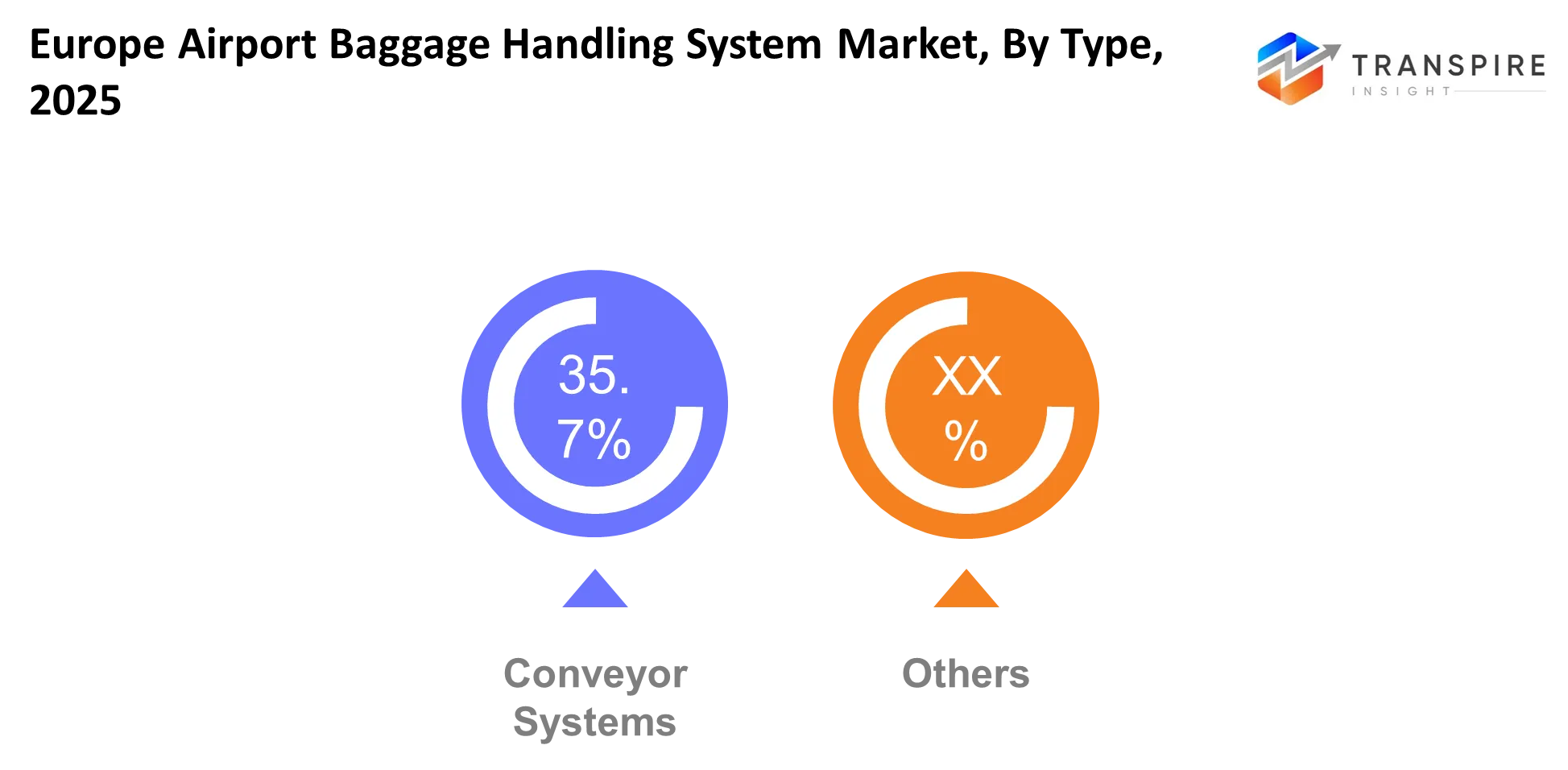
- Even with new systems, belts and conveyors still handle much of the work. Bags travel from check-in to screening. Then they move to sorting. After that, they go toward transfers and finally to reclaim.
- More places are using RFID instead of just basic barcodes. Airports want clearer bag location at every stage. That includes the moment a bag is taken in, through loading, movement, handoffs, and the final stop.
- In 2024, IATA reported that 40% of European airlines had already adopted Resolution 753 tracking. If it is only 40%, then the remaining airlines still have gaps to close.
- SITA also shared numbers for mishandled bags. In 2024, it was 6.3 per 1,000 passengers. This is below 6.9 in 2023, even with higher travel volumes.
- Transfer handling stays tough. In 2024, it made up 41% of mishandled bags. That means better sorting and tracking are still needed around connections.
- Bag-drop automation is growing. In 2024, 66% of airlines offered it. Another 16% said they would add it by 2027.
- Teams are moving beyond only machines. Many current efforts rely on software help too. Examples include computer vision, connected sensors, and tools that forecast daily flow and events.
- Large suppliers compete with full baggage automation packages. Siemens Logistics, Vanderlande, BEUMER Group, SITA, and Alstef Group are named among them. They sell setup services, digital tracking support, airport relationships, and long-term help.
What are the Key Drivers, Restraints, and Opportunities in the Europe Airport Baggage Handling System Market?
Driver: Airport upgrades still drive the biggest gains. As more people fly again, airports must move more bags and passengers through fast. They also need clearer bag trace data and quicker turnarounds for aircraft. SITA counted 5.3 billion passengers worldwide in 2024. At the same time, mishandled bags fell to 6.3 per 1,000 passengers. That mix supports automation. With better tracking and sorting, airports can lower payouts, cut manual fixes, and reduce delays.
Restraint: Costs and system setup issues hold things back. Many terminals already run older conveyor lines, scanner units, control parts, and software that do not match newer gear. Swapping it all out can mean stopping daily work, which most airports cannot do. Big rollouts also need long testing, skilled engineers, and tight coordination. Airports, airlines, security bodies, and vendors all have to align. Because of this, buying plans can take longer. Smaller airports often choose step by step upgrades instead of full replacement.
Opportunity: AI based baggage control is the next big chance. Computer vision can help detect where bags are. Machine learning can support smarter sorting and decision making. RFID data can add analytics. Predictive maintenance can flag problems before they grow. SITA's work on related technology has already delivered clear outcomes. Also, automated bag drop and live bag tracking open more room for software use. If airports pair automation with ongoing digital monitoring, they can earn money again and again from tools, analytics, upkeep, and services tied to results.
What Has the Impact of Artificial Intelligence Been on the Europe Airport Baggage Handling System Market?
AI is changing how airports handle bags. Instead of only using fixed machines, teams are moving toward control based on data. Computer vision helps too. It can spot bags, capture visual details, and notice when items sit the wrong way. That can feed sorting choices made by software. SITA points to computer vision and machine learning as key tools as volumes rise. It also notes that AI in baggage work can link daily operational data with tracking and recovery steps.
Machine learning can also help with maintenance. It looks at how conveyor motors behave, what sensors report, how sorters perform, and what past equipment faults showed. The goal is to spot strange operating signs before a mechanical failure turns into delays or a terminal disruption. Risk modelling is another piece. It can combine live bag status and flight details to spot transfer issues and suggest what to do. SITA’s WorldTracer Auto Reflight already shows this kind of automation in practice. During the first year at Munich Airport for Lufthansa Group, it says automation handled eight out of ten mishandled bags.
Even with these gains, adoption is not simple. Costs for setup can be high, and data quality can be hard to manage. Many airports still run older gear from more than one vendor. That leads to mismatched data formats and makes system work difficult. To get dependable AI results, airports need lots of clean operational data, solid testing, strong cybersecurity steps, and people who review outcomes. This matters even more for safety-related baggage operations.
Key Market Trends
- From 2023 on, more money has gone into tracking bags in real time. Airlines want to cut down on issues during transfers.
- RFID is showing up more often, not just where barcodes are used. Bigger airports in particular want quicker and more dependable bag checks.
- Computer vision went past the test phase. It is now helping with tasks like identifying bags, sorting them, and supporting recovery work.
- During the same recovery period, automated drop areas grew too. By 2024, 66% of airlines had this option.
- Work on AI risk models is also getting more focus. Airports link bag data with flight times and use it in day to day planning systems.
- Transfer bags are still a key concern. In 2024, 41% of mishandled bags were linked to transfers.
- Digital tracking is starting to face passengers. More updates are being shared in real time, and there are added features for finding a bag’s location.
- Several large projects in Europe now bundle setup with support and maintenance. This helps create steady repeat work.
- At airports, stand alone devices are being swapped out over time. Many new setups use IoT links, sensors, analytics, and a central monitoring view.
- Energy use is also getting more attention. Operators look at motor controls, how much conveyors are used, and how well the equipment performs, not just speed.
Europe Airport Baggage Handling System Market Segmentation
By Type:
Conveyor Systems, Sortation Systems, Screening Systems, Baggage Reclaim Systems, Check-In Systems, Early Baggage Storage, Automated Baggage Handling, and Baggage Tracking Systems all fit into different parts of moving luggage at an airport.
Conveyor Systems keep bags moving in a steady way between work areas.
Sortation Systems route each bag to the right flight and end point.
Screening Systems handle the security checks before bags go on an aircraft.
Baggage Reclaim Systems bring the cleared bags to people after they arrive.
Check-In Systems start the process by tying passenger drop off to what happens next.
Early Baggage Storage keeps bags from sitting in limbo when people arrive early.
Automated Baggage Handling cuts down on manual pushing and pulling by using linked equipment.
Baggage Tracking Systems add ID and position checks so staff can see where bags are and respond faster.
Many big airports choose a grouped setup instead of using one machine alone. That is because bags have to move as a chain. Check-in feeds screening. Screening feeds sorting. Sorting supports transfers. Transfers lead to loading. Then reclaim finishes the job.
Conveyor Systems and Sortation Systems handle the real movement and the routing.
Screening Systems keep security work intact.
Baggage Reclaim Systems support what happens on arrival.
Early Baggage Storage helps during busy windows and tight connection timing.
Automated Baggage Handling raises how much gets done, with less hands-on work.
Baggage Tracking Systems supply the view and records needed for recovery and review.
Taken together, the setup speeds work, lowers the odds of handling mistakes, and makes better use of space in the terminal.
By Technology:
Barcode scanning is still common at airports. The main reason is that most airports already have equipment and workflows for barcodes. RFID can add more automated ID and better item location tracking. Computer vision also helps by recognizing what is in images, which can support sorting and monitoring.
AI-based sorting can use day-to-day operating data and learned patterns to choose routes. Automated guided vehicles can carry baggage without relying on fixed conveyor paths in some setups. Robotics can also help with repeat tasks like loading and handling. IoT ties together sensors, motors, scanners, and control units so teams can watch conditions in one place. Digital twin tech makes a virtual copy of the system so people can test layouts, check capacity, and plan upkeep.
What you pick depends on the airport itself. Size matters, along with baggage volume and what is already installed. Budget priorities also play a role. Barcode scanning fits many sites because it is familiar and easy to keep running. RFID tends to matter more when an airport handles large volumes and needs stronger traceability. Computer vision and AI-based sorting can increase automation when that is a goal. Automated guided vehicles and robotics are more suitable when flexible handling is important.
By Airport Type:
Airports have to move bags through a chain of steps. Some flights go to many places, so bags may need several transfers. There are also security checks and short time limits between connections.
Big international hubs are built for heavy work. They sort a lot of bags fast. They also track bags across many legs. Space for early bag storage matters because transfer windows are tight. More links in the network mean more chances for delays.
Smaller domestic sites usually face less crowded routing. The cycles are often shorter, so the system has less pressure at once. Regional airports also deal with fewer riders. Their setup needs to grow without adding major changes each time demand rises.
Low-cost airports often push for automation. They want results without large spending on new builds. Using controlled upgrades can help keep costs down while reducing manual steps.
Military-civil airports must plan for different rules. Schedules can shift and security steps can vary. Systems have to handle those differences without breaking flow.
Cargo-focused airports run a different kind of baggage stream. They need handling steps made for freight timing and routing. Smart airports aim to join bag systems into the wider airport stack. That includes passenger flow, site operations, reporting, and other digital tools.
International airports and hub airports both call for strong tools for sorting, checks, and bag visibility. Domestic and regional airports often prefer modular designs. Low-cost airports lean toward automation that speeds up processing. Military-civil airports need flexible arrangements. Cargo airports need special workflows. Smart airports connect bag handling to passenger processing and the rest of the digital platform.
By System Component:
Conveyors move baggage along the main route through airport areas. Sorters take over after that and guide bags to the right flight, terminal, or baggage pickup. Scanners check what is in the bags and help the security work. Carousels then bring arriving bags to the passenger collection point. Baggage Trays help place and carry bags in an orderly way during sorting.
PLCs run the automated parts together. Sensors keep watching the units and the bag flow. Software handles the data needed for routing, control, and day to day operation checks.
When choosing components, teams now look more at reliability and fit between parts than at one unit working well on its own. Conveyors, Sorters, and Trays are built for fast, heavy movement. Scanners and Sensors focus on ID and the facts needed for operations. PLCs keep control going across linked machinery. Software ties the equipment to airport information systems.
Carousels still matter for arrival handling in front of passengers. Many new builds connect mechanical sections with software and sensors. This helps with monitoring, upkeep planning, and overall operational control.
By Application:
Check-In Baggage is where most passenger bag trips begin. It has to be accepted correctly and tied to the right identity so it can be sent to the right place.
Transfer Baggage has a different job. It must move fast during tight connection times.
Arrival Baggage focuses on getting bags to the reclaim area in a smooth order.
Departure Baggage needs the correct route to the assigned aircraft.
Security Screening adds a compliance step before bags are loaded.
Oversized Baggage also has its own path. It needs special tools and separate processing.
Transit Baggage must be coordinated during the handoff.
Lost Baggage Management uses tracking details, set recovery steps, and messages to the passenger to find delayed bags.
There is extra pressure on Transfer Baggage operations. Short connection windows make sorting time small and aircraft loading time tight.
Check-In Baggage and Departure Baggage both rely on solid identification and routing before departure.
Arrival Baggage depends on careful unloading and reclaim area timing.
Security Screening ties bag handling to airport security rules.
Oversized Baggage still needs separate equipment and a different workflow.
Transit Baggage and Lost Baggage Management lean more on digital tracking and automatic updates, plus shared operational data.
By Region:
In the UK, Germany, France, Spain, Italy, the Netherlands, Switzerland, and Sweden, the airport setups are not the same. Their investment plans also differ. Germany stands out for its large global hubs, solid engineering know-how, and experience with baggage automation. The UK moves big baggage numbers via key international arrival points. France has major hubs and has been modernizing terminals. Spain and Italy are tied closely to tourism flow and to spending on airport works. The Netherlands keeps steady demand because Amsterdam Schiphol acts as a hub. Switzerland tends to require careful handling at major international airports.
Sweden leans toward technology-first airport work and good digital foundations. Switzerland focuses more on dependable systems that can handle high volume. Germany stays strong, backed by hubs such as Frankfurt and Munich plus other large airports. The UK and France still need a lot of infrastructure support. Spain and Italy can be good places for upgrades. The Netherlands has the advantage of hub-based operations. Sweden and Switzerland both fit well with automation, better baggage tracking, and linked baggage processes. What happens by 2033 will depend on local buying cycles, passenger counts, terminal growth, and the move away from older systems.
What are the Key Use Cases Driving the Europe Airport Baggage Handling System Market?
Big airports and hubs mainly need help with moving and sorting bags on their own. When passenger numbers are high, the time to connect flights and load aircraft gets tight. That is why sorting has to stay dependable. Transfers feel even more stressful. If a bag misses the connection, it can raise repair costs and upset travelers. SITA put transfer mishandling at 41% of all mishandled bags in 2024. That points back to why good tracking and routing matter.
There are also other useful tasks. Automated bag drop and live baggage tracking are spreading. Many airports are shifting to self service to cut down on staff time spent on manual checks. Airlines then use tracking data to talk with passengers better and to run recovery faster. In 2024, SITA said 66% of airlines already had automated bag drop. Another 16% planned to roll it out by 2027.
New work is starting to show up too. People are looking at AI for bag ID, tools for predictive maintenance, and step by step recovery systems that run with less manual effort. Computer vision can help with recognition at the right points. Machine learning can spot equipment issues early, before breakdowns slow down bag movement. Digital platforms can link bag records to flight schedules and recovery actions. This can support more independent bag handling across major hubs in Europe.
|
Report Metrics |
Details |
|
Market size value in 2025 |
USD 0.34 Billion |
|
Market size value in 2026 |
USD 0.38 Billion |
|
Revenue forecast in 2033 |
USD 0.89 Billion |
|
Growth rate |
CAGR of 12.93% from 2026 to 2033 |
|
Base year |
2025 |
|
Historical data |
2021 - 2024 |
|
Forecast period |
2026 - 2033 |
|
Report coverage |
Revenue forecast, competitive landscape, growth factors, and trends |
|
Regional scope |
Europe |
|
Key company profiled |
Siemens Logistics, Vanderlande, BEUMER Group, SITA, Daifuku, Alstef Group, Leidos, Honeywell, Collins Aerospace, Leonardo, Fives Group, Siemens, Scarabee Aviation Group, ULMA Handling Systems, Crisplant |
|
Customization scope |
Free report customization (country, regional & segment scope). Avail customized purchase options to meet your exact research needs. |
|
Report Segmentation |
By Type (Conveyor Systems, Sortation Systems, Screening Systems, Baggage Reclaim Systems, Check-In Systems, Early Baggage Storage, Automated Baggage Handling, Baggage Tracking Systems); By Technology (Barcode Scanning, RFID, Computer Vision, AI-Based Sorting, Automated Guided Vehicles, Robotics, IoT, Digital Twin Technology); By Airport Type (International Airports, Domestic Airports, Regional Airports, Hub Airports, Low-Cost Airports, Military-Civil Airports, Cargo Airports, Smart Airports); By System Component (Conveyors, Sorters, Scanners, Carousels, Baggage Trays, PLCs, Sensors, Software); By Application (Check-In Baggage, Transfer Baggage, Arrival Baggage, Departure Baggage, Security Screening, Oversized Baggage, Transit Baggage, Lost Baggage Management); By Region (UK, Germany, France, Spain, Italy, Netherlands, Switzerland, Sweden) |
Which Regions are Driving the Europe Airport Baggage Handling System Market Growth?
Germany is at the front of the European market. Frankfurt and Munich handle huge numbers of travelers. They also run busy transfer flows. On top of that, they use big automated baggage setups. The country has strong engineering know how. Terminals keep getting updated. That helps keep a working network for conveyors, sorting units, screening tools, control systems, and baggage software. Germany also has long standing ties across airport groups, airlines, automation firms, and maintenance teams. These links make repeat upgrades and service work more likely.
The United Kingdom is close behind, but the pattern looks different. Its focus is on major international hubs and long running operating agreements. Heathrow’s size means constant needs for system uptime. It also drives work on predictive checks, software linking, and support over each asset’s life. In this view, the goal is not only fresh hardware. Vanderlande’s work with Heathrow shows a model that leans more on ongoing service. The scope covers how the baggage system performs day to day, plus maintenance.
Spain is gaining speed. Local airports are putting money into central handling. They are also adding automation and raising capacity for riders coming later. At the same time, other parts of Europe are modernizing too. Bordeaux-Mérignac picked Alstef’s XSORT system in 2026. More work is underway that adds central sorting and updates to baggage infrastructure. Between 2026 and 2033, Spain’s build out can open doors for automation vendors, software firms, maintenance specialists, and technology integrators. Their target is the kind of upgrades that can grow with demand.
Who are the Key Players in the Europe Airport Baggage Handling System Market and How Do They Compete?
Competition is fairly tight among the big automation and airport tech firms. Still, smaller regional players keep winning deals for upgrades and niche work. For most buyers, the deciding factors are now broader. They look at how well the equipment runs, how smoothly it fits into existing systems, and whether support lasts. They also care about how projects are handled and how maintenance is managed over time. Price alone matters less than it used to.
The market has shifted after Vanderlande bought Siemens Logistics. That move added more airport baggage and cargo capabilities for Vanderlande. It also boosted the company’s service reach across Europe. Vanderlande aims to stand out with a full setup. The mix includes baggage automation, software, and lifecycle support. Heathrow is used as a key reference in Europe, mainly for predictive upkeep and ongoing system help. Vanderlande is also pursuing new ground-up installations. One example is the planned CPK Airport setup in Poland. That plan includes about 16 km of conveyor lines. It also calls for full baggage tracking, robotics, and automated operations.BEUMER Group pushes with high-capacity handling systems and long-standing ties with airports. Its offerings back track-and-trace functions. They also support the ECAC Standard 3 screening needs.
Alstef Group leans on its ability to adjust projects and grow in nearby markets. A good example is the 2025 upgrade in Bucharest. That work covered 56 check-in conveyors. It added 12 self-service bag drops. It also included five screening machines for Standard 3. On top of that, new carousels were installed, plus supporting infrastructure changes. The deal also includes a five-year maintenance contract.SITA positions itself more around software. It links baggage tracking with passenger updates and other digital airport tools. This gives airports a path to improve visibility. It does not require replacing every physical handling unit.
Company List
- Siemens Logistics
- Vanderlande
- BEUMER Group
- SITA
- Daifuku
- Alstef Group
- Leidos
- Honeywell
- Collins Aerospace
- Leonardo
- Fives Group
- Siemens
- Scarabee Aviation Group
- ULMA Handling Systems
- Crisplant
Recent Development News
- "In March 2026, Alstef Group was selected by Bordeaux-Mérignac Airport to deliver a new centralized baggage handling system featuring the XSORT cross-belt sorter. The project will integrate baggage sorting, arrivals, check-in, oversized baggage handling, and maintenance support, strengthening automated baggage infrastructure at the French airport.https://alstefgroup.com/bordeaux-merignac-airport-selects-alstef-group-xsort/ (Alstef Group)."
- "In November 2025, Alstef Group signed a contract with Hent for a complete baggage handling system at Bodø Airport in Norway. The project covers inbound and outbound baggage handling and expands automated baggage infrastructure within Avinor's airport network.https://alstefgroup.com/category/bhs/page/2/ (Alstef Group)."
- "In 2025, Vanderlande expanded its digital baggage management offering through Baggage 360, a software platform that monitors baggage operations and uses machine learning to predict baggage flows up to 24 hours ahead. The solution gives airports greater operational visibility and supports more proactive baggage-flow planning.https://www.vanderlande.com/software/baggage-360/ (Vanderlande)."
What Strategic Insights Define the Future of the Europe Airport Baggage Handling System Market?
Airports are shifting toward a setup where machines and software work together as one. That includes the handling gear, the sensors, the tracking tools, and the upkeep work.
This change is not only tied to more passengers. It is also driven by a basic constraint. Airport space and systems are limited, so operators want higher throughput and better uptime without tearing down and rebuilding terminals again and again.
There is another issue that gets less attention. After big mergers, suppliers can become too concentrated. This matters most after the Siemens Logistics deal. With fewer big integrators, buyers may have fewer choices when they need complex projects.
Still, there is a real opening for vendors right now. Airports can add AI tools for baggage checks and predictive maintenance. The focus is on upgrades to older setups, not on replacing the full installation.
If market players want to win, they should push modular designs. These should fit with existing conveyor lines and current control systems. On top of that, they should add tracking, analytics, and predictive maintenance features.
Done well, this kind of upgrade can reduce downtime during changes. It can also support repeat revenue from software and service work. It may improve how European airports compete through 2033.
Europe Airport Baggage Handling System Market Report Segmentation
By Type
- Conveyor Systems
- Sortation Systems
- Screening Systems
- Baggage Reclaim Systems
- Check-In Systems
- Early Baggage Storage
- Automated Baggage Handling
- Baggage Tracking Systems
By Technology
- Barcode Scanning
- RFID
- Computer Vision
- AI-Based Sorting
- Automated Guided Vehicles
- Robotics
- IoT
- Digital Twin Technology
By Airport Type
- International Airports
- Domestic Airports
- Regional Airports
- Hub Airports
- Low-Cost Airports
- Military-Civil Airports
- Cargo Airports
- Smart Airports
By System Component
- Conveyors
- Sorters
- Scanners
- Carousels
- Baggage Trays
- PLCs
- Sensors
- Software
By Application
- Check-In Baggage
- Transfer Baggage
- Arrival Baggage
- Departure Baggage
- Security Screening
- Oversized Baggage
- Transit Baggage
- Lost Baggage Management
By Region
- UK
- Germany
- France
- Spain
- Italy
- Netherlands
- Switzerland
- Sweden
Frequently Asked Questions
Find quick answers to common questions.
The expected Europe Airport Baggage Handling System Market size for the market will be USD 0.89 Billion in 2033.
Key segments for the Europe Airport Baggage Handling System Market are By Type (Conveyor Systems, Sortation Systems, Screening Systems, Baggage Reclaim Systems, Check-In Systems, Early Baggage Storage, Automated Baggage Handling, Baggage Tracking Systems); By Technology (Barcode Scanning, RFID, Computer Vision, AI-Based Sorting, Automated Guided Vehicles, Robotics, IoT, Digital Twin Technology); By Airport Type (International Airports, Domestic Airports, Regional Airports, Hub Airports, Low-Cost Airports, Military-Civil Airports, Cargo Airports, Smart Airports); By System Component (Conveyors, Sorters, Scanners, Carousels, Baggage Trays, PLCs, Sensors, Software); By Application (Check-In Baggage, Transfer Baggage, Arrival Baggage, Departure Baggage, Security Screening, Oversized Baggage, Transit Baggage, Lost Baggage Management); By Region (UK, Germany, France, Spain, Italy, Netherlands, Switzerland, Sweden).
Major Europe Airport Baggage Handling System Market players are Siemens Logistics, Vanderlande, BEUMER Group, SITA, Daifuku, Alstef Group, Leidos, Honeywell, Collins Aerospace, Leonardo, Fives Group, Siemens, Scarabee Aviation Group, ULMA Handling Systems, Crisplant.
The Europe Airport Baggage Handling System Market size is USD 0.34 Billion in 2025.
The Europe Airport Baggage Handling System Market CAGR is 12.93% from 2026 to 2033.
- Siemens Logistics
- Vanderlande
- BEUMER Group
- SITA
- Daifuku
- Alstef Group
- Leidos
- Honeywell
- Collins Aerospace
- Leonardo
- Fives Group
- Siemens
- Scarabee Aviation Group
- ULMA Handling Systems
- Crisplant
About the Authors

Tejashri Dhatrak
I am Tejashri Dhatrak, a Senior Research Analyst at Transpire Insight, specializing in the Aerospace and Defence sector. My work focuses on analyzing industry trends, defence technologies, market developments, and emerging innovations that shape the global aerospace and security landscape. At Transpire Insight, I research complex topics, evaluate credible sources, and transform technical insights into accurate, well-structured, and easy-to-understand content for industry professionals and decision-makers. My goal is to provide reliable, research-backed information that helps readers stay informed about defence capabilities, aerospace advancements, strategic developments, and the evolving dynamics of the global defence ecosystem.

Chakradhar Khansole
Chakradhar serves as the Research Director at Transpire Insight, bringing over 8 years of experience in technology, innovation, and strategic market intelligence. He specializes in transforming complex market data into actionable business insights that enable organizations to make informed, growth-oriented decisions. Recognized for his strategic vision and analytical expertise, Chakradhar leads high-impact research initiatives, delivering comprehensive market assessments, competitive intelligence, and forward-looking industry analysis.
Recently Published Reports
-
Apr 2026
Aerospace Fluoropolymers Market
Aerospace Fluoropolymers Market Size, Share & Analysis Report By Type (PTFE, FEP, PFA, ETFE, and Others), By Application (Electrical Insulation, Seals & Gaskets, Coatings, and Others), By End User (Commercial Aviation, Military Aviation, General Aviation, and Others), and Geography (North America, Europe, Asia-Pacific, Middle East and Africa, South and Central America), 2021 - 2031
-
Apr 2026
Airborne SATCOM System Market
Airborne SATCOM System Market Size, Share & Analysis Report By Type (SATCOM Terminals, Transceivers, Airborne Radio, Modems and Routers, SATCOM Radomes, and Other), By Application (Government and Defense and Commercial), and Geography (North America, Europe, Asia-Pacific, Middle East and Africa, South and Central America), 2021 – 2031
-
Apr 2026
Ship Leasing Market
Ship Leasing Market Size, Share & Analysis Report By Vessel Type (Container Ships, Bulk Carriers, Tankers, and Specialized Vessels), By Lease Duration (Short-Term Lease (Less than 1 year), Medium-Term Lease (1-5 years), and Long-Term Lease (More than 5 years)), By Lease Type (Bareboat Charter, Time Charter, Financial Lease, and Others), By End-User Industry (Oil and Gas, Manufacturing and Industrial, Automotive, Agriculture and Food, Retail and Consumer Goods, and Others), and Geography (North America, Europe, Asia-Pacific, Middle East and Africa, South and Central America), 2021 – 2031
-
Apr 2026
Thread Rolling Dies Market
Thread Rolling Dies Market Size, Share & Analysis Report By Type (Flat Thread Rolling Dies, Circular (Cylindrical) Dies, Tangential Thread Rolling Dies, Planetary Thread Rolling Dies, and Other Types), By Material Type (High-Speed Steel (HSS), Carbide, Tool Steel, Alloy Steel, and Other Specialized Alloys), By Distribution Channel (Direct Sales, Distributors and Dealers, and Online Platforms), By Application (Automotive Industry, Aerospace and Defense, Construction and Infrastructure, Industrial Machinery, Electronics and Electrical Components, Medical Devices, and Fastener Production), and Geography (North America, Europe, Asia-Pacific, Middle East and Africa, South and Central America), 2021 – 2031
Our Clients