

Europe AI EDA Market Size & Forecast:
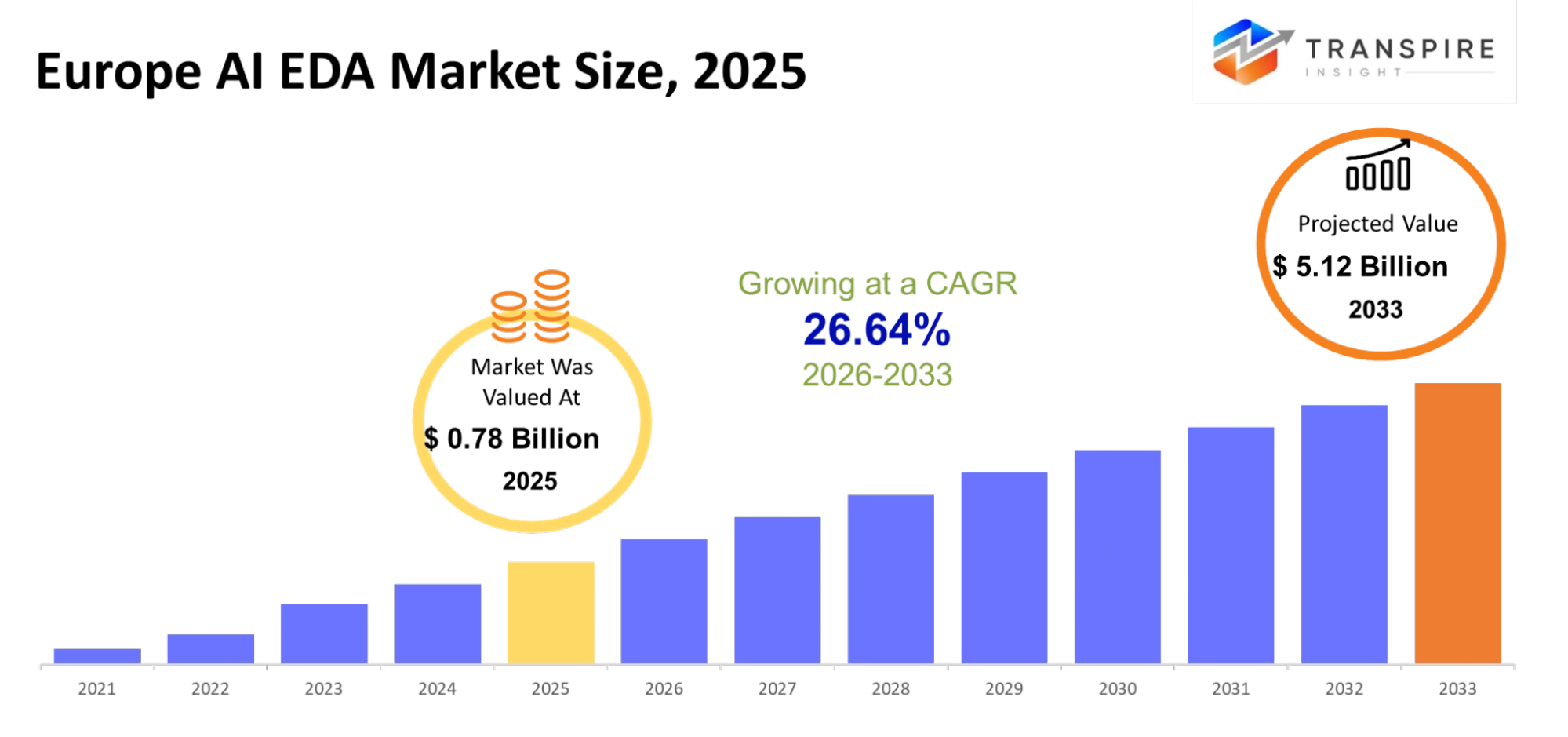
- Europe AI EDA Market Size 2025: USD 0.78 Billion
- Europe AI EDA Market Size 2033: USD 5.12 Billion
- Europe AI EDA Market CAGR: 26.64%
- Europe AI EDA Market Segments: By Tool (Simulation, Verification), By Application (IC Design), By End-User (Semiconductor)
To learn more about this report,  Download Free Sample Report
Europe AI EDA Market Summary:
Europe AI EDA Market size was estimated at USD 0.78 Billionin 2025 and is anticipated to reach USD 5.12 Billion by 2033, growing at a CAGR of 26.64% from 2026 to 2033.
The European AI EDA Market will develop as a dedicated portion of the semiconductor software and chip design sector. The design automation tools use artificial intelligence to help engineers create chips more efficiently and accurately. The software will define this field together with the European design systems which will adapt to rising demands for more complex chips. The traditional design process which required designers to manually adjust parameters through rule-based systems now uses machine learning to develop design optimization systems which use algorithms to forecast design and timing and power results with better accuracy. The European semiconductor market will shape this industry because Europe controls less market share than North America and Asia but establishes a solid presence in automotive and aerospace and industrial electronics sectors. Companies will require AI-assisted workflows to manage their complex designs because system-on-chip architectures and domain-specific processors become their primary design method. The industrial sectors which include electric vehicles and advanced driver systems and industrial automation will drive the need for systems which provide both reliability and energy efficiency.
The current condition of the European AI electronic design automation market will undergo changes because of three main driving forces which include regulatory organizations showing restraint, technological enterprises pursuing their innovations, and user needs which are currently evolving. European companies will continue to prioritize data security and compliance, leading to a preference for private or sovereign cloud-based design environments instead of fully public cloud adoption. The method of AI integration will use transparent systems which show all processes and outcomes while excluding hidden automated functions. The EU Chips Act public programs together with extensive research funding will develop local expertise in advanced chip design and prototyping, which supports the initiative to achieve technological self-sufficiency during the AI development period. The market for consumer products will change because customers want Smart and energy-efficient and highly specialized devices which will compel design teams to use AI-enabled tools for faster product development that meets performance standards. The European chip creation process will experience changes because design and simulation platforms will merge together with AI technologies which will be integrated into verification and testing processes, thus creating a fundamental supportive system that helps the continent achieve its digital and industrial advancement goals.
Key Market Trends & Insights:
- The European AI electronic design automation market experiences consistent expansion because the automotive and telecommunications and industrial sectors face increasing demands for complex semiconductor solutions. The use of AI-based tools will enhance layout precision while shortening the required time for design development. The industry will require advanced automation solutions because manufacturers adopt more sophisticated technological processes during their semiconductor manufacturing and integrated circuit development activities.
- The strong automotive industry presence in Germany and France will drive growth for the European AI electronic design automation market. The rising demand for high-performance chips in electric vehicles and autonomous systems creates a need for AI-based verification and simulation solutions. The importance of design accuracy will drive companies to adopt EDA solutions which use machine learning technology for better results.
- The design process for chips includes verification as a time-intensive phase which lets Europe AI EDA Market develop new business possibilities. AI algorithms will help detect errors at an earlier stage while enhancing testing procedures. The semiconductor industry will benefit from faster debugging and more reliable systems which will help companies cut down on time lost during production.
- The European AI electronic design automation market will grow stronger through government backing and private investment. Universities and research institutions will work together with semiconductor companies to develop AI-powered design solutions. The commitment to innovation will generate a continuous stream of solutions which will help organizations enhance productivity while minimizing their operational expenses.
- The sustainability objectives throughout Europe will shape the market developments of AI EDA technology in Europe. The AI-powered EDA tools will enable designers to create low-power chips through their capacity to optimize chip architecture and material selection methods. The data centers and consumer electronics sectors will continue to prioritize energy efficiency which will drive the increased use of advanced design technologies.
Europe AI EDA Market Segmentation
By Tool :
- Simulation: The Europe AI EDA Market uses simulation technology to create accurate chip behavior models which designers can test before they produce actual hardware. This design method decreases development expenses while it reduces design mistakes. Engineers use simulation tools to evaluate performance across various testing conditions which helps them establish operational reliability and enhanced performance during the initial phases of integrated circuit development.
- Verification: Verification establishes that chip designs satisfy required specifications while functioning correctly under predetermined conditions. The verification tools in the Europe AI EDA Market enable verification teams to discover both logical errors and structural defects before they proceed to production. Established verification procedures decrease product failure rates while they enhance system reliability which enables faster product launches without compromising quality in complex semiconductor design projects.

To learn more about this report, Download Free Sample Report
By Application :
- IC Design:The European AI electronic design automation market uses IC design which has become its main application area because of rising needs for small yet powerful electronic components. The layout planning process and power optimization process and design automation process receive assistance from AI-powered tools. The system develops advanced integrated circuits faster because it improves accuracy and decreases the need for human work across multiple business sectors.
By End-User :
- Semiconductor: The Europe AI EDA Market gives its main user base to semiconductor companies because they require advanced chips which are currently in-demand. These companies use AI-based EDA tools to handle their increasing design challenges while they seek to enhance their manufacturing efficiency. The adoption of these technologies leads to innovative advancements which improve product quality and enable modern electronic devices to achieve their performance standards.
Country Insights
- Germany maintains strong operations in the European AI EDA Market because its established automotive industry and industrial electronics sector serve as foundation for its technology development. The need for exact chip design in electric vehicles and automation systems drives people to use these technologies. The combination of engineering expertise and research institutions enables design teams to implement AI technologies throughout their design processes which leads to ongoing progress in advanced semiconductor research. The United Kingdom shows continuous development in the European AI EDA Market because design-oriented semiconductor companies and educational institutions create a strong research foundation. The development of AI simulation tools and advanced chip design methods drives businesses to adopt these technologies more widely. The government technology programs and startup initiatives enable the creation of intelligent design solutions which various industries can use.
- France enables its contribution to the European AI EDA Market through its funding of projects in the electronics and aerospace and defense industries. The dedicated research partnership approach together with digital change initiatives creates a solid foundation for AI adoption in chip design methods. The national semiconductor development programs create a need for design solutions that use automation to enhance design efficiency through performance improvements and time reduction.
- The European AI EDA Market in Italy experiences slow development because industrial automation and manufacturing improvements drive its growth. The increasing requirement for high-performance electronic components used in equipment and consumer electronics drives demand for AI-based design solutions. The local companies work to enhance their design precision while decreasing their project completion times, which leads to the continuous adoption of modern EDA technologies. The European AI EDA Market in Spain shows development because digital transformation increases across various fields including telecommunications and renewable energy. The demand for better chip design solutions drives companies to use AI-powered EDA tools. The government backing of innovation and technological progress creates a strong base which supports the market's sustained growth.
Recent Development News
EU launches €2.5B NanoIC pilot line to boost AI chip design capabilities
- Europe significantly strengthened its AI chip design ecosystem with the launch of a €2.5 billion NanoIC pilot line in Belgium. The facility is designed to support advanced semiconductor prototyping (sub-2nm nodes), which is critical for next-generation AI chips and EDA workflows. It enables companies and researchers to test and refine chip designs before mass production, directly supporting AI-driven design automation.
EU plans €200B AI investment to strengthen industrial design ecosystems
- The European Commission announced plans to mobilize up to €200 billion in AI investments, targeting industrial AI applications including semiconductor design and automation tools. Major companies involved include chip and equipment leaders, highlighting the growing role of AI in EDA and hardware innovation.
|
Report Metrics |
Details |
|
Market size value in 2025 |
USD 0.78 Billion |
|
Market size value in 2026 |
USD 0.98 Billion |
|
Revenue forecast in 2033 |
USD 5.12 Billion |
|
Growth rate |
CAGR of 26.64% from 2026 to 2033 |
|
Base year |
2025 |
|
Historical data |
2021 - 2024 |
|
Forecast period |
2026 - 2033 |
|
Report coverage |
Revenue forecast, competitive landscape, growth factors, and trends |
|
Country scope |
Europe (Germany, United Kingdom, France, Italy, Spain, Rest of Europe) |
|
Key company profiled |
Synopsys, Cadence, Siemens EDA, Ansys, Keysight, Altair, Dassault, Autodesk, Silvaco, Empyrean, Xilinx, Intel, Arm, Zuken, Altium |
|
Customization scope |
Free report customization (country, regional & segment scope). Avail customized purchase options to meet your exact research needs. |
|
Report Segmentation |
By Tool (Simulation, Verification), By Application (IC Design), By End-User (Semiconductor) |
Key Europe AI EDA Company Insights
- The AI EDA Market in Europe demonstrates continuous development because semiconductor design work relies on automated systems and intelligent design tools. The industry needs improved speed for chip production together with decreased errors during the design process which has resulted in greater usage of artificial intelligence throughout electronic design automation work. The industry experiences expansion through technological developments that impact automotive electronic systems and industrial automation technologies and communication network infrastructure. The countries of Germany, France and the Netherlands possess strong engineering capabilities which enable them to enhance design efficiency through ongoing technological development. The growing complexity of integrated circuits has made traditional methods ineffective which creates opportunities for AI-based solutions that enhance precision and decrease processing times. The companies operating in this industry work on developing algorithms that improve layout design verification and simulation processes to achieve better results without lengthening development time.
- The main findings from Key Europe AI EDA Company demonstrate that existing semiconductor software companies and new technology startups maintain a research development competition within the market. The team works to develop machine learning capabilities within design tools which will enable them to conduct predictive analysis and perform automated corrections. The innovation systems of chip manufacturers will become more powerful because software partnerships create new approaches to meet shifting industry demands. European companies establish partnerships with universities to sustain their agreement which enables them to share research findings and develop their workforce. The market participants work to enhance solution user experience and system capacity which enables both large corporations and medium-sized design companies to use their products. The European AI EDA Market will develop during the next few years because companies will keep investing in cloud services which provide them with operational flexibility and financial advantages.
Europe AI EDA Market Companies:
- Synopsys
- Cadence
- Siemens EDA
- Ansys
- Keysight
- Altair
- Dassault
- Autodesk
- Silvaco
- Empyrean
- Xilinx
- Intel
- Arm
- Zuken
- Altium
Europe AI EDA Market Segmentation
By Tool
- Simulation
- Verification
By Application
- IC Design
By End-User
- Semiconductor
Frequently Asked Questions
Find quick answers to common questions.
The Approximate Europe AI EDA Market size for the Market will be USD 5.12 Billion in 2033.
Key Segments for the Europe AI EDA Market are By Tool (Simulation, Verification), By Application (IC Design), By End-User (Semiconductor).
Major Europe AI EDA Market Players are Synopsys, Cadence, Siemens EDA, Ansys, Keysight, Altair, Dassault, Autodesk, Silvaco, Empyrean, Xilinx, Intel, Arm, Zuken, Altium.
The Europe AI EDA Market size is USD 0.78 Billion in 2025.
The Europe AI EDA Market CAGR is 26.64%.
- Synopsys
- Cadence
- Siemens EDA
- Ansys
- Keysight
- Altair
- Dassault
- Autodesk
- Silvaco
- Empyrean
- Xilinx
- Intel
- Arm
- Zuken
- Altium
Recently Published Reports
-
Apr 2026
3D Optical Profiler Market
3D Optical Profiler Market Size, Share & Analysis Report By Type (Desktop 3D Optical Profiler, and Portable 3D Optical Profiler), By Technology (Confocal Technology, and White Light Interference), By End-Use Industry (Manufacturing, Research Institutions, Automotive, Aerospace and Defense, Medical Devices, and Other), and Geography (North America, Europe, Asia-Pacific, Middle East and Africa, South and Central America), 2021 - 2031
-
Apr 2026
Depth Sensor Market
Depth Sensor Market Size, Share & Analysis Report By Type (Infrared Depth Sensors, Time-of-Flight (ToF) Sensors, Stereo Vision Sensors, Structured Light Sensors, Ultrasonic Depth Sensors), By Application (Automotive, Robotics, Gaming, Consumer Electronics, Industrial Automation, Healthcare, Security & Surveillance, Others), By End Users (Automotive Manufacturers, Consumer Electronics Companies, Healthcare Providers, Industrial Companies, Security Agencies, Gaming Companies, Robotics Companies, Others), and Geography (North America, Europe, Asia-Pacific, Middle East and Africa, South and Central America), 2021 – 2031
-
Apr 2026
Digital Manufacturing Market
Digital Manufacturing Market Size, Share & Analysis Report By Component (Hardware, Software, and Services), By Technology (Robotics, 3D Printing, Internet of Things (IoT), and Others), By Application (Automotive and Transportation, Aerospace and Defense, Consumer Electronics, Industrial Machinery, and Others), By Process Type (Computer-Based Designing, Computer-Based Simulation, Computer 3D Visualization, Analytics, and Others), and Geography (North America, Europe, Asia-Pacific, Middle East and Africa, South and Central America), 2021 – 2031
-
Apr 2026
Digital Visa Services Market
Digital Visa Services Market Size, Share & Analysis Report By Type (Individual Travelers, Group Travelers), By Application (Tourism, Business Travel, Others), and Geography (North America, Europe, Asia-Pacific, Middle East and Africa, South and Central America), 2021 – 2031