
Europe Aerospace Cold Forgings Market Summary
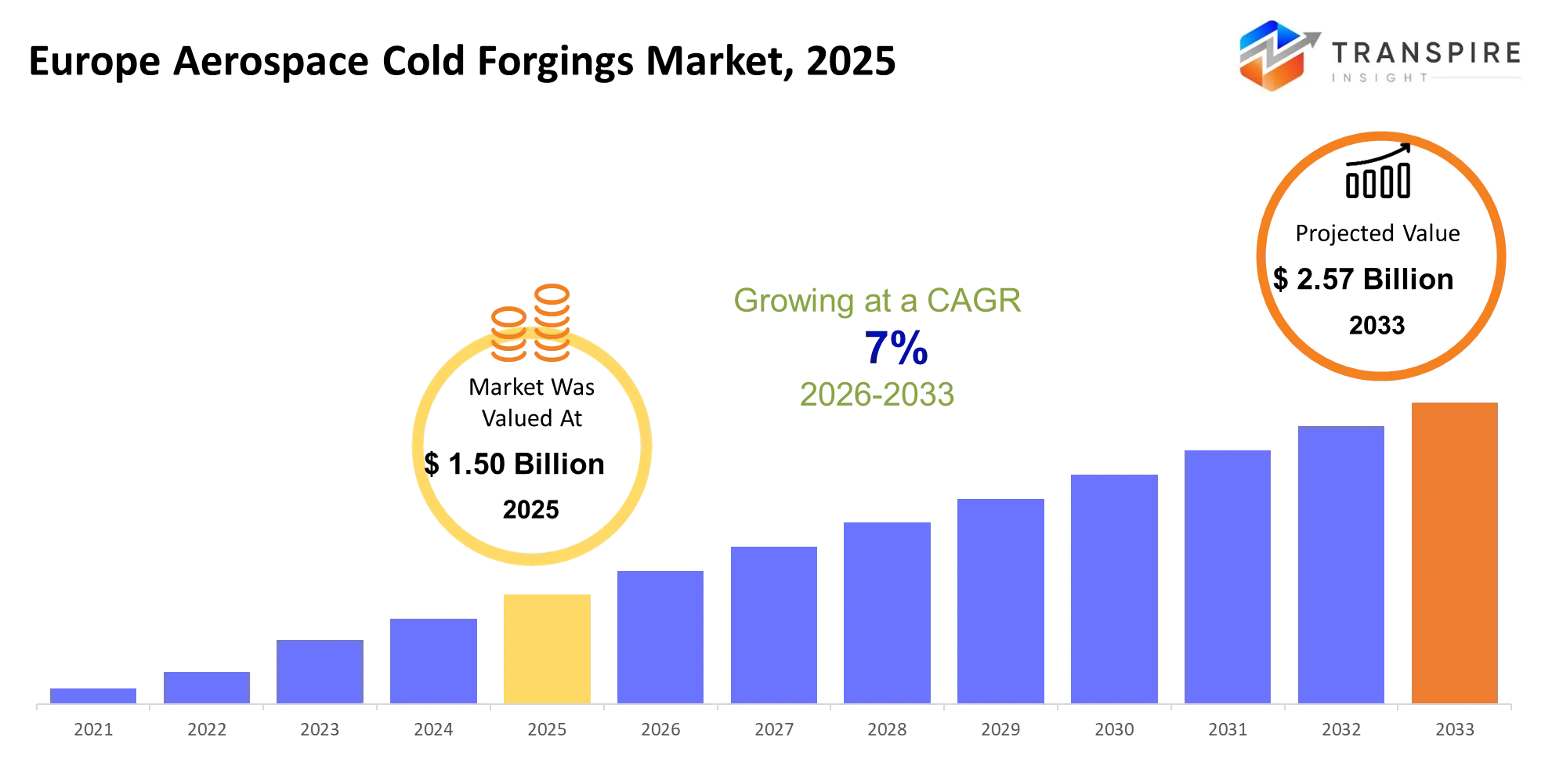
As per Transpire Insight, the Europe Aerospace Cold Forgings Market size is estimated at USD 1.50 Billion in 2025 and is anticipated to reach USD 2.57 Billion by 2033, growing at a CAGR of 7% from 2026 to 2033.
Transpire Insight’s analysis puts the Europe aerospace cold forgings market at about USD 1.50 billion for 2025. The same study expects the figure to grow to USD 2.57 billion by 2033.
Cold forgings help build aircraft parts. They make strong fasteners and fittings. They also support brackets, bushings, shafts, and other tight-tolerance pieces. The goal is consistent dimensions and dependable mechanical output.In the last three to five years, European aerospace output has moved in a new direction. Production targets have risen. More work is done through automated forging. Near-net-shape methods are also being used more often. Material use is now managed more carefully.
Airbus plans to raise output for the A320 Family. The target is as high as 75 aircraft per month by 2027. At the same time, supply issues have caused firms to adjust. Some suppliers push for stronger regional sourcing. Others focus on keeping production stable even when risks rise.Safran has also made a clear move. The company said it will invest €150 million in a forging press in France. The press is designed for 30,000 metric tons. Safran links this to engine production. The project is also expected to add 130 jobs.With these steps, forging capacity grows. Production should run more smoothly. Suppliers can also find new paths for revenue in the European aerospace component market.
Europe Aerospace Cold Forgings Market Size & Forecast:
- Europe Aerospace Cold Forgings Market Size 2025: USD 1.50 Billion
- Expected Market Value 2033: USD 2.57 Billion
- Forecast CAGR: 7%
- Leading region in 2025: Germany
- Fastest Growing region: France
- Key Profile: Airbus, Safran, Boeing, Rolls-Royce, Leonardo, GKN Aerospace, Spirit AeroSystems, Collins Aerospace, MTU Aero Engines, Melrose Industries, ATI, Howmet Aerospace, Precision Castparts, Forgital, Doncasters
Key Market Insights
- Germany is a major force in European aerospace making. Airbus sites, engine work, tight precision engineering, and mature supply links help back that role.
- France is seeing quicker growth in the market. Safran is pushing it with a 150 million euro forging project. The plan also adds more capacity for key engine parts.
- Commercial plane output is still the main demand driver. Airbus is aiming to ship 70 to 75 A320 Family jets each month by 2027.
- Safran’s new press will handle 30,000 metric tons. It is set to make as many as 14,000 parts each year. This supports more forging work in Europe starting in 2029.
- Fasteners keep a strong position in the supply chain. Aircraft build still needs huge runs of light, tough joining parts. These are used across many parts of the airframe.
- Titanium and aluminum alloys are picked often for weight goals. They also help with corrosion control and fatigue life. They matter for aircraft structures that need better fuel efficiency.
- Engine uses are getting more weight in strategy. European firms are expanding LEAP output. They are also growing military engine and high-thrust programs.
- Near-net forging and more automated lines are spreading. Makers want less material waste from cutting. They also want faster cycles and steadier dimensions.
- Defense aerospace budgets have improved planning clarity. That shows up in work for military aircraft and engine components. It runs through several European production programs.
- Large suppliers are competing in new ways. They lean on materials skill and certification work. They also add automated forging space, careful finishing, and long-term ties with OEM partners.
What are the Key Drivers, Restraints, and Opportunities in the Europe Aerospace Cold Forgings Market?
Driver: Aircraft output growth is a top market driver. In 2025, Airbus shipped 793 commercial jets. The company is also pushing its production line to reach up to 75 A320 Family aircraft each month by 2027. When more planes are built, more fasteners and parts are needed. That includes brackets, fittings, shafts, bushings, and engine pieces. Defense work adds more pull too. European governments are buying more aircraft and military gear. With both areas rising, forging demand grows. Suppliers can also lock in deals for the long run.
Restraint: Qualification rules in aerospace are a real stop point. Cold forged parts must pass heavy certification checks. That covers material proof, dimensional verification, fatigue tests, and full trace records. Firms must also show tight process control and secure customer sign off. New plants do not turn into sales right away. The validation work can take years. On top of that, tooling and special forging machines are costly. Smaller suppliers feel that burden more.
Opportunity: Better forging capacity can open new growth. Safran plans a €150 million site upgrade in Gennevilliers. The plan includes a 30,000-metric-ton hydraulic press. At full speed, it is set to make about 14,000 parts each year. Other moves can help as well. Automated forging and near-net methods can cut waste. Titanium processing and digital inspection can also support higher output. France, Germany, and other aerospace production hubs provide a favorable base. That makes capacity expansion easier.
What Has the Impact of Artificial Intelligence Been on the Europe Aerospace Cold Forgings Market?
AI tools are starting to show real use in aircraft forging plants. They help with automated checks, live process watching, making production plans, and running quality reviews. With machine vision, operators can scan forged parts for size issues, surface flaws, cracks, and signs that a tool is acting wrong. This can lower how much people must inspect parts by hand. In the same way, AI can look at press settings, temperature logs, material lot data, and what the tools are doing. That helps spot process problems sooner. Airbus has pointed to new manufacturing methods and digital systems in its growing sites, which fits the larger shift to more connected factory work.
Forecasting models can learn from past output. They can flag likely tool wear, equipment breakdown risk, shifts in dimensions, and when maintenance may be needed. Catching issues early can cut sudden downtime on presses. It can also help equipment run closer to plan and keep part quality more steady. AI can tune how materials are used and can adjust process settings for titanium, aluminum, nickel, and other special alloys. That can reduce scrap and lower how much extra machining is required. Still, there is a key problem. The setup and integration cost is high, and there are not many verified aerospace manufacturing datasets ready to use. On top of that, certification rules are strict. Because of that, teams cannot quickly roll out AI choices that are not fully proven. Human engineers still need to oversee the critical decisions.
Key Market Trends
- Airbus is shifting away from the early post-pandemic supply rebound. It now plans a more fixed ramp in output. By 2027, it aims to build 70 to 75 A320 jets each month.
- More European makers are also leaning toward local sourcing. Recent supply problems showed weak points in how aerospace parts and materials move through global chains.
- Safran said it will put €150 million into forging. The move points to a longer push to grow engine part making in Europe.
- Many forging firms are moving toward near-net output. They do this to cut back on heavy cutting, waste, and setup time. It also helps lower overall build costs for components.
- Builders are using more titanium and other advanced metals. Designers want less weight in the airframe. At the same time, they still need strength, good fatigue life, and long service durability.
- Inspection work is getting more automated. Aerospace plants want quicker defect checks. They also want better trace records and steadier quality, especially as output rises.
- Defense work has grown since 2022. That growth adds new manufacturing steps for European military aircraft and for engine related programs.
- OEMs are choosing vendors with production scale that is also certified. This trend fits Airbus and other firms as they expand their aircraft output plans.Factory monitoring is changing too. It is no longer just about tracking gear.
- More sites are using it to support upkeep before failures, improve processes, and run automated checks for quality.
- Some firms are buying others and tying suppliers in more closely. Aerospace companies want tighter control of key aerostructure and component supply paths.
Europe Aerospace Cold Forgings Market Segmentation
By Product Type:
Fasteners help with aircraft build work. They need high strength. They also need tight dimensions and good fatigue behavior. Corrosion resistance matters tooStructural components back the main airframe. They should keep a steady shape. They also rely on strong material performance over time.
Engine components face harsh heat. They must resist high temperatures. They also need accurate sizing. Strength has to hold up in both commercial and military engines.Landing gear components take repeated hits. Because landings cause repeated mechanical loads, these parts need high strength. They also need strong fatigue resistance.
Aircraft fittings join structural and mechanical parts. They help aircraft stay built in a reliable way. Brackets give support without much added weight. They can hold equipment, wiring, hydraulic lines, and other systems.Shafts move and rotate in mechanical setups. For those jobs, accurate dimensions are key. Fatigue resistance also matters. Bushings allow controlled motion in moving assemblies. They reduce wear during operation, which drives demand in new aircraft work and in upkeep.Precision forging still matters for safety critical aerospace parts. Material know-how also remains important.
By Material:
Titanium alloys help make aircraft parts that must stay light but also handle tough loads. They also resist corrosion and perform well under repeated stress.Aluminum alloys are often used where every gram matters. They have a lower density, so the finished airframe can weigh less. These alloys also work well for clamps and fittings.
Nickel alloys fit engine needs. They can hold up at high temperatures and resist oxidation. That makes them useful where heat is constant. Stainless steel is for parts that need both strength and corrosion resistance. It is also chosen when long service life matters.Carbon steel goes into some chosen parts when you want a good mix of strength and cost. Cobalt alloys are used for special cases where high heat and wear resistance are needed.
Superalloys are made for the most demanding engine pieces. They face high temperatures and heavy mechanical stress at the same time.Specialty alloys are picked when a part needs a specific mix of traits. This can include temperature limits, corrosion behavior, fatigue life, strength, and weight.In European aerospace work, titanium, nickel, and aluminum keep showing up. Aircraft parts still need low weight and solid mechanical performance, and these materials help meet that goal.
By Aircraft Type:
Commercial aircraft have big needs for fasteners, fittings, brackets, shafts, and other structural parts. A typical aircraft program keeps making certified pieces, over and over.Military aircraft also call for strong components. They face tough conditions and they must last for many years.
Business jets need parts made with tight tolerances. This matters for airframe sections, engines, landing gear, and cabin systems.Regional aircraft focus on parts that can handle everyday wear. They serve smaller passenger fleets and the related support equipment.Helicopters need lighter parts that can handle fatigue. This covers rotating parts, structure items, and landing hardware.
UAV programs are still growing. That growth pushes demand for compact, lightweight components for unmanned aircraft.Cargo aircraft need durable components. They run hard, with high usage and heavy operating loads.
Spacecraft require very dependable parts. They also need good material behavior, correct dimensions, and careful inspection at each step.Across these aircraft types, the needs do not match in every way. Size, materials, required strength, and how closely parts must be made can all differ.
By Application:
Airframe work uses forged parts at key joints and where fittings, brackets, and assemblies connect. Those parts must hold up over time under load.
Engine work calls for components that survive heat, shake, pressure, and many cycles of mechanical stress. They also need to keep their shape after repeated use.Landing gear needs parts that are tough and able to handle fatigue. Gear systems take hard contact and repeated strain, so the components must last.
Flight control systems rely on parts that move as they should. When the pieces are built well, the aircraft responds with steadier control.
Hydraulic systems depend on parts with tight tolerances. These parts must resist pressure and stay within the right sizes.Fuel systems use components that must not fail in harsh conditions. Corrosion resistance matters because of how fuel and environment interact.Cabin systems use brackets, fittings, shafts, and other pieces for support and equipment mounting. These parts help keep the layout stable.Avionics setups need smaller, lighter brackets and accurate fittings. The goal is secure installation for the electronics.As more aircraft get built, the same kind of component needs keep showing up. They show in structural, mechanical, control, and support areas.
By Manufacturing Process:
Cold Heading is used for large run making of precision fasteners. It keeps dimensions steady. It also uses material in a more efficient way.Cold Extrusion shapes parts by pushing metal through a set process. The flow is controlled. This can cut down on how much machining is needed after forming.
Cold Upsetting helps make fasteners and other parts that need thicker sections in chosen spots. This method supports stronger section buildup where it matters.Precision Forging focuses on tight size control. It helps in making aerospace parts in a way that fits production needs.Multi-Stage Forging uses more than one forming step. That lets it create parts with harder forms. It is meant for shapes that need extra care.Automated Forging aims for repeatable results. It also helps manage the process and can raise output speed. This is useful when the same part is made again and again.
Near-Net Forging makes parts closer to final size. That can lower material loss. It can also reduce later machining work.Finishing is done to improve the outside of the part. It helps with surface finish, size match, and better resistance to corrosion. It also supports final part quality.Digital process checks can track what is happening during production. Automated production helps keep results more steady. This matters as aerospace makers raise their output.
By End User:
Aircraft makers are big customers. They need certified forged parts for both commercial planes and defense builds. These programs keep running, so supply must stay steady. Engine makers also have specific needs. Propulsion parts face intense heat and heavy mechanical stress. Forgings help them meet those demands. Tier-1 suppliers put forged parts into major aircraft sections. They also use them in systems and assembled units that matter for performance and safety.
MRO groups drive new demand in a different way. During maintenance, repair, inspections, and ongoing service, they identify parts that must be replaced. That creates ordering needs. For defense work, contractors look for approved components for military aircraft and related projects. Space firms focus on parts for spacecraft bodies, propulsion systems, and launch vehicles.
Component makers use forgings as a starting point. Those forgings then go on to further processing. They are also used for system assembly and integration. Research groups in aerospace use precise components for tests and development work. They also rely on material studies and other advanced projects. Quality rules are strict. Qualification timelines run long. Because of that, relationships between suppliers can last across the ae rospace production network.

What are the Key Use Cases Driving the Europe Aerospace Cold Forgings Market?
Commercial aircraft building is the main customer need. Big airplane programs use a lot of certified parts. That includes fasteners, brackets, fittings, shafts, and other tight tolerance items. Airbus shipped 793 commercial planes in 2025. Its plan is to reach as many as 75 A320 Family jets each month after 2027. When assembly runs faster, the demand for approved forged parts rises. This shows up in both the airframe and the main mechanical systems.
Engine work is also growing. The trend is clear for LEAP engines and for European military engine programs. Safran is putting €150 million into forging. This money will back both commercial and military engine output. The new press is set to make 14,000 parts each year when it runs at full rate. Landing gear, flight control parts, and hydraulic units add steady buying too. Tier 1 suppliers and aircraft makers keep needing forged items for those areas.
UAVs and spacecraft are newer areas. They can call for very tight tolerances. They may also need less mass and special metal grades. European defense growth is adding chances for forged components in military aircraft. It also boosts demand for parts tied to propulsion systems. More funding for unmanned aviation, defense production, and European space programs will further push this demand.
|
Report Metrics |
Details |
|
Market size value in 2025 |
USD 1.50 Billion |
|
Market size value in 2026 |
USD 1.60 Billion |
|
Revenue forecast in 2033 |
USD 2.57 Billion |
|
Growth rate |
CAGR of 7% from 2026 to 2033 |
|
Base year |
2025 |
|
Historical data |
2021 - 2024 |
|
Forecast period |
2026 - 2033 |
|
Report coverage |
Revenue forecast, competitive landscape, growth factors, and trends |
|
Regional scope |
Europe |
|
Key company profiled |
Airbus, Safran, Boeing, Rolls-Royce, Leonardo, GKN Aerospace, Spirit AeroSystems, Collins Aerospace, MTU Aero Engines, Melrose Industries, ATI, Howmet Aerospace, Precision Castparts, Forgital, Doncasters |
|
Customization scope |
Free report customization (country, regional & segment scope). Avail customized purchase options to meet your exact research needs. |
|
Report Segmentation |
By Product Type (Fasteners, Structural Components, Engine Components, Landing Gear Components, Aircraft Fittings, Brackets, Shafts, Bushings); By Material (Titanium Alloys, Aluminum Alloys, Nickel Alloys, Stainless Steel, Carbon Steel, Cobalt Alloys, Superalloys, Specialty Alloys); By Aircraft Type (Commercial Aircraft, Military Aircraft, Business Jets, Regional Aircraft, Helicopters, UAVs, Cargo Aircraft, Spacecraft); By Application (Airframe, Engine, Landing Gear, Flight Control Systems, Hydraulic Systems, Fuel Systems, Cabin Systems, Avionics); By Manufacturing Process (Cold Heading, Cold Extrusion, Cold Upsetting, Precision Forging, Multi-Stage Forging, Automated Forging, Near-Net Forging, Finishing); By End User (Aircraft OEMs, Engine OEMs, Tier-1 Suppliers, MRO Providers, Defense Contractors, Space Companies, Component Manufacturers, Aerospace Research Organizations) |
Which Regions are Driving the Europe Aerospace Cold Forgings Market Growth?
Germany is in front due to its aerospace manufacturing strength, its ability to build with tight tolerances, and its wide set of suppliers for aircraft and engines. Companies like Airbus and MTU Aero Engines, plus many smaller makers, support production of forged fasteners, fittings, engine parts, and airframe structural pieces. The country also benefits from automation on the shop floor and from well known certification know how. That mix helps high value output and keeps long term links with original equipment makers. With both know how and a deep supply chain, Germany has a solid base for steady revenue.
France comes next, with growth that looks different. It leans more on engine making, defense aviation work, and aerospace production that is more vertically organized. Safran plans to put €150 million into a 30,000 metric ton forging press at Gennevilliers in April 2026. That move should raise output for both commercial and military engine components. Safran expects near a two fold increase in production by 2035. The project also backs engine and defense programs tied to LEAP, Rafale, Mirage, and A400M. In practice, France can rely on engine tech and defense demand, supported by major industrial spending, rather than depending mostly on commercial airframe builds.
France is also showing strong momentum right now. It is adding forging capacity, expanding defense manufacturing, and investing in propulsion for the next generation. Safran says the Gennevilliers press can make about 14,000 parts each year when it runs at full pace. It is expected to start up in 2029. That should open more room for specialized vendors and firms that bring new process know how.
Who are the Key Players in the Europe Aerospace Cold Forgings Market and How Do They Compete?
Most of the competition sits with the big names in aerospace. This includes major aircraft builders, engine makers, and firms that make specific parts. Fewer small producers play a major role.
Price still matters in buying decisions. Still, buyers often place more weight on other items. They look at certification work, deep material know-how, tight manufacturing control, enough production room, and steady delivery. These points matter most for parts used in safety-critical systems.
Airbus has been moving to tighten its supply chain. It did this by buying certain Spirit AeroSystems industrial assets. Those assets include sites in France, Northern Ireland, and Scotland. The deal added over 4,000 employees to Airbus. It also gives Airbus more direct control over key work tied to commercial aircraft.
Safran also leans into a vertical build approach. It put €150 million into a forging press in Gennevilliers. The press can handle 30,000 metric tons. This helps both commercial and military engine programs.Rolls-Royce leans on advanced engine work and high-end parts. GKN Aerospace focuses on tough aerospace structures and its manufacturing strength around Europe. Howmet Aerospace and Precision Castparts emphasize advanced materials and precision cast parts.
Across the market, the best edge seems to come from more than one factor at once. It helps when a firm can produce parts with proper certification and also knows materials well. Automation matters too. Direct ties with aircraft and engine makers also help.
Company List
- Airbus
- Safran
- Boeing
- Rolls-Royce
- Leonardo
- GKN Aerospace
- Spirit AeroSystems
- Collins Aerospace
- MTU Aero Engines
- Melrose Industries
- ATI
- Howmet Aerospace
- Precision Castparts
- Forgital
- Doncasters
Recent Development News
- "In April 2026, Safran announced a €150 million investment in a 30,000-metric-ton hydraulic forging press at its Gennevilliers site. The project will support strategic commercial and military engine parts, create 130 jobs, and produce up to 14,000 parts annually at full capacity.https://www.safran-group.com/pressroom/safran-upgrades-and-strenghtens-forging-capabilities-historic-gennevilliers-site-2026-04-13 (Safran)."
- "In December 2025, Airbus completed the acquisition of selected Spirit AeroSystems industrial assets dedicated to commercial aircraft programs. The transaction strengthens Airbus control over critical aerostructure activities and expands its European manufacturing footprint across France, Northern Ireland, and Scotland.https://www.airbus.com/en/newsroom/press-releases/2025-12-airbus-completes-acquisition-of-spirit-aerosystems-sites (Airbus)."
- "In April 2025, Airbus signed a definitive agreement to acquire selected Spirit AeroSystems industrial assets supporting the A350, A220, and A320 aircraft families. The transaction aimed to strengthen supply stability and secure critical production activities across key European aerospace locations.https://www.airbus.com/en/newsroom/press-releases/2025-04-airbus-signs-definitive-agreement-with-spirit-aerosystems (Airbus)."
What Strategic Insights Define the Future of the Europe Aerospace Cold Forgings Market?
The market is shifting toward higher-value forging and more automation. More of this work is also being kept within specific regions. This is happening as European plane and engine makers ramp up output. They also want more control over key parts.
A key issue to watch is how much capacity is grouped in a few places. If there are only a small number of approved forging vendors, delays can happen. This can occur even if the order book for aircraft is still strong. On top of that, the approval steps for new suppliers are slow. That makes it hard to swap vendors quickly. So raw-material problems, machine breakdowns, or political shocks can hit output harder than expected.
There is also a new opening in connected forging. With sensors and process data, and with automated checks, quality can be tracked more closely. That can also help cut losses on the shop floor.Safran’s new press in Gennevilliers already uses connected tools. It includes data-based monitoring of the process.Suppliers and backers should favor certified plants in Europe that are automated. They should also bring strong work with advanced alloys. In addition, they should seek steady deals tied to OEM or engine programs. Competing mostly on the lowest unit price may not be the best route.
Europe Aerospace Cold Forgings Market Report Segmentation
By Product Type
- Fasteners
- Structural Components
- Engine Components
- Landing Gear Components
- Aircraft Fittings
- Brackets
- Shafts
- Bushings
By Material
- Titanium Alloys
- Aluminum Alloys
- Nickel Alloys
- Stainless Steel
- Carbon Steel
- Cobalt Alloys
- Superalloys
- Specialty Alloys
By Aircraft Type
- Commercial Aircraft
- Military Aircraft
- Business Jets
- Regional Aircraft
- Helicopters
- UAVs
- Cargo Aircraft
- Spacecraft
By Application
- Airframe
- Engine
- Landing Gear
- Flight Control Systems
- Hydraulic Systems
- Fuel Systems
- Cabin Systems
- Avionics
By Manufacturing Process
- Cold Heading
- Cold Extrusion
- Cold Upsetting
- Precision Forging
- Multi-Stage Forging
- Automated Forging
- Near-Net Forging
- Finishing
By End User
- Aircraft OEMs
- Engine OEMs
- Tier-1 Suppliers
- MRO Providers
- Defense Contractors
- Space Companies
- Component Manufacturers
- Aerospace Research Organizations
Frequently Asked Questions
Find quick answers to common questions.
The expected Europe Aerospace Cold Forgings Market size for the market will be USD 2.57 Billion in 2033.
Key segments for the Europe Aerospace Cold Forgings Market are By Product Type (Fasteners, Structural Components, Engine Components, Landing Gear Components, Aircraft Fittings, Brackets, Shafts, Bushings); By Material (Titanium Alloys, Aluminum Alloys, Nickel Alloys, Stainless Steel, Carbon Steel, Cobalt Alloys, Superalloys, Specialty Alloys); By Aircraft Type (Commercial Aircraft, Military Aircraft, Business Jets, Regional Aircraft, Helicopters, UAVs, Cargo Aircraft, Spacecraft); By Application (Airframe, Engine, Landing Gear, Flight Control Systems, Hydraulic Systems, Fuel Systems, Cabin Systems, Avionics); By Manufacturing Process (Cold Heading, Cold Extrusion, Cold Upsetting, Precision Forging, Multi-Stage Forging, Automated Forging, Near-Net Forging, Finishing); By End User (Aircraft OEMs, Engine OEMs, Tier-1 Suppliers, MRO Providers, Defense Contractors, Space Companies, Component Manufacturers, Aerospace Research Organizations).
Major Europe Aerospace Cold Forgings Market players are Airbus, Safran, Boeing, Rolls-Royce, Leonardo, GKN Aerospace, Spirit AeroSystems, Collins Aerospace, MTU Aero Engines, Melrose Industries, ATI, Howmet Aerospace, Precision Castparts, Forgital, Doncasters.
The Europe Aerospace Cold Forgings Market size is USD 1.50 Billion in 2025.
The Europe Aerospace Cold Forgings Market CAGR is 7% from 2026 to 2033.
- Airbus
- Safran
- Boeing
- Rolls-Royce
- Leonardo
- GKN Aerospace
- Spirit AeroSystems
- Collins Aerospace
- MTU Aero Engines
- Melrose Industries
- ATI
- Howmet Aerospace
- Precision Castparts
- Forgital
- Doncasters
About the Authors

Tejashri Dhatrak
I am Tejashri Dhatrak, a Senior Research Analyst at Transpire Insight, specializing in the Aerospace and Defence sector. My work focuses on analyzing industry trends, defence technologies, market developments, and emerging innovations that shape the global aerospace and security landscape. At Transpire Insight, I research complex topics, evaluate credible sources, and transform technical insights into accurate, well-structured, and easy-to-understand content for industry professionals and decision-makers. My goal is to provide reliable, research-backed information that helps readers stay informed about defence capabilities, aerospace advancements, strategic developments, and the evolving dynamics of the global defence ecosystem.

Chakradhar Khansole
Chakradhar serves as the Research Director at Transpire Insight, bringing over 8 years of experience in technology, innovation, and strategic market intelligence. He specializes in transforming complex market data into actionable business insights that enable organizations to make informed, growth-oriented decisions. Recognized for his strategic vision and analytical expertise, Chakradhar leads high-impact research initiatives, delivering comprehensive market assessments, competitive intelligence, and forward-looking industry analysis.
Recently Published Reports
-
Apr 2026
Aerospace Fluoropolymers Market
Aerospace Fluoropolymers Market Size, Share & Analysis Report By Type (PTFE, FEP, PFA, ETFE, and Others), By Application (Electrical Insulation, Seals & Gaskets, Coatings, and Others), By End User (Commercial Aviation, Military Aviation, General Aviation, and Others), and Geography (North America, Europe, Asia-Pacific, Middle East and Africa, South and Central America), 2021 - 2031
-
Apr 2026
Airborne SATCOM System Market
Airborne SATCOM System Market Size, Share & Analysis Report By Type (SATCOM Terminals, Transceivers, Airborne Radio, Modems and Routers, SATCOM Radomes, and Other), By Application (Government and Defense and Commercial), and Geography (North America, Europe, Asia-Pacific, Middle East and Africa, South and Central America), 2021 – 2031
-
Apr 2026
Ship Leasing Market
Ship Leasing Market Size, Share & Analysis Report By Vessel Type (Container Ships, Bulk Carriers, Tankers, and Specialized Vessels), By Lease Duration (Short-Term Lease (Less than 1 year), Medium-Term Lease (1-5 years), and Long-Term Lease (More than 5 years)), By Lease Type (Bareboat Charter, Time Charter, Financial Lease, and Others), By End-User Industry (Oil and Gas, Manufacturing and Industrial, Automotive, Agriculture and Food, Retail and Consumer Goods, and Others), and Geography (North America, Europe, Asia-Pacific, Middle East and Africa, South and Central America), 2021 – 2031
-
Apr 2026
Thread Rolling Dies Market
Thread Rolling Dies Market Size, Share & Analysis Report By Type (Flat Thread Rolling Dies, Circular (Cylindrical) Dies, Tangential Thread Rolling Dies, Planetary Thread Rolling Dies, and Other Types), By Material Type (High-Speed Steel (HSS), Carbide, Tool Steel, Alloy Steel, and Other Specialized Alloys), By Distribution Channel (Direct Sales, Distributors and Dealers, and Online Platforms), By Application (Automotive Industry, Aerospace and Defense, Construction and Infrastructure, Industrial Machinery, Electronics and Electrical Components, Medical Devices, and Fastener Production), and Geography (North America, Europe, Asia-Pacific, Middle East and Africa, South and Central America), 2021 – 2031
Our Clients