
Electronic Medical Records Market Summary:
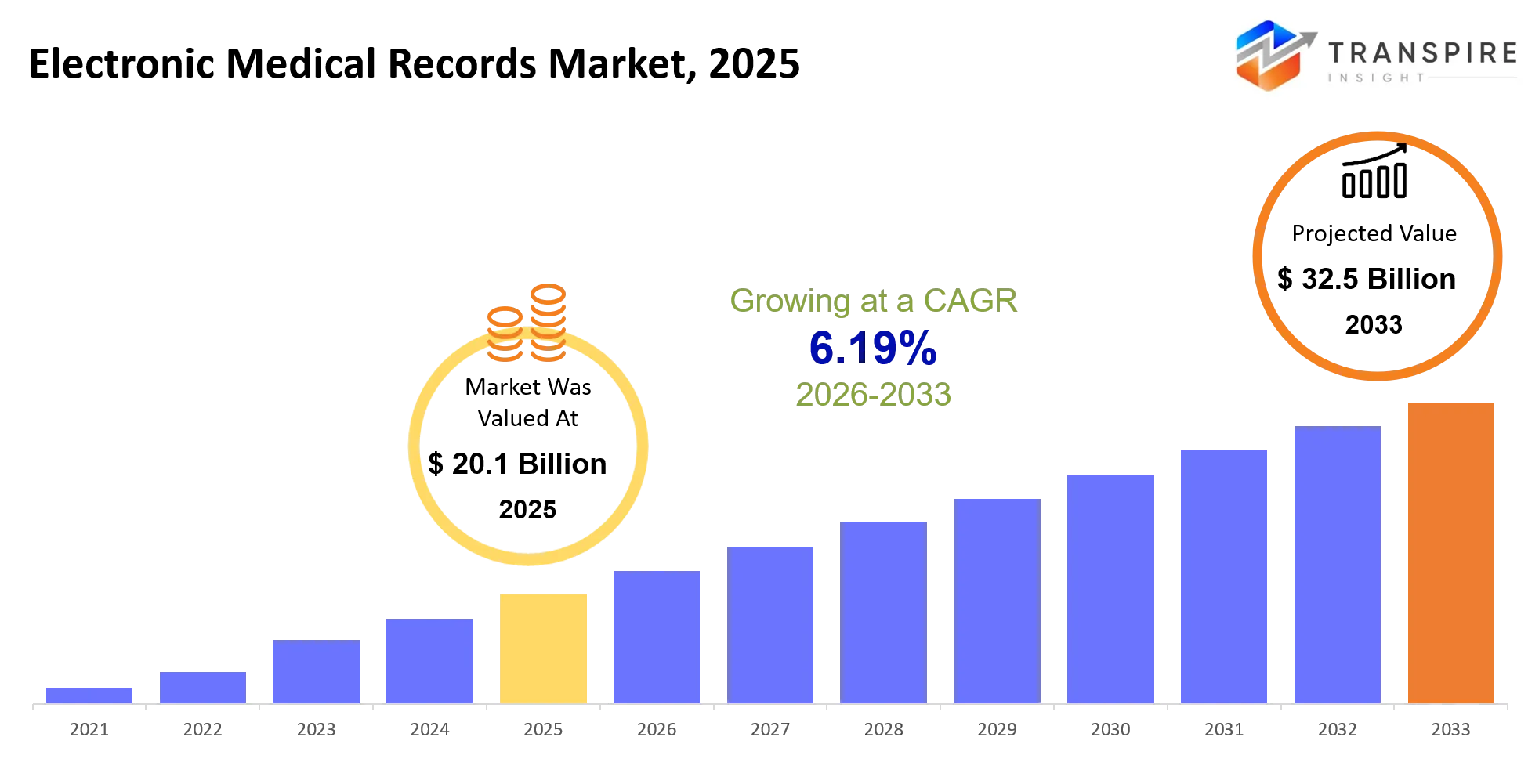
As per the Transpire Insight Analysis, The Electronic Medical Records Market size is estimated at USD 20.1 billion in 2025 and is anticipated to reach USD 32.5 billion by 2033, growing at a CAGR of 6.19% from 2026 to 2033.
The electronic medical records (EMR) market enables providers to record patient history, treatment diagnosis, prescriptions, treatment planning, hospital stay, and integrate clinical data with billing and reporting solutions. The market is moving rapidly from digitising paper charts over recent years to cloud-connected, interoperable, and AI-assisted clinical workflows. A structural change is happening as health systems focus on sharing clinical information with hospitals, labs, pharmacies, and outpatient facilities, rather than keeping data in silos. Demand-side pressures, including shortages of clinicians, increased volumes of administrative work, and the need for quicker access to patient history, are accelerating this transition. Regional regulations requiring digital reporting and system data exchange are speeding up the departure from legacy systems. Healthcare organisations are investing in software to reduce duplication in documentation, enable good continuity of care, and facilitate resource planning, driving software subscription revenue, cloud service sales and system integration opportunities.
Electronic Medical Records Market Size & Forecast:
- Market Size 2025: USD 20.1 Billion
- Expected Market Value (2033): USD 32.5 Billion
- Forecast CAGR (2026–2033): 6.19%
- Leading Region in 2025: North America
- Fastest Growing Region: Asia Pacific
- Key Company Profiles: Epic Systems, Oracle Health, MEDITECH, Veradigm, eClinicalWorks, NextGen Healthcare, athenahealth, GE HealthCare, Siemens Healthineers, Philips, Allscripts, CPSI, Greenway Health, InterSystems, Tietoevry.
Key Electronic Medical Records Market Insights:
While record storage is no longer the primary focus of the market, interoperability and workflow efficiency are emerging as key buyer criteria for the connected, AI-powered care delivery market. Reducing clinician workload while maintaining accurate, secure, and portable clinical data is a growing factor of competitive advantage.
- The software piece of the market is 70.4% of the total, and Epic is integrating generative AI, ambient documentation, and workflow automation into its EHR.
- Cloud-based EMR experiences 12.9% CAGR growth; Oracle Health introduces an AI-native, voice-first platform on Oracle Cloud Infrastructure.
- In the U.S. acute-care hospital EHR market, Epic was the largest system and accounted for 43.7% of the segment in 2025, bolstered by large system migrations.
- Oracle Health's share of the market was 21.9%, and it is positioning itself with cloud-native architecture, clinical AI agents, and revenue-cycle AI.
- MEDITECH's U.S. acute-care hospital share was 14.7%, and it extended its suite of interoperability, analytics, and clinician-workflow capabilities to expand Expanse.
- NextGen Enterprise, NextGen Office, and ambient AI documentation are all aimed at specialty and ambulatory practices.
- eClinicalWorks is making strides in per-provider cloud subscriptions for multi-specialty ambulatory groups through the use of AI ambient drafting.
- GE HealthCare, Siemens Healthineers, and Philips are integrating EMR information with imaging, monitoring, and connected-care platforms to aid in real-time clinical decisions.
- Providers put off replacing their acute-care EHRs by 40% as they focused on investing in AI, reflecting a shift toward EHR upgrades.
What are the Key Drivers, Restraints, and Opportunities in the Electronic Medical Records Market?
Driver:
Healthcare providers are prioritising connected records because fragmented patient histories delay treatment, duplicate tests, and increase administrative work. The expansion of health information exchange networks is turning interoperability into a practical purchasing requirement. In the United States, the TEFCA network reached one billion health records exchanged by June 2026, illustrating the growing scale of connected healthcare data. As providers seek compatible systems, vendors gain opportunities through software upgrades, integration contracts, and recurring subscriptions.
Restraint:
High implementation complexity and cybersecurity exposure continue to limit adoption, especially among small clinics and community hospitals. Legacy systems, fragmented workflows, clinician training needs, and ransomware risks make replacement expensive and operationally disruptive. The problem persists because healthcare data is highly sensitive, IT teams are scarce, and interoperability often requires coordination across vendors, payers, and public-health systems.
Opportunity:
Cloud-native platforms, standards-based APIs, and AI-assisted documentation create opportunities to modernise outdated systems without rebuilding every application independently. India's digital health infrastructure offers a relevant example: continued development of interoperable digital health standards can help providers connect records across facilities. Vendors that provide affordable subscriptions, local implementation support, and secure data exchange can reach smaller providers while generating additional revenue from analytics, integration, and workflow automation.
What Has the Impact of Artificial Intelligence Been on the Electronic Medical Records Market?
AI is turning electronic medical records (EMRs) from record-keeping applications into intelligent platforms for clinical decision-making and workflow automation. Ambient AI scribes record clinical conversations and produce structured notes, decreasing manual charting. In a study conducted at an academic medical centre, the median note-completion time was shorter, and clinicians spent almost 20 minutes less time on daily EHR work. AI enables charge capture, coding recommendations, scheduling, and managing your inbox.
At the organisational level, AI-powered dashboards make it possible for healthcare organisations to reduce bed blocking, optimise staffing levels, streamline referrals, and inform better revenue-cycle management. Providers can also optimise patient flow and better address medication-adherence gaps and population health requirements, which, in turn, can enhance productivity and accelerate decision-making based on data insights. But integration, accuracy, cost, and cybersecurity issues impact adoption. Clinicians must verify notes and recommendations made by the AI; patient-consent policies, specialty-specific configuration, and legacy EMR compatibility add obstacles. There needs to be defined governance and data-protection policies in place to ensure reliable, safe, and responsible adoption.
In October 2026, signed an enterprise-wide agreement with the University of Texas System to deploy its AI clinician intelligence platform across all eight UT health institutions. This expansion accelerates ambient clinical documentation and workflow automation across a network handling nearly 11.7 million outpatient visits annually, reducing manual chart-entry time and scaling clinical decision support.
Key Electronic Medical Records Market Trends:
The EMR purchasing journey has moved from digitising records to intelligent and connected clinical operations. Providers are more and more appreciative of systems that provide reliable information, minimise documentation efforts, and enable coordinated care between facilities.
- After-hours charting and clinician burnout are being replaced by ambient AI documentation, which is now scaling to enterprise adoption from pilot programs.
- Cloud-native EMRs are taking over on-premise systems because providers want to be able to access them remotely, save on infrastructure and get updates quickly.
- FHIR-based interoperability is becoming an expectation for interprovider data exchange, not just a technical option.
- Value-based care is driving the need for EMRs to incorporate quality measures, risk stratification, and population health analytics.
- Ransomware, privacy laws, and third-party data sharing are driving up operational risk, leading to a rise in cybersecurity investment.
- Mobile and remote-care integration is making EMR use go beyond the hospital to telehealth, home care, and chronic-disease management.
- Specialty-specific EMRs are becoming more popular in behavioral health, oncology, and ambulatory surgery, where the generic workflows don't work.
- Structured records are being adopted at a rapid pace with the introduction of national digital-health programs like Ayushman Bharat Digital Mission (ABDM) in India and EHDS in Europe.
- As providers look to speed up claims, improve documentation, and decrease denials, revenue-cycle automation is becoming a key EMR function.
Electronic Medical Records Market Segmentation
By Component:
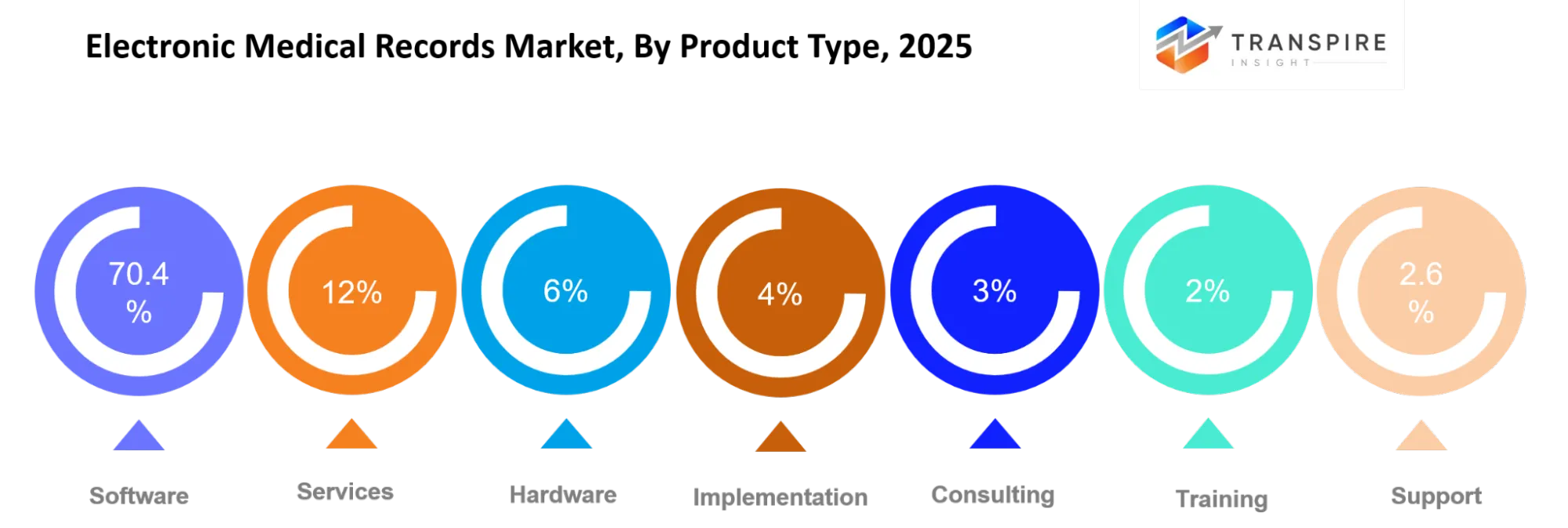
Software continues to dominate the EMR market with 70.4% of overall market share, as this category encompasses the core functions of the EMR, including clinical documentation, patient data management, and workflow execution. Services account for 12%, followed by hardware at 6%, implementation at 4%, consulting at 3%, training at 2%, support at 1.5%, and others at 1.1%. Overall, software purchase remains the top priority for EMR buyers, and services and implementation support, system migration, configuration and integration, consulting and training support for workflow change management, and technical support ensure the functionality of the system. Hardware demand is mainly governed by infrastructure needs, while cloud adoption can reduce reliance on equipment.
By Deployment:
Cloud-based EMR is the fastest-growing deployment segment, with a 12.9% CAGR, as healthcare providers seek scalable infrastructure, remote record access, and centrally managed updates. On-premise systems remain relevant for organisations requiring direct control over infrastructure, data storage, and security configurations. Hybrid deployments support providers transitioning from legacy systems, while hosted solutions reduce the need for in-house maintenance. Software-as-a-Service (SaaS), public cloud, and private cloud models offer different levels of flexibility, customisation, management responsibility, and control over healthcare information.
By Application:
Clinical documentation remains a foundational EMR application because diagnoses, treatment notes, and medical histories support routine patient encounters and continuity of care. Order entry and e-prescribing connect clinical decisions with diagnostic testing and medication management, helping reduce manual processes. Patient management supports registration and care coordination, while billing and scheduling improve administrative efficiency. Clinical decision-support tools analyse patient information to highlight potential risks and care gaps. Together, these applications connect medical records with operational workflows, supporting more coordinated, accurate, and efficient healthcare delivery.
By End User:
Hospitals require integrated EMR systems that connect departments, admissions, pharmacies, laboratories, and discharge processes within a unified clinical environment. Clinics and physician offices prioritise efficient consultations, accessible patient histories, and straightforward documentation. Ambulatory surgery centres need procedure-specific workflows, while speciality clinics require features tailored to particular conditions and treatment pathways. Laboratories depend on accurate results exchange, and government facilities use digital records for service delivery, monitoring, and reporting. These differing requirements encourage vendors to develop configurable platforms suited to each healthcare setting.
By Enterprise Size:
Large hospitals and multisite healthcare networks typically require extensive integrations, centralised governance, and consolidated reporting across facilities. Medium-sized hospitals seek comprehensive clinical functionality while managing implementation costs and limited IT resources. Small clinics and independent practices often prefer subscription-based EMR platforms with simpler deployment, predictable expenses, and vendor-managed maintenance. Academic institutions need systems that support clinical research alongside patient care, while government organisations prioritise scalability, reporting, and oversight. These differences shape purchasing decisions, influencing platform complexity, customisation, deployment models, and ongoing support requirements.
By Function:
Patient records and clinical workflow functions form the operational foundation of EMR systems, supporting documentation, treatment coordination, and access to medical histories. Reporting and interoperability connect internal records with external healthcare providers, laboratories, and administrative systems. Analytics and population health tools help identify patient risks, monitor outcomes, and guide service planning. Revenue-cycle functionality links clinical documentation with coding, claims, and reimbursement processes. As providers pursue more connected operations, demand is expanding for platforms that combine accurate records, actionable insights, and efficient administrative workflows.
By Architecture:
Client-server and standalone architectures remain in established healthcare installations, particularly where providers rely on existing infrastructure and customised workflows. Web-based and cloud-native systems offer broader access, simplified updates, and greater flexibility across locations. Modular architectures allow healthcare organisations to introduce capabilities gradually, helping manage costs and minimise disruption. Integrated platforms connect clinical and administrative applications, reducing information silos and duplicate data entry. Mobile-enabled architectures extend selected workflows beyond fixed workstations, allowing clinicians to access relevant information securely through appropriate authentication and access controls.
What are the Key Use Cases Driving the Electronic Medical Records Market?
The core use case is digital clinical documentation, supported by software’s 70.4% component share. Hospitals and physician offices use EMRs to maintain patient histories, record diagnoses, reconcile medications, and coordinate treatment. Integrating these activities reduces repeated data entry and helps clinicians make decisions using accessible patient information.
Expanding applications include e-prescribing, laboratory result management, appointment scheduling, billing, and discharge planning. Connected workflows help hospitals, speciality clinics, and ambulatory surgery centres coordinate services while improving documentation completeness and administrative efficiency.
Emerging use cases include AI-assisted consultation notes, predictive risk alerts, population health monitoring, and cross-provider record exchange. Cloud-based platforms can extend these capabilities across multisite networks, while interoperable records support continuity of care and more timely interventions.
|
Report Metrics |
Details |
|
Market size value in 2025 |
USD 20.1 Billion |
|
Market size value in 2026 |
USD 21.35 Billion |
|
Revenue forecast in 2033 |
USD 32.5 Billion |
|
Growth rate |
CAGR of 6.19% from 2026 to 2033 |
|
Base year |
2025 |
|
Historical data |
2021 - 2024 |
|
Forecast period |
2026 - 2033 |
|
Report coverage |
Revenue forecast, competitive landscape, growth factors, and trends |
|
Regional scope |
United States; Canada; Mexico; United Kingdom; Germany; France; Italy; Spain; Denmark; Sweden; Norway; China; Japan; India; Australia; South Korea; Thailand; Brazil; Argentina; South Africa; Saudi Arabia; United Arab Emirates |
|
Key companies profiled |
Epic Systems, Oracle Health, MEDITECH, Veradigm, eClinicalWorks, NextGen Healthcare, athenahealth, GE HealthCare, Siemens Healthineers, Philips, Allscripts, CPSI, Greenway Health, InterSystems, Tietoevry. |
|
Customization scope |
Free report customization (country, regional & segment scope). Available customized purchase options to meet your exact research needs. |
|
Report Segmentation |
By Component (Software, Services, Hardware, Implementation, Consulting, Training, Support, Others); By Deployment (Cloud, On-premise, Hybrid, Hosted, SaaS, Private Cloud, Public Cloud, Others); By Application (Clinical Documentation, Order Entry, E-prescribing, Patient Management, Billing, Scheduling, Decision Support, Others); By End User (Hospitals, Clinics, Physician Offices, Ambulatory Surgery Centers, Specialty Clinics, Laboratories, Government, Others); By Enterprise Size (Large Hospitals, Medium Hospitals, Small Clinics, Multisite Networks, Independent Practices, Government, Academic, Others); By Function (Patient Records, Clinical Workflow, Reporting, Interoperability, Analytics, Revenue Cycle, Population Health, Others); By Architecture (Client-server, Web-based, Cloud-native, Mobile, Modular, Integrated, Standalone, Others). |
Which Regions are Driving the Electronic Medical Records Market Growth?
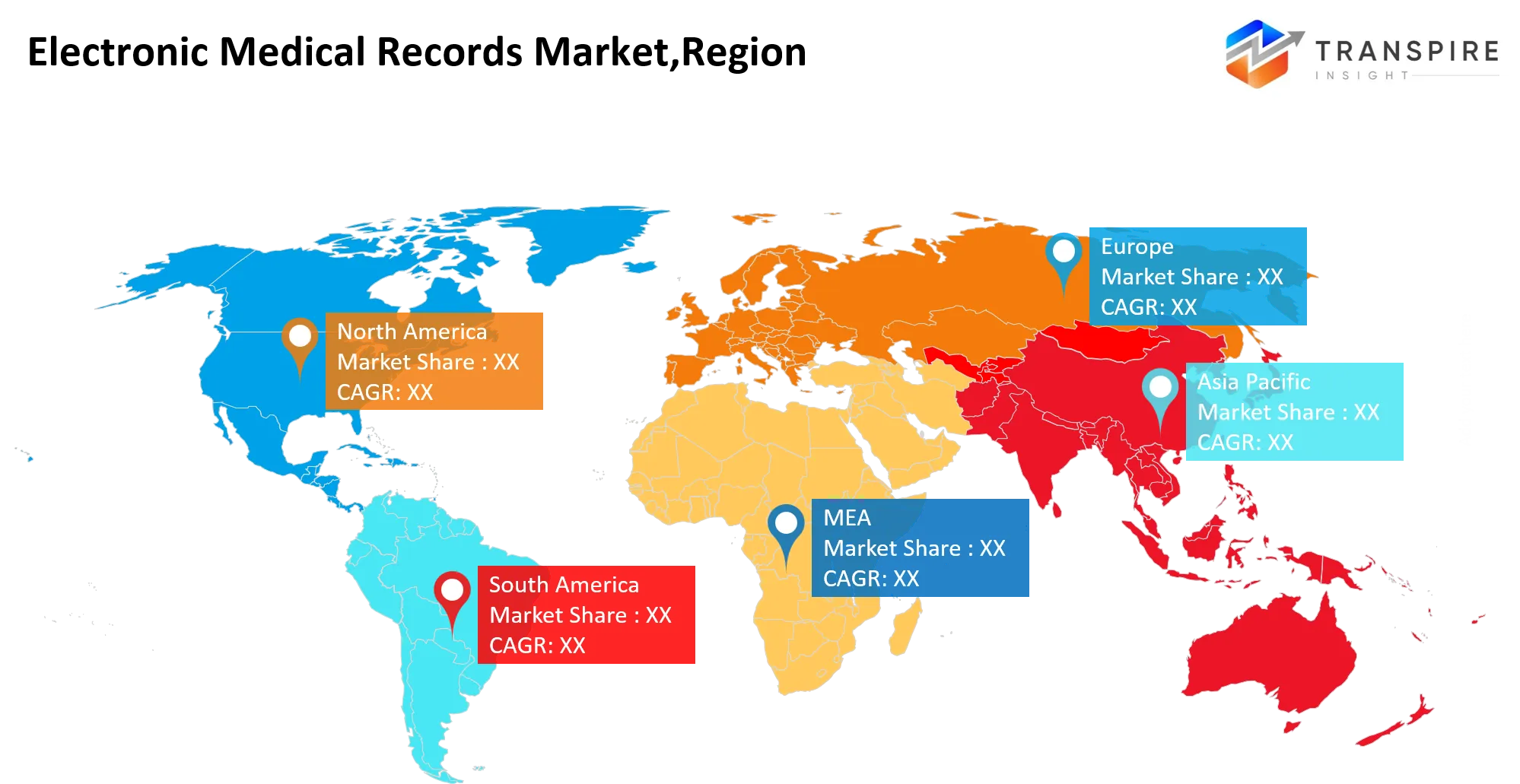
North America currently accounts for the largest portion of the electronic medical records market, 44.8%, due to its advanced IT infrastructure in hospitals, broad adoption of EMRs, and payer imperatives around quality reporting and value-based care. This region also benefits from a large, well-developed ecosystem of proven EMR vendors, such as Epic, Oracle Health, MEDITECH, and athenahealth, which is helping them drive innovation in AI-assisted documentation and cybersecurity. Interoperability mandates and patient data-access requirements are further helping hospitals link clinical, financial, and administrative workflows and advance their EMR systems.
In September 2026, athenahealth launched new embedded AI-powered workflow capabilities within its athenaOne EHR platform. These new features include the Clinically Inferred Diagnosis Gaps tool, which integrates value-based care intelligence directly into clinical workflows.
https://www.healthcareitnews.com/news/ai-roundup-new-products-oracle-athenahealth-suki-and-others
Europe represents 27% of the electronic medical records market, driven by publicly financed healthcare systems, national digital health strategies, and the European Health Data Space project. In contrast to North America's enterprise-led buying process, Europe's demanding privacy conditions, interconnectedness of digital health strategies, and real-time cross-border sharing of medical data have motivated private practices and hospitals to adopt privacy-preserving, fully interoperable EMR systems that provide purchasing power to upgrade systems, unite patient records, and connect all clinical work processes.
In January 2026, Oviva announced a €200 million Series D funding round to scale its AI-enabled chronic care platform across the region. This capital injection directly leverages Europe's regulatory environment by expanding evidence-backed, digitally integrated treatments that align with national reimbursement models and electronic health infrastructure.
https://disrupting.healthcare/2026/03/18/healthtech-companies-europe/
Asia-Pacific comprises 22% of the total market, representing the fastest-growing region with a CAGR of 13.5%. Digital health and hospital expansion through new builds, coupled with telemedicine and cloud infrastructure growth, are propelling EMR penetration throughout India, China, Japan, and Southeast Asia. Mature markets are primarily upgrading legacy systems, whereas regional growth is being propelled by first-time deployment and healthcare access expansion. Cost-efficient cloud-based EMRs, multilingual and language-independent platforms, and mobile-first systems create enormous opportunity among rural providers, single-provider clinics, and orphan outpatient networks.
In February 2026, WiseMan launched an updated version of its ER electronic medical record system. This product rollout directly integrates support for Japan’s nationwide EMR information-sharing service utilising HL7 FHIR standards. The deployment removes traditional language and localisation barriers to enhance security.
https://www.openpr.com/news/4403221/japan-electronic-medical-records-market-2026-growth-drivers
Who are the Key Players in the Electronic Medical Records Market, and how do they compete?
This competition remains fierce, with intensified competition over AI-enabled workflows, interoperability, cloud migration, and speciality solutions, with vendors flexing bundles of ambient documentation, analytics, and revenue-cycle management solutions to lock in customers and recur.
Epic Systems pursues an innovation-led enterprise strategy, with differentiation from the world's largest acute care ecosystem and generative AI, as it advances into community hospital markets via Community Connect. Oracle Health focuses on an AI-native EHR, voice-first user experience, and Oracle Cloud Infrastructure to compete for health systems replacing legacy systems. MEDITECH seeks a cost-effective hospital-focused strategy, via a combination of Expanse, interoperability, and analytics for community and mid-sized providers.
In Ambulatory care, competition among athenahealth, eClinicalWorks, and Next Gen Healthcare centres around subscriptions, speciality-specific workflows, billing and payment automation, and AI-assisted charting. Competition among GE HealthCare, Siemens Healthineers, and Philips is defined by the ability to connect to other devices, such as Imaging, monitoring, and other connected-care workflows, building out their digital hospital ecosystem. Competitive advantage across both groups is increasingly driven by speed of implementation, productivity gains that can be proven, and secure data liquidity.
Key Players are:
- Epic Systems
- Oracle Health
- MEDITECH
- Veradigm
- eClinicalWorks
- NextGen Healthcare
- Athenahealth
- GE HealthCare
- Siemens Healthineers
- Philips
- Allscripts
- CPSI
- Greenway Health
- InterSystems
- Tietoevry
Recent Development News
In September 2026, Quorum Health selected Oracle to standardize its clinical, operational, and financial technology systems, including Oracle Health Electronic Health Record, Clinical AI Agent, Patient Portal, and Data Intelligence solutions. The initiative is designed to connect patient care and administrative workflows across its 11 acute care hospitals, laying the foundation for AI-enabled clinical operations and a more integrated patient experience.
In April 2026, GRAIL announced a collaboration with Epic to integrate its Galleri multi-cancer early detection test into the Epic electronic health record platform. The integration is expected to enable healthcare providers across approximately 450 health systems to order the test, access results, and manage patient follow-up within existing clinical workflows, supporting wider adoption of connected diagnostic services.
In October 2026, UPMC executed a massive consolidation workflow by migrating 15hospitals and hundreds of ambulatory clinical practices onto a single unified enterprise platform. The successful launch of this system-wide electronic health records transition eliminated a fragmented network of nine separate legacy clinical platforms to drive better data synchronisation across both inpatient and outpatient settings.
What Strategic Insights Define the Future of the Electronic Medical Records Market?
The future of electronic medical records is for AI-native, cloud-based platforms that automate documentation, coding, referrals, and care collaboration inside singular clinical workflows. This can lighten administrative burdens and facilitate information access. The major risks are vendor dominance and lock-in. As they become increasingly dependent on the likes of Epic, Oracle Health, and MEDITECH, care providers face high switch costs that will limit their negotiating leverage as well as complicate future technology upgrades. An emerging opportunity is for AI-enabled interoperability, using FHIR-based data sharing and predictive analytics to connect care providers, enhance population health management and underpin value-based care models. To seize this opportunity, platform vendors should focus on modular, cloud-hosted architectures, transparent AI controls and workflow solutions specific to specialties. Providers should review how well a platform supports interoperability, data portability, cybersecurity, and the potential for increased productivity before making a decision. Its success will come down to connected and dependable clinical systems that don't add complexity.
Key Segmentations are:
By Component
- Software
- Services
- Hardware
- Implementation
- Consulting
- Training
- Support
- Others
By Deployment
- Cloud
- On-premises
- Hybrid
- Hosted
- SaaS
- Private Cloud
- Public Cloud
- Others
By Application
- Clinical Documentation
- Order Entry
- E-prescribing
- Patient Management
- Billing
- Scheduling
- Decision Support
- Others
By End User
- Hospitals
- Clinics
- Physician Offices
- Ambulatory Surgery Centres
- Specialty Clinics
- Laboratories
- Government
- Others
By Enterprise Size
- Large Hospitals
- Medium Hospitals
- Small Clinics
- Multisite Networks
- Independent Practices
- Government
- Academic
- Others
By Function
- Patient Records
- Clinical Workflow
- Reporting
- Interoperability
- Analytics
- Revenue Cycle
- Population Health
- Others
By Architecture
- Client-server
- Web-based
- Cloud-native
- Mobile
- Modular
- Integrated
- Standalone
- Others
Frequently Asked Questions
Find quick answers to common questions.
The electronic medical records market size was valued at USD 20.1 billion in 2025 and is poised to reach USD 32.5 billion by 2033, expanding at a 6.19% CAGR
Key segments for the electronic medical records market are By Component (Software, Services, Hardware, Implementation, Consulting, Training, Support, Others); By Deployment (Cloud, On-premise, Hybrid, Hosted, SaaS, Private Cloud, Public Cloud, Others); By Application (Clinical Documentation, Order Entry, E-prescribing, Patient Management, Billing, Scheduling, Decision Support, Others); By End User (Hospitals, Clinics, Physician Offices, Ambulatory Surgery Centers, Specialty Clinics, Laboratories, Government, Others); By Enterprise Size (Large Hospitals, Medium Hospitals, Small Clinics, Multisite Networks, Independent Practices, Government, Academic, Others); By Function (Patient Records, Clinical Workflow, Reporting, Interoperability, Analytics, Revenue Cycle, Population Health, Others); By Architecture (Client-server, Web-based, Cloud-native, Mobile, Modular, Integrated, Standalone, Others).
Growth is primarily driven by rising healthcare digitisation, increasing demand for interoperable patient records, expanding telehealth services, regulatory requirements for digital health data, and growing adoption of cloud-based platforms and AI-powered clinical workflows.
The electronic medical records market is led by major manufacturers, including Epic Systems, Oracle Health, MEDITECH, Veradigm, eClinicalWorks, NextGen Healthcare, athenahealth, GE HealthCare, Siemens Healthineers, Philips, Allscripts, CPSI, Greenway Health, InterSystems, and Tietoevry.
North America holds a 44.8% market share, supported by mature healthcare IT infrastructure, widespread EMR adoption, established technology vendors, regulatory reporting requirements, and increasing investment in AI-enabled clinical workflows and interoperability.
Key opportunities include cloud-based EMR adoption, AI-assisted clinical documentation, interoperability solutions, predictive analytics, and affordable platforms for small clinics and emerging healthcare markets.
- Epic Systems
- Oracle Health
- MEDITECH
- Veradigm
- eClinicalWorks
- NextGen Healthcare
- Athenahealth
- GE HealthCare
- Siemens Healthineers
- Philips
- Allscripts
- CPSI
- Greenway Health
- InterSystems
- Tietoevry
About the Authors

Pankaj Ghogare Patil
I am Pankaj Ghogare Patil, a Senior Research Analyst at Transpire Insight, specializing in the Pharmaceutical, Chemicals & Materials, Healthcare IT, and Biotechnology industry. My expertise lies in conducting comprehensive market research, analyzing industry trends, evaluating competitive landscapes, and translating complex data into actionable insights. At Transpire Insight, I closely follow emerging technologies, regulatory developments, and market innovations to create accurate, well-researched, and informative content that helps businesses and professionals make informed decisions. I am committed to producing credible, evidence-based articles that reflect industry best practices while making technical topics accessible and valuable for a broad audience.

Chakradhar Khansole
Chakradhar serves as the Research Director at Transpire Insight, bringing over 8 years of experience in technology, innovation, and strategic market intelligence. He specializes in transforming complex market data into actionable business insights that enable organizations to make informed, growth-oriented decisions. Recognized for his strategic vision and analytical expertise, Chakradhar leads high-impact research initiatives, delivering comprehensive market assessments, competitive intelligence, and forward-looking industry analysis.
Recently Published Reports
-
Apr 2026
AI in Diabetic Retinopathy Market
AI in Diabetic Retinopathy Market Size, Share & Analysis Report By Type (Screening AI Systems, Diagnostic AI Systems, and Predictive AI Models), By Application Segment (Hospitals, Ophthalmology Clinics, Diagnostic Centers, and Research and Development), and Geography (North America, Europe, Asia-Pacific, Middle East and Africa, South and Central America), 2021 - 2031
-
Apr 2026
Psychometric Tests Market
Psychometric Tests Market Size, Share & Analysis Report By Type (Personality Tests, Ability/Aptitude Tests, Skill/Knowledge Tests, and Others), By Application (Talent Acquisition and Talent Management), and Geography (North America, Europe, Asia-Pacific, Middle East and Africa, South and Central America), 2021 – 2031
-
Apr 2026
Rare Biological Sample Collection Market
Rare Biological Sample Collection Market Size, Share & Analysis Report By Type (Isolation Kits & Reagent, Blood Collection Tubes, and Others), By Application (Oncology, Transcriptomics, Pharmacogenomics, and Others), and Geography (North America, Europe, Asia-Pacific, Middle East and Africa, South and Central America), 2021 – 2031
-
Jul 2026
Diabetic Retinopathy Market
Diabetic Retinopathy Market Size, Share & Analysis Report By Type (Proliferative Diabetic Retinopathy, and Diabetic Macular Edema (DME)), By Treatment Type (Anti VEGF Drug, Steroid Implants, Laser Surgeries, and Vitrectomy), and Geography (North America, Europe, Asia-Pacific, Middle East and Africa, South and Central America), 2021 – 2031
Our Clients