

Electronic Clinical Outcome Assessment Solutions (ECOA) Market Summary:
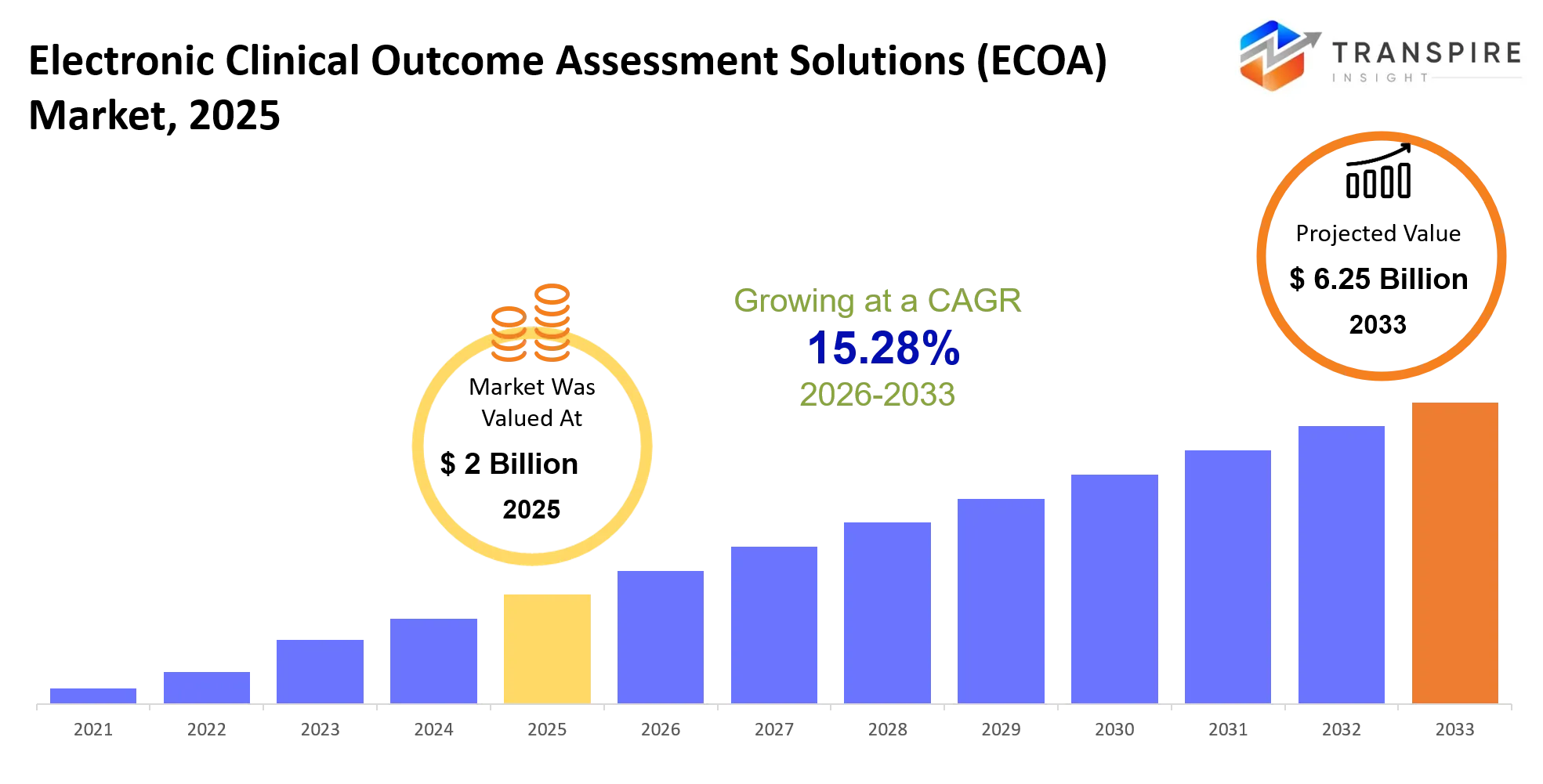
As per Transpire Insight Analysis, the Electronic Clinical Outcome Assessment Solutions (ECOA) Market size is estimated at USD 2.0 billion in 2025 and is anticipated to reach USD 6.25 billion by 2033, growing at a CAGR of 15.28%from 2026 to 2033.
The Electronic Clinical Outcome Assessment Solutions (eCOA) Market supports pharmaceutical companies, biotechnology firms and clinical research organisations in collecting symptoms, treatment experiences and clinical results through digital means. These eCOA platforms replace paper-based questionnaires with electronic tools. This shift improves how data is accessed, monitored and maintained across trials. Over the last three to five years, there has been an increase in the number of decentralised clinical trials where assessments and communications happen via mobile and wearable devices. This development enables the patients to provide their results from home, and therefore there is no need to visit hospitals or research sites for the sake of reporting the results. Over the last few years, the complexity of the clinical studies has increased, and therefore the importance of accurate patient data has increased, and hence the need for eCOA has become higher. Artificial intelligence and automation are making it easier to develop and assess the studies.
Electronic Clinical Outcome Assessment Solutions (ECOA) Market Size & Forecast:
- Market Size 2025: USD 2.0 Billion
- Expected Market Value (2033): USD 6.25 Billion
- Forecast CAGR (2026–2033): 15.28%
- Leading Region in 2025: North America
- Fastest Growing Region: Asia Pacific
- Key Company Profiles: Clario, Medidata, Signant Health, IQVIA, Oracle Health Sciences, Parexel, ICON, Veeva Systems, Medable, THREAD Research, Castor, Alira Health, ERT, ObvioHealth, YPrime
Key Market Insights:
Market trends are evolving away from primitive questionnaires into clinical data platforms that integrate feedback from patients, clinician assessments, and digital monitoring devices.
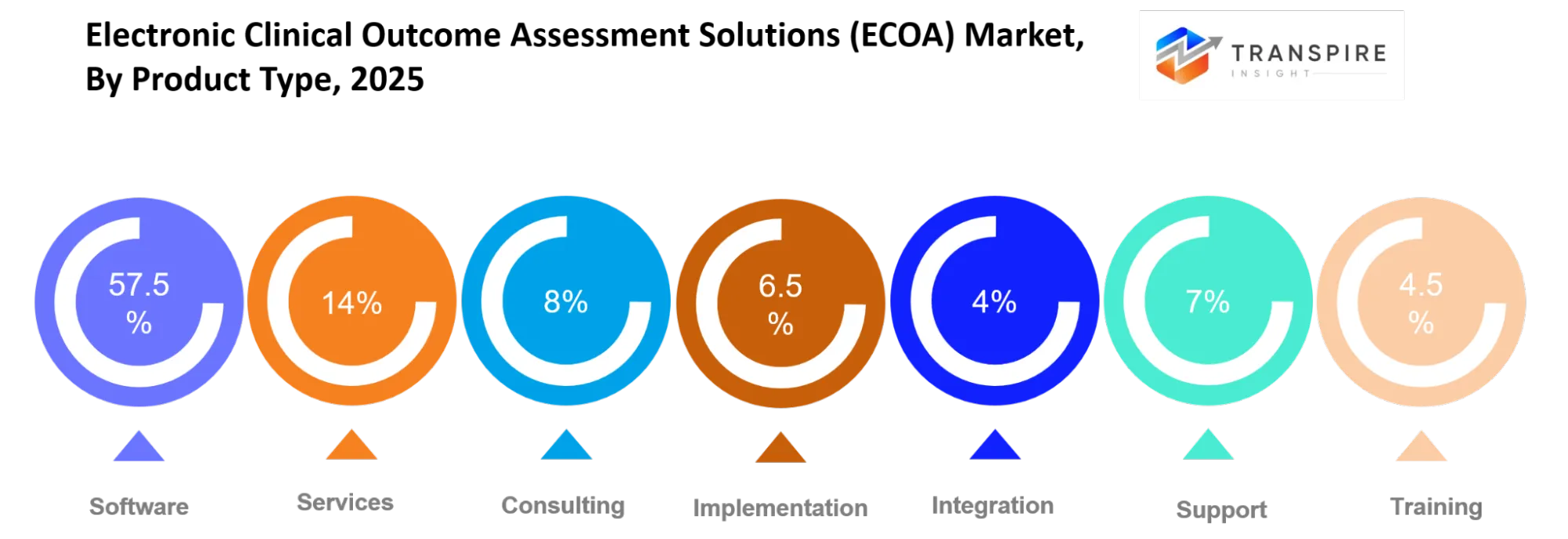
- Software represents 57.5% of the component segment, indicating the significance of digital technology platforms in capturing and handling outcome data validation in clinical studies.
- Services hold 14.0% of the component segment, indicating the significance of implementation services, management of studies, and technical services in clinical assessment programs.
- The consulting service takes up 8.0% of the component market share, where the sponsor seeks help regarding choosing evaluation instruments and ensuring digital processes align with the protocol of the clinical trial.
- The implementation service takes up 6.5% of the component market share, reflecting the fact that eCOA needs to be configured in terms of the requirements of studies and patients' workflow.
- The integration of outcome assessment software platforms with electronic data capture systems is 5.5% of the component share of the market.
- The support service takes up 4.0% of the component market share, whereas the training service makes up 2.5% of the component segment of market share.
What are the Key Drivers, Restraints, and Opportunities in the Electronic Clinical Outcome Assessment Solutions (ECOA) Market?
Drivers
Decentralised & Hybrid Trials Decentralized and hybrid clinical trials are driving awareness of electronic clinical outcome assessment solutions. There is a growing need for pharmaceutical companies to obtain patient input more quickly than is often possible at the research site. Platforms such as remote surveys, mobile applications and reminders make it easier for patients to participate and make patient data available more quickly to sponsors.
Restraints
challenges include implementation costs, integration with the system and usability for the participants. Sponsors may need to transfer current processes into a digital format, validate digital instruments for assessment, coordinate translations and train staff. Variability in digital literacy levels, internet access and the devices available to the participants may also introduce complications. Data privacy regulations and local practices in study sites involved in international studies add further limitations.
Opportunities
Assessments embedded in wearables, artificial intelligence and cloud-enabled trial sites are opening up new markets that go beyond traditional electronic questionnaires. Integrating patient reported data with real activity, sleep or mobility data, for example, might give trial teams a more comprehensive view of a treatment response. Asia-Pacific could be another growth market, as sponsors look to expand into new geographies and patient groups. Vendors offering flexible deployments, local language capability, seamless integration, and transparent pricing models could be more successful in winning new customers.
|
Driver |
Relative Impact on Growth (%) |
Geographic Relevance |
Impact Timeline |
Demand Strength |
Growth Mechanism |
Key Beneficiaries |
Major Constraint |
|
Increasing Adoption of Decentralized and Patient-Centric Clinical Trials |
25% |
North America, Europe |
Short-term (≤2 years) |
High |
Enables remote patient reporting and reduces site visits |
Pharmaceutical companies, CROs, eCOA solution providers |
Digital literacy gaps and inconsistent patient engagement |
|
Rising Demand for Real-Time Clinical Data and Improved Data Quality |
23% |
North America, Asia-Pacific |
Short-term (≤2 years) |
High |
Captures timely patient outcomes and reduces data entry errors |
Clinical research organizations, sponsors, data management vendors |
Integration challenges with existing clinical systems |
|
Growing Regulatory Emphasis on Electronic Data Integrity and Traceability |
20% |
North America, Europe |
Medium-term (2–4 years) |
High |
Supports audit trails, validated records, and regulatory compliance |
Pharmaceutical sponsors, CROs, compliance technology providers |
Evolving regulations and costly system validation |
|
Increasing Pharmaceutical and Biotechnology R&D Investment |
18% |
North America, Europe, Asia-Pacific |
Medium-term (2–4 years) |
High |
Expands clinical trial volumes and digital assessment budgets |
Biotechnology firms, pharmaceutical companies, eCOA vendors |
R&D budget cuts and fluctuating clinical trial funding |
|
Advancements in AI, Wearables, and Integrated Digital Health Technologies |
14% |
North America, Europe, Asia-Pacific |
Long-term (≥4 years) |
Medium |
Enables intelligent assessments and continuous patient monitoring |
Digital health vendors, eCOA developers, clinical trial sponsors |
Data privacy risks and limited technology interoperability |
|
Total |
100% |
— |
— |
— |
— |
— |
— |
What Has the Impact of artificial intelligence on the Electronic Clinical Outcome Assessment Solutions (ECOA) Market?
AI is revolutionising approaches to the configuration, monitoring, and deployment of electronic clinical outcomes assessment solutions throughout clinical trials. An interesting application would be study-building automation that involves the ability of smart solutions to assist in structuring workflows and creating assessment templates. These functionalities could save time on repetitive tasks and allow the clinical team to concentrate on protocol design and the needs of patients better. Medidata announced adding more AI-powered functionalities to their clinical trial platform. Operational monitoring can also benefit from AI as an approach to detect anomalies, missed responses or other issues related to data quality. Predictive analysis can also help a study team to recognise patients who are at risk of forgetting to fill out the questionnaire and to address such situations immediately. However, there are some obstacles that impede wider adoption of AI in clinical settings. First of all, integration requires investment of effort and money to validate solutions and make them compliant with clinical regulations. Besides, inaccurate predictions, biased models or inappropriate alerts can result in distorted findings.
Instance
In January 2026, Medable launched an AI-based solution that would enable researchers to create summaries of eCOA data and ensure better oversight in clinical trials.
Key Market Trends:
The eCOA sector is moving away from being an industry of individual questionnaires towards being a more integrated one that facilitates the entire clinical assessment process. It is becoming common for eCOA vendors to focus on patient-friendliness, automation, remote capability, and integration.
- Clinical researchers are adopting electronic questionnaires as an alternative to paper diaries to enhance data collection and minimise manual data entry.
- Bring-your-own-device models offer patients greater flexibility as well as decreasing reliance on devices provided by the companies.
- Remote assessments become more relevant as sponsors are trying to avoid unnecessary site visits and make participation easier.
- Electronic assessments are often supplemented with activity, sleep, and mobility data to get a bigger picture of patients' outcomes.
- Various vendors are offering solutions that facilitate questionnaire configuration, assessment process, and study preparation.
- The integration of eCOA, electronic data capture, electronic consent, and trial management systems is contributing to the minimisation of fragmented processes.
Electronic Clinical Outcome Assessment Solutions (ECOA) MarketSegmentation
By Components
Software leads the components sector with a market share of 57.5%, owing to the significance of software in the process of distributing, collecting responses, validating data, and managing research. Services constitute 14.0%, consulting comes next with 8.0%, implementation with 6.5%, integration with 5.5%, support with 4.0%, training with 2.5%, and others with 2.0%. The use of software is justified by the necessity of conducting uniform data collection at several research sites, whereas service-related sectors are concerned with configuration, connection of systems, and operations.
By Assessment Type
Patient-reported outcomes encompass symptoms, treatment experience, and any other functional benefit or loss described directly by the trial participants. Clinician reported outcomes describe information observed and reported by a clinical care professional, whilst observer reported outcomes encompass observations and recordings by a caregiver or other informal observer. Performance outcomes measure a skill or ability in a specific, standardised environment, whereas quality of life measures comprise a set of interrelated experiences and attitudes concerning overall life-related impact. Diary outcomes capture symptom variability over time, while cognitive outcomes apply to neurological and psychiatric indications. The various categories of outcomes serve different measurements, demanding a different approach depending on the trial, therapeutic area, and desired endpoints.
By Delivery Mode
All three eCOA methodologies-Web, mobile, and tablet-offer what you need to collect eCOA data, just through different portals. Market stats say wearable-enabled eCOA is the fastest-growing delivery mechanism in the sample (15.6% CAGR), as investigators try to quantify sensor data along with participant input. BYOD programs help reduce the burdens of study participation for patients, but site-based programs still have value (for drug trials and other studies that benefit from patient monitoring, supervised assessments, or clinical observation). Cloud-based solutions make site and investigator collaboration easier across multiple locations.
By Clinical Trial
Data on tolerability and early safety can be captured, and electronic collection of assessments can be used to assess response to treatment and to select endpoints for further studies. Phase III studies usually need to include the collection of outcome measures at regular time points in a larger and more geographically dispersed sample size. Outcome collection in Phase IV and post-marketing studies benefits from this long-term collection happening in routine clinical practice, and observational studies / Real-World Evidence programmes will include structured collection of patient experience outside of the traditional interventional trial environment. Adoption is likely to vary depending on the rationale for the study, patient inclusion criteria and the need for long-term evidence collection.
By End User
New drugs and pharmaceuticals are produced by pharmaceutical companies; they need eCOA for capturing the endpoint of their clinical trials and assessing how the patients react to the drug that is being produced. Several different CROs monitor different platforms for various sponsor programs. Therefore, there should be consideration of scale and integration when thinking about purchasing. Device makers need usability, performance, and benefits for the patients that they can see through electronic assessment techniques. Research centres and investigators will require a flexible configuration of systems, while hospitals assist in facilitating clinical research. Regulatory organisations are included in the broader spectrum of evidence but with a different purchasing role.
By Indication
Examples of indications suitable for eCOA in clinical trials: Oncology. Symptom- and treatment-related effects, and changes in quality of life. Central nervous system. Cognitive tests, physician reports, frequent symptom surveys. Immunology/ rare disease. Longitudinal patient reporting, especially with fluctuating symptoms or broad trial geography. Cardiovascular/respiratory. Both patient-reported symptoms and objective measurements. Dermatology. Symptom severity and response to treatment. Other indications. ECOA has potential for other indications depending on what the study endpoints require, and others are planning or developing validated and readily available assessments.
What are the key use cases driving the Electronic Clinical Outcome Assessment Solutions (ECOA) Market?
Software patient assessments represent a use case of the eCOA industry and correspond to software solutions. Both pharmaceutical companies and CROs utilise various types of digital questionnaires, electronic diaries, and assessment instruments utilised by clinicians to track symptoms and reactions to treatments and study outcomes. This helps in organising data collection at multiple research sites, reducing the need for using paper documentation. Additional applications involve remote follow-ups, health-related quality of life measurements, and endpoint tracking in oncology, neurology, immunology, and rare disease studies. Delivery through web and mobile devices facilitates participation of subjects who take assessments outside the boundaries of research laboratories.New uses of eCOA combine software assessments with activity and movement data collected through wearables. Such combinations might be valuable especially in cases where high-frequency tracking of the subject is required.
|
Report Metrics |
Details |
|
Market size value in 2025 |
USD 2.0 Billion |
|
Market size value in 2026 |
USD2.31 Billion |
|
Revenue forecast in 2033 |
USD 6.25 Billion |
|
Growth rate |
CAGR of 15.28%from 2026 to 2033 |
|
Base year |
2025 |
|
Historical data |
2021 - 2024 |
|
Forecast period |
2026 - 2033 |
|
Report coverage |
Revenue forecast, competitive landscape, growth factors, and trends |
|
Regional scope |
United States; Canada; Mexico; United Kingdom; Germany; France; Italy; Spain; Denmark; Sweden; Norway; China; Japan; India; Australia; South Korea; Thailand; Brazil; Argentina; South Africa; Saudi Arabia; United Arab Emirates |
|
Key company profiled |
Clario, Medidata, Signant Health, IQVIA, Oracle Health Sciences, Parexel, ICON, Veeva Systems, Medable, THREAD Research, Castor, Alira Health, ERT, ObvioHealth, YPrime |
|
Customization scope |
Free report customization (country, regional & segment scope). Avail customized purchase options to meet your exact research needs. |
|
Report Segmentation |
Component (Software, Services, Consulting, Implementation, Integration, Support, Training, Others)Assessment Type (Patient-Reported Outcomes, Clinician-Reported Outcomes, Observer-Reported Outcomes, Performance Outcomes, Quality-of-Life Assessments, Symptom Diaries, Cognitive Assessments, Others)Delivery Mode (Web-Based, Mobile App, Tablet-Based, Wearable-Integrated, Bring-Your-Own-Device, Site-Based, Cloud-Based, Others)Clinical Trial Phase (Phase I, Phase II, Phase III, Phase IV, Observational Studies, Post-Marketing Studies, Real-World Evidence, Others)End User (Pharmaceutical Companies, Biotechnology Companies, CROs, Medical Device Companies, Academic Research, Hospitals, Regulatory Bodies, Others)Indication (Oncology, CNS, Immunology, Rare Diseases, Cardiovascular, Respiratory, Dermatology, Others) |
Which Regions are Driving the Electronic Clinical Outcome Assessment Solutions (ECOA) Market Growth?
North America
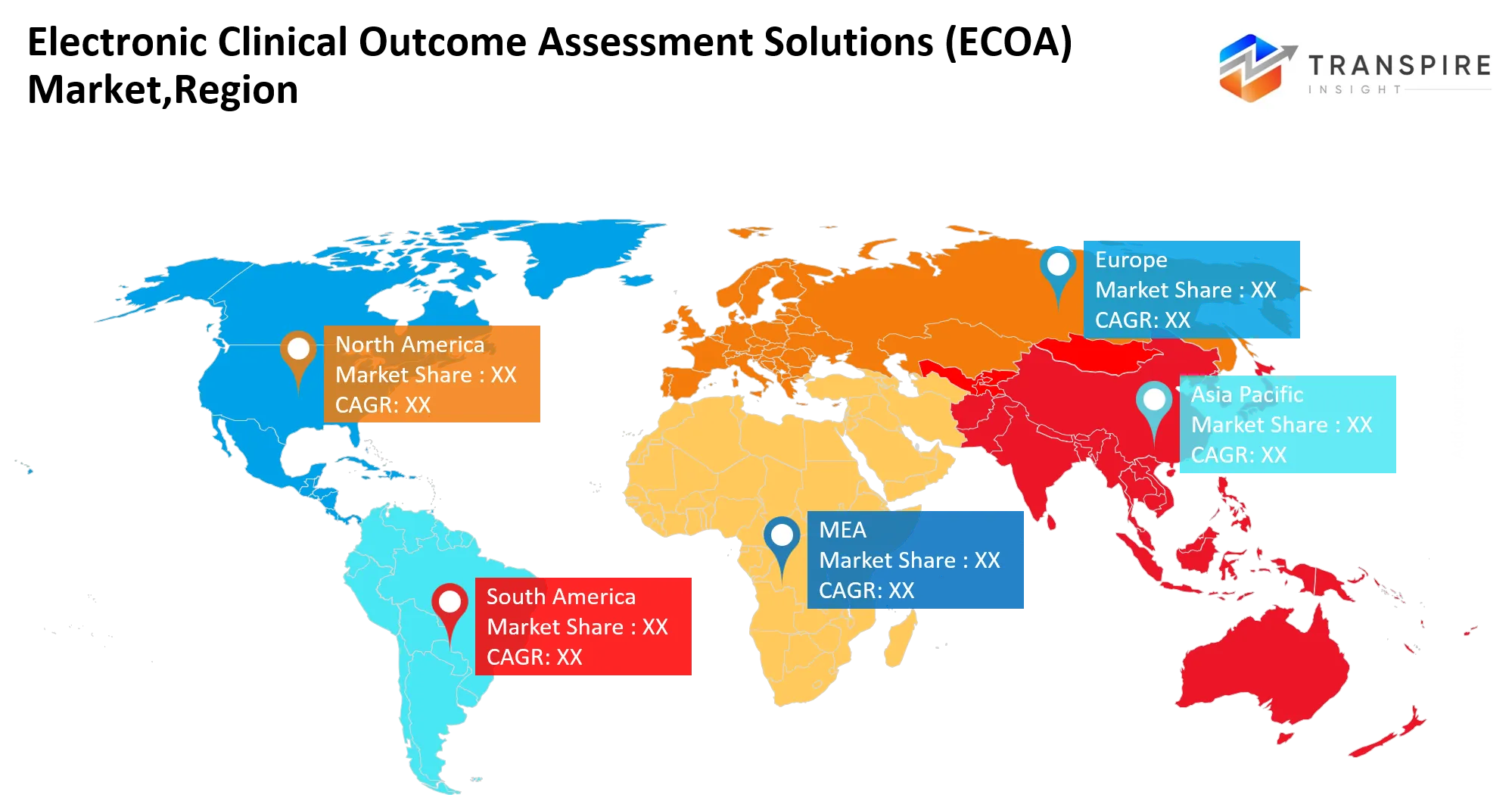
North America has dominated the market and holds a 44.2% share. This dominance can be attributed to its existing pharmaceutical industry, clinical research structure, and the application of digital trial technologies. This area has experienced CROs, technology experts, and regulatory frameworks for clinical research. All these factors favour the use of eCOA platforms in multinational studies. The further development of digital clinical development will continue to create demand
In March 2025,Clario announced a deal to purchase the eCOA service from WCG, thereby improving its digital data acquisition in clinical trials and boosting support for pharmaceutical studies.
Europe
Europe constitutes 29.1% of the market. The pharmaceutical and biotechnological industry, clinical research networks, and cross-border studies present opportunities for eCOA providers. Nonetheless, vendors have to overcome challenges such as different languages, operational practices, and data regulations. Multilingual solutions may help in serving research projects in Europe.
In November 2025,UNIFIED Project between Erasmus University Rotterdam and Pfizer started astudy to enhance patient-focused clinical trial endpoints and digital health technology.
Asia Pacific
The Asia Pacific region constitutes 17.4% of the market and is the most rapidly growing region with a projected CAGR of 14.9%. This region's growth potential is dependent on increasing clinical research activity, a large number of patients, and an opportunity to increase digital participation in both new and existing research markets. Mobile technology would help in delivering remote assessments, although internet penetration and digital literacy differ by geography. Vendors offering localised interfaces, device flexibility, and regional implementation would gain from increased clinical research activity.
In September 2026, EClinCloud noted that its eCOA system had grown to cover 177 nations and territories, enabling outcome assessments through clinical research conducted in multiple nations.
Who are the Key Players in the Electronic Clinical Outcome Assessment Solutions (ECOA) Market, and how do they compete?
The competition in the eCOA industry is based on the platform's capabilities, the quality of the assessments performed, ease of use, integration, time to implement, and coverage. Competing companies offer unique therapeutic expertise, integrated clinical research systems, and deployment options. Established players target large multinational trials, while specialised vendors target specific needs of particular trials or participants.
Medidata integrates eCOA with the entire clinical trial technology solution and offers sponsors and CROs an integrated workflow and an AI-driven study design process. Signiant Health offers eCOA solutions together with scientific expertise and integration of eCOA with other clinical trial solutions. Its acquisition of Ametris in May 2026 enhanced its capabilities in the area of digital outcomes from wearables, going beyond the questionnaire-based assessment approach. Clario's competitive advantage lies in its clinical endpoints data and therapeutic speciality expertise, particularly in neuroscience.
Electronic Clinical Outcome Assessment Solutions (ECOA) Marketcompanies
- Clario
- Medidata
- Signant Health
- IQVIA
- Oracle Health Sciences
- Parexel
- ICON
- Veeva Systems
- Medable
- THREAD Research
- Castor
- Alira Health
- ERT
- ObvioHealth
- YPrime
|
Company |
Est. Revenue Share Range |
Key Offerings |
Strategic Positioning |
Geographic Strength |
Technology Focus |
|
Clario |
Estimated 12–17% |
eCOA Platform, ePRO, eClinRO, electronic assessments |
Science-led leadership in complex clinical endpoints |
North America, Europe, Asia Pacific |
BYOD, validated assessments, multimedia capture |
|
Medidata |
Estimated 10–15% |
Medidata eCOA, ePRO, eClinRO, myMedidata |
Integrated clinical trial platform differentiation |
North America, Europe, Asia Pacific |
AI-assisted study design, cloud data integration |
|
Signant Health |
Estimated 9–14% |
SmartSignals eCOA, ePRO, clinician ratings, rater training |
Specialist leadership in endpoint quality and assessment science |
North America, Europe, Asia Pacific |
Digital assessments, scoring analytics, BYOD |
|
IQVIA |
Estimated 7–12% |
IQVIA eCOA, patient engagement solutions, connected devices |
Clinical research and technology service integration |
North America, Europe, Asia Pacific |
Real-time data capture, automated scoring, analytics |
|
Oracle Health Sciences |
Estimated 5–9% |
Clinical One, patient-facing trial applications, clinical data integration |
Enterprise clinical research ecosystem strategy |
North America, Europe, Asia Pacific |
Cloud infrastructure, clinical data interoperability |
|
Veeva Systems |
Estimated 3–6% |
Veeva Clinical Platform, Vault Clinical applications, patient-facing workflows |
Cloud-based clinical application ecosystem expansion |
North America, Europe, Asia Pacific |
Cloud-native architecture, unified clinical workflows |
|
Medable |
Estimated 3–6% |
Medable eCOA, eConsent, decentralized trial solutions |
Patient-centric decentralized trial specialization |
North America, Europe, Asia Pacific |
Mobile-first capture, remote participation, integrations |
|
THREAD Research |
Estimated 2–4% |
THREAD eCOA, ePRO, decentralized trial technology |
Flexible digital trial delivery for sponsors and CROs |
North America, Europe, Asia Pacific |
Mobile and web assessments, remote data collection |
|
Castor |
Estimated 1–3% |
Castor eCOA, Castor EDC, digital trial data capture |
Flexible digital research platform for varied study sizes |
Europe, North America, Asia Pacific |
Cloud-based capture, configurable workflows, integrations |
|
YPrime |
Estimated 1–3% |
YPrime eCOA, ePRO, eConsent, patient engagement solutions |
Specialized eCOA delivery with implementation support |
North America, Europe, Asia Pacific |
Patient apps, multilingual assessments, device flexibility |
Recent Development News
In February 2026, Medidata announced the increased capabilities of AI in their clinical trial platform, stating that AI technology from the company was used in over 500 clinical trials within the past ten years.
In May 2025, Clario completed the acquisition of WCG's eCOA business unit, increasing the capabilities of collecting digital endpoint data and providing further assistance in neuroscience clinical trials. The acquisition brought assessment expertise to the company.
What Strategic Insights Define the Future of the Electronic Clinical Outcome Assessment Solutions (ECOA) Market?
The future growth of the Electronic Clinical Outcome Assessment Solutions Market will largely depend upon providers' ability to link electronic assessments to wider research workflows. At the moment, software solutions are a component segment, yet differentiation in the future will rely on something more than just questionnaires. Product development will increasingly depend on such aspects as integration with wearable devices, automation of study setups and user-oriented interfaces. One possible threat could emerge as low participant adherence to tests. Even the most advanced platforms will produce inaccurate or inconsistent data if the assessments are difficult to perform and/or perceive for the users. So vendors need to look at usability and accessibility in addition to technical capabilities of software.One interesting opportunity is in the combination of patient-reported outcomes and wearable-generated metrics in neurological, respiratory and mobility-related studies. Asia Pacific region that is expected also has much room for geographic expansion.
Component
- Software
- Services
- Consulting
- Implementation
- Integration
- Support
- Training
- Others
Assessment Type
- Patient-Reported Outcomes
- Clinician-Reported Outcomes
- Observer-Reported Outcomes
- Performance Outcomes
- Quality-of-Life Assessments
- Symptom Diaries
- Cognitive Assessments
- Others
Delivery Mode
- Web-Based
- Mobile App
- Tablet-Based
- Wearable-Integrated
- Bring-Your-Own-Device
- Site-Based
- Cloud-Based
- Others
Clinical Trial Phase
- Phase I
- Phase II
- Phase III
- Phase IV
- Observational Studies
- Post-Marketing Studies
- Real-World Evidence
- Others
End User
- Pharmaceutical Companies
- Biotechnology Companies
- CROs
- Medical Device Companies
- Academic Research
- Hospitals
- Regulatory Bodies
- Others
Indication
- Oncology
- CNS
- Immunology
- Rare Diseases
- Cardiovascular
- Respiratory
- Dermatology
- Others
Frequently Asked Questions
Find quick answers to common questions.
The electronic clinical outcome assessment solutions (ECOA) market size was valued at USD 2.0 billion in 2025 and is poised to reach USD 6.25 billion by 2033, expanding at a 15.28% CAGR.
Key segments for the electronic clinical outcome assessment solutions (ECOA) market are Component (Software, Services, Consulting, Implementation, Integration, Support, Training, Others)Assessment Type (Patient-Reported Outcomes, Clinician-Reported Outcomes, Observer-Reported Outcomes, Performance Outcomes, Quality-of-Life Assessments, Symptom Diaries, Cognitive Assessments, Others)Delivery Mode (Web-Based, Mobile App, Tablet-Based, Wearable-Integrated, Bring-Your-Own-Device, Site-Based, Cloud-Based, Others)Clinical Trial Phase (Phase I, Phase II, Phase III, Phase IV, Observational Studies, Post-Marketing Studies, Real-World Evidence, Others)End User (Pharmaceutical Companies, Biotechnology Companies, CROs, Medical Device Companies, Academic Research, Hospitals, Regulatory Bodies, Others)Indication (Oncology, CNS, Immunology, Rare Diseases, Cardiovascular, Respiratory, Dermatology, Others)
Growth is primarily driven by increasing adoption of digital clinical trials, rising demand for accurate real-time patient data, growing pharmaceutical and biotechnology research activities, wider use of decentralised clinical trials, and the need to improve data quality, patient engagement, and regulatory compliance.
The market is led by major manufacturers including Clario, Medidata, Signant Health, IQVIA, Oracle Health Sciences, Parexel, ICON, Veeva Systems, Medable, THREAD Research, Castor, Alira Health, ERT, ObvioHealth, YPrime
North America leads the market of ECOA solutions, holding 44.2% of the market share. This region has been dominating the market owing to its developed healthcare infrastructure, adoption of clinical trial technology, robust pharmaceutical and biotechnology industry, considerable spending on clinical research, and regulatory environment
The commercial opportunities in the ECOA solutions market include the increasing number of decentralised clinical studies being undertaken, increased adoption of digitally enabled patient-oriented evaluations, AI and real-time data analytics, expanding clinical research activities in developing economies, and increasing need for cloud based ECOA solutions among drug and pharmaceutical organizations.
- Clario
- Medidata
- Signant Health
- IQVIA
- Oracle Health Sciences
- Parexel
- ICON
- Veeva Systems
- Medable
- THREAD Research
- Castor
- Alira Health
- ERT
- ObvioHealth
- YPrime
About the Authors

Pankaj Ghogare Patil
I am Pankaj Ghogare Patil, a Senior Research Analyst at Transpire Insight, specializing in the Pharmaceutical, Chemicals & Materials, Healthcare IT, and Biotechnology industry. My expertise lies in conducting comprehensive market research, analyzing industry trends, evaluating competitive landscapes, and translating complex data into actionable insights. At Transpire Insight, I closely follow emerging technologies, regulatory developments, and market innovations to create accurate, well-researched, and informative content that helps businesses and professionals make informed decisions. I am committed to producing credible, evidence-based articles that reflect industry best practices while making technical topics accessible and valuable for a broad audience.

Chakradhar Khansole
Chakradhar serves as the Research Director at Transpire Insight, bringing over 8 years of experience in technology, innovation, and strategic market intelligence. He specializes in transforming complex market data into actionable business insights that enable organizations to make informed, growth-oriented decisions. Recognized for his strategic vision and analytical expertise, Chakradhar leads high-impact research initiatives, delivering comprehensive market assessments, competitive intelligence, and forward-looking industry analysis.
Recently Published Reports
-
Apr 2026
AI in Diabetic Retinopathy Market
AI in Diabetic Retinopathy Market Size, Share & Analysis Report By Type (Screening AI Systems, Diagnostic AI Systems, and Predictive AI Models), By Application Segment (Hospitals, Ophthalmology Clinics, Diagnostic Centers, and Research and Development), and Geography (North America, Europe, Asia-Pacific, Middle East and Africa, South and Central America), 2021 - 2031
-
Apr 2026
Psychometric Tests Market
Psychometric Tests Market Size, Share & Analysis Report By Type (Personality Tests, Ability/Aptitude Tests, Skill/Knowledge Tests, and Others), By Application (Talent Acquisition and Talent Management), and Geography (North America, Europe, Asia-Pacific, Middle East and Africa, South and Central America), 2021 – 2031
-
Apr 2026
Rare Biological Sample Collection Market
Rare Biological Sample Collection Market Size, Share & Analysis Report By Type (Isolation Kits & Reagent, Blood Collection Tubes, and Others), By Application (Oncology, Transcriptomics, Pharmacogenomics, and Others), and Geography (North America, Europe, Asia-Pacific, Middle East and Africa, South and Central America), 2021 – 2031
-
Jul 2026
Diabetic Retinopathy Market
Diabetic Retinopathy Market Size, Share & Analysis Report By Type (Proliferative Diabetic Retinopathy, and Diabetic Macular Edema (DME)), By Treatment Type (Anti VEGF Drug, Steroid Implants, Laser Surgeries, and Vitrectomy), and Geography (North America, Europe, Asia-Pacific, Middle East and Africa, South and Central America), 2021 – 2031
Our Clients







