

Electronic Cigarette Market Summary:
As per Transpire Insight Analysis, the Electronic Cigarette Market size is estimated at USD 28.58 billion in 2025 and is anticipated to reach USD 58.73 billion by 2033, growing at a CAGR of 9.42% from 2026 to 2033.
The market of electronic cigarettes provides vaping options in the form of rechargeable and disposable e-cigarettes to adults who are looking for an alternative to cigarettes. In the past three to five years, the electronic cigarette market has moved toward smaller gadgets, pod‑style models, better battery systems and easier designs. A big shift in the cigarette market is the stronger focus on rechargeable and high‑tech devices. Real changes happened when governments made rules about electronic cigarette products, flavours, nicotine levels and where they can be sold. These rules made companies change their products and how they follow the rules. At the time, disposable electronic cigarettes have become popular because they are ready to use and do not need charging or upkeep. This mix of products' ease of use and changing tastes in the electronic cigarette market is helping more people try them, while makers keep making devices that fit new laws and market needs.
Electronic Cigarette Market Size & Forecast:
- Market Size 2025: USD 28.58 Billion
- Expected Market Value (2033): USD 58.73 Billion
- Forecast CAGR (2026–2033): 9.42%
- Leading Region in 2025: North America
- Fastest Growing Region: Asia Pacific
- Key Company Profiles: British American Tobacco, Philip Morris International, Altria, Imperial Brands, Japan Tobacco, RELX International, Juul Labs, NJOY, Logic Technology, Vuse, Elf Bar, Geek Bar, Vaporesso, SMOK, Innokin

Key Market Insights:
The market is shifting towards reusability and convenience of vaping methods, where rechargeable vaping products continue to dominate the market. In addition, there is also an increasing trend towards disposable devices due to their portability and user-friendly design.
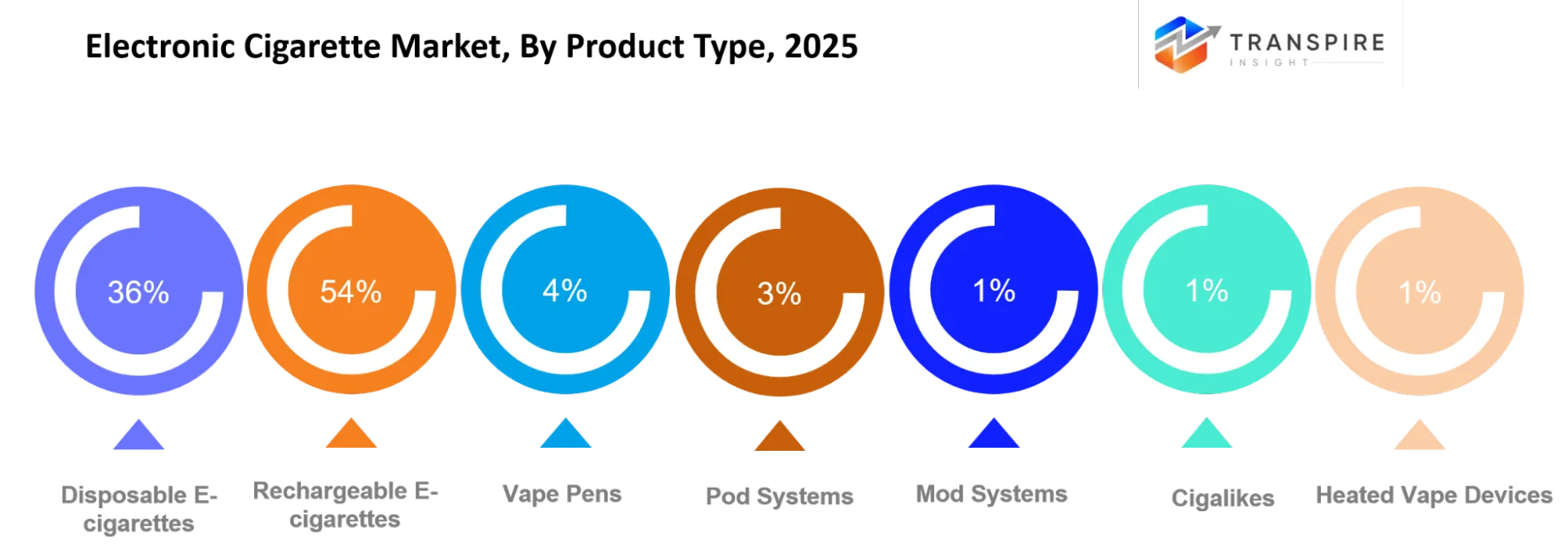
- Rechargeable electronic cigarettes account for 54% of the total market share, driven by consumers who favour rechargeability and better battery capabilities.
- The market for disposable e-cigarettes holds to 36%, and their convenience and ready-to-use feature will drive a forecasted CAGR of 12.1%.
- Vape pens make up 4% of the market as consumers favour portable and familiar formats of vaping.
- Pod systems amount to 3%, which is facilitated by the compact size of the devices and cartridge-based system.
- Mod systems make up 1%, as these devices cater to users who require more control over their vaping experience.
- The market for cigalikes is at 1%, but they have smaller market shares as new portable formats get more product attention.
What are the Key Drivers, Restraints, and Opportunities in the Electronic Cigarette Market?
Drivers
The key drivers of growth have been product innovation, as companies have gone beyond providing simple vaping equipment and started developing rechargeable units, enhanced controls, more efficient heating mechanisms, and pod-style products. The advent of connected devices has affected consumer interactions with products, but higher efficiency and simpler recharging procedures have made reusable products more viable. Product innovation can lead to repeat purchases since customers may need to update their devices, pods, batteries, or other components of the product range.
Restraints
Regulation continues to be one of the main limitations, as the e-cigarette products have to comply with various regulations related to nicotine content, flavours, marketing, product approval, packaging, and sales. Such a regulatory environment is fragmented and thus results in increased costs and can even lead to delays in product launch
Opportunities
The technology of connected and compliance-oriented vaping offers opportunities for future growth. Access control via Bluetooth, monitoring of the devices, tracking of consumption, and automated production processes can enable the manufacturers to gain an edge in product differentiation as well as increase the efficiency of their operations.
What Has the Impact of Artificial Intelligence Been on the Electronic Cigarette Market?
Artificial intelligence is starting to have an effect on the electronic cigarettes sector via product monitoring, production process automation, compliance solutions, and analysis of data collected from devices. Manufacturers can take advantage of artificial intelligence and machine learning in identifying inconsistencies in production, improving their quality control process, as well as analysing data. In developing smart-device technologies, artificial intelligence may assist in building systems for interpreting usage data and providing insights to manufacturers about the performance of their products. According to IKE Tech, agentic AI capabilities were to be incorporated in a Bluetooth-based access and onboarding system for age-restricted vape hardware. Artificial intelligence technologies are employed by researchers in recognising new e-cigarette designs based on online product pictures in order to monitor rapid changes in product features. Yet, implementation of artificial intelligence in the industry is hindered by integration costs, quality of data, incompatibility of devices and regulatory restrictions.
Instance
In April 2026, the U.S. FDA worked with IKE Tech LLC regarding its AI-based compliance system for ENDS, which was built based on the technology of age verification that could prevent underage activation of electronic cigarettes. It is noteworthy to mention that AI is becoming increasingly used in compliance and access control systems.
Key Market Trends:
The trend of the market is shifting towards having more rechargeable and advanced devices as opposed to having products in traditional cigarette form only.
- Rechargeable devices are becoming significant due to manufacturers incorporating better batteries and increased rates of charging in their range of rechargeable products.
- Disposables have become significantly advanced, with manufacturers enhancing capacity, flavour delivery, and reducing size.
- Pod-based devices are becoming popular by manufacturers as they incorporate portability alongside replaceable/refillable cartridges.
- Devices with digital screens have become common amongst new devices that allow users to see battery level, liquid volume, and other device information.
- Bluetooth compatibility has become an aspect of premium devices for app integration, controls, and personalisation options.
- Development of flavours continues to be a key product strategy, with manufacturers developing fruit, mint, menthol, tobacco, and other flavours.
Electronic Cigarette Market Segmentation
By y product type
rechargeable e-cigarettes dominate the market at 54%, followed by disposable e-cigarettes at 36%, vape pens at 4%, pod systems at 3%, mod systems at 1%, cigalikes at 1%, heated vape devices at 0.5%, and other types of vaping products at 0.5%. Rechargeable e-cigarettes have retained their dominant market share because the device can be reused, and the power supply within the device can be changed or recharged, which makes it appropriate for regular use. Disposable e-cigarettes have become the fastest-growing product type with a forecasted CAGR of 12.1%, owing to their ease of use, small size, and ready-to-use nature.
By battery used
there are built-in, replaceable, rechargeable, disposable, lithium-ion, lithium-polymer and other battery types available in the market. Built-in and rechargeable battery types remain relevant for reusable products. The battery used is important in helping achieve small designs as well as effective performance of the power used. Battery life, battery charging speed, safety and product size are expected to feature prominently in future product innovation.
By flavor
there are flavors such as tobacco, menthol, fruit, candy and sweet, beverage, mint, unflavored and others available in the market. The use of tobacco and menthol flavor remains common while the use of fruit, sweet, beverage and mint flavors helps differentiate product offerings. Flavor variety continues to play a role in consumer product choice despite restrictions on flavoured e-cigarettes in some countries.
By distribution
e-cigarettes are sold via online outlets, vape shops, convenience stores, supermarkets, speciality shops, tobacco shops, direct selling, and others. Both vape shops and tobacco shops provide an extensive range of devices and accessories, while both convenience stores and supermarkets provide better accessibility. Online distribution is possible with a wide selection of products depending upon regulatory policies regarding sales, marketing, and purchase from online outlets.
By device type
there are open system, closed system, pod system, tank system, cartridge system, refillable, single-use, and others. The open and refillable systems are more flexible, while closed and single-use systems are convenient and easier to use. Pods have gained popularity due to their small size and convenience in handling. Device manufacturers will be concentrating on portability, no leaks, battery life, and ease of use.
By consumer type
The market includes adults, smokers, ex-smokers, dual, occasional, regular, premium, budget consumers, among others. The demand from adult smokers and regular users is significant, but that of ex-smokers and dual consumers is more for complementary products. Convenience is the preference of occasional consumers, while premium and budget consumers differ in preferences. Future demand will depend on the mode of consumption, cost, and device preferences.
By nicotine content
market includes high, medium, low, no nicotine, salt nicotine, and freebase nicotine, no nicotine, among others. The concentration of nicotine is still an essential criterion when choosing products. Salt nicotine products are found in smaller pod devices, while freebase nicotine products can be found in a number of devices. Low- and zero-nicotine products are other options for consumers.
What are the Key Use Cases Driving the Electronic Cigarette Market?
The use case of rechargeable e-cigarettes is very important due to the fact that these devices are used repeatedly together with removable or rechargeable parts, which fits the need for convenient usage during the day. Disposable products are promoted for portability and easy use, while pod systems are promoted as small and compact devices needed by customers who want cartridges. Vape pens and mod systems are developed to satisfy people who prefer the use of devices with various sizes and settings. Connected devices refer to the latest use case and include the following functions: battery life management, display, Bluetooth connection, device locking, and application control.
|
Report Metrics |
Details |
|
Market size value in 2025 |
USD 28.58 Billion |
|
Market size value in 2026 |
USD 31.27 Billion |
|
Revenue forecast in 2033 |
USD 58.73 Billion |
|
Growth rate |
CAGR of 9.42% from 2026 to 2033 |
|
Base year |
2025 |
|
Historical data |
2021 - 2024 |
|
Forecast period |
2026 - 2033 |
|
Report coverage |
Revenue forecast, competitive landscape, growth factors, and trends |
|
Regional scope |
United States; Canada; Mexico; United Kingdom; Germany; France; Italy; Spain; Denmark; Sweden; Norway; China; Japan; India; Australia; South Korea; Thailand; Brazil; Argentina; South Africa; Saudi Arabia; United Arab Emirates |
|
Key company profiled |
British American Tobacco, Philip Morris International, Altria, Imperial Brands, Japan Tobacco, RELX International, Juul Labs, NJOY, Logic Technology, Vuse, Elf Bar, Geek Bar, Vaporesso, SMOK, Innokin |
|
Customization scope |
Free report customization (country, regional & segment scope). Avail customized purchase options to meet your exact research needs. |
|
Report Segmentation |
By Product Type (Disposable E-cigarettes, Rechargeable E-cigarettes, Vape Pens, Pod Systems, Mod Systems, Cigalikes, Heated Vape Devices, Others); By Battery Type (Built-in, Replaceable, Rechargeable, Disposable Battery, Lithium-ion, Lithium-polymer, Others); By Flavor (Tobacco, Menthol, Fruit, Candy & Sweet, Beverage, Mint, Unflavored, Others); By Distribution (Online, Vape Shops, Convenience Stores, Supermarkets, Specialty Stores, Tobacco Shops, Direct Sales, Others); By Device Type (Open System, Closed System, Pod-based, Tank-based, Cartridge-based, Refillable, Single-use, Others); By Consumer Type (Adult Smokers, Former Smokers, Dual Users, Occasional Users, Regular Users, Premium Users, Budget Users, Others); By Nicotine Level (High, Medium, Low, Zero Nicotine, Salt Nicotine, Freebase Nicotine, Nicotine-free, Others) |
Which Regions are Driving the Electronic Cigarette Market Growth?
North America
North America dominates the regional market share with 35% owing to a well-established vaping environment, a well-developed retail network and high involvement of tobacco and nicotine products firms. In addition, the region has seen fast-paced development in terms of product authorisation and enforcement regulations. Such developments are pushing companies to invest in authorized products and compliance-based technology. Development of rechargeable and connected devices is facilitating firms in meeting changes in the market.
In August 2026, the U.S. FDA approved three JUUL2 electronic cigarette products from JUUL Labs Inc., which include the JUUL2 device and tobacco and menthol-flavoured pods.
Europe
The European market accounts for 29% of the worldwide market and has a well-developed vaping industry with well-established specialist retailers, tobacco companies and brand products. Unlike North America, the European market is significantly influenced by the regulatory requirements and preferences of individual countries. Companies are still investing in rechargeable pod systems, disposable products and different flavour products.
In June 2025, the Government of UK introduced a nationwide ban on the sale and distribution of single-use vapes, which will require manufacturers and retailers to change their product portfolio in favour of reusable devices.
https://www.gov.uk/guidance/single-use-vapes-ban
Asia Pacific
Asia Pacific represents 25% of the market and is the most rapidly expanding market in the region at a 10.9% CAGR. Growing manufacturing capacity, technological advances, urban consumer demand, and increasing availability of electronic nicotine delivery systems are some of the factors driving growth in this market. Asia Pacific is a key source of production of vaping equipment and parts, making the region increasingly important in the supply chain for the industry.
In April 2025, Innokin has been developing its Platform Series, Z Coil, and PZP Coil series of products, indicating that the Asia-based electronic cigarette manufacturer has been engaging in product development.
https://www.innokin.com/news/a-new-chapter

Who are the Key Players in the Electronic Cigarette Market and how do they compete?
The competition in the worldwide e-cigarette industry is increasingly concentrated around innovative products, unique branding, regulatory compliance, distribution networks, and customer experiences. Apart from the hardware itself, companies are investing in rechargeable devices, connected gadgets, improved heating, and unique flavour combinations. Products also help companies target different customer bases and price ranges. British American Tobacco competes in the e-cigarette market through technology-based product development as part of the Vuse brand. With the introduction of the Vuse Ultra in March 2025, the company introduced Bluetooth connectivity, a ClearView display, flavour recognition, intensity adjustment, device locking, and rechargeability. In addition, BAT expanded this product into other markets, relying on its premium offering to distinguish its vaping products.
Electronic Cigarette Market companies
- British American Tobacco,
- Philip Morris International
- Altria
- Imperial Brands
- Japan Tobacco
- RELX International
- Juul Labs
- NJOY
- Logic Technology
- Vuse
- Elf Bar
- Geek Bar
- Vaporesso
- SMOK
- Innokin
Recent Development News
In June 2025, Imperial Brands revealed information regarding its behavioural study findings with blu products, where adult participants modified their use of cigarettes and vaping products during the process of the study. The findings would be used to support their product research.
In February 2026, BAT reported encouraging early results from its premium innovation initiatives, which include Vuse Ultra and is scheduled to do more targeted roll-outs in 2026. The update suggests ongoing commitment to premium vaping products and international expansion.
What Strategic Insights Define the Future of the Electronic Cigarette Market?
The electronic cigarette market is evolving towards a product mix that is based on technology, where recharging, connectivity, pod systems and regulations become much more important. The competition among the products will no longer be about availability, but about batteries, ease of use, flavour uniformity, device intelligence and regulatory alignment. One of the risks associated with this situation will be regulatory divergence, where there will be products that are authorised and illicit ones, which may impact the manufacturers, distributors and consumers in different ways. On the other hand, there is a possibility for companies that offer connectivity with convenience, access and device control. The manufacturers may have a competitive advantage in the following aspects: focus on regulated markets, development of recharging and connectivity technologies and consumer research. The most advantageous strategy in such an environment will be the creation of products that are practical and technological.
By Product Type
- Disposable E-cigarettes
- Rechargeable E-cigarettes
- Vape Pens
- Pod Systems
- Mod Systems
- Cigalikes
- Heated Vape Devices
- Others
By Battery Type
- Built-in
- Replaceable
- Rechargeable
- Disposable Battery
- Lithium-ion
- Lithium-polymer
- Others
By Flavor
- Tobacco
- Menthol
- Fruit
- Candy & Sweet
- Beverage
- Mint
- Unflavored
- Others
By Distribution
- Online
- Vape Shops
- Convenience Stores
- Supermarkets
- Specialty Stores
- Tobacco Shops
- Direct Sales
- Others
By Device Type
- Open System
- Closed System
- Pod-based
- Tank-based
- Cartridge-based
- Refillable
- Single-use
- Others
By Consumer Type
- Adult Smokers
- Former Smokers
- Dual Users
- Occasional Users
- Regular Users
- Premium Users
- Budget Users
- Others
By Nicotine Level
- High
- Medium
- Low
- Zero Nicotine
- Salt Nicotine
- Freebase Nicotine
- Nicotine-free
- Others
Frequently Asked Questions
Find quick answers to common questions.
The electronic cigarette market size was valued at USD 28.58 billion in 2025 and is poised to reach USD 58.73 billion by 2033, expanding at a 9.42%CAGR.
Key segments for the electronic cigarette market are By Product Type (Disposable E-cigarettes, Rechargeable E-cigarettes, Vape Pens, Pod Systems, Mod Systems, Cigalikes, Heated Vape Devices, Others); By Battery Type (Built-in, Replaceable, Rechargeable, Disposable Battery, Lithium-ion, Lithium-polymer, Others); By Flavor (Tobacco, Menthol, Fruit, Candy & Sweet, Beverage, Mint, Unflavored, Others); By Distribution (Online, Vape Shops, Convenience Stores, Supermarkets, Specialty Stores, Tobacco Shops, Direct Sales, Others); By Device Type (Open System, Closed System, Pod-based, Tank-based, Cartridge-based, Refillable, Single-use, Others); By Consumer Type (Adult Smokers, Former Smokers, Dual Users, Occasional Users, Regular Users, Premium Users, Budget Users, Others); By Nicotine Level (High, Medium, Low, Zero Nicotine, Salt Nicotine, Freebase Nicotine, Nicotine-free, Others)
Growth is primarily driven by increased demand from consumers for alternatives to smoking, more innovation in products, availability of many different flavors and forms of devices, increased online retailing opportunities, and more widespread use of rechargeable vaping devices.
The market is led by major manufacturers including British American Tobacco, Philip Morris International, Altria, Imperial Brands, Japan Tobacco, RELX International, Juul Labs, NJOY, Logic Technology, Vuse, Elf Bar, Geek Bar, Vaporesso, SMOK, and Innokin
The North American market constitutes 35% of the total market for e-cigarettes due to high consumer demand, product innovation, recognised vape brands, and availability through various distribution networks. There are other factors that affect the role of the North American market in market dynamics.
Opportunities within the market for electronic cigarettes include innovations with the product itself, creation of new flavors and designs, expansion in terms of online sales networks, and increased demand for portable and rechargeable electronic cigarettes. Opportunities are also to be found in emerging markets with increased consumer awareness.
- British American Tobacco,
- Philip Morris International
- Altria
- Imperial Brands
- Japan Tobacco
- RELX International
- Juul Labs
- NJOY
- Logic Technology
- Vuse
- Elf Bar
- Geek Bar
- Vaporesso
- SMOK
- Innokin
About the Authors

Chetan Dhatrak
I’m Chetan Dhatrak, a Senior Research Analyst at Transpire Insight, specializing in the Consumer Goods, Foods and Beverages industry. I focus on analyzing market trends, consumer behavior, competitive landscapes, and industry developments to deliver accurate, data-driven insights. My research at Transpire Insight is built on credible sources and in-depth analysis, helping businesses and readers better understand market dynamics, emerging opportunities, and evolving consumer preferences. I’m committed to creating reliable, well-researched content that supports informed decision-making and reflects the latest developments in the consumer goods and food & beverage sectors.

Chakradhar Khansole
Chakradhar serves as the Research Director at Transpire Insight, bringing over 8 years of experience in technology, innovation, and strategic market intelligence. He specializes in transforming complex market data into actionable business insights that enable organizations to make informed, growth-oriented decisions. Recognized for his strategic vision and analytical expertise, Chakradhar leads high-impact research initiatives, delivering comprehensive market assessments, competitive intelligence, and forward-looking industry analysis.
Recently Published Reports
-
Apr 2026
Bottled Water Market
Bottled Water Market Size, Share & Analysis Report By Product Type (Still Bottled Water, Carbonated Bottled Water, Functional Bottled Water, and Others), By Packaging (PET, Cans, and Others), By Sales Channel (Supermarkets/Hypermarkets, Convenience Stores/Drug Stores, Grocery Stores/Club Stores, Foodservice, and Others) and Geography (North America, Europe, Asia-Pacific, Middle East and Africa, South and Central America), 2021 - 2032
-
Apr 2026
Color Cosmetic Packaging Market
Color Cosmetic Packaging Market Size, Share & Analysis Report By Application (Mascara Packaging, Liquid Packaging, and Liquid Face), By Type (Tubes & Bottles, Pens & Markers, Compacts & Containers, and Droppers & Pumps), and Geography (North America, Europe, Asia-Pacific, Middle East and Africa, South and Central America), 2021 - 2031
-
Apr 2026
External Microphone For Camera Market
External Microphone For Camera Market Size, Share & Analysis Report By Type (Shotgun Microphone, Lavalier Microphone, and Others), By Application (Digital Camera, Professional Video Camera, and Others), and Geography (North America, Europe, Asia-Pacific, Middle East and Africa, South and Central America), 2021 - 2031
-
Apr 2026
Foot Orthotic Insoles Market
Foot Orthotic Insoles Market Size, Share & Analysis Report By Type (Pre-fabricated, and Custom-made), By Material (Thermoplastic, Composite Carbon Fiber, and Others), By Distribution Channel (Drug Stores, Hospitals & Clinics, and Others), and Geography (North America, Europe, Asia-Pacific, Middle East and Africa, South and Central America), 2021 - 2031