Electric Traction Motor Market Summary:
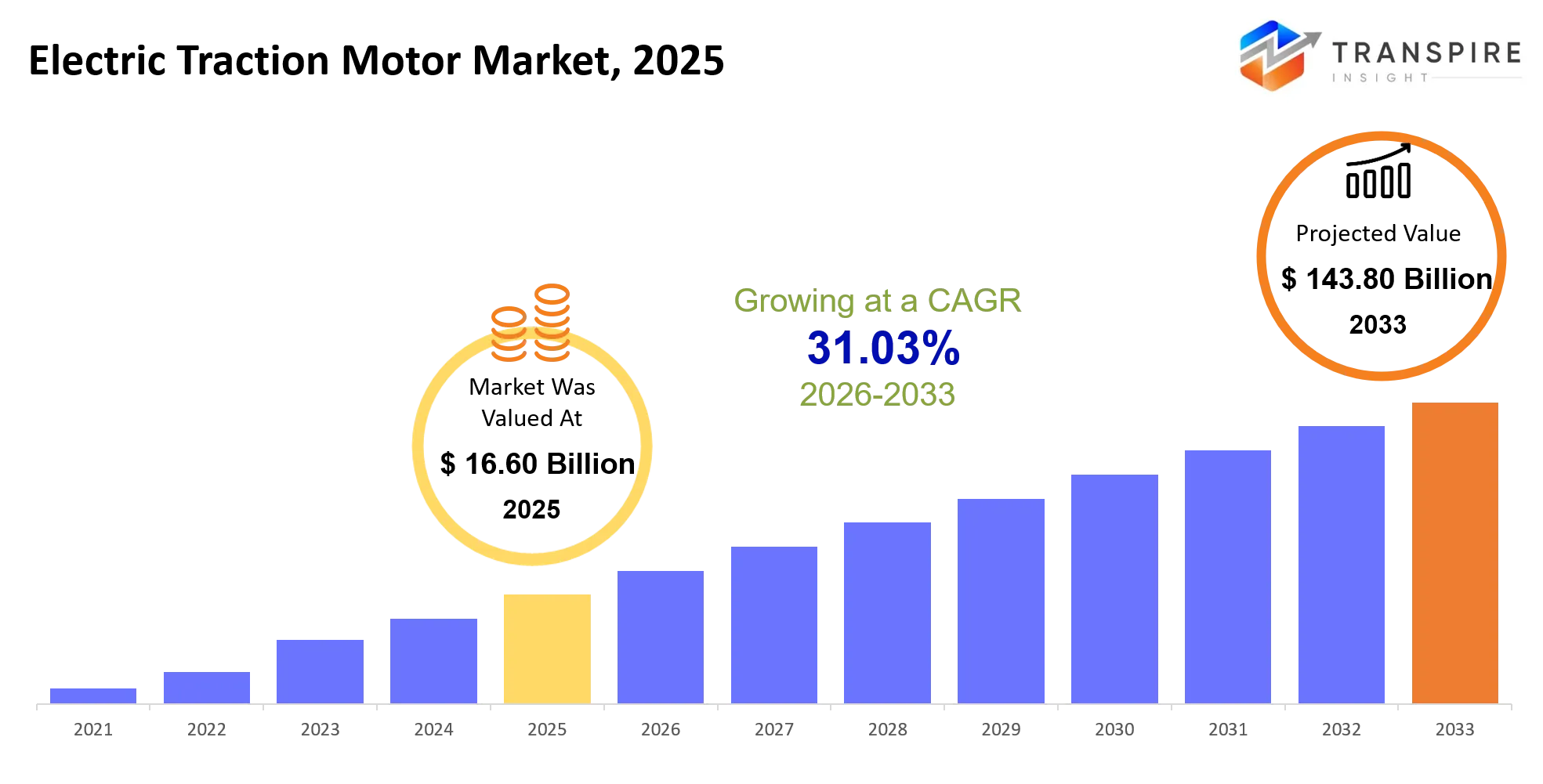
As per the Transpire Insight Analysis, The Electric Traction Motor Market size is estimated at USD 16.60 billion in 2025 and is anticipated to reach USD 143.80 billion by 2033, growing at a CAGR of 31.03% from 2026 to 2033.
The electric traction motor market enables electric vehicles and rail vehicles to operate by transforming electrical energy into mechanical energy. Manufacturers have moved from traditional open motor designs to high-efficiency, small, and more integrated motors that incorporate power electronics, digital control devices, and battery platforms over the past three to five years. The adoption of battery- electric vehicles, railway electrification, and public transport systems has driven the penetration of high-torque, low-energy-loss motors. A major structural change in the market is the integration of an electric drive system with the electric motor and inverter/transmission to improve packaging and drivetrain efficiency. Market growth is driven by real-world investments in charging infrastructure and production of electric vehicles, encouraging OEMs to expand the electrified vehicle portfolio, thus creating a new level of demand for traction motors. At the same time, drive-efficiency standards, resource constraints, and emissions-related initiatives are compelling operators to replace internal combustion engine propulsion with electric propulsion.
Electric Traction Motor Market Size & Forecast:
- Market Size 2025: USD 16.60 Billion
- Expected Market Value (2033): USD 143.80 Billion
- Forecast CAGR (2026–2033): 31.03%
- Leading Region in 2025: Asia Pacific
- Fastest Growing Region: Latin America
- Key Company Profiles: Nidec, Siemens, ABB, Alstom, Wabtec, CRRC Corporation, Hitachi Rail, Toshiba, Mitsubishi Electric, Voith, TECO Electric, Dana, BorgWarner, GE Vernova, Parker Hannifin.
Key Electric Traction Motor Market Insights:
The market is moving toward integrated, software-controlled propulsion, and efficiency, material durability, and life costs are becoming increasingly important in the buying decision. The success of the company will rely on the ability to match motor architecture to vehicle duty cycles, and to build local manufacturing and digital maintenance capabilities.
- AC motors are the leader with a 42.0% share, while Nidec is expanding its e-axle platform to 800-volt for high-end EV programs.
- Permanent-magnet motors account for 16.5% of the market, and BorgWarner's PMSM motors are designed to be compact, enabling high power density and lightweight integration into EVs.
- Above 400kW motors are growing at a 9.6% CAGR, and CRRC's new motors for high-speed trains feature advanced cooling technology for higher power density.
- The DC motors keep 18.0% of the energy; Toshiba's energy-efficient AC locomotive motors are geared to lower maintenance in heavy-rail fleets.
- Induction motors account for 10.0%, and Siemens is investing in retrofit-ready integrated drives for metro and high-speed trains.
- Switched-reluctance motors make up 5.0%, and Nidec's investment demonstrates a rising interest in rare-earth-free propulsion.
- Brushless DC motors account for 3.0%, while ABB stresses configurable traction platforms for heavy-duty applications.
- Battery-electric propulsion is the preferred option; Alstom is developing rare-earth-free motors for heavy-rail use.
- The focus of fleet operators is increasingly shifting to predictive maintenance, and AI-powered sensor integration is helping to lengthen service cycles and minimize downtime.
What are the Key Drivers, Restraints, and Opportunities in the Electric Traction Motor Market?
Driver:
Vehicle electrification and railway modernisation are creating demand for traction motors with higher torque density, improved efficiency and lower maintenance requirements. The rollout of electric buses, commercial vehicles and battery-powered passenger cars has encouraged manufacturers to scale motor production and integrate motors with inverters and transmission systems. In India, the government’s phased manufacturing requirements for electric trucks, including traction motor assembly and controller manufacturing from September 2026, are strengthening incentives for domestic component production. This can increase local supplier participation and create revenue opportunities across motor manufacturing and drivetrain integration.
Restraint:
High-performance motors face cost pressures from copper, electrical steel, permanent magnets, and precision manufacturing. Rare-earth supply concentration adds procurement risk for permanent-magnet designs, while high-power motors require advanced cooling, insulation and rigorous testing. These requirements increase development expenditure and can delay qualification, particularly for smaller manufacturers and new vehicle platforms.
Opportunity:
Rare-earth-free motor architectures, localised production and integrated electric drivetrains offer meaningful growth opportunities. In May 2026, L&T Electronic Products & Systems partnered with EVR Motors to develop and manufacture traction motors for Indian vehicles, emphasising compact designs and reduced reliance on rare-earth materials. Such collaborations can improve supply-chain resilience, accelerate product commercialisation, and support adoption across two-wheelers, commercial vehicles and larger electric platforms.
Driver Impact Analysis – Electric Traction Motor Market
|
Driver |
Relative Impact on Growth (%) |
Geographic Relevance |
Impact Timeline |
Demand Strength |
Growth Mechanism |
Key Beneficiaries |
Major Constraint |
|
Railway electrification and expansion of metro, high-speed, and freight networks |
28% |
Asia Pacific, Europe, India |
Medium-term (2–4 years) |
High |
Electrified routes require traction motors for new locomotives and trainsets. |
Railway OEMs, traction motor manufacturers, infrastructure suppliers |
High project costs and delayed infrastructure commissioning. |
|
Accelerating electric vehicle and commercial fleet adoption |
25% |
China, Europe, North America, India |
Short-term (≤2 years) |
High |
EV production growth increases demand for automotive propulsion motors. |
Automotive OEMs, motor suppliers, e-axle manufacturers |
Battery costs and inconsistent policy incentives constrain adoption. |
|
Stricter emissions regulations and transportation decarbonization |
18% |
Europe, China, India, North America |
Medium-term (2–4 years) |
High |
Emissions targets accelerate replacement of diesel and combustion-powered vehicles. |
Low-emission transport OEMs, motor manufacturers, public transport operators |
Regulatory uncertainty and limited low-carbon electricity availability. |
|
Rolling-stock modernisation and replacement of aging propulsion systems |
16% |
Europe, Asia Pacific, North America |
Medium-term (2–4 years) |
High |
Fleet upgrades drive orders for efficient motors and replacement units. |
Railway operators, traction system integrators, component suppliers |
Long procurement cycles and capital budget constraints. |
|
High-efficiency motor designs, advanced power electronics and predictive maintenance |
13% |
Europe, China, Japan, South Korea, North America |
Long-term (≥4 years) |
Medium |
SiC inverters, optimised motor designs and diagnostics improve efficiency and reliability. |
Motor manufacturers, semiconductor vendors, maintenance service providers |
Advanced component costs and demanding qualification requirements. |
|
Total |
100% |
— |
— |
— |
— |
— |
— |
What Has the Impact of Artificial Intelligence Been on the Electric Traction Motor Market?
AI is shifting electric traction motors from static electromechanical devices to networked, adaptive drives. In manufacturing, machine vision and automation control systems are detecting early deviations in winding, magnet assembly, and other processes to reduce scrap and drive greater consistency in zero-tolerance motor production. AI-enabled motor controllers during use optimise torque, regenerative braking and heat load management based on route, payload, driving mode and other characteristics.
In rail and commercial fleets, the use of sensor data related to temperature, vibration, current and insulation condition can enable operators to predict bearing and winding failures or cooling system anomalies before breakdowns cause costly downtime. AI prediction helps to maximise fleet availability, extend maintenance cycles and lower overall life cycle costs for metro, locomotive and bus operators. The only challenge to the widespread adoption of AI capabilities relates to the added costs of integration. Wrapping legacy fleets with sensors and controllers, secure communications, and platforms can be pricey, and the variability of traffic conditions and driver behaviours can impact model accuracy and slow its application.
In May 2026, L&T Electronic Products & Systems (LTEPS) entered into a strategic partnership with EVR Motors to jointly develop, manufacture, and deploy next-generation EV traction motors. This collaboration delivers advanced, high-efficiency traction motor solutions optimised for demanding operating conditions with a compact design and reduced reliance on rare-earth materials.
Key Electric Traction Motor Market Trends:
The market is shifting from motor supply to integrated, software-defined propulsion systems, and efficiency, material security, and lifecycle performance are now fundamental purchasing criteria.
- OEMs are moving away from the individual motor and towards integrated e-axles, which integrate motors, inverters, and reduction gears for cost and thermal control.
- The transition from 400-volt to 800-volt systems is driving motor design to become more efficient and reduce current losses.
- The new silicon-carbide inverters are allowing lighter, higher-frequency motors, some of which are below 70 kg.
- Permanent-magnet synchronous motors are becoming more popular because of their high torque density and power-to-weight ratio.
- The rare-earth-free designs of induction, synchronous-reluctance and switched-reluctance are being targeted for investment to minimise supply-chain exposure.
- The trend is towards the use of motors with built-in condition-monitoring and predictive-maintenance systems, which are preferred by rail operators.
- As motors become smaller and smaller, they are now required to deliver more continuous power, and liquid and direct-oil cooling are becoming increasingly necessary.
- Localisation requirements in India and Europe are driving motor and magnet production to vehicle and rail assembly locations. Motor and magnet production is being driven toward vehicle and rail assembly locations by localisation requirements in India and Europe.
- Procurement is evolving to be project-specific, with buyers looking for interoperability, serviceability, and long-term maintenance plans.
Electric Traction Motor Market Segmentation
Motor Type:
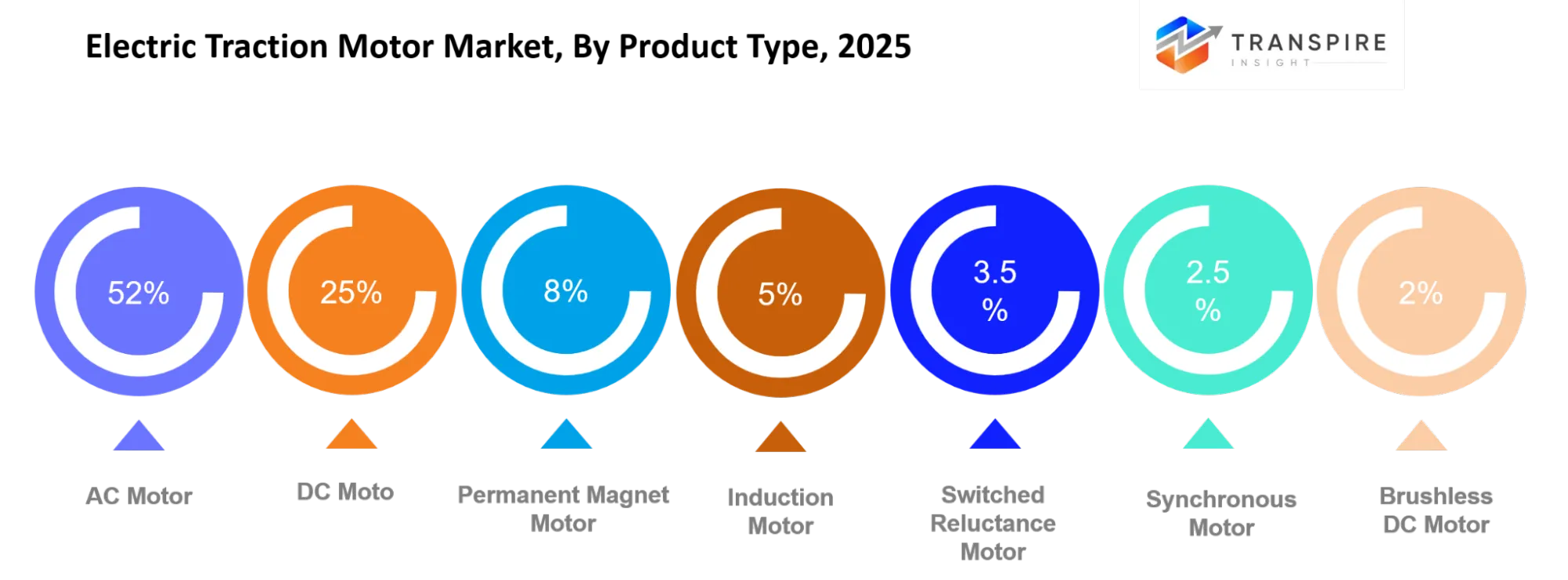
AC motors have 42.0% of the market share based on their higher efficiency, control capabilities, and applications in current EV and rail drivetrain markets. DC motors have an 18.0% market share as old rail infrastructure and procurement channels still promote these motors. Permanent-magnet motors hold a 16.5% market share and are growing in high-torque EVs and advanced rail platforms. Induction motors contribute 10.0% as they are more robust and less dependent on rare-earth materials. Switched-reluctance motors account for 5.0% because these motors, which do not require rare-earth materials, are emerging as a cheaper alternative. Synchronous motors comprise 4.0%, brushless DC motors 3.0%, and other types 1.5%. The fastest-growing type of motor is over 400-kW power-rated motors, which grow at a 9.6% CAGR as they are used in heavy-duty EVs, locomotives and high-speed rail systems.
Power Rating:
Below-200 kW motors serve passenger cars, light commercial vehicles, and smaller transit applications, where compactness and energy efficiency are priorities. The 200–400 kW range supports heavier vehicles and demanding transport operations. Above-400 kW motors are projected to grow at a 9.6% CAGR, driven by opportunities in locomotives, heavy commercial vehicles and specialised rail platforms. The 50–100 kW and 100–200 kW categories meet lower and mid-range requirements, while 400–600 kW and above-600 kW systems address intensive, high-torque applications.
Application:
Railways require traction motors capable of repeated acceleration, regenerative braking, and prolonged operation under demanding conditions. Electric vehicles expand opportunities through new battery platforms and integrated drivetrains. Metro systems and trams need dependable motors for frequent stops and rapid acceleration. Industrial vehicles require sustained torque for material handling and heavy-duty operations. Electric buses and locomotives create additional demand based on payload, route conditions, and utilisation. Future adoption will depend on electrification investment, reliability and lifecycle operating economics.
Vehicle Type:
Passenger cars favour compact, efficient propulsion systems that fit increasingly standardised vehicle platforms. Commercial vehicles require durable motors capable of delivering sustained torque under heavy loads. Electric buses support urban transport electrification, while locomotives and high-speed trains require robust traction systems for demanding operating cycles. Metro trains prioritise acceleration, braking efficiency and reliability across frequent services. Light rail benefits from compact motor designs suited to urban networks. Fleet replacement, improved energy efficiency and railway modernisation will shape future requirements across these vehicle categories.
Propulsion System:
Battery-electric platforms require efficient motors integrated with inverters and battery-management systems to optimise energy consumption. Hybrid-electric vehicles combine electric traction with another power source, balancing performance and operating range. Fuel-cell electric vehicles use motors powered by electricity generated through hydrogen-based systems. Overhead-electric and third-rail propulsion remain essential for electrified rail networks. Dual-mode systems allow locomotives to operate across electrified and non-electrified routes. Regenerative braking captures kinetic energy during deceleration, improving efficiency and reducing energy consumption across transport applications.
End User:
Automotive OEMs influence motor demand through platform design, supplier selection and production volumes. Rail operators and railway OEMs prioritise durability, maintenance access and long service life to minimise operational disruption. Transit authorities shape procurement through fleet renewal, efficiency targets and public transport modernisation. Fleet operators evaluate energy savings, vehicle availability and maintenance expenditure when selecting electric propulsion. Industrial manufacturers prioritise dependable performance under demanding workloads. Government agencies influence adoption through electrification policies, infrastructure funding, localisation requirements and public procurement programmes, supporting long-term market development.
What are the Key Use Cases Driving the Electric Traction Motor Market?
The core use case is electric propulsion in passenger vehicles and railways, where AC motors provide 42.0% of market share. Their ability to deliver controlled torque and support regenerative braking makes them suitable for battery-electric cars, metro trains and other high-utilisation transport systems. Adoption is reinforced by operating-efficiency goals and electrification policies.
Expanding applications include electric buses, commercial vehicles, trams and industrial vehicles. Fleet operators use traction motors to reduce fuel expenditure and routine drivetrain maintenance, particularly on predictable urban routes and intensive operating schedules.
Emerging use cases include high-power electric trucks, dual-mode locomotives and advanced drivetrains using rare-earth-free motors. Above-400 kW motors, projected to grow at a 9.6% CAGR, could benefit from heavy-duty electrification and specialised transport requirements.
|
Report Metrics |
Details |
|
Market size value in 2025 |
USD 16.60 Billion |
|
Market size value in 2026 |
USD 21.68 Billion |
|
Revenue forecast in 2033 |
USD 143.80 Billion |
|
Growth rate |
CAGR of 31.03% from 2026 to 2033 |
|
Base year |
2025 |
|
Historical data |
2021 - 2024 |
|
Forecast period |
2026 - 2033 |
|
Report coverage |
Revenue forecast, competitive landscape, growth factors, and trends |
|
Regional scope |
United States; Canada; Mexico; United Kingdom; Germany; France; Italy; Spain; Denmark; Sweden; Norway; China; Japan; India; Australia; South Korea; Thailand; Brazil; Argentina; South Africa; Saudi Arabia; United Arab Emirates |
|
Key companies profiled |
Nidec, Siemens, ABB, Alstom, Wabtec, CRRC Corporation, Hitachi Rail, Toshiba, Mitsubishi Electric, Voith, TECO Electric, Dana, BorgWarner, GE Vernova, Parker Hannifin. |
|
Customization scope |
Free report customization (country, regional & segment scope). Available customized purchase options to meet your exact research needs. |
|
Report Segmentation |
Motor Type (AC Motor, DC Motor, Permanent Magnet Motor, Induction Motor, Switched Reluctance Motor, Synchronous Motor, Brushless DC Motor, Others)Power Rating (Below 200 kW, 200–400 kW, Above 400 kW, 50–100 kW, 100–200 kW, 400–600 kW, Above 600 kW, Others)Application (Railways, Electric Vehicles, Metro Systems, Trams, Industrial Vehicles, Electric Buses, Locomotives, Others)Vehicle Type (Passenger Cars, Commercial Vehicles, Electric Buses, Locomotives, Metro Trains, High-Speed Trains, Light Rail, Others)Propulsion System (Battery Electric, Hybrid Electric, Fuel Cell Electric, Overhead Electric, Third-Rail Electric, Dual-Mode, Regenerative, Others)End User (Automotive OEMs, Rail Operators, Transit Authorities, Industrial Manufacturers, Fleet Operators, Government Agencies, Railway OEMs, Others). |
Which Regions are Driving the Electric Traction Motor Market Growth?
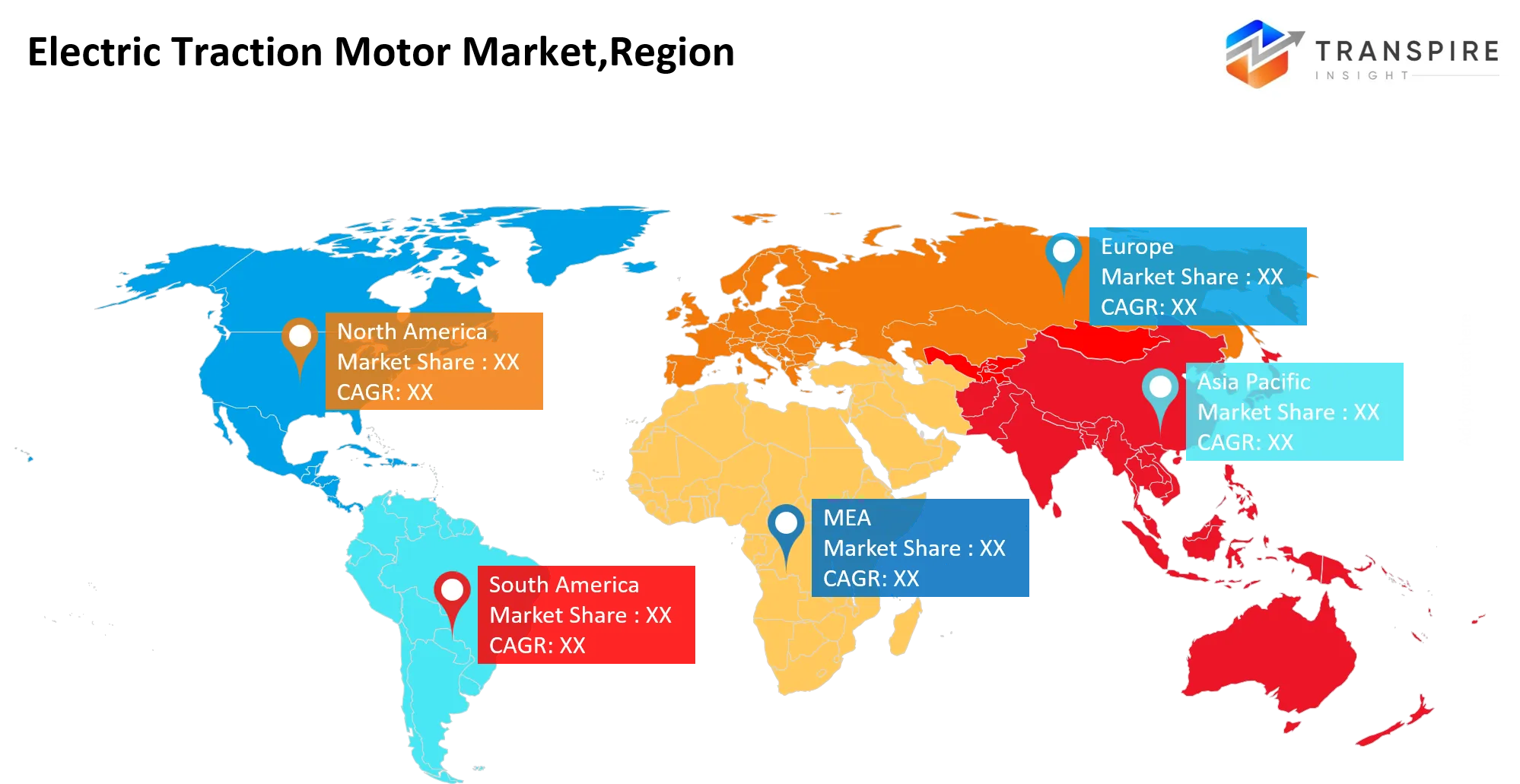
Asia Pacific remains the leader with a 49.5% share in the market thanks to China's high-speed rail expansion, India's metro and rail electrification programs, and the region's strong presence in electric vehicle manufacturing. Building on significant local demand, suppliers like CRRC, Nidec and Hitachi are able to combine scale, localised supply chains and fast product iteration. The region's cost and capacity benefits are also bolstered by policy momentum for clean mobility and rail modernisation.
In September 2026, Hitachi Rail partnered with ÖBB to sign a massive €1.3 billion nationwide framework contract for digitalising railway interlocking signalling technology.
https://www.hitachi.com/en/press/
Europe makes up 25.0% of the market, competing on engineering quality over volume. Europe has a rail OEM base, high efficiency and safety standards, and significant demand for high-end EVs and high-speed trains. While Asia Pacific's equation is built on scale, Europe's is built on longevity; it is driven by long-term rail procurement, research and development, and a growing focus on rare-earth-free and recyclable motors.
In September 2026, Siemens showcased its new Mireo Class 4884 single-deck train at the InnoTrans exhibition in Berlin. This advanced rail platform optimises passenger transport efficiency along Austria's long-distance routes.
https://www.innotrans.de/en/press/press-release/news_37952.html
North America accounts for 17.5%, Latin America 4.5%, and the Middle East and Africa 3.5%. Latin America is the most rapidly growing emerging market, driven by urban transit growth, bus electrification and higher levels of rail and commercial vehicle supply chain domestic content (10.4% CAGR). Opportunities in recent commitments to electric buses and metro modernisation and procurement are likely to be coupled with the need for reliable, serviceable and low-cost traction systems.
In March 2026, Yutong launched its complete electrified and high-efficiency passenger portfolio in Latin America during the event in Mexico City. This product launch featured the region's premiere of the C11E electric road model alongside its long-life EV battery systems.
https://en.yutong.com/pressmedia/news/2041436893719171072.shtml
Who are the Key Players in the Electric Traction Motor Market, and how do they compete?
Competition is focused among vertically integrated rail OEMs, automotive e-axle suppliers, permanent magnet Motorand industrial electrification companies. Suppliers are competing on system efficiency and local manufacturing and lifecycle services, pushing motor pricing in volume to the back seat.
Nidec positions itself as an innovation leader on large-volume e-axle systems, 800-volt motor capability, at the passenger EV scale and small form factor with superior electric motor integration. CRRC is both vertically integrated and a cost leader with in-house motor design, large volumes, and aftermarket centres for the China rail network and export sales. Alstom and Siemens build on specifically tailored rail engineering, retrofit opportunities, and bespoke propulsion packages for metros and high-speed trains. ABB and Toshiba leverage scalable, energy-efficient locomotive motors and configurable platforms, and are expanding via partnerships with rail operators. Borg Warner, Dana, and Mitsubishi Electric serve automotive and commercial vehicle segments with small-package, high power density motors, while Wabtec, Hitachi Rail, GE Vernova, Voith, TECO, and Parker Hannifin define the base of the rail electrification and industrial services model.
Key Players are:
- Nidec
- Siemens
- ABB
- Alstom
- Wabtec
- CRRC Corporation
- Hitachi Rail
- Toshiba
- Mitsubishi Electric
- Voith
- TECO Electric
- Dana
- BorgWarner
- GE Vernova
- Parker Hannifin
Electric Traction Motor Market — Enhanced Competitive Benchmarking
|
Company |
Est. Revenue Share Range |
Key Offerings |
Strategic Positioning |
Geographic Strength |
Technology Focus |
|
Siemens AG |
8–14% (estimated) |
MoComp traction motors; AC motors; integrated traction drives; motor servicing |
leader in integrated rail propulsion solutions |
Europe, Asia Pacific, North America |
High-efficiency motors and integrated propulsion systems |
|
CRRC Corporation Limited |
8–14% (estimated) |
AC traction motors; DC traction motors; locomotive drives; rail transit motor systems |
Scale-driven leadership through vertically integrated manufacturing |
Asia Pacific, Europe, Latin America |
High-volume manufacturing and integrated electric drive systems |
|
ABB Ltd. |
7–12% (estimated) |
AMXM traction motors; AMXL motors; traction generators; motor lifecycle services |
Premium supplier emphasizing efficiency and lifecycle reliability |
Europe, North America, Asia Pacific |
Modular induction motors and energy-efficient traction systems |
|
Nidec Corporation |
5–10% (estimated) |
Automotive traction motors; electric drive units; EV propulsion components; motor control integration |
Automotive electrification specialist targeting scalable drive platforms |
Asia Pacific, Europe, North America |
Compact high-power-density motors and integrated EV drives |
|
Toshiba Corporation |
4–8% (estimated) |
Railway traction motors; induction motors; permanent-magnet motors; propulsion equipment |
Engineering-led supplier focused on dependable railway applications |
Asia Pacific, Europe, North America |
High-efficiency motor design and advanced propulsion engineering |
|
Mitsubishi Electric Corporation |
4–8% (estimated) |
AC traction motors; SynTRACS motor systems; gear-coupled drives; traction inverters |
Integrated railway systems supplier with differentiated motor architectures |
Asia Pacific, Europe, North America |
Synchronous reluctance motors and silicon-carbide power electronics |
|
Alstom SA |
3–7% (estimated) |
Rolling-stock traction motors; propulsion equipment; motor-drive integration; maintenance support |
Rail OEM leveraging integrated train platforms and service contracts |
Europe, Asia Pacific, Middle East & Africa |
Integrated traction architectures and energy-efficient rail propulsion |
|
Wabtec Corporation |
3–7% (estimated) |
EMD traction motors; GE-series motors; remanufactured AC/DC motors; replacement components |
Freight-rail specialist with strong aftermarket capabilities |
North America, Latin America, Asia Pacific |
Heavy-duty traction motors and remanufacturing technologies |
|
Hitachi Ltd. |
3–6% (estimated) |
Railway induction motors; permanent-magnet motors; customised traction motors; replacement parts |
Application-engineering specialist serving metro through high-speed rail |
Asia Pacific, Europe, North America |
Lightweight motor designs and maintenance-oriented cooling systems |
|
Traktionssysteme Austria GmbH (TSA) |
1–4% (estimated) |
Railway traction motors; traction generators; drive systems; customised motor solutions |
Specialised supplier focused on tailored electric traction applications |
Europe, Asia Pacific, North America |
Application-specific motor engineering and compact drive configurations |
Recent Development News
In May 2026, L&T Electronic Products & Systems partnered with EVR Motors to jointly develop, manufacture and deploy next-generation electric vehicle traction motors in India. The collaboration targets two-wheelers, three-wheelers, passenger vehicles, and commercial vehicles, with a focus on high efficiency, compact motor designs, and reduced reliance on rare-earth materials. The initiative is expected to strengthen domestic manufacturing and support the development of locally integrated electric drivetrain solutions.
In July 2026, Sona BLW Precision Forgings (Sona Comstar) and DENSO Corporation signed definitive agreements to establish two joint ventures focused on electric and hybrid powertrain systems. The proposed businesses will develop and manufacture traction motors, inverters, generators, and e-Axles for multiple vehicle categories, strengthening technology integration and manufacturing capabilities while creating opportunities to serve domestic and international electrification programmes.
What Strategic Insights Define the Future of the Electric Traction Motor Market?
The electric traction market is heading towards standard software-enabled e-axle and dedicated rail traction systems. Additional 800V architectures are gaining importance in premium and heavy-duty platforms for e-axle applications. Advanced features are aiming for increased power density, thermal management, powertrain efficiency, and system simplification. The concentrated supply chains of rare-earth mining and magnet processing and manufacturing remain a latent risk, with manufacturers exposed to price swings, long lead times, and regulatory risk. A common trend here is the possibility of cost-competitive rare-earth-free induction, switch reluctance, and synchronous-reluctance designs, particularly in European and Asian railway electrification programs. To address material risks, manufacturers should partner with OEMs to co-develop motor-inverter systems, localise critical component manufacturing and windings, and ramp up supply chain diversification. Predictive maintenance and digital monitoring of the traction system to reduce downtime and gain ongoing service revenue are an additional route to growth.
Key Segmentations are:
Motor Type
- AC Motor
- DC Motor
- Permanent Magnet Motor
- Induction Motor
- Switched Reluctance Motor
- Synchronous Motor
- Brushless DC Motor
- Others
Power Rating
- Below 200 kW
- 200–400 kW
- Above 400 kW
- 50–100 kW
- 100–200 kW
- 400–600 kW
- Above 600 kW
- Others
Application
- Railways
- Electric Vehicles
- Metro Systems
- Trams
- Industrial Vehicles
- Electric Buses
- Locomotives
- Others
Vehicle Type
- Passenger Cars
- Commercial Vehicles
- Electric Buses
- Locomotives
- Metro Trains
- High-Speed Trains
- Light Rail
- Others
Propulsion System
- Battery Electric
- Hybrid Electric
- Fuel Cell Electric
- Overhead Electric
- Third-Rail Electric
- Dual-Mode
- Regenerative
- Others
End User
- Automotive OEMs
- Rail Operators
- Transit Authorities
- Industrial Manufacturers
- Fleet Operators
- Government Agencies
- Railway OEMs
- Others
Frequently Asked Questions
Find quick answers to common questions.
The electric traction motor market size was valued at USD 16.60 billion in 2025 and is poised to reach USD 143.80 billion by 2033, expanding at a 31.03% CAGR.
Key segments for the electric traction motor market are Motor Type (AC Motor, DC Motor, Permanent Magnet Motor, Induction Motor, Switched Reluctance Motor, Synchronous Motor, Brushless DC Motor, Others)Power Rating (Below 200 kW, 200–400 kW, Above 400 kW, 50–100 kW, 100–200 kW, 400–600 kW, Above 600 kW, Others)Application (Railways, Electric Vehicles, Metro Systems, Trams, Industrial Vehicles, Electric Buses, Locomotives, Others)Vehicle Type (Passenger Cars, Commercial Vehicles, Electric Buses, Locomotives, Metro Trains, High-Speed Trains, Light Rail, Others)Propulsion System (Battery Electric, Hybrid Electric, Fuel Cell Electric, Overhead Electric, Third-Rail Electric, Dual-Mode, Regenerative, Others)End User (Automotive OEMs, Rail Operators, Transit Authorities, Industrial Manufacturers, Fleet Operators, Government Agencies, Railway OEMs, Others).
Growth is primarily driven by electric vehicle adoption, railway electrification, metro expansion, demand for energy-efficient propulsion, drivetrain integration, and investment in domestic motor manufacturing.
The electric traction motor market is led by major manufacturers, including Nidec, Siemens, ABB, Alstom, Wabtec, CRRC Corporation, Hitachi Rail, Toshiba, Mitsubishi Electric, Voith, TECO Electric, Dana, BorgWarner, GE Vernova, and Parker Hannifin.
Asia Pacific accounts for 49.5% of the market, supported by large-scale electric vehicle manufacturing, extensive railway networks, domestic supply chains, urban transit investment, and government-backed electrification initiatives.
Key opportunities include rare-earth-free motor technologies, integrated motor-inverter systems, high-power traction motors, localized manufacturing, and AI-enabled predictive maintenance services.
About the Authors

Mayur Shinde
I am Mayur Shinde, a Senior Research Analyst at Transpire Insight, specializing in the Automotive & Transportation and Information & Communication Technology (ICT) Industry. My work focuses on analyzing emerging market trends, technological advancements, competitive landscapes, and industry developments to deliver accurate, data-driven insights. I am passionate about transforming complex market information into clear, actionable content that helps businesses, professionals, and decision-makers stay informed and make confident strategic decisions.

Chakradhar Khansole
Chakradhar serves as the Research Director at Transpire Insight, bringing over 8 years of experience in technology, innovation, and strategic market intelligence. He specializes in transforming complex market data into actionable business insights that enable organizations to make informed, growth-oriented decisions. Recognized for his strategic vision and analytical expertise, Chakradhar leads high-impact research initiatives, delivering comprehensive market assessments, competitive intelligence, and forward-looking industry analysis.
Recently Published Reports
-
Apr 2026
ATV & UTV Market
ATV & UTV Market Size, Share & Analysis Report By Type (ATV, and UTV), By Variants (Less Than 400 CC, 400 CC To 800 CC, and More Than 800 CC), and Geography (North America, Europe, Asia-Pacific, Middle East and Africa, South and Central America), 2021 - 2031
-
Apr 2026
Automotive Central Gateway Module Market
Automotive Central Gateway Module Market Size, Share & Analysis Report By Type (Ethernet Central Gateway Module, CAN Central Gateway Module, LIN Central Gateway Module, and FlexRay), By Application (Powertrain Control, Body Control, Infotainment System, Advanced Driver Assistance Systems (ADAS), and Others), By End User (Passenger Vehicles, and Commercial Vehicles), and Geography (North America, Europe, Asia-Pacific, Middle East and Africa, South and Central America), 2021 - 2031
-
Apr 2026
Automotive Engine Oil Filter Market
Automotive Engine Oil Filter Market Size, Share & Analysis Report By Filter Type (Fuel Filter, Engine Oil Filter, Hydraulic Oil Filter, and Others), By Filter Media (Cellulose, Synthetic, and Micro), By Sales Channel (OEMs, and Aftermarket), By Vehicle Type (Passenger Cars, Light Commercial Vehicles, Heavy Duty Trucks, Buses and Coaches, and Off-road Vehicles), and Geography (North America, Europe, Asia-Pacific, Middle East and Africa, South and Central America), 2021 - 2031
-
Apr 2026
Automotive Parts Aluminium Die Casting Market
Automotive Parts Aluminium Die Casting Market Size, Share & Analysis Report By Production Process (Pressure Die Casting, Vacuum Die Casting, Squeeze Die Casting, Gravity Die Casting), By Application (Body Parts, Engine Parts, Transmission Parts, Battery And Related Components, Other Application Types), and Geography (North America, Europe, Asia-Pacific, Middle East and Africa, South and Central America), 2021 - 2031
Our Clients