

Domestic Service Robots Market Summary:
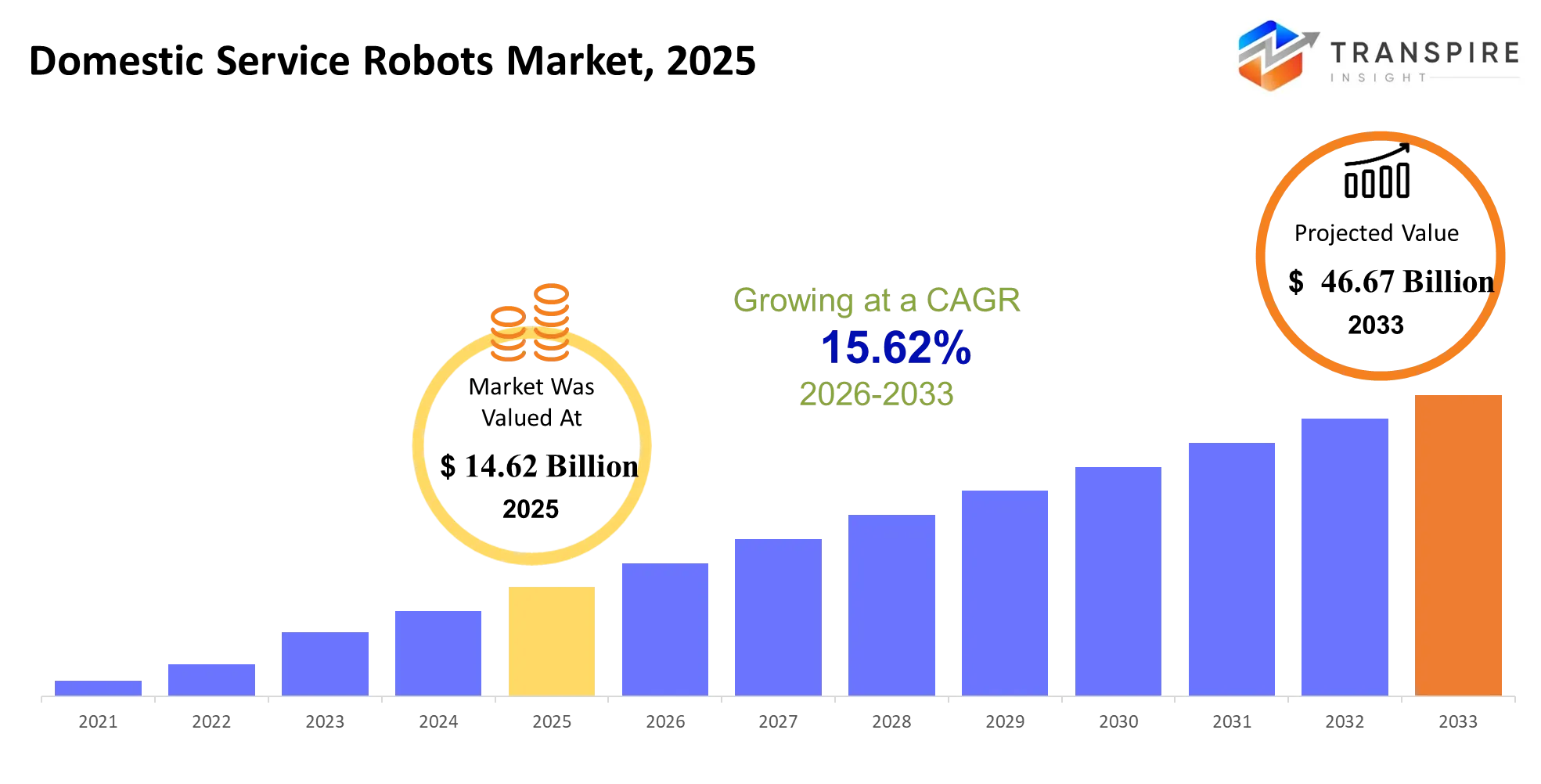
As per Transpire Insight Analysis, the Domestic Service Robots Market size is estimated at USD 14.62 billion in 2025 and is anticipated to reach USD 46.67 billion by 2033, growing at a CAGR of 15.62% from 2026 to 2033.
Domestic service robots are changing from tools that do one thing to useful helpers around the house that can handle everyday jobs with less support from people. Cleaning floors is still the obvious and popular use, but robots that take care of lawns, pools, windows and even act as companions are bringing automation to more areas of daily life. In the past three to five years, these products have gotten better at mapping areas, recognising obstacles being controlled through apps and doing both vacuuming and mopping at the same time. There is a change happening from simple programmed movement to using artificial intelligence for navigation and connecting with smart home systems. A real example of this change is the introduction of products that can charge themselves during breaks avoid objects more easily, and continue cleaning with less help from users. These upgrades solve problems like missing corners, getting tangled in cables, needing to help manually again and not having enough power to cover the whole house. Because of this people can now see more real value in buying robot tools, and companies can now compete by focusing on software, extra parts and better service stations of just making machines, with stronger suction. Growth is happening because of convenience, better performance and more robots doing tasks that go beyond just cleaning floors.
Domestic Service Robots Market Size & Forecast:
- Market Size 2025: USD 14.62 Billion
- Expected Market Value (2033): USD 46.67 Billion
- Forecast CAGR (2026-2033): 15.62%
- Leading Region in 2025: North America
- Fastest Growing Region: Asia-Pacific
- Key Company Profiles: iRobot, Ecovacs Robotics, Roborock, Samsung Electronics, Neato Robotics, SharkNinja, Xiaomi, Dreame Technology, Dyson, LG Electronics, Panasonic, Cecotec, Husqvarna, Maytronics, Segway-Ninebot
Key Market Insights:
The market is moving toward manufacturers venturing into specialised tasks in the home. Product design is becoming more inclined to enhance navigation, minimise manual operation, and make robots more relevant in day-to-day activities.
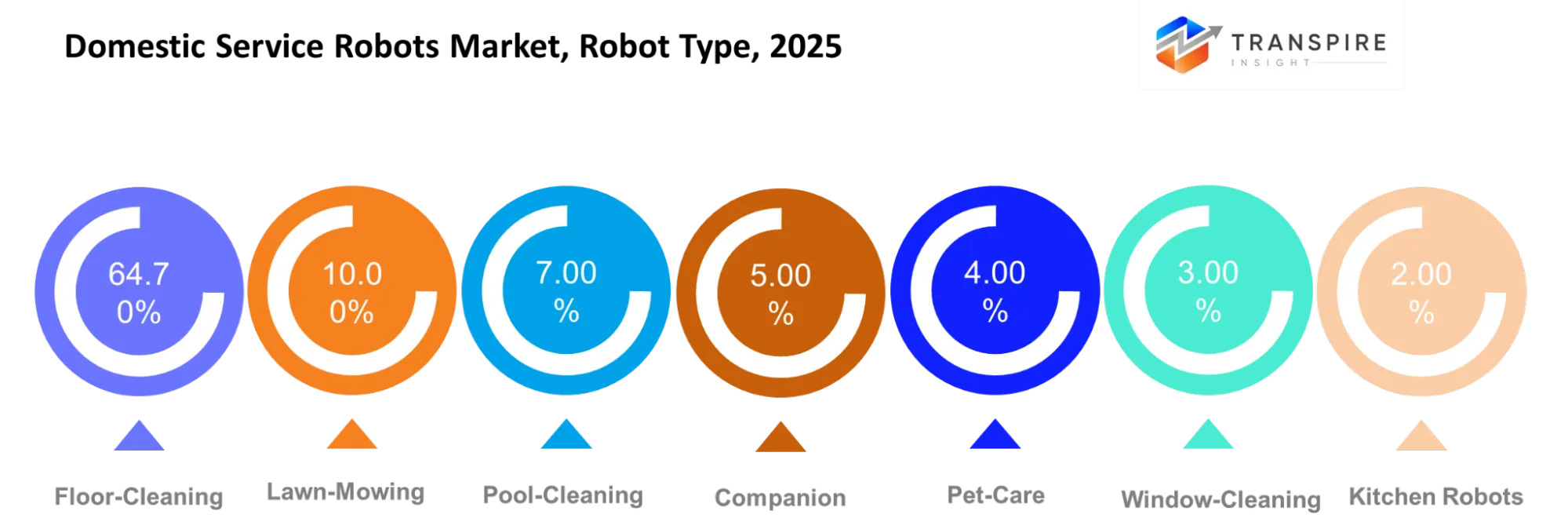
- The market share of floor cleaning robots is 64.70%, which will push ECOVACS, Roborock, and other companies to enhance their products in terms of navigation, vacuuming efficiency, mopping systems and docking.
- The companion robots market will grow at a CAGR of 17.60% due to growing demand for household assistance, and in the future, the adoption of such robots depends on their price, privacy concerns and everyday usefulness.
- Lawn mowing robots take 10.00% of the market, as companies such as Mammotion apply AI vision and autonomous navigation capabilities to make lawn maintenance easier and cut down on boundary wire installation.
- Pool cleaning robots make up 7.00% of the market share, as ECOVACS has recently entered the segment of pool cleaners
- Pet care robots constitute 4.00% of the market, providing opportunities for the development of scheduled care and monitoring capabilities for pet owners who wish to get rid of some responsibilities.
- The market share of window cleaning robots is 3.00%, which encourages manufacturers to perfect edge detection, route planning and safety mechanisms for cleaning robots of glass surfaces.
What are the Key Drivers, Restraints, and Opportunities in the Domestic Service Robots Market?
Drivers
The development of the market is The improvements in the fields of mapping technology, obstacle recognition, battery handling, and self-maintenance make domestic robots more viable for usage in real households. The driver behind all of this will be the shift from a product that makes simple programmed movements to one that can map out a room, recognise common obstacles, and go back to the dock for charging or maintenance. As the robot performs more and more tasks by itself, the buyer will get more and more motivation to buy it, and the manufacturer will differentiate its premium line by software, docks, and cleaning.
Restraints
The issue of high cost remains a concern, especially for those machines that come fitted with advanced sensors, cameras, robotic arms or entire stations. This is because there are more expenses involved as far as the engineering and equipment is concerned, and, besides, each house has a unique layout, entrance, clutter, connections and surfaces. If the robot needs to provide much assistance, or if it does not function well in complex conditions, it might end up not being worth its cost.
Opportunities
Opportunities in the market is affordable sensors and edge-AI computing could help with reliable navigation in mid-level devices, while the use of subscription and robot-as-a-service approaches will decrease the upfront purchasing cost. There is also room for development in the area of after-sale services provided away from the home (e.g., lawn and pool cleaning), as well as collaboration in creating robots as part of other household devices.
What Has the Impact of artificial intelligence on the Domestic Service Robots Market?
The use of artificial intelligence makes it possible to improve domestic service robots by giving them the capability to respond to environmental changes apart from operating on pre-programmed trajectories. Computer vision along with sensor fusion makes it possible for a robot to identify such objects as furniture, cables, toys, pets, or any other obstacles, while SLAM technology allows making a map of the room and developing routes. Predictive features can forecast the moment when a battery needs to be charged, notify about the required maintenance, or change the schedule of cleaning according to daily routine. However, the results are not always accurate, as poor illumination, reflections, clutter, irregular layout, and faults of the sensors may affect detection and navigation. The use of advanced cameras, processors, and docking stations increases the price of products, while the interconnected gadgets should ensure the protection of household maps and other private information. Therefore, artificial intelligence provides a competitive advantage only when it is efficient.
Instance
In January 2026, LG Electronics demonstrated its CLOiD artificial intelligence-based domestic robot. The robot makes use of AI technology to help in performing tasks within the house and interacting with smart home appliances. This shows how artificial intelligence is making domestic service robots smarter.https://www.lg.com//newsroom/news/home-appliance-solution/lg-electronics-presents-lg-cloid-home-robot-to-demonstrate-zero-labor-home-at-ces-2026/
Key Market Trends:
Product development is moving away from simple automation tasks to robots that are easy to maintain and capable of doing more in the process of cleaning. The area of competition has expanded from floor care to general assistance at home.
- The method of navigation has progressed from simple methods of bumps and turns to sophisticated technology such as the use of LiDAR, cameras to identify objects, and sensors to fuse the two.
- Water management, mop cleaning, dust removal, and charging stations are being incorporated into the docking station by manufacturers as means of ensuring that routine maintenance is limited.
- Lawn and pool cleaners are also getting some attention as the same navigation and obstacle avoidance technology is applied to other tasks within households.
- Artificial Intelligence is becoming an advantage for companies where it plays a role in identifying objects, making changes in the routes followed, or even task planning instead of just marketing AI.
- Compatibility with mobile phones, voice assistants, and smart home systems is becoming a key consideration for consumers.
Domestic Service Robots Market Segmentation
By Robot type
Floor cleaning robots are market-leading with a market share of 64.70%, far ahead of lawnmowers at 10.00% and pool cleaners at 7.00%. The dominance can be attributed to its regularity as a domestic activity as well as to its potential to save people time. Companion robots account for 5.00% and constitute the fastest-growing category with a CAGR of 17.60%, as interactive assistance continues to evolve from cleaning tasks. Pet care robots make up 4.00%, window cleaners 3.00%, kitchen robots 2.00%, while others account for 4.30%.
By Applications
Vacuuming & Mopping serve as the primary use-case due to their repetitiveness and measurability. Mowing and pool cleaning involve extending automation to outdoor maintenance, whereas elder care, pet care, home security and kitchen tasks cater to other household applications. In terms of commercial value, the difference lies in that cleaning applications have coverage and maintenance as their priorities, care applications need safe interaction and reliable alerts, and security applications put extra focus on sensing and connectivity. As products evolve, application-specific approaches along with clear benefits for the users are expected to drive usage rather than general automation claims.
By Connectivity
WiFi-connected and cloud-connected robots enable remote scheduling and software updates, whereas stand-alone robots appeal to those users who value easier-to-use products. Bluetooth can help with local communication, while 5G could be useful for selective connected use cases. Edge-AI processing can perform some of the decisions locally on the robot, thus providing faster responses and reducing the necessity to stay connected to the cloud continuously. Multi-robot connectivity could become more relevant in the future in case families use different robots for floors, lawns and pools.
By Intelligence
The sensor-equipped robots serve as the base for obstacle detection and reaction to the surroundings. AI support will be able to enhance object recognition. SLAM can be used to create maps and find paths. The voice command system will make it easier to give orders, while autonomous navigation will decrease the necessity of repeated user inputs. Multi-modal AI can merge visual, spatial and voice information for better task interpretation. The future benefit will be based on accuracy in performing tasks in real houses, safe behaviour around people and pets, and upgrades that increase functionality without complicating product usage.
By Distribution Channel
Online retailing makes comparison of features and prices easy for the buyer, whereas direct sales enable the manufacturer to have better control over education and customer relations. The speciality store channel can be helpful for providing advice on premium and unique items. The subscription and robot-as-a-service channels allow the buyer to choose without having to pay a large sum of money at one go, although the effectiveness of these channels depends on many factors like maintenance policies and cost-effectiveness.
What are the Key Use Cases Driving the Domestic Service Robots Market?
The use cases of these machines are the regular maintenance of the floor. Floor cleaning robots automatically clean and vacuum on a set schedule. This helps the residents reduce their workload for dusting and other chores on the floor. The applications range into the automation of lawn mowing and pool cleaning. Products that can perform these jobs help the residents take care of their regular jobs using navigation techniques in an automated manner. Pet care and window cleaning robots are another application area that is specific to some narrow requirements. Other applications include companion robots, robots to assist elderly people and robots that can help in home security. These applications might be possible only if they have some valuable function and are safe to operate.
|
Report Metrics |
Details |
|
Market size value in 2025 |
USD 14.62 Billion |
|
Market size value in 2026 |
USD 16.9 Billion |
|
Revenue forecast in 2033 |
USD 46.67 Billion |
|
Growth rate |
CAGR of 15.62% from 2026 to 2033 |
|
Base year |
2025 |
|
Historical data |
2021 - 2024 |
|
Forecast period |
2026 - 2033 |
|
Report coverage |
Revenue forecast, competitive landscape, growth factors, and trends |
|
Regional scope |
United States; Canada; Mexico; United Kingdom; Germany; France; Italy; Spain; Denmark; Sweden; Norway; China; Japan; India; Australia; South Korea; Thailand; Brazil; Argentina; South Africa; Saudi Arabia; United Arab Emirates |
|
Key company profiled |
iRobot, Ecovacs Robotics, Roborock, Samsung Electronics, Neato Robotics, SharkNinja, Xiaomi, Dreame Technology, Dyson, LG Electronics, Panasonic, Cecotec, Husqvarna, Maytronics, Segway-Ninebot |
|
Customization scope |
Free report customization (country, regional & segment scope). Avail customized purchase options to meet your exact research needs. |
|
Report Segmentation |
Robot Type (Floor-Cleaning Robots, Lawn-Mowing Robots, Pool-Cleaning Robots, Companion Robots, Pet-Care Robots, Window-Cleaning Robots, Kitchen Robots, Others); Application (Vacuuming & Mopping, Lawn Mowing, Pool Cleaning, Elderly Care, Pet Care, Home Security, Kitchen Assistance, Others); Connectivity (Wi-Fi Connected, Stand-Alone, Bluetooth, 5G, Cloud-Connected, Edge-AI, Multi-Robot, Others); Intelligence (Sensor-Based, AI-Assisted, Computer Vision, SLAM, Voice-Controlled, Autonomous Navigation, Multi-Modal AI, Others); Distribution Channel (Online Retail, Offline Retail, Specialty Stores, Manufacturer Direct, E-Commerce Marketplaces, Subscription/RaaS, Consumer Electronics Stores, Others) |
Which Regions are Driving the Domestic Service Robots Market Growth?
North America
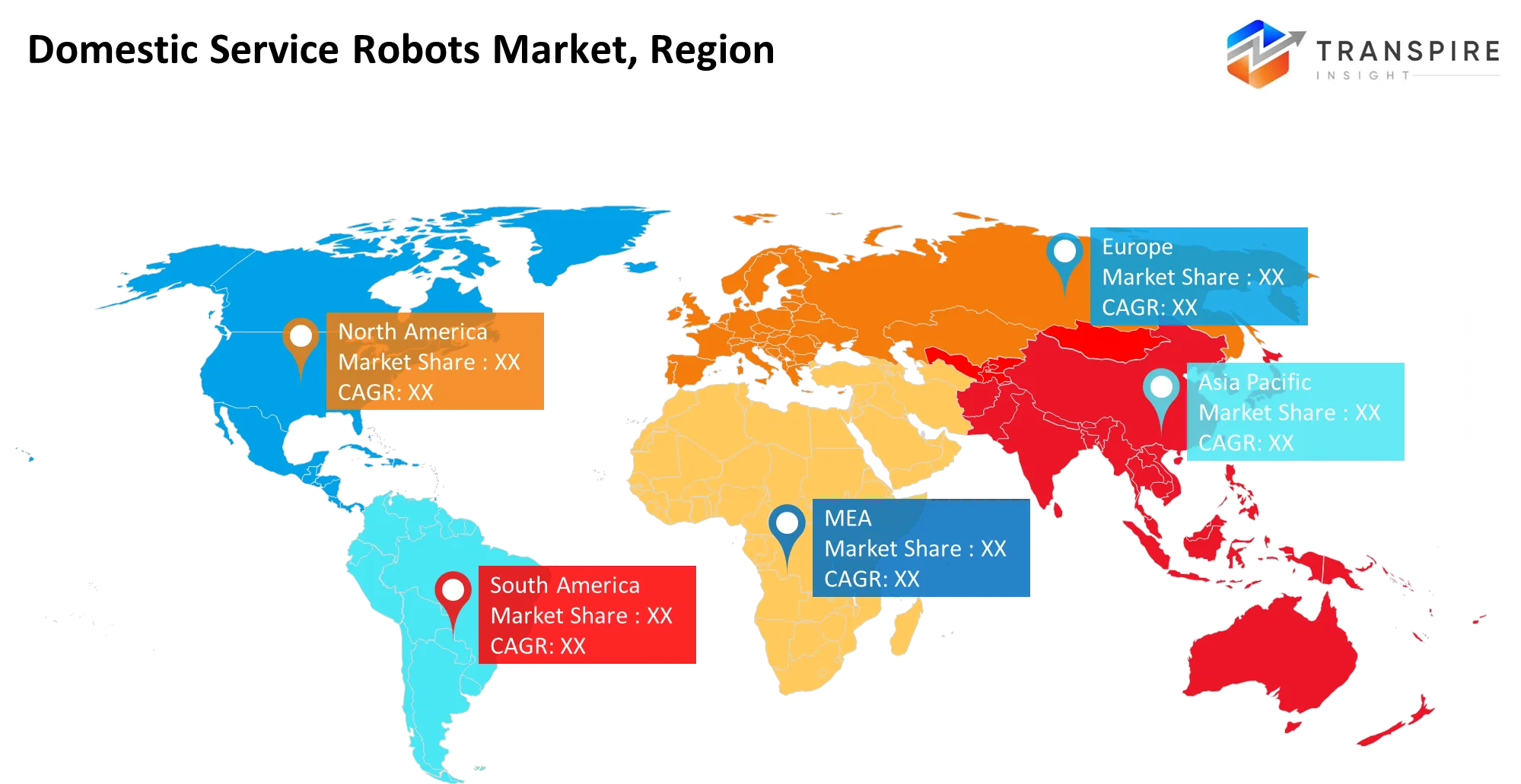
North America is the leading region with its 38.30% share due to the high level of consumers' awareness of connected home equipment and premium convenience products. The already developed channels of sales through e-commerce and electronics allow the customers to choose between the available robotic cleaning machines. There is a need to reduce the time spent on maintaining the household in North America.
In March 2026, the manufacturer released a robot vacuum and mop called PowerDetect UV Reveal by SharkNinja. The announcement was the launch of a cleaning robot equipped with ultraviolet light sensors combined with an RGB camera. The machine is able to detect stains and eliminate them through automatic vacuuming and mopping. The introduction demonstrates a demand for premium domestic service robots in North America with their intelligent cleaning and increased convenience.https://newsroom.sharkninja.com/shark-launches-powerdetect-uv-reveal-the-first-robot-vacuum-mop-to-use-uv-technology-to-detect-invisible-messes/
Europe
Europe accounts for 24.00% of the market share and is a significant base for home-cleaning and outdoor maintenance robots. Product differentiation is usually based on design, energy consumption, safety and compatibility with various home designs. A well-developed retail chain and customers' interest in automation of household activities will ensure consistent sales. In comparison with North America, the contribution of Europe to the market can be assessed by its consumer base and demand for reliable and integrated products rather than the same premium convenience factors.
In September 2025,The company presented the new model of the robotic vacuum called DEEBOT X11. The model was presented during IFA 2025, the annual International Consumer Electronics Show held in Berlin. The product features PowerBoost technology. The launch is connected with the European domestic service robots market because it shows the trend for product development among manufacturers in terms of cleaning performance and automation.https://www.ecovacs.com//newsroom
Asia-Pacific
The Asia-Pacific accounts for 27.00% of the market share and is the fastest-growing one with a CAGR of 19.70%. The region is favoured by a well-developed base of electronics and robotics manufacturing, a broad range of prices, and a variety of products, including AI-based home appliances. Urban families and small apartments may prefer automation of repetitive jobs if the product operates efficiently in narrow environments. Further growth can be achieved through wider distribution, localisation of products and affordable prices.
In September 2026, the Indian market got the news about a new domestic service robot from a company called Dreame Technology. It released the new slim model of the robotic vacuum with the name of X60 Ultra Complete. The robot is aimed at hard-area navigation and the ability to change cleaning functions in a real-time mode.https://www.prnewswire.com/in/news-releases/dreame-technology-launches-flagship-x60-ultra-complete-robot-vacuum-in-india-redefining-whole-home-cleaning-with-smarter-intelligence-and-powerful-performance-302884549.html
Who are the Key Players in the Domestic Service Robots Market and how do they compete?
Competition in the domestic service robots market is influenced by existing cleaning specialists, diversified electronics manufacturers, and also outdoor-robot producers. The companies compete in their navigation efficiency, cleaning effectiveness, battery life, self-maintenance, software, and price. Trust in brand name and service coverage also plays a role, as customers want to be sure that a robot will be able to operate successfully through different cycles of use. Floor-cleaning is found in the supplied market data to be the biggest segment, which means that vacuuming and mopping stay the main field of competition, while others can be used for extending the company’s portfolio. The multi-category strategy of ECOVACS involves DEEBOT floor cleaners, WINBOT window cleaners, GOAT lawn mowers, and pool-cleaning products. The launch of DEEBOT X11 showed improvements in charging with the PowerBoost feature and mopping. ULTRAMARINE has extended the company’s range of household robotics. Partnership with BSH shows that integration strategy is being used by the company which implies incorporating robotics into kitchen furniture.
Domestic Service Robots Market companies
- iRobot
- Ecovacs Robotics
- Roborock
- Samsung Electronics
- Neato Robotics
- SharkNinja
- Xiaomi
- Dreame Technology
- Dyson
- LG Electronics
- Panasonic
- Cecotec
- Husqvarna
- Maytronics
- Segway-Ninebot
Recent Development News
In September 2026, ECOVACS moves on to more robotics categories in the household. ECOVACS displayed their new models of the WINBOT W3 OMNI window-cleaning robot, GOAT lawn mowers and DEEBOT X12S OmniCyclone. The move demonstrates the company's focus on integrating its robotics technology to handle floor, window, lawn and pool maintenance other than vacuum cleaning.https://www.prnewswire.com/news-releases/ecovacs-at-ifa-berlin-2026-named-as-no1-brand-in--home-robotics-bringing-robotics-to-more-of-everyday-life-302869605.html
In June 2025, Mammotion joined the robotic pool cleaners market. Mammotion launched its SPINO E1, the first robotic pool cleaner by the company. The robotic pool cleaner has a triple motor system, intelligent path planning and cleaning capabilities for pool floor, walls and waterlines. This move shows the expansion of Mammotion's business from robotic lawn mowers to another recurring maintenance task.https://mammotion.com/blogs/news/mammotion-dives-into-pool-care-with-spino-e1-robotic-pool-cleaner
What Strategic Insights Define the Future of the Domestic Service Robots Market?
The future of the market will move towards connected machines that can perform several recurring household chores. Although floor-cleaning robots are the commercial success story, other adjacent products such as lawn, pool, window and companion robots are areas where growth can be pursued. The lurking danger is that feature innovation can come at the expense of reliability: if the robot with AI gets stuck, does not detect an object correctly, requires cleaning frequently, or poses any security concerns, the robot will disappoint. Therefore, reliable navigation, easy maintenance, secure data handling and repairs must come first before innovative but useless in daily life features are developed. There is an obvious opportunity to integrate robotics technology with appliances, furniture and smart home platforms to enable natural interaction with these devices within the household. Another route to follow would be to offer mid-range products and services to make robots less costly. The best approach here would be to demonstrate efficiency first and then go for adjacent activities.
Robot Type
- Floor-Cleaning Robots
- Lawn-Mowing Robots
- Pool-Cleaning Robots
- Companion Robots
- Pet-Care Robots
- Window-Cleaning Robots
- Kitchen Robots
- Others
Application
- Vacuuming & Mopping
- Lawn Mowing
- Pool Cleaning
- Elderly Care
- Pet Care
- Home Security
- Kitchen Assistance
- Others
Connectivity
- Wi-Fi Connected
- Stand-Alone
- Bluetooth
- 5G
- Cloud-Connected
- Edge-AI
- Multi-Robot
- Others
Intelligence
- Sensor-Based
- AI-Assisted
- Computer Vision
- SLAM
- Voice-Controlled
- Autonomous Navigation
- Multi-Modal AI
- Others
Distribution Channel
- Online Retail
- Offline Retail
- Specialty Stores
- Manufacturer Direct
- E-Commerce Marketplaces
- Subscription/RaaS
- Consumer Electronics Stores
- Others
By Regional Analysis
North America
- US
- Canada
- Mexico
Europe
- Germany
- UK
- France
- Italy
- Spain
- Russia
- Rest of Europe
Asia Pacific
- China
- Japan
- India
- South Korea
- Australia
- Rest of Asia Pacific
South America
- Brazil
- Argentina
- Rest of South America
Middle East & Africa
- UAE
- Saudi Arabia
- Qatar
- South Africa
- Rest of the Middle East & Africa
Frequently Asked Questions
Find quick answers to common questions.
The domestic service robots market size was valued at USD 14.62 billion in 2025 and is poised to reach USD 46.67 billion by 2033, expanding at a 15.62%CAGR.
Key segments for the domestic service robots market are Robot Type (Floor-Cleaning Robots, Lawn-Mowing Robots, Pool-Cleaning Robots, Companion Robots, Pet-Care Robots, Window-Cleaning Robots, Kitchen Robots, Others); Application (Vacuuming & Mopping, Lawn Mowing, Pool Cleaning, Elderly Care, Pet Care, Home Security, Kitchen Assistance, Others); Connectivity (Wi-Fi Connected, Stand-Alone, Bluetooth, 5G, Cloud-Connected, Edge-AI, Multi-Robot, Others); Intelligence (Sensor-Based, AI-Assisted, Computer Vision, SLAM, Voice-Controlled, Autonomous Navigation, Multi-Modal AI, Others); Distribution Channel (Online Retail, Offline Retail, Specialty Stores, Manufacturer Direct, E-Commerce Marketplaces, Subscription/RaaS, Consumer Electronics Stores, Others)
Growth is primarily driven by increased demand for automation at home, increased cost of labour, increased use of smart home technology, increased use of artificial intelligence and sensors, and the requirement for convenient cleaning.
The market is led by major manufacturers including iRobot, Ecovacs Robotics, Roborock, Samsung Electronics, Neato Robotics, SharkNinja, Xiaomi, Dreame Technology, Dyson, LG Electronics, Panasonic, Cecotec, Husqvarna, Maytronics, Segway-Ninebot
North America is the largest market for domestic service robots ly, with a market share of 38.30%. This is due to increased use of smart home technologies, high labour costs, high consumer purchasing power, and growing demand for automated cleaning and home assistance
Business opportunities in the domestic service robots market include increasing demand for smart home automation, the use of AI-based cleaning robots, development of elderly care and companion robots, and demand for lawn mowing and window cleaning robots. Some other business opportunities that manufacturers can consider are emerging markets, cost-effective robots, and maintenance services.
- iRobot
- Ecovacs Robotics
- Roborock
- Samsung Electronics
- Neato Robotics
- SharkNinja
- Xiaomi
- Dreame Technology
- Dyson
- LG Electronics
- Panasonic
- Cecotec
- Husqvarna
- Maytronics
- Segway-Ninebot
About the Authors

Mayur Shinde
I am Mayur Shinde, a Senior Research Analyst at Transpire Insight, specializing in the Automotive & Transportation and Information & Communication Technology (ICT) Industry. My work focuses on analyzing emerging market trends, technological advancements, competitive landscapes, and industry developments to deliver accurate, data-driven insights. I am passionate about transforming complex market information into clear, actionable content that helps businesses, professionals, and decision-makers stay informed and make confident strategic decisions.

Chakradhar Khansole
Chakradhar serves as the Research Director at Transpire Insight, bringing over 8 years of experience in technology, innovation, and strategic market intelligence. He specializes in transforming complex market data into actionable business insights that enable organizations to make informed, growth-oriented decisions. Recognized for his strategic vision and analytical expertise, Chakradhar leads high-impact research initiatives, delivering comprehensive market assessments, competitive intelligence, and forward-looking industry analysis.
Recently Published Reports
-
Apr 2026
3D Optical Profiler Market
3D Optical Profiler Market Size, Share & Analysis Report By Type (Desktop 3D Optical Profiler, and Portable 3D Optical Profiler), By Technology (Confocal Technology, and White Light Interference), By End-Use Industry (Manufacturing, Research Institutions, Automotive, Aerospace and Defense, Medical Devices, and Other), and Geography (North America, Europe, Asia-Pacific, Middle East and Africa, South and Central America), 2021 - 2031
-
Apr 2026
Depth Sensor Market
Depth Sensor Market Size, Share & Analysis Report By Type (Infrared Depth Sensors, Time-of-Flight (ToF) Sensors, Stereo Vision Sensors, Structured Light Sensors, Ultrasonic Depth Sensors), By Application (Automotive, Robotics, Gaming, Consumer Electronics, Industrial Automation, Healthcare, Security & Surveillance, Others), By End Users (Automotive Manufacturers, Consumer Electronics Companies, Healthcare Providers, Industrial Companies, Security Agencies, Gaming Companies, Robotics Companies, Others), and Geography (North America, Europe, Asia-Pacific, Middle East and Africa, South and Central America), 2021 – 2031
-
Apr 2026
Digital Manufacturing Market
Digital Manufacturing Market Size, Share & Analysis Report By Component (Hardware, Software, and Services), By Technology (Robotics, 3D Printing, Internet of Things (IoT), and Others), By Application (Automotive and Transportation, Aerospace and Defense, Consumer Electronics, Industrial Machinery, and Others), By Process Type (Computer-Based Designing, Computer-Based Simulation, Computer 3D Visualization, Analytics, and Others), and Geography (North America, Europe, Asia-Pacific, Middle East and Africa, South and Central America), 2021 – 2031
-
Apr 2026
Digital Visa Services Market
Digital Visa Services Market Size, Share & Analysis Report By Type (Individual Travelers, Group Travelers), By Application (Tourism, Business Travel, Others), and Geography (North America, Europe, Asia-Pacific, Middle East and Africa, South and Central America), 2021 – 2031