

Digital Goods Market Summary:
According to Transpire Insight, a detailed research report on the market reflects that the online games and virtual goods segment dominates the Global Digital Goods Market, accounting for approximately 37.45% of the total share worldwide in 2025. Microsoft, Google, Apple, Amazon, Adobe, Netflix, Spotify, Steam, Electronic Arts, Sony, Nintendo, Tencent, ByteDance, Meta, and Udemy are among the prominent companies participating across digital content, gaming, software, subscriptions, creator platforms, and online education, contributing to market development, technological innovation, digital distribution capabilities, platform expansion, and evolving growth dynamics.
Market Snapshot
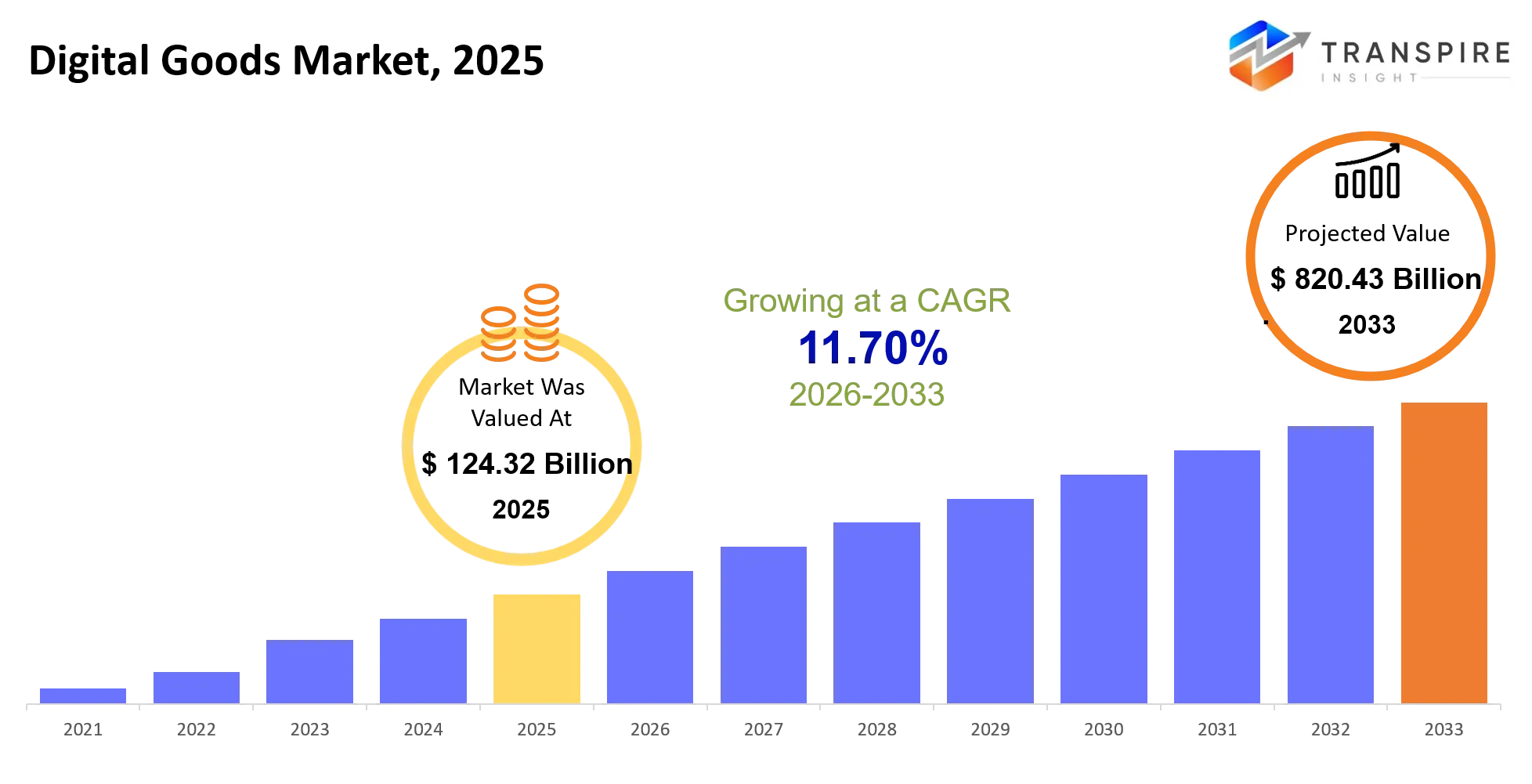
- Market Value (2025): USD 124.32 Billion.
- Expected Market Value (2026): USD 157.39 Billion.
- Estimated Market Value (2033): USD 820.43 Billion.
- Forecast CAGR (2026–2033): 26.60%
- Leading Region in 2025: Asia Pacific
- Second-largest Region: North America
- Fastest Growing Region: Europe
Introduction
The Digital Goods Market refers to an online economy system through which intangible items like software, e-books, digital media, online courses, gaming material, subscriptions, and virtual goods are produced, marketed, sold, and used. While unlike tangible goods, digital goods do not need warehousing, transport, or any form of physical storage, thereby making them easily distributable globally. Cloud computing, digital platforms, mobile applications, and payment gateways make it possible for the consumer, producers, and publishers to easily conduct transactions online. Artificial intelligence, personalized content, creator economy, and subscription business model are some of the trends that are shaping up the digital goods market. Internet usage, smartphone penetration, and digital payment infrastructure are factors contributing to growing adoption of digital goods.
For instance:-
- North America: North America dominates the Digital Goods Market by holding 32.40% market revenue share in 2025 owing to high disposable income, availability of broadband connectivity, digital payment options, and thriving gaming industry.
- Asia Pacific: Asia Pacific accounts for the fastest growth in Digital Goods Market with 26.9% CAGR throughout 2031 owing to adoption of smartphones, mobile payments, gaming, and super-apps.
Key Market Highlights: -
- Asia Pacific is expected to grow at a rapid CAGR in the Digital Goods Market by holding around 55 % of the share during the forecast period.
- North America is anticipated to hold roughly 27 % share of the Digital Goods Market over the predicted timeframe.
- Europe is anticipated to hold nearly 26 %share of the Digital Goods Market over the predicted timeframe.
- By Product, the Digital Games dominated the market and holds nearly 45% share in 2025 and is projected to grow at a substantial CAGR during the forecast period.
- By Platform, the Mobile gaming dominated the market and holds close to 44% share in 2025 and is projected to grow at a substantial CAGR during the forecast period.
- By Revenue Model, the In-app Purchase (IAP) dominated the market and holds about 62% share in 2025 and is projected to grow at a substantial CAGR during the forecast period.
- The ONDC, Digital MSME, MSME-TEAM, Startup India, and Digital Public Infrastructure schemes of India are boosting digital business, MSME engagement, online transactions, and technology adoption, aiding Digital Goods Market development.
How is Technology Driving Growth in the Digital Goods Market?
Technology is the main force that fosters growth in the Digital Goods Market through such factors as scalability of delivery, personalization, automation of content creation, and digitized transactions. Cloud computing lowers infrastructure expenses while at the same time allowing fast deployment and worldwide scalability. Artificial intelligence and machine learning contribute to the personalization of content recommendations and the automation of digital products' creation process and improve customer service. Digital wallets and fintech infrastructure ensure safe cross-border and micropayments. In addition, AR, VR, and 5G technologies foster growth in the market of immersive digital products.
|
Report Metrics |
Details |
|
Market size value in 2025 |
USD 124.32 Billion |
|
Market size value in 2026 |
USD 157.39 Billion |
|
Revenue forecast in 2033 |
USD 820.43 Billion |
|
Growth rate |
CAGR of 11.70%from 2026 to 2033 |
|
Base year |
2025 |
|
Historical data |
2021 - 2024 |
|
Forecast period |
2026 - 2033 |
|
Report coverage |
Revenue forecast, competitive landscape, growth factors, and trends |
|
Regional scope |
United States; Canada; Mexico; United Kingdom; Germany; France; Italy; Spain; Denmark; Sweden; Norway; China; Japan; India; Australia; South Korea; Thailand; Brazil; Argentina; South Africa; Saudi Arabia; United Arab Emirates |
|
Key company profiled |
Apple, Google, Microsoft, Amazon, Adobe, Netflix, Spotify, Steam, Electronic Arts, Sony, Nintendo, Tencent, ByteDance, Meta, Udemy |
|
Customization scope |
Free report customization (country, regional & segment scope). Avail customized purchase options to meet your exact research needs. |
|
Report Segmentation |
By Product (Digital Media, Software, E-books, Online Courses, Digital Games, Music, Video, Others); By Platform (Mobile, Desktop, Web, Cloud, Streaming, Gaming Consoles, VR/AR, Others); By Revenue Model (Subscription, One-time Purchase, Freemium, In-app Purchase, Advertising, Pay-per-view, Licensing, Others); By Consumer Type (Individual, Enterprise, Educational, Government, Creator, Professional, Corporate, Others); By Distribution (App Stores, Websites, Marketplaces, Streaming Platforms, Digital Libraries, Social Platforms, Gaming Platforms, Others); By Content Type (Entertainment, Education, Business, Productivity, Communication, Gaming, Creative, Others); By End User (Consumers, Businesses, Students, Professionals, Creators, Developers, Institutions, Others) |
Market Drivers
Mobile-first Consumption: Smartphones and tablets contributed 62.10% to Digital Goods Market revenue in 2025 through the widespread use of smartphones, mobile internet connectivity, payment systems, and ease of digital consumption. Subscription economy: The subscription model held a 56.20% market share in 2025 owing to the recurring availability of software, streaming, gaming, and other digital contents. Global scalability & efficiency: Immediate delivery, low cost of replication, cloud-based platform, and international digital ecosystems help organizations scale fast, while creator-based monetization and mobile-first economies keep growing digital goods market globally.
For instance:-
Europe: Europe is a prominent region of Digital Goods Market with the help of growing online transactions, adoption of digital content, e-learning, streaming, and evolving regulatory policies.
Restrain
The main limitations on the Digital Goods Market involve digital piracy, illegal distribution, cyber security risks, data privacy issues, subscription weariness, and regulation challenges. The ease of replicating digital content without any substantial cost of production could result in lost revenue from legitimate sources, and security risks like malware, scams, and data theft could undermine consumer confidence. At the same time, duplicate subscription costs could increase customer turnover rates, while differing tax rates and regulations could raise compliance costs.
|
Driver |
Relative Impact on Growth (%) |
Geographic Relevance |
Impact Timeline |
Demand Strength |
Growth Mechanism |
Key Beneficiaries |
Major Constraint |
|
Driver 1: Mobile-First Digital Consumption |
25% |
Asia Pacific, North America, Europe |
Short-term |
High |
Smartphones expand convenient access to digital products |
Mobile platforms, developers, content providers, consumers |
Platform fees and intense application competition |
|
Driver 2: Subscription-Based Monetization |
22% |
North America, Europe, Asia Pacific |
Short-term |
High |
Recurring subscriptions create predictable digital revenues |
Software providers, streaming platforms, gaming companies, consumers |
Subscription fatigue and increasing customer churn |
|
Driver 3: AI-Enabled Digital Content |
20% |
North America, Asia Pacific, Europe |
Medium-term |
High |
AI personalizes and accelerates digital content creation |
AI developers, creators, software vendors, digital platforms |
High computing costs and intellectual-property concerns |
|
Driver 4: Digital Payments and Microtransactions |
18% |
Asia Pacific, North America, Europe |
Short-term |
High |
Frictionless payments increase conversion and transaction frequency |
Payment providers, gaming platforms, creators, consumers |
Fraud, cybersecurity risks, and payment regulations |
|
Driver 5: Immersive Gaming and Virtual Goods |
15% |
Asia Pacific, North America, Europe |
Long-term |
High |
AR/VR and gaming ecosystems expand virtual product consumption |
Game developers, publishers, platform operators, virtual-asset creators |
Hardware costs and regulatory uncertainty |
Analysis of Prices and Consumer Behaviour
The market of digital products comprises mainly digital games (68% of the market; because of the demand of the gaming, entertainment, and digital media industries). Premium digital products with advanced features are going to cost 35% more compared to other digital products because they will be created based on advanced technologies, top-quality content, and constant user experience. Almost 45% of all unit sales of digital goods come from mobile devices. The reasons behind the sales volume are the easy availability of mobile applications, easy and fast digital payments, and popular usage of smartphones. The gaming and entertainment industries account for 70% of the demand of these industries. The consumer buying behavior shows that 55% of the consumers pay more attention to product quality, functionality, security, and platform compatibility. Another 33% of the consumers prefer to buy products using subscription plans, packages, or long-term contracts in order to minimize the costs related to purchasing digital products and ensure constant access to digital services worldwide.
|
Company |
Est. Revenue Share Range |
Key Offerings |
Strategic Positioning |
Geographic Strength |
Technology Focus |
|
Apple |
4–8% |
App Store, Apple Music, Apple TV+, iCloud |
Ecosystem-led premium digital monetization |
North America, Europe, Asia Pacific |
Cloud, AI, mobile ecosystem, payments |
|
|
3–6% |
Google Play, YouTube, Google One, YouTube Premium |
Platform ecosystem and subscription diversification |
North America, Europe, Asia Pacific |
AI, cloud, search, digital payments |
|
Microsoft |
3–6% |
Microsoft 365, Xbox Game Pass, Xbox Cloud Gaming, digital games |
Integrated software, cloud, and gaming ecosystem |
North America, Europe, Asia Pacific |
AI, cloud, gaming, subscriptions |
|
Tencent |
2–5% |
WeChat, online games, digital content, virtual goods |
Gaming-led ecosystem and mobile monetization |
Asia Pacific, Europe, Latin America |
AI, cloud gaming, mobile platforms |
|
Amazon |
2–4% |
Prime Video, Kindle, Audible, Amazon Music |
Broad digital-content ecosystem and bundling |
North America, Europe, Asia Pacific |
Cloud, streaming, AI, digital platforms |
|
Sony Group |
2–4% |
PlayStation Store, digital games, PlayStation Plus |
Premium gaming ecosystem and exclusive content |
North America, Europe, Asia Pacific |
Cloud gaming, digital distribution, AI |
|
Nintendo |
1–3% |
Nintendo eShop, digital games, subscriptions, virtual content |
IP-driven gaming and proprietary ecosystem |
Asia Pacific, North America, Europe |
Gaming platforms, digital distribution, cloud |
|
Meta Platforms |
1–3% |
Meta Quest content, virtual goods, creator monetization |
Social and immersive digital ecosystem |
North America, Europe, Asia Pacific |
AI, VR/AR, metaverse, creator tools |
|
Valve |
1–3% |
Steam, Steam Marketplace, digital games, virtual items |
PC gaming marketplace and digital distribution |
North America, Europe, Asia Pacific |
Cloud infrastructure, digital storefronts, gaming |
|
Adobe |
1–2% |
Creative Cloud, Acrobat, Adobe Stock, Firefly |
Subscription-based creative software leadership |
North America, Europe, Asia Pacific |
Generative AI, cloud software, digital content |
Who are the Key Players in the Digital Goods Market and how do they compete?
The competitiveness of Digital Goods Market in the international market is determined by companies which focus on innovations in technologies, digital solutions tailored to industries and distribution networks on a global scale. Competing not only on prices but also through innovations in technology, scalability in digital products, intelligence and connected solutions, integration with digital platforms and systems, the company approaches the competition in a way that helps with continuous product development and increased customer engagement, efficiency, accessibility, and digital commerce.
Creating digital content, software platforms, subscription services, AI-powered solutions and connected digital experiences, Apple establishes itself in the market. Creating high-performance digital products for entertainment, gaming, education, productivity and other digital applications, Google distinguishes itself among its competitors. Through the creation of integrated solutions in software, cloud services, productivity apps, digital platforms and AI-powered apps, Microsoft builds its competitive advantage helping consumers and businesses increase their productivity and efficiency.
Top Companies in the Digital Goods Market
- Apple
- Microsoft
- Amazon
- Adobe
- Netflix
- Spotify
- Steam
- Electronic Arts
- Sony
- Nintendo
- Tencent
- ByteDance
- Meta
- Udemy
|
16. Investment Factor |
Why It Matters to Investors |
Opportunity |
Investment Implication |
|
High Market Growth Potential |
Rapid market expansion supports scalable revenue opportunities |
Digital content, gaming, software, and virtual goods |
Strong long-term growth exposure |
|
Recurring Subscription Revenue |
Subscription models provide predictable recurring cash flows |
Software, streaming, gaming passes, memberships |
Attractive recurring-revenue models |
|
Mobile-First Consumption |
Mobile access expands digital product reach and transaction frequency |
Mobile gaming, apps, streaming, digital content |
Scalable mobile distribution opportunity |
|
AI-Enabled Digital Goods |
AI lowers creation costs while enabling personalization and automation |
AI software, creative tools, generated content |
Technology-led product differentiation |
|
Asia-Pacific Expansion |
Rapid smartphone adoption and digital payments accelerate regional monetization |
India, China, Southeast Asia, mobile ecosystems |
High-growth geographic expansion opportunity |
|
Virtual Goods & Immersive Experiences |
Gaming and virtual assets create additional monetization layers |
In-game items, virtual assets, AR/VR experiences |
Emerging high-value digital ecosystems |
Airport Quick Service Restaurant (QSR) Market Segmentation
The Digital Goods Market share is divided into seven categories: By Product Type, By Platform, By Revenue Model, By Consumer Type, By Distribution, By Content Type, By End User
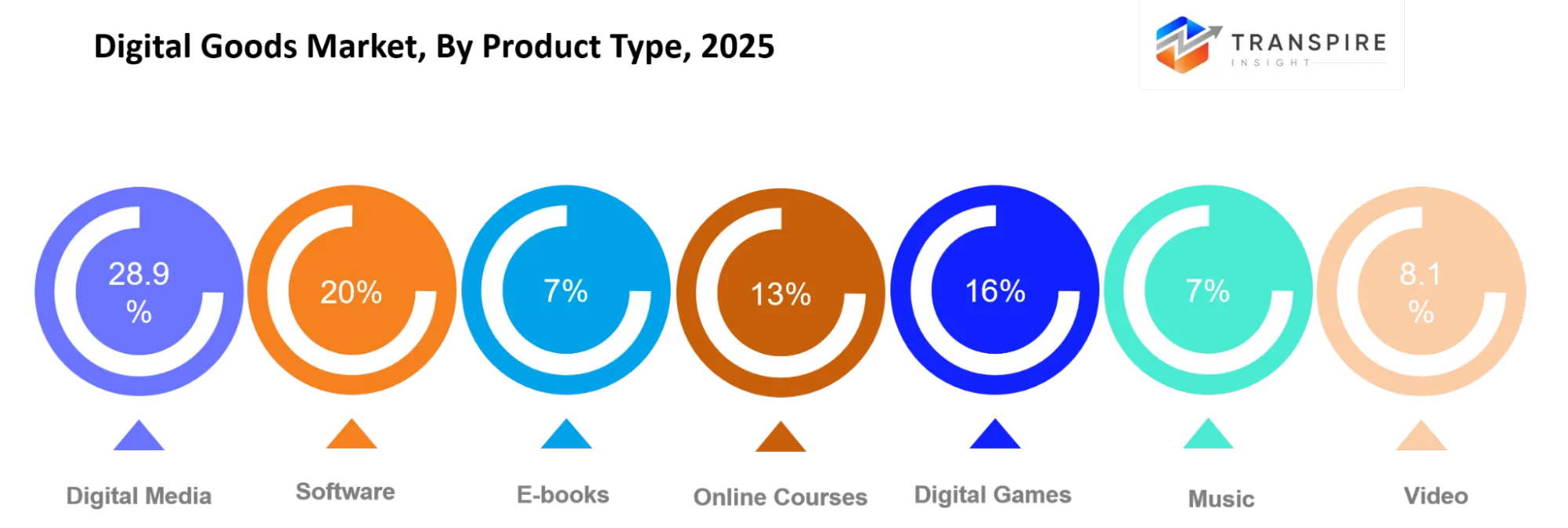
The Digital Games dominated the market, accounting for nearly 45% in 2025 and is expected to rise at a significant CAGR during the forecast period.
The Digital Goods Market is by product into digital media, software, e-books, online courses, digital games, music, video, others. Among these, the Digital Games dominated the market, accounting for nearly 45% in 2025 and expected to increase at a significant CAGR during the forecast period. Digital games were at the top because of the widespread use of smartphones, enhanced gaming environment, in-app purchases, subscriptions, and increased user interaction with downloadable entertainment.
The Mobile gaming dominated the market, accounting for close to 44% in 2025, and is expected to rise at a significant CAGR during the forecast period
The Digital Goods Market is segmented by platform into mobile, desktop, web, cloud, streaming, gaming consoles, vr/ar, others. Among these, the Mobile gaming dominated the market, accounting for close to 44% in 2025 and expected to increase at a significant CAGR during the forecast period. Mobile games were dominant because of widespread use of smartphones, cheap internet connection, easy playability, increasing app ecosystem, and increasing in-app purchases.
The In-app Purchase (IAP) dominated the market, accounting for about 62% in 2025 and is expected to rise at a significant CAGR during the forecast period.
The Digital Goods Market by revenue model into subscription, one-time purchase, freemium, in-app purchase, advertising, pay-per-view, licensing, others. Among these, the In-app Purchase (IAP) dominated the market, accounting for about 62% in 2025 and expected to increase at a significant CAGR during the forecast period. In-app Purchases were dominant because of repeated transactions, convenient mobile payments, personalized content, and increased monetization on gaming and digital platforms.
Regional Segment Analysis of the Digital Goods Market
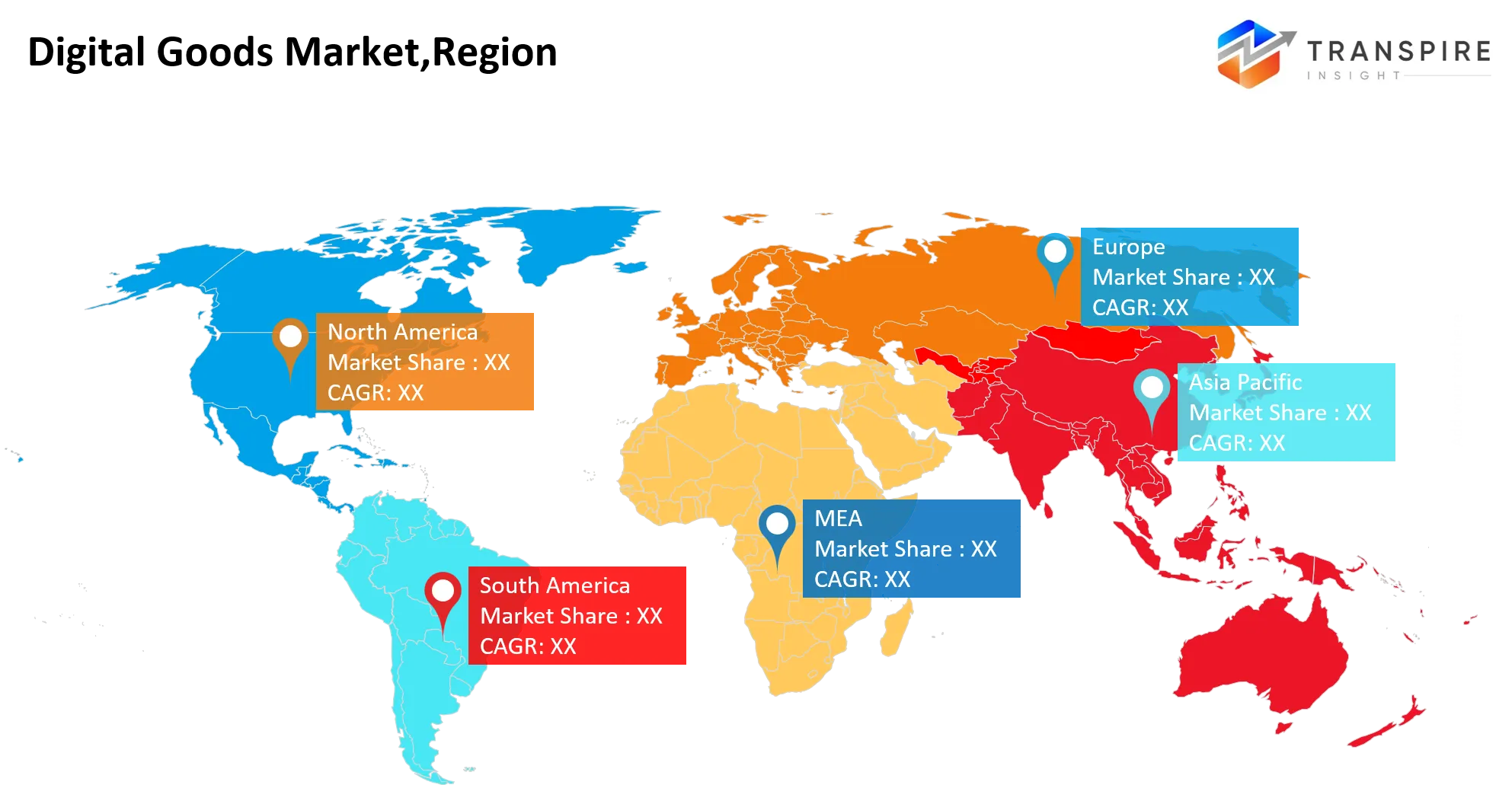
- Europe (Germany, France, U.K., Italy, Spain, Rest of Europe)
- North America (U.S., Canada, Mexico)
- Asia-Pacific (China, Japan, India, Rest of APAC)
- South America (Brazil and the Rest of South America)
- The Middle East and Africa (UAE, South Africa, Rest of MEA)
Asia Pacific is expected to grow at a rapid CAGR in the Digital Goods Market, holding around 55% of the share during the forecast period.
The Asia Pacific region is estimated to exhibit a fast CAGR in the Digital Goods Market, accounting for nearly 55% market share during the forecast period. The key factors behind the dominance of this region include high usage of smartphones and the internet, development of e-commerce platforms, increased adoption of digital payments, and rising consumption of software, gaming content, subscriptions, online courses, and virtual goods. Digitalization in China, India, Japan, and Southeast Asia, coupled with increasing creator economy and technology, drives the demand for digital goods in this region.
North America is the high-growth region in the Digital Goods Market during the period, holding roughly 27% share.
North America is the fastest-growing region in the Digital Goods Market over the forecast period, accounting for nearly 27% market share. The high growth is driven by the high consumption of digital goods, advanced internet infrastructure, high usage of smartphones, and high demand for software, subscriptions, gaming content, online education, and digital media. Technology ecosystem, creator economy, digital payment system, and investments in artificial intelligence and cloud platform drive the adoption of digital goods in the US and Canada.
Europe is the fastest-growing region in the Digital Goods Market during the period, holding nearly 26% share.
Region wise, Europe is expected to be the fastest growing region in the Digital Goods Market for the forecast period, accounting for almost 26% market share. The growth in the region is attributed to higher levels of internet penetration, developments in e-commerce, use of digital payment, and increasing demand for software, subscription services, gaming, digital media, and digital education. The robust creator economy and increased digitization and cloud computing along with investment in artificial intelligence boost the consumption of digital goods.
Strategies for Market Growth in Non-Leading Regions:
The development of non-leading regions via effective and scalable methods of production, distribution, and fulfillment of digital goods would be beneficial for small to medium-sized digital goods producers. The local production of software, digital content, virtual goods, templates, e-courses, and other digital goods, along with regional digital commerce platforms, would lower dependence on foreign suppliers and cut down the distribution cost. The formation of alliances with regional creators, software developers, e-learning companies, video game producers, digital retailers, and content distributors would boost market penetration of digital goods providers. For increasing awareness about digital goods production, cybersecurity, digital payments, intellectual property protection, quality assurance, and platform management, education and improvement of technical skills would be needed. Also, flexible financing, subscription-based services, long-term agreements with platforms, and distribution partnerships would allow making digital goods more accessible to customers. The development of collaboration programs with governments, technology associations, educational establishments, and digital commerce initiatives, along with the use of digital commerce and social media selling channels, would enhance accessibility of digital goods and facilitate their sustainable worldwide market development in developing regions.
Future Market Trends for the Digital Goods Market: -
Digital Products Driven by AI: Generative AI tools, prompts, automatic templates, and AI-based creative assets are broadening the range of digital products and creating new ways to generate revenue.
Immersive Digital Assets: Virtual goods, avatars, game assets, and 3D content are growing popular in metaverse, AR, and VR environments, fueling the demand for digital goods.
Monetization Driven by Creators: More and more individual creators start to monetize templates, online classes, creative assets, and downloadable digital products directly.
Recent Development
In June 1, 2026 – Strategic Ecosystem Launch: Next MSC announced the launch of next-generation digital marketplaces leveraging software, subscription models, and enterprise platforms, facilitating digital goods distribution and ecosystem commerce.
In June 2026 – ONDC Expansion Launch: India’s ONDC launched its services to 20 crore buyers and 5 lakh sellers, enabling greater interoperability and accelerated growth of digital goods and services commerce.
In July 15, 2026 – Virtual Assets Market Launch: SkyQuest announced the launch of the virtual assets market due to growing opportunities in digital goods fueled by metaverse technology and AR-based virtual assets.
In July 16, 2026 – Mobile Marketplace Launch: Mobile channels eclipsed 52.5% of digital marketplaces transactions, enabling micro-transactions and accelerating the adoption of digital goods via mobile commerce platforms.
Market Segment
This study forecasts revenue at global, regional and country levels from 2020 to 2033. Transpire Insights has segmented the Digital Goods Market based on the below-mentioned segments:
Digital Goods Market, By Product
- Digital Media
- Software
- E-books
- Online Courses
- Digital Games
- Music
- Video
- Others
Digital Goods Market, By Platform
- Mobile
- Desktop
- Web
- Cloud
- Streaming
- Gaming Consoles
- VR/AR
- Others
Digital Goods Market, By Revenue Model
- Subscription
- One-time Purchase
- Freemium
- In-app Purchase
- Advertising
- Pay-per-view
- Licensing
- Others
Digital Goods Market, By Consumer Type
- Individual
- Enterprise
- Educational
- Government
- Creator
- Professional
- Corporate
- Others
Digital Goods Market, By Distribution
- App Stores
- Websites
- Marketplaces
- Streaming Platforms
- Digital Libraries
- Social Platforms
- Gaming Platforms
- Others
Digital Goods Market, By Content Type
- Entertainment
- Education
- Business
- Productivity
- Communication
- Gaming
- Creative
- Others
Digital Goods Market, By End User
- Consumers
- Businesses
- Students
- Professionals
- Creators
- Developers
- Institutions
- Others
Digital Goods Market, By Regional Analysis
North America
- US
- Canada
- Mexico
Europe
- Germany
- UK
- France
- Italy
- Spain
- Russia
- Rest of Europe
Asia Pacific
- China
- Japan
- India
- South Korea
- Australia
- Rest of Asia Pacific
South America
- Brazil
- Argentina
- Rest of South America
Middle East & Africa
- UAE
- Saudi Arabia
- Qatar
- South Africa
- Rest of the Middle East & Africa
Frequently Asked Questions
Find quick answers to common questions.
Mobile consumption, subscription models, AI-enabled products, digital payments, gaming, and virtual goods are accelerating global Digital Goods Market growth.
AI-powered digital products, mobile gaming, virtual goods, subscriptions, and creator marketplaces offer attractive scalable revenue opportunities.
Subscription models generate recurring revenue, strengthen customer retention, improve revenue predictability, and support continuous monetization across software, media, and gaming.
Asia Pacific presents significant opportunities due to smartphone adoption, expanding digital payments, mobile gaming, and rapidly developing digital commerce ecosystems.
Investors should evaluate digital piracy, cybersecurity threats, platform dependency, subscription churn, intellectual-property concerns, and evolving regulatory requirements.
About the Authors

Mayur Shinde
I am Mayur Shinde, a Senior Research Analyst at Transpire Insight, specializing in the Automotive & Transportation and Information & Communication Technology (ICT) Industry. My work focuses on analyzing emerging market trends, technological advancements, competitive landscapes, and industry developments to deliver accurate, data-driven insights. I am passionate about transforming complex market information into clear, actionable content that helps businesses, professionals, and decision-makers stay informed and make confident strategic decisions.

Chakradhar Khansole
Chakradhar serves as the Research Director at Transpire Insight, bringing over 8 years of experience in technology, innovation, and strategic market intelligence. He specializes in transforming complex market data into actionable business insights that enable organizations to make informed, growth-oriented decisions. Recognized for his strategic vision and analytical expertise, Chakradhar leads high-impact research initiatives, delivering comprehensive market assessments, competitive intelligence, and forward-looking industry analysis.
Recently Published Reports
-
Apr 2026
3D Optical Profiler Market
3D Optical Profiler Market Size, Share & Analysis Report By Type (Desktop 3D Optical Profiler, and Portable 3D Optical Profiler), By Technology (Confocal Technology, and White Light Interference), By End-Use Industry (Manufacturing, Research Institutions, Automotive, Aerospace and Defense, Medical Devices, and Other), and Geography (North America, Europe, Asia-Pacific, Middle East and Africa, South and Central America), 2021 - 2031
-
Apr 2026
Depth Sensor Market
Depth Sensor Market Size, Share & Analysis Report By Type (Infrared Depth Sensors, Time-of-Flight (ToF) Sensors, Stereo Vision Sensors, Structured Light Sensors, Ultrasonic Depth Sensors), By Application (Automotive, Robotics, Gaming, Consumer Electronics, Industrial Automation, Healthcare, Security & Surveillance, Others), By End Users (Automotive Manufacturers, Consumer Electronics Companies, Healthcare Providers, Industrial Companies, Security Agencies, Gaming Companies, Robotics Companies, Others), and Geography (North America, Europe, Asia-Pacific, Middle East and Africa, South and Central America), 2021 – 2031
-
Apr 2026
Digital Manufacturing Market
Digital Manufacturing Market Size, Share & Analysis Report By Component (Hardware, Software, and Services), By Technology (Robotics, 3D Printing, Internet of Things (IoT), and Others), By Application (Automotive and Transportation, Aerospace and Defense, Consumer Electronics, Industrial Machinery, and Others), By Process Type (Computer-Based Designing, Computer-Based Simulation, Computer 3D Visualization, Analytics, and Others), and Geography (North America, Europe, Asia-Pacific, Middle East and Africa, South and Central America), 2021 – 2031
-
Apr 2026
Digital Visa Services Market
Digital Visa Services Market Size, Share & Analysis Report By Type (Individual Travelers, Group Travelers), By Application (Tourism, Business Travel, Others), and Geography (North America, Europe, Asia-Pacific, Middle East and Africa, South and Central America), 2021 – 2031