

United States Massive Open Online Courses (MOOCS) Market Size & Forecast:
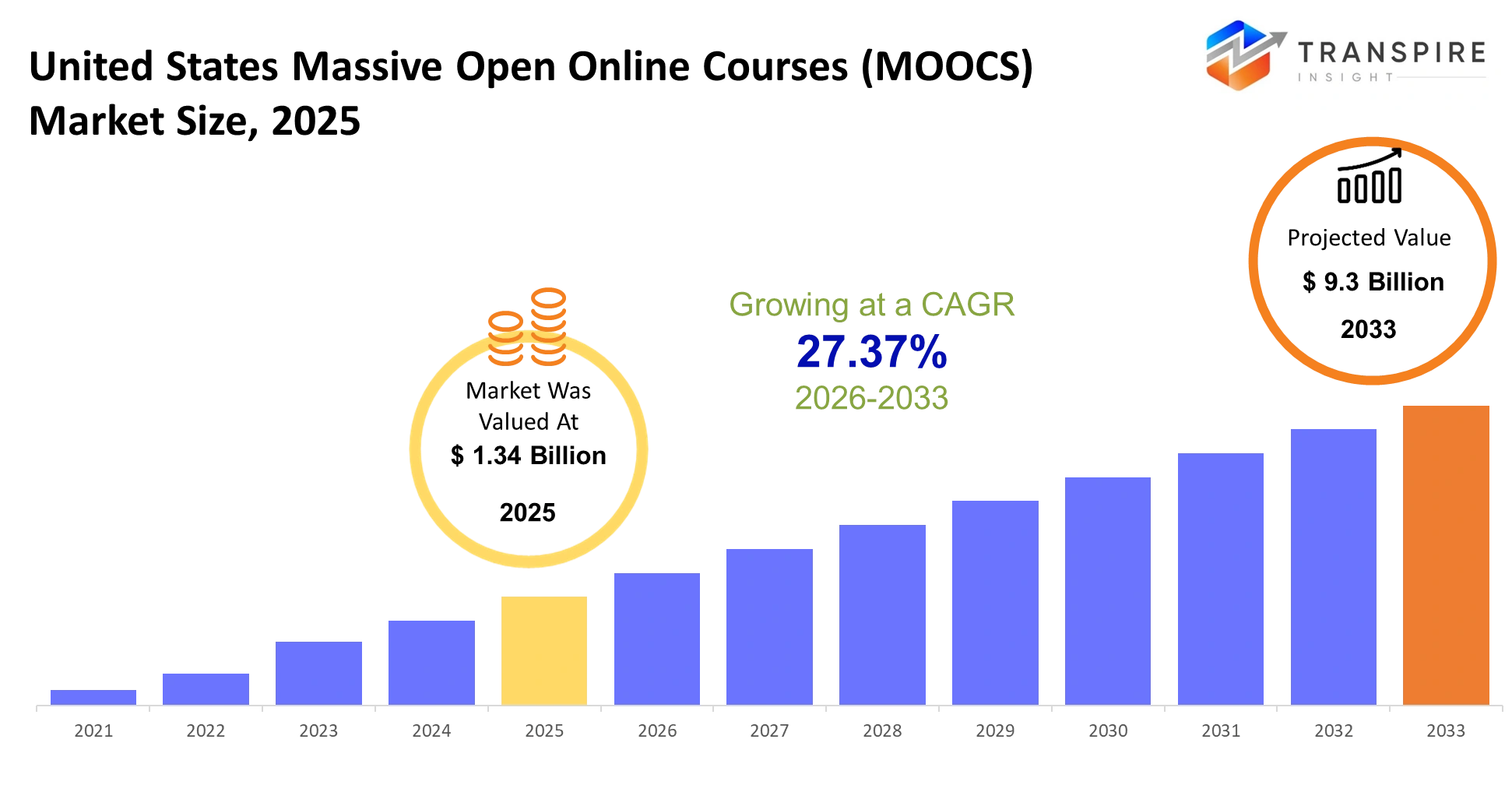
- United States Massive Open Online Courses (MOOCS) Market Size 2025: USD 1.34 Billion
- United States Massive Open Online Courses (MOOCS) Market Size 2033: USD 9.3 Billion
- United States Massive Open Online Courses (MOOCS) Market CAGR: 27.37%
- United States Massive Open Online Courses (MOOCS) Market Segments:By Course Type (Humanities, Business Management, Computer Science & Programming, Science & Technology), By Platform (xMOOCs, cMOOCs), By End User (Students, Professionals, Enterprises).
To learn more about this report,  Download Free Sample Report
United States Massive Open Online Courses (MOOCS) Market Summary:
The United States Massive Open Online Courses (MOOCs) market size is estimated at USD 1.34 billion in 2025 and is anticipated to reach USD 9.3 billion by 2033, growing at a CAGR of 27.37% from 2026 to 2033. The United States Massive Open Online Courses (MOOCs) market continues to grow because more students demand educational programs which provide them with flexible and affordable learning opportunities. The combination of digital technology improvements and the need for upskilling has created a situation where MOOCs now attract students and professionals as well as lifelong learners. The educational institutions and private platforms extend their course offerings through interactive content which teaches industry-specific skills. The market experiences growth because corporate partnerships and remote learning trends enhance educational access while they change how people share knowledge across the country.
Key Market Trends & Insights:
- Learners are increasingly choosing courses that offer practical, job-ready skills rather than theoretical knowledge. The workforce needs of industries today require workers to develop skills which organizations need to maintain their competitive advantage.
- Organizations use MOOC platforms to partner with companies for employee training and skill development programs. The programs enable organizations to create flexible workforces while they decrease both training expenses and training duration.
- Short-term certifications and micro-credentials are gaining popularity because they enable learners to achieve specific educational goals through brief study sessions. The credentials receive extensive recognition from employers, which enhances their value on resumes.
- U.S. universities expand their online educational offerings through MOOC programmes. This approach enables them to provide remote learning opportunities while preserving their institutional academic standards.
- The emergence of self-paced and hybrid learning formats enables working professionals to access educational opportunities. The flexibility of MOOCs serves as the primary factor that drives their increasing use.
United States Massive Open Online Courses (MOOCS) Market Segmentation
By Course Type
- Humanities: The humanities field attracts students who want to study history and philosophy and literature through its course offerings. The courses provide educational content that enables students to study academic material while they want to develop themselves. The educational system enables students to study different cultural and social subjects, which leads to their educational development that goes beyond their professional objectives.
- Business Management: The student body and professional workers show high demand for business management courses which teach leadership and strategic skills development. The courses combine finance and marketing and entrepreneurship education to deliver real-world workplace skills that help students maintain their competitive edge in today's fast-changing business landscape.
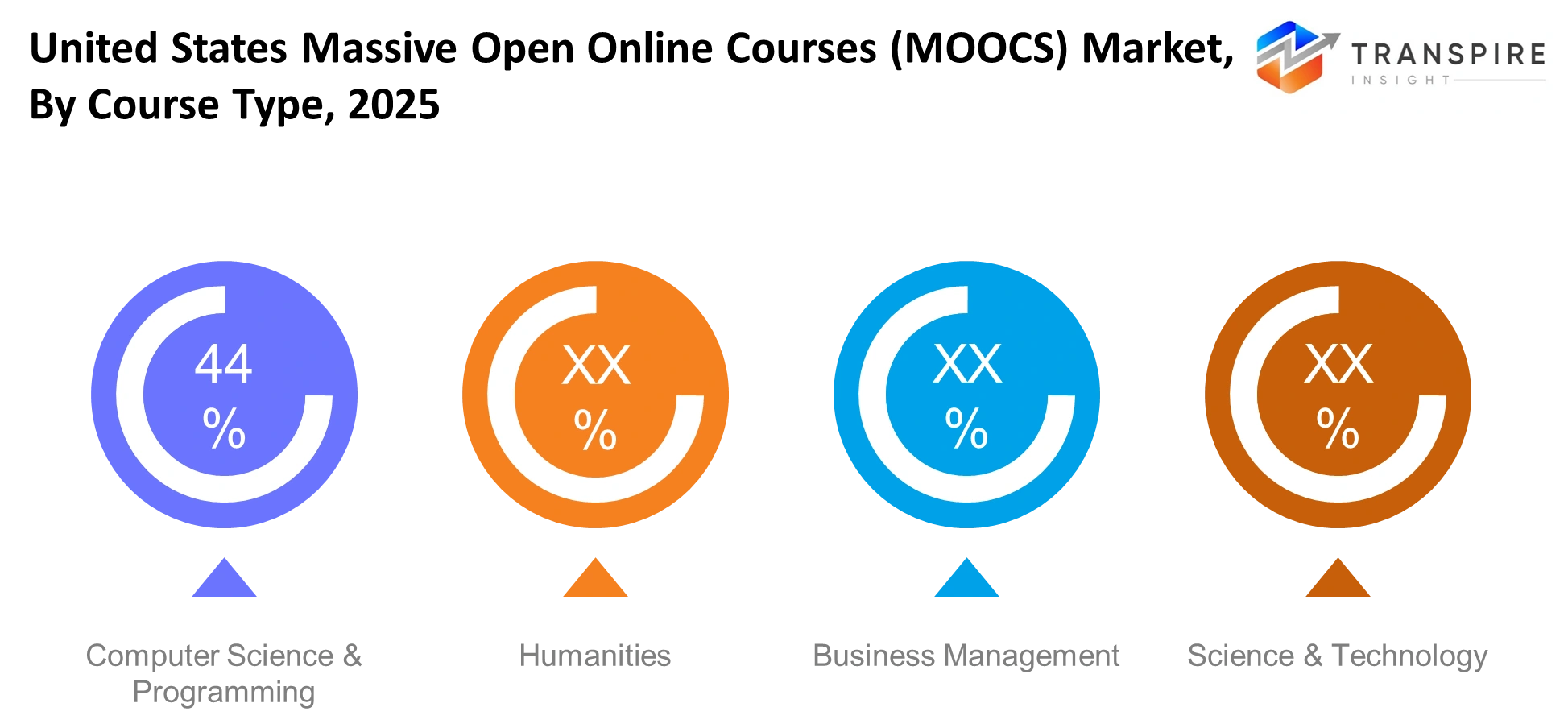
- Computer Science & Programming: The MOOC market exists because of strong demand for technology-related educational content, which drives this segment to become its largest section. Students who want to work in IT fields choose coding and software development and data structure courses. The courses deliver industry-relevant experience through their practical projects and real-world application work.
- Science & Technology: Science and technology education has open opportunities due to the growth in innovation-driven industries. Artificial intelligence and biotechnology and environmental science create research opportunities which attract both professional experts and the general public. The courses combine theoretical knowledge with practical skills development to help students build understanding of difficult subjects while they learn about technological progress.
To learn more about this report, Download Free Sample Report
By Platform
- xMOOCs: xMOOCs use a traditional educational method which includes video lectures and quizzes and assignments. The universities and established platforms offer their courses as formal educational programmes to students. The MOOC format, which requires organised study methods, attracts learners who need structured learning with measurable results.
- cMOOCs: cMOOCs enable users to work together with others to create new knowledge which they can share with their peers. The learning process enables students to participate in various activities, which include discussions and blogs and peer interactions. The approach lets students learn through community-based activities while developing their critical thinking skills and building their professional networks.
By End User
- Students: Students represent a major user group who use MOOCs to support their academic studies and learn about new topics. The platforms enable students to access various courses which extend beyond their regular academic programmes, enabling them to develop extra skills and earn certifications which help them prepare for future employment in a competitive job market.
- Professionals: Working professionals increasingly rely on MOOCs for upskilling and career growth. The courses provide flexible learning options which enable people to acquire current industry knowledge through actual market needs. The professional development of people in their current jobs and new career paths uses MOOCs as a learning platform which enables them to study at their own pace.
- Enterprises: Enterprises use MOOCs to provide employee training which helps boost their workforce efficiency. Organisations achieve standardised learning delivery through online course integration into their corporate training systems. This method decreases training expenses while enabling employees to acquire critical skills that match organisational objectives.
Country Insights
The United States Massive Open Online Courses (MOOCs) market shows a constant development of new ideas which provides educational opportunities and meets the changing needs of learners. The country has established itself as the top nation for online education because of its extensive digital infrastructure and its ability to provide internet access to all its citizens. People from all age groups use MOOCs to develop new skills which help them change their careers or explore their personal interests through self-paced learning. The system gains strength from its association with top universities and major educational technology companies, which provide students access to high-quality content that matches current industry requirements. Educational institutions and corporations are working together to develop courses which focus on practical results through their growing partnership. The U.S. market benefits from its established cultural tradition which supports people to engage in learning activities throughout their entire professional journey. The increasing use of remote work and hybrid work setups has established MOOCs as essential tools which help people develop necessary skills while providing educational opportunities that meet current workplace requirements.
Recent Development News
In December 2025, Coursera to Acquire Udemy in $2.5 Billion Deal to Expand AI Training: The U.S. MOOC industry is witnessing platform consolidation because providers need to expand their operations in order to meet increasing demand from businesses which require AI training programmes.
In December 2025, Major U.S. Online Learning Platforms Merge to Target AI Upskilling Demand: This merger reflects a broader shift toward workforce reskilling, with companies investing heavily in online learning platforms.
|
Report Metrics |
Details |
|
Market size value in 2025 |
USD 1.34 Billion |
|
Market size value in 2026 |
USD 1.71 Billion |
|
Revenue forecast in 2033 |
USD 9.3 Billion |
|
Growth rate |
CAGR of 27.37% from 2026 to 2033 |
|
Base year |
2025 |
|
Historical data |
2021 – 2024 |
|
Forecast period |
2026 – 2033 |
|
Report coverage |
Revenue forecast, competitive landscape, growth factors, and trends |
|
Country scope |
United States |
|
Key company profiled |
Coursera Inc., edX Inc., Udemy Inc., FutureLearn Ltd., Udacity Inc., LinkedIn Learning, Skillshare Inc., Pluralsight Inc., Khan Academy, Canvas Network, Alison Ltd., Simplilearn Solutions Pvt. Ltd., MasterClass Inc., OpenLearning Ltd., DataCamp Inc. |
|
Customization scope |
Free report customization (country, regional & segment scope). Avail customized purchase options to meet your exact research needs. |
|
Report Segmentation |
By Course Type (Humanities, Business Management, Computer Science & Programming, Science & Technology), By Platform (xMOOCs, cMOOCs), By End User (Students, Professionals, Enterprises). |
Key United States Massive Open Online Courses (MOOCS) Company Insights
The United States' Massive Open Online Courses (MOOCs) market is shaped by a mix of established platforms and innovative edtech companies which develop new digital learning solutions. The companies develop interactive educational materials and easy-to-use platforms and profession-based training programmes to attract all types of students. The development of course content through university and corporate partnership agreements boosts educational institution trustworthiness. Advanced technologies, which include AI, are being adopted by multiple organisations to create customized educational paths for their students. The increasing competition in the market forces companies to offer more affordable products which provide valuable certifications and essential job-related skills to boost their market share.
Company List
- Coursera Inc.
- edX Inc.
- Udemy Inc.
- FutureLearn Ltd.
- Udacity Inc.
- LinkedIn Learning
- Skillshare Inc.
- Pluralsight Inc.
- Khan Academy
- Canvas Network
- Alison Ltd.
- Simplilearn Solutions Pvt. Ltd.
- MasterClass Inc.
- OpenLearning Ltd.
- DataCamp Inc.
United States Massive Open Online Courses (MOOCS) Market Report Segmentation
By Course Type
- Humanities
- Business Management
- Computer Science & Programming
- Science & Technology
By Platform
- xMOOCs
- cMOOCs
By End User
- Students
- Professionals
- Enterprises
Frequently Asked Questions
Find quick answers to common questions.
The Approximate United States Massive Open Online Courses (MOOCS) Market size for the Market will be USD 9.3 Billion in 2033.
The key Segments of the United States Massive Open Online Courses (MOOCS) Market are By Course Type (Humanities, Business Management, Computer Science & Programming, Science & Technology), By Platform (xMOOCs, cMOOCs), By End User (Students, Professionals, Enterprises).
Major Players in the United States Massive Open Online Courses (MOOCS) Market are Coursera Inc., edX Inc., Udemy Inc., FutureLearn Ltd., Udacity Inc., LinkedIn Learning, Skillshare Inc., Pluralsight Inc., Khan Academy, Canvas Network, Alison Ltd., Simplilearn Solutions Pvt. Ltd., MasterClass Inc., OpenLearning Ltd., DataCamp Inc.
The Current Market size of the United States Massive Open Online Courses (MOOCS) Market is USD 1.34 Billion in 2025.
The United States Massive Open Online Courses (MOOCS) Market CAGR is 27.37%.
- Coursera Inc.
- edX Inc.
- Udemy Inc.
- FutureLearn Ltd.
- Udacity Inc.
- LinkedIn Learning
- Skillshare Inc.
- Pluralsight Inc.
- Khan Academy
- Canvas Network
- Alison Ltd.
- Simplilearn Solutions Pvt. Ltd.
- MasterClass Inc.
- OpenLearning Ltd.
- DataCamp Inc.
Recently Published Reports
-
Apr 2026
3D Optical Profiler Market
3D Optical Profiler Market Size, Share & Analysis Report By Type (Desktop 3D Optical Profiler, and Portable 3D Optical Profiler), By Technology (Confocal Technology, and White Light Interference), By End-Use Industry (Manufacturing, Research Institutions, Automotive, Aerospace and Defense, Medical Devices, and Other), and Geography (North America, Europe, Asia-Pacific, Middle East and Africa, South and Central America), 2021 - 2031
-
Apr 2026
Depth Sensor Market
Depth Sensor Market Size, Share & Analysis Report By Type (Infrared Depth Sensors, Time-of-Flight (ToF) Sensors, Stereo Vision Sensors, Structured Light Sensors, Ultrasonic Depth Sensors), By Application (Automotive, Robotics, Gaming, Consumer Electronics, Industrial Automation, Healthcare, Security & Surveillance, Others), By End Users (Automotive Manufacturers, Consumer Electronics Companies, Healthcare Providers, Industrial Companies, Security Agencies, Gaming Companies, Robotics Companies, Others), and Geography (North America, Europe, Asia-Pacific, Middle East and Africa, South and Central America), 2021 – 2031
-
Apr 2026
Digital Manufacturing Market
Digital Manufacturing Market Size, Share & Analysis Report By Component (Hardware, Software, and Services), By Technology (Robotics, 3D Printing, Internet of Things (IoT), and Others), By Application (Automotive and Transportation, Aerospace and Defense, Consumer Electronics, Industrial Machinery, and Others), By Process Type (Computer-Based Designing, Computer-Based Simulation, Computer 3D Visualization, Analytics, and Others), and Geography (North America, Europe, Asia-Pacific, Middle East and Africa, South and Central America), 2021 – 2031
-
Apr 2026
Digital Visa Services Market
Digital Visa Services Market Size, Share & Analysis Report By Type (Individual Travelers, Group Travelers), By Application (Tourism, Business Travel, Others), and Geography (North America, Europe, Asia-Pacific, Middle East and Africa, South and Central America), 2021 – 2031