

Die Casting Market Summary:
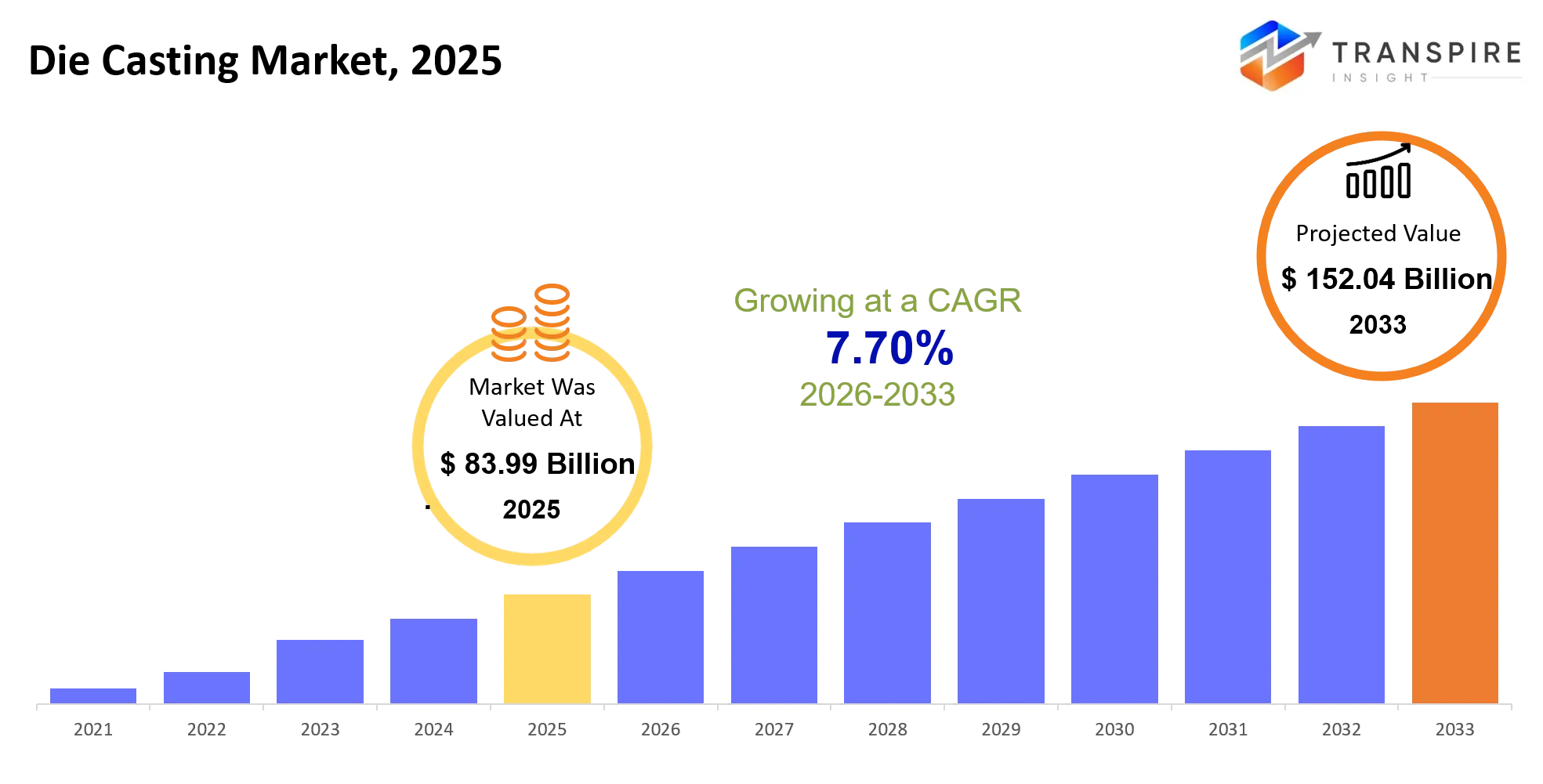
As per the Transpire Insight Analysis, The Die Casting Market size is estimated at USD 83.99 billion in 2025 and is anticipated to reach USD 152.04 billion by 2033, growing at a CAGR of 7.70 % from 2026 to 2033.
The automotive die casting market delivers high-volume, precision metal components used within vehicles, electronics, industrial machinery, appliances, and infrastructure, such as motor housings, transmission housings, heat sinks, enclosures, and structural frames. This industry has shifted over the last 3-5 years from extensive small metal mechanical components into large, lightweight aluminium structural castings for electric vehicles. Tesla's ride on large single-piece rear underbody castings has brought the concept into practical use and helped automakers understand that multiple welded and stamped parts can be consolidated down to fewer cast parts, saving assembly processes, material logistics, joint operations, and defects.
European automotive circularity legislation has increased concern about recycled aluminium content, and foundries are installing closed-loop scrap collection and lower-energy melting techniques. Electrified and lightweight vehicle architectures need integrated aluminium components, forcing capacity upgrades for high-pressure casting, automation, and alloy research, while also increasing investments in machinery, tooling, process monitoring, and qualified casting partners.
Die Casting Market Size & Forecast:
- Market Size 2025: USD 83.99 Billion
- Expected Market Value (2033): USD 152.04 Billion
- Forecast CAGR (2026–2033): 7.70%
- Leading Region in 2025: Asia-Pacific
- Fastest Growing Region: North America
- Key Company Profiles: Nemak, Ryobi, Rheinmetall, GF Casting Solutions, Endurance Technologies, Ahresty, Dynacast, Pace Industries, Gibbs Die Casting, Shiloh Industries, Sandhar Technologies, Meridian Lightweight Technologies, Toyota Industries, Bühler, Form Technologies.
Key Die Casting Market Insights:
The market is transitioning from traditional small parts production to integrated low-porosity aluminium structures for EVs, and the reliability of the process and material circularity are more valuable than just the quantity of output. Automotive redesign, megacasting investment, and recycled-metal rules are driving a shift in supplier selection toward foundries that possess engineering depth and automation, and that are located near OEMs.
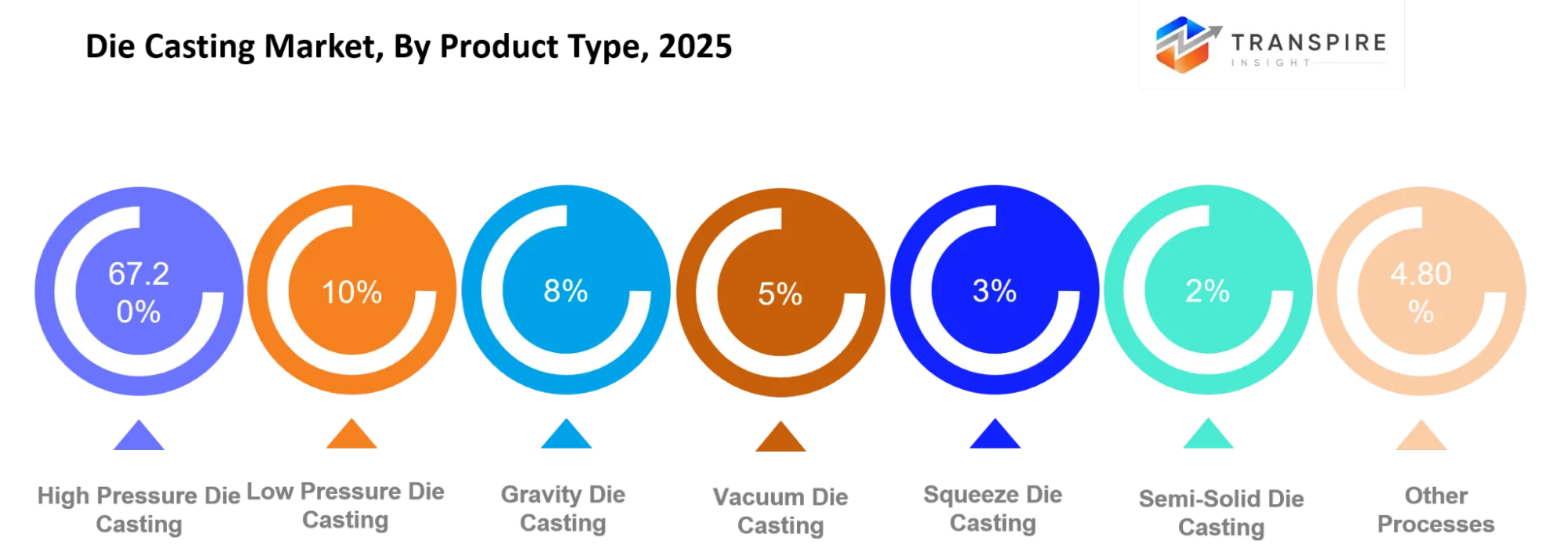
- High Pressure Die Casting accounts for 67.20%, and Bühler's 50th Carat megacasting order is a sign of the trend toward larger structural parts and fewer assembly operations.
- Low Pressure Die Casting accounts for 10.00%, and suppliers are applying controlled filling to meet more stringent OEM qualification requirements for higher integrity chassis and safety parts.
- Gravity Die Casting is 8.00%; foundries keep it for thicker, lower-volume parts where tooling flexibility is more important than maximum cycle time.
- Vacuum Die Casting is a 5.00% contributor and is gaining traction as it becomes necessary to control porosity for EV battery trays and structural castings.
- Asia Pacific accounts for 55.30% of the market, with the installation of two 92,000-kN Carat cells in Vietnam reflecting a regional shift towards EV megacasting capacity.
- Europe accounts for 20.00%, and new circularity rules are driving up the recovery of recycled aluminium and demand for traceable low-carbon castings.
- North America's share is 18.00%, and local megacasting investment is growing as automakers look for shorter supply chains and fewer steps in vehicle assembly.
- In the Middle East and Africa, the CAGR is 6.20%, and the infrastructure, industrial diversification, and regional automotive investment provide a longer-term entry point.
What are the Key Drivers, Restraints, and Opportunities in the Die Casting Market?
Driver:
Vehicle electrification and lightweight platform redesign are the central growth engines. EV manufacturers need battery housings, e-axle cases, inverter enclosures, motor frames, and crash-relevant structural members that are light yet rigid. The driver is the need to preserve driving range while simplifying vehicle assembly. High-pressure aluminium die casting enables suppliers to replace multi-part welded assemblies with integrated components, reducing joining operations and improving production-line throughput. As OEMs redesign platforms around these parts, die casters gain revenue not only from casting volume, but also from higher-value tooling, engineering support, automation cells, vacuum systems, and quality validation.
Restraint:
The sector remains exposed to alloy-price volatility, high electricity consumption, and expensive tooling. Aluminium can represent 40–50% of production cost in automotive die casting, while large structural programs require costly dies, high-tonnage machines, thermal management, and defect-control systems. This persists because quality depends on narrow process windows: porosity, die erosion, and thermal stress cannot be solved simply by buying cheaper inputs.
Opportunity:
Recycled aluminium and closed-loop scrap systems can create a stronger cost and compliance proposition. The EU’s 2026 vehicle-circularity framework introduces future recycled-aluminium requirements and stronger material documentation, encouraging foundries to improve scrap segregation, traceability, remelting, and low-carbon alloy sourcing. At the same time, AI-based inspection can reduce quality losses: 2026 research demonstrated thermographic computer vision for identifying internal defects in engine-block die casting. Together, circular materials and data-driven quality control can help suppliers win programs that evaluate lightweighting, traceability, and yield together. This supports longer-term supplier relationships and program qualification.
What Has the Impact of Artificial Intelligence Been on the Die Casting Market?
AI helps die casters make better quality parts by translating machine and process signals into critical decisions before expensive scrap occurs: machine-learning algorithms analyse the entire shot pressure curve, and a host of process parameters including metal and die temperature, fill speed, cooling rate, vacuum level, and cycle-time information to pinpoint the recipe or process window that's the cause of porosity, cold shuts, surface defects, or dimensional variation. The algorithm can then suggest tweaks to pouring temperature, injection and fill parameters, mould preheat, cooling time, or gating conditions to improve quality, consistency, and throughput.
AI also enhances predictive maintenance, identifying when to adjust control systems before a defective part or component, die, or peripheral process results in downtime. Pressure, vibration, hydraulic condition, lubricant use, cycle time abnormalities, and more can be detected by AI before the equipment produces scrap, enabling pre-emptive correction. In foundry deployments, computer vision systems that monitor shot or machined parts have been effective at diagnosing surface problems and boosting first-pass yield. Case studies show a strong benefit from process and traceability AI, reducing scrap when the data is rich.
In July 2026, YIZUMI launched its LEAP series die casting machines integrated with the Yi+AI platform. This system implements five distinct AI-driven operational scenarios that analyse real-time production telemetry to recommend optimised process parameters, autonomously alert operators to defect risks, and significantly lower factory energy consumption.
Key Die Casting Market Trends:
The market is shifting from traditional component suppliers to integrated manufacturing cells with lightweight alloys, fewer-part vehicle architectures, and digital monitoring. Not only casting capabilities, but also defect control, recycled-material capability, and engineering collaboration are essential to achieve competitive advantage.
- The redesign of the EV platform is driving a change in orders from powertrain components to battery trays, motor housings, inverter cases, and structural aluminium castings.
- Giga-casting is the process of replacing assemblies of hundreds of stamped and welded parts with single large high-pressure aluminium sections.
- Lower porosity and more reliable mechanical performance of structural components are driving the use of vacuum-assisted processes by automakers.
- Lightweighting is helping to extend EV range and meet fuel efficiency goals, with aluminium gaining share over heavier materials.
- European vehicle policy is changing the way vehicles are purchased, with a focus on recycled content and on lower carbon supply chains for aluminium.
- Energy consumption is being reduced due to electric melting, holding, and distribution systems as compared to conventional aluminium melting systems.
- Foundries are using IIoT sensors and AI to optimise temperature, injection, cooling, and vacuum during manufacturing.
- Computer vision is making the transition from manual sampling to quicker, more repeatable defect detection and corrective feedback.
- The high tonnage presses are driving suppliers to provide design-for-casting skills as well as manufacturing capability.
- Thin-wall housings, heat sinks, connectors, and thermal-management components are keeping thin-wall housings alive.
Die Casting Market Segmentation
Process Type:
High Pressure Die Casting (HPDC) holds the leading 67.20% share, reflecting its suitability for high-volume automotive, electronics, and appliance components requiring repeatability, thin walls, and short cycle times. Its future importance will increase as EV programs adopt larger structural castings and integrated housings. Low Pressure Die Casting accounts for 10.00%, serving applications where controlled filling and improved metallurgical quality are more important than maximum output. Gravity Die Casting represents 8.00%, remaining relevant for lower-volume, thicker-wall, and complex parts. Vacuum Die Casting contributes 5.00% and is expanding as OEMs require reduced porosity for safety-critical and heat-treated structural parts. Squeeze Die Casting holds 3.00%, while Semi-Solid Die Casting represents 2.00%; both support higher-integrity components but face higher equipment and process-control requirements. Other processes account for 4.80%.
Material:
Aluminium leads because its low weight, corrosion resistance, recyclability, and thermal conductivity suit EV structures, motor housings, and thermal-management components. Zinc remains important for detailed, dimensionally precise parts, while magnesium supports further lightweighting where controlled alloy processing is required. Copper, lead, tin, and other alloys serve specialised electrical, shielding, wear-resistant, and industrial applications. Recycled-aluminium requirements are also becoming more influential in sourcing, alloy qualification, and production planning as vehicle circularity regulations strengthen across major automotive markets.
Application:
Automotive remains the principal demand centre, supported by industrial machinery, consumer electronics, aerospace and defence, telecommunications, construction, medical devices, and other applications. Automotive casting is shifting toward battery housings, motor components, e-powertrain parts, and body structures as vehicle architectures change. Consumer electronics and telecommunications increasingly require compact enclosures with efficient heat dissipation and dimensional precision. Industrial applications provide diversification through equipment housings, machinery components, and thermal parts, while aerospace and medical applications emphasise material consistency, reliability, and controlled production.
Production Type:
Cold-chamber systems remain important for aluminum and magnesium casting, while hot-chamber machines efficiently support zinc-based components. Automated and robotic cells are gaining preference because they stabilize cycle times, reduce manual handling, improve workplace safety, and generate process data for quality monitoring. Semi-automated and manual systems remain relevant for flexible or lower-volume operations. Hybrid production provides a practical transition path for established facilities, allowing legacy presses to receive sensors, automated material handling, robotic extraction, and digital monitoring without complete equipment replacement.
End User:
OEMs and Tier-1 suppliers establish demanding specifications for structural, powertrain, thermal, and functional components, while Tier-2 suppliers, foundries, contract manufacturers, industrial producers, and aftermarket companies address specialized requirements. OEM-linked suppliers increasingly participate earlier in component design, tooling development, simulation, and validation. Foundries capable of co-developing tooling and qualifying recycled alloys can shift from transactional production toward strategic engineering partnerships. This deeper involvement can improve program retention while helping customers manage material traceability, quality requirements, production scalability, and increasingly complex component architectures.
Component:
Engine and transmission parts remain significant, while structural components, housings and enclosures, heat sinks, wheels and chassis, and electrical components gain strategic importance. Vehicle electrification is redirecting casting value toward battery structures, motor housings, thermal-management parts, and integrated chassis components. Large structural castings can consolidate multiple assemblies, reducing joining operations, component count, and downstream handling. Heat sinks and electrical housings benefit from aluminum’s thermal and weight characteristics. Future component development will increasingly prioritise dimensional control, defect prevention, recyclability, and integrated manufacturing.
What are the Key Use Cases Driving the Die Casting Market?
The core use case is automotive component production, aligned with High Pressure Die Casting’s 67.20% process share. It supports engine, transmission, structural, housing, wheel, and chassis parts where cycle speed and part consolidation reduce manufacturing cost. EV architectures are strengthening battery housing and motor-related applications requiring lightweight, rigid castings.
Expanding applications span industrial machinery, consumer electronics, telecommunications, construction, aerospace and defence, and medical devices. Heat sinks, electrical enclosures, equipment housings, and complex structural parts benefit from repeatable production.
Emerging use cases centre on large integrated castings, recycled-aluminium components, and digitally monitored cells. Automated and robotic systems increasingly combine casting, trimming, inspection, and traceability, helping suppliers meet quality and circularity requirements.
|
Report Metrics |
Details |
|
Market size value in 2025 |
USD 83.99 Billion |
|
Market size value in 2026 |
USD 90.46 Billion |
|
Revenue forecast in 2033 |
USD 152.04 Billion |
|
Growth rate |
CAGR of 7.70% from 2026 to 2033 |
|
Base year |
2025 |
|
Historical data |
2021 - 2024 |
|
Forecast period |
2026 - 2033 |
|
Report coverage |
Revenue forecast, competitive landscape, growth factors, and trends |
|
Regional scope |
United States; Canada; Mexico; United Kingdom; Germany; France; Italy; Spain; Denmark; Sweden; Norway; China; Japan; India; Australia; South Korea; Thailand; Brazil; Argentina; South Africa; Saudi Arabia; United Arab Emirates |
|
Key companies profiled |
Nemak, Ryobi, Rheinmetall, GF Casting Solutions, Endurance Technologies, Ahresty, Dynacast, Pace Industries, Gibbs Die Casting, Shiloh Industries, Sandhar Technologies, Meridian Lightweight Technologies, Toyota Industries, Bühler, Form Technologies. |
|
Customization scope |
Free report customisation (country, regional & segment scope). Available customised purchase options to meet your exact research needs. |
|
Report Segmentation |
Process Type (High Pressure Die Casting, Low Pressure Die Casting, Gravity Die Casting, Vacuum Die Casting, Squeeze Die Casting, Semi-Solid Die Casting, Other Processes); Material (Aluminum, Zinc, Magnesium, Copper, Lead, Tin, Other Alloys); Application (Automotive, Industrial Machinery, Consumer Electronics, Aerospace & Defense, Telecommunications, Construction, Medical Devices, Other Applications); Production Type (Hot-Chamber, Cold-Chamber, Automated, Semi-Automated, Manual, Robotic, Hybrid); End User (OEMs, Tier-1 Suppliers, Tier-2 Suppliers, Foundries, Contract Manufacturers, Industrial Producers, Aftermarket); Component (Engine Components, Transmission Components, Structural Components, Housing & Enclosures, Heat Sinks, Wheels & Chassis, Electrical Components, Other Components). |
Which Regions are Driving the Die Casting Market Growth?
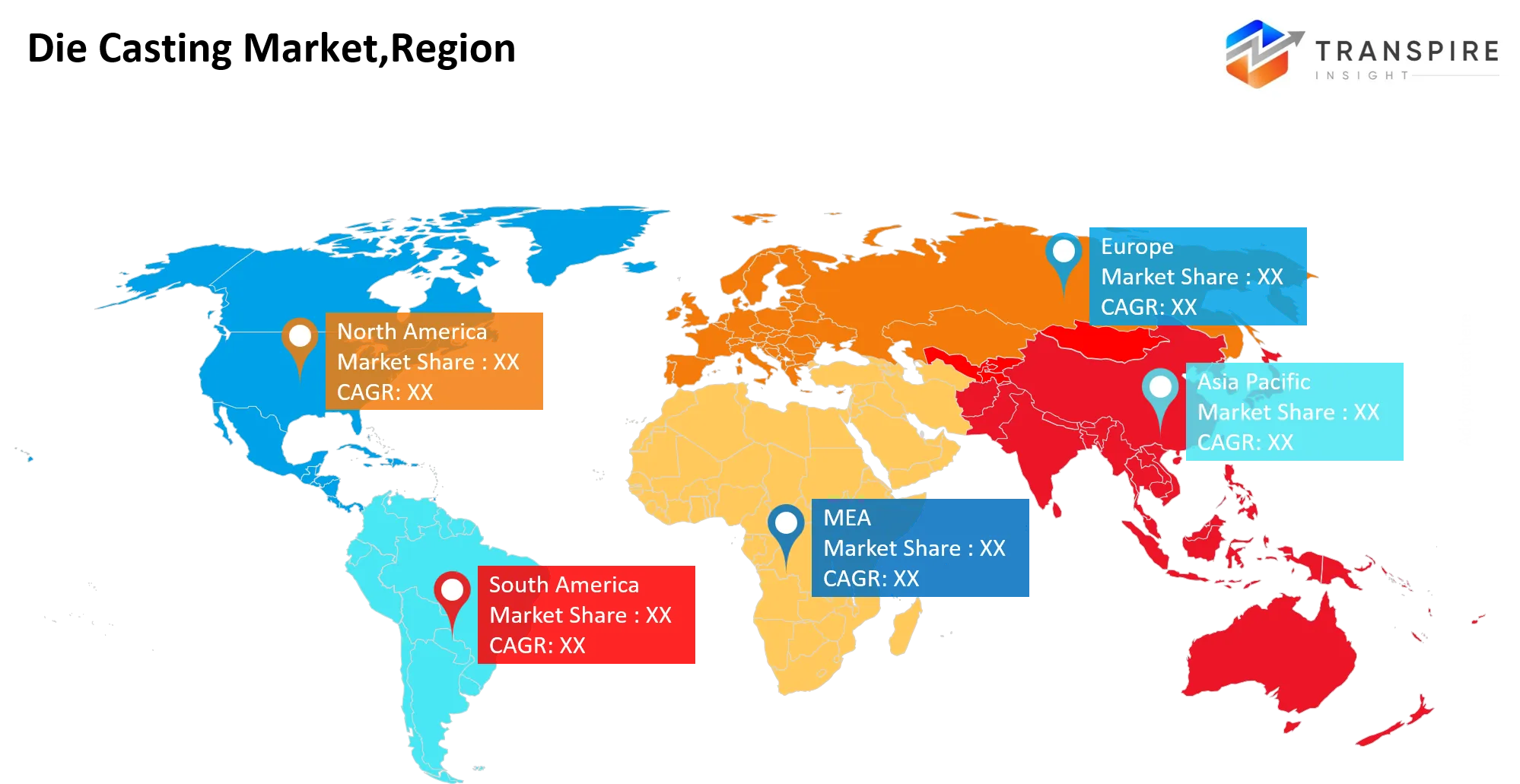
Asia Pacific currently leads the die casting market share at 55.30% due to vehicle production, electronics manufacturing, alloy supply, and engineering provision from China, Japan, South Korea, and India. As well as the region's apparent edge, the rapid adoption of new-energy vehicles comes with the need for battery trays, motor housings, inverter cases, and structural aluminium components. In China, the enormous EV industry feeds demand for high-pressure diecasting and megacasting, and in India, domestic manufacturing ensures casting and machining capacity at a local level; meanwhile, regional suppliers such as Bühler are investing in megacasting lines such as the Carat 920, which will be used in Vietnam for EV battery trays and rear underbodies.
In September 2026, Bühler Group celebrated a major 20-year die-casting partnership milestone with Hyundai Motor Group. By delivering 43 advanced die-casting systems, including Carat and Evolution machines, across production facilities in South Korea, China, and India, the collaboration directly enhances regional supply chains and manufacturing capabilities for structural automotive components.
Europe is 20.00% of the market with a significant emphasis on engineering excellence, premium vehicles, emissions compliance, and circular input materials. Europe's strength is based upon long-standing relationships between OEMs and Tier-1 suppliers, sophisticated tooling strength, and regulatory needs around recycled aluminium and end-of-life vehicle recovery. Nemak's buyout of GF Casting Solutions' automotive division helps to strengthen the region's structural-casting ecosystem as well as providing a foothold into premium European and Chinese OEMs.
In February 2026, Nemak completed the acquisition of GF Casting Solutions' automotive business from Georg Fischer for an enterprise value of US$336 million. This strategic transaction reorients Nemak's manufacturing footprint toward sustainable e-mobility and structural chassis components by integrating nine production facilities across Europe, Asia, and North America.
North America 18.00% Latin America 4.00% Despite being vehicle localisation and nearshoring economies, Latin America and North America differ in their growth story from the manufacturing density in Asia Pacific. The Middle East and Africa account for 2.70% of the market today, but are growing the fastest at a CAGR of 6.20%, driven by diversification of industries, investment in infrastructure, and upcoming automotive supply chain projects. There is an opportunity to develop recycling plants, regional foundries, and low-carbon manufacturing locations before the market gets saturated.
In March 2026, General Motors (GM) Mexico announced a major US$1 billion investment to scale and secure its manufacturing operations. This funding supports vehicle localization and regional supply chain resilience in North America amid evolving trade policies.
https://procurementmag.com/news/general-motors-strategy-shield-supply-chains
Who are the Key Players in the Die Casting Market, and how do they compete?
Industry competition is divided among automotive casting specialists, regional players, precision component companies, and equipment manufacturers. Players compete based on large-structure production, alloy knowledge, scrap avoidance, machining capability, location, and electric vehicle platform-qualified parts. The sector is also increasingly consolidating, with a recent example being Nemak's purchase of GF Casting Solutions' automotive division – the deal adds a second high-pressure casting facility to Nemak's portfolio, which today has close to 80% of its products targeted for e-mobility and structural/chassis.
Nemak, GF Casting Solutions, Rheinmetall, Ryobi, Ahresty, Endurance Technologies, Shiloh Industries, Meridian Lightweight Technologies, Toyota Industries and Sandhar Technologies are all focused on auto scale, lightweight alloys and regional production. Nemak is targeting expansion through portfolio integration and large structural equipment. GF and Rheinmetall bring the advantage of complex aluminium and magnesium engineering. Ryobi invests in plant development and EV localisation. Endurance Technologies is expanding its Indian plant capacity, while Meridian Lightweight Technologies focuses on lightweight magnesium and aluminium systems. Dynacast and Form Technologies compete through high-precision zinc and aluminium components, miniaturisation and multi-site services. Pace Industries and Gibbs Die Casting focus on customer-specific tooling, prototyping and speed in North America. Bhler competes as an equipment supplier and process technologist; its Carat platform can deliver clamping forces up to 92,000kN and help OEMs and suppliers industrialise mega casting. Toyota Industries is specialised in captive manufacturing and vehicle-system integration, creating added value in quality, process alignment and OEM long-term programmes.
Key players are:
- Nemak
- Ryobi
- Rheinmetall
- GF Casting Solutions
- Endurance Technologies
- Ahresty
- Dynacast
- Pace Industries
- Gibbs Die Casting
- Shiloh Industries
- Sandhar Technologies
- Meridian Lightweight Technologies
- Toyota Industries
- Bühler
- Form Technologies
Recent Development News
- In September 2026, ArtiFlex Holdings acquired a casting facility in Jackson, Tennessee, and launched ArtiCast Jackson to expand high-pressure die-casting and manufacturing capacity in the southeastern United States. The new operation strengthens regional production capacity and supports additional manufacturing programs requiring advanced die-cast components.
- In August 2026, Jaya Hind Industries announced an investment of INR 6 billion over two years to expand manufacturing capabilities and die-casting capacity at its facilities in Pune and Chennai. The investment is expected to increase production capacity and support the company’s growing requirements for advanced aluminium cast components.
- In September 2026, Highway Roop Precision Technologies This acquisition adds complex aluminium die-casting and precision-machining capabilities to the company's existing automotive component platform.
What Strategic Insights Define the Future of the Die Casting Market?
The market will move toward integrated, low-part-count vehicle architectures, where high-pressure die casting, vacuum, robotics, simulation, and quality AI control are seen as one production system. The real hidden danger is not demand softening but qualification complexity: recycled aluminium chemistry, die wear, porosity, repairability, and structural safety will need to be stable in every plant worldwide. The new circularity regulations in Europe will also pressure for traceable secondary aluminium and may raise the cost of non-compliant suppliers. The downstream opportunity exists in combining mega casting with circular scrap recovery, digital passports and predictive process control across new markets such as India, Southeast Asia, Mexico and the Middle East. Suppliers should therefore selectively develop large presses, vacuum, alloy laboratories, sensorised tooling and integrated machining, and engage early with OEMs in new part co-design, as the future value for others will move away from the casting sale towards weight saving, defect-free production, recyclability and lower assembly cost.
Key Segmentations are:
Process Type
- High Pressure Die Casting
- Low Pressure Die Casting
- Gravity Die Casting
- Vacuum Die Casting
- Squeeze Die Casting
- Semi-Solid Die Casting
- Other Processes
Material
- Aluminium
- Zinc
- Magnesium
- Copper
- Lead
- Tin
- Other Alloys
Application
- Automotive
- Industrial Machinery
- Consumer Electronics
- Aerospace & Defense
- Telecommunications
- Construction
- Medical Devices
- Other Applications
Production Type
- Hot-Chamber
- Cold-Chamber
- Automated
- Semi-Automated
- Manual
- Robotic
- Hybrid
End User
- OEMs
- Tier-1 Suppliers
- Tier-2 Suppliers
- Foundries
- Contract Manufacturers
- Industrial Producers
- Aftermarket
Component
- Engine Components
- Transmission Components
- Structural Components
- Housing & Enclosures
- Heat Sinks
- Wheels & Chassis
- Electrical Components
- Other Components
Frequently Asked Questions
Find quick answers to common questions.
The die casting market size was valued at USD 83.99 billion in 2025 and is poised to reach USD 152.78 billion by 2033, expanding at a 7.70% CAGR.
Key segments for the die casting market are Process Type (High Pressure Die Casting, Low Pressure Die Casting, Gravity Die Casting, Vacuum Die Casting, Squeeze Die Casting, Semi-Solid Die Casting, Other Processes); Material (Aluminum, Zinc, Magnesium, Copper, Lead, Tin, Other Alloys); Application (Automotive, Industrial Machinery, Consumer Electronics, Aerospace & Defense, Telecommunications, Construction, Medical Devices, Other Applications); Production Type (Hot-Chamber, Cold-Chamber, Automated, Semi-Automated, Manual, Robotic, Hybrid); End User (OEMs, Tier-1 Suppliers, Tier-2 Suppliers, Foundries, Contract Manufacturers, Industrial Producers, Aftermarket); Component (Engine Components, Transmission Components, Structural Components, Housing & Enclosures, Heat Sinks, Wheels & Chassis, Electrical Components, Other Components).
Growth is primarily driven by automotive lightweighting, EV battery and e-powertrain component production, large structural casting adoption, automation and robotics, part consolidation, and demand for recyclable aluminium components.
The die casting market is led by major manufacturers, including Nemak, Ryobi, Rheinmetall, GF Casting Solutions, Endurance Technologies, Ahresty, Dynacast, Pace Industries, Gibbs Die Casting, Shiloh Industries, Sandhar Technologies, Meridian Lightweight Technologies, Toyota Industries, Bühler, and Form Technologies.
Asia Pacific holds 55.30% of the die casting market, supported by its large automotive and EV manufacturing base, established aluminium supply chains, cost-efficient production ecosystem, and expanding investments in automated and high-pressure casting capacity.
Commercial opportunities include megacasting, recycled-aluminium supply chains, AI-based defect detection, automated production cells, EV structural components, and integrated low-carbon casting solutions.
- Nemak
- Ryobi
- Rheinmetall
- GF Casting Solutions
- Endurance Technologies
- Ahresty
- Dynacast
- Pace Industries
- Gibbs Die Casting
- Shiloh Industries
- Sandhar Technologies
- Meridian Lightweight Technologies
- Toyota Industries
- Bühler
- Form Technologies
About the Authors

Kartik bhong
I am Kartik Bhong, a Senior Research Analyst at Transpire Insight, specializing in the Packaging, Manufacturing, and Construction industry. My work focuses on analyzing market trends, emerging technologies, industry regulations, and competitive landscapes to deliver accurate, data-driven insights. I am passionate about transforming complex industry information into clear, practical content that helps businesses, professionals, and decision-makers stay informed and make confident strategic decisions. Through continuous research and a strong commitment to accuracy, I strive to create reliable, well-researched content that reflects the latest developments across these dynamic industries and supports the vision of Transpire Insight in delivering valuable market intelligence.

Chakradhar Khansole
Chakradhar serves as the Research Director at Transpire Insight, bringing over 8 years of experience in technology, innovation, and strategic market intelligence. He specializes in transforming complex market data into actionable business insights that enable organizations to make informed, growth-oriented decisions. Recognized for his strategic vision and analytical expertise, Chakradhar leads high-impact research initiatives, delivering comprehensive market assessments, competitive intelligence, and forward-looking industry analysis.
Recently Published Reports
-
Apr 2026
Handling and Lifting Equipment Market
Handling and Lifting Equipment Market Size, Share & Analysis Report By Product (Cranes and Hoists, Forklifts, Conveyor Systems, Aerial Work Platforms, Others), By Application (E-Commerce, Automotive and Railway, Food and Beverages, Aviation, Others), and Geography (North America, Europe, Asia-Pacific, Middle East and Africa, South and Central America), 2021 - 2031
-
Apr 2026
HVAC Equipment Market
HVAC Equipment Market Size, Share & Analysis Report By Heating Equipment Type (Boilers and Furnaces, Heat Pumps, and Unitary Heaters), By Ventilation Equipment (Air Handling Units, Humidifiers and Dehumidifiers, Air Filters, and Fan Coiling Units), By Air Conditioning Equipment (Unitary Air Conditioners, Room Air Conditioners, Packaged Terminal Air Conditioners, and Chillers), By End User (Commercial, Residential, Industrial, and others), and Geography (North America, Europe, Asia-Pacific, Middle East and Africa, South and Central America), 2021 – 2031
-
Apr 2026
Refrigeration Valves Market
Refrigeration Valves Market Size, Share & Analysis Report By Type (Solenoid Valves, Expansion Valves, Check Valves, Service Valves, Others), By Application (Commercial Refrigeration, Industrial Refrigeration, Transport Refrigeration, Residential Refrigeration, Air Conditioning Systems), By End User (Food and Beverage Industry, Pharmaceutical Industry, HVAC Industry, Chemical Industry, Others), and Geography (North America, Europe, Asia-Pacific, Middle East and Africa, South and Central America), 2021 – 2031
-
Apr 2026
E-Commerce Packaging Materials Market
E-Commerce Packaging Materials Market By Material Type (Corrugated Boxes, Paper & Paperboard, Foam & Cushioning Materials, Plastic Packaging, Flexible Packaging, Protective Packaging, Others), By Product(Primary Packaging, Secondary Packaging, Tertiary Packaging), By Packaging Function (Protective Packaging, Branding & Presentation Packaging, Transit & Logistic Packaging, Sustainable Packaging, Tamper Evidence Packaging), By End-User (Retail & Consumer Goods, Electronic Appliances, Food & Beverages, Healthcare & Pharmaceutical, Fashion & Apparel, Home & Furnishing, Others); By Industry Analysis, Size, Share, Growth, Trends, and Forecasts 2021-2033