

Demand Response Management System Market Summary:
According to Transpire Insights, a detailed research report on the market reflects that the industrial application segment dominates the Global Demand Response Management System Market, accounting for approximately 45.3% of the total share worldwide. Schneider Electric leads the market with approximately (around USD 38.2 billion) in annual revenue and an estimated 8–11% global market share, making it the leading contributor to global market development, innovation, advanced demand response management system production, expanding technology capabilities, and growth dynamics.
Market Snapshot
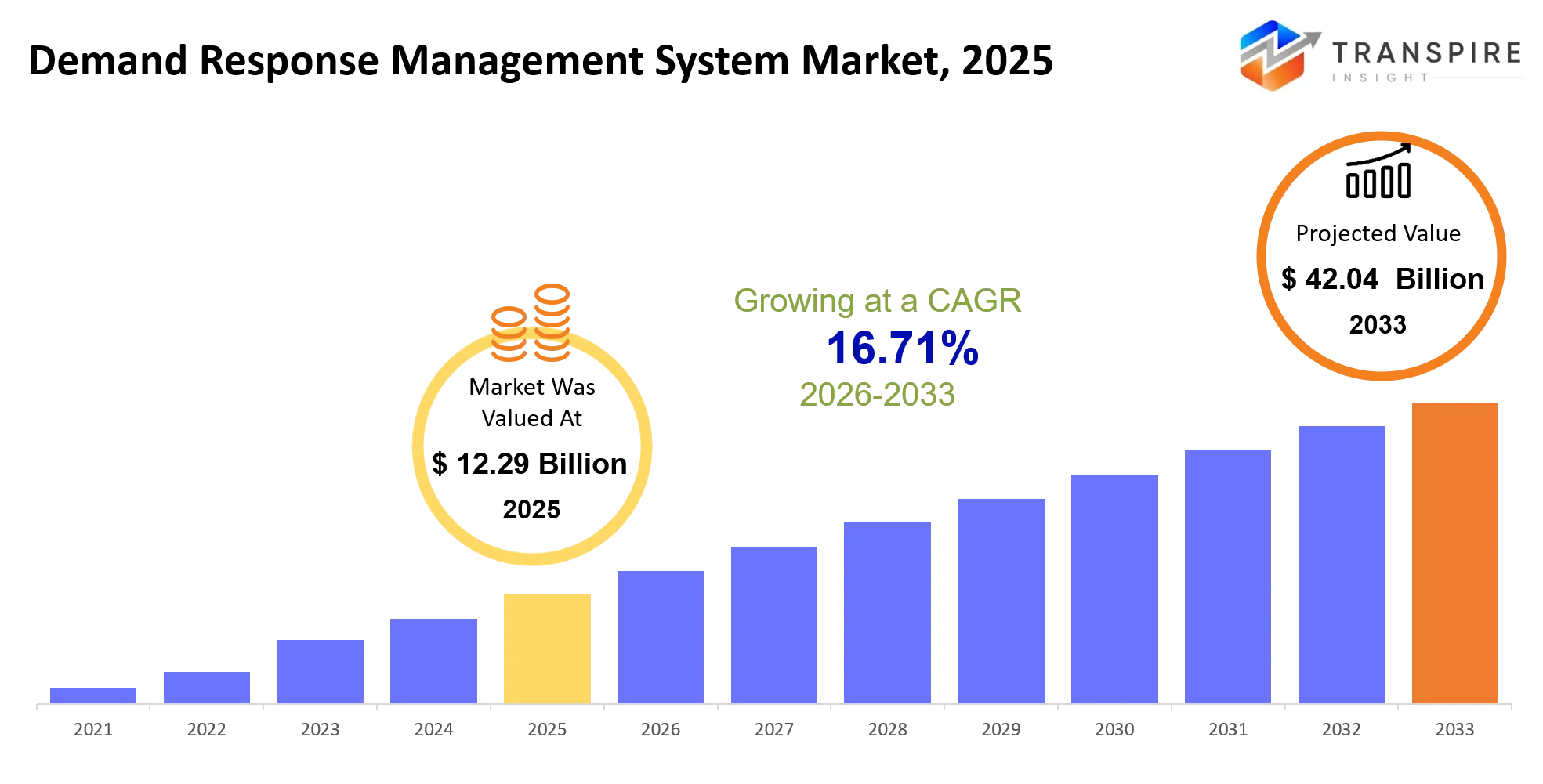
- Market Value (2025): USD 12.29 Billion.
- Expected Market Value (2026): USD 14.25 Billion.
- Estimated Market Value (2033): USD 42.04 Billion.
- Forecast CAGR (2026–2033): 16.71%.
- Leading Region in 2025: North America
- Second-largest Region: Europe
- Fastest Growing Region: Asia Pacific
Introduction
The Demand Response Management System (DRMS) Market refers to technologies consisting of software, hardware, and services that enable electricity providers, grid managers, and energy users to observe, regulate, and optimize electricity demand based on the fluctuating state of the grid, price information, and other parameters. Through the use of DRMS solutions, the management of peak loads, demand shifting, automatic load reduction, and incorporation of distributed energy sources can be performed. The significance of this market is rising because utilities have to tackle challenges of growing demand for electricity, renewable energy sources' intermittency, electrification, and development of smart grid technology. Modern DRMS solutions are becoming more advanced with the help of artificial intelligence, cloud computing, Internet of Things (IoT), data analytics, and automation. With the help of such capabilities, utilities and commercial and industrial consumers can optimize their energy consumption, alleviate the pressure on peak demand, and utilize renewable energy sources.
For instance:-
- North America: Grid modernization, peak load management, dynamic pricing, smart meter rollouts, and existing utility demand response schemes still contribute to a high adoption rate of DRMS systems.
- Europe: Integration of renewables, electricity market liberalization, dynamic pricing, and the emergence of flexibility markets are contributing to higher adoption rates of DRMS solutions for consumer and aggregator participation in grid services.
Key Market Highlights: -
- North America is expected to grow at a rapid CAGR in the Demand Response Management System Market by holding around39% of the share during the forecast period.
- Europe is anticipated to hold roughly27% share of the Demand Response Management System Market over the predicted timeframe.
- Asia Pacific is anticipated to hold nearly 25%share of the Demand Response Management System Market over the predicted timeframe.
- By Component, the Hardware dominated the market and holds nearly 61% share in 2025 and is projected to grow at a substantial CAGR during the forecast period.
- By Deployment, the Public Cloud dominated the market and holds close to 25% share in 2025 and is projected to grow at a substantial CAGR during the forecast period.
- By Application, the Multinational Corporations dominated the market and holds about 54%share in 2025 and is projected to grow at a substantial CAGR during the forecast period.
- Programs launched by government that help install smart meters, promote renewable energy sources, facilitate dynamic pricing and demand response have been contributing to the implementation of DRMS systems across the world.
How is Technology Driving Growth in the Demand Response Management System Market?
Technology is enhancing the pace of growth of DRMS Market through the real-time monitoring, predictive analysis, automation, and distribution of energy. AI and ML technology helps in load forecasting, peak-demand prediction, and load scheduling. IoT sensors and smart meters offer real-time consumption information. Smart grid technology helps in improving the efficiency of renewable energy through coordination of flexible demands with variable renewable energy production from wind and solar sources. Virtual power plant technology helps in aggregating energy sources like energy storage and flexible demand to ensure flexibility of the grid.
|
Report Metrics |
Details |
|
Market size value in 2025 |
USD 12.29 Billion |
|
Market size value in 2026 |
USD 14.25 Billion |
|
Revenue forecast in 2033 |
USD 42.04 Billion |
|
Growth rate |
CAGR of 16.71%from 2026 to 2033 |
|
Base year |
2025 |
|
Historical data |
2021 - 2024 |
|
Forecast period |
2026 - 2033 |
|
Report coverage |
Revenue forecast, competitive landscape, growth factors, and trends |
|
Regional scope |
United States; Canada; Mexico; United Kingdom; Germany; France; Italy; Spain; Denmark; Sweden; Norway; China; Japan; India; Australia; South Korea; Thailand; Brazil; Argentina; South Africa; Saudi Arabia; United Arab Emirates |
|
Key company profiled |
Siemens, Schneider Electric, Honeywell, General Electric, ABB, Eaton, AutoGrid, Enel X, Oracle, Itron, Landis+Gyr, Johnson Controls, EnergyHub, Centrica, Siemens Grid Software |
|
Customization scope |
Free report customization (country, regional & segment scope). Avail customized purchase options to meet your exact research needs. |
|
Report Segmentation |
By Component (Software, Hardware, Services, Analytics, Communication Infrastructure, Control Systems, Metering Devices, Others); By Deployment (Cloud, On-premise, Hybrid, Edge, Hosted, Private Cloud, Public Cloud, Others); By Application (Residential, Commercial, Industrial, Utilities, Microgrids, EV Charging, Renewable Integration, Others); By Solution (Automated Demand Response, Price-based Response, Incentive-based Response, Load Shifting, Peak Shaving, Load Curtailment, Real-time Response, Others); By End User (Utilities, Grid Operators, Commercial Buildings, Industrial Facilities, Residential Aggregators, Energy Retailers, Government, Others); By Technology (IoT, AI, Machine Learning, Smart Metering, Cloud Computing, Advanced Analytics, Blockchain, Others); By Service (Consulting, Implementation, Integration, Maintenance, Managed Services, Monitoring, Support, Others) |
Market Drivers
The Demand Response Management System Market is spurred by increasing demand for flexibility on account of rising electricity demand, renewable sources, and electrification. Higher deployment of solar and wind capacity is leading to increasing variability, which in turn is driving adoption of automated demand response systems for peak shaving, load shifting, and grid balancing. The increased adoption of smart grids, AMI, Internet of Things (IoT), and digital energy systems is leading to enhanced capabilities for monitoring and automatic load management. Further, regulations for promoting demand flexibility, distributed energy resources, and virtual power plants are also providing opportunities in the market. Moreover, advanced forecasting using AI, cloud platforms, and analytics are increasing operational efficiency and facilitating optimization of electricity usage by utilities, commercial buildings, and industries.
For instance:-
- Asia Pacific: High electricity demand growth, renewable energy development, smart grid investments, and the emergence of virtual power plant programs are driving the adoption of demand response management systems.
- Latin America: Renewable energy development, grid modernization, increasing electricity demand, and rising interest in distributed energy resources create opportunities for demand response management systems.
Restrain
Integration and implementation complexity continues to be one of the main constraints in the Demand Response Management Systems Market. The process of integrating DRMS solutions with existing power grids, smart meters, and other energy systems increases both cost and complexity. Security threats and issues related to the interoperability of the information make the data sharing process more complicated. Budget limitations of small utilities may hinder the updating process, while customizations required may lead to longer implementation periods. In addition, insufficient consumer involvement and rigidity of the manufacturing processes limit demand response usage.
|
Driver |
Relative Impact on Growth (%) |
Geographic Relevance |
Impact Timeline |
Demand Strength |
Growth Mechanism |
Key Beneficiaries |
Major Constraint |
|
Rising Electricity Demand and Grid Congestion |
25% |
North America, Europe, Asia Pacific |
Short-term |
High |
Shifts peak loads, reducing congestion and infrastructure stress. |
Utilities, aggregators, commercial users, industrial consumers |
Limited flexible loads and customer participation |
|
Renewable Energy Integration and Grid Flexibility Requirements |
23% |
Europe, North America, Asia Pacific |
Medium-term |
High |
Balances variable renewable generation through flexible electricity consumption. |
Renewable developers, utilities, system operators, DR providers |
Renewable intermittency and insufficient flexibility markets |
|
Virtual Power Plants and DER Aggregation Expansion |
20% |
North America, Europe |
Medium-term |
High |
Aggregates distributed loads and assets into dispatchable grid resources. |
VPP operators, aggregators, utilities, DER owners |
Interoperability and distributed-resource coordination challenges |
|
AI, IoT, Smart Meters and Automated Energy Management |
18% |
North America, Europe, Asia Pacific |
Short-term |
High |
Automates load forecasting, optimization, monitoring and real-time response. |
Software vendors, utilities, building operators, consumers |
Cybersecurity, data quality and integration costs |
|
Regulatory Support and Market-Based Demand Response Participation |
14% |
North America, Europe, Asia Pacific |
Long-term |
Medium |
Expands revenue opportunities through flexibility programs and electricity markets. |
Aggregators, utilities, commercial users, technology providers |
Regulatory fragmentation and complex participation rules |
Analysis of Prices and Consumer Behaviour
The market for the Demand Response Management Systems consists mainly of the top-notch automated systems (68% of total market; mostly driven by the demand for such systems in utilities, commercial and industrial premises and grid companies). The cost of a high-end advanced DRMS solution would be estimated at 35% higher than for other products, since the system would be produced using automation technology, will be quality certified and would deliver stable demand response performance. Around 45% of all units sold in the market of Demand Response Management Systems are deployed using cloud technologies. The deployment rate depends on the scalability of the cloud platform and energy management flexibility. The demand from the commercial and industrial sector constitutes about 70% of the total demand from those sectors. The consumer buying behavior shows that 55% of consumers highly value the demand response performance and system reliability and interoperability. Also 33% of consumers prefer buying systems using bulk deals and contracts to reduce procurement costs and to ensure consistent supply of their services in various parts of the world.
|
Company |
Est. Revenue Share Range |
Key Offerings |
Strategic Positioning |
Geographic Strength |
Technology Focus |
|
Schneider Electric |
8–11% |
EcoStruxure ADMS; DERMS; demand response; flexibility management |
Integrated grid-to-prosumer platform leadership |
North America, Europe, Asia Pacific |
DERMS, AI, cloud, grid-edge optimization |
|
Siemens |
7–10% |
Spectrum Power; EnergyIP; ADMS; demand-side management |
Utility-grade automation and grid integration |
Europe, North America, Asia Pacific |
ADMS, DERMS, automation, digital twins |
|
GE Vernova |
6–9% |
Grid software; ADMS; DERMS; grid orchestration |
Grid modernization and utility software specialization |
North America, Europe, Asia Pacific |
Grid orchestration, analytics, automation, DERMS |
|
Honeywell |
5–8% |
Energy management; building controls; demand response; connected buildings |
Building-centric automation and energy optimization |
North America, Europe, Middle East |
IoT, automation, analytics, building controls |
|
Enel |
5–8% |
Demand response; flexibility services; C&I aggregation; energy optimization |
Large-scale aggregation and flexibility services |
North America, Europe, Latin America |
AI-enabled aggregation, optimization, dispatch |
|
Itron |
4–7% |
Distributed intelligence; demand response; AMI; grid-edge management |
Meter-to-grid intelligence and utility integration |
North America, Europe, Asia Pacific |
AMI, edge computing, analytics, IoT |
|
ABB |
4–6% |
Grid automation; energy management; demand response; DER integration |
Automation-led grid flexibility solutions |
Europe, North America, Asia Pacific |
Grid automation, control, analytics, DER integration |
|
Uplight |
3–6% |
AutoGrid Flex; VPPs; DERMS; customer engagement |
Customer-centric VPP and flexibility ecosystem |
North America, Europe, selected global markets |
VPP orchestration, DERMS, customer engagement |
|
EnergyHub |
3–5% |
Mercury; Edge DERMS; VPPs; managed EV charging |
Grid-edge flexibility and multi-DER aggregation |
North America |
DERMS, VPPs, EV charging, device orchestration |
|
CPower |
2–4% |
Demand response; VPPs; C&I flexibility; DER management |
C&I-focused VPP and demand-response specialization |
North America |
VPP software, DER aggregation, automated dispatch |
Who are the Key Players in the Demand Response Management System Market and how do they compete?
For a company to be competitive in the international market of Demand Response Management Systems, it is important to develop innovative technologies, industry-specific solutions, as well as global distribution networks. Being competitive not on price but on the basis of durable systems, sophisticated technologies, intelligent solutions and their integration with digital and operational platforms, such a strategy of competition will help a firm constantly work on solutions development and increase productivity, efficiency and resource optimization.
By developing intelligent grid management systems, demand response solutions, automation technologies, and connected energy management platforms, Siemens strengthens its competitive position on the market. By developing sophisticated demand response systems for utilities, commercial sites, industrial sites and other energy management purposes, Schneider Electric differs from its competitors. Honeywell creates its competitive position by providing integrated solutions in demand response management, automation, energy management and smart grid technologies, helping utilities and energy consumers improve productivity and efficiency.
Top Companies in the Demand Response Management System Market
- Siemens
- Schneider Electric
- Honeywell
- General Electric
- ABB
- Eaton
- AutoGrid
- Enel X
- Oracle
- Itron
- Landis+Gyr
- Johnson Controls
- EnergyHub
- Centrica
- Siemens Grid Software
|
Investment Factor |
Why It Matters to Investors |
Opportunity |
Investment Implication |
|
Rapid Expansion of Grid Flexibility Requirements |
Electrification and concentrated loads increase peak-management and grid-balancing requirements. |
Utility-scale DRMS for peak reduction, congestion management and reliability services. |
Short-to-medium term: scalable utility software opportunity |
|
Virtual Power Plant and DER Aggregation Growth |
Aggregating EVs, batteries, HVAC and solar creates monetizable flexible capacity. |
VPP orchestration, DERMS integration and multi-asset aggregation platforms. |
Medium-to-long term: recurring platform revenue potential |
|
AI-Enabled Automated Demand Response |
AI improves load forecasting, dispatch optimization and real-time flexibility valuation. |
Predictive analytics, automated controls and intelligent dispatch software. |
Short-to-medium term: technology differentiation opportunity |
|
Renewable Integration and Electrification |
Variable renewables and electrified transport, heating and industry require responsive consumption. |
Renewable-linked flexibility services and demand-shifting solutions. |
Medium-to-long term: structural demand expansion |
|
Regulatory Opening for Distributed Resources |
Wholesale-market reforms can enable aggregated DERs to access additional revenue streams. |
Aggregator platforms compliant with market participation, metering and telemetry requirements. |
Medium-term: geographically targeted market-entry opportunity |
|
Untapped Commercial and Industrial Flexibility |
Large flexible loads can generate value while reducing peak electricity costs. |
C&I demand-response programs for factories, buildings and energy-intensive facilities. |
Short-to-medium term: high-value customer acquisition opportunity |
Airport Quick Service Restaurant (QSR) Market Segmentation
The Demand Response Management System Market share is divided into seven categories: By Component, By Deployment, By Application, By Solution, By End User, By Technology, By Service.
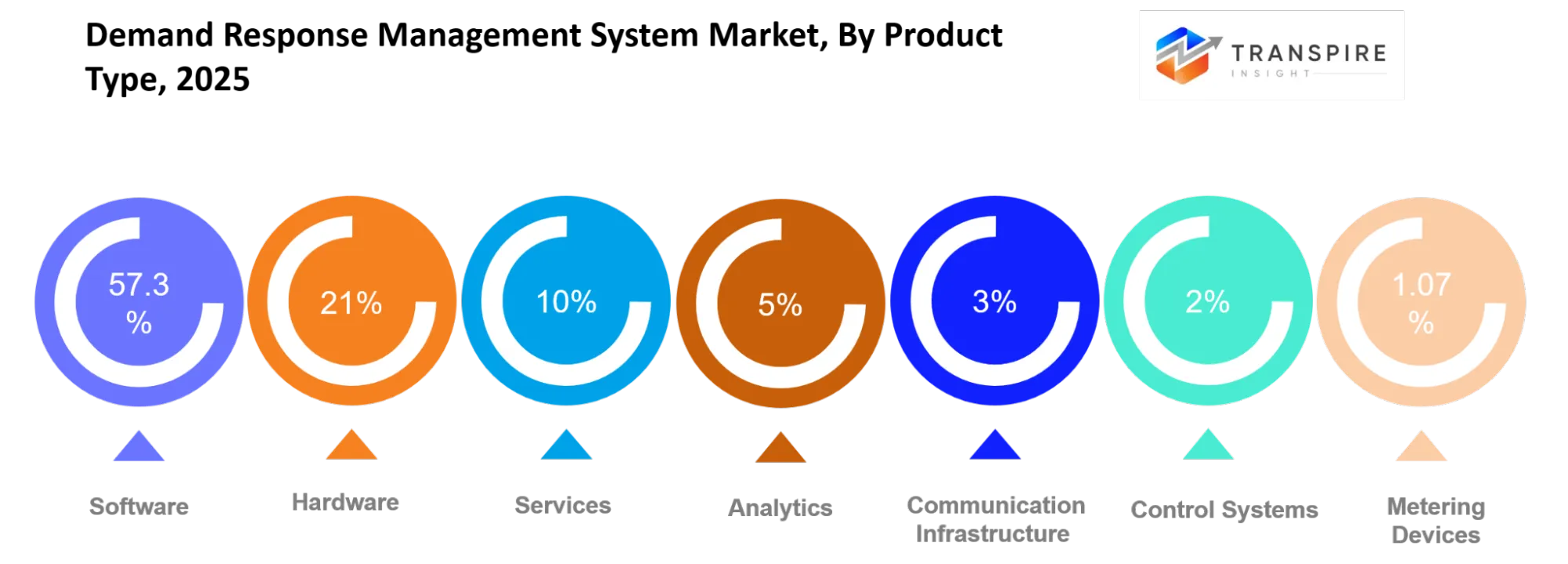
The Hardware dominated the market, accounting for nearly 61% in 2025 and is expected to rise at a significant CAGR during the forecast period.
The Demand Response Management System Market is by component into software, hardware, services, analytics, communication infrastructure, control systems, metering devices, others. Among these, the Hardware dominated the market, accounting for nearly 61% in 2025 and expected to increase at a significant CAGR during the forecast period. The Hardware segment was leading the Demand Response Management System Market, with almost 61% in 2025, owing to factors such as smart meters, sensors, communication devices, and grid control system which facilitate real-time demand management.
The Public Cloud dominated the market, accounting for close to 25% in 2025, and is expected to rise at a significant CAGR during the forecast period
The Demand Response Management System Market is segmented by deployment into cloud, on-premise, hybrid, edge, hosted, private cloud, public cloud, others. Among these, the Public Cloud dominated the market, accounting for close to 25% in 2025 and expected to increase at a significant CAGR during the forecast period. The Public Cloud segment was leading the Demand Response Management System Market, owing to reasons such as scalable infrastructure, cost reduction in deployment, remote access capability, and flexible integration with distributed energy resources.
The Utilities (Utility-scale) dominated the market, accounting for about 54%in 2025 and is expected to rise at a significant CAGR during the forecast period.
The Demand Response Management System Market by application into residential, commercial, industrial, utilities, microgrids, ev charging, renewable integration, others. Among these, theMultinational Corporations dominated the market, accounting for about 54%in 2025 and expected to increase at a significant CAGR during the forecast period. The Utilities segment was leading the Demand Response Management System Market, owing to factors such as grid modernization, peak load management, and integration of renewables.
Regional Segment Analysis of the Demand Response Management System Market
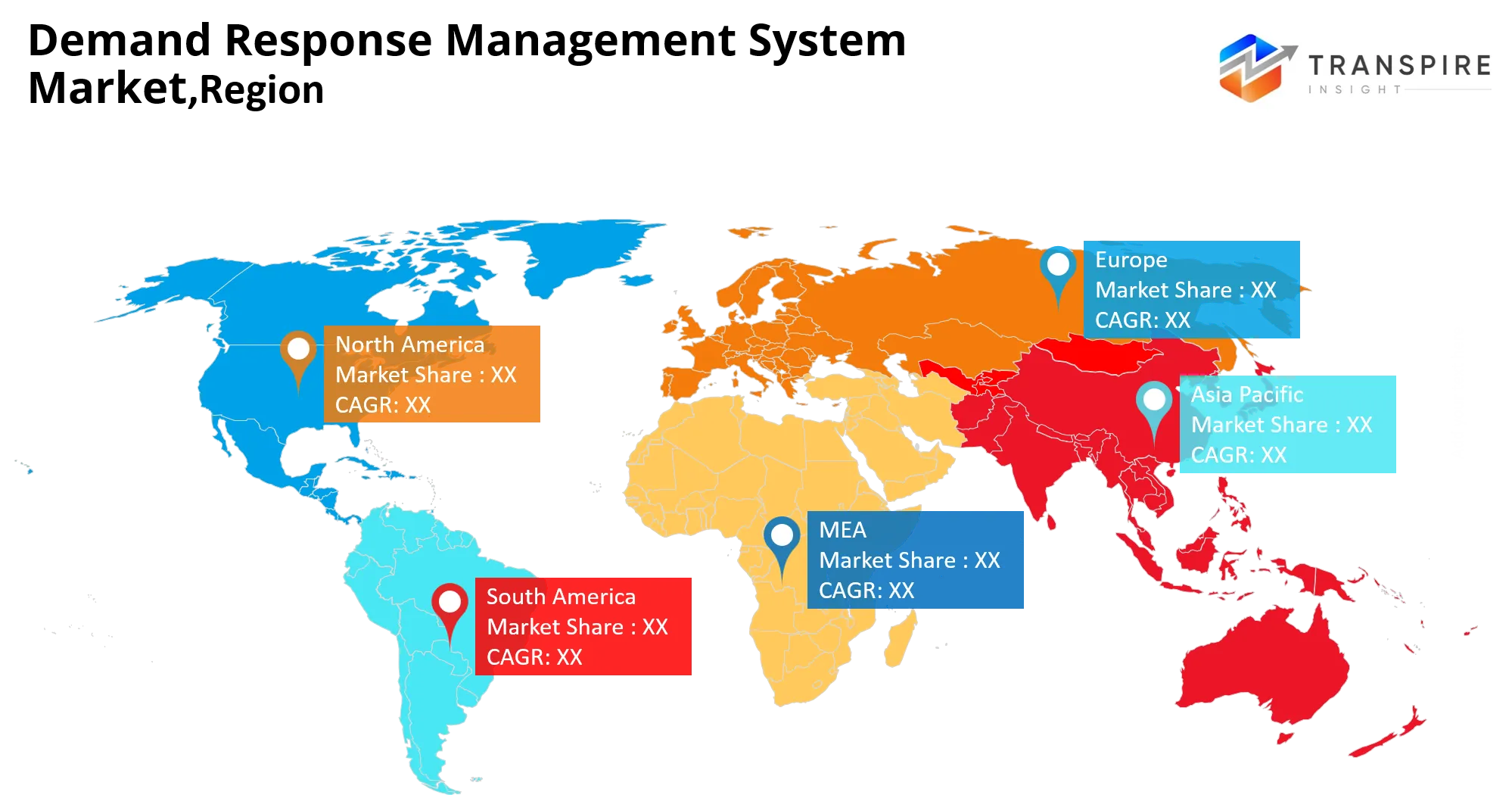
- Europe (Germany, France, U.K., Italy, Spain, Rest of Europe)
- North America (U.S., Canada, Mexico)
- Asia-Pacific (China, Japan, India, Rest of APAC)
- South America (Brazil and the Rest of South America)
- The Middle East and Africa (UAE, South Africa, Rest of MEA)
North America is expected to grow at a rapid CAGR in the Demand Response Management System Market, holding around 39% of the share during the forecast period.
North America is one of the dominating regions in the Demand Response Management System Market due to availability of advanced smart grid infrastructure, installation of smart meters and adoption of automated demand response solutions by utility companies. The region is backed by the presence of electricity markets, favorable regulatory landscape and investments towards modernization of grid infrastructure and distributed energy resources. Increased integration of renewable energy sources, electrification and peak demand management needs are further contributing to adoption of DRMS by utilities, commercial establishments and industrial consumers leading to sustainable market growth in the coming years.
Europe is the high-growth region in the Demand Response Management System Market during the period, holding roughly 27% share.
Europe is a fast-growing region in the Demand Response Management System Market owing to rapid integration of renewable energy, modernization of grid and favorable electricity market reform policies. Increased implementation of smart meters, distributed energy sources and digital energy platforms is increasing flexibility in the demand. Increased electrification, energy efficiency targets and growing needs for grid balancing are further encouraging adoption of advanced DRMS solutions by utilities and commercial/industrial consumers.
Asia Pacific is the fastest-growing region in the Demand Response Management System Market during the period, holding nearly 25% share.
The Asia Pacific region has been noted to be the fastest growing region in the Demand Response Management System Market owing to fast growing electricity demand, growing renewable energy generation capacity, and accelerated grid modernization process. With the increased adoption of smart meters, digitization of utilities, and investment in distributed energy resources, demand for flexible energy management is high. Policies in favor of smart grids, energy efficiency, and renewable energy further drive the growth of DRMS Market in the region.
Strategies for Market Growth in Non-Leading Regions:
Deployment of effective and cost-efficient Demand Response Management System technologies would help small to medium-sized utilities and energy consumers. The implementation of smart meters, distributed energy resources and automatic demand response infrastructure could reduce reliance on central systems and cut total cost of operations. Strategic alliances with regional utilities, technology providers, commercial buildings, industry energy consumers and energy service companies would facilitate market penetration for DRMS solutions. To increase awareness about the demand response management, grid flexibility, energy optimization, cybersecurity and integration issues, training programs and skills improvement are needed. Flexible financing mechanisms, long-term service contracts and managed technology solutions will help to make DRMS solutions more affordable and facilitate their adoption by energy consumers. Development of joint programs with government, utility and energy efficiency initiatives, as well as use of digital marketing techniques, would increase access to DRMS solutions and promote worldwide sustainable market growth in developing countries.
Future Market Trends for the Demand Response Management System Market: -
Artificial Intelligence-Powered Demand Response Automation: AI will aid in improving predictions and automation for load forecasting, dispatching, grid balancing, and demand response programs.
Integrating DERs and Virtual Power Plants: The use of solar, batteries, EVs, and distributed energy resources will be increasingly utilized to make the power plants virtual and increase demand flexibility.
Smart Devices and Home Energy Management System-based Demand Response Automation: Advanced meters, smart thermostats, IoT-enabled home appliances, and home energy management system will assist in automating demand response.
Recent Development
In April 9, 2026 – Launch: The Demand Flexibility Service in the UK became more sophisticated, featuring bi-directional flexibility, zonal procurement, and an eligibility criteria reduced to 0.1 MW.
In March 12, 2026 – Funding News: The U.S. Department of Energy provided almost $1.9 billion in funding for important grid improvements to meet growing demands.
In October 7, 2026 – Launch Expected: The NESO is expected to introduce the process of constraint-management procurement in the Demand Flexibility Service, allowing providers to take part in margin and system-tagged actions.
Market Segment
This study forecasts revenue at global, regional and country levels from 2020 to 2033. Transpire Insights has segmented the Demand Response Management System Market based on the below-mentioned segments:
Demand Response Management System Market, By Component
- Software
- Hardware
- Services
- Analytics
- Communication Infrastructure
- Control Systems
- Metering Devices
- Others
Demand Response Management System Market, By Deployment
- Cloud
- On-premise
- Hybrid
- Edge
- Hosted
- Private Cloud
- Public Cloud
- Others
Demand Response Management System Market, By Application
- Residential
- Commercial
- Industrial
- Utilities
- Microgrids
- EV Charging
- Renewable Integration
- Others
Demand Response Management System Market, By Solution
- Automated Demand Response
- Price-based Response
- Incentive-based Response
- Load Shifting
- Peak Shaving
- Load Curtailment
- Real-time Response
- Others
Demand Response Management System Market, By End User
- Utilities
- Grid Operators
- Commercial Buildings
- Industrial Facilities
- Residential Aggregators
- Energy Retailers
- Government
- Others
Demand Response Management System Market, By Technology
- IoT
- AI
- Machine Learning
- Smart Metering
- Cloud Computing
- Advanced Analytic
- Blockchain
- Others
Demand Response Management System Market, By Service
- Consulting
- Implementation
- Integration
- Maintenance
- Managed Services
- Monitoring
- Support
- Others
Demand Response Management System Market, By Regional Analysis
North America
- US
- Canada
- Mexico
Europe
- Germany
- UK
- France
- Italy
- Spain
- Russia
- Rest of Europe
Asia Pacific
- China
- Japan
- India
- South Korea
- Australia
- Rest of Asia Pacific
South America
- Brazil
- Argentina
- Rest of South America
Middle East & Africa
- UAE
- Saudi Arabia
- Qatar
- South Africa
- Rest of the Middle East & Africa
Frequently Asked Questions
Find quick answers to common questions.
Rising electricity demand, renewable integration, grid modernization, electrification, smart meters, and regulatory support are accelerating DRMS adoption across utilities worldwide.
Hardware dominated the market in 2025, accounting for nearly 61%, supported by smart meters, sensors, communication devices, and grid-control infrastructure.
Public Cloud dominated deployment, accounting for close to 25% in 2025, supported by scalability, access, lower deployment costs, and flexibility.
North America leads with around 39% share due to advanced smart-grid infrastructure, established demand-response programs, supportive regulations, and utility adoption.
AI-enabled automation, VPPs, DER integration, smart meters, and analytics will strengthen forecasting, load management, grid flexibility, and consumer participation.
- Siemens
- Schneider Electric
- Honeywell
- General Electric
- ABB
- Eaton
- AutoGrid
- Enel X
- Oracle
- Itron
- Landis+Gyr
- Johnson Controls
- EnergyHub
- Centrica
- Siemens Grid Software
About the Authors

Mayur Shinde
I am Mayur Shinde, a Senior Research Analyst at Transpire Insight, specializing in the Automotive & Transportation and Information & Communication Technology (ICT) Industry. My work focuses on analyzing emerging market trends, technological advancements, competitive landscapes, and industry developments to deliver accurate, data-driven insights. I am passionate about transforming complex market information into clear, actionable content that helps businesses, professionals, and decision-makers stay informed and make confident strategic decisions.

Chakradhar Khansole
Chakradhar serves as the Research Director at Transpire Insight, bringing over 8 years of experience in technology, innovation, and strategic market intelligence. He specializes in transforming complex market data into actionable business insights that enable organizations to make informed, growth-oriented decisions. Recognized for his strategic vision and analytical expertise, Chakradhar leads high-impact research initiatives, delivering comprehensive market assessments, competitive intelligence, and forward-looking industry analysis.
Recently Published Reports
-
Apr 2026
3D Optical Profiler Market
3D Optical Profiler Market Size, Share & Analysis Report By Type (Desktop 3D Optical Profiler, and Portable 3D Optical Profiler), By Technology (Confocal Technology, and White Light Interference), By End-Use Industry (Manufacturing, Research Institutions, Automotive, Aerospace and Defense, Medical Devices, and Other), and Geography (North America, Europe, Asia-Pacific, Middle East and Africa, South and Central America), 2021 - 2031
-
Apr 2026
Depth Sensor Market
Depth Sensor Market Size, Share & Analysis Report By Type (Infrared Depth Sensors, Time-of-Flight (ToF) Sensors, Stereo Vision Sensors, Structured Light Sensors, Ultrasonic Depth Sensors), By Application (Automotive, Robotics, Gaming, Consumer Electronics, Industrial Automation, Healthcare, Security & Surveillance, Others), By End Users (Automotive Manufacturers, Consumer Electronics Companies, Healthcare Providers, Industrial Companies, Security Agencies, Gaming Companies, Robotics Companies, Others), and Geography (North America, Europe, Asia-Pacific, Middle East and Africa, South and Central America), 2021 – 2031
-
Apr 2026
Digital Manufacturing Market
Digital Manufacturing Market Size, Share & Analysis Report By Component (Hardware, Software, and Services), By Technology (Robotics, 3D Printing, Internet of Things (IoT), and Others), By Application (Automotive and Transportation, Aerospace and Defense, Consumer Electronics, Industrial Machinery, and Others), By Process Type (Computer-Based Designing, Computer-Based Simulation, Computer 3D Visualization, Analytics, and Others), and Geography (North America, Europe, Asia-Pacific, Middle East and Africa, South and Central America), 2021 – 2031
-
Apr 2026
Digital Visa Services Market
Digital Visa Services Market Size, Share & Analysis Report By Type (Individual Travelers, Group Travelers), By Application (Tourism, Business Travel, Others), and Geography (North America, Europe, Asia-Pacific, Middle East and Africa, South and Central America), 2021 – 2031